The Annonas Four: Sugar, Sour, Custard, Pond
Many species and a few family of plants sit on the cusp of edible/non-edible, among them the Annonas, tropicals which run from delicious to medicinal, but edible. The pulp ranges from sweet with the Sugar Apple or Sweet Soursop, top right, to the ether-
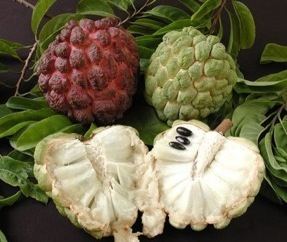
Sugar Apple, Annona squamosa
smelling barely tolerable Pond Apple, on bottom right. In between is the Soursop, second from the top, and Custard Apple, next to the bottom. The seeds of all of them are NOT edible. Do not eat them. Also keep your fingers away from your eyes after handing the seeds. Wash your hands first. All Annona are found in Florida into the tropics though their ranges vary.
The Sugar Apple, Annona squamosa (ahn-NOE-nah skwa-MO-suh) is native to the topics. It’s a tree to 20 feet and slender with a round head. Its leaves are evergreen and narrow, up to about four inches long, dull. The flowers are greenish yellow on short stems, three or four in a cluster. The large fruit — up 4.5 inches across — is found in summer. It has a thick rind and is composed of segments which separate when the fruit is ripe. It can range when ripe form yellow to red. The pulp is in segments as well, creamy, sweet, seeds are bean-like. Seeds are not edible. Pulp can be eaten as is or made in to jelly.
Annona muricata (ahn-NOE-nah mur-ee-KAY-tuh) the Soursop, like its cousin, is a tree to 20
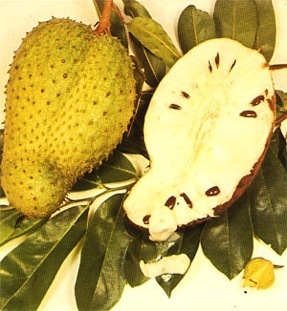
Soursop, Annona muricata
feet, slender, has nearly evergreen leaves to four inches. They are dark green, glossy, pungently aromatic. The flowers are whitish, fleshy, on short stems, fruit can be 10 inches long, six inches wide, often an irregular long heart shape with the tip often curling. It is covered with soft spines, flesh is white, cottony, very juicy, subacid to acid, aromatic, seeds black, bean-like. Strained pulp is excellent mixed with milk and sugar as a cold drink and it makes great ice cream. Seeds are not edible. Fruits continuously, found in protected peninsula Florida and the Keys.
The Custard Apple, Annona reticulata (ahn-NOE-nah reh-tick-yoo-LAY-tuh) is a larger tree than the two above, to 25 feet. It is a spreading tree, loses its lance-shaped 7-inch leaves seasonally. The
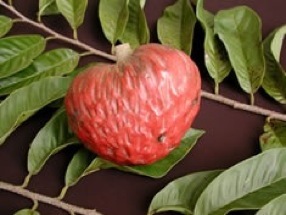
Custard Apple, Annona reticulata
Custard Apple’s flowers are greenish or yellowish with purple markings. The fruit is conical or heart shaped, up to six inches long. It ranges from yellow to bright red. The pulp is creamy, custard-like, sometimes grainy, sweet. Seeds are like brown beans. Seeds not edible. Able to withstand cold better than the two above it is often found around old South Florida homesteads.
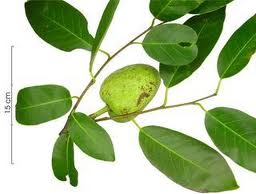
Pond Apple, Alligator Apple, Annona glabra
I did not save the best for last. The Pond Apple, Alligator Apple, Annona glabra (ahn-NOE-nah-GLAY-brah.). A large tree, much larger than all those above, to 45 feet. Leaves evergreen, often oval, with pointed tip and glossy. Flowers up to one inch across, whitish or greenish with dark red markings. Fruits nearly all year, conical to five inches long, smooth, rich yellow skin, pulp salmon-yellow in dry segments. Musky, subacid, resinous flavor, not desirable. Some fruit reach edible quality. Seeds NOT edible. Boiling the fruit makes it a bit more palatable. Can be made into a jelly. The tree prefers swamps. Leaves and seeds are insecticidal. Leaves in hens’ nests kills lice on hens. Its seeds can be used to poison fish. If you handle the seeds do NOT touch your eyes until you have washed your hands. Seed powder has caused blindness.
Annona is from the Taino word for the tree. Squamosa means scaly, muricata is roughened, reticulata means netted, and glabra smooth or hairless.
HERB BLURB
Annona glabra’s claim to fame is not culinary but medicinal. Seeds, bark and leaves contain many chemicals including acetogenins, apomorphnes alkaloids, cyclopepties, diterpenoids, phenylpropanoid, reticuline and methyl-lacto-daphnine. In large doses most of these are considered poisons. That said test have shown these chemical inhibit tumor growth. Acetogenins prevent oxygen uptake, apomorphine will make you throw up. Pond Apple syrup has been used to treat lung and chest problems, abdominal cramps, colic, diarrhea and dysentery. A tea has been used to kill worms internally, and to treat rheumatism. A fruit rind decoction has been used to treat pulmonary problems. Leaves and flowers boiled together have been used to treat liver trouble, particularly jaundice. However, there is some evidence that tea from the tree can cause symptoms of Parkinson’s Disease.
Pawpaw is in the same annonaceae family, along with various custard apples, soursop, corossol, graviola, and guanabana. Some research indicates that long term high consumption of these fruits or herbal teas may foster a disease similar to treatment-resistant Parkinson’s. This has been studied in the custard apple group not pawpaw per se. But a similar chemical (acetogenin) is found in them all. In parts of the world where custard apples are available commercially, not just seasonally, large long-term consumption might increase the risk of cognitive impairment. In some area the species are used in herbal medicine. One fruit every five days for one year, or any consumption of Annonaceae herbal tea increases the risk of having severe symptoms and dementia. There is one case in the research literature involving one old man who at a lot of them for more than two years. Using acetogenic researchers can induce problems in lab rats. There are too many variables to make any definitive conclusions, such as different cultivars, is the chemical in the skin, or pulp, both? Or is it linked to pesticides? There is also a possible genetic link. It might be wise if Parkinson runs in your family to avoid such fruits.
The researchers published: “We hypothesize that even low consumption of Annonaceae fruits, juices and herbal teas is potentially a new risk factor for cognitive impairment and dementia in tropical areas. We suggest that more restrictive public health preventive recommendations should be made regarding the consumption of Annonaceae products.”