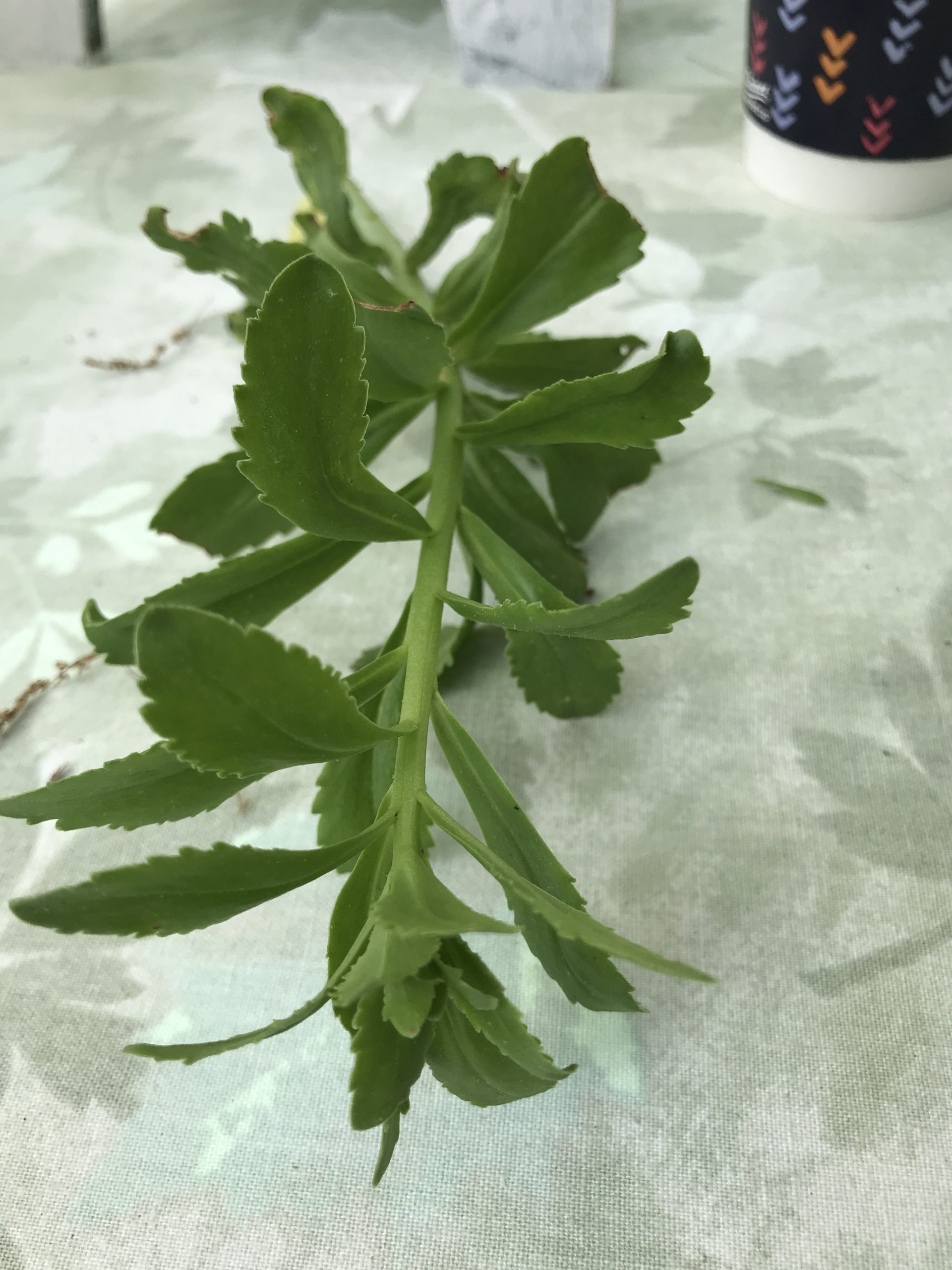
Sedum with mild flavored leaves. Photo by Green Deane

Confessions of  forager: In a general sense I have known for many years that “Stonecrops” were edible. I avoided them as they were usually associated by writers with cactus (In that they grow well where it is warm and dry and rocky. Where I live it is hot, wet and no rocks.) So I ignored “stonecrops” for decades except for two:  a distant edible relative I stumble across in Florida, Ice Plant, Carpobrotus edulis,  and sedum ternatum which I played with as a kid in Maine. 

I grew up on a dirt road out in the country, five miles west of the famous L.L.Bean store in Freeport Maine. Of course back then it was a relatively small store over the post office. Now it’s the entire town. My grandfather printed catalogues for L.L. himself and invented their one-wheel deer carrier.

Down the road from our house in Pownal was a seasonal pond with alder trees and polywogs and what we called Frog Bellies growing right beside the road. It was Sedum ternatum. As kids we didn’t know what it was but we would suck on the leaves. The upper layer of the leaf would separate and balloon up, filled with air which to a kid looked close enough to a frog’s puffy belly. There are between 400 and 475 different species of Sedum.    Several species of stonecrop have a history of edibility.”the genus native to Europe, Northern Africa and Asia where varities grow in rock crevices, on ravine edges and in scrubby areas. It’s among the fe plants tht can survive in the rocky Greek landscape.

Ice Plant is native to South Africa.

Among the edibles are: Sedum, sarmentosum (which is high in vitamin C) S. roseum, S. rhodanthum, S. reflexum, S. telephium var. purpureum, and S. acre. Roots of Sedum roseum are eaten after being cooked. The roots of S. roseum are also a common supplement sold under the name Rhodiola rosea. The roots of S. telephium var. purpureum have also been eaten. Sedum telephium var telephium is a cultivated salad plant in Europe, the leaves are used. S. acre has pungent leaves and is used as a condiment. Native Americans used S. divergens, and S. laxum for food, the latter rolled with salt grass. The red tops of  Sedum integriforlim ssp. integrifolium  were used to make a tea, or the leaves eaten fresh or with fat, the root was also eaten. S. rosea (The rhodiola) was eaten fresh, cooked or fermented. Roots eaten with fat or fermented.  Interestingly kalanchoe is in the wider stonecrop group though I have never heard of any of them being edible. Avoid Sedum alfredii which is known to accumulate cadmium.

Contemporary references say Sedum means “House Leek” in Dead Latin. Merritt Fernald,the Big Botanical Man at Harvard from 1900 to 1950, author of Gray’s Manual of Botany 1950 (the year he died) says “Name [is] from sedire, to sit, alluding to the manner in which many species affix themselves to rocks or walls.


Green Dean’s Itemized Plant Profile

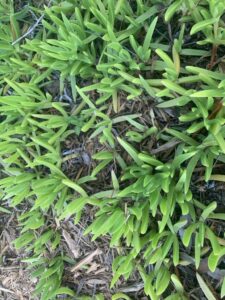
IDENTIFICATION:  Sedum acre,  tuberous-rooted, carpet-forming, evergreen succulent  to  3” tall spreads moss-like along the ground to often making an impressive ground cover. Plants are thickly clothed with blunt, conical, pale green leaves. Leaves overlap in shingle-like fashion. Small, terminal clusters of tiny, star-shaped, five-petaled, yellow flowers to half an inch  blooms most of the summer.

TIME OF YEAR: warm weather, most like it suuny and dry

ENVIRONMENT: Sunny locations, Varies. Some like to cling to rock faces and well-drained gravely soil others like lawns. Like Ice Plant a good plant to cultivate near the sea. Can tolerate some shade, rarely needs to be watered

METHOD OF PREPARATION: Varies with species, some just the young and tender  leaves, others the entire plant, often roots are eaten with fat. Or dried and powdered and use for tea. The sap os S acre, can irritate the skin of some people and the leaves, eaten in quantity, can cause stomach upsets.


{ 6 comments }

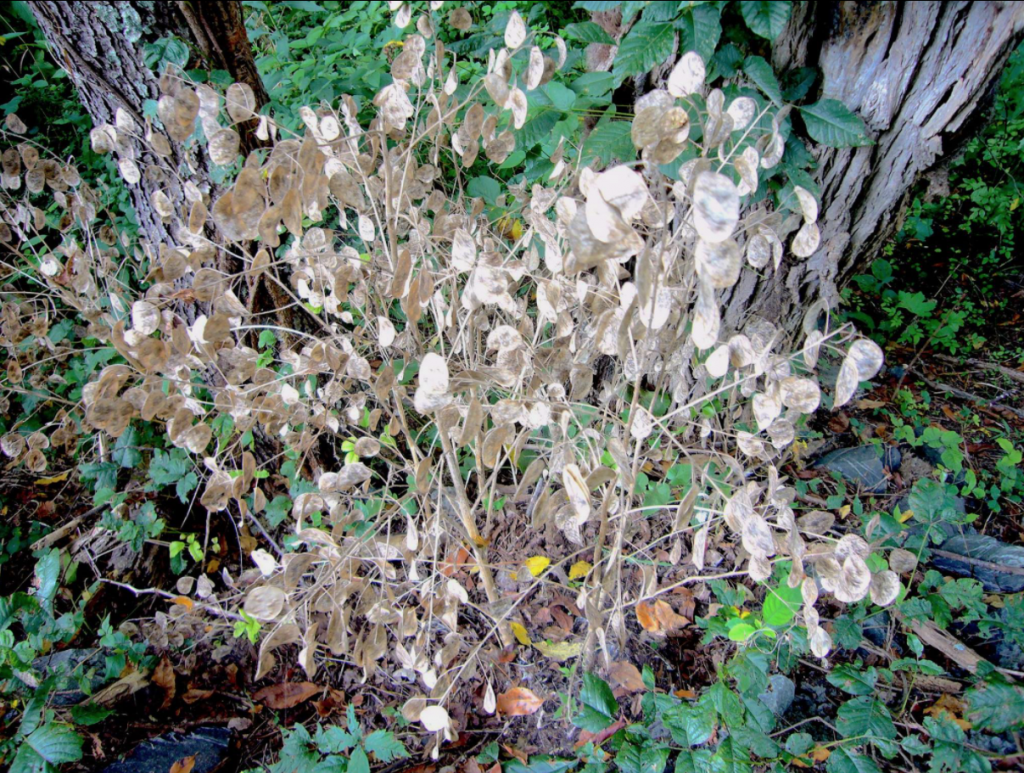
Self-seeded Moon Plant in North Carolina forest. Photo by Green Deane

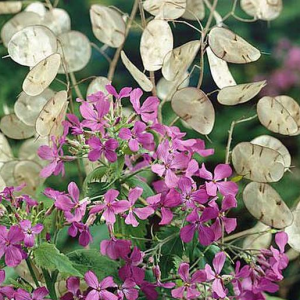
It looks like a fake plant created for a low-budget space movie. It even has a good name: Lunaria annua, Annual Moon. It’s also edible. I first saw them was in mile-high Beech Mountain, a city near Boone North Carolina. Then later I saw them growing on my cousin’s property in upstate South Carolina. 

The blossom tell you it’s in the mustard family.

Lunaria annua (loo-NAIR-ee-uh AN-yoo-uh) is a purple-flowered native of southeastern Europe* — the Balkans — and western Asia. Its unconventional seed pods (silicles  SILL-ah-cle) prompted the species to be used as a garden ornamental. It’s been widely planted in the United States and Canada. It’s also widely scattered in Great Britian — introduce there 400 years ago, it was popular in the Victorian era. The species is listed as invasive in Australia (and the U.S.)  As you might also presume it is a popular in flower arranging. A relative, Lunaria annua var. alba, has white flowers, L. alba var. albiflora ‘Alba Variegata, is variegated with white trimming on its leaves. There is also a Lunaria rediviva which has oval seed pods and likes to be slightly damp. There are about a dozen plants in the genus. Lunaria is sometimes confused with Dame’s Rocket, Hesperis matronalis, which is also edible (young leaves, seedpods, flowers and seeds sprouted.) 

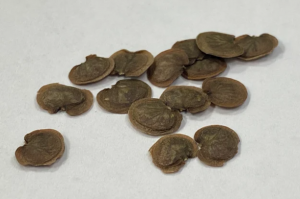
Lunaria annua seeds.

Other common names for Lunaria annua include Honesty, Silver Dollar, Dollar Plant, Money Plant, Moneywort, Moonwort, Satin Flower, and Kuuruoho (yes, that is spelled correctly.)  It was also once known as Lunaria biennis. The plant attracts butterflies, long-tongued bees and is disease/pest resistant. 

It was one of the first European flowers introduce into the American colonies where it was value for its striking seedpods and edible roots. Thomas Jefferson was growing them in 1767.  

Green Deane’s Itemized Plant Profile

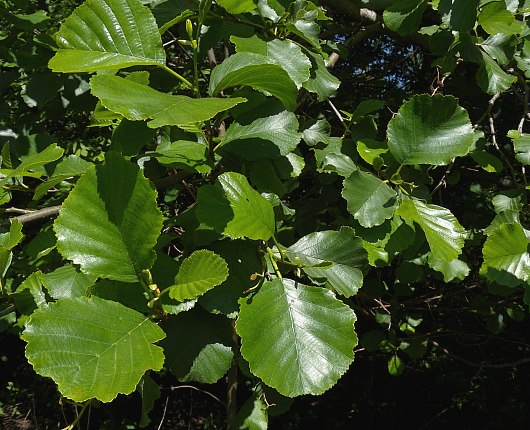
Identification:  Two to three feet tall with alternate to opposite, oval to heart-shaped leaves. They are toothy, medium green and slightly fuzzy, pointed at the tip, upper leaves are stemless. Four-petaled purple flowers are in racemes above the leaves in spring. Flowers are replaced with flattened, paper-thin, silver-dollar sized fruit which become translucent. Several seeds are in the fruit and are easy to winnow. 

Time of year. As the plant has a long juvenile stage it should be planted in very early spring for a late summer or fall harvest. They can take a frost and temperatures down to 10.6 F. Biannual, it produces only leaves the first year and is a small plant that year; as a tall plant flowers and seeds the second year. As it reseeds you only have to plant it once. Soak the seeds in water a day hours before planting. 

Environment:  Edges and transition zones. Open woodlands, naturalized areas such as permaculture lots with native and non-native species, semi-shady gardens. It likes well-drained, rich soil, full sun in cooler climates, afternoon shade in warmer areas. It needs six hours of sunlight a day, an is hardy in zones 5a, 5b, 6b, 6a, 7a, 7b, 8a, 8b, 9b, and. 9a

Method of Preparation: The thick root is edible raw or cooked before blossoming. When the energy in the root is used to make flowers and seed the roots usually get tough. Cooked, pungent seeds are a mustard substitute. The seed is 30 to 38% oil, high in erucic acid, 44%, and nervonic acid, 23% (which is a base material in creating medicine for multiple sclerosis.) The long-chain oil itself is also a high-temperature lubricant. As with most mustards most of the plant is edible — leaves, flowers and unripe fruit — but are bitter. It is also believed to be high in vitamin C as most mustards are. Leaves are edible by rabbits. 

*To be more specific it is native to Albania, Bulgaria, France, Greece, Italy, Crete, Romania, Spain, Switzerland, and Yugoslavia. It has been introduce into: Alabama, southern Argentina, Austria, the Baltic States, Belarus, Belgium, British Columbia, California, Colorado, Connecticut, Czechoslovakia, Delaware, Denmark, Germany, Great Britain, Hungary, Idaho, Illinois, India, Indiana, Ireland, Kentucky, Madeira, Maine, Manitoba, Maryland, Massachusetts, Michigan, New Hampshire, New York, Norway, Nova Scotia, Ohio, Ontario, Oregon, Pakistan, Pennsylvania, Québec, Rhode I., Sweden, Tennessee, Ukraine, Utah, Vermont and Washington

{ 2 comments }

Shepherdia were an important Native American and First People’s food.

There are only three species in the genus Shepherdia, all in North America, and one brings up a good point. When you go up in elevation you often go north in flora and fauna. There are some northern plants that grow south on the tops of Appalachian Mountains but no where else at lower elevations in the south. Two of the Shepherdia species grow mostly in northern states. But, one is in Utah and Arizona on the Colorado Plateau… which is 5,000 to 7000 feet. The plant thinks it’s further north than it really is. 

Some three dozen native groups depended on the species and with good reason. A hundred grams of Shepherdia canadensis has 80 calories, 0.7 grams of protein, 0.7 grams of fat, 16.6 grams of carbohydrates, and 5.3 grams of fiber. Vitamin C is outstanding and about three times your daily need, at 165.6 mg. Vitamin A in a separate report said it was 0.97 grams. The B vitamins are B1 (thiamin) 0.03 mg, B2 (riboflavin) 0.1 mg B3 (niacin) 0. 2 mg. Phosphorus is 21 mg, calcium 16 mg, magnesium 8 mg, zinc 1.4 mg, iron and sodium, o.5 mg each, 0.2 mg manganese, 200 mcg copper and strontium 70 mcg. 

These berries get around. S. aragentea is in the western two-thirds of North America excluding Texas to Maine and southeast. Oddly it’s in one eastern country of New York, an escapee perhaps. Of all the west it is not reported in Washington state. S. canadensis is in all of Canada, the western third of the U.S. and the states north and east of Illinois. It’s in Vermont were I still have cousins living and didn’t quite get down to where I lived in Maine. Roundleaf Buffaloberry is found in southern Utah and northern Arizona.

Argentea is new Dead Latin for silvery. Canadensis of or from Canada. Rotundifolia means round leaf. The genus is named for John Shepherd, 1764-1836, curator at the Liverpool Botanic Garden.

IDENTIFICATION:

Shepherida argentea: Deciduous shrub to small tree 20 feet tall,  (20 ft) dense silvery surface on the bottom of leaves and young twigs. Older branches commonly tipped with a spine, leaves wedge-oblong, no teeth. Flowers small, inconspicuous, in clusters in the leaf axils, fruits are scarlet. Also called Silver Buffaloberry,  it’s high in pectin.

Shepherdia canadensis: Soapberry. Deciduous shrub under six feet, oval to lance-shaped leaves, smooth edges. Bottom of leaves and twigs covered with rust-colored surface, flowers small, green, inconspicuous, bloom in early spring, berries single or in clusters in leaf axils, orange to deep red, covered with small dots.  It also has a small amount of saponins so it can make a foam. Also called Buffaloberry it pairs well with Blackberries.

Shepherdia rotundifolia: Roundleaf Buffaloberry:  Unlike its relatives the S. rotundifolia is evergreen, has tightly packed silvery leaves, wooly below, and scruffy rough berries. 

TIME OF YEAR:  Shepherdia canadensis: Bitter berries in July to early August. Shepherdia argentea: Tart berries in in fall usually after a frost. Shepherdia rotundifolia fruits in late summer.

ENVIRONMENT: Open woods, thickets, rocks, shores. The species is a nitrogen-fixer. 

METHOD OF PREPARATION: Eaten raw, cooked or dried. Can be made into a juice, jam, jelly or used as a flavoring. Natives also dried, smoked and pressed into cakes. They were also whipped until they created a foam then sugar was added for something akin to whipped cream. 

{ 3 comments }

Silverweed

Pacific Silverweed, a traditional vegetable.

Pacific Silverweed gets around… mostly the top of the world: Siberia, Alaska, the Yukon, British Columbia, Nunavut, Ontario, Quebec, Newfoundland, Greenland… New Hampshire…( Mt. Washington is, after all, a mile high) western Long Island, Washington state, Oregon, California… And it has a long list of names: Silverweed, Pacific Silverweed, Greenland Silverweed, Eged’s Silverweed, Potentilla pacifica, Potentilla anserina ssp. pacifica, Argentina egedii ssp. ededii, Argentina egedii ssp. groenlandica and no doubt others. It was renamed in the 1990’s and not everyone is pleased. I think the nom de jour is Argentina egedii. What ever it is called many native groups ate it for a very long time proving botanists are not necessary. 

Pacific Silverweed roots. Photo by Radix4roots

Pacific Silverweed also has a lot of things we need. Per 100 grams of steamed roots it has: 132 calories, 3.1 grams of protein, 0.6 grams of fat, 29.5 grams of carbohydrates, 9.5 grams of fiber. No vitamin C reported and barely any Vitamin A, 0.2 RE. The B vitamins are B1(thiamin) 0.01, B2 (riboflavin) 0.01 and B3 (niacin) 2.4 mg. The minerals line up: Phosphorus 109 mg, sodium 65 mg, magnesium 60 mg, calcium 37 mg, iron 3.5 mg, zinc and copper 1.1 mg each, and manganese 0.8 mg. 

One of the problems with the plant is it grows like crazy. But if you’re hungry that’s great. At least 12 native groups in North America considered it a staple. They also ate A. anserina the same way (Silverweed, Common Silverweed and Silver Cinquefoil.) It’s a smaller plant and is found in wet places inland distributed sporadically throughout most of North America except the Old South. 

As for the botanical names… What Argentina means is easy, “silvery.” “Anserina” is Dead Latin for “of the goose” either because it was fed to geese or the plant’s leaf shape reminded someone of a goose foot which is also what “chenopodium” means. In Sweden it is called Goosewort.  Egedii” took me far longer to sort out. But, I had an inspiration one day and found the answer on page 813 of a 72-year old book, Gray’s Manual of Botany, edited by Merritt Fernal. (If you’ve visited my website I’ve mentioned Fernald here and there.) Egedii honors Hans Poulsen Egede (1686 -1758) “the father of Greenland” (or in new Dead Latin, groenlandica.)  

Green Deane’s Itemized Plant Profile

IDENTIFICATION: A low-growing perennial that spreads by creeping stolons. Leaves are pinnately compound, alternating, glossy green with very silver undersides. The five-petaled, five-sepaled flowers remind one of buttercups. 

TIME OF YEAR: Fall

ENVIRONMENT: Beaches, dunes, sand flats, coastal estuaries, high tidal marshes, at or above the mean high tide. (When you consider New Hampshire only has 18.57 miles of coastline that’s quite a feet… feat. If you count every tidal nook and cranny it’s 235 miles.)  

METHOD OF PREPARATION: The roots are always cooked — boiling or roasting — to remove bitterness. They can be dried before or after cooking for storage 

{ 1 comment }

The little chestnut that survived. Photo by Will Cook, North Carolina Plant Photos.

One way to think of Chinquapins is they are small Chestnuts that survived. In the same genus as their bigger relative — Castenea — when the  blight wipeout the Chestnuts Chinquepins suffered but some managed to survive. One can see the  Allegany Chinquepin (C. pumila) while hiking the Appalachian Trail. Their nut is about half of the size of their deceased relative but still worth collecting. We also know some of the nutrition of another edible Chinquepin, the Ozark Chinkapin (C.  ozarkensis.) 

Chinquapins pack a lot of nutrition.

Per 100 grams it has 443 calories, 18 grams of fat, 57 grams of carbohydrates, 13 grams of protein and 6 grams of fiber. The fat is 10 grams monounsaturated, 4 grams polyunsaturated and 4 grams saturated. Potassium is 77 mg, no sodium reported. A second report says they are 5% fat, 55 protein, 40% starch and 50% water with 4736 calories per kilo. European chestnuts, not affected by blight,  are the only cultivated and consumed nut that has vitamin C, about 40 mg per 3.5 ounce serving. 

In the Beech family the Chinkapin has been called them most  ignored and undervalued native North American nut tree. It has a sweet and edible nut and has been used for fuel, charcoal, fence posts, railroad ties and a coffee and chocolate substitute (as are the seeds of the Blue Beech, aka the American Hornbean, Carpinus caroliniana.)

 Just how many “Castanea” species there are is anyone’s guess. For example the USDA uses the name Castanea pumila for the Allegany Chinkepin. They say it is also called American chinquapin, C. alnifolia, C. ashei, C. floridana, C. margaretta, C. nana, C. paucispina, chinquapin, dwarf chestnut, Fagus pumila, and Golden Chinquapin. We are fairly sure C. ozarkensis is a separate species.  C. davidii, C. seguinii, C. mollissima and C. henryi are from Asia, C. creanata, Japan. To my knowledge all of them have edible nuts. Chinkapin’s native range is New Jersey and West Virginia, west to Missouri and Oklahoma, and south to Texas and Florida. It’s been planted in Wisconsin and Michigan. 

Green Deane Itemized Plant Profile

IDENTIFICATION: Chinkapin is a small tree or large shrub that grows six to 15 feet tall. Twigs are densely hairy when young becoming shiny brown with reddish-hairy buds. The leaves alternate, are simple, short-stemmed, prominently veined, oblong with fine pointed teeth or bristles, and hairy on the lower surface. The fruit is a spiny bur with a single nut. Bur opens like a clam shell. 

TIME OF YEAR: Early September with some leeway for location.

ENVIRONMENT: It does not like limestone or sand dunes. Prefers mixed hardwood forests with pines and oaks on ridges and slopes, under 4450 feet. Heat tolerant but intolerant of salt spay or shade.  

METHOD OF PREPARATION: Shelled nuts eaten raw or roasted. 

{ 1 comment }