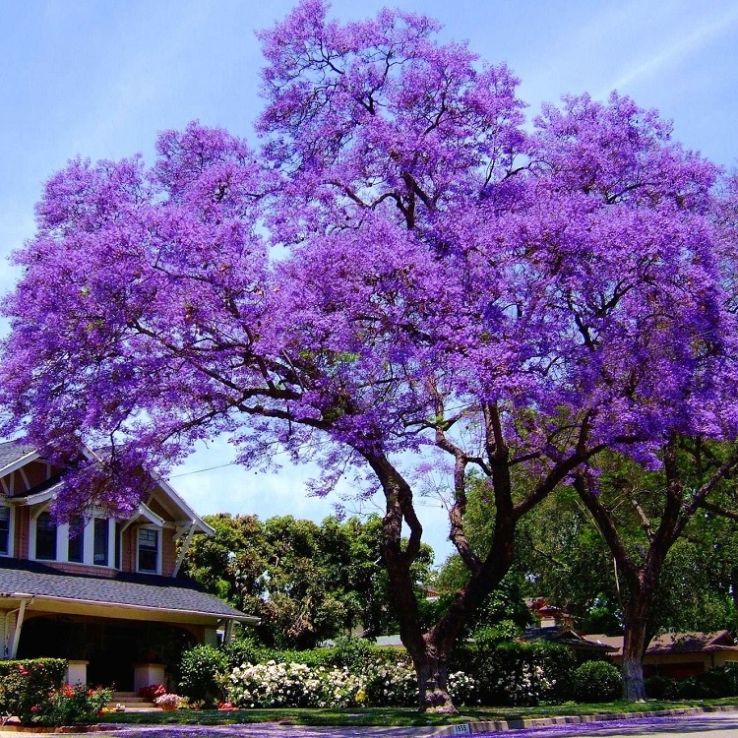
Pink Empress Tree, photo by Quinta dos Ouriques
Excluding palms Paulownia probably has the largest tree leaves you will ever see. It can have palmate leaves two feet wide or long. Because of the huge leaves and amazing fast growth folks tend to overlook the large edible flowers. Parboiled younger leaves are also edible.
Native to China, the Paulownia is the most dense “softwood” often called the second balsa. Because it can grow up to 20 feet a year it is a source of timber.In Japan it was a tree to plant after the birth of a daughter so the wood could be used for her marriage chest. Interestingly the wood also resists burning. Houses built with paulownia wood are considered fire resistant. Classified invasive in many places, such as North Carolina, Misouri, and Pennsylvania, it is still planted as an ornamental in many public parks and the like.
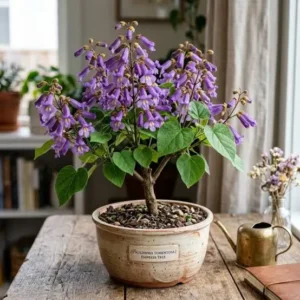
Paulownia tomentosa, photo by Etsy.
Paulownia tormentosa is the most common Paulownia species from China. Among other names are princess tree, royal paulownia, empress tree, imperial-tree, and kiri tree. Originally it was called Pavlona after Anna pavlova, queen consort of the Netherland (1795-1865.) Anna was the daughter of Russian Czar Paul I. Tormentosa refers to soft hair on the leaves’ base stems. The blossom resembles the much smaller foxglove.
The tree was brought to France in 1834, and North America in 1844. While now considered native to china it has been found fossilized in Washington state and Georgia in Eastern Europe.The species’ fluffy seeds — 20 million per tree — were used as packing material and helped spread the species. Its large brown seed pods are considered ugly in many places prompting the tree to be removed. Paulownia is among the fastest growing trees in the world, the more trimmed when young the taller it will grow.
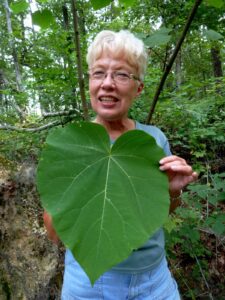
Paulownia tomentosa, photo by Springfield Plateau
The flowers, leaves, fruits, and barks of Paulownia have a long tradition of use in herbal medicine used to treat bloating, detoxify, reduce swelling, relieve pain, dissolve phlegm, and relieve cough. The flowers have flavonoids, phenylpropanoids, terpenoids, polysaccharides, lignans, and iridoids, which are antioxidant, anti-inflammatory, antibacterial, antiviral, anticancer, hypoglycemic, hypolipidemic, neuroprotective and immunoregulation. Extracts of the flowers have been proven safe for animals.
Other species in the genus include Paulownia fortunei, Paulownia tomentosa, Paulownia elongata, Paulownia albiphloea , Paulownia australis, Paulownia catalpifolia, Paulownia kawakamii, Paulownia fargesii, and Paulownia taiwaniana. Many references suggest all have edible flowers but as I can only confirm by published reports that the P. tormentosa has edible flowers.
The moisture, protein, fiber, fat, and ash of dry Paulownia flower accounts for 8.69–9.26 %, 10.8–14.8 %, 3.5–6.4 %, 11.3–13.6 % and 5.4–6.1 %, respectively. It contains 17 amino acids (0.95–1.15 % asparticacid, 1.11–1.38 % glutamicacid, 0.46–0.54 % serine, 0.46–0.56 % arginine, 0.54–0.62 % glycine, 0.80–0.88 % threonine, 0.49–0.59 % proline, 0.57–0.67 % alanine, 0.62–0.69 % valine, 0.07–0.09 % methionine, 0.06–0.08 % cystine, 0.45–0.55 % isoleucine, 0.77–0.94 % and leucine, 0.41–0.48 %
Identification:
Tree with a crown 40 feet across and 40 feet high. Grows extremely fast. If young branches trimmed leaves grow to enormous size, Opposite huge dark green eaves, five petal tubular blossoms with fuzzy brown base which turn into large capsules with dense sticky hairs 2000 seeds per capsule.
Time:
Blossoms in spring when 10 years old.
Environment
Nearly any unpacked soil, open sun and moderate water. Hardy to zone 6, has been grown in protective spaces in Nova Scotia, Isle of Man, and is considered potentially invasive in Australia. Seeds can survive in soils two to three years. In the eastern United States, Paulownia occurs in a variety of disturbed, high-light environments including forest gaps and edges, stream banks, river and lakesides, south facing slopes, roadsides, fencerows, and vacant lots.
Method of preparation:
Leaves raw in salads. Young leaves parboiled.