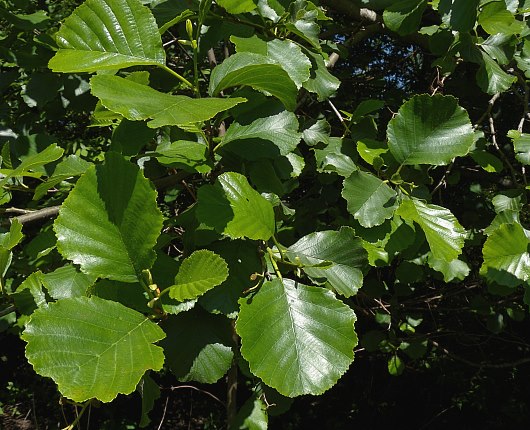
Black Alder* (Alnus glutinosa) Photo by Illinois wildflowers.
Where I grew up the Alder, related to Birch, was called a trash tree. Why? It took over fresh-water wetlands and filled in ponds. Not a strong wood, long lived or large. Folks never mentioned it is prime wood for smoking meat and other comestibles… such as cheese, eggs and some greens.
Smoking can preserve and flavor. Pairing the wood to the food to be smoked is perhaps more an art than a science, an exercise in personal taste. I am more inclined to use what I have on hand or tinker with it a little. I save by-chance woods for smoking food. My stash includes maple, white oak, apple, mesquite, avocado, citrus and pistachio shells.
American barbecue internet pages all scream Camphor wood is toxic. I used to burn camphor wood in my fireplace without issue. The Chinese make a famous duck dish (Zhangcha duck) using camphor smoke for flavoring. One commercial smoke house in northwest Florida uses camphor wood particularly on fish. Many sites warn cherry is toxic though you can buy cherrywood expressly for smoking particularly seafood. (I think they are confusing species, the toxic Purnus caroliniana for the useable P. serotina.) Sites also approve a western juniper but condemn an eastern juniper and mistakenly call them cedars. Everyone condemns sycamore…. a wood which when dry can be used for skewers, spoons and bowels et cetera. Sycamores have a dark orange sap which imparts a urine flavor to whatever it smokes. Redwood and cypress are also NOT used for smoking.
Meats, seafoods, and cheese are foods that are regularly smoked. Delicate smoke for mild foods, stronger flavored for red meats et cetera. Getting general approval is:
Acacia: Fish, chicken, beef, lamb, pork, slightly sweet
Alder: Everything, delicate, subtle, slightly sweet.
Almond: Pairs with all meats, nutty sweet flavor.
Apple: Sweet and fruity Poultry and game, grouse, pheasants, turkey, pork, ham and quail.
Apricot: Chicken and pork
Ash: Perfect for red meats and fish
Aspen: If it is extremely dry and you have nothing else. I would presume the same with popular. Tulip popular generally burns too hot and fast for smoking.
Australian Pine (which is not a pine, wood and dampened needles) Has been used to smoke mullet
Beech: Mild, slightly nutty.
Birch: Pork and poultry, salmon is a classic choice
Blackberry root: mild, smoky taste
Bottlebrush: Seafood, earthy, woody flavor
Bunya Bunya cone leftovers: Highly esteemed for meat and seafood
Butternut: Can impart a bitter flavor so it is paired with other woods. Works better with red meats. The cut and paste internet confuses Butternut with Buckeye saying Butternut and its nuts are toxic. Not true. Butternuts were esteemed and called the white hickory. Buckeyes are the toxic ones.
Carob: Never use green carob wood for smoking.
Carrotwood: Rich and fruity, poultry, red meats, game and lamb.
Cherry: Fruity and sweet, fish, poultry and pork. (If the leaves smell like almonds you have the wrong species.)
Chestnut, if you can find it:
Melaleuca: Seafood, earthy, woody flavor
Sassafras: mild, musky, sweet smoke with a root beer aftertaste. Especially good on beef, pork and poultry.
Seaweed: Seaweed is commonly used for smoking shellfish such as clams, crab, lobster, mussels, and shrimp. The seaweed is washed to remove the salt and air or sun-dried before use. It provides a somewhat spicy and natural flavor to the foods being smoked or grilled Clams, crab, lobster, mussels, and shrimp. I grew up in Maine and seaweed was absolutely necessary for a clam bake (for steam and flavor.) As a kid we would paddle out to coastal islands, collecting mussels along the way. We’d build a pit with rocks, pull seaweed off the ledges, start a fire then go back before the tide would strand us for 12 hours.
Walnut (Black) Pork.
Coconut Husks, Corn Cobs, Cottonwood, Dogwood, Fig (sparingly, can be bitter) Grape Vine, Gorse, Guava, Heather, Hickory, Honey Locus, Jabuticaba, Jackfruit, Kiawe, Lead Tree (Leucaena leucocephala) Lilac, Lychee, Madrone, Magnolia (I presume M. virginiana which is also a good wood to grow oyster mushrooms one) Maleleuca, Manzanita, Mulberry, Nectarine, Oak (white and red) Olive, Orange (the latter for pork, also grapefruit, lemon, lime) Osage Orange (blended with oak) Peach, Pear, Peat, Pecan, Persimmon,
Pistachio Shells,If you like the taste of pistachio nuts, the mild smoke adds it’s flavor. Good on beef and pork, not good with fish.
Pimento, Plum, Red Mangrove (Rhizophora racemosa) Santol, Sassafras, Seaweed (washed) Starfruit, Straw, Sugarcane, Tamarind, Willow, and Walnut, Black and English.
Some that are in … limbo. Sourwood is one. Natives cooked meat on sourwood sticks so it can’t be that bad. No reports on Southern Wax Myrtle, some report Crape Myrtles can be used. If the Bradford Pear could be used to smoke food it would help eliminate that invasive, non-productive ornamental. I’ve also got three gallons of dried Queen Palm seeds. They have a coconut-flavored seed inside. I wonder how they would smoke and taste? You don’t use conifers for smoking (such as true pines, firs, hatmatacks (eastern larch), cypress et cetera
Avoid completely poison ivy/oak, yew and Oleander. Also do not use eucalyptus or Golden Rain Tree. American Elm was not used for smoking.
*I must regrettably admit the first bird I ever shot was a sparrow with a BB gun when I was a kid was in an Alder patch. I was amazed that I hit it. And would apologize to it if I could. Later in the Amy I was an expert marksman.