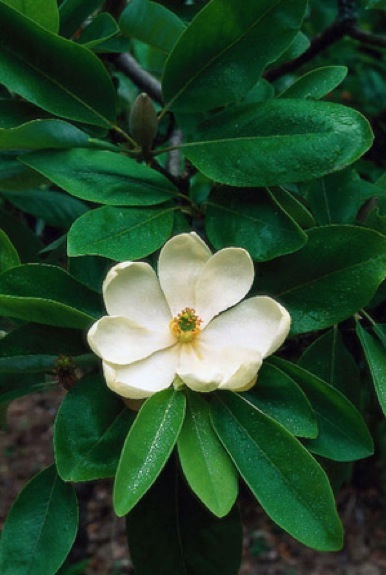
The Sweetbay has large, waxy blossoms

Magnolia viginiana: How Sweet It Is

Let’s say you want or need to trap a beaver. First you need a trap, but then you need to bait the trap. And then the question becomes, what do you bait a beaver trap with?  There is an answer: Magnolia virginiana.

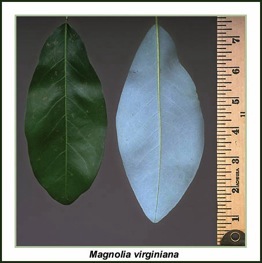
The silver is caused by little hairs

Beavers find the fleshy roots of the “Sweet bay” irresistible, a preference that was not missed by early colonists to North America. Beavers aren’t the only ones who find the tree a source of a meal. Deer and cattle like the leaves and twigs. It can be up to 25% of their winter diet. Squirrels, white-footed mice, turkeys, quails and songbirds like its fruit. Humans make a tea from its leaves and use them to flavor soups and stews.

Among those who consider such things the leaves of the M. virginiana are considered slightly inferior to those of the Perseas in flavor, though they are used the same way (to see an article on the Perseas elsewhere on this site click here.) While the Perseas have a more complex flavor profile the Sweetbay appeals more to the nose with a hint of vanilla. It is also a more attractive, larger tree. And the truth be told, the Sweetbay is a whole lot easier to identify than the Perseas. The lance-shaped leaves are a rich green on top and a solid silver on the bottom. When the wind blows, the tree flashes a handsome metallic sheen. That glimmer is caused by minute white hairs on the young leaves, which can be rubbed off.

Pierre Magnol, 1638-1715

The aromatic wood is soft, even-grained and very easy to work. Besides trapping beavers, it’s used for veneer, boxes, containers, tool handles, furniture, lumber and plywood. The Sweetbay ranges from Glouster, Massachusetts, to Florida to Texas, though it is most common in South Carolina, Georgia, Florida and Alabama.

Besides the Sweetbay the leaves of the Magnolia grandifolia can be used for seasoning (slightly bitter) and the petals of the blossoms pickled in a vinegar and sugar solution to make a condiment. Interestingly the Magnolias are related to the smaller papaw, but much younger say the botanists.

Two other magnolias are worth mentioning, M. hypoleuca and M. kobus. The young leaves, flower buds of the M. hypoleuca are boiled and eaten as a vegetable. Older leaves are dried then sprinkled on food as a flavoring. Whole dried leaves are filled like small boats with food then grilled. Leaves used that way are not eaten but they impart their flavor to the food cooked in them.

The flowers and buds of the M. kobus are also boiled and eaten. Older leaves are eaten or used to make a tea. The leaves are also dried and powered and used as a seasoning.

As for the scientific name, Magnolia (mag-NO-lee-ah)  is named after French botanist Pierre Magnol, 1638-1715, who was the physician of King Louis XIV of France and was the director of a botanical garden at Montpellier and also a professor of Botany at Montpellier. Virginiana (vir-gin-knee-AY-nah) means of North America. Grandifolia means large leaves. Hypoleuca (high-poh-LOO-kuh) is Greek that means “under white.” Kobus (KOE-bus) is the native name for that magnolia.

 Green Deane’s “Itemized” Plant Profile

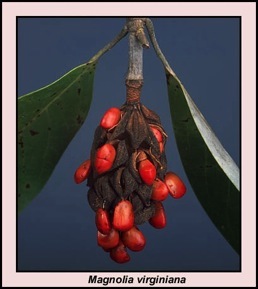
Seeds are not edible

IDENTIFICATION: The Sweetbay Magnolia is a tree to 90 feet, with an open crown of sparse branches. The farther north the smaller the tree. Its leaves are simple, alternating, oval to oblong, four to six inches in length. Its bark is gray-brown, smooth and tight. the thin leathery leaves are smooth and shiny green on top, white below.  The fruit is an aggregate that releases many flat. oval, red seeds (not edible.)

TIME OF YEAR: Year round

ENVIRONMENT: It is found in swampy areas, wet soil and along streams and ponds.

METHOD OF PREPARATION: Leaves can be used to make a tea or use like a bay leaf to flavor soups and stews or make a marinade.


{ 18 comments }

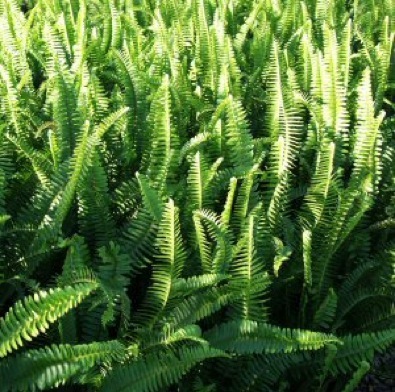
Sword Fern’s Water Storage Swelling

Nephrolepis cordifolia: Edible Watery Stolons

Edibles are often right under your feet, or my feet as it were.

I had a yard of non-edible ferns. If you like fiddleheads that’s an irritation. That irritation in time lead me to buying a regional fern book to seek out more fiddleheads than I already knew. To make sure I could ID ferns well I started with the ones in my yard, Nephrolepis cordifolia. From the other side of the world they were first found growing in Florida beside a road in Sumter County in 1933.  They have since covered much of the state.

Sword Ferns From Nepal Found In Florida in 1933

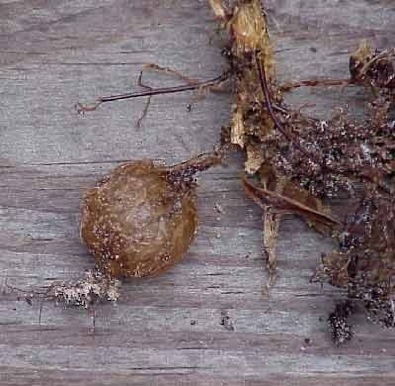
As the N. cordifolia does not produce much of a fiddlehead I ignored it for some eight years as it spread, covering half my property.  The identification was rather easy in that of the five Nephrolepis in the state the cordifolia is the only one with marble-size stolons growing off its roots. In fact when I wanted to move ferns to a new spot I often planted the stolons. I thought nothing of them.

My research led me to a scientific paper on the plant from Nepal, Nutrient Analysis of Nephrolepsis, Kathmandu University Journal of Science, Engineering and Technology, Vol 4, No 1 (2008). A team not only tested the Nephrolepis cordifolia for nutritional content but reported children there eat the stolons raw all the time, apparently their favorite wild snack. The team recommended the stolons be investigated as a potential commercial crop. After rechecking my plants I suddenly realized I had thousands of ferns with edible stolons.

This was a win win in disguise. Florida put the N. cordifolia on the state’s plant pest list, the only fern of about 100 to make it. The state doesn’t like it because the fern is squeezing out the native Nephrolepis exaltata, which is a commercial product.  While many ferns species have useable rhizomes only two Nephrolepis  have swolen stolons and both are edible, N. cordifolia  and  N. undulata.  What that means is if you have a Nephrolepis and it has stolons you have an edible. If you don’t live in pan-tropical regions around the world, no problem. There is probably a pot of sword ferns in any number of businesses and lobbies near you. Gently pull the fern root mass out of the pot and look for stolons. If it is a sword fern (Nephrolepis) and it has stolons, it is edible.  Often the N. cordifolia is sold as the N. exaltata because folks don’t know the difference. So you could have fern stolons near you.

Research on the Nephrolepis can be confusing. While online references say there are about 30 species of Nephrolepis in the world a recent study suggests 19 or so, read some consolidation and parsing happened.  There still may be some future sorting out in that not all agree there are 19 species.  A Florida botanist is quoted on a site as saying there are four species of Nephrolepis with stolons. I contacted him and he flatly denies ever writing or saying any such thing. That is why contacting primary sources is important. While the Internet might be  a place to start your research. It is not the place to end it.

Nutritionally the stolons of the N. cordifolia are 13.42 percent carbohydrates, 1.34% protein, 1.25 percent starch, 14.88 percent crude fiber, 6.53 ash, 0.75 percent calcium and trace phosphorus. They’re also about 96% water. They can range in color from cream to yellow to dark tan or brown. To me they taste similar Jerusalem Artichokes with the same crunch, a varying amount of astringency, water and potato-like earthy aroma. From the plant’s point of view the tubers are for water storage. The fern is often an epiphyte growing on other plants, most noticeably on palm trees. The stolons can provide water for the dry spells.

Nephrolepis (nef-roh-LEP-iss) is Greek and means kidney shaped scales, referring to the shape of the spoor packets on the back of the fern’s leaf.  Cordifolia (kor-di-FOH-lee-uh) means heart-leaf. Where each leaf (pinnule) attaches to the stem (rachis) there is a little protrusion that looks like the bottom of a heart.  Identifying ferns is often nearly microscopic in nature. You definitely need a hand lens at least 10x and a lot of patients.  The plant is native to Australia and the Himalaya areas. It is found in the Society Islands, New Zealand, Puerto Rico, Hawaii, Florida, Georgia, Alabama, and protected pots elsewhere. If you have a “Boston Fern” in might be the N. cordifolia. Look for the stolons. See my video on said.

Other ferns species with reportedly edible tubers include Angiopteris evecta, Diplazium esculentum, Cyathea medullaris, Pteris esculenta, Gleichenia dichotoma, and Marattia alata. Pteris aquilinum and Aspidium filix tubers have been used to make beer. Tubers are usually starchy and much larger than stolons.

Green Deane’s “Itemized” Plant Profile

IDENTIFICATION: A medium-sized, medium-green, Boston/sword Fern, tapering to both ends,  producing below ground scaly round  stolons. Leaves pinnate, fertile and sterile fronds similar to three feet long and three inches wide; petioles to eight inches long, Forty to 100 leaflets on each side, oblong-lanceolate with a heart shaped lobe stem end of leaf; leaflet entire to slightly toothed, underside spore packets kidney-shaped

TIME OF YEAR: Tubers are available year round. The plant produces a horizontal root (rhizome.) Off the rhizome are wiry roots, stolons. Growing on the stolons will be the fuzzy hairs. I think calling them “tubers” is not exactly correct, more like water storage units, swollen stolons.

ENVIRONMENT: Shady areas, lawns, waste ground, limestone ledges, wet places, roadsides, in palm trees.

METHOD OF PREPARATION: Eaten raw, out of hand. If you roast large ones in a slow oven the turn into sweet, chewy lumps. Small ones keep their shape but turn to a powder inside that tastes like coffee. Young stolons (which are green with white hairs) are the least astringent, the darker and older the stolons the more astringent.


{ 28 comments }


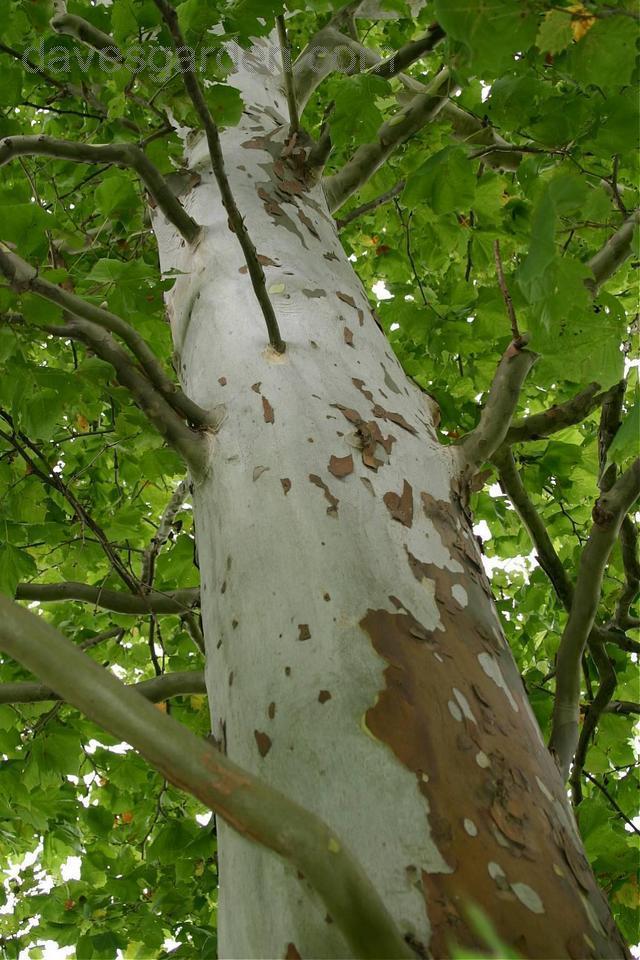
Sycamore has distinctive bark

Sycamore has distinctive bark

Sycamores: Not Just Another Plane Tree

Sycamore trees are not high on the edible list, unless you’re in need.

Actually, sycamores, Platanus occidentalis (PLAT-uh-nus ock-sih-den-TAY-liss) get a bad rap. Though they grow big and showy, landscapers don’t use them because they can have a lot of tree diseases. Homeowners don’t like them because they shed piles of maple-like leaves and disrupt underground lines. Woodworkers don’t care for the wood because it tends to hold water and twist when it dries. But that is one reason why we like it.

The sycamore is full of drinkable sap, read water when you need it. The sycamore can also provide a maple-like syrup as well, but you’ve have to boil many gallons of it to get syrup or sugar.  Knowing there is always a source of drinkable sap/water nearby has its advantages.

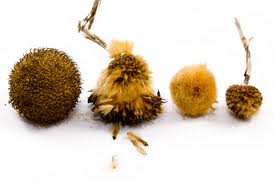
Sycamore seeds

To the forager, or the bushcrafter, another advantage of the sycamore is its light-colored wood can be used to make safe utensils such as wooden spoons, forks or skewers. Historically it was made into boxes to hold food as well as fruit and vegetable baskets.  Other early uses included barber poles, wooden washing machines, lard pails, Saratoga trunks, piano and organ cases, phonograph boxes, and broad paneling in Pullman train cars. It has been used for butcher blocks for many years because it is hard to split, as well as flooring, handles, and pallets. Incidentally, there is a second sycamore of interest but it only grows in California and Mexico, Platanus racemosa. Chunks of its bark can be use for a coffee substitute.

And while it may never come to this, sycamores can grow so large they have hollow trunks and many a settler sought long-term shelter inside a sycamore. It was not uncommon to house a pig to a horse inside a living sycamore. At one time two brothers lived for three years inside the hollow trunk of an American Sycamore. One can believe that given the size of the champion sycamore tree in the United States. It’s in Jeromesville, Ohio, and is nearly 50 feet around at the base (582 inches at 4 1/2 feet high.) It is 129 feet tall and has a crown spread of 105 feet.

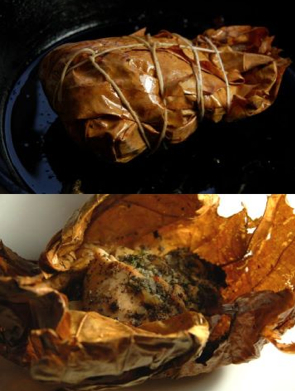
Mia Wasilevich using the fragrant sycamore leaves as a wrap to keep lambsquarter seed stuffed rabbit leg moist.

Mia Wasilevich using the fragrant sycamore leaves as a wrap to keep lambsquarter seed stuffed rabbit leg moist.

And just as the tree is human friendly it is kind to animals as well. Sycamore seeds are eaten by some birds including the purple finch, goldfinch, chickadees, and dark-eyed junco. The seeds are also eaten by muskrats, beavers, and squirrels. Hollow sycamores can provide dens for black bear. Cavity nesting birds that call the sycamore home include the barred owl, eastern screech-owl, great crested flycatcher, chimney swift, and the wood duck. In fact one bird uses the tree rather cleverly.

If you look at a sycamore of any size you will often see a line of little holes in the bark, made by the Sapsucker. And while the Sapsucker likes sweet sap it has an ulterior motive. After the bird flies away insects come to feed on the sugary sap. The bird then returns and eats he bugs. Clever bird. Hummingbirds also eat the seeping sap.

The naming of the sycamore is a rather complex affair. Sycamore is from two Greek words siga and mora which  mean “Fig and mulberry.”  First there was a fig tree in the Middle East called Ficus sycomorus, the Sycomore Fig of Bible fame. The American sycamore’s leafs and round seeds were reminiscent of the Sycomore Fig, thus it was called Sycamore. It’s botanical name is a combination of Greek and Dead Latin.  Planatos (plane) was a Greek name for the tree, and occidentalis means “of the west” to separate it from similar European trees. Greeks also call the tree Daphne, a strange little word. Depending upon the accent in Greek it can be the tree and an area of Athens that once had an insane asylum, and where we get the word “daffy” in English. Racemosa means cluster and refers to the seed cluster of the California sycamore.

Also, according to Herodotus, the Greeks owed some of their success to the charm of the plane tree. In 480 BC, invading Persian King Xerxes camped his army in a grove of those trees. The king was so enamored by them that he put off his march for a few days. This delay helped lose Xerxes the war, and Greece went on to build the Athenian Empire.

The American sycamore is sometimes confused with the several other trees in the same family that are similar in appearance. If the tree has single seed pod, it is the sycamore. If there are two seed pods together, it’s a London planetree. If there are 3-5 seed pods, it is an Oriental planetree which has the seed pods hanging like beads. Those seed pods when dry have a coating of tiny hairs and can irritate air passages, so handle them carefully. However, that same hair makes excellent tinder.

Green Deane’s “Itemized” Plant Profile

IDENTIFICATION: Tall tree resembling a maple with mottled bark, leaves palmate, large, eight inches wide and long or more, with three lobes, glossy green on top, paler underneath. Non-edible fruit, a brown cluster.

TIME OF YEAR: Sap availability depends on location, year round in warm areas.

ENVIRONMENT: Grows best on sandy loams or loam with a good supply of ground water, typically on the edges of lakes and streams. Found in eastern North America, except the California Sycamore.

METHOD OF PREPARATION: For the American sycamore, the occidentalis, sap, tap like a maple. For the California Sycamore, the Racemosa, put chips of the bark and root in hot water. One thing the sycamore cannot be used for is smoking food.  It gives a foul flavor to the food.


HERB BLURB

Native Americans used Platanus occidentalis for a variety of medicinal purposes, including cold and cough remedies, as well as dietary, dermatological, gynecological, respiratory, and gastrointestinal aids


{ 78 comments }


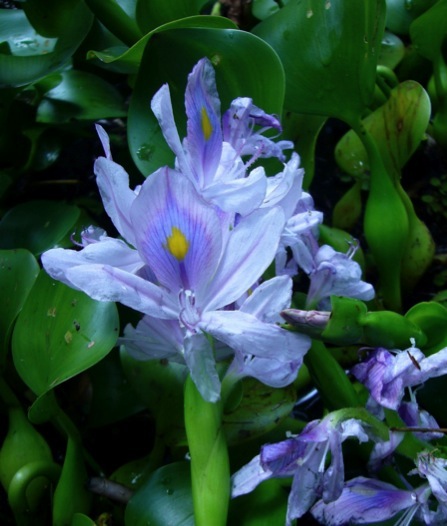
Water Hyacinth's blossoms always have a gold spot

Water Hyacinth Stir Fry

The state of Florida minces no words about the water hyacinth: “Eichhornia crassipes is one of the worst weeds in the world  — aquatic or terrestrial.” They apparently have not tried them deep fried with butter, or steamed like mustard greens with a bit of bacon or pork fat.

Water Hyacinths, a member of the pickerelweed family, are born nearly pregnant adults. … Okay, that might be an exaggeration but they can double in population in as little as two weeks. One plant in one season can multiply to cover one acre. They caused a serious threat to Florida waterways not long ago and have only been fought to a constant draw. If the state were to stop fighting for one season the weed would get the permanent upper hand. In Panama, it would make the canal impassible in three years if not kept under control.

Of course, the other view is here is a plant that can feed you again in two weeks. That’s not a bad return if you’re starving or need green vegetables for a balanced diet. Even when viewed as an edible there are two down sides: While young leaves and stems can be eaten cooked or raw, raw they give quite a few people the itches, and cooked they still make a few people itch. So you have to sort that out before you eat too many. And very much like lichen, water hyacinths can absorb and hold just about any chemical pollutant around. Moral of the story, collect them from only clean waters. Never collect them down stream from any mine because mining can cause toxins. On the other hand, if I were selling hydroponics foods in a state that has a real winter to limit escape, this would be a plant I would experiment with: Fast growing, reproduces easily with about the same leaf texture of some seaweeds. The deep fried bottoms are more along the lines of deep fried pork rinds. Some writers say water hyacinth is tasteless but I have found when cooked to be close in texture and taste to a mild collard green. It always retains some “tooth.”
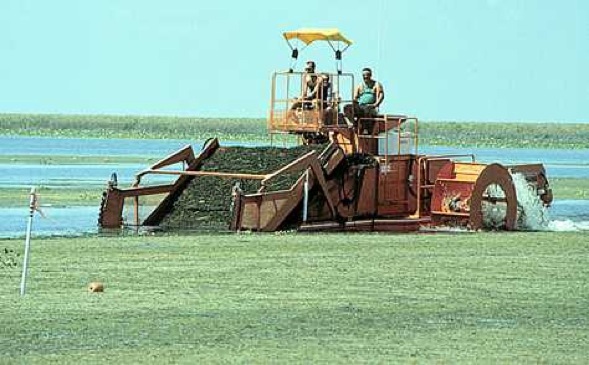
Clearing a lake of water hyacinths, temporarily

Water hyacinth originated in tropical South America, but is naturalized in warm areas of the world: Central America, California and southern states, Africa, India, Asia, Australia, and New Zealand, the latter where it is illegal so eat it fast. It was introduced to the United States in 1884 at an exposition in New Orleans. A Florida visitor to the exposition returned home with water hyacinth and subsequently released them into the St. Johns River. He later said the citizens of the state should thank him for what he did. The view now is they should have hanged him. While water hyacinth does not like winer temperatures it can be found in many protected spots in northern states such as Illinois, New Jersey, Connecticut, New York even adjoining Canada.

I suspect a lot of reported northern locations are aquariums. The plant is known as a natural oxygenator for fish and at the same time keeps the fish tank clean. If you keep a natural fish tank it makes sense. In the wild, opinions aside, it’s a breeding ground for many insects fish eat.

Water hyacinth is a good cattle fodder, chicken feed, mulch. dry fuel, mushroom growing medium, cigar wrappers, furniture and fertilizer. It is also a fantastic biomass for making alternative fuels. Florida should be thinking of water hyacinths as “green” oil, Florida Tea, a sustainable source of fuel. Instead, it’s a “weed” they don’t know what to do with. (See my 14 March 2008 blog.)  The water hyacinth’s leaves are a source of vitamins A, B1 and B2 and betacarotene. They contain 18.7% protein, 17.1% fiber and 36.6% carbohydrates. Each year, the state of Florida spends some $15 million to control it. Some of that control is by spraying poisons, so be careful where you collect hyacinths. (See photo at bottom of page for mechanical means.)

Don’t confuse water hyacinth with Frog Bit, Limnobium spongia,  which has similar looking leaves. The water hyacinth has black feathery roots and a bulbous float at the bottom of its stem. Floating Frog’s Bit has white roots, slender and ridged stems  and no bulbous growth at the bottom of its stem.  The water hyacinth also has runners to sister plants.

Its genus name, Eichhornia,  (ike-HOR-nee-uh) honors once Prussian Minister of Education, Culture and Medicine, John Albert Friedrich Eichhorn. Crassipes krah-SEE-peez also KRASS-ih-peez) means thick foot, referring to the plant’s large, floating root mass.

Lastly, a law was passed in Florida to reduce the spread of this pant. It says: “It is illegal to collect, transport, possess or cultivate this plant (Rule 62C-52.011 FAC).”  “But officer, I was only taking it home for supper….”

Green Deane’s “Itemized” Plant Profile

IDENTIFICATION: A floating aquatic herb, also rooting in mud, in dense mats with young plants attached to adults, submerge roots . Submersed roots feathery. Leaves in rosettes; stems spongy, usually inflated orbulbous near base; leaf roundish or broadly elliptic, glossy green. Flower a showy spike above rosette, lavender-blue, six petals, one with a yellow blotch. Fruit a three-celled capsule with many seeds. They can be dormant for as much as 30 years. Remember, the stalks are always bulbous and the flower has an orange spot on the upper lobe of the flower.

TIME OF YEAR: Year round in Florida, further north flowering in late summer, early fall.

ENVIRONMENT: A wide variety of wetland from lakes, streams, ponds, waterways, ditches, to backwater areas and factory discharges. It does not like brackish water. Make sure the water and area are wholesome.

METHOD OF PREPARATION: Leaves boiled or fried, young bulbous bottoms fried, flowers boiled or candied.   All can still make some people itch after cooking, try cautiously.

HERB BLURB

Herbalists in India say juice from the water hyacinth is good for treating fresh wounds to keep them from infecting. The flowers have also been used to treat skin conditions on horses.

And the following are as published so you can read them  and make up your own mind:

(The FASEB Journal. 2007;21:1724-1729.)

Novel rhythms of N1-acetyl-N2-formyl-5-methoxykynuramine and its precursor melatonin in water hyacinth: importance for phytoremediation N1-acetyl-N2-formyl- 5-methoxykynuramine (AMFK) is a major metabolite of melatonin in mammals. To investigate whether AFMK exists in plants, an aquatic plant, water hyacinth, was used. To achieve this, LC/MS/MS with a deuterated standard was employed. AFMK was identified in any plant for the first time. Both it and its precursor, melatonin, were rhythmic with peaks during the late light phase. These novel rhythms indicate that these molecules do not serve as the chemical signal of darkness as in animals but may relate to processes of photosynthesis or photoprotection. These possibilities are supported by higher production of melatonin and AFMK in plants grown in sunlight (10,000–15,000 µW/cm2) compared to those grown under artificial light (400–450 µW/cm2). Melatonin and AFMK, as potent free radical scavengers, may assist plants in coping with harsh environmental insults, including soil and water pollutants. High levels of melatonin and AFMK in water hyacinth may explain why this plant more easily tolerates environmental pollutants, including toxic chemicals and heavy metals and is successfully used in phytoremediation. These novel findings could lead to improvements in the phytoremediative capacity of plants by either stimulating endogenous melatonin synthesis or by adding melatonin to water/soil in which they are grown.—Dun-Xian Tan, Lucien C. Manchester, Paolo Di Mascio, Glaucia R. Martinez, Fernanda M. Prado, and Russel J. Reiter. Novel rhythms of N1-acetyl-N2-formyl-5-methoxykynuramine and its precursor melatonin in water hyacinth: importance for phytoremediation.

Potential of water hyacinth (Eicchornia crassipes) in ruminant nutrition in Tanzania: Abstract, Livestock Research for Rural Development, Volume 17, Number 8, August 2005

Two experiments were conducted to investigate the potential of water hyacinth (Eicchornia crassipes) in ruminant nutrition in Tanzania. In the first experiment , biomass yield, chemical composition, in vitro dry matter (IVDMD) and organic matter digestibility (IVOMD) and in-sacco degradability of water hyacinth were investigated. In the second experiment water hyacinth was ensiled using 0, 10 and 20% molasses levels as an additive, and subsequently analysed for dry matter (DM), water soluble carbohydrates (WSC), IVDMD and IVOMD.

Biomass yield (ton/ha/year) of water hyacinth was estimated as 322.2 tons (approx. 30.45 tons DM/ha/year at 9%-10% DM content) . Sun drying for 8 hours was adequate to wilt the fresh water hyacinth to a product of 15.35% DM, the chemical composition of which was 18%CP in leaves and in shoots. The whole plant showed significantly (P<0.001) lower DM digestibility (42.32%) compared to leaves and shoots (58.15 and 57.03%). No significant difference in dry matter digestibility was observed between leaves and shoots. Potential degradability was 68.09%, 60.82% and 52.91% for leaves, shoots and whole plant respectively. The rumen degradable fraction was 44.2%± 3.11 in the whole plant, 58.71%± 6.29 and 52.41%±1.38 in the leaves and shoots respectively.

Addition of 10% or 20% molasses to WH silage significantly (P<0.001) improved IVOMD from 42.15% in untreated silage to respectively 54.6 and 52.76% .Likewise the in-sacco DM degradability was improved from 48.53% in untreated silage to 54.76% and 54.55%. The Crude Protein (CP) content was significantly (P<0.001) lower for 10 and 20 % molasses treated silage (80.75 and 77.68 gkg-1DM respectively) compared to untreated silage (97.61 gkg-1DM.).  It was concluded that water hyacinth could provide large quantities of nutritious feed to ruminants in the Lake zone.



{ 39 comments }

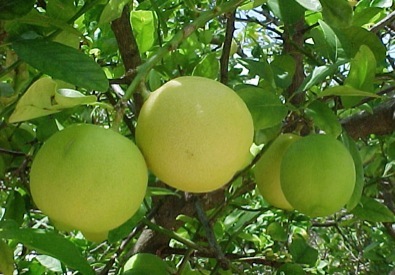
Without attention citrus reverts back towards original forms

Feral Citrus: Snack, Seasoning and Soap

Citrus, like apples when left unattended by man, tend to revert to their natural state of being sour and acidic. A lot of folks think that makes them inedible but that is not true plus they have other uses.

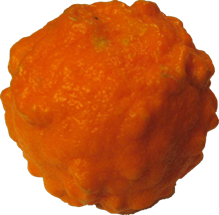
A “wild” orange, usually highly acidic

Some wild citrus has kept its palatability, the Key Lime (Citrus aurantifolia) is a good example. Imported from Asia to the West Indies and naturalized in the Keys it is perhaps the most prized of small limes. A piece of authentic key lime pie is indeed a treat. Another naturalized citrus that is not that pleasant is the Sour Orange or Seville Orange, Citrus aurantifolium. You can use it to wash your hair.

Contact with the feisty key lime can cause an itchy rash on exposure to the sun, or burn and blister sensitive individuals. The  Sour Orange is so acidic it cannot be eaten as is. Its juice, however, can make an ade and be used as a seasoning. The pulp and peel can be used for marmalade. In fact, the fruit and leaves can be crushed and used like soap, and it will lather. It can also be used to shampoo with. Also remember that citrus acid can be used to cook some shellfish and small pieces of fish. Simply put the food in the acid and let it sit for an hour or so until done.

Other wild citrus vary from still edible to be used for washing. I have an old tangerine grove near me and some of those trees still produce edible fruit. In nearby Spring Hammock, the wild oranges taste like lemons. You simply have to try them. Best advice is to chew a little well, spit it out and wait about 30 minutes. If the fruit is too acidic it will show up within that time. If not consume as one would any citrus. Don’t, however, be fooled by initial sweetness. That can still mask considerable acid. Chew it, spit it out, and wait. Then decide.

Botanically they are Citrus aurantifolia (KIT-roos aw-ran-tee-FOH-lee-ah)  and Citrus aurantifolium (KIT-roos  aw-ran-tee-FOH-lee-um)  Citrus came form the Latin word for the citron tree but the Romans got it through the Etruscans who got it from the Greek word “kedros” meaning cedar. Both endings mean golden leaf.

 Green Deane’s “Itemized” Plant Profile

IDENTIFICATION: Key Lime:  Small tree or straggling shrub to 15 feet, numerous sharp thorns, leave alternate, oval to elliptical, usually rounded at the tip, edges minutely scalloped, stalks winged, strong lime aroma. Fruit round, one to two inches, green when unripe, yellow when ripe, pulp greenish juicy, sharply acidic. Seville Orange:  Shrub to tree to 30 feet, long sharp thorns, leaves ovate to elliptic, often pointed, to four inches long, fruit round to three inches wide, reddish orange, roughly pitted, thick bitter rind, pulp orange, somewhat bitter, core hollow,  seeds ivory white, oval.

TIME OF YEAR: Fall and spring but also nearly all year in warm areas, seasonal in others, which can be fall or spring.

ENVIRONMENT: Abandoned homesteads and campsites, other citrus virtually any where it will survive the winters

METHOD OF PREPARATION: Juice from both can be used for an ade or seasoning. Both can also be used cooked.  Non-acidic wild citrus can be eaten as is.


{ 1 comment }