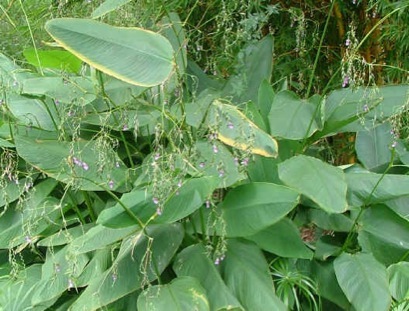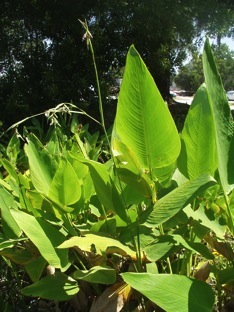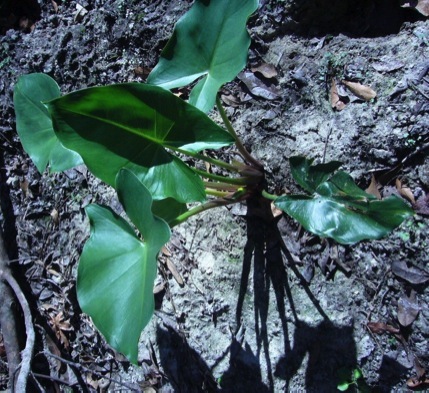
Prefers to grow in water or mud

   Peltandra virginica: Starch Storer

You wouldn’t think there would be a connection between the United States’ Capital and a toxic bog plant, but there is. Much of the fine, white marble in Washington DC came from quarries in Tuckahoe, N.Y., north of Yonkers. Tuckahoe was named for one of the staple vegetables of the Indians in the area, now called Arrow Arum or Peltandra virginica (pel-TAN-dra vir-JIN-ee-ca.) It’s a plant with a rhizome laced with a toxin though the Indians knew how to get rid of. That Tuckahoe should be named after the Tuckahoe is not unusual in that Sag Harbor on Long Island was named after the Sagabon, another local root now called Apios americana, or Ground Nut or Hopniss. It, too, has to be cooked to be edible. See my article on it here.

The Arrow Arum, or Tuckahoe, likes still or slow moving waters: Ponds, swamps, marshes, and the banks of streams. It can grow in full sun to shade. Its native range is from east Texas to Florida north to the Great Lakes and southern Maine, though I did not see it there too often. It also is also established in California and Oregon. On the move, it has been located in spots in Minnesota, Kansas, Iowa, and southeastern Canada. In northern climes it goes dormant in winter; in the South, it stays green unless we get a frost or freeze.
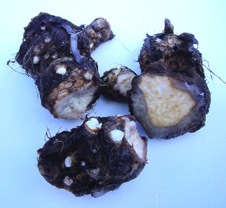
Dry heat destroys the burning chemical

Like other aroids the Tuckahoe is toxic and has raphides of calcium oxalate, microscopic needle-shaped crystals that cause severe swelling and a burning sensation as they puncture the membranes of the lips, mouth, throat, tongue, fingers et cetera. Swallowing too much of it can be a fatal mistake, though that is rare these days. The chemical can clog up your kidneys but that, too, rarely happens because of the one-minute after eating burning sensation. Like most aroids, this is a living-in-the-wild, long-term survival food. However, rid of the raphides the Tuckahoe is an excellent source of starch, very necessary for living off the land.

The raphides can be destroyed by very long cooking, heating or drying. The rhizome starch was dried and ground for making breads and soups. The spadix, fruit, and seeds were considered delicacies (after cooking them some nine hours or drying them and then cooking them for hours.)  William Bartram reported that the Indians ate the long-boiled spadix and berries as a luxury. They have a hint of cocoa flavor. The growth dynamic is the plant produces berries then bends over and literally buries the blackish green seeds in the mud. (Sometimes the seeds can be yellowish.)

What most foraging books don’t tell you is the plant can be a chore to dig up. The starchy payoff is worth it but it is more a shovel forageable than a hand-dug one, though I have done that. If you are going to dig it up by hand I recommend elbow-length tough dishwashing gloves. The rhizome is covered in spaghetti like rootlets and thousands of small hair-like roots. It also likes to grow horizontally between one and two feet down in wet soil. It does not give up easily and often the mud it is in is… ah… aromatic.

Like the Jack-in-the-Pulpit the best use is to slice it up and dry it for a few months. It can also be roasted in an oven for a day or more, which is not cost effective. The Indians would collect them, bury them in the ground, build a huge fire over them and cook them for a day or more. Tuckahoe also respond to microwaving but it is hard to get the right timing between made safe to eat and turning to charcoal. However, microwaving them some shortens the drying time to edibility significantly. I nuke the slices one minute to 90 seconds and then let them sit until edible, which can be immediately to a few weeks.

Another technique I’ve used is my solar oven. I peel the roots and put them in whole. It takes about 10 hours of solar drying over two days to make them edible, though hard. I haven’t tried making them into chips and using a shorter amount of time.

The edibility test is the same for the Jack-in-the-Pulpit. To test them: Chew a quarter-inch square piece on one side of your mouth for a full minute then spit it out and wait ten minutes. And I mean chew for a minute and I mean wait ten minutes and I mean one side of your mouth (to limit the area that burns.)  The effect can be quite delayed. If the calcium oxalate is still present it will make one side of your mouth burn, and your tongue and lips. That can last up to a half an hour or so. If no burn, try a bigger piece the same way. If no burn then, you’re ready to go. You can eat the dry chips as is, or grind them up as a flour. If you air dried them they can be used as a thickener. If you dried them at over 150F they can be used as a flour but not as a thickener because the starch will have already been cooked.

Peltandra is from the Greek words pelte for “small shield” referring to the leaves, and andros meaning “man” referring to shape of stamen standing in the spathe. Virginica, literally means of Virginia but botanically it means of North America   It takes about 500 of its seeds to weigh a pound. Those seeds are a favorite food of rails, muskrats, wood ducks and black ducks. The Tuckahoe is also sometimes called “duck corn” after the seeds. Colonies provide cover for deer, beaver, muskrat, snakes, turtles, frogs, dragonflies, and fish.

Green Deane’s “Itemized” Plant Profile

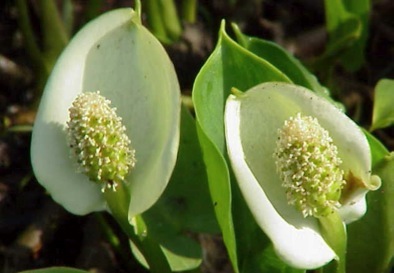
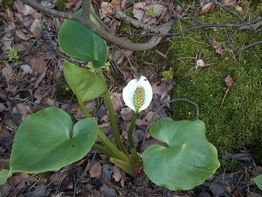
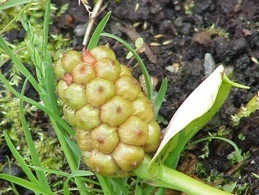
IDENTIFICATION: Long, fleshy, arrowhead-shaped green leaves with pronounced veins on the undersides, the veins are parallel, radiating from the sides of the main veins. There also are a few spaced larger veins also parallel, two near the back of the leaf, see photo above, middle leaf.  Leaves can be wavy along the edge and up to 18 inches long and nearly six inches wide. The plant can be up to a yard high. The rhizome is thick and grows horizontally about a foot down or more.  A possible similar looking plant –when not in flower — is the Sagittaria but it has veins running from one point and the flower is three petaled white, whereas the Tuckahoe has a spike in a sheath that splits on one side. The spathe is four to seven inches long with many tiny yellow-green flowers on it, male part is on top, female part that produces the seeds on bottom. In northern areas don’t confuse the Tuckahoe with the water arum, Calla palustris which has heart-shaped leaves, a very white spathe and red berries (though it has roots that are edible after similar but more extensive rendering. (See article on Calla palustris elsewhere on site.)

TIME OF YEAR: Year round though best in early spring before seasonal growth or fall after seasonal growth.

ENVIRONMENT: Wet areas similar to cattails. Can grow in large colonies in shallow or slow-moving waterways, such as bogs, swamps and marshes. Will also grow in semi-dry well-flooded areas

METHOD OF PREPARATION: Method: Long term drying, long term roasting, microwaving and drying. Always tastes test twice before use.  Peel the roots before you dry them, and you might want to consider wearing gloves when you peel them.

 

{ 8 comments }

Tulip field in Holland

Tulips: Famine Food, Appetizer Assistant

Many years ago a social acquaintance upon learning I ate weeds said she and her mother had eaten tulip bulbs. If I remember correctly they had dug them up and weren’t going to plant them again so they decided to eat them. She said they boiled them and ate them like onions. She reported the tulips bulbs were good… until they had to go to the hospital.

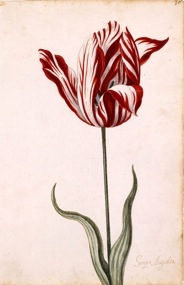
Tulip Semper Augustus.

That’s one of the problems with tulips. You read they are edible but then you meet someone who ate them and ended up in the hospital. Death from tulip bulb consumption (via a glycoside) is rare but it has happened, particularly in World War II.

A few years after my acquaintance’s comment I was interviewing a businessman who had an import store. At one point he mentioned he was from Holland. Without thinking I asked him quite innocently if he ever ate tulip bulbs. His countenance change and I knew I had crossed some line and the interview as essentially over. He said yes, as a boy, he was forced to eat tulips bulbs to survive War War II. As out of place as my question might have been, he did not mention getting ill.

Let’s see if we can clear up the issue of edibility. This is from the book “The Hunger Winter: Occupied Holland, 1944-1945” by Henrie A. van der Zee, pages 149-150.

“Another ‘delicacy’ the Dutch devoured was tulip bulbs. At the beginning of the war doctors had pronounced the bulbs fit for human consumption, but withdrew this in 1942. In the winter of 1944-45 they were rediscovered, and the Office for Food Supply again published some booklets to tell the Dutch how to handle the bulbs. ‘They  contain a lot of starch’

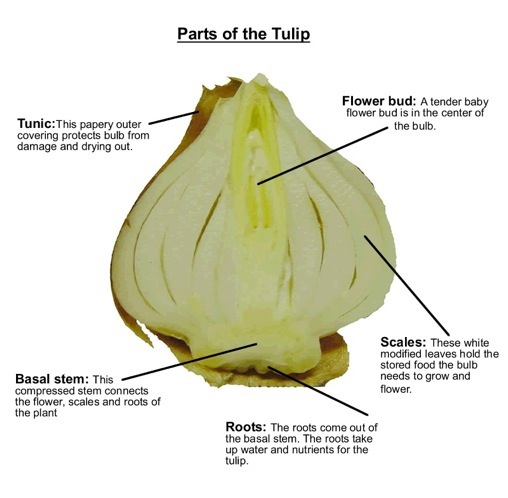
Remove the yellow core before cooking

they told us, ‘and when cooked their consistency will be slightly mealy.’ It was impossible to say how many bulbs were needed for the recipes that followed, but we were advised to peel them, cut them in half and remove the bitter little yellow core. Almost everybody tried it out and nobody liked them, but the Dutch saying ‘Hunger sweetens even raw beans’ was now more true than ever, and Dr. Mees discovered that the bulbs were ‘not too bad’ when boiled like potatoes… Rather better was tulip soup, the authorities had advised. ‘Take one litre of water, 1 onion, 4-6 tulip bulbs, some seasoning and salt… one teaspoon of oil and some curry-substitute. Cut up the onion and brown together with the oil and the curry. Add water and seasoning and bring to the boil, while grating the cleaned bulbs into the boiling liquid. Add salt to taste.’ It had virtually no nutritional value, but it filled the stomach. One had to be careful not to eat too many tulip bulbs as they could cause indigestion… Dahlia bulbs were also tried, but they never became as ‘popular’ as the tulip bulbs. One tulip grower later told an English journalist that he alone had sold 2500 tons of bulbs — ‘crocuses for coffee, daffodils and hyacinths for fodder, and tulips for the humans.'”

Here’s another personal account, this time from Father Leo Zonneveld, who was a boy during the occupation and whose father grew tulips.

Father Leo

Father Leo Zonneveld as a boy

“Trading was very important because there was nothing in the stores to buy, only empty shelves. Money had no value. Of course, there was the black market, but you didn’t dare do anything in public. Father would trade a lot in the beginning, especially with the dairy farmers; however, the last year of the war, there was nothing left to trade. That last part of the war was called the “Hunger Winter.” Even though much of Western Europe had been liberated from Nazis control, Holland remained under their firm grip. I remember the hunger. We were forced to eat tulip bulbs and sugar beets because there was no other food. Bread made from tulips is not very good; I can tell you that! The skin of the bulb is removed, pretty much like an onion, and so is the center, because that is poisonous. Then it is dried and baked in the oven. My mother or older sisters would grind the bulbs to a meal-like consistency. Then they would mix the meal with water and salt, shape it like a meatloaf, and bake it. I can still remember the taste of it: like wet sawdust. Sugar beets were usually thrown to the hogs, but that winter we ate them, too. We still shared tulip bulbs and sugar beets with those with hand-drawn carts who continued to go from door to door. I think seeing my mother still give to the hungry at this time, even though we had very little, made me want to be a missionary: To help people, especially in China or the Philippines who were a lot worse off than we were.” 

Tulips fields from the air

From these two personal accounts you know two things. Tulip bulbs are a famine food, and they must be prepared correctly, that is the centers must be removed. Fortunately tulip petals are more edible. The petals can be eaten raw or cooked but loose much of their color when cooked. They can have many flavors: Bland, beans, peas, and cucumbers. Pink, peach and white blossoms are the sweetest, red and yellow the most flavorful. While you can use them to garnish salads their more common use is to hold appetizers or dip. If you use the entire blossom cut off the pistil and stamens from the center of the blossom. The ends of the petals can also be bitter so cut them off as well when used individually.

There is one other word of caution. Some people are quite allergic to tulips and they also cause a common dermatitis problem among florists called “tulip fingers.”

Botanically most tulips are varieties of Tulipa gesneriana, named for Conrad von Gessner, 16th century naturalist and father of bibliography. Tulipa is pronounced TOO-lee-pah and means turban. Gesneriana is said jes-ner-ee-AY-nuh. Incidentally not all species of Tulipa need to be cooked. The Bedouins ate T. amblyophylla raw. And tulips also show  up in heraldry now and then, most noticeably in the coat of arms of Raphael. There a bay horse holds tulips in its mouth.

Green Deane’s “Itemized” Plant Profile

IDENTIFICATION: A perennial that grown from a bulb. Can be from four to 28 inches high, usually one flower per stem. The flower has three petals and three sepals which are often darker at the base. They are produced in several colors except blue. They have six distinct stamens. Seed capsules have disc-shaped seeds in two rose per chamber. The stem has few leaves. What leaves there are are strap shaped, waxy, and alternate around the stem

TIME OF YEAR: Usually spring.

ENVIRONMENT: Well-drained soil, temperate climates with long, cool springs and early summers.

METHOD OF PREPARATION: Blossoms raw or cooked. Bulbs cooked AFTER removal of outer skin and inner flower bud.  Eating too many tulip bulbs can cause indigestion.


{ 8 comments }

Calla palustris roots can be processed into food

Calla palustris: Missen…Famine Bread

Like so many in the same family the starchy rhizome of the Calla palustris is laced with calcium oxalate crystals called raphides. These raphides are needle shaped and pierce all flesh they come in contact with, such as fingers, lips, tongue, mouth and throat. This is removed from the root by long-term drying, dry heat, or (if like the others) careful use of a microwave and drying. In Scandinavia the roots were dried, ground, boiled in water and left for several days then dried and ground again. The dry meal was mixed with other flours, including that made from the cambium of the fir tree. The roots were also dried, ground and heated until the raphides were gone. The berries can be dried and ground in to a nutritious flour but  it is not at all tasty.  Bread made from the roots was called “missen bread”  (famine bread.)

In a book called “Vegetables Substances Used For The Food Of Man” published in 1832, the father of plant naming, Carl Linnaeus, was reported saying this about missen bread made out of the Water Arum:

Usually found in bogs

“The roots of this plant are taken up in spring before the leaves come forth, and, after being extremely well washed, are dried either in the sun or in the house. The fibrous parts are then taken away, and the remainder dried in an oven. Afterwards it is bruised in a hollow vessel or tub, made of fir wood, about three feed deep; as is also practiced occasionally with the fir bark. The dried roots are chopped in this vessel, with a kind of spade, like cabbage for making sour kale (sauerkraut) till they become as small as peas or oatmeal, when they acquire a pleasant sweetish smell; after which they are ground. The meal is boiled slowly in water, being continually kept stirring, till it grows as thick as flummery [an oat meal custard]. In this state it is left standing in the pot for three or four days and nights. Some persons let it remains but twenty-four hours; but the longer the better, for if used immediately it is bitter and acrid; both which qualities go off by keeping. It is mixed for use, either with the meal made of fir bark, or with some other kind of flour, not being usually to be had in sufficient quantity by itself…the flummery … is baked into bread, which proves as tough as rye-bread, but is perfectly sweet and white. It is really, when new, extremely well-flavored.”

Prepared berries can be edible as well

The edibility test for the dried Water Arum is the same for the Jack-in-the-Pulpit. To test them: Chew a quarter-inch square (if powder a small amount, say eight of a teaspoon)  piece on one side of your mouth for a full minute then spit it out and wait ten minutes. And I mean chew for a minute and I mean wait ten minutes and I mean one side of your mouth (to limit the area that burns.)  The effect can be quite delayed. If the calcium oxalate is still present it will make one side of your mouth burn, and your tongue and lips. That can last up to a half an hour or so. If no burn, try a bigger piece the same way. If no burn then, you’re ready to go. You can eat the dry chips as is, or grind them up as a flour. If you air dried them they can be used as a thickener. If you dried them at over 150F they can be used as a flour but not as a thickener because the starch will have already been cooked.

The Water Arum likes it cool and can be found in northern climates around the world. In the United States it doesn’t grow much beyond the southern end of the Great Lakes.  Calla comes from the Greek word “kallos” which means good or pretty, and palustris is latin for from the bog.  Lastly, I have an issue with the pronunciation. We tend to say KAL-la as in calla lilly. But Greeks would say ka-LA. So Calla palustris would be ka-LA pal-US-tris

   Green Deane’s “Itemized” Plant Profile

IDENTIFICATION: A hardy swamp or bog plant, in and out of the water, leaves glossy, heart-shaped, up to 6″ long, rising on 8″-12″ stems, long underwater rhizomes, to one inch through. Flower a white petal-like spathe, surrounding a yellow knob-shaped spadix. Often fertilized by snails. Fruit bright red, pear-shaped berries,  covering spadix in fall. Seed brown with dark spots at one end, cylindric.

TIME OF YEAR: Best in spring before shoots are tall, or late in fall.

ENVIRONMENT: Common in along calm shores, ponds, slow moving streams, bogs, marshes, wooded swamps, and marshy shores of rivers, ponds, and lakes

METHOD OF PREPARATION: Long term drying, pounding of starch, and fiber removal, used as flour. Make sure there is no burning before consuming.


{ 0 comments }

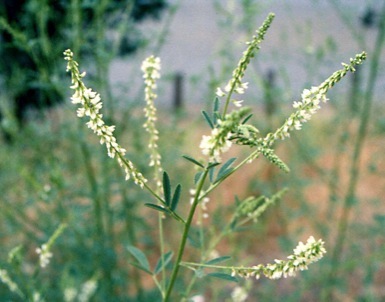
Sweet Clover, M. alba, has a hint of vanilla flavor

Melitotus: Condiment to Tea to Blood Thinner

When I was growing up we owned horses. Lots of horses. And they eat a lot of hay in the winter. Lots of hay. Several tons each (which also has to be shoveled away after… ah… processing.)

So we hayed every summer, loose hay. While most kids had a summer break I went from the classroom to the hay fields for at least 13 summers. School in the fall was a welcomed relief. I remember two things clearly from all those summers in the hay fields: Running over ground hornet nests — they weren’t pleased — and the smell of blood thinner.

Frank W. Schofield

Did he say blood thinner? Yep, blood thinner. And many of you have smelled it too, that sweet aroma when you drive by a field of newly mown hay.  What you smelled was coumarin in the making, mostly from the Sweet Clover. It’s the plant’s version of coumadin, Warfarin, rat killer… blood thinner. Actually, the story is more complex and I think an interesting one.

In the early 1900’s the common feed for bovines was Sweet Clover, a native of Europe, introduced to North America in the 1600’s. Over the first 30 years or so of the 20th century farmers would find cows dead in a pool of blood. Frank W. Schofield, left, a Canadian veterinarian, had described “Sweet Clover Disease” in 1924 but there was no explanation for it. (By the way, Schofield was no social slouch and was very much involved in the independence movement for Korea.)

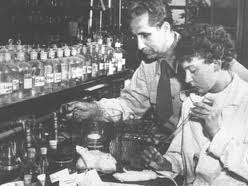
Professor Karl Link who developed Warfarin, and an assistant.

In February 1933, Ed Carlson, a farmer from Deer Park, Wisconsin, took one dead heifer, a bucketful of still unclotted blood and 100 pounds of old Sweet Clover to the university looking for answers. It was depression times and Carlson couldn’t afford the loss of a heifer (50% of his stock then) nor even the hay. Karl-Paul Link, right, professor of agriculture with a speciality in chemistry, agreed to research the issue. Link was … different, empathetic, an emotional maverick. I suspect today we would call him bipolar

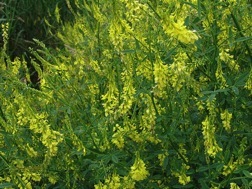
Melilous officinalis can be white or yellow

 Link with the help of PhD students Harold Campbell, Ralph Overman, Charles Huebner, and (later Nobel Prize winner) Mark Stahmann, found coumarin, an anticoagulant, with the Sweet Clover. However, Sweet Clover does not make the thinner. A mold on the clover does. That particular hay year, 1932, was a wet year and the mold very active. Link had discovered what was killing the cattle and steps were taken among cattle owners to reduce their consumption of moldy Sweet Clover. This is why clover should be harvested fresh and mold free, used or immediately dried to prevent molding. (Note to self: Mold also gave us penicillin.)

As fate would have it more than a decade later Professor Link, who had tuberculosis, went on a six month sabbatical to a sanitarium for his health. While there he read about the problem of rodent control and he hit upon the idea of using coumarin to kill rats. He developed and patented in 1947 Warfarin (part of the name comes from Wisconsin Alumni Research Foundation which funded his work. In time he also gave them the patent.)

Technically coumarin does not “thin” the blood. It lengthens the time it takes to clot, that is, it inhibits the production of Vitamin K1 which is a clotting agent.  The antidote for coumarin is Vitamin K1. That can be given by a doctor or vet or can also be found in foods such as leafy vegetables, cauliflower, broccoli, spinach and some herbal teas.

Link, who was also known as a very eccentric dresser, suffered from his tuberculosis and died from it in 1978 (as did a Greek grandfather and aunt of mine.)  His little-known role in the discovery of one of the most common anticoagulants, has been called… wait for it… “The Missing Link.” Schofield the vet, born in England in 1889, died in Korea in 1970 and is buried with honors there.

So what of Sweet Clover, Melilotus alba, M. indica, and M. officinalis as forageables?

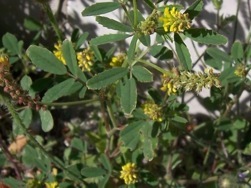
Melilous indica, of India

The young leaves can be eaten raw, preferably before the plant blossoms. They are bitter and aromatic, usually used as flavoring in salads. The whole plant thoroughly dried can be used to make a tea with a hint of vanilla. The seeds can be used as a spice. Fermented or moldy clover should never be used. Lastly excess consumption can make you throw up. Use carefully and sparingly. Some people report getting a headache when they smell the plant.

Melilotus means honey lotus, from two Greek words, the later the name of a Greek plant possibly clover, or meaning fragrant like the lotus. Alba means white and indica of India. Officinalis does mean official. But in ancient Rome that meant it was sold in a medicinal shop approved by the state. So it means medicinal. The Sweet Clover is also called Sertula in Greek, which is now a separate genus.

Some botanists think M. alba and M. officinalis are the same species, just a white version and a yellow version.

Green Deane’s “Itemized” Plant Profile

IDENTIFICATION: Two to five feet tall, floppy flowers 1/8 inch long, white or yellow, annual or biennial, branching occasionally, often lanky. Light green stems are round or furrowed on all sides) smooth. Leaves alternate, trifoliate,  sparsely distributed along the stems, petioles up to one inch long. Grayish leaflets to one one inch long and a third across. Hairless, toothy along the upper margins, and oblong or oblong-ovate, small narrow stipules at the base of each trifoliate leaf’s petiole. The middle leaflet has longest petiole, side leaflets nearly sessile.

TIME OF YEAR: Flowers in March in Florida, June to September in northern climes

ENVIRONMENT: Roadsides, waste places, vacant lots, lightly wooded areas, weed meadows.

METHOD OF PREPARATION: Leaves raw in moderation, used for flavoring in salads, seeds used as a spice, usually the plant is dried and used for tea.


{ 10 comments }

Large leaves of the Swamp Lilly used for cooking

Thalia geniculata: Swamp Wrap

You won’t find the “swamp lilly” in many foraging books. For a big plant it receives little attention.

 Thalia geniculata (THAL-ee-yah gen-ik-yoo-LAH-tuh) comes from a good family, closely related to the gingers.  It’s easy to identify, grows year round, and the forager has many uses for it. But several things conspire against the Swamp Lilly. First, its edible root turns pink when you cook it and tastes swampy. Not exactly the best asset to have, then again, not too many people are eating it. And as one of its other name implies, Alligator Flag, it likes to grow where alligators grow. That make collecting a tad more dangerous and limits its range. So what is the Swamp Lilly’s claim to fame? You can cook with its leaves.

Roots taste like swamp water

Most of our ancestors who foraged daily to stay alive didn’t have pots and pans. They would often wrap foods in leaves to cook them, and to keep them clean from the ashes. This was particularly true of any bread-like food. In fact  “tamales” used to mean any food wrapped in leaves then cooked. While many foods can be cooked over a fire, cooking wrapped food in the embers extends the use of the fire and often allows the use of local spices.

Swamp Lilly leaves can grow up to eight inches wide and two and a half feet long (so catch a big fish.) They were also used to boil cornbread-like mixtures. Like the banana leaf and many others, the Swamp Lilly leaf can also be used to carry food. Young leaves are reportedly edible. I haven’t tried the leaves yet. When cooked the little roots resemble cooked shrimp, but not in flavor. They are swampy, just as alligator meat is swampy. Botanical researchers say Swamp Lilly was highly used during war times. The raw root does has medicinal uses from an antiseptic to a stimulant.

The Swamp Lilly, an appellation used in Panama, has many common names, including Alligator Flag, Red Flag and Fire Flag. It’s called a flag because alligator movements in the swamp makes the large leaf wave, showing the lizard’s location. Botanically, the Swamp Lilly is named after German physician Johannes Thal,(1542-83) though “thalia” has an allusion to the muse of the same name that presided over comedy.  Geniculata means “many knees” and refers to the plant’s many jointed stems. Those stems are used for basket weaving in Africa. There are seven species in the genus, only a few like their feet wet.

 Green Deane’s “Itemized” Plant Profile

IDENTIFICATION: A giant herb with a short root and many string-like roots, five to nine feet tall. Leaves long-stalked, lance shaped to oval, blunt point at apex, rounded a base, bright green, smooth. Flowers in pairs, rose-purple, dangling, fuzzy bracts, stems zigzag.

TIME OF YEAR: Year round

ENVIRONMENT: Swamps, ponds, lakes, low spots, sides of rivers.

METHOD OF PREPARATION: Young roots boiled, turning pink. Swampy flavor. Young leaves edible. Older leaves used for cooking other foods. To make the leaves easier to wrap with, wilt them by holding them close to the fire.  The flowers and base of the stem are reported as edible cooked. I have not tired them yet.


{ 1 comment }