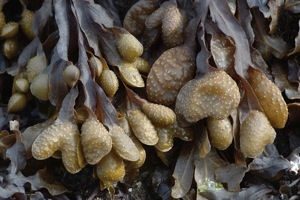
Bladderwrack in calm waters

Fucus vesiculosus: Edible Bladderwrack

Bladderwrack can wrack your brain.

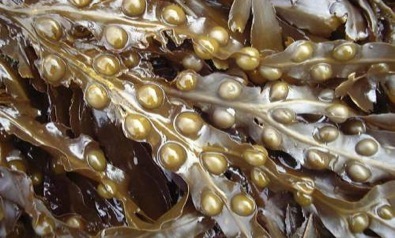
Why? Because in some places it has bladders and is textbook perfect. And in others places it has few bladders and makes the pictures look wrong but also textbook perfect.  Why? Because the numbers of bladders varies with wave action. Less waves mean more bladders, more waves, less bladders. But best of all Bladderwrack is nutritious, edible raw and cooked. It’s also medicinal, and like many things that have a medicinal applications, the flavor is strong.

Bladderwrack in turgid waters

Also called seawrack and rockweed, it can be used sparingly in soups and the like, depending upon your like or dislike of the flavor. It tastes like salty fish. Bladderwrack can also be dried for future use. On dehydration it turns black. (Slow roasting after drying with a little oil until brittle helps.) In large amounts it can be laxative. And of course, it can be eaten raw though try to get it in ocean waters not fertilized by human waste.  It has also been used as fertilizer, being high in potassium, and also to smoke meat and fish.

Fresh Bladderwrack is green to orange to olive to brown, the brighter the fresher. Found between high and low tide, it  lives three years and is firmly attached to the bottom, preferably to rocks usually in northern waters. To my knowledge, all Fucus are edible, but they vary significantly in description and will grow in the same locale.  Consult you local expert. Sagassum used to be Fucus, such as the F. natans, but now has its own genus and is Sagassum natans (see my Sagassum entry.)

Fucus vesiculosus has been well-researched. It’s rich in dietary fiber, antioxidants and iodine. (In 1811 iodine was discovered in Fucus, the original source for it.) Bladderwrack lowers plasma cholesterol levels and has been used in anti-estrogen therapy, actually increasing the length of the menstrual cycle.   (See Herb Blurb below.)

Fucus (FEW-cuss) comes from the Greek word “phykos” (FEE-kos) meaning seaweed.  Vesiculosus (ves-see-kew-LOW-sus) is Latin and means with bladder. Natans (NAY-tanz) is floating. Fucus is sometimes incorrectly called kelp. In the past several seaweeds were burned to create soda ash which was called “kelp.” The seaweed kelp and the Fucus are different seaweeds.

Green Deane’s “Itemized” Plant Profile

IDENTIFICATION: A perennial attached sea-weed, with a hard flattish root,  frond ranges from a few inches to four feet in length, and to an inch in width, flat with midrib throughout length, occasionally twisted like a spiral, branches often notched at the end. Air sacks vary from the size, from a pea to a marble,  in pairs, at irregular intervals; sometimes 2 or 3 pairs are next to each other, rarely totally absent.

TIME OF YEAR:  Year round

ENVIRONMENT: Shoreline, between high and low tides, prefers protected areas. Found in northern waters, in the United States North Carolina and central California northward. Usually collected at low tide.

METHOD OF PREPARATION: Raw or cooked, boiled or steamed, can be dried, strong flavored.

HERB BLURB

Bladderwrack contains: Iodine, algin, mucilage, bromine, sodium, potassium, lutein, zeaxanthin, chlorophyll, cellulose,  mannitol, silicon, essential fatty acids, vitamin C, B-vitamins, beta-carotene, zinc, magnesium, selenium, manganese, iron, phosphorus, iodide, oleic acid, polyphenols, protein and fiber.


{ 14 comments }

Guapira discolor: A Blolly by Golly

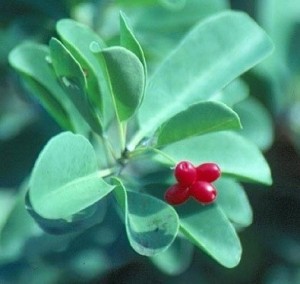
The Blolly confounded me when I first saw the tree for it was growing by itself in a park. The fruit is quite distinct, a red cylinder with a dimple at the end. I thought I could identify it quickly but didn’t. Then, as often happens, I was looking for something else and identified it.

Blolly fruit has 10 subtle ribs

This tree has long been associated with White Crowned Pigeons, particularly capturing them. Apparently they favor the berries and is their second most common food throughout the year; fig berries are dominate part of the year and Poisonwood berries the rest of the year.  Tanagers, catbirds, warblers… and Iguanas like them, too. The tree’s twigs, which are strong and flexible, were used to make wattle. That’s when you fill a frame with a lattice then mud it in.  Called Wattle and Daub, it’s a construction technique at least 6,000 years old and still in use in many parts of the world. Wattle and Daub making a comeback because it’s “sustainable.”

One little confusing aspect about the fruit is that it is faintly ribbed and has 10 ribs. But, you would not notice them if they weren’t pointed out to you. They usually are not obvious. Some writers mention them, some don’t.

Botanically, the Blolly is Guapira discolor (gwah-PEER-uh DIS-kol-or.) Guapira is a combination of two native words usually given as wa’bi rob which sounds closer than it looks. They mean “to eat bitter.” Discolor means two colors, which the leaves have. Blolly is from an English word, loblolly, which refers to thickets growing in moist depressions.  Blolly means thicket after its characteristic growth habit.

Green Deane’s “Itemized” Plant Profile

IDENTIFICATION:

A shrub or sometimes a tree to 40 feet, tallest known is 55 feet; compact, round crown, with many crooked trunks, leaves opposite or alternate, elliptical to obvate, light green in color, leathery simple, one to two inches long, one half to and inch wide, wavy edge, rounded or notched at the end, on slender stalks, grooved. Veins are obscure except for the central vein which is yellowish green and translucent when held up to the light. Leaves start thin and thicken.  Flowers funnel shaped, lacking petals, to a half inch long. Fruit,slender, oval, juicy, half inch long, red, 10-ribbed, one tan cylindrical seed.

TIME OF YEAR:

Summer and fall, farther south all year

ENVIRONMENT:

Hammocks, coastal shrub, pine lands, landscaping, mid-state south. Very common in Miami and the Cayman Islands. In the topics the tree is often covered with a green lichen.

METHOD OF PREPARATION:

Ripe fruit out of hand.


{ 0 comments }
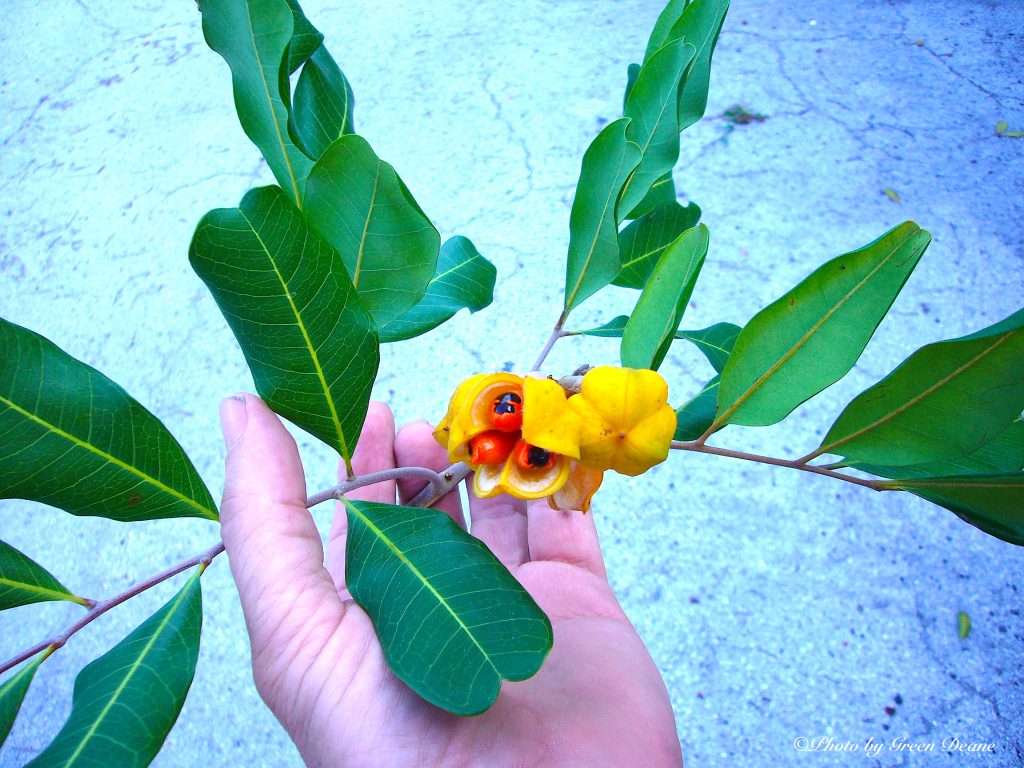
The arils on the fruit are reportedly edible.

Cupaniopsis anacardioides: An Aboriginal Treat

With a nickname of Tuckeroo, you know the Carrotwood Tree has to be from Australia, and it is. What foraging books in this hemisphere won’t tell you is that part of the ripe fruit is supposedly edible. (Many thanks to Lee Etherington at the www.bushtuckershop.com for doing some original Australian research for me. Please visit their site and watch the Bushtucker Man videos.)  That said, not all opinions agree on aril edibility and at least one source says the arils are not edible.

The leaves form uneven terminating pairs. Photo by Green Deane

Several governmental sources in Australia say the Aboriginals did indeed eat the ripe aril, some say it is toxic. I found it nearly tastless but it burns my mouth and upsets my stomach. I’m not sure how the Aboriginals considered it a treat. Perhaps I am missing a bit of information. In Australia the tree is also called the Cupania Tree and the Beach Tamarind. Botanically it is the Cupaniopsis anacardioides  (koo-pan-nee-OP-sis  an-nuh-kar-dee-OP-sis )

Carrotwood fruit attracts birds. Photo by Green Deane

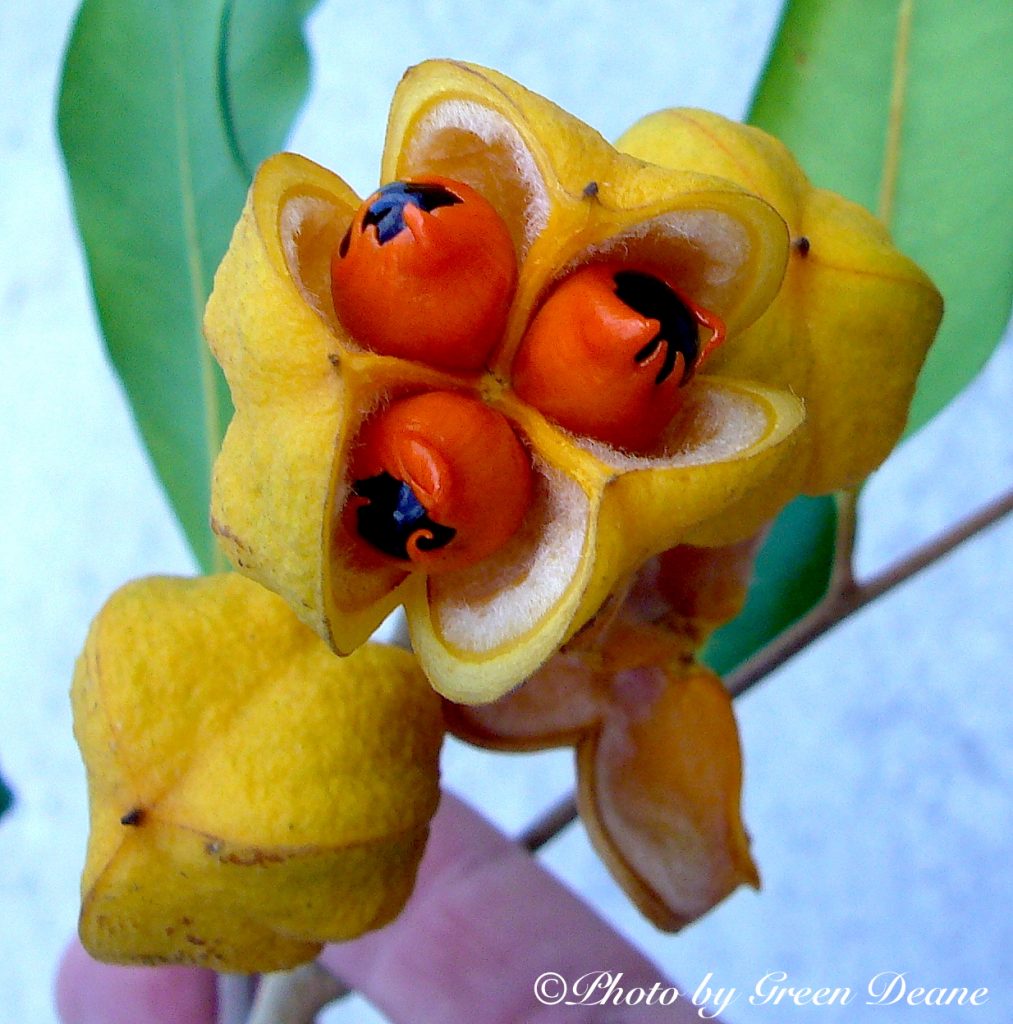
One can find a lot about the evergreen C. anacardioides on the internet because it is on Florida’s hit list of invasive gawd-awful weeds. (I am beginning to suspect the best place to find edibles is on your state’s official weed list.)  The fruit  starts out green then turns bright yellow.  It’s a common tree on the east and north coasts of Australia and was imported in the 1960’s to Florida, Texas and California for landscaping. It has not become a pest in California. What caught my eye the first time I saw them was the distinctive shape of the fruit, three lobed comprised of six segments.

The tree’s status in Florida brings up several issues. You cannot own the tree without a permit, the state considers it so bad. Birds, of course, don’t apply for permits to eat the fruit. But then the political correctness kicks in. The state says there is no use for the tree. That is quite false. The wood is favored by wood turners and pricy. Seems to me cutting down the trees for turning reduces the population and generates income. The state just needs to sell the permits to harvest them.

Although called the Carrotwood Tree it wood is actually apricot to pink, close-grained and very tough. It has been used for lumber as well as turning. The tree can grow some 80 feed high and two feet through at the butt. Locally they are half that height and 20 inches thick.

Cupaniopsis means resembling the genus Cupania (which is named for Francesco Cupani, an 18th century Italian monk and natural scientist who wrote Hortus catholicus and is famous for his work with Lathyrus odorata.Anacardioides means resembling Anacardia (the genus name for Cashew.) Two resemblances…. they must of run out of ideas that day.  Several plants are called “tuckeroo” in Australia so make sure you have the right Tucheroo,  Cupaniopsis anacardioides.

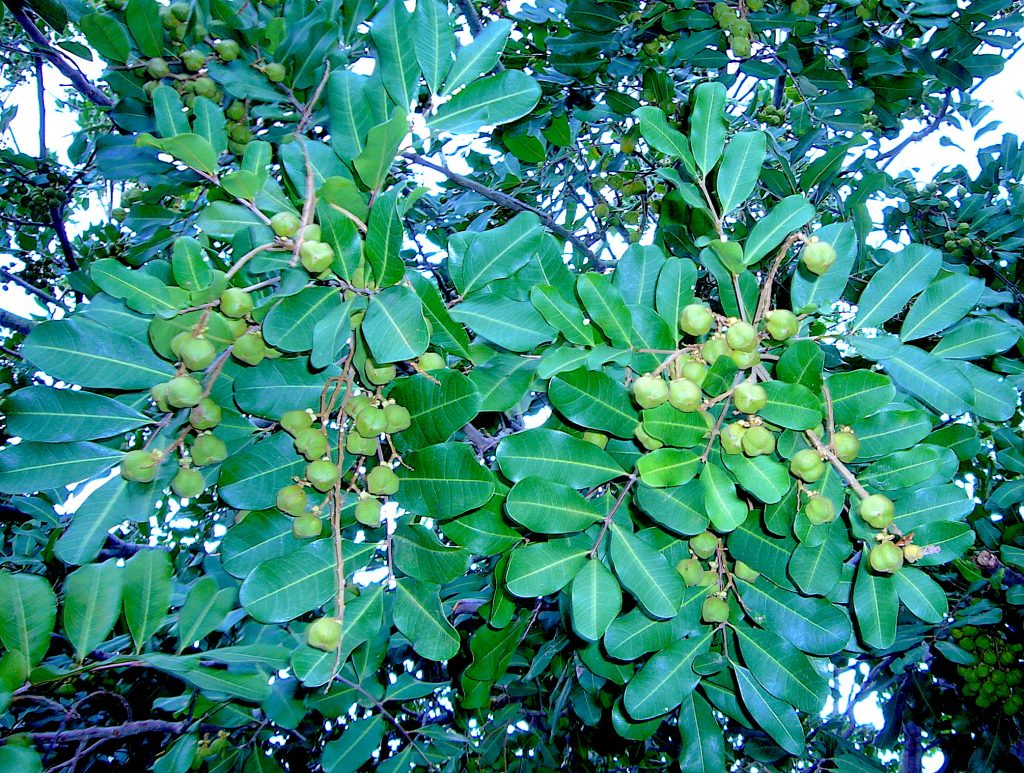
One quick identification of the tree is the leaves are spatulate with a bit of an indentation at the end, and each branch ends in a pair of leaves slightly off set (whereas the Jambul tree end leaves are an equal pair.)

You can find them mid-state and south.

Green Deane’s “Itemized” Plant Profile

IDENTIFICATION: Small to medium tree to 30 feet. Leaves compound, 4-11 leaflets, glossy-green,  obovate to oblong, 5-15 cm long, 2-6 cm wide, end two leaves are always form a pair. Flowers yellowish, occurring in winter. Fruit orange, 15-30 mm diameter, short-stalked, three-segmented woody capsules up to 0.9 inches across that are yellow-orange when ripen and then dry to brown before splitting open to reveal three black seeds each covered by a yellow-red crust.

TIME OF YEAR: Flowers in Florida in late winter or early spring, January and February, with fruits maturing in April and May depending upon location, sooner farther south, later farther north.

ENVIRONMENT:Spoil islands, beach dunes, marshes, tropical hammocks, pine lands, mangrove and cypress swamps, scrub habitats, and coastal strands.

METHOD OF PREPARATION: Ripe aril eaten raw, not the seeds, not the pulp.  I know one source says the arils are not edible. I don’t eat them.

{ 21 comments }

Cassia occidentalis: Faux Coffee & Greens

You either cook the Cassia Clan right or they make you sick. Any questions?

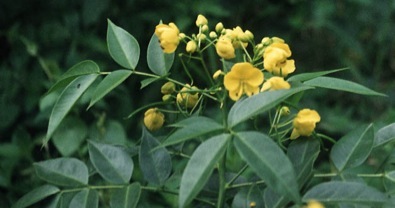
Cassia occidentalis

Now that I have your attention, they are not as bad as a lot of the toxic plants around, especially if you’re an adult. But, the raw seeds in 2007 did cause the death of three children. On the other side, some Cassias have been used as a coffee substitute and pot herbs since ancient times.

The young shoots, leaves and unripe pods of the Cassia occidentalis, C. marilandica and C. tora, are edible AFTER boiling in a change of water to reduce the strong smell. The torrefied seeds are used as a coffee substitute, though nothing really substitutes for coffee.

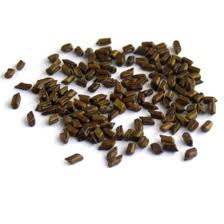
Cassia seeds

That’s all fairly straight-forward until one adds that botanists just can’t leave a genus name be, so the Cassia are also known as Senna marilandia, S.occidentalis, and S. tora.

Cassia (KASS-ee-uh) comes from the Greek word Kassia (ka-SEE-ah.) It was a desert name for some unnamed plant. Marilandica (mary-LAND-ik-uh) means of Maryland, occidentalis  (ok-sid-en-tay-liss) of the western world, and tora (TORE-ah) what it means botanically I do not know… Tora is “lion” in Japanese, “now” in Greek.  Senna (SEN-uh) is an Arabic name for a thorny bush.

Cassias are found from about west Texas north to Iowa and Florida north to Massachusetts, with California sometimes tossed in.

Green Deane’s “Itemized” Plant Profile

IDENTIFICATION: Cassia occidentalis: Annual plant two to six feet tall, brownish-red young stems, leaves up to eight inches long, compound with eight to twelve ovate to lanceolate somewhat pointed leaves, about one to two inches long. Unpleasant odor when crushed. Flowers yellow, to one inch wide, in clusters, seedpod three to five inches long, to 3/8 inch wide, thin, slightly curved, with thickened edges with about 40 brown, flat seeds one half inch long.

TIME OF YEAR: Summer time

ENVIRONMENT: Rich soils, riverbanks, wastelands, pastures

METHOD OF PREPARATION: Raw seeds purgative, roasted and ground used like coffee, no caffein. Young leaves and pods cooked as greens, very young pods in salads. Cassia are toxic to grazing animals.  The plants smell mightily but it dissipated on cooking.

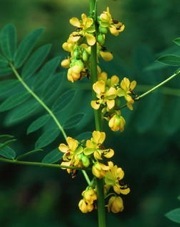
Cassia marilandica

Cassia tora

{ 7 comments }

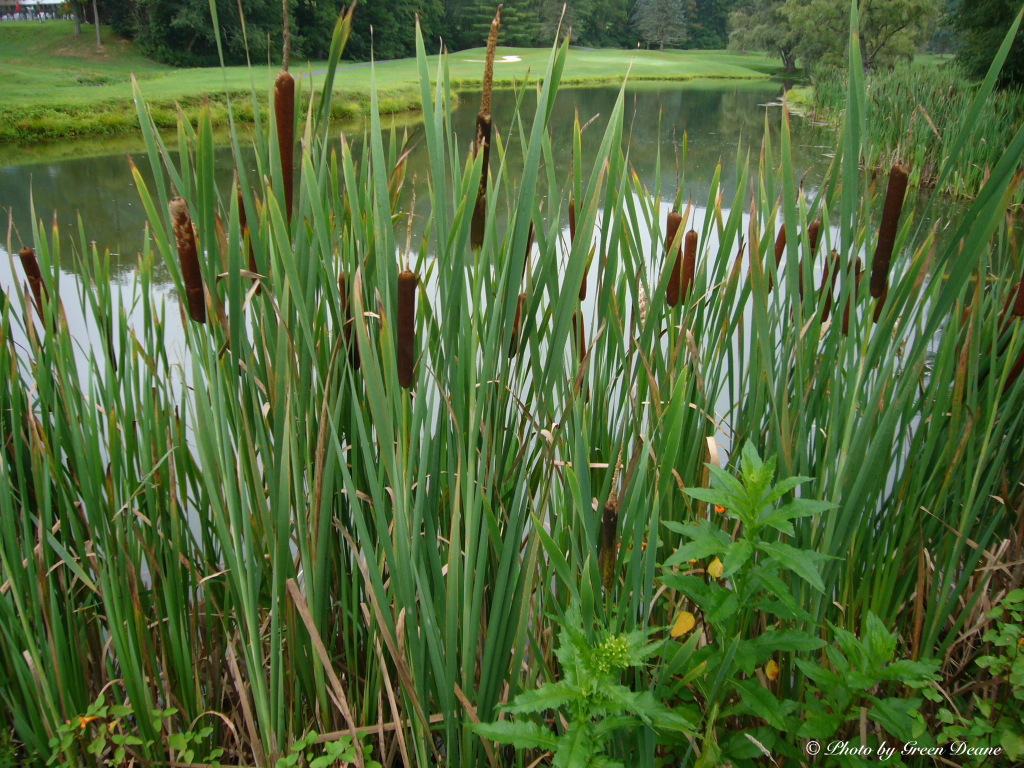
Cattails have many edible parts, top to bottom. Photo by Green Deane

Cattails have many edible parts, top to bottom. Photo by Green Deane

Cattails: Swamp Supermarket

The United States almost won WWII with cattails.

No green plant produces more edible starch per acre than the Cat O’ Nine Tails; not potatoes, rice, taros or yams. Plans were underway to feed American soldiers with that starch when WWII stopped. Lichen, not a green plant, might produce more carbs per acre. One acre of cattails can produce 6,475 pounds of flour per year on average (Harrington 1972).
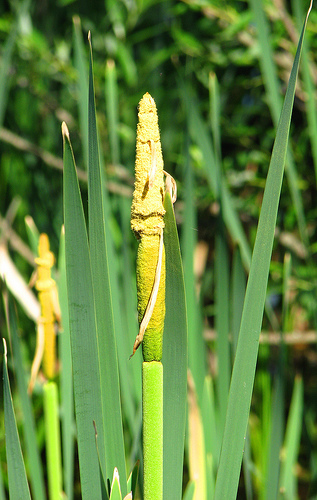
Cattail pollen

Two species of cattails are common in North America today. One is Typha latifolia (TYE-fuh   lat-ih-FOH-lee-uh)  the other Typha angustifolia (an-gus-tee-FOH-lee-uh.) Typha is from Greek and means “marsh” — now you how “typhoid” got its name and Typhoid Mary. Latifolia mean wide leaf, angustifolia means skinny leaf.  Besides that difference, the T. latifolia likes shallower water, the T. angustifolia deeper water, but it is not unusual to find them living side by side and also crossbreeding — L’angustifolia perhaps. Cattails get their name from their mature brown cylindrical flower spikes. When I was a kid we used to used the dried spikes as torches while skating in the winter time. The end of season fluffy “tails” make excellent tinder and the Indians used them insulation, mattresses and absorption.

There is so much to know about cattails that a book could be written just about them. First, no other plants in their mature stage look like the cattail, so it is difficult to misidentify. Younger plants can be misidentified with three toxic ones so always look for last year’s classic growth to confirm you have found cattails. Cattail are oval at the base, not flatish. They are also very mild tasting and without much aroma meaning if what you think you’ve got is a cattail and it is strongly flavored and or aromatic — not counting the smell of mud — you’ve got the wrong plant.
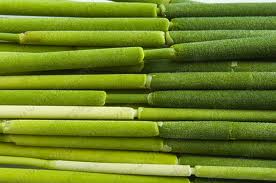
Flower spikes when green

It is said that if a lost person has found cattails, they have four of the five things they need to survive: Water, food, shelter and a source of fuel for heat—the dry old stalks. The one item missing is companionship.  Of course, the other thing to point out is that no matter where the water flows, down stream is civilization in North, Central and South America. Remember that when you are lost in the Americas. This does not hold true in Africa or Siberia. Many rivers in Africa are largest near their source then dry up as the water is used or evaporates. In Siberia rivers flow north towards the uninhabited arctic.

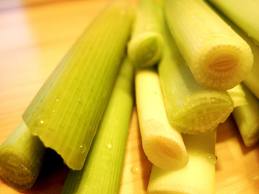
One Boy Scout motto is “You name it and we’ll make it from cattails!” Cattails are the supermarket of the wilds. The young cob-like tips of the plant are edible as is the white bottom of the stalk, spurs off the main roots and spaghetti like rootlets off the main roots. They have vitamins A, B,
Cattail lower stalks

and C, potassium and phosphorus. The pollen can be used like flour.  I like their convenience as a trail nibble, or canoe nibble as it were. Just pull on one and where it pulls from the stalk there’s usually a tasty bite or two. I think the best part, though, are the new shoots off the main root. They’re start out looking like an alligator’s tooth then a pointed hook three or four inches long. The roots themselves need some processing and I’ll get to them in a moment.
The “Listronotus” grub grows larger

Cattails have a surprising function and history. The spread of cattails in a body of water is an important part of the process of open water being converted to marsh then dry land. They are native to both North America and Europe. In Europe cattails are called bulrushes or greater reed mace. They’re first mentioned — meaning mentioned in writing — in the United States in the 1830s and at that time were only found along the Atlantic seaboard and the Gulf of Mexico excluding Texas. They weren’t even reported in places like Wisconsin until after World War I. They weren’t a significant plant in the Dakotas until the 1960s. The native cattail, Typha gracilis, seems to have all but disappeared, hybridizing with the European version to form the two species mentioned here. Eastern natives used cattails extensively, not only for food, but for hemp and stuffing. In fact, one Indian word for cattails means “fruit for papoose’s bed.” The fluff was used in diapers and for menstruation.

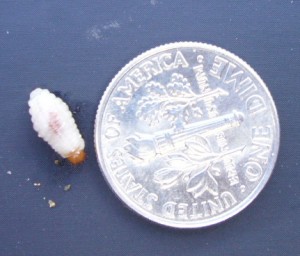
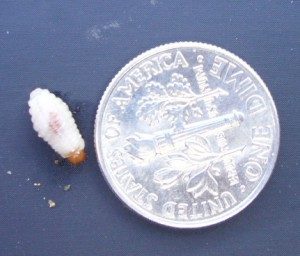
Like most aquatic plants in the area the cattail is also home to a beetle grub that fish like. On a green cattail look for an outer leaf that is going brown at the bottom of the leaf and main stalk. You will find a grub, actually the larval form of an Arrowhead Beetle, of the Listronotus genus. The size will vary but they do grow big enough for a small hook and fish love them. As a weevil the grub is also probably edible by humans but I haven’t got around to trying one. You can find the same grub in the tops of bulrushes and wapato.

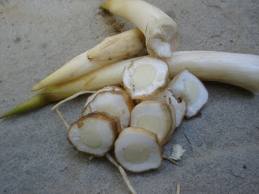
As mentioned earlier, cattails are the champion of starch production. The way you get the starch is to clean the exterior of the roots and then crush them in clean water and let them sit. The starch settles to the bottom then one pours off the water.  It may take several drain and settle sessions get rid of the fiber. I sampled the starch raw once and got a bit of a stomach ache.  Once you have just the starch it is excellent for cooking as you would any flour. Getting starch that way is quite labor intensive. Here are three other ways to get to the root starch:
Clean cattail roots

Dry the peeled roots (peel roots while they are wet–they are difficult to peel when dry). Chop roots into small pieces, and then pound them wtih a little water. When the long fibers are removed, the resultant goup powder can be dried and used as flour.   The roots also can be boiled like potatoes then the starch chewed out (spitting away the fibers) or you can also roast the root in a fire until the outer spongy core is completely black. Then chew the starch off of the fiber.  Don’t eat the fiber. It will give you a stomach ache. I know from personal experience. The advantage of the latter method is no pots or pans are needed. If you have fire and a pond you have a nutritious meal.  You can also put the roots on the barbecue.

Lastly, cattails, Typha latifolia, is suspeced in the fatal poisoning of several horses in Indiana, one case over 80 years ago. Symptoms included stiffness, disinclination to move, profuse perspiration, and muscular trembling.

Green Deane’s “Itemized” Plant Profile

IDENTIFICATION: Cattails grow to 9 feet; leaves are strap-like, stiff, spongy inside, rounded on back, sheathed together at base to appear “flattened” but oval; the cigar-looking “blossom” is very densely packed with tiny flowers, male flowers in top cluster, female flowers in bottom cluster. Roots grow horizontally. If there is a gap between the male and female parts of the plant it is T. angustifolia, or the narrow leaf cattail. If the male and female parts of the plant meet, it is T. latifolia, the common cattail.

TIME OF YEAR: Spikes, pollen and flowers in the spring, bottoms of stalks and root year best in fall and spring.

ENVIRONMENT: Grows where it is wet, rivers, ponds, ditches, lakes, close to shore or farther out.

METHOD OF PREPARATION: Numerous, boiled immature and mature flowers, pollen in bread, stalks as a trail nibble, root starch for sustenance, root stems shoots as vegetables.   The roots can be boiled and the starch stripped or sucked off the fibers. They can be dried, the starch grated off the fibers and the starch used as flour. You can crush the roots in water, let the starch settle, pour off the water, then use the starch. Or you can but the roots on embers and roast until black, then peel the black layer off and chew or such the starch off the fibers. Also the core of the roots can be roasted until dry and used as a coffee substitute.

Scalloped Cattails

Take two cups of chooped cattail tops and put them into a bowl with two beaten eggs, one-half cup melted butter, one-half teaspoon each sugar and nutmeg and black pepper. Blend well and add slowly one cup of scalded milk to the cattail mixture and blended. Pour the mixture into a greased casserole and top with grated Swiss cheese —optional — and add a dab of butter. Bake 275 degrees for 30 minutes.

Cattail Pollen Biscuits

The green bloom spikes turn a bright yellow as they become covered with pollen. Put a large plastic bag over the head (or tail) and shake. The pollen is very fine, resembling a curry-colored talc powder. Pancakes, muffins and cookies are excellent by substituting pollen for the wheat flour in any recipe. Cattail Pollen Biscuits: Mix a quarter cup of cattail pollen, one and three-quarters cup of flour, three teaspoons baking powder, one teaspoon salt, four tablespoons shortening, and three quarters a cup of milk. Bake, after cutting out biscuits, in 425-degree oven for 20 minutes. For an even more golden tone, you may add an additional quarter cup of pollen.

Cattail Pollen Pancakes

Mix one-half cup pollen, one-half cup flour, two tablespoons baking powder, one teaspoon salt, one egg, one cup of milk, three tablespoon bacon drippings. Pour into a hot skillet or griddle in dollar, four-inch pancake amounts.

Cattail Casserole

Two cups scrapped spikes, one cup bread crumbs, one egg, beaten, one-half cup milk, salt and pepper, one onion diced, one-half cup shredded cheddar cheese. Combine all ingredients in a casseroles dish and place in an oven set to 350 degrees for 25 minutes. Serve when hot.



{ 51 comments }