Popcorn Tree, Florida Aspen, Tallow Tree
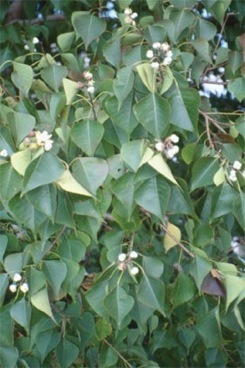
Chinese Tallow Tree in Fruit
There is a lot of debate whether the white waxy aril of the Chinese Tallow Tree is edible or not, and understandably so. The tree is in a family that has a lot of very poisonous plants. And the seed kernel oil (as opposed to the waxy outer coating around the seed) is toxic. Thus there are many reasons to be cautious.
The most definitive reference I have found is this. Cheryl M. McCormick, PhD., plant ecologist, authored a report in 2005 from “The Florida Exotic Pest Plant Council’s Chinese Tallow Task Force.” On page 19 she writes:
“The opaque, waxy outer layer of the seeds is used in the production of soaps, cosmetics, candles, wax paper, and as a source of glycerine (Uphof, 1959; Scheld, 1983; Heywood, 1993), and is separated from the seed by emersion in hot water and skimming off the wax as it floats to the surface. The wax is solid at temperatures below 40° C, and has the consistency of lard. Subsequently, it is employed as a lard substitute in cooking and is used in cocoa butter production (Scheld, 1983; Facciola, 1999).”
I have not found McCormick’s Scheld source, which she lists as Scheld, H.W., 1983. Report on a Trip to the Zhejiang Province Science Study Institute, October, 24-31, 1983. Personal notes in holdings at the Rice University Library, Houston, Texas, 21 p.
Her second source is Facciola, S. 1999. Cornucopia II: A Sourcebook of Edible Plants. Second Edition. Kampong Publications, Vista, California, 674 p. I happen to have the 1998 edition of that book and it says on page 101:
“Outer covering of the seed produces a waxy fat sometimes used as a substitute for lard or cacao butter. In Hangzhou, China, it is used in the unique frying processes employed for Longjing or Dragon Well tea, a small amount being rubbed on the inside of the wok firing pan. The wax is absorbed by the leaves and small droplets can be seen on the surface of brewed tea. The flowers yield a light amber, well-flavored honey that is high in enzymes and low in sucrose.”
Plant Resources of Tropical Africa says:
The fruit of the Triadica sebifera
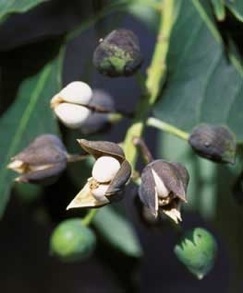
contains two types of fat: the white, fleshy outer seed coat (sarcotesta) yields a fat known as ‘Chinese vegetable tallow’ or ‘pi-yu’ in trade, while the seed kernel yields a drying oil called ‘stillingia oil’ or ‘ting-yu’ in trade. Chinese vegetable tallow is widely used in China for edible purposes, as a substitute for animal tallow and for lighting. Candles made by mixing 10 parts Chinese vegetable tallow with 3 parts white insect wax are reputed to remain pure white for any length of time and to burn with a clear bright flame without smell or smoke. Elsewhere, Chinese vegetable tallow is used to make soap, as a substitute for cocoa butter and to increase the consistence of soft edible fats. Stillingia oil is used in paints and varnishes, for illumination and to waterproof umbrellas. Both Chinese vegetable tallow and stillingia oil are used as fuel extenders on a small scale. The presscake remaining after tallow and oil extraction is unsuitable as feed for livestock because it contains saponins, but can be used as fuel or as manure. However, the presscake can be detoxified. The leaves contain a dye, used in Indo-China and China to dye silk black. Triadica sebifera is also an agroforestry species and an ornamental. It is a good soil binder and contributes to nutrient recycling. In tea plantations, it is planted as a shade tree. Its wood has been used to make various implements, toys, furniture and Chinese printing blocks. Because Triadica sebifera tolerates many unfavourable soil conditions and some frost, interest in it has grown again since the 1980s as a potential fuel and biomass producer on marginal soils, particularly in the south-eastern United States, but there it is now considered a noxious invasive weed. In traditional medicine in China, the root bark is utilized for its diuretic properties and is said to be effective in the treatment of schistosomiasis. The leaves are applied to cure shingles.
Despite all that I’d still like to find a first-hand account. Why? Because so I have not been able to melt the saturated fat around the seed. I put them in a frying pan. No melting, just burning. I boiled them in water. I had clean seeds but no melting. Steam is next, or perhaps it is late season fruit. There is no shortage of professional journal articles on Triadica sebifera aka Sapium sebiferum aka Stillingia sebiferum. It is perhaps the solution to the United States oil problem being able to produce 10,000 pounds of oil per acre or more.
The white seed coat — the aril — is essentially a triglyceride wax, very saturated, whereas the kernel seed oil is already a commercial drying oil, stillingia, which is not edible. It, like the bark, contains a poisonous alkaloid. Either oil can also be used for lubrication and fuel.
Used for 15 centuries, the Chinese Tallow Tree is native to southern China along the Yantgtze River Valley. It was introduced into the U.S. by Benjamin Franklin in 1772. He forwarded some seeds he got from (now) southern Vietnam and sent them to Mr. Noble Wimberly Jones, a horticultural enthusiast and gentleman farmer in Darien Georgia. In a letter dated 7 October 1772 Franklin wrote: “I send also a few seeds of the Chinese Tallow Tree, which will I believe grow and thrive with you. Tis a most useful plant.”
The famous botanist Andre Michaux in 1803 said the tree had been “cultivated in Charleston and Savannah, but was then spreading spontaneously into the coastal forests.” In 1826 legislator and botanist Stephen Elliot (1771-1830) wrote the tree “bears fruit in great abundance, but though they contain much oil, no use is yet made of them.”
By 1906 the (very misguided) Foreign Plant Introduction Division of the United States Department of Agriculture advocated extensive cultivation of the tree in coastal Louisiana and Texas again to use the triglyceride aril wax in the soap making industry. The tree is now naturalized from North Carolina west to Arkansas south to Florida and Texas. It has also escaped ornamental cultivation in California and various locations around the world. Older references say nothing about using the aril as a source of cooking or edible oil.
In 1983 Dr. James Duke, a friend of foragers, wrote about this tree extensively in the Handbook of Energy Crops. He does not mention, however, the arils as a source of edible oil though they are composed mainly of palmitic and oleic acids, what we find in palm oil, olive oil, many animals fats and in our own body fat. It would be out of character for Duke to skip over such a fact.
Then we get to what the US database says: (http://www.fs.fed.us/database/feis/plants/tree/triseb/all.html) The waxy seed coating is used in candles, soaps, and cosmetics in China and Japan. It is also edible and may replace animal tallow when processed properly. 51, 174, 191
Darn, I wish they hadn’t said that. What is processed properly? More so, reference 51 is the Duke study I mentioned earlier just above. He does not mention aril processing. How can the government reference Duke on aril processing when he doesn’t mention aril processing? I think there a bit of government cut and paste going on.
I have not been able to locate the other two references (174: Sharma, Subrat; Rikhari, Hem C.; Palni, Lok Man S. 1996. Adoption of a potential plantation tree crop as an agroforestry species but for the wrong reasons: a case study of the Chinese tallow tree from central Himalaya. International Tree Crops Journal. 9(1): 37-45) and reference 191: Singh, Kuldeep; Kapur, S. K.; Sarin, Y. K. 1993. Domestication of Sapium sebiferum under Jammu conditions. Indian Forester. 119(1): 36-42.
Thus we do have some degreed botanists saying the white fat coating is edible and yet we have other experts who make the picture fuzzy by exclusion or the mentioning of processing.
Modern research has shown the Chinese Tallow Tree has strong anti-viral and anti-carcinogen properties and also eases high blood pressure. Conversely the toxic oil of the seed kernel is deadly in modest amounts and in small amounts can promote tumor formation and inflammation. Fortunately the hard seed coating keeps the two oils apart. Oddly, once processed and rid of the oil the protein rich seed meal (76%) can be used as livestock feed or even to enrich baking flour for human consumption.
Sapium (SAY-pee-um) is an ancient Latin name for pine sap that lathers like soap. Sebiferum (seb-EE-fer-um) means wax bearing. Triadica (try-uh-DEE-kuh) is Greek meaning three-locular capsules with three seeds. Sebifera (seb-EE-fer-uh) wax bearing. Stillingia (stil-LING-ee-uh) was named after Dr. Benjamin Stillingfleet, botanist and raconteur, 1702-1771. Lastly the leaves and seeds crushed and tossed into water will kill fish. The leaves can externally be used to draw infection from wounds.
Francis Porcher, MD, U.S. Civil War, wrote:
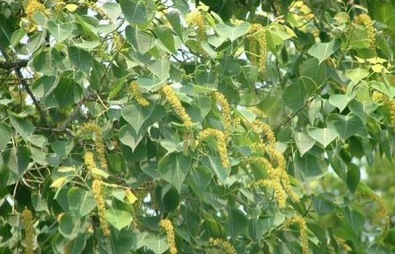
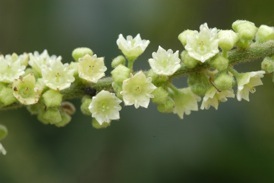
Chinese Tallow catkins
In my report on the Medical Botany of South Carolina to the American Medical Association, in 1849, I had, as above, reported the fact of this tree being already naturalized. I have recommended it particularly to the soap manufacturers of Charleston and the Confederate States, as a rich material for oil. The seeds, when burned, give out a great deal of light. It could be planted with profit. In the Patent Office Report, 1851, p. 54, there is also a paper on the uses of the S. sebifera, with a notice of the Pe-la, or Insect Wax of China. By D. J. Macgowan, M. D., dated Ningpo, August, 1850. In this article, it is stated that the Encyclopædia Americana refers to its being grown along our coast. “Analytical chemistry shows animal tallow to consist of two proximate principles–stearine and elaine. Now, what renders the fruit of this tree peculiarly interesting, is the fact that both these principles exist in it separately, in nearly a pure state.” “Nor is the tree prized merely for the stearine and elaine it yields, though these products constitute its chief value: its leaves are employed as a black dye; its wood, being hard and durable, may be easily used for printing-blocks, and various other articles; and, finally, the refuse of the nut is employed as fuel and manure.” Dr. Roxburgh, in his Flora Indica, had condemned the plant as of little value, because, in simply crushing and boiling the seeds, the two principles referred to as existing together are not properly separated. I had myself, long since, in my report, published in 1849, and also in my paper in DeBow’s Review, August, 1861, recommended this plant to the candle and soap manufacturers for the large amount of oil it contained, and because of its abundance around Charleston. I also gave some of the seeds to a manufacturer of castor oil, to experiment with, in 1851. I will now quote from the paper mentioned, and also refer the reader to a paper on the subject in the Charleston Medical Journal, by H. W. Ravenel.
“The Stillingia sebifera is chiefly cultivated in the provinces of Brangsi, Kongnain, and Chekkiang. In some districts near Hangchan, the inhabitants defray all their taxes with its produce. It grows alike on low, alluvial plains, and on granite hills, on the rich mould, at the margin of canals, and on the sandy sea-beach. The sandy estuary of Hangchan yields little else. Some of the trees are known to be several hundred years old, and, though prostrated, still send forth branches and bear fruit. Some are made to fall over rivulets, forming convenient bridges. They are seldom planted where anything else can be conveniently cultivated–in detached places, in corners about houses, roads, canals, and fields. Grafting is performed at the close of March, or early in April, when the trees are about three inches in diameter, and also when they attain their growth. The Fragrant Herbal recommends for trial the practice of an old gardener, who, instead of grafting, preferred breaking the small branches and twigs, taking care not to tear or wound the bark. In midwinter, when the nuts are ripe, they are cut off, with their twigs, by a sharp, crescentic knife, attached to the extremity of a long pole, which is held in the hand, and pushed upward against the twigs, removing at the same time such as are fruitless. The capsules are gently pounded in a mortar, to loosen the seeds from their shells, from which they are separated by sifting. To facilitate the separation of the white, sebaceous matter enveloping the seeds, they are steamed in tubs having convex open wicker bottoms, placed over caldrons of boiling water. When thoroughly heated, they are reduced to a mash in the mortar, and thence transferred to bamboo sieves, kept at a uniform temperature over hot ashes. A single operation does not suffice to deprive them of all their tallow; the steaming and sifting are therefore repeated. The article thus procured becomes a solid mass on falling through the sieve, and, to purify it, is melted and formed into cakes for the press. These receive their form in bamboo hoops, a foot in diameter, and three inches deep, which are laid on the ground over a little straw. On being filled with the hot liquid, the buds of the straw are drawn up and spread over the top, and when of sufficient consistence, are placed with their rings in the press. This apparatus, which is of the rudest description, is constructed of two large beams, placed horizontally, so as to form a through capable of containing about fifty of the rings, with their sebaceous cakes. At one end it is closed, and at the other it is used for receiving wedges, which are successively driven into it by ponderous sledge-hammers, wielded by athletic men. The tallow oozes in a melted state into a receptacle below, where it cools. It is again melted, and poured into tubs smeared with mud, to prevent its adhering. It is now marketable, in masses of about eighty pounds each, hard, brittle, white, opaque, tasteless, and without the odor of animal tallow. Under high pressure it scarcely stains bibulous paper; melts at 104° Fahrenheit. It may be regarded as nearly pure stearine; the slight difference is doubtless owing to the admixture of oil expressed from the seeds in the process just described. The seeds yield about eight per cent. of tallow, which sells for about five cents per pound. The process for pressing the oil, which is carried on at the same time, remains to be noticed. It is contained in the kernel of the nut–the sebaceous matter which lies between the shell and the husk having been removed in the manner described. The kernel, and the husk covering it, are ground between two stones, which are heated to prevent clogging from the sebaceous matter still adhering. The mass is then placed in a winnowing machine, precisely like those in use in western countries. The chaff being separated, exposes the white, oleaginous kernels, which, after being strained, are placed in a mill to be mashed. This machine is formed of a circular stone groove, twelve feet in diameter, three inches deep, and about as many wide, into which a thick, solid stone wheel, eight feet in diameter, tapering at the edge, is made to revolve perpendicularly by an ox harnessed to the outer end of its axle, the inner turning on a pivot in the centre of the machine. Under this perpendicular weight the seeds are reduced to a mealy state, steamed in the tubs, formed into cakes, and pressed by wedges in the manner above described; the process of mashing, steaming, and dressing being repeated with the kernels likewise. The kernels yield about thirty per cent. of oil. It is called ising-yu, sells for about three cents a pound, answers well for lamps, though inferior for this purpose to some other vegetable oils in use. It is also employed for various purposes in the arts, and has a place in the Chinese pharmacopoeia because of its quality of changing gray hair black, and other imaginary virtues. The husk which envelops the kernel, and the shell which encloses them and their sebaceous covering, are used to feed the furnaces–scarcely any other fuel being needed for this purpose. The residuary tallow cakes are also employed for fuel, as a small quantity of it remains ignited a whole day. It is in great demand for chafing-dishes during the cold season, and, finally, the cakes which remain after the oil has been pressed out are much valued as a manure, particularly for tobacco fields, the soil of which is rapidly impoverished by the Virginia weed. Artificial illumination in China is generally procured by vegetable oils; but candles are also employed by those who can afford it, and for lanterns. In religious ceremonies no other material is used. As no one ventures out after dark without a lantern, and as the gods cannot be acceptably worshipped without candles, the quantity consumed is very great. With an unimportant exception, the candles are made of what I beg to designate as vegetable stearine. When the candles, which are made by dipping, are of the required diameter, they receive a final dip into a mixture of the same material and insect wax, by which their consistency is preserved in the hottest weather. They are generally colored red, which is done by throwing a minute quantity of alkanet root (Anchusa tinctoria), brought from Shangtung, into the mixture. Verdigris is sometimes employed to dye them green. The wicks are made of rush coiled round a stem of coarse grass, the lower part of which is slit to receive the pin of the candlestick, which is more economical than if put into a socket. Tested in the mode recommended by Count Rumford, these candles compare favorably with those made from spermaceti, but not when the clumsy wick of the Chinese is employed. Stearine candles cost about eight cents per pound.
Again the fat is used to make candles and the clear seed oil for lamps. At the 35 minutes mark this video shows a process. https://www.youtube.com/watch?v=Akbnkc8PfFk
Green Deane’s “Itemized” Plant Profile
IDENTIFICATION:
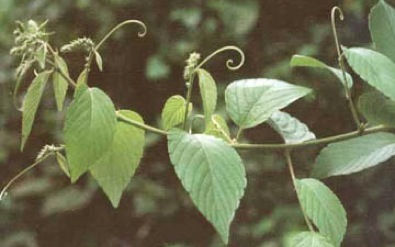
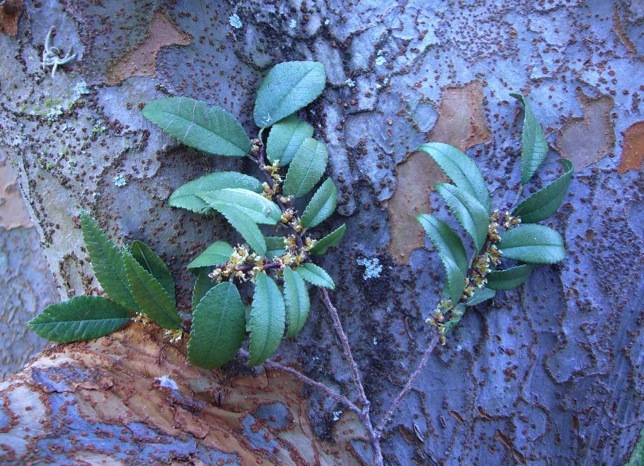
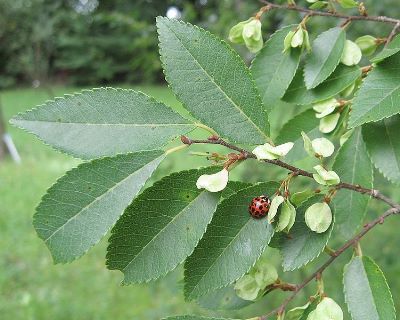
Chinese tallow is a quick-growing, deciduous tree typically growing from 24 to 35 feet but up to 65 feet all and over 3 feet in diameter. Leaves alternate, simple, typically oval to round, may also be rhombic, 1.4 to 3.3 inches long, 1.4 to 3.5 inches wide, resembles an aspen. Trunks can be gnarled with fissured bark which thickens as the tree grows. Tiny flowers in terminal spikes 2.4 to 7.9 inches. Fruits are capsules contain 3 wax-coated seeds.
TIME OF YEAR:
Fruit ripens August to November
ENVIRONMENT:
Nearly any environment but road sides, low lands, trashy sites, borders are common.
METHOD OF PREPARATION:
Waxy outer coating of seed can be melted off, used for edible oil, according to experts. I have not tired it and do not yet recommend it. Do not open the seed because the inner seed oil is toxic.