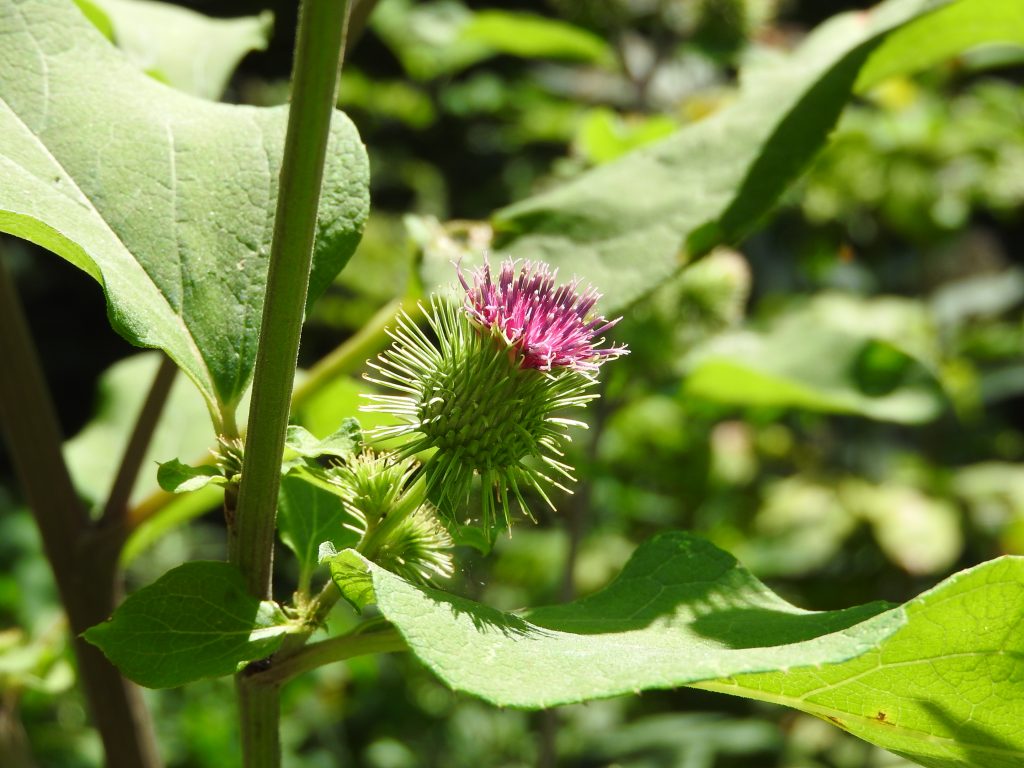
Burdock has a clingy nature. It is particularly bad in animal fur.

Arctium minus: Burdock’s Plus Side

I have a confession to make: When I was a kid I had a miniature corn cob pipe. And in it I smoked dried burdock leaf… I think that’s why my voice changed when I was seven.
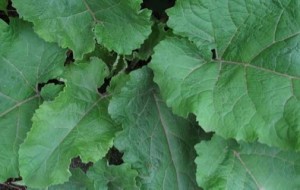
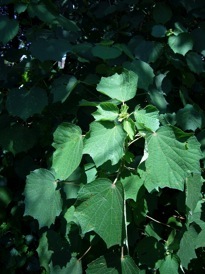
Burdock leaves vaguely resemble rhubarb

We conspiratorial kids didn’t call it burdock. It was “snake rhubarb” and it did resemble the rhubarb in the garden… somewhat. My mother found out one day but decided the smoking was punishment enough. It was harsh, hot, dry and a lot of fun until she knew. Only years later would I return to the plant, this time to eat it and grow it.

Burdock is not native to North America. I grow Gobo, which is the original Japanese cultivated version of the plant. I had eaten it many times when I lived in Japan so it was an addition to my garden. Like many temperate plants it doesn’t like the Florida heat. (Horseradish, Lilacs, and Asparagus, for example, completely refuse to grow here.) What most people don’t know is burdock is an escaped plant from Asia. That was rather surprising to me because it was an extremely common weed in southern Maine, which is just about as far from Japan as one can  get (I know because I was stationed in Japan while in the military. It took two days to fly back.)

Burdock’s can make two claims to fame: It was in the original recipe for root beer, and, was the inspiration for velcro. Burdock is also the second half of the British drink Dandelion and Burdock. That concoction is even more bitter than Moxie, which is flavored with gentian root. And therein lies the burdock tale of woe: It is on the bitter side. That is how it protects itself from predators, by putting a layer of bitterness on the outside of the plant.
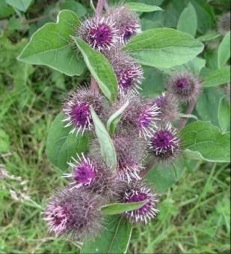
Burdock seeds inspired velcro

First year roots are the prime fare, young leaves can be eaten but you have to like bitter foods. As the roots age they become more bitter and woody, particularly in their second year. Peeled burdock stems are also edible, and not as bitter as the leaves. One of the reason why I like burdock, especially in temperate climates, is it’s a leaf large enough to wrap wild food in for cooking in the campfire.  Wrap up a trout with some wild garlic and Northern Bay leaves and roast in the embers: Life is good.  (See recipes on bottom of page.)

Burdock is in the same family with daisies, chicory, thistles and dandelions. There are at least three species of burdock in North America, all edible and all imports. The most common is the “lesser”  Arctium minus. (ARK-ti-um MYE-nus)  It grows from knee to shoulder height and is found just about everywhere except Florida. The “great burdock” and the “wooly burdock” are less known. The “great” can grow to nine feet high but usually doesn’t but its flowers are larger than the minus. The “woolly” has “fleece” on its flower heads.

The species name Arctium is Latinized Greek. The Greek is “arktos” meaning bear, in reference to the round, brown burs. Minus means the lesser or smaller since the Great Burdock (A. lappa) is larger. A. Lappa (LAH-pah) is a combination of Latin and Greek and means bur and to seize. A. tomentosum (toe-men-TOE-sum ) is the wooly burdock. Tormetosum means fuzzy or hairy.

Green Deane’s “Itemized” Plant Profile

IDENTIFICATION:  Biannual. First year plant a low circle of rhubarb looking leaves with a foul odor. Second year flowering stalk, bushy, many purple flowers, thistle-like burs. Leaves usually large, ovate, woolly underneath, leafstalks usually hollow.

TIME OF YEAR:  Middle summer to late fall, even after a frost, just mark where they are.

ENVIRONMENT: Sun or part shade, any type of well-drained soil. Grows a huge tap root so loosened soil is helpful to harvesting. Normally found along roadsides, barnyards, fence lines, disturbed soil, under bird feeders.

METHOD OF PREPARATION: First year roots can be eaten raw, or can be slow roasted for many hours making them sweeter. Older first year roots — scrubbed –boiled 20 minutes. Young shoots boiled until tender, more if bitter. Second year, stems peeled before flowering and boiled 20 minutes. Seed sprouts edible. Young leaves boiled edible but bitter. Leaf stems peeled and boiled. Also leaves can be wilted by fire then used for wrapping food. 

HERB BLURB

Burdock has anti-bacterial and anti-fungal proprieties. It’s anti-cancer properties similar to broccoli and cabbage.  Burdock is also a diuretic and the roots can be laxative.

Dandelion and burdock beer ingredients:

1 lb Young nettles

4 oz. Dandelion leaves

4 oz. Burdock root, fresh, sliced

-OR-

2 oz. Dried burdock root, sliced

1/2 oz. Ginger root, bruised

2 each Lemons

1 g water

1 lb +4 t. soft brown sugar

1 oz. Cream of tartar

Brewing yeast ( see the manufacturer’s instructions for amount)


Dandelion and burdock beer preparation:

1. Put the nettles, dandelion leaves, burdock, ginger and thinly pared rinds of the lemons into a large pan. Add the water.

2. Bring to a boil and simmer for 30 mins.

3. Put the lemon juice from the lemons,1 lb. sugar and cream of tartar into a large container and pour in the liquid thru a strainer, pressing down well on the nettles and other ingredients.

4. Stir to dissolve the sugar.

5. Cool to room temperature.

6. Sprinkle in the yeast.

7. Cover the beer and leave it to ferment in a warm place for 3 days.

8. Pour off the beer and bottle it, adding  t. sugar per pint.

  1. 9.Leave the bottles undisturbed until the beer is clear-about 1 week.


Nettle, Dandelion and Burdock Beer

Ingredients:     450g young nettles

120g dandelion leaves

120g fresh, sliced or 60g dried burdock root

15g root ginger, bruised

2 lemons

4.5 litres water

450g plus 4tsp. demerara sugar

30g cream of tartar

Brewer’s yeast (see manufacturer’s instructions for amount to use)

Put the herbs and the thinly pared rinds of the lemons into a large pan with the water. Bring to the boil and simmer for 30 minutes. Put the lemon juice, 450g of sugar and the cream of tartar into a large container and add the strained liquid from the pan, squeezing the herbs well. Stir to dissolve the sugar and cool to blood heat. Sprinkle in the yeast. Cover the beer and leave to ferment in a warm place for three days. Rack off the beer and bottle it, adding half a teaspoon of sugar per pint. Leave the bottles until the beer is clear – about one week.

This recipe will make a strong syrup which will then need to be watered down with soda 1:4.

Heat 1.5 litres of water in a pan, when boiling add:

* 2 teaspoons fine ground dandelion root (Might need a mortar & pestle)

* 1.5 teaspoons fine ground burdock root (Might need a mortar & pestle)

* 5x 50p sized slices of root ginger

* 1 1/2 star anise

* 1 teaspoon of citric acid

* Zest of an orange

Leave that little lot to simmer for 15-20 minutes, it will smell a lot like a health food shop, then strain through a tea towel, muslin isn’t really fine enough. Whilst the liquid is still hot you need to dissolve about 750g sugar. If you prefer is sweeter or ‘not-sweeter’ adjust the sugar. If you’re finding the drink a bit flavourless simply add more sugar, it accentuates the flavours of the roots and anise. In the summer mix it with plenty of ice and stir through borage flowers for the ultimate English soft drink! Enjoy.

Greek Cardune , with thanks to Wildman Steve Brill

4 cups immature burdock flower stalks, sliced, parboiled 1 minute in

salted water (to remove the bitterness), with dashes of any vinegar

and olive oil

2 cups water or vegetable stock

2 red onions, sliced

1/4 cup olive oil

4 small tomatoes, sliced

2 cups carrots, sliced

2/3 cups basmati brown rice

3 tbs. fresh dill weed, chopped

The juice of 1 lemon

2 tsp. salt, or to taste

1/4 tsp. white pepper, ground

Simmer all ingredients together over low heat in a covered saucepan 70

minutes, or until the rice is tender.

Serves 6 to 8
 

{ 35 comments }

Heart of Palm and Controversy

The state tree of Florida isn’t a tree, but it is a weed of many edible parts.

Cabbage Palm

The Sabal palmetto, actually an overgrown bundle of grass, is native to the southeastern US and West Bahamas Islands that produces many products.

At the top of the list is dark amber honey made from the palm’s sweet edible flowers. It’s esteemed and pricey. Next is the bittersweet thin fruit coating on the seeds, which are about the size of a pea. The layer of fruit is extremely thin, a skin really,  but it does have a prune-like flavor. As for the seeds themselves…That is a bit of debate:

Of all places, the US Army Field Manuel on Survival (FM 3-05-70, dated 17 May  2002) says the seeds can be ground up and used for flour. It is quoted on several sites on the Internet and is the only source I know of that specifically refers to the seeds themselves as edible.

Several authorities, Dr. Julia Morton among them, seem to agree the seeds are edible but their language is always ambiguous, For example, Morton writes: “the Indians reduced the dried fruit to a coarse meal with which they made bread.”

The lack of detail in that sentence is telling to anyone who has tried to reduce the dried fruit to a coarse meal. That meal could or could not include kernels. Of course, anyone who has “eaten” the fruit of the cabbage palm knows there is almost no fruit at all, just a layer of edible paint on a round flattened seed. It would be nearly impossible to get enough “fruit” to make bread from it without using the kernel. It makes sense that they ground up the entire fruit, it just is not mentioned specifically by anyone other than in the US Army manual, which I have a copy of.

Young leaves of the Sabal palmetto (SAY-bul pal-MET-to) are also edible raw or cooked which leads to the most controversial edible of all, the heart of the palm, the inner core of the terminal bud. Taking it kills the tree, thus the controversy. It’s called swamp cabbage and millionaire’s cabbage though it doesn’t taste like cabbage at all. Raw it is similar to cattail stalks, read it is mild and crunchy, artichoke-ish. Cooked it tastes just like cooked asparagus to me. To get it I just go to places where developers have permission to take down the trees and I get my palm hearts that way. Once you have a tree you can do “heart surgery.” Here’s how you do it:

Cut off the top three feet below where the fronds are growing. Then cut off the top foot of that three foot section The young fronds in the center of that one foot piece are edible cooked but are tough. Now concentrate on the lower two feet or so that you have left. To remove the heart, which is the central core, the outer leaf stems are cut or pulled away.  The fronds have a woody base called a boot which wraps around the trunk. They are shaped like upside down “Y’s”. The “boots” are stripped from the section until the tender, closely wrapped, central core is reached. The core is the swamp cabbage. It’s cylindrical, creamy white, and composed of leek-like layers of undeveloped boots (leaves really) with the texture of regular cabbage, but a nutty flavor. Many foraging sources tell us the lower pith that resembles a sponge is also edible. I have always found it too bitter to eat, raw or cooked, so I cannot vouch for its edibility.

Swamp cabbage can be prepared in various ways. Edible raw, the most popular Florida Cracker way is to cut it into thin slices like cole slaw and cook with meat seasoning until done, turning it from white to yellow brown. or gray-brown. When served raw in slices with dates or guava it is Heart of Palm Salad. Incidentally, the natives did not eat heart of palm until Europeans introduced metal axes.

This “recipe” is from Wild Edibles by Marian Van Atta, whom I knew in Rockledge, Florida, in the early 1980’s. Swamp Cabbage: Cut hearts of palm fine or shred into fine pieces. Optional: Soak in ice water for an hour. Slaw: Mix with mayonnaise and 1 or 2 teaspoons pickle relish. Season to taste. That’s it, not much to it.

Marion Van Atta was a rotund, slightly shorter than usual woman who always wore a straw hat and what looked like homespun clothes. A blue denim-like outfit was one of her favorite, judging by the number of times I saw it.  I worked on a small weekly paper at the time — the Rockledge Reporter — and she would drop off her weekly column “Living off the Land.” Though a forager she leaned towards gardening and homemaking. She’s and my Florida mentor, Dick Deuerling, did not always see eye to eye. He thought her knowledge of trees was lacking.

Now, what of the fruit and seeds, or kernels?

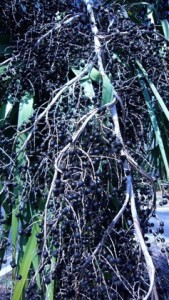
Pulp is paint thin on hard seeds

The kernel is extremely tough. You have three choices. Eat the thin pulp off, which is prune-ish in flavor but also astringent, then use the bare kernel. Or let the entire fruit dry as is with the pulp on it. You can grind up the pulp and kernel to make a crude flour or you can grind up just the kernel to make a crude flour. Either way it is a huge amount of work. It definitely is more calories out than in. I don’t know how Native Americans did this efficiently. Mill stones would be my guess, or perhaps they sprouted the kernels.

I have obtained a coarse powder by tossing roasted kernels into an industrial strength coffee grinder to break them up and then putting them through a grain grinder. If you roast the pulp-less kernels at 350º F for 20 to 30 minutes they break up much easier and grind easily. The powder has a nutty flavor and makes a passable coffee-like drink, especially to the nose.

If ground raw crude cakes can be made from the pulp and kernels with a little water and cooked. It’s roughage and roughing it, and you might end up with brown goop  I’ve tried boiling them to no success. They remained as hard as rocks. Roasting was easy but reduces the ground up kernel to an additive rather than a flour.

Historically, the palms have had many uses. The trunks are used for wharf pilings, brushes and brooms can be made from young leaves. The Seminole Indians used the large fan-shaped leaves to thatch their traditional buildings called chickees.

Fiber is obtained from the leaf stalks and is used to make brushes that remain stiff in hot water or caustic materials. Parts of the bark has been used for scrubbing brushes and the roots contain about 10 percent tannin.  The trunk is still used to make canes and the leaves are woven to make coarse hats, mats and baskets. Fronds are also shipped around the world for Palm Sunday services.  The boot fiber makes excellent tinder and if one digs some dry tinder can usually be found there even in the rain. And in case you need to know this, when the wood is struck by cannon balls it bends but does not break or splinter.

Keith Boyer, in his book, Palms and Cycads Beyond the Tropics, proposes that the genus name is derived from the Latin for palmetto, that is, “palmetto” comes from the Italian version of the original Spanish for “little palm.” Sabal is anyone’s guess  but he suggests is it is a French anagram of La bas, which means “down there.”  Labas also is  a word in Lithuanian that means good and is usually used in greeting.  But I think La bas and Labas are reaching. My guess is “sabal” it is from the sound alike sable, as in the fur, which was sabel in Middle German, zobel in Old German, and sobol in Slav and Polish for “black” like the color of the berries. That seems more sensible to me than an anagram for a bit of awkward French.

It is not without surprise that the palm also provides a substantial part of the diet of many animals including deer, bear, raccoon, squirrel, bobwhite, and wild turkey.  And while the S. palmetto may not make up much of the human diet, palms themselves are the third most important crop for humans. Cabbage Palms also like their feet dry so in swamps and other wet areas they are a signal for higher, dryer ground. Look for them when slogging through swamps. Also, the Silver Palm (aka Florida Silver Palm, Coccothrinax argentata) also has edible fruit, not too appealing, and the terminal bud is also edible. It is a fan palm, dark blue green above, silver below.

Lastly, is the tree protected? I was certainly taught that over 30 years ago, and have read so many times. I think I also said so in my video. But it was recentlhy brought to my attention that it might not be so. And indeed, I can not find a state wide law protecting though I did find some local ordinances that protect the tree. In fact, the law that made it a state tree in 1953 specifically said its designation shall not prevent it from being harvested and used. If anyone knows of a state law that says otherwise, please let me know.

Green Deane’s “Itemized” Plant Profile

IDENTIFICATION: Tree up to 60 ft. tall, long spreading leaves to 9 feet, yellow-white flowers in many branched clusters; fragrant, fruit 1/4″ wide. Ends of the fan fronds are folded in half vertically. The only reishi mushroom that grows on palms is Ganoderma zonatum.

TIME OF YEAR: Evergreen, fruits in summer to fall.

ENVIRONMENT: Brackish marshes, seacoast, woodlands or hammocks and sandy soils near the coast and inland.

METHOD OF PREPARATION: Fresh  fruit, ground seeds with or without pulp, growing end of young leaves, the heart. Roasted pulpless kernels have a nutty, if not coffee taste when ground. There is sugar in the fronds but it has to be beaten and soaked out. Incidentally, if the palm’s top is cocked, going off at an odd angle, or it is recently deceased, look for Palmetto Weevil grubs, about an inch long, edible raw or cooked. Burned stalks can yield an ash that tastes salty.


{ 20 comments }

Caesar Weed’s most edible part, the blossom

Urena Lobata: Cash crop to noxious weed

Once it was an invited money-maker, now it is a hunted money spender: Caesar weed, cash crop to noxious weed.

We have often discussed what is a weed, and what is a noxious weed. Many “weeds” were food for previous generations, and some noxious weeds were valuable plants until technology moved on. Such is the story of the Caesar Weed.

Caesar Weed, Urena lobata, is in the mallow family and was imported to Florida for cordage a little prior to 1882, which makes sense; its cousin is cotton. Caesar weed is a good substitute for flax and jute and was at one time an important crop, still is in Brazil where it is called Armina Guaxima or Armania fiber.  It’s also called Congo Jute. Now it‘s a “noxious weed” in Florida because it is not used anymore and spreads easily. While it grows  happily river side it can grow on dry land with enough rain.

If you remember, the foraging phrase is all mallows are edible in some way, except the cotton (it’s oil is edible after processing.) The Caesar Weed is one of those mallows on the cusp of edible/not edible. As a food, Caesar weed is not high on the list. It is a “famine food” in Africa. When you eat it the main issue is not taste but texture. It’s not like eating sandpaper but it’s heading in that direction… tender sandpaper perhaps. The leaves are best boiled as are the calyces. After eating it can make some feel queezy. The seeds have polyunsaturated oil and are used as a cereal and in the production of soap (as is the oil of its cousin, cotton.)  Young sprouts are edible as micro-greens. While Caesar Weed is low on the food list it has a saving grace in that it’s a traditional medicine that has the support of science.

Extracts from either the roots or the leaves have broad antibacterial activity against both gram-positive and gram-negative bacterial isolates, and it is anti-fungal as well. I think some antioxidants were also found and one other extract was nearly as good aspirin. It is a good plant to know if push ever comes to shove and there are no pharmacies around. The roots are also diuretic and used for stomach aches (which eating too much of the cooked leaves can give you.)  Leaves are pasted and applied to skin problems. Medicine were made from fresh and dried parts.

Young leaves are famine food

The lobed leaves are covered especially on the bottom with “stellate trichomes” which are star-shaped plant hairs, which is probably why cattle, which have only lower teeth, won’t eat it.  The cocklebur seeds cling to their hair, however, so they help spread it around. The nutritional value of 100 grams of raw leaves is:  81.8 percent moisture, 54 cal, 3.2 g of protein, 0.1 g fat, 12.8 g carbohydrates, 1.8 g fiber, and 2.1 g ash, 558 mg calcium, and 67 mg of phosphorous per 100 g. When one cooks the leaves the resulting roan-colored water is tossed away. If you were an herbalist you might want to investigate that water. In some places that water is used as a tea for colds.

The Caesar Weed has bast fiber. The fiber strands are cream colored and lustrous. It’s grown mainly in the Congo area although some is raised in Brazil, India and the Phillippines.  It has the same uses as  jute and sometimes is used to make tea bags (you could have had some Caesar Weed and not known it.)  The fiber is obtained by retting, which is letting the plant partially rot in water.

Urena (you-RE-nah) is the Malaysian word for the plant and lobata (low-BAH-tuh) refers to the lobed leaves, after ear lobes. It is also sometimes called U. sinuata (there is a bit of disagreement if sinuata is a subspecies, a different species, or just another name for lobata.) Sinuata means bending or curving. In English we say “sinuous.”

Incidentally, even U. lobata’s common name refers obliquely to a plant characteristic and is something of a joke. “Caesar” mean’s “head of hair” and the plant is very hairy, something the bald Julius Caesar would have envied. Indeed, the Caesars were well-known for being very bald while their family name meant just the opposite.

Green Deane’s “Itemized” Plant Profile

IDENTIFICATION:

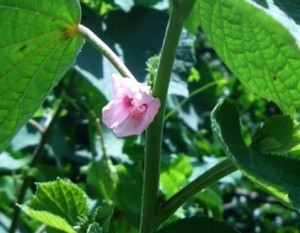
Shrub to 13 feet. Hairy stemmed, burdock-like seeds pods, small, five segments. The small pink five-petal blossoms usually  grow with a right twist or a left twist. Leaves 3 to 6 inches, oval with shallow lobes.

TIME OF YEAR:

Flowers nearly year round

ENVIRONMENT:

Moist soil, watered waste grounds, dry land with good rain, found in subtropic to tropic areas.

METHOD OF PREPARATION:

Young leaves, flowers, calyces, seeds, cooked, also flowers raw. Seeds used to thicken soup, porridge, A famine food, or an addition to the herb pot when foraging is scarce. It can make some queezy. Better used as a medicinal herb.

HERB BLURB

Broad antibacterial activity against both gram-positive and gram-negative bacterial isolates, anti-fungal, contains antioxidants, has aspirin like uses. Roots used for stomach aches and are diuretic. Leaves are pasted and applied to skin problems.

It is used to make tea for colds and flowers as an expectorant for “dry and inveterate coughs”.  In South America it provides a sedative and in Brazil a root and stem decoction is a treatment for colic.  Also used in Chinese medicine to treat kidney failure.

Crushed flowers, with salt, are applied to boils. Decoction of roots are taken by children with fevers. A decoction of roots, with those of Sida rhombifolia, is taken for stomachache and coughs. Leaves are used in aromatic steam bath for fevers and decoction of leaves is applied to skin rashes. The root is also used as a poultice to reduce swellings.

Decoction of the leaf is taken twice daily to reduce blood pressure; and also is taken before sleep to relieve rheumatic pain and body ache. The leaves are used as tea against sore throats and oral erosion, while leaves are good to treat urinary troubles and dysentery.


{ 28 comments }

Juglans nigra and butternut, too!

Black Walnut, Juglans nigra

I didn’t see my first Black Walnut tree until about 16 years ago. It so happened that the two places I lived the longest, Maine and Florida, are on both ends of the tree’s range. I lived a little north of the range and half a state south of the range.

However, I visited Alexandria, Virginia for an extended time and one day while jogging along a park trail there was a walnut tree covered with green mana. I went back later that same day and carried home all that I could carry (and did so for several weeks.) Then came the hard work. Walnuts are delicious, but they don’t give up easily.

The walnut most people buy are actually Juglans regia, (JEW-glanz  REE-jee-uh) or “royal walnut.” They are also called English walnuts because English merchants popularized that particular nut, which is grown in the Balkans. You can find it from Greece to southwest China.  The North American walnut, which is smaller and tougher to crack, is the Juglans nigra (JEW-glanz NYE-gruh), the Black Walnut.

Written references to the walnut are some 4,000 years old. About 1795 BC, Hammurabi mentioned them in a code of laws governing food. The Greeks were the first to systematically improve the species they got from Persia. The walnut is in Greek mythology in the story of Carya.

The god Dionysus (Dennis the Menace) fell in love with her. When she died, he changed her into a walnut tree. The goddess Artemis (Dianah) told Carya’s father the news and he ordered a temple be built in her memory. Its columns, sculpted from wood, were in the shape of young women. They were called catyatides, or nymphs of the walnut tree. Three famous stone  Catyatides (and one cement substitute) are still standing at the Acropolis in Athens.  Carya, incidentally, is the genus for hickories and pecans.

From Greece walnuts went to Rome around 100 BC and from Rome to Spain and France. When they got to England is a bit of a debate, from 400 AD to the 1400’s but the Old English name for walnut also started around 400 AD.  The common walnut came to North America via the Spanish in California in the 1800’s. California leads the nation and the world in walnut production. Some 99% of the commercially purchased walnuts in the United States come from California, and 65%, almost two thirds of the walnuts consumed in the rest of the world come from California. The common walnut, J. regis,  lives to about 60 and grow, on average, to 60 feet.

Black Walnut

The American native, the Black walnut, J. nigra grows from New England west to Minnesota south to the Gulf of Mexico and across northern Florida. It can grow to 60 feet and can live past 100 years. Black Walnut trees are more valued for their wood than their walnuts. However the walnuts are used in baking, ice cream, and candy. The walnuts can be shelled into large pieces if soaked overnight in water. The nutmeat is crunchy and spicy.

A favorite of my family was the Butternut or White walnut, J. cinerea. (JEW-glanz sin-EER-ee-uh.) It’s closely related to the black walnut and has oval-shaped nuts, with a thick shell with white kernels. The best flavored of the walnuts, it was prized in my family for homemade butternut ice cream. It was one of my mother’s joys in life. There was a butternut orchard nearby. The nuts are sticky, hull easily, and in three segments. And delicious. J. cinerea can grow to 100 feet  and live around 75 years and is the most cold tolerant of the walnuts.  Like black walnut trees, the roots of the Butternut tree release a phytotoxin that keeps many other plants from growing near it.

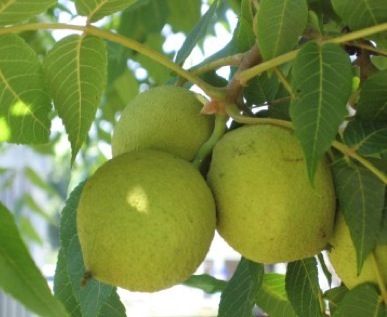
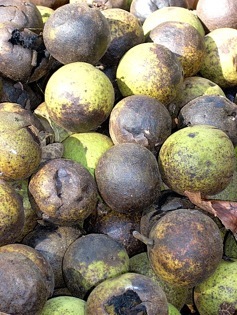
The Black Walnut is the most common walnut among foragers. They’re shaped like basketballs two inches in diameter and are usually ready for harvest in late summer or early fall.  Try to get the nuts off the tree if possible, and good ones on the ground. Remove the husk and let the nut dry which “cures” it. After curing they can be stored shelled or unshelled. Two pounds of walnuts off the tree will produce about a cup of nutmeat.

To process them, first do with the walnuts what you do with acorns. Put them in water and discard any that float. Kernel quality can be ruined by insects; darker than usual husks may be evidence of insect damage. The water test gets rid of most but not all of the bad nuts. (Check those floating walnuts for edible grubs.)

Hulling walnuts is dirty, difficult work. A dye from the husk can stains your hands, clothes, tools and work surfaces. If the nuts are dry you can pound the hull side to side with a hammer. You can also use a cement mixer with three parts nuts to one part water plus a handful of gravel. Actually driving over them is dangerous in that the pressure can cause the nuts to pop out and hurt someone. Lastly, you can get a walnut sheller. After hulling, wash the unshelled nuts. Don’t compost the hulls because walnut hulls can suppress the grows of other plants. Tomatoes and apples, for example, won’t grow near walnuts.

After removing the husks walnuts have to be cured. Curing lets the walnut develop flavor. Stack the clean hulled nuts in shallow layers,  put in a cool, dry, ventilated area out of sunlight for two weeks. A nut is cured when the kernel breaks crispy with a sharp snap. If you don’t cure them correctly they will mold. Store at 60F or less.  Ideal humidity is 70%

When you’re ready to shell the walnuts, put them into hot tap water and soak for a day. Next day put them in hot tap water again for about two hours. Then shell. In a sealed jar in the refrigerator nutmeats can stay good for up to nine months, two years if frozen.

Butternuts

As for the scientific name Juglans… Carl Linnaeus, who thought up naming plants and who was the main man at doing so until he died, had a dirty mind. He was an R-rated professor. Many of the names he picked were not only risque — perhaps he was running out of ideas — but one wonders how he came up with some of them.  Amorphophallus titanum and Capparis cynophallophora come to mind.

Amorphophallus titanum means large shapeless penis — which seems a contradiction in terms.  Cynophallo… means  “dog penis.” So the plant’s name, Capparis cynophallophora, means “dog-penis bearing caper.” And while I am no expert on dog anatomy I have seen the latter plant and I have no idea what Linnaeus was thinking. Which brings me back to Juglans.

Linnaeus made up “Juglans” from “Jove’s glans”  meaning the end of Jove’s penis. Having collected a lot of walnuts I would have thought “Jugorchis” would have been more accurate (Jove’s testicle.)  And who said plants aren’t sexy?

Some food authors, who know little about language, say Juglans means “Jupiter’s acorn” which it does but that is still referring to the same part of the male anatomy for the acorn was named, or vice versa. Then they soft pedal and say Juglans really means “a nut fit for Jupiter.” Frankly, their ain’t no polite way around it and be accurate.  Linnaeus was the original dirty old man. As for the other parts of their name. Nigra is easy: That means black. Regia royal, and Cinera means “ash-colored.”  We still see those words in “regal” and  “cinder.”

The word “walnut” is G-rated and comes from the Old English phrase “wealh nutu” which means “foreign nut.” Variations of “wealh” are with us today as in Welsh” and the name ” Vlach.”   In fact, in some parts of England walnuts are still called Welchnuts. The walnut was foreign to the English of yore because it came to them via the Romans from what is today France. When Latin was still the language of the educated, and “walnut” has not been adopted,  it was called nux Gallica meaning  “Gallic nut” or French nut.

Lastly, the most unusual use of walnut oil: The ancient Egyptians used it for embalming fluid. I like it on salads.

Green Deane’s “Itemized” Plant Profile


IDENTIFICATION:

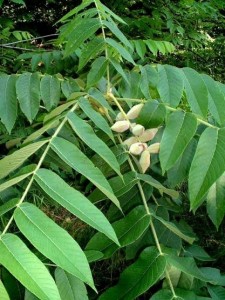
A large tree with compound leaves, alternately arranged on the branches. Each leaf has 15-23 leaflets; the terminal leaf is often missing; leaf surface is dull with a slightly hairy or downy texture on the underside.

TIME OF YEAR:

Late summer, fall. Husk changes from solid green to yellowish green. Press the hull of the walnut with your thumb; ripe nuts will show an indentation. Monitor over a six week period as nuts will mature over that time. Try to harvest off tree than the ground.

ENVIRONMENT:

Moist, well drained soil, along streams, in mixed forests.

METHOD OF PREPARATION:

Harvest, hull, dry (cure) nuts at least two weeks, soak before shelling. Nuts are cured when the are crispy and snap when broken. Use as regular walnuts. For another application see recipe below.


Walnut Liquor

25 dehusked green walnuts, about the size of home-grown apricots

3 cloves

1 stick cinnamon

peel of 1 lemon (yellow part only; no white pith)

1 quart of vodka, 100 proof

3 cups sugar

1?4 liter of cheap sparkling wine (alternative recipe)

1. Soak the walnuts overnight to draw out any worms and other impurities.

2. Quarter them and put them into a large jar with all other ingredients.

3. Place in a sunny spot, sealed, for at least 40 days; 2 months is better.

4. Shake every few days.

5. Strain and bottle the liquid. Let it sit for another month or two,

minimum. At that point it’s drinkable, but if you can, put a few bottles

away to age. After two or three years it really becomes something special.


Some make a second, less potent liqueur by adding 2 cups

of alcohol, a cup of sugar, and a bottle of cheap sparkling wine to the

solids you filter out of the mix. Let that mixture stand another couple of

months, shaking occasionally.

{ 66 comments }

Tall Blue Porter Weed. Photo by Green Deane

Stachytarpheta jamaicensis: Near Beer

Should the civilized world come to an end and you have a hankering for a stout beer you’re in luck: You can make one from the Blue Porterweed, Stachytarpheta jamaicensis. And if a beer is not to your liking, then you can make it into a tea with a beer-like foam.

Porter is a dark brown beer on the bitter side. A stout is a strong porter. Porter’s Beer, Porter’s Ale, Porter House Steaks all go back to shops that serviced porters and laborers in England as early as the early 1700’s. The Central American brew made with the Blue Porterweed got its name by the dark color and bitter flavor of that ancient ale.

The tea side of the Blue Porterweed is better known. It was once exported from Brazil as Brazilian Tea and was also used to stretch “Chinese” tea. In fact it is still used in Brazil today. It is drank for taste or medicinally.

Beer and tea is not the plant’s only claim to fame, besides a long list of herbal uses (see the herb blurb below.)  It is a mainstay of almost every butterfly garden. Because of the plant’s growth habit of sending up a spike that then flowers out continuously it is butterfly fast food. Attracted to it are skippers, viceroys, monarchs, and queens, among many.

Tastes like mushrooms

Stachytarpheta is from the Greek words stachys meaning spike and tarphys which means thick or dense. This is reference to the flower spike.  How that is said is a bit of debate. In Latin they say steak-ee-tar-FEE-tuh. In Greek, which is what the words are, the first “A” would be short: stah-ee-tar-FEE-tuh.  Jamaicensis means of Jamaica — read Caribbean — and is said jah-may-CEN-sis. At any rate some think it got to Florida around 1700 from Jamaica and then butterfly gardens around the world.

How did they make the beer? No one seems to report that. The way to do it is make a tea of suitable taste and then add sugar and yeast, which is how the soft drink Root Beer started out, as root tea.

I learned from my good friend Ryan (husband of forager Sunny Savage and good friends of mine) that the blossoms taste like mushrooms. And they do! Delicately so. I’ve never found a reference for said but Ryan said they ate them in Hawaii where he grew up. I’ve tried them. Tasty and quite surprising.

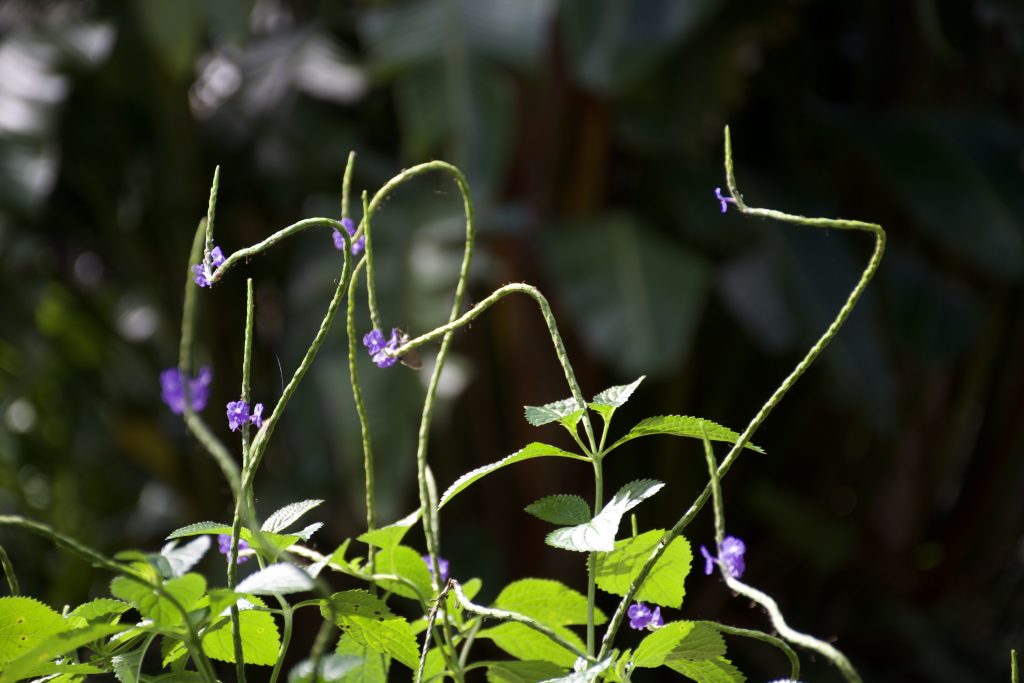
A few words of caution: Don’t mistake Vervain, Verbena Officinalis, which has some edible parts, for Blue Porterweed. There is some resemblance but Vervain branches more freely, has plump bloom tips and the leaves are more lance shaped whereas the Blue Porterweed tends to have oval leaves, less branching, and has a long skinny flowering tip that is skinny to the end. Stachytarpheta urticifolia was historically used in Bangladesh to induce abortions. Research with mice in 2004 confirmed that effect. 

Green Deane’s “Itemized” Plant Profile

IDENTIFICATION:

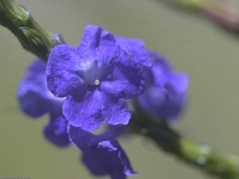
A low shrub that trails on the ground, tips rising up, no taller than a yard, usually much less, one or two feet,  stems angled, leaves opposite, oval to lance shaped, dark green one to four inches long, edges distinctly toothed. Five petal blue flowers grow on a spike, a few at a time opening only one day. There are several related species: Remember, it is a short plant with blue flowers. If it came from a nursery it is probably NOT the right plant.

TIME OF YEAR:

Year round, spring to fall in more northern climes.

ENVIRONMENT:

Sand dunes to pine forests to scrub land and even occasionally wetlands. Naturalized in Florida, Alabama, Hawaii and Puerto Rico. Found in seasonal flower gardens

METHOD OF PREPARATION:

Dry the leaves, use like Chinese tea, or brew beer, blossoms as a trail side nibble. You can also use the spikes as a flavoring ingredient like a bay leaf.

HERB BLURB

2003 Abstract: The anti-oxidant effects of ethyl acetate (EAcE) and n-hexane extracts (nHE) of dried leaves of Stachytarpheta jamaicensis Vahl. (Verbenaceae) on the reactive oxygen species (ROS) generating during the respiratory burst of rat peritoneal macrophages were investigated. Only EAcE, at concentrations between 0.4 and 40 µg/ml, inhibited the extracellular release of oxygen radicals by resident peritoneal macrophages stimulated with phorbol-12-myristate 13-acetate (PMA). At concentrations above 40 µg/ml, EAcE inhibited the production of nitric oxide (NO) in macrophages stimulated in vivo with sodium thioglycollate then in vitro with lipopolysaccharide (LPS) and gamma-interferon (IFN-). nHE extracts at concentrations between 0.4 and 40 µg/ml did not scavenge O-2 generated enzymatically by hypoxanthine/xanthine oxidase (HX/XO) system, but EAcE at the same concentrations showed potent O-2-scavenging activity. At 40 µg/ml, EAcE also inhibited XO activity. These results suggest that the EAcE extract of S. jamaicensis may be a potential pharmaceutical value in treatment of immunopathological diseases related to oxidative stress.

{ 20 comments }