Cardiospermum halicacabum: Edible Leaves

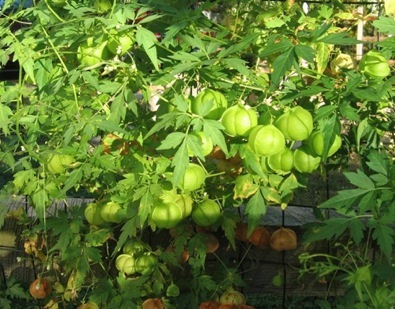
Balloon vine, heart seed, heart vine, Cardiospermum halicacabum

Photo by Rob’s Plants

For a tropical plant, the Balloon Vine can take cold weather, growing from west Texas north to Montana, Florida north to Massachusetts and most points in between. In fact, in Texas, Alabama, South Carolina and Arkansas it is a noxious and invasive weed… all the more to eat though few know it is edible. It’s not a plant found in most foraging books.

Here in Florida if you see a vine covering other plants it will usually be the Bitter Gourd or the Balloon Vine. The latter’s fruit is quite eye-catching and distinctive, looking like little balloons, albeit with seams. There are three edibles, by the way. The Cardiospermum halicacabum, C. microcarpum and C. corindum.  The C. microcarpum is found in Florida, Puerto Rico and Washington DC. The C. corindum is found in Florida, Texas, Arizona and Puerto Rico.

While not naturalized on the west coast there are several reports it grows well there, from lower California to Washington State. It also grows in Central America, South America, (cultivated in Brazil) Hawaii, Taiwan, the Philippines, Malaysia, Polynesia, India, Sri Lanka, Africa, Malta, Europe, window boxes in Brooklyn et cetera. In cooler areas it is an annual, in warmer, a perennial.

Balloon vine, heart seed, heart vine, Cardiospermum halicacabum

© Photos by Central Texas Plants

As mentioned, the Balloon Vine is found all around the world and is used for food and medicine. It is also popular with the butterflies , locally the Amethyst Hairstreak, the Silver-Banded Hairstreak, and Miami Blue. Almost all of the fruit on the Balloon Vine will have frass inside from where the caterpillars dined. Fortunately we eat the young leaves and shoots.

C. halicacabum is a problem plant for soybean seed growers because the  seed size and shape are similar. Because of C. halicacabum can form thick mats, it’s a problem in Southern United States where it can smother and kill native vegetation. Aboriginal people used Balloon Vine in the treatment of rheumatism, nervous diseases, stiffness of the limbs and snakebite. Leaves were crushed and made into a tea for itchy skin. Salted leaves are used as a poultice on swellings. Young leaves can be cooked as vegetables. The leaf juice has been used as a treatment for earache.

Balloon vine, heart seed, heart vine, Cardiospermum halicacabum

© Photos by Central Texas Plants

What Cardiospermum (kar-dee-oh-SPER-mum) means is not in any dispute, it is “heart seed” referring to the tiny image of a heart on the seed. Halicacabum (hal-ee-KAY-ka-bum) is not so clear. In Greek it means “salt barrel” and goes back to perhaps to Xalo (ha-LOW) with means to spoil or to break. Such barrels were short and squat, and the Greeks called some plant by the same name. The Romans stole the plant name from the Greek but thought it kind of looked like a bladder so they used it with a plant that had inflated fruits.   Microcarpum (mye-crow-KARP-um, though in Greek it would be mee-krow-KARP-um)  which means small seed and corindum which can mean “heart of India” or more likely “heart of Indian Ivory.”  In the Soapberry family, the Balloon Vine is also called “Love In A Puff.”

Green Deane’s “Itemized” Plant Profile

IDENTIFICATION:

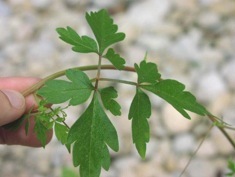
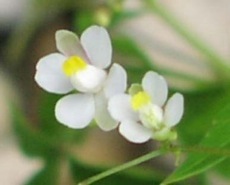
C. halicacabum: A woody, perennial vine native to Tropical America. They are fast growing to 10 feet (3 m) with twice 3-parted leaves that will reach 4 inches (10 cm) long. The plants climb with tendrils and need some form of support. They are used as annuals in USDA zones 5-8 and are perennial in zones 9-11. The small white flowers bloom from summer through the fall, flowers are not very showy. The fruit from which the plant gets its common name is a brown, thin-shelled, inflated angled capsule up to 1 1/8 inch (3 cm) in diameter containing 3 black seeds each, with a white heart-shaped scar.

TIME OF YEAR:

All year in warmer climates, seasonal in cooler climates

ENVIRONMENT:

Waste places and cultivated ground

METHOD OF PREPARATION:

Young leaves and shoots cooked.

{ 16 comments }
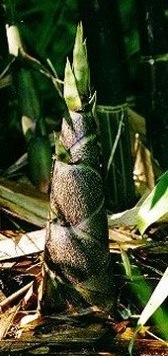
Bamboo: The Most Versatile Grass In The World. Photo by Green Deane

Bamboo: The Most Versatile Grass In The World. Photo by Green Deane

Bambusa

Do not tell me you don’t live near bamboo.  I grew up in 50-below-zero Maine and we had bamboo in front of the house for decades.  In fact, the cooler the climate the bamboo comes from the better tasting are its shoots.

There are over 100 edible species of bamboo, and perhaps nearly all of the shoots of 1500-plus species are edible. No one really knows for sure. Most of them, even the edible ones, are bitter raw and that bitterness can vary. A few have some or no bitterness. Usually cooking the shoots in one or more changes of water reduces or gets rid of that bitterness. To prepare them remove the protective sheath, slice and boil, or chop and boil, or just boil.  Incidentally, the size of the dentrocalamus shoot when it comes out of the ground will be the diameter it will be when full grown.

Bamboo shoot

Actually there tends to be two kinds of bamboo, clumpers and runnners. Clumpers tend to be tropical and runners tend to be temperate. The temperate Phyllostachys bamboos are a leading source of shoots, among them Phyllostachys nuda, P. platyglossa, P. nidularia, P. hindsii, P. dulcis, and P. vivax. Other temperate bamboos are  Semiarundinaria fastuosa and Qiongzhuea tumidissinoda. The most common shoots harvested for food in China are P. heterocycla f. pubescens, P. praecox, P. dulcis and P. iridescens.

The following may seem worth knowing but really isn’t: The seed grain of the flowering bamboo is also edible. Boil the seeds like rice or pulverize them, mix with water, and make into cakes. Why isn’t that good to know? The bamboo, depending on the species, flowers only once every 7 to 120 years.

The bamboo, which is really a grass, is so useful several books could be written about it and have.  It’s food and building material. Without it several million people could not get by. It is probably only second to the palm in usefulness, or may even exceed palms. However, in many parts of the world it has become an invasive weed, Australia is a good example. It’s banned there in many places. The genus name, Bambusa, comes from the Malayan name for the plant.

Other Uses: Bamboo is used to build structures or to make containers (one section alone can carry water or serve as cooking pot. ) It also makes ladles, spoons, and various other cooking utensils. Bamboo is used to make tools, weapons, even a friction fire saw. You can make a strong bow by splitting the bamboo and putting several pieces together.  Through technology, it is also made into plywood, composite beams and paper. You can also wrap food in the leaves.

When I shopped around for bamboo for my backyard (Phyllostachys viridis)  I specifically bought one that was mild enough to eat raw, but I don’t make it a habit of it and here’s why. Most foraging books and various websites fail to mention that bamboo shoots have a cyanogenic glycoside, specifically taxiphyllin which is mostly responsible for the bitter taste.  In your gut that can change to hydrogen cyanid also called prussic acid. Not good. However, taxiphyllin degrades readily in boiling water so I recommend boiling any bamboo shoots you try. And if you cannot boil the bitterness out, don’t eat it.

The only problem I had raising the bamboo is that it took a few years for the stand to get established. It spent a lot of time sending up underground runners, but when it did sprout, it grew incredibly fast. Indeed, it is the fastest growing renewable resource known to man. Some can grow four feet a day. Here are a few of the more desirable edible species:

Bambusa multiplex, one of the hardiest clumping bamboos often used for a hedge or windbreak. Bambusa oldhamii , another clumping bamboo with straight stems, also used for hedges and windbreaks. Bambusa tuidoides ‘Ventricosa’ also called  Buddha’s Belly. It has pot belly type internodes. It’s a clumping bamboo or can be grown in a pot.

Bambusa Vuigaris ‘Vittata’ the Painted Bamboo, has golden stems with green stripes that vary in width. It can be grown in a pot indoors. Phyllostachys edulis, Moso, the largest of the hardy bamboos. It makes a hedge or windbreak and is used in bamboo crafts. Phyllostachys vivax, has stems with thin walls  and white powdery bands below the nodes. It is cold hardy. Phyllostachys atrovaginata, edible raw, little bite, cold hardy. Makes a good hedge or windbreak. Phyllostachys nidularia, also edible raw, makes a good hedge or windbreak, cold hardy. Phyllostachys rubromarginata, high cold tolerance, good eating quality, can be used for hedge or windbreak or in bamboo craft.

Lastly, bamboo is tough. One stand was at ground zero at the 1945 Hiroshima atomic blast. Within days it sent up new shoots.

With 70 genera and 1,575 species it is difficult to identify.  Stems have nodes that are hollow in between. Growth is columnar. No branches first year, can grow up to 39 inches a day.

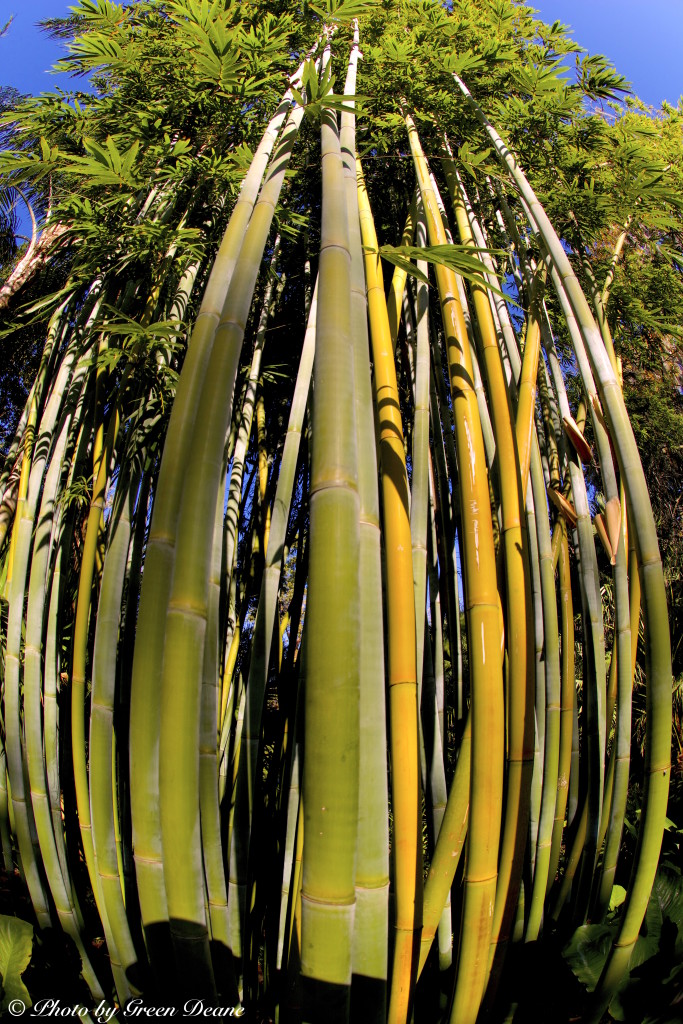
Pictured above is “Emerald Bamboo” or Bambusa textilis mutabilis, growing happily in Leu Gardens in Orlando, Florida.

Green Deane’s “Itemized” Plant Profile

TIME OF YEAR:

Seasonal and year round depending upon climate

ENVIRONMENT:

Bamboo can be found from cold mountains to hot deserts.

METHOD OF PREPARATION:

Many bamboo shoots have to be cooked to rid them of cyanide. The sap and shoots can be fermented. Pith of young shoots can be pickled. The seeds are edible but some bamboos only flower once every 120 years.

{ 28 comments }

Ironwood, Krugiodendron ferreum

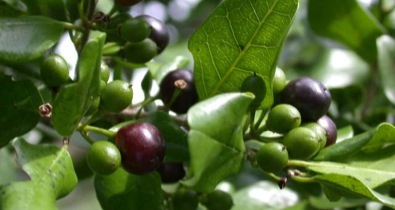
Krugiodendron ferreum: Ironwood M&Ms

Green twigs of Black Ironwood will sink in salt water. It’s that dense.

The Black Ironwood was once esteemed for its hard wood,  some of the densest woods on earth at 1.42, on par with Lignum Vitae.  It resists disease, termites and will outlast salt spray better than iron. For such a strong wood, though, hurricanes damage it, probably because it is so unyielding.

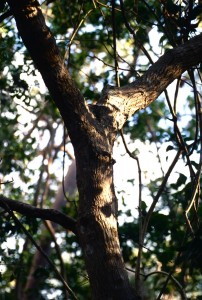
Ironwood Trunk

Dr. Daniel Austin, on whose scholarship I owe so much, said he took a class of undergraduates to a particular hammock for 31 years in a row and a trunk piece of blown-down Black Ironwood heartwood remain unchanged over the decades. His last undergraduate class and the authorities saw to it that Dr. Austin, retired, now has that  piece of heartwood. It was Austin who noted the 50-some year old piece of wood far outlasted any piece of iron in the same environment.

In the Buckthorn family, Black Ironwood Is also called Leadwood because when it is cut the aroma given off is nearly identical to the smell of molten lead. Through the more rural Caribbean it is still used for tools and for making weapons, such as bows, arrows and lances. Because of its density it takes a high polish and is favored by turners. The sapwood is light brown, streaked, with the heartwood orange brown to dark brown. The fruit look similar to dark M&Ms.

The Black Ironwood is evergreen if it has plenty of water, though it can drop leaves in time of drought. By the way did you know in the tropics many trees don’t have visible growth rings because their moisture level is nearly even all year. Seasonal changes produce growth rings.

Botanically it is Krugiodendron ferreum (krug-ee-oh-DEN-dron krug-ee-oh-DEN-dron) Literally it means Krug’s Tree Iron. It was named for Carl Wilhelm Leopold Krug 1833-1898 German consul in Puerto RIco, businessman, botanist, science patron. Ferreum means iron and refers to the tree’s resistance.

Green Deane’s “Itemized” Plant Profile

IDENTIFICATION:

Shrub to small tree, 20 to 30 feet, with truck 10 inches thick, heaviest native wood in the United States, bark ridged, scaly. Leaves persist several years, opposite or alternate, ovate, may be notched at tip, deep-green, glossy above, pale below, to 2.5 inches long. Flowers late spring early summer, greenish, small clusters, fruits many, nearly round, 2/8 inch long, black, glossy, think skinned, juicy, sweet flesh, on single hard stone.

TIME OF YEAR:

September to November

ENVIRONMENT:

Hammocks, does not like salt water

METHOD OF PREPARATION:

Jam, jelly, wine, and raw out of hand.  Not the greatest and not the worst.

HERB BLURB

The Maya used the bark and root decoction as a mouth was for toothache and gum issues. A decoction of the roots are purgative.

{ 1 comment }

Cattail’s Maligned Companion

The bulrush has a public relations problem. It found in the same environment as the cattail, can be used the same way, and tastes better yet one never hears the bulrush praised as much as the cattail. It should be.

Young shoots in spring can be eaten raw or cooked. Its pollen can be eaten as flour in bread, mush or pancakes. The seeds can be parched and consumed or ground and used like flour. The large, horizontal rhizomes roots can be eaten raw or cooked. Indians dried them in the sun then pounded them into flour. The estimated food value is 8% sugar — making it sweeter than the cattail —  5.5% starch 1% protein.
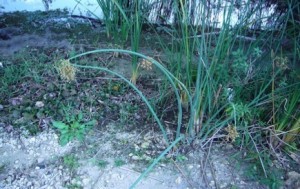
Nodding Bulrush along the St. Johns River

The bulrush, and other edible rushes in the same family (Scirpus validus, SKIR-pus VAL-ih-duh,  Scirpus  acutus, SKIR-pus uh-KYOO-tuhs)  are found throughout North America. The bulrush itself is native across the southern United States to California north to Oregon and south to Argentina and Chile. It’s also found in Illinois, Hawaii, the Cook Islands and Easter Island, where it arrived some 30,000 years ago. Related rushes are found in northern areas and have similar use. Though called a rush the plant is a soft-sided sedge. If you haven’ t heard the rhyme to help you remember the difference between sedges and other plants, here it is: Sedges have edges. All sedges are triangular, some markedly so, other barely so.

One bulrush also has a Latin name you will either like or avoid: Scripus californicus (kal-ih-FOR-nik-us.) Scripus means sharp and refers to the usual edges found on sedges. Californicus means of California. That takes a bit more to explain. In 1772 there was a large lake, some 760 square miles, in what is now the San Joaquin Valley of California. It was discovered by Pedro Fages but no longer exists. Fages named the area Los Tules because of large bulrush marshes. “Tule” probably came from tullin which in Spanish means cattail. The Spanish got it from the Aztec word “Tollin” which meant a group of plants including the cattail, bulrush, and similar plants. Large stands of tules are called tulares.
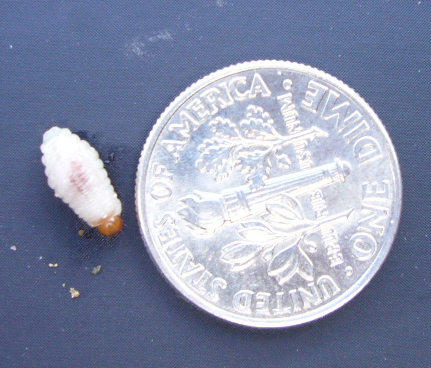
The "Listronotus" grub grows larger

Tulares are significant wetland habitats for some 160 species of birds and many mammals and amphibians. Marsh wrens and blackbirds build their nests there. Migratory ducks seek food and shelter among the bulrushes. Wading birds forage on fish, amphibians, and invertebrates that hide among the bottom of the bulrushes. Geese feed on the new shoots and roots.  Among the birds found in rushes are the bufflehead, mallard, pintail, shoveler, blue-winged teal, cinnamon teal, greater scaup, lesser scaup, avocet, marbled godwit, clapper rail, Virginia rail, sora rail, long-billed dowitcher, tricolored blackbird, canada geese and white-fronted geese. Indians hunted the ducks in the rushes. They would sink nets and make decoys made of rushes. When the ducks landed entire flocks were captured by pulling up the nets.

The Indians cut rushes for mats and thatching for their houses. The thatching is insulating and water-proof. Woven with grape vines, they form floats a person can stand on and pole over water. A similar rush was used by Thor Heyerdahl when he made the Kontiki. Bulrush “shoes” helped hunters to walk over muddy flats without sinking in. Shredded rushes were used to make baskets, baby diapers, sleeping mats,  menstrual material, ‘grass’ skirts for the ladies and capes for the men

Like most aquatic plants in the area the bulrush is also home to a beetle grub that fish like. On the bulrush look for a small hole and a brown streak in the upper portion of the stalk. You will find a small grub, actually the larval form of an Arrowhead Beetle. The size will vary but they do grow big enough for a small hook and fish love them. As a weevil the grub is also probably edible by humans but I haven’t got around to trying one. You can find the same grub in the base of cattails. Look for a green cattail with an outer leave that is browing at the bottom.
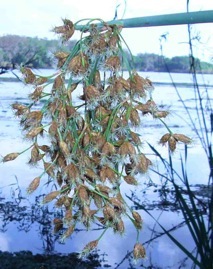
Bulrushes are sedges

The bulrush can also be cultivated by planting rhizomes a yard apart in moist rich soil but not standing water. Or, broadcast seed in the same environment, rake in to one-quarter or one-half inch. Seeds are commercially available. Bulrush can be occasionally  confused with Pampas Grass. However, Pampas Grass does not like to get its feet wet, has a central ball root system — not a rhizome —  and has very sharp edges. Incidentally, when the British use the word bulrush they are referring to the cattail.

There are two large local bulrush that look similar, the S. californicus (Southern Bulrush) and the S. validus (soft-stemed bulrush.)  On S. californicus the seeds are reddish brown and feathery, on S. validus the seeds are white and barbed. Saltmarsh Bulrush (Scirpus rubustus) was similarly used. It is found is brackish water, is about three feet tall, has a very triangular, hard stem, leaves that are flat on one side, rounded on the other, and has inch-long spikelets with hooked tipped scales.

Green Deane’s “Itemized” Plant Profile

IDENTIFICATION: When mature 5 to 13 feet tall, leaves are slender, grasslike; stem pithy, long stem. Flowers in a spikelet looking like orange-brown scales. Other Scripus are edible and local varieties vary.

TIME OF YEAR: Shoots and pollen in the spring, seeds, bottoms of stalks and root year best in fall.

ENVIRONMENT: Grows where it is wet, rivers, ponds, ditches, lakes, close to shore or farther out.

METHOD OF PREPARATION: Peeled shoots and roots dried into flour, pollen, seeds starch and sugar, root tips roasted like potatoes. As a Fresh Vegetable: The young shoots and the tender parts inside the base of the stalks are edible raw, or when boiled. The young base roots are also edible both raw and cooked.


Recipies From: http://www.everything2.org/title/bulrush

Roasted Bulrush Roots: Dig up the roots and clean thoroughly, removing all the hair roots by scraping, then wrap in big leaves. Dig a hole in the ground about 18 inches across and 6 inches deep. Build a fire in it, and when you have a good bed of coals, remove most of the coals from the hole and place the wrapped roots in. Scrape the coals back on top of the wrapped roots. Roast for 2 to 3 hours.

Bulrush Stew: Peel the skin off the roots and cut in inch log pieces. place in a pot with boiling water and add a few wild onions or sprigs of mint. Then add pieces of porcupine or other small animals. Boil one hour.

Bulrush Flour: Clean the roots thoroughly and dry them completely in a dry place in the sun. When they are dry, remove the fibers from the root and pound the remaining pulp into a flour. The texture of the flour depends upon how much elbow grease you use in its preparation. It is very sweet.

Bulrush Pancakes: Peel the skin from the roots, cut into small sections, add water, and boil into a gruel. Let cool. Stir in porcupine fat, or any other fat, then add chopped porcupine or bacon. Heat a couple of flat stones over the fire. Form small patties of the mixture and fry on the stones. If berries are in season, mash a cupful and use a compliment.

Bulrush Bread: Skin the roots and cut them into small pieces, the boil in to a gruel. Remove the fibers and let the water evaporate. When all the water is gone you have a sweet-tasting flour. Mix some fat into the flour and mix. Roll the dough mixture out onto a flat rock and bake in a reflector oven. Or make small rolls about 6 inches long and half an inch thick, twist around a stick and set in from of the fire to bake.

Bulrush Broth

Ingredients:

* 1 1/2 pounds oxtail, cut up

* 1 1/2 teaspoons salt

* 1/2 cup flour

* 2 tablespoons bulrush flour

* 2 tablespoons mustard seed

* 2 tablespoons bacon fat

* 6 cups water

* 1/2 cup bulrush shoots

* 3 wild onions

* 1/4 cup wild rice

* 3 bulrush roots, thinly sliced

* 1 tablespoon Worcestershire sauce


Roll the meat pieces in a mixture of flour and salt. Saute them in hot fat, turning several times to brown completely. Add the water, bulrush shoots, and wild onions, then cover and simmer 1 1/2 hours. or until the wild rice is tender.

Bulrush Casserole

Ingredients:

* 1 pound small bulrush sprouts

* 1 pound ground beef

* 1 large onion

* 1 can tomato soup

* 1 cup tomato juice

* Potato chips

* Salt and pepper

The small inner stalks of the bulrush are tender and taste like asparagus when cooked. These stalks are easy to remove from the plant: simply part the leaves and pull the shoots from the roots. Wash them in running water, and cut into small pieces. Soak in salted water.

Mix meat and finely chopped onion, add salt and pepper to taste. In a greased casserole put a layer of bulrush sprouts, then a layer of meat. repeat until all the ingredients are used. Pour the tomato soup over the mixture.

Place in a 425 degree oven for about an hour or until the bulrush sprouts are tender, adding a little tomato juice from time to time to keep it moist. Top with potato chips and let stand in oven ten minutes more. Serves six.

Creamed Bulrush

Ingredients:

* 12 pounds tender bulrush shoots

* 1/2 teaspoon salt

* 1 cup water

* 3 tablespoons butter

* 3 tablespoons bulrush flour

* 3 cups liquid (milk plus drained bulrush juice)

* 1 tablespoon sugar

* 1/4 teaspoon pepper

* Hard boiled egg slices

Rinse the fresh bulrush shoots and steam with salt and water in a covered pan until limp. Drain off all juice into a measuring cup and save.

Chop bulrush shoots finely. melt butter in the top of a double boiler and stir in flour. Gradually add bulrush juice and enough milk to bring total liquid to 3 cups. Stir constantly until smooth. Season with salt and pepper to taste.

Garnish each serving with hard boiled egg slices.


Hunters’ Stew with Bulrush

Ingredients:

* 2 cups finely chopped wild onion

* 2 medium sized bulrush roots

* 10 slices bacon, diced

* 3 pounds boneless beef chunk, cut into 2-inch cubes

* 1 tablespoon finely chopped chives

* 2 cups water

* 1/2 cup dry red wine

* 1/2 teaspoon black pepper

* 1/2 cup dry red wine

* 1 cup wild rice

* 8 bulrush shoots

* 1 1/2 cups beef stock

Skin the onion, chop very fine, and put aside. In a 2-quart saucepan cover the bulrush roots with water, add a pinch of salt, and bring to a boil. Reduce heat and cook for 30 minutes.

Drain water. Scrape and slice bulrush roots in 1/4 inch slices and set aside

In a 12-inch skillet cook the bacon over medium heat until it is crisp. Remove bacon from pan and set on a layer paper towels. Pour off all but a thin layer of fat from the skillet and set the skillet aside.

Add the onions and bring the heat up. Cook until onions are transparent. Add the beef cubes and the rendered bacon fat, then the chives and bulrush roots. Cook for 15 minutes over medium heat. Return the bacon to the skillet. Stir in the water and wine. season with salt and pepper and reduce heat to a low simmer. Cover and cook for about an hour.

Drop wild rice into a quart saucepan. Add a pinch of salt and just enough water to cover. Bring to boil, lower heat and cook for 30 minutes.

Gradually stir the cooked rice, bulrush shoots, and one cup of beef stock into the skillet. Bring to a boil, reduce heat, cover and simmer for 30 minutes.

Taste for seasoning. If the rice becomes too dry, you can add the remaining beef stock to keep it from sticking to the bottom of the pan

Garnish bowl of stew with chopped leeks and parsley. Serves Six

{ 6 comments }

Munching Cornus canadensis/unalaschkensis

Discussing things little ears shouldn’t hear, they barely interrupt their conversations to pick a low Bunchberry from off the forest floor.  It was a natural action, like picking a flower while one walked.

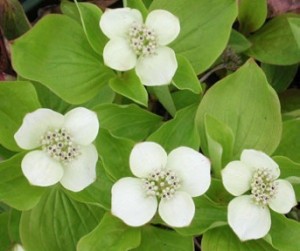
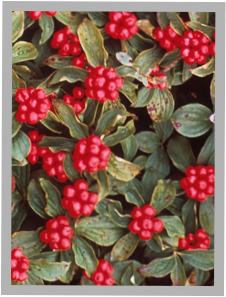
Bunchberry flowers resemble their dogwood membership

“They” were my mother and grandmother, walking along that endangered relic called a woods road. I shall try to forget that it was more than a half a century ago.  As they munched on Bunchberries my dog “Sister” and I terrorized the woods. Though not much bigger than my setter/collie I learned the difference between the Bunchberry and Doll Eyes, one edible, one deadly.

There was a continuity there which has been lost for most people. My mother, Mae Lydia Putney, picked Bunchberries because her mother, Abby Ora Blake, picked them, and my grandmother picked them because her mother, May Eudora Dillingham, picked them and no doubt learned it from her mother Abby Warren. (In most cultures women tend to be the foragers, men the hunters. It’s my father’s side that’s Greek.) And somewhere back in that line they learned it from Native Americans, and they learned it the hard way over the millennia.  Somewhere along the line we stopped appreciating or learning the experiences that were passed on, whether about plants or life.

I once had a friend in the mid-1980s tell me she was certain no one in her family ever collected wild foods. As proof she said her father, John White — now there’s a genealogical nightmare — was born in New York City in 1900.  Mr. White, whom I met,  had my friend when he was 50. “And his parents” I asked? They immigrated from rural Ireland around 1870.  “So” I said, your grandparents were foragers. In one generation the knowledge, habit. and mindset can be lost.

Not much taste but a lot of pectin

The Bunchberry, Cornus canadensis, (KOR-nus kan-uh-DEN-sis) has its champions and detractors. The particular say it has no taste. I knew two women who didn’t miss a single one. The Inuit saved them by the bushel basket for winter. For such a humble plant it has many names: Dwarf dogwood, bunchberry dogwood, Canadian dwarf cornel, pigeonberry, squirrelberry, low cornel, ground dogwood, bunchplum, creeping dogwood, cuckoo-plum, frothberry, dogberry, crowberry and crackerberry. The last two are actually the same.  “Cracker” comes from “crake” and that means crow. As if that’s not enough names it is also called the puddingberry. Why puddingberry? It was the habit in New England cooking to add a few bunchberries to a pudding to add color and help it jell. Seems the little berry has a good dose of pectin in it.

The Bunchberry is a perennial sub-shrub and is the smallest member of the dogwood family. Dwarf dogwood is native to a broad area extending west from southern Greenland across Canada and the United States the south along the Rocky Mountains. You also find it in northeastern Asia. It likes moist well-drained forest soils and can often be the dominant ground cover. It will not grow where the summer ground temperature exceeds 65F.

The “flowers” of dwarf dogwood — like most dogwood — aren’t what they appear to be. The four white “petals” are bracts that look like petals. Clustered in the center, like the berries will later be, are many tiny white to purplish flowers. They are pollinated by flies and bees attracted by the bright bracts. In late summer a bunch of round red fruit appears giving the plant its name. Their texture is mealy and each has one seed, occasionally two. While the Inuit froze the Bunchberry other natives preserved them in bear fat. The berries make an excellent jelly.

What the scientific name means is a bit of debate. Canadensis means northern North America. Cornus means horn which can mean a wind instrument or hard. The dogwood is known to make stiff skewers and dogwood is from Dag where we also get the word dagger.  Oh, they recently changed its name to Cornus unalaschkensis, KOR-nus un-uh-las-KEN-sis, named for Unalaska, one of the Aleutian Island. It looks like Un-Alaska to me rather than un-uh-las-KEE-sis.

As an aside, think of the comic character, Dagwood Bumstead.  “Dagwood” means “luminous forest” but was corrupted to  dogwood. “Bumstead” was originally Bumpstead and means a “place of trees.” So his name mean place of bright trees (and when dogwoods are in blossom) they are luminous.

A variety of birds and moose like the bunchberry, which is the fastest flower in the world. Oh, you doubt that. Well, read on.

Bunchberry found to be fastest plant

The Independent, London 12 May 2005

By Steve Connor

Botanists have identified the fastest moving plant in the world ” the bunchberry dogwood of North America.

Tests have shown that the petals of the plant’s tiny flowers can move at 22 feet per second when they open with an explosive force. The bunchberry dogwood ” Cornus canadensis ” grows in dense carpets in the vast spruce- fir forests of the North American taiga. The petals explode open to launch pollen an inch into the air, a study at Williams College in Williamstown, Massachusetts, showed. The pollen is ejected to 10 times the height of the small plant so that it can be carried away on the wind.

The scientists say in Nature: ‘Bunchberry stamens are like miniature medieval trebuchets ” specialized catapults that maximize throwing distance by having the payload [pollen in the anther] attached to the throwing arm [filament] by a hinge or flexible strap.’

Green Deane’s “Itemized” Plant Profile

IDENTIFICATION:

Spreading subshrub terminal whorls of oval, lance-shaped leaves.  Tiny bunch of flowers over four white bracts above six green dogwood shaped leaves. Flowers in May and June, sometimes in autumn.

TIME OF YEAR:

Bunch of red berries, late summer to early fall

ENVIRONMENT:

Northern forests, well drained soil, ground never warmer than 65F or lower than -28F

METHOD

Out of hand, or made into jelly.

HERB BLURB

Dogwood bark is a substitute for cinchona bark, the source of quinine, for treating Malaria


{ 9 comments }