Cultivated they're "Sunchokes" wild they're Jerusalem Artichokes

There used to be a huge patch of Jerusalem Artichokes here in Central Florida beside the Interstate. Now they’re under a new exit ramp, and that was the only place I saw them in Central Florida although they grow in northern Florida and almost all of North America except New Mexico, Arizona and Nevada.

In fact, my mother as a kid in northern Vermont used to tell about coming home after school in the fall and stopping in the kitchen only long enough to grab a salt shaker. Then she and her two brothers would run out and dig up Jerusalem Artichokes and eat away. She did it because her mother did it and her grandmother did.

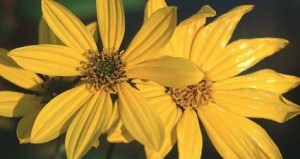
Large yellow blossoms, sand paper leaves

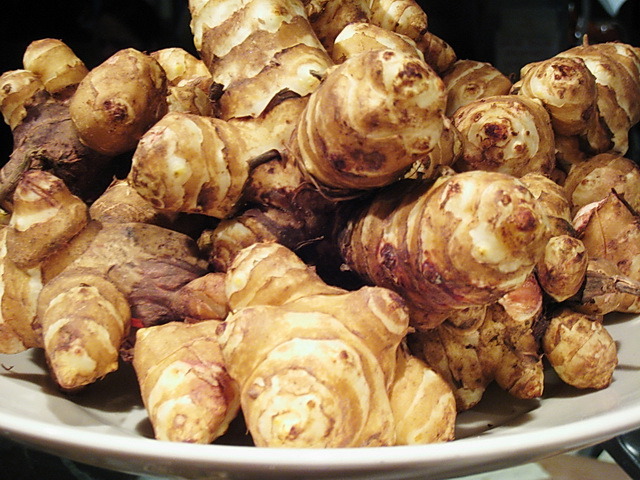
Of course, Jerusalem artichokes have nothing to do with Jerusalem or with artichokes, being in the sunflower family. They are quite easy to raise and one fascinating element about them is their carbohydrate is “inulin.” Diabetics can eat it without affecting their blood sugar.  When the plant was first discovered by Europeans they called it Girasole, the Italian word for turning to the sun, which some in the family do. Over time Girasole got mangled into Jerusalem. Recently they have been called sunchokes, a more fitting and sorter name.

The artichoke part of the Jerusalem Artichoke’s name comes from the taste of its edible tuber. Samuel de Champlain, the French explorer, sent the first samples of the plant to France, noting that its taste was similar to an artichoke. The word artichoke comes form the Arab phrase Ardi-Shoki which means “ground thorny.” The roots are very lumpy. The scientific name is quite easy to sort out: Helianthus tuberosus. (hee-lee-AN-thus  tew-ber-OH-sus.) Helianthus means sunflower and tuberosus means having tubers.

Jerusalem artichokes are about 80% water, 15% protein, 1% fat, 60% inulin, 4% fiber and 5% ash, 0.099% phosphorus, 0.023%, 3.4 mg iron with traces of aluminum, chlorine, iodine, magnesium, potassium, sulphur, zinc, vitamins B and C.

Jerusalem artichoke root is also used to produce a spirit called “Topinambur” “Topi” or “Rossler.”  Topinambour is the French word for Jerusalem Artichokes and comes from a tribe of Brazilian Indians who were taken to France about the same time as the root.

Green Deane’s “Itemizing” plant profile

IDENTIFICATION: Large, gangly, multi-branched plant to 10 feet tall, rough, sandpapery leaves and stems. Many yellow flowers.  Leaves ovate, broadest below the middle, 5-10 inches long. Flower 3-4  cinches across with 10-20 bright yellow petals

TIME OF YEAR: Showy blossoms in late summer and early fall. Pick tubes two weeks after flowers fade.

ENVIRONMENT: Almost any soil but the softer, fertile and friable the better. Grow your own! By some from the grocery story and plant in spring, even in pots.

METHOD OF PREPARATION: Raw or cooked or pickled. Tedious to clean, and overcooks easily.  Excellent grated raw into salads, boiled lightly similar to potatoes, will make make French fries and creamy soup. Can be roasted but eat immediately after cooking as they grow mushy in a few minutes.

{ 57 comments }

Glorifying Morning Glories

Three of the pictures below are are not of the same Ipomoea. It’s three different species, but that should tell you something. When you see a Morning Glory species with a large, white blossom and a ruby throat it is worth investigating. Large white Morning Glories flowers without ruby throats are worth investigating, too. Other color blossoms are more iffy.

A word of warning:  There are several edible and several inedible Morning Glories and impostors. They can all be easily sorted out so do your homework. When you find a possible edible take a picture and research it!
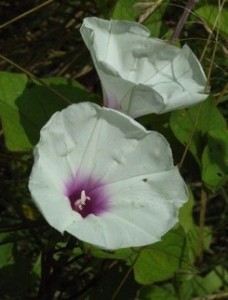
Ipomoea pandurata, Wild Potato Vine

Ipomoea pandurata (eep-oh-MEE-uh  pand-yoor-RAY-tuh, shaped like a fiddle)  is native to Florida and the eastern half of North America. It has a large root that can be eaten if cubed and boiled in at least two changes of water. Never eat it raw. It is also called Wild Potato Vine and “Man of the Earth” because it can create huge roots. Younger and smaller is better. Young roots can also be roasted but they will be on the bitter side.  Boiling twice is the preferred method, then roast the boiled cubes if you like. Usually straight down deep from where the vine goes into the ground you will find the root. Yard-long roots weighing 25 pounds are possible. But, they get more acrid the older they get so if you can find an big old one you might want to let it be and look for a smaller younger one nearby.

I looked for I. pandurata for many years before I found one, being constantly misled by the iffy Alamo Vine. My friend and teacher, Dick Deuerling spoke of the I. pandurata often but all I ever saw was the very common Alamo Vine.  Then one day while on the Orange County Bike Trail near Chapin Station there it was (such moments are important and remembered.) Now I see them often. Leaves are heart-shaped.

The I. pandurata has two similar looking plants. They have white flowers as well. The key to sorting them out are the leaves and flower size. The aforementioned Alamo Vine (Merremia dissecta) has small white flowers with a ruby throat and very dissected leaves that are shaped like fingers on a hand, read palmate. While not edible per se the Merremia dissecta is not totally with out some good features. It has been used as a condiment and for medicinal needs. Leaf extracts have an almond flavor from amygdalin, a cyanide precursor also called natural laetrile. Needless to say it can be toxic stuff if handled poorly either as a flavoring or a medicine. I offer no instruction on that. Crush a leaf and smell it. If you smell almonds you have the M. dissecta. That said, the young roots of a relative, Merremia dissecta var. edentata, are cooked and eaten but it only grows in central South America. The M. dissecta edentata leaves are not toothy and the flower’s throat is not ruby. The name Merremia may be from the name Miriam, meaning Mary, or Virgin Mary plant, said me-REE-mee-uh. Dissecta is said dy-SEK-tuh and means dissected. Edentata, e-DEN-tay-tuh, is toothless.
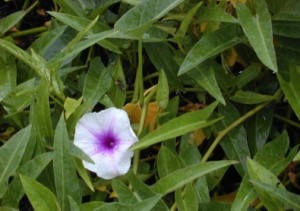
Ipomoea aquatica, Water Spinach

Our next Morning Glory on the white and ruby line up is Ipomoea aquatica, (eep-oh-MEE-uh a-KWA-ti-ka, water loving.) It’s a native of China called “water spinach.” If you do find it, depending where you live, you’re expected to report it because it grows aggressively. Where fresh water doesn’t freeze, such as Florida, it is colonizing the waterways. In northern areas, winter keeps it in check.

There are two versions of I. aquatica, narrow leaf and wide leaf, both are edible. And actually they come in two colors. The “green” version has green stems and white flowers with red throats. The “red” version has purple-tinged stems with pink or lilac flowers with red throats. They both grow only in water, or very damp soil. The vines, with milky sap, can reach up to 70-feet long (the state of Florida says only nine feet.) Shoots and leaves are the edible parts. You will not find this in dry areas.

Recognized as a potential problem in Florida since the 1950s, I. aquatica has been introduced into the state several times since 1979 by various Asian communities.  It is raised as a vegetable in Florida under strict conditions and only for out-of-state sale. It is also cultivated in Texas, Hawaii and California. In the United States it is found in the wild in (mostly central west) Florida, Hawaii and Puerto Rico.

Should you find it do your best to stop its spread by devouring said. It’s the civic thing to do. It can be eaten raw when found in wholesome water. Otherwise, it should be cooked. The leaves are 48% carbohydrates, 24% proteins, 13% ash. They are rich in minerals and a good source of  vitamins A, C and E. It is a major food crop and vegetable in the Orient. The roots are sometimes eaten. Like other members of this family, they are toxic to horses.
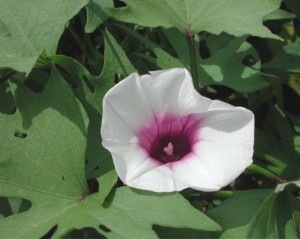
Ipomoea batatas, the Sweet Potato

Our third similar Morning Glory is the common cultivated Sweet Potato, Ipomoea batatas (eep-oh-MEE-uh  bah-TAY-tas.) As we already know the root is edible but so are the leaves, cooked like a green. There’s a huge variety of them you can raise. More so, in the winter time if you have a sunny window, you can put a root in partial water and will will grow greens for you through the winter. The Sweet Potato is mistakenly called yams.. well… that’s not originally true. More than a century ago the marketing decision was made to call Sweet Potatoes “yams” because true yams, of the Discorea genus, were widely eaten. That moved into common language and now, wrongly, the Sweet Potates are sold as yams and true yams are sold as yams, but rarely canned in this country. To make things worse in other countries the root of the edible  Oxalis tuberosa, is also called a yam.

Another white and red combo is rare so no picture, Ipomoea macrorhiza (large root) a perennial vine from large tuber. The rare night-flowering morning glory is found in coastal areas of the southeastern US. It was presumably introduced from the Yucatan by aboriginal inhabitants before Columbus. Found on Indian shell middens, large roots were cooked, might be edible raw. Plant has attractive crinkled foliage and large white to pale pink flowers which bloom at night like moonflower, which is up next.
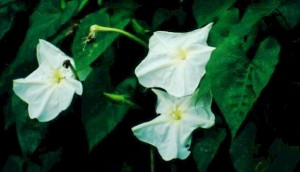
Ipomoea alba, Beach Moonflower

We keep the large white flower but abandon the ruby throat. We have two examples which are very similar. The first is Ipomoea alba (eep-oh-MEE-uh AL-buh, white) a night-blooming morning glory with a very fragrant, luxurious flower. Its sepals are mucronate ( that is having a fine point often rising abruptly at the tip.) Note it is a white flower without any color in the throat — okay a little yellow maybe — though it has a five-star like greenish wrinkling or folding on the top of the blossom, technically called midpetaline bands. The leaves are heart-shaped. Nicknamed, Moonflower, the young leaves and fleshy calyces are edible when cooked. They can be boiled or steamed. They can also be dried for later use.  Seeds edible when young. Incidentally, it takes the flower about a minute to open. It is also sometimes called Calonyction album. The raw leaves can be used like soap. Looking nearly identical is the Ipomoea tuba, (eep-oh-MEE-uh TOO-bah

I. tuba, aka Beach Moonflower, has has thicker leaves than the I. alba and likes a coastal environment, such as mangrove swamps. It is used the same was as I. alba. I. tuba is found from about St. Petersburg Fl. south on the west coast of Florida. To help identify it from the I. alba where their range overlap the sepals of the I. tuba are NOT pointed but are round and blunt.  Incidentally the white sap of the I. alba and I. tuba might cause dermatitis and was used in the early rubber-making process. “Tuba” in Dead Latin means trumpet. Ipomoea macrantha (ma-cra-ANN-tha, large flowered)  not pictured, also looks similar to I. alba and can be used the same way as I. alba.
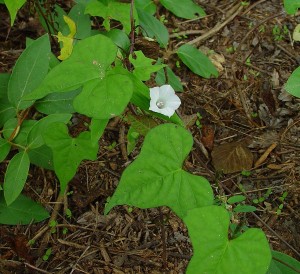
Ipomoea lacunosa, Whitestar Potato

Do you remember the first Ipomoea in this article, the I. pandurata, the Wild Potato Vine? The Whitestar Potato is similar except small white flowers and heartshaped leaves.  The cooked root of the Ipomoea lacunosa, was eaten by American Indians in central and eastern North America and California. Also consumed were the young roots of the Ipomoea leptophylla , boiled or roasted. Roots over three-years-old were not eaten. I. plummerae (which has grass-like leaves) was another cooked root food of the Amerindians.
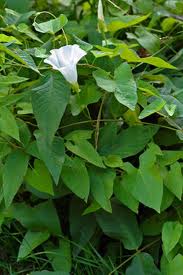
Calystegia sepium, Hedge Bindweed

The Hedge Bindweed (Calystegia sepium) has small white flowers often without a red throat. It has triangle shaped leaves and climbs counter clockwise. The bindweed stalks, young shoots and root are edible cooked, green parts steamed or boiled, roots boiled. However, it can be purgative so regular eating of said is not recommended. The name is from the Greek kalyx (calyx) and stegon (cover), referring to the bracts that conceal the calyx, pronounced kal-ee-STEE-jee-uh or kal-ee-STEG-ee-uh.  Sepium, SEE-pee-um, of the hedges. The blossoms can also have a pinkish tinge.
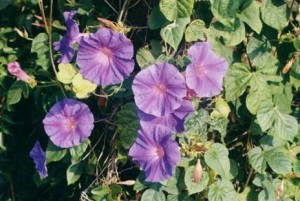
Ipomoea violacea, Morning Glory

The Ipomoea violacea (vye-o-LAY-see-uh, violet) is a bit of a chameleon, it can range in color from white to blue under cultivation (aka Ipomoea tricolor) but in the wild it tends to be violet. It’s used the same way as the I. alba, that is young leaves and fleshy calyces are edible when cooked. They can be boiled or steamed. They can also be dried for later use.  Seeds edible when young, cooked. Raw leaves can be used like soap. This is the Morning Glory of drug culture fame. The raw seeds have a little amount of a crude form of LSD.
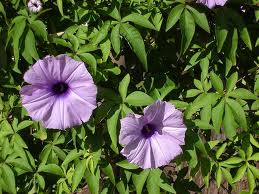
Ipomoea cairica, Mile a Minute Vine

 Ipomoea cairica, (KY-rik-uh, from Cairo) is naturalized from Africa. Called the Mile-A-Minute-Vine it has edible roots and stems though they are slightly bitter and both are slightly cyanogenetic.  Its flowers range from violet-purple to light pink to white with a pink  or red throat. The leaves while called ivy-like look more palm-like to me with deep lobes of five to seven. Roots were boiled, or, grated then roasted, no doubt to drive off the cyanide. The fruit of the I. cairica (holding the seeds) is used as a soap, just crushed against the skin and water applied. It creates a lather.  Animals known to eat the plant raw include giraffes, goats, rabbits, guinea-pigs, and pigs. It is apparently toxic to horses.
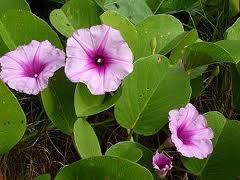
Ipomoea pes-caprae, Railroad Vine

Ipomoea pes-caprae (goat foot) or Railroad Vine, Beach Morning Glory and Goat’s Foot Morning Glory, is often found on the sandy seashore. Its cooked roots, stems and leaves can be eaten in small amounts as a famine food. It is extremely common and usually the only Morning Glory found along the eastern shore of Florida, literally on the beach. One of its claims to fame is that it can reach 100 feet long or more.
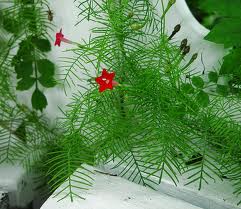
Ipomoea quamoclit, Cypress VIne

According to Kew Gardens also eaten are the cooked leaves of the Cypress Vine, Ipomoea quamoclit (KWAH-moe-klit, the Mexican name),  though they may make you sleepy and are cyanogenic. They definitely must be boiled. Leaves of the Ipomoea obscura (ob-SCUR-ah, dark) are eaten either in soups or as a cooked vegetable, and leaves of the Ipomoea involucrata are eaten cooked like a green. (in-vol-yoo-KRAY-ta, a reference to its bracts.)  Some subspecies are more forgiving on the gastrointestinal track. On the other side of the world the Ipomoea digitata (finger-like) has edible oblong tubers and leaves when cooked. It is not found in the Americas.
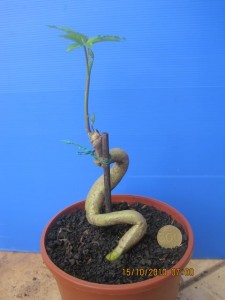
Ipomoea digitata, Vidhari Kand

There are several hundred species in the Morning Glory group and it is suspected that most of them have edible leaves and other parts. But don’t guess. Check out your local species with an expert.

Seeds of the I. tricolor, I. pandurata, I. nil, I. violacea and I. tuba have been used for their hallucinogenic properties. In the state of Louisiana the I. tuba became illegal in 2005 to cultivate for any purpose other than ornamental. A close relative of the Ipomoea is the Jicama, which has toxic seeds. All part of that plant above ground have high amounts of rotenone, a fish killer.

The genus name, Ipomoea, is mangled Greek via Dead Latin. Ipo is often said to come from Ips and means worm but that’s just linguistic illiteracy among botany professors. To say it means “worm” is stretching it. The basic word is Ipo which means below, beneath or under. Homoios is perverted via Dead Latin as well. The basic word in Greek is omoio not homoios. It means “similarity.”  Ipomoea means “resembling underground” as in the sprawl of a root, or perhaps the tunnels of a worm.  Batata is going to take some explaining:

When Columbus landed on Haiti the natives there, the Tainos (Arawaks) called the root “batatas” which literally means potato. The Spanish changed that to Patatas. When the Spanish later saw the white potato they called that Patatas as well. That changed in English to potato. So, the white potato was named after the Batatas and became potato but now in English we call Batatas the Sweet Potato. And worse, of course, is calling the Sweet Potato a yam, which it is not. Yams are from a totally different family, the Dioscorea.

{ 28 comments }

Henbit, brief salad green of spring

Henbit: Springtime Salad Green and More

It was a zig and a zag for me. I heard the name as an edible for many years and saw the plant often but never put the two together until one spring I was picking chickweed and saw this plant yet again and decided to look it up then give it a try. Now it is one of those great little edibles of spring.

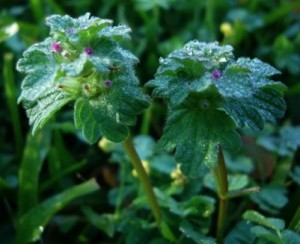
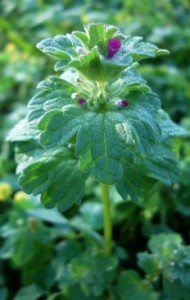
Note heart-shaped scalloped leaves that grasp the stem

The henbit is a member of the mint family. If you remember from my first blog and my second video all mints that smell like a mint and look like a mint are edible, but they must do both. There are a lot of mints that do not smell minty, some of them are edible and some of them are not. In fact, some of the mints can make you ill.  Henbit does not smell minty, but it is an edible mint.  By they way, there are no poisonous look alikes. As for toxicity, we’re safe but it has causes “staggers” in sheep, horses, and cattle.

Its botanical name, Lamium amplexicaule (LAM-ee-um am-plex-i-kaw-lee) causes much confusion. As usual, there isn’t much problem with the species name, amplexicaule, which means “clasping” or in this case how the leaves grab the stem. It’s the genus name, Lamium, that causes problems. Most writers say it is Greek through Latin then define it to means a thin layer, plate or scale, or in this case the corolla tube between two lips. Unfortunately, that is not correct. And at this point remember that another common name for Henbit is Giraffe Head.

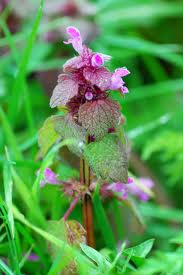
Edible Dead Nettle has triangle shaped leaves

“Lamina” is Latin, from which we get the English word “laminate.” It would be fine to say “Lamium” comes from the Latin word “Lamina.” But when you say it comes from Greek Lamium would come from a totally different word, “Lamia.”  “Lamia” was the name of grotesque creatures in Greek mythology and means “female man-eater.”  The little flower can resemble creatures, if you have an imagination.

The common name, Henbit, is like chickweed and comes from watching chickens liking it. They’re not alone. Humming birds like it, too, but for nectar, and Henbit can be used for erosion control.

Henbit can sometimes be confused with Purple Dead Nettle, above, which is also edible. The difference in the two can be seen in the leaves. Henbit has heart-shaped leaves with big scalloped edges that grow along the entire length of the stem. The Purple Dead Nettle (dead in this case means not stinging) has more triangular shaped leaves that grow in a big clumps. Both are very nutritious, high in iron, vitamins and fiber. The seeds of the Purple Dead Nettle, Lamium purpureum, (LAM-ee-um  per-PER-ee-um)  have antioxidants and presumably the L. amplexicaule would as well.

As an aside, I have a tenuous connection with Lamium purpureum. Purpureum is Latin for purple, and of course, was taken from a Greek word for a particular shellfish. In Roman times purple dye was extremely expensive, and only the royal family and senators and the like could afford it. It was expensive because the dye had to be collected from tiny saltwatershellfish in Greece, the porphyra. More so, only the miniscule anal gland of porphyra had the purple dye so it took tens of thousands of them to make enough dye to dye clothes. (It does make one wonder who noticed the purple color in the first place.)  In

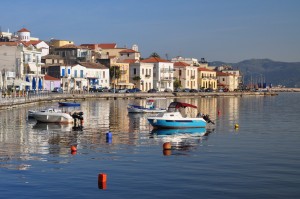
Gythio, Greece, ancient exporter of purple dye

Gythio, in southern Peloponnesos, there still stands the little ruins where the Greeks made that dye thousands of years ago. It’s directly beside the main road into town from Sparta and would be dismissed as trash if not for the a little clearing and a sign. My ancestors are from that area. Who knows, maybe one of them crush some shellfish so some important person of the day could have a purple robe. In fact, my Greek family name can be poetically translated into “master gardener.” A more literal  translation is “Caesar of the Hoe.”  One linguistic factorid: Did you know “caesar” means bald?
Henbit has been an esteemed vegetable for a long time. Their mild, sweet taste stands in contrast to the crisp leaves usually put in salads. John Gerard, the English herbalist for whom the Geradia is named, wrote of Henbit some 400 years ago: “The floures are baked with sugar as Roses are, which is called Sugar roset: as also the distilled water of them, which is used to make the heart merry, to make a good colour in the face, and to refresh the vitall spirits.”

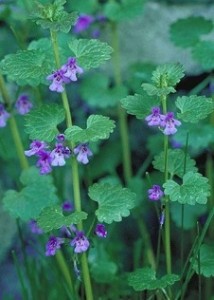
Don’t confuse henbit with Ground Ivy, Glechoma hederacea, above left, which has much larger flowers.  It, however, is also edible is small amounts, raw or cooled, and the leaves are used for tea. Ground Ivy leaves are also made into aromatic sauces.

SPICY HENBIT

Chop four cups of shoots, cover with water, boil 10 minutes. In a separate pan melt three tablespoons butter, add one teaspoon curry powder, two whole cloves, and a quarter teaspoon of ground cinnamon. Stir and cook for one minute, stir in two tablespoons of flour and cook one more minute. Add a half a cup of boiling water from the Henbit, stir until smooth. Drain and add the boiled Henbit  and 3.4 cup sour cream. Cook on low for 15 minutes.

Green Deane’s “Itemized” Plant Profile

IDENTIFICATION: Multiple square stems from a taproot, to six to eighteen inches, purplish near bottom,  greenish near stop. above. spreads indefinitely in all directions, leaves opposite, hairy, scalloped, flower pale pink to purple to red, spotted on lower lip, no aroma, tiny purple hairs on the upper part of the flowers. Don’t mistake for ground ivy which is hairless.

TIME OF YEAR: Springtime in temperate climes, February and March in Florida, found throughout North America into arctic circle.

ENVIRONMENT: Waste ground, lawns, cultivated fields, pastures, roadsides, railroads, can created a bed of purple. Tolerates most soils and conditions.  Can grow under shrubs where grass won’t.

METHOD OF PREPARATIOIN: Young leaves, raw or cooked, added to salads or as a potherb. No poisonous look alikes. Stems and flowers are edible, too.

{ 61 comments }

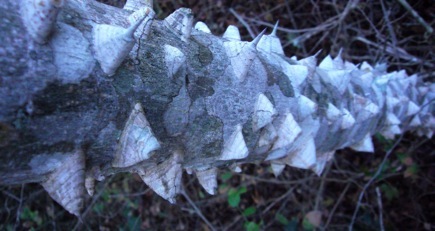
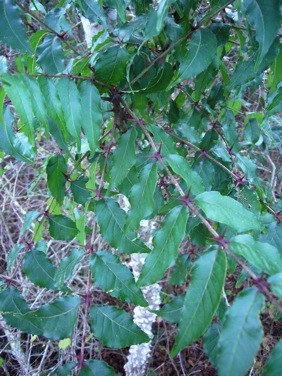
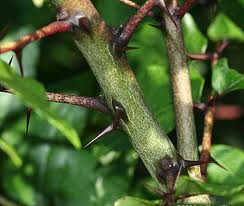
The spine-covered trunk of a Hercule’s Club, photo by Green Deane

Hercules’ Club: Zanthoxylum Clava-Herculis

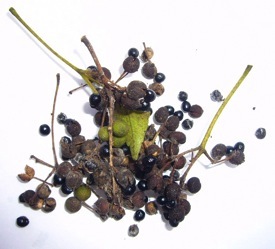
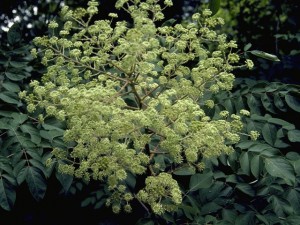
Hercule’s Club Berries, Photo by Green Deane

I sometimes feel sorry for my neighbors, who have lawns of decapitated grass. I’m sure my wild-looking but well-planned yard bothers them but I have the yard of the future, and they of the past.

When I moved into this cul-de-sac house a dozen years ago, it was 1960s suburbanized, read lots of august Augustine lawn, obligatory dwarf legustrums, sago palms (cockroach high rises) and no privet privacy. Since then I’ve managed to get rid of most of the lawn and standard drudgery shrubbery. In their place is an edible landscape, including numerous trees. Every bit of green I’ve planted is consumable in some way, from Amaranth to Zanthoxylum, the latter a  magnificent Hercules Club, now some 30 feet high.


Thorny foliage smells like toothache drops, Photo by Green Deane

The full botanical name for the Hercules Club is Zanthoxylum clava-herculis, which in bastardized Greek — my term for Dead Latin  — means “yellow wood club of Hercules.”  The roots of The Club are indeed yellow but very weak, not at all Herculean. They are easily broken by hand. Quite odorous, they also appear to be barkless. The “clava” part, the club, comes from Hercules’ weapon of choice,  a club that grew spikes, and the Zanthoxylum has spikes: All over its trunk and branches. Mythology aside, The Club has been used to treat toothaches for thousands of years, with a natural kind of topical Novocaine found in all parts to varying degrees.  The Club also has chelerythrine, which in the lab is effective against  resistant staphylococcus, a little nasty bug one picks up in hospitals.

The Club protects itself

American natives used The Club,  for a range of ailments.  A bark decoction was used for venereal disease; the bark, wood and leaves for toothaches, and a decoction of boiled roots was also used to increase perspiration. Indians and settlers mixed the inner bark with bear fat and used it as a poultice for ulcers and a treatment for itches.  Ripe berries were seeped in hot water to make a spray used in the mouth and blown on the chest and throat for chest ailments.  The bark was also used for inflammations of the throat.

What its leaves, bark and roots, taste and smell like is a matter of subjective debate. Some say its smells like lime, others bitter lime. To me it smells just like Ambersol, the toothache application you can buy in drug stores…or …Anbersol smells like The Club. The tree is also covered with thorns which means kids and other climbing animals leave it alone. One creature, however, that is not deterred by the thorns is the larvae of the giant swallowtail butterfly (Papilio cresphontes). All stages of the caterpillar like the tree. The Club

Late spring blossoms

blooms in early spring. In fact, as I write it is late February and it is readying to blossom. Each tiny flower turns into a fruit that dries and splits to reveal a shiny black seed, see photo upper left. Some folks use the seeds of a closely related species, the Prickly Ash (Z. americanum) like hot peppercorns, and some think the seeds from The Club can be used the same way.   Z. clava-herculis
seeds taste medicinal to me besides peppery. I also boiled and dried them as recommend. Again mildly medicinal.  Some however, heat the seeds in salt then use the salt and seeds as a dipping material. One can also eat a fruit or two as a aromatic nibble (the intense taste will go away in an hour or so.)

Surprisingly, The Club is cousin to the non-native citrus. small world.  My particular tree has travelled quite a lot. It was first rescued as a sapling from a bull dozer in Daytona Beach in the early ’90s, Port Orange to be specific. It then spent a few years in Lake Mary, Fl., and a clone from that tree is now in Maitland, some 70 miles from where it started.  One doesn’t see them too often but when you do there are usually several around, like a dispersed colony. The national champion  is 7.5 feet around, 38 feet high, and currently residing in Little Rock, Ar., USA. Its name is said: zan-THOCK-sill-lum CLAY-va-her-KEW-lis.

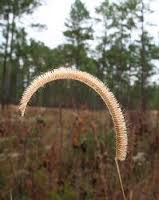
Florida Orangegrass


Incidentally, if you live in The South there is a grass that can also ease the pain of a toothache, Florida Orangegrass, Ctenium floridanum. (TEN-ee-um flor-re-DAY-um, from the Greek xteni, hah-TEN-nee, meaning comb, read all the seed heads on one side.)

My Club shades my Florida Room, below, which has a trash-bin granite floor ( notice my helper, Oliver Whitecat, in the chair.) Tons of broken and end-pieces granite are thrown away every day. All one has to do is a little dumpster diving to get it. In this case a few early Sunday mornings. Not only do I have a granite floor, but four walkways as well. Now that’s recycling!

One last thing: The Club is related to Szechuan pepper. In that case the seeds and shell are used for flavoring whereas with The Club it is just the seed shell.

Green Deane’s “Itemized” Plant Profile

Florida room with counter-top granite floor rescued from the trash. Photo by Green Deane

IDENTIFICATION: Young growth covered with spikes, leaves alternate, pinnately compound, 7-9 narrowly elliptical to lanceolate leaflets with round-pointed teeth, waxy-shiny above, light green below, 5-8 inches overall

TIME OF YEAR: Inner bark available year round, leaves except for winter. Seeds, summer.

ENVIRONMENT: Well-drained, dry sandy spots, full sun to some shade.

METHOD OF PREPARATION: Leaves and inner bark for topical use against toothaches.  Seed shells might be used like pepper but this is not an endorsement of that practice. Some heat the seeds in salt (in the oven) and use the mix as a dipping material (like a sauce.) A potentially toxic tree, approach accordingly.

{ 26 comments }

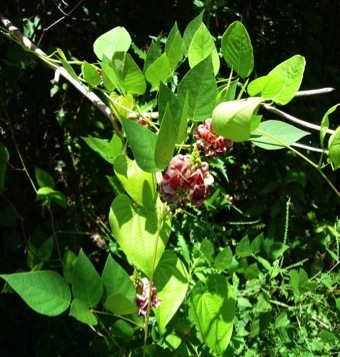
Groundnuts, a weak vine with maroon pea flowers

Groundnuts: Dig ’em

I will never forget the first time I dug up Apios americana, groundnuts. I got poison ivy for the first time, too. Oddly it showed up in the crook of one elbow, then the next and then behind both knees. Fortunately it took 24 more years before I got my second case of poison ivy.

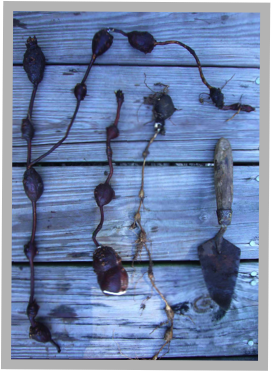
Unmistakeable tubers on a string, note 6 inch trowel

Groundnuts were highly esteemed by the first European colonists.  But, their two-year growth cycle kept them from becoming a commercial crop, and now only foragers enjoy them though there is some interest in going commercial with them and they have been under agricultural study. Groundnuts are a prime wild edible that’s hard to misidentify. They’re like beads on a string except they are are larger and farther spread out, with the spacing irregular.  The “string” can also branch off. But, once you find the string you are on to them and all you have to do is dig them out of the other roots.  To find them I look for the vine climbing bushes and trees. It is unmistakably in the pea family. The vine can grow up to 20 feet a year. It’s thin, about an eight of an inch through, covered with fine hair, and tough for its size.  The leaves are pinnately compound, sometimes folded in the midrib, and have three to nine two-inch leaflets with no teeth (five leaves are the most common.)  The flowers are lavender to brown and fragrant, similar to lilacs some say, some say violets. Franky I think their aroma is not pleasant. When in blossom the vine is unmistakable between the color and shape. And of course, the root arrangement makes it nearly impossible to misidentify. Incidentally, it is the preferred plant for the Silver-Spotted Skipper so if you can recognize one of those, follow it.

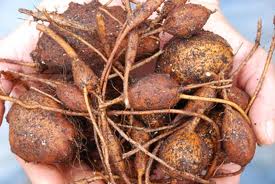
Groundnuts are usually egg size

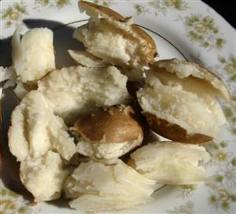
The flowers are edible raw or cooked and the seeds are edible cooked, shelled first. Some writers say the tubers are edible raw but that only tells me they never tried to eat one raw, or coped with the gas that produces. Groundnuts have a bitter latex in them and should be cooked first. They also have some “anti-nutrition factors” including protease inhibitors which cooking neutralizes. I prefer to boil them first and then use them otherwise, such as for frying. Groundnuts definitely taste better when they are hot. Their texture and flavor degrades as they cool though they can be warmed up again. Groundnuts can be pea size to baseball size, smooth or lumpy. Most of the ones I find look like dark brown lumpy eggs. First year groundnuts are light yellow to reddish brown, and small. Second year, larger, darker, coarser. All are edible and peel like a tough potato. Groundnut also contains genistein, a known anti-carcinogenic compound. The Indians made a plaster out of it (cooked) for external cancers.

Boiling can burst the groundnut

The groundnut was a very important food for the Indians. Some mixed it with acorns. Each tribe had a different related name for it. The Powhtan called it ouhpnhhauk which phonetically became ohpen. The Delaware called it hopenis, the Fox, ahpenya, the  Menomini, ophen,  the Ojibwa, oppin, the Penobscott, ppan (that is not a typo) and the Shawnee peneeakee.  Some French-speaking Canadians still call it penacs.  In fact, Sag Harbor on Long Island got its name from groundnuts. The local tribe, the Metoac Algonquins, abandoned the theme of the rest and called them sagabon. It was also called Indian Potato from about 1626 on, along with many other roots. Then it was Indian ground nut, then groundnut and by 1787, Apios americana.  Apios (AH-pee-os) is Greek for pear, because they can be slightly pear-shaped, and americana (ah-mer-ree-KAY-na) means American.

Groundnut distribution map

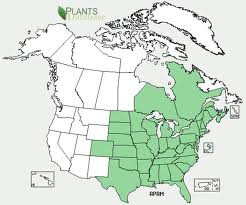
The groundnut grows throughout eastern North America west to Colorado. It likes crowded wet areas, usually near rivers, streams, and lakes. If you see Elderberries there is a good chance there are groundnuts there. Poison Ivy also likes that environment so beware. They can be dug any time of year, and are usually just under the surface. Start where the vine enters the earth near a bush. That’s usually where the largest tubers are, but that is not always true, and roots can crisscross like cattail roots do. First year tubers peel easily, second year are more stubborn. Cut out any dark spots. Also look for exposed ground nuts after river flooding.  In Northern states they come out in June/July and are gone by September. Here in Florida they are flowering by late spring and carry on until late fall.  In fact, the first time I found one I was wandering around a stream and smelled an interesting fragrance and saw the ruddy blossom. That exact spot is now covered with a huge house.

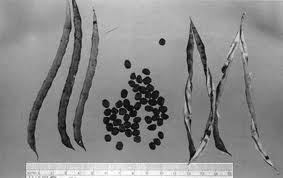
Groundnut has long pea pods

The tubers can be up to 17% protein and have similar amino acids to beans, the predominant amino acids being aspartic acid and glutamic acid. The seeds can have as much as 25-30% crude protein. The favor to me is like a yam (Dioscorea not Ipomoea) with the texture of boiled turnip. Many, copying botanist Merritt Fernald from a book older than me, Gray’s Manual of Botany, report it has a turnip flavor. I think that is an exaggeration, but I can understand why they say that. Once boiled groundnuts can be used like potatoes but it is not a potato flavor nor does it have the starchiness of a potato. I enjoying slicing up boiled A. americana and frying them. Boiled then roasted groundnuts can be ground into a flour.  As always, try a little first and make sure it agrees with you. Some people have a bad reaction to the groundnut, causing them to lose fluids from both ends. I suspect that comes from under cooking the latex or an allergy. Be careful. Try a little first. Curiously, a government data base offers a false nutritional profile of the goundnut. Someone got their data mixed up and gave groundnut the same nutrition as the peanut. 

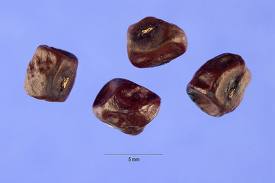
Groundnut seeds

One warning, some people have eaten groundnuts for years with no problem and then have a reaction to it. It is not common but it does happen. A few, perhaps five percent, have an immediate reaction to it. Whether it is an allergy or the way the groundnut is grown is not known. So, be careful.

There is actually an Apios in China and two more in North America. There used to be more here but botanists think most are a variation of the A. americana. The other one is A. priceana. It likes open hardwoods forests, rocky, drained soil, and only grows one large root and has pink to white flowers. Called “traveler’s delight” is is found sporadically in Mississippi, Alabama, Tennessee, Kentucky and southern Indiana. Named after Sarah France Price, its discoverer, it is “endangered” because of loss of habitat. Please don’t eat it should you find one. (I have two videos about the groundnut. Here’s the first one, and the second one. )

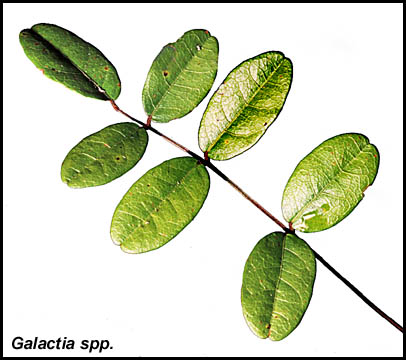
Milk Pea, Galactis spp., not edible

One word of caution: Don’t confuse the groundnut with the non-edible Milk Pea. Our local our Milk Pea, Galactia elliottii, has leaflets of five to nine though five and seven are common like the groundnut. However the Milk Pea likes dry ground, usually pinelands or open sandy soil. More so the Milk Pea has white flowers, sometimes tinged with pink. Its leaves also have round tips whereas the Groundnut’s leaves are pointed. There are 11 different species of Milk Pea, many of them are difficult to tell apart, some with pink blossoms and purple flowers. The most common milk peas grow from Texas to Florida and north to New York and Kansas. Also don’t confuse it with Vigna luteola, the Hairy Cowpea, which has leaflets of three and yellow blossoms. However the Hairy Cow pea blossoms and seeds can be eaten cooked.

If you want to grow ground nuts they can be started from seed or tuber. Oddly, while one finds groundnuts in water-logged soil they grow best under cultivation in well-drained soil. To quote Purdue’s new crop proceedings of 1990:

“Most of the research involving cultural practices has been directed towards developing techniques to screen large numbers of plants. Direct-seeding has presented problems. Seeds may take 10 to 30 days to germinate. Seedlings are small and early seedling growth is not vigorous. Seedling death, presumably from insects or diseases, has plagued this technique for starting apios. The most satisfactory method has been to start plants in peat pellets. After germination, when the shoots begin elongation, the plants are pinched back to the first leaves. This prevents the plants in a flat from twining on each other, allows for better root development prior to planting, and permits plants from slower germinating seed to reach sufficient size to transplant. However, pinching back carries a potential risk of spreading disease among the seedlings. Weak seedlings can be discarded at this stage.

Tubers are planted intact. The buds that give rise to the shoots and rhizomes occur at the distal end of the tubers. The potential of dividing tubers into sections prior to planting needs evaluation. Generally the larger the tuber, the more rapid the early growth.

Seeds may be harvested from the time the pods first begin to dry. If left on the vine too long some pods will shatter  Tubers are harvested after frost. Since most of the plants are different (originating from seeds), the tubers are harvested with a shovel to insure that genotypes can be evaluated individually. Fortunately, tubers can remain in the soil for extended periods without rotting even under water-logged conditions, thus allowing an extended harvest period.

Although apios in its native habitat is found growing on water-logged and acidic soils (Reed and Blackmon 1985), observations under field conditions indicate that apios grows best on well-drained soils. A pH less than 5 or as high as 8 may also be detrimental to growth. Adequate moisture is important, but excess moisture encourages longer rhizomes.”

Groundnut and Olive Stew

8 to 16 oz boiled groundnuts

one can or about 16 oz olives (California or Kalamata, reduce salt if using Kalamata olives.)

One can or about 16 ounces chopped tomatoes

One large onion chopped

Garlic to taste, I add several whole cloves.

Broth or water to cover. If you use commercial broth compensate for the added salt.

Olive oil for flavoring, approximately 1 tablespoon, and pepper to taste

Optional: One lamb shank or about 12 ounces of meat. Cuts that respond to slow cooking are the best

Salt to taste

First cook large-cut groundnuts in a lot of water until done, about 40 minutes. Drain. Put all of the ingredients into a pot and cook until done. If not adding meat, cook until the flavors marry, usually about an hour on medium heat. If cooking with meat, cook on low heat until it is tender, two or three hours.  Serve with hearty bread and red wine.

 Green Deane’s “Itemized” Plant Profile

IDENTIFICATIOIN: Climbing vine to 20 feet,  pinnate leaves with 3-5-7-9 leaflets about two inches long, five leaflets is the norm. The flowers are red-brown to purple, very fragrant, pea-like wings and keel. Seeds in a pod. Roots like beads on a string.

TIME OF YEAR: In most climes blossoms in summer, sets fruit all the time. In Florida blossom sooner and sets longer.

ENVIRONMENT: Where you find Elderberries you can find groundnuts. They like the moist soil near streams and bodies of water, places usually populated with poison ivy and mosquitoes.

METHOD OF PREPARATION: Peel and boil like you would a potato then use like a potato, or slice raw and fry. But they must be cooked for raw they can be bitter and contain latex.  Do not cook in an aluminum pot. Beans are edible when shelled and cooked. Rat studies show they thrive far better on cooked groundnuts than raw groundnuts. Tubers can be stored up to 15 weeks in the refrigerator without any significant loss of quality. I prefer to boil them first and then use them otherwise, such as for frying.

 HERB BLURB

Dep. of Plant Pathology, Univ. of Missouri, Columbia, MO:  American groundnut (Apios americana Medikus) is a nitrogen fixing legume that produces edible tubers and seeds. Even though studies have been conducted on the quality of tuber storage compounds, very little is known about compounds that could have beneficial effects on human and animal health. The objective of this study was to investigate the presence of genistein in the tubers. The nodC gene of Rhizobium fredii Scholla and Elkan USDA191 that had been fused with ß-galactosidase was used to detect the presence of genistein in A. americana tubers. The flavonoids from A. americana tubers were purified by C18 reversed-phase HPLC. The HPLC profile revealed nine UV absorbing peaks. Among them, Peaks 6 and 8 activated the nodC-lacZ gene fusion about two fold, while the bulk of the inducing activity was associated with Peak 9. The compound in Peak 9 and authentic genistein standard had identical retention times. When A. americana tuber flavonoids were spiked with an authentic genistein standard, Peak 9 coeluted with genistein. In addition, a peak at m/z 271, corresponding to the protonated genistein, was found when the HPLC Peak 9 was analyzed by electrostaticspray mass spectrometry. The results of this present investigation indicate that A. americana tubers contain the isoflavone genistein. The discovery of genistein in A. americana tubers should rekindle interest in this legume as a food crop since genistein has been shown to reduce the incidence of various forms of cancer.  Contribution from the Univ. of Missouri Agric. Exp. Stn., Journal no. 12703, Columbia, MO 65211. Received for publication November 13, 1997.

{ 17 comments }