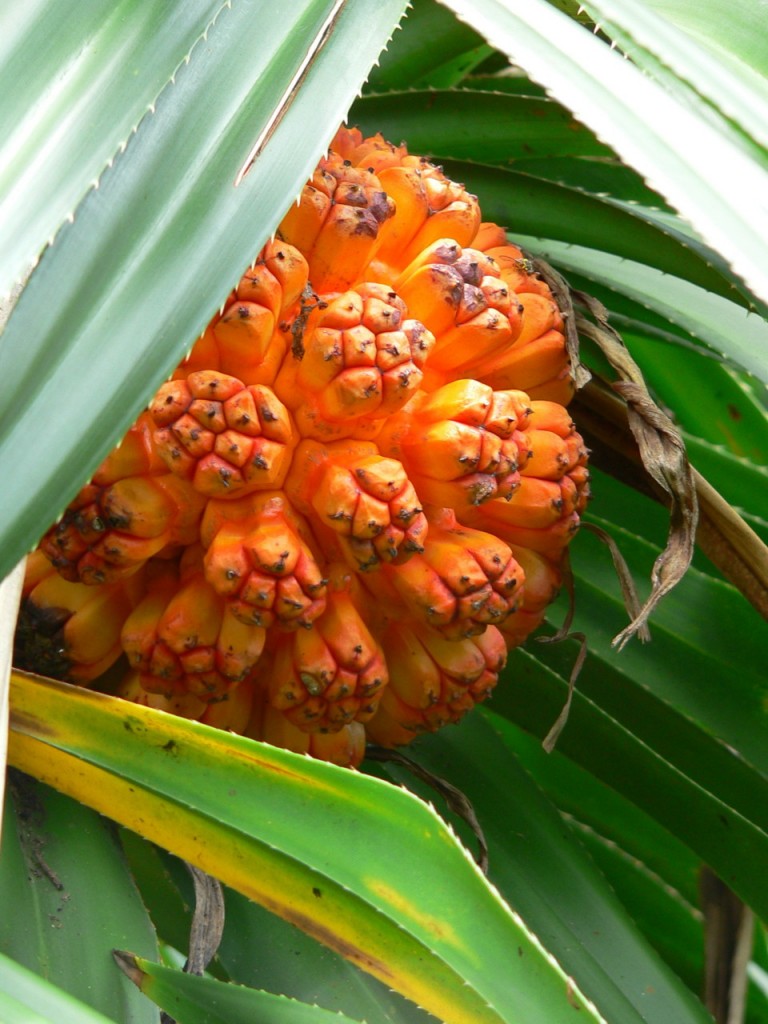
Pandanus fruit ripen from green to orange and red, photo by Green Deane

During several visits over the course of a year it looked like a large berm of tall grass, about the size and height of a one-story house. For some reason it was trimmed back and began to fruit which led to its general identification: Pandanus. That naturally leads to a Pandanus problem: Which species is it?

The genus Pandanus has over 500 members and are found from West Africa eastward to Hawaii, from coastal areas up mountains to 10,000 feet, from species a few feet high to 10o-foot trees. There are many natural species of Pandanus and several cultivated varieties. They are and have been a major textile and food crop throughout the Pacific region and figure significantly in Polynesian culture.
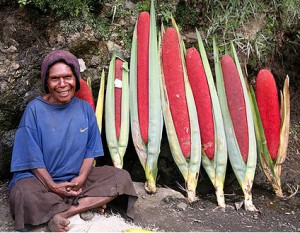
Pandanus conoideus fruit produces food and medicine.

Also called “Pandans” they fall into two large subgroups, those used for the fruit and those used for the seeds. Some fall in both groups.  The ones with edible fruit and or seeds are usually either oily or consist mainly of carbohydrates.  That group, generally known as “marita” is mainly Pandanus conoideus and perhaps Pandanus englerianus and Pandanus magnificus. Not every one agrees that the last two are separate species. The edible fruit is mostly red or yellow. Generally after processing it is used as a spread like butter. Another set in this subgroup is Pandanus tectorius which also includes Pandanus leram and the cultivated Pandanus fischerianus.
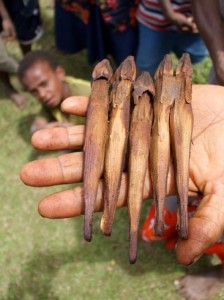
Smoked seeds of the Pandanus julianettii.

The second major food group of Pandanus produce edible seeds, some edible raw, some edible after proper cooking.  The prime species for that is the ‘karuka’ of New Guinea, which can be either Pandanus brosimos or Pandanus julianettii. The seeds are oily, contain protein, and are on par with coconuts in their use and value. Some experts think all Pandanus species probably produce edible seeds but no one really knows. Trees begin to fruit between seven and eight years old and will produce for some 60 years. When they do fruit it takes two to six  months for the fruit to ripen depending upon the species. Those used for the spread take two to three months to ripen, seed bearing ones four to six.
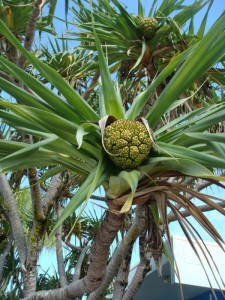
Unripe Pandanus tectorius

Besides carb or oil producing is there any other division we should be aware of? Yes. Wild versions can contain large amounts of calcium-oxalate crystals (raphides and rhomboids) which can irritate the mouth. Heating can break them down. In cultivated versions the raphides are reduced or missing so that some forms can be eaten raw.  Minus the calcium oxalates Pandanus can be quite nutritional. The fruit flesh of the Pandanus tectorius, for example, contains per 100 gram of edible portion: water 80 grams, protein 0.4 g, fat 0.3 g, carbohydrates 19 g, fibre 0.3 g.  Oven-dried seeds of karuka (Pandanus brosimos) contain per 100 g edible portion: water 6—10 g, protein 8.5—14 g, fat 0.4—37 g, fibre 5—12 g, the remainder ash and carbohydrates. In those what is eaten is the terminal bud, or the growing end, like the heart of palm.
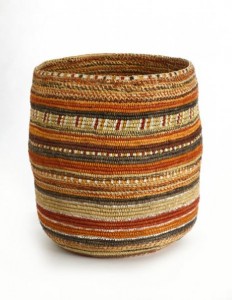
A basket made from Pandanus leaves.

Pandans used for textiles include Pandanus dubius, Pandanus kaida, and Pandanus tectorius. Various products are made from them as bags, hats, pocketbooks, umbrellas mats, dolls even sails. Pandans did not escape the attention of the oldest still extant foraging group on earth, the Aboriginals of Australia. They used the top leaves for baskets, ate the fruit, and used dead trunks to carry fire with them, smouldering like an all-day, baseball-bat-sized cigarette. At least six species have been exported to warm areas of the world.  Several species of Pandanus have been planted in Florida including Pandanus amaryllifolius, Pandanus baptistii, Pandanus sanderi, Pandanus tectorius, Pandanus utilius and Pandanus veitchii. Some Pandanus grow in Texas (definitely P. utilis) and many in Hawaii and Puerto Rico.
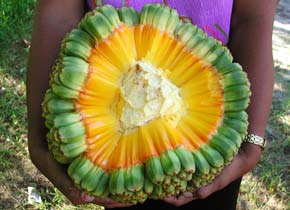
Pandanus tectorius cultivar ‘Antinakarewe’

Among those in Florida Pandanus tectorius, aka Nicobar Breadfruit,  is native to the seacoast from southern China to tropical Australia and Polynesia. Common in Hawaii, it’s a tree to 25 feet with spreading branches, numerous prop roots, and forms large, dense thickets. The leaves are evergreen, spirally set, strap-like to five feet long. Their edges are spiny and the leaves droop. The female flower is a single spike with a yellow spathe; male flowers are on a separate plant, very fragrant, composed of many dangling spikes in long, white spathes. The fruit is a globose, knobby head to ten inches long, orange-yellow, breaking apart when fully ripe, exposing soft edible pulp in the center. The terminal bud is also edible. Leaves are used for thatching and mats.  The fleshy pulp of the fruit may be eaten raw, cooked, or made into flour, paste and thick flat cakes. Flour is often mixed with palm syrup or diluted with water to make a popular drink. Tender, white bases of the young leaves are eaten raw or cooked. Aerial roots are cooked and eaten or processed into beverage. Flowers and pollen are edible, too. Seeds can be made edible after processing. It’s also called Pandanus odoratissimus though that might just be a variation. Botanists can’t agree. Pandanus tectorius can withstand drought, strong winds, salt spray and propagates readily from seed or branch cuttings,
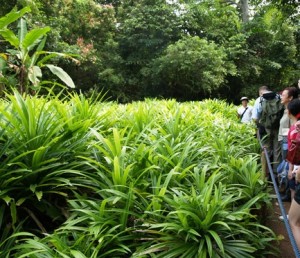
Pandanus amaryllifolius leaves are used for flavoring.

Pandanus amaryllifolius, uncommon in Florida, is the only species in the genus with fragrant leaves. It grows between 1.5 and 3 feet tall, sometimes to six feet.  When older it produces aerial roots and stilt roots to support itself from falling. Leaves are slender, lush-green and smooth-edged up to 20 inches long. It resembles an amaryllis, hence the name. Leaves have a depressed center running from the base outwards gradually flatten towards the tip. Fragrant young leaves are cooked as a vegetable or used as a condiment. Fresh or dried leaves add a musty odor and flavor and green color to tofu, jellies, doughs, curries, syrups, sauces, coconut rice, and sweets. It is also added to cooking oil before cooking as a spice. The leave are used to wrap food such as rice dumplings.  Sometimes called Pandanus latifolius. There is a bit of a schism with the Fragrant Pandan.  Some insist the leaves are used only for flavoring and removed. Others insist young leaves can be cooked and eaten. As folk dancers say when they encounter a variation in a dance they know… “different village.”
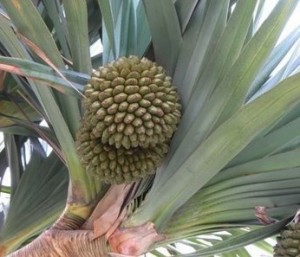
Unripe Pandanus utilis fruit.

Pandanus utilis, native to Madagascar, is a tree to 60 feet with stilt-like prop roots. Branches are few, sleek, rounded, tipped with clusters of evergreen, strap-like spiny leaves three feet long and three inches wide. Fruit is nearly round, six inches across,  compound and rough surface, green, yellowing as it ripens with a small amount of edible pulp, numerous large seeds (which are sometimes called keys.) Leaves are used for matting and baskets. Fiber can be gotten from the roots for cordage and weaving thus the name “utilis” meaning useful. It is very slow growing from seeds or cuttings. Prop roots are also used as torches.

Pandanus baptistii is native to the South Sea islands. It’s herbaceous and dwarf with a short stem hidden by a clump of upright, arching, one-inch wide ribbon-like leaves. They are blue-green, striped yellow or white, smooth edge. Often grows in clumps. No edibility mentioned. Pandanus sanderi, native to East Indies and Timor, will not survive temperatures below 55 F thus it is usually a houseplant beyond the tropics. Also herbaceous, short stemmed and densely tufted with ribbon-like leaves 2.5 feet long with tiny spines on edges. They, too, alternate green and yellow from base to tip. Grows in clumps.  No mention of edibility. Pandanus veitchii, native to Polynesia, to 40 feet, stilt-like prop roots, few branches, ending in huge clusters of strap-like leaves to eight feet long, three inches wide, bordered on both edges with a white strip, spiny margins and long-pointed tip.  Non-fruiting in Florida. Usually a house plant. Leaves used for mats, screens, and lamp shades. Often a potted plant in northern climes. No mention of edibility.
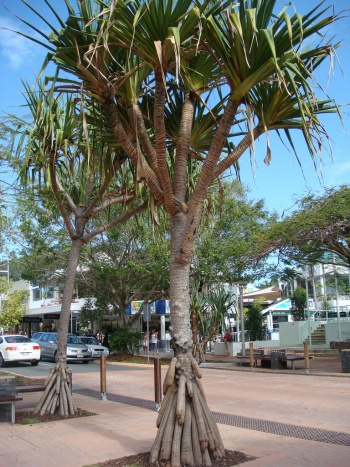
Pandanus trees in urban setting

Other Pandanus: Pandanus antaresensis, seeds. This species fruits continuously; Pandanus brosimos, West New Guinea, now West Irian Jaya, seeds are edible. Oven-dried seeds of P. brosimos contain per 100 g edible portion: water 6—10 g, protein 8.5—14 g, fat 0.4—37 g, fibre 5—12 g, the remainder consisting of ash and carbohydrates. The tree can grow to 100 feet tall. In Pandanus species that produce white seeds their flavor is similar to coconuts. Pandanus castaneus, oil; Pandanus conoideus, Papua, Indonesia, fruit is edible cooked, a red flavoring is also made from it; Pandanus dubius, southeast Asia, Pacific Islands, roundish seeds edible raw. Pandanus fascicularism, India, male flowers are the source of kewda attar, used for flavoring betel nuts, soft drinks, curries and an Indian rice dish called biryani; Pandanus foveolatus, seeds, fruits continuously; Pandanus galorei, seeds, fruits continuously; Pandanus houlettei, edible fruit; Pandanus Iwen, seeds; Pandanus leram, Nicobar Islands, the fruit is cooked for five to eight hours depend upon the state of ripeness. It is then pressed to separate a yellow paste from the fiber. The edible paste is used in a variety of ways, often as a spread like butter. Pandanus limbatus, seeds, fruits continuously but is the least preferred of all the Pandanus with edible seeds; Pandanus spiralis, Australia, fruit and seeds. The latter can be extracted from fruit and ground into flour and taste like a combination of peanuts and coconuts. There are 37 species found in Australia, usually along the coast of the northern territories.
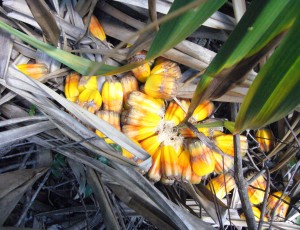
Pandanus fruit falls apart when ripe.

While there are male and female trees P. brosimos, P. julianettii, and P. conoideus are believed to be parthenogenetic, read reproduce on their own. Fruiting for most Pandanus can also be a result of timing. Male flowers bloom every year. Female flowers every second year. And while male and female flowers may bloom at different times thus no fruit that year. The genus name, Pandanus, comes from the Indonesian name of the tree, Pandan. In English it is called Screw Pine because some species leaves appear to grow in spirals. Lastly, often the fruit is picked and just used for decoration.

{ 47 comments }

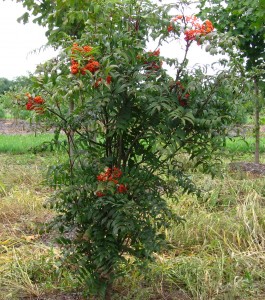
American Mountain Ash in Banner Elk, N.C, at 3,739 feet. Note the red stems.

Long before Henry Potter Rowanwood wands were popular  ancients carried talismans of the tree to ward off evil and ate the fruit.  Well… sort of.

European Mountain Ash, note the yellow stems.

Rowan is another name for the European Mountain Ash. Mountain ashes around the world tend to fall into two groups. One group has berries that are usually processed into jelly or jams and are barely edible off the tree after frost if not after freezing a few times or a long stint in your freezer. Raw their quality is not great. The other group has been bred to be eaten raw and can also be made into various sweet products. So the fruit is edible but… You will read in some places that the seeds contain compounds which upon digestion release small amounts of cyanide. This is probably true.  The seeds of some 1,000 plants in the greater group (Rose) do have some cyanidic compounds. Processing (the breaking down of cell structures and letting enzymes go to work) and or cooking usually take care of that issue. Small amounts of raw fruit are considered tolerable and to my knowledge there are no bad cyanide-related reports about Mountain Ash fruit. Man probably discovered these fruit — and their necessary vitamin C — were edible in the winter time because they persist on the tree and taste better the older they get (which additionally might reduce the potential cyanide amount.) The berries also contain malic acid and parasorbic acid. Malic acid is what makes apples tart. Parasorbic acid can upset the tummy raw but cooking changes it to sorbic acid which is not a problem.

While traipsing around the Blue Ridge Mountains in August I saw two mountain ashes, the American and the European. They look very similar and live to around 25 or 30. The American has red stems near the end of branches, the European yellowish stems. However they are used the same way. In fact, there are at least 10  to 18 edible members in the genus depending on the definition and who’s counting.

The American Mountain Ash is usually a small tree.

The American Mountain Ash, Sorbus americana,  (SOR-bus ah-mare-ree-KAY-nah) is found in the wilds of eastern North America: Newfoundland and Nova Scotia south to New Jersey and Pennsylvania and in the mountains to South Carolina and Georgia, west to Minnesota and eastern North and South Dakota. Elevation is the key. In New England most American Mountain Ash are found in the White Mountains from 2,310 to 4,290 feet.) In the Adirondack Mountains of New York it rarely occurs below 3,135 feet. In the Blue Ridge Mountains I saw them between 3,000 and 4,000 feet. They like cool, humid climates.  Not a true ash they are called that because while closely related to the apple their leaves resemble those of ashes (Fraxinus spp.) Unlike the true ash, however, the American Mountain Ash’s leaves are alternate, not opposite.

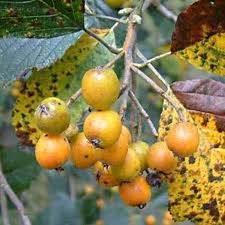
Sorbus latifolia, the French Hales with yellow fruit

Native American made much use of the related Mountain Ashes for food. The Algonquin, Quebec, Montagnais and Ojibwa ate Sorbus americana berries, the Thompson, Sorbus sitchensis and the Heiltzuk, Sorbus sitchensis var. grayi. Usually the berries were dried then ground and added to four or soups and the like. To that North American list Lee Peterson also adds Sorbus decora, called the Northern Mountain Ash; Cornucopia II adds the Western Mountain Ash, Sorbus scopulina. Across the Atlantic the European Mountain Ash, Sorbus aucuparia, was used for food as well as the Sorbus latifolia which oddly has yellow fruit with black dots. In Eurasia there’s Sorbus domestica, Sorbus aria, which has brown berries with red spots, and Scorbus torminalis which looks similar to S. aria. There are also several cultivars of the various species: Rabina, Rosina, Edulis, Moravica, Rossica, Apple, Pear, and Devoneinsis. These tend to have larger, better tasting fruit.

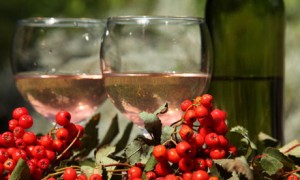
Rowanberry Wine

The berries of the wild versions are often made into jellies or cooked with meat. When young and raw their flavor is sharp and not pleasant. This moderates on aging. Cultivated versions are often eaten raw. The berries are full of pectin. Nutritionally they’re about 5.5 percent protein, 8 percent fiber, and high in iron and vitamin C. There’s also a good amount of vitamin A. Per pound there are some 388,000 seeds. They need to be chilled at 33 to 41 degrees F. for 60 or more days to germinate.

The tart berries have been used for home remedies including a gargle for sore throats and to treat scurvy and malaria. Efficacy of the latter, however, is doubtful as it was used only because the leaves resembled the Quinine tree which was used for fevers.

Rowanwood Wand

The Harry Potter series borrowed ancient Celtic views towards the European Mountain Ash also called the Rowan Tree. The Celts and other people of early British Isles thought the tree had magical properties. Its powers were to protect you from witchcraft, one of two reasons why it is also called Witchwood. The other reason is a pucker at the end of the fruit reminds some of a pentagram which is associated with witchery.

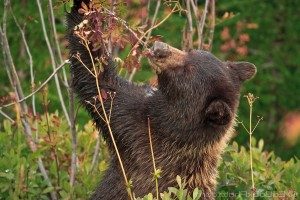
Black Bear Cub eating Mountain Ash Berries, photo by Ed Book.

As one might think, animals also know the mountain ashes as food. It is a favored browse of moose and white-tailed deer. Bears, fishers and martens like it as well as snowshoe hares, squirrels, small woodland rodents, the ruffed grouse, ptarmigans, sharp-tailed grouse, blue grouse, American robins, thrushes, waxwings, and jays. It’s also the preferred food for the (despised) gypsy moth larvae.

Sorbus (SORE-bus) is Dead Latin for “service tree” which was actually a dogwood.  Americana means of North America. The European Mountain Ash’s name is a bit more interesting, “aucuparia” ow-kew-PAH-ree-ah. It means “to catch a bird.” Fowl like the fruit and were caught at the tree. “Rowan” means “becoming red” and is from the Germanic word raudnian.

European Mountain Ash Wine, courtesy of John Wright and The Guardian

2kg rowanberries, snipped off with scissors, picked over and washed
1.2kg sugar
500ml white grape juice concentrate
Juice of 2 lemons
1 tsp of wine tannin
1 tsp pectolase
1 tsp yeast nutrient
Sachet of white wine yeast
About 4 litres of boiling water

Put the berries in a food grade plastic bucket and mash them coarsely. Boil the water then stir in the sugar until dissolved, bring to the boil again and immediately pour over the berries. Cover and allow to cool. Add the grape concentrate, pectolase, lemon juice and tannin. Cover and leave for 24 hours then stir in the yeast nutrient and yeast (activated if necessary).

Cover and leave for a week, stirring every day for the first five days. If your brew has separated nicely into three layers – sludge / liquid / sludge – carefully place the end of a siphon at a strategic height and siphon off the liquid into a clean demi-john – though a bit of sludge won’t hurt. Otherwise strain through clean muslin using a funnel. Top up to the bottom of the neck with boiled and cooled water if necessary. Fit the fermentation lock and leave to ferment for a couple of months.

Rack off into a fresh demi-john and leave until all fermentation has stopped for a week, then bottle. Rowanberry wine benefits from a long maturation period in the bottle – at least a year

Green Deane’s Itemized Plant Profile: American Mountain Ash

IDENTIFICATION: Sorbus americana: A small tree to 40 feet, usually shorter. Leaves alternate, pinnately compound, 6 to 10 inches long, 11 to 17 lance-shaped, serrated leaflets, 2 to 2 1/2 inches long, dark green on top, paler on bottom. In the top photograph the leaflets are opposite but the leaves alternate. Showy clusters of small white flowers, clusters 3 to 5 inches across. Fruit: Clusters of showy, red, small (1/4 to 3/8 inch in diameter) pomes. The bark yields a gray dye.

TIME OF YEAR: Flowers late spring to early summer, fruit late summer to fall, persist through the winter.

ENVIRONMENT: Cool, moist habitats, borders of swamps, rocky hillsides, in openings or in woods, upland roadsides or under semi-open stands of birches, fir and spruce. Prefers full sun.

METHOD OF PREPARATION: Berries of the wild varieties made into jams, jelly, syrups, conserves, wine, vinegar, eaten raw after frost or a freeze. Berries of cultivated versions eaten when ripe. Often cooked with meat. Can be used to thicken other jellies. Jelly goes well with sharp cheese. Dried ground berries can be added to flour to make bread. Use can vary significantly from species to species. For example, the leaves and flowers of the American Mountain Ash are not used but the leaves and flowers of the European Mountain Ash (also planted in North America) can be used for tea.

{ 18 comments }


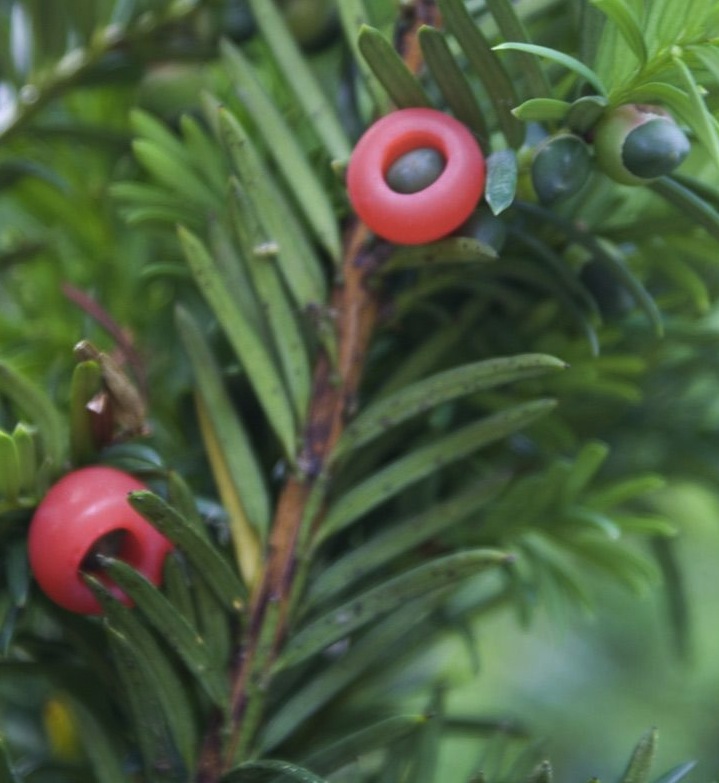
Only the red part is edible, not the seed inside.

The Yew can kill you, very quickly.

Did that get your attention? Good. It should. There is only one safe, small part of the tree that is edible. The rest is toxic. What’s edible? The fleshy aril around the seed. The seeds are NOT edible though those who have eaten them have said before they died that the seeds had a good flavor. The same has been said of deadly mushrooms and fatal water hemlock. What do chewed seeds do? They stop your heart. Any questions? The leaves are toxic as well killing, besides humans, horses, cattle and pigs. Taxine alkaloids (A and B) are thought to inhibit heart depolarization. The largest concentration is in the seeds. 

Yew Bow

While the aril has a firm texture it falls apart once removed from the seed, it is watery and sweet but with almost no flavor. Get your fingers messy: Don’t even think about putting it all in your mouth then spitting the seed out. That’s too dangerous. Take the aril, which looks like a little cup, off the seed, throw the seed away, then eat the aril. I would not be surprised to learn the arils has antioxidants. While the aril is edible the flavor and texture are not WOW. They’re okay… barely. It’s a lot of danger to approach for little pay off.

Now, what if you swallow one seed whole? Those who know say it will probably pass through without a problem. Personally, I would rather throw up than take the chance, or have the stomach pumped out. Chewed seeds or a few ounces of leaves will definitely kill you, or a horse. How toxic is the tree? It is favored by bow makers, and has been since ancient times. However there are reports of some bow makers being killed by the tree’s toxins because they handle the wood so much. Oh… did I mention the yew is a common landscaping ornamental? Surrounding ones house with a deadly hedge is not a good idea.

Poisoning symptoms can include difficulty walking, muscle tremors, convulsions, collapsing, difficult breathing, coldness and heart failure. However the toxin works so quickly some of those symptoms might be skipped.  Dead animals are often found with twigs or leaves still in their mouth.

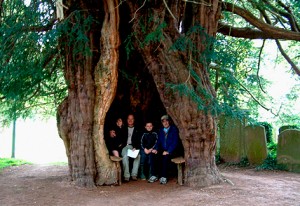
A yew near Ledbury, Herfordshire, England

That said the Yew tree has a lot of history behind it. The word itself is ancient Germanic and means brown, like the bark. The oldest piece of worked wood in the world is a Yew spearhead dated 450,000 years old. Within written times the European Yew was dedicated to the Erinyes or Furies, goddesses of vengeance for human punishment.  Caesar referenced a Celtic leader named Eburones who poisoned himself with Yew rather than submit to Rome. The Roman historian Florus said that in 22 BC the Cantabrians on the coast of northern Spain killed themselves by sword, fire or Yew rather than surrender to the legate Gaius Furnius. The Astures, also of Spain, when under siege at Mons Medullius also chose to die by Yew than be captured. Yews are among the oldest trees in Britain with several over 1,000 years old and one perhaps 4,000 years old.

Cornucopia II lists two Yews. Of the Taxus baccata (the English Yew) it says on page 240 “the bark is used as a substitute for tea. Fruits are sometimes eaten, however the seeds are considered poisonous.” And of the Taxus cuspidata (the Japanese Yew) it says: “the sweet aril, or fruit pulp, is eaten raw, made into jam, or brewed into wine. Caution is recommended, as the seeds of many species are poisonous.”

All that said Ethnobotanist Dr. Daniel Austin reports the native species were used by Indigenous Peoples for medicine. Eastern tribes used the Taxus canadensis in minute amounts for tea to treat rheumatism, bowel ailments, fevers, colds, scurvy, to rid clots, as a diuretic and to expel afterbirth. However, Dr. James Duke in 2002 wrote T. baccata, T. brevifolia and T. canadensis are too toxic to be used as medicine.

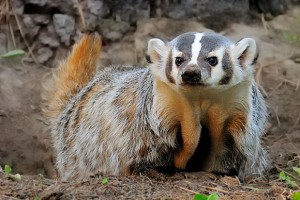
Badger, Taxidea taxus

The study of plants is also the study of language and history. The yew genus is Taxus. That comes from either taxic or toxic which in Greek means “that in which arrows are dipped.” Interestingly the Greek word for bow is toxon and for the Yew taxos. One can see and hear the connection of these words for over 4,000 years. By the way the animal called the Badger is Taxidea taxus, which means” the badger hides in the yew forest.” I think it is one of a few or the only case in which a plant and an animal have similar scientific names. And while the little fellow to the left looks cute Badgers are renowned for their ill-temper and brass.

Most Yews used in landscaping are either the European Yew or the Japanese Yew. There are three native Yews to North America, T. brevifolia, T, canadensis, and T. floridana.

Green Deane’s Itemized Plant Profile: Yew

IDENTIFICATION: An evergreen, bark reddish-brown, thin, flaking in thin scales; leaves linear, stiff, one-half to one inch long, two ranked, on twigs; upper surface dark green, lower surface yellow-green, midrib prominent. Fruit comprised of a single stony seed mostly surrounded by  a bright scarlet, thick, ovoid, fleshy cup, the whole .5 to .75 inches long.

T. baccata, the European yew, hardy north to New York, T. cuspidta hardy into southern Canada, T. brevifolia, the western yew, to 75 feet high, forests, wooded slops and ravines, central California to Montana, British Columbia and Alaska. T. canadensis, ground hemlock,  likes marshes, spreading shrub rarely more than 5 feet high, deep woods, Kentucky north to Canada. Taxus floridana is so rare we’ll leave them alone. Yews are mostly found in yards as an ornamental.

TIME OF YEAR: Summer to fall

ENVIRONMENT: Varies by species

METHOD OF PREPARATION: Aril raw. The seeds are deadly.  Read that sentence again: The seeds are deadly. Indeed, the entire plant is deadly except for the aril. I have also eaten yellow yew arils.

{ 87 comments }

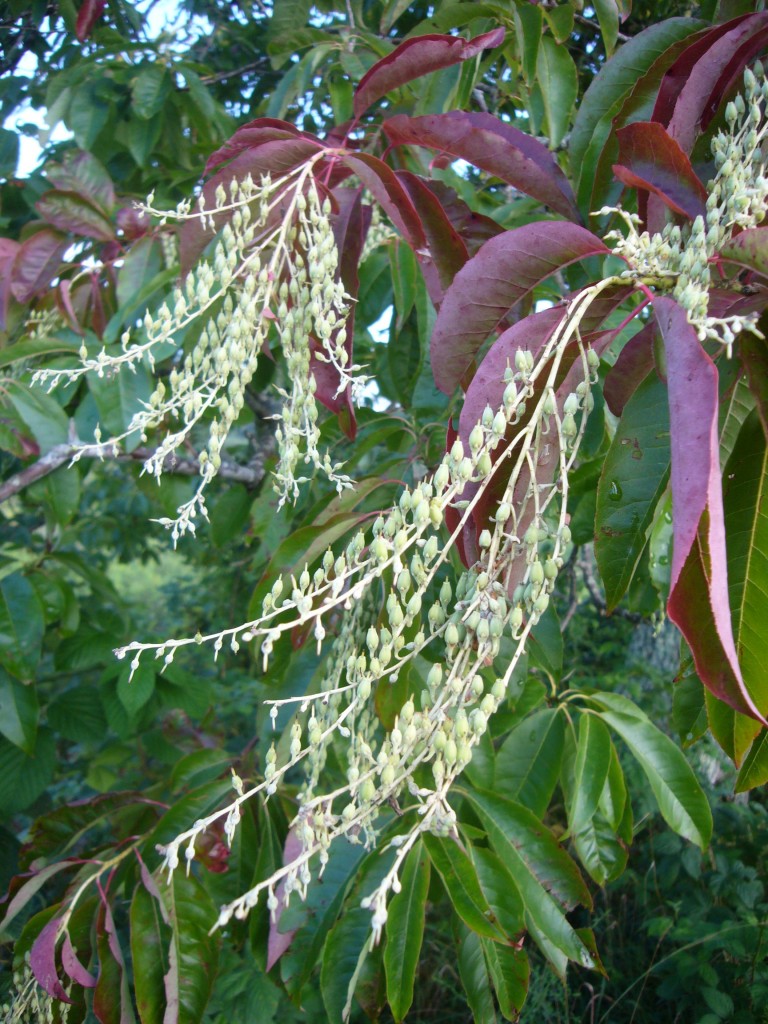
Sourwood blossoms with green leaves and fall color. Note how they fold. Photo by Kelly Fagan

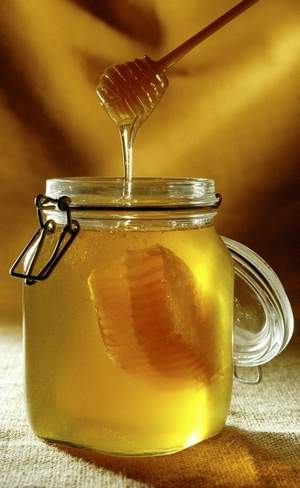
Sourwood honey is considered by some to be the best-flavored honey in North America, perhaps the world. Carson Brewer, a conservationist who wrote about life in Appalachia, mused that “Most honey is made by bees. But sourwood is made by bees and angels.”

Sourwood Honey

Honey connoisseurs say there’s an excellent crop of sourwood honey about once a decade making it rare as well as good. This rarity is as much dependent on weather patterns as it is timing and bee-keeping expertise. The honey’s color can be white to amber sometimes with a light gray tint. Its texture is smooth, caramel-esque, buttery.  The flavor is similar to gingerbread with a bit of kick in the aftertaste.  I have two bottles of it squirreled away. And while sourwood honey is famous, the tree has more to offer. However, like many trees, it just barely slips into the edible range.

The small blossoms can be used to make jelly, and the leaves chewed to quench thirst (chewed not swallowed. They’re a laxative.) In years when there isn’t enough good blossoms for honey jelly is an option. The urn-shaped blossoms grow along terminal panicles and resemble Lilys-of-the-valley. While some writers call them aromatic I find their scent pleasant but barely detectable. During my last August trip to the Blue Ridge Mountains of North Carolina I saw altitude-stunted sourwoods blossoming on the top of mountains and yet-to blossom large trees in the valleys.

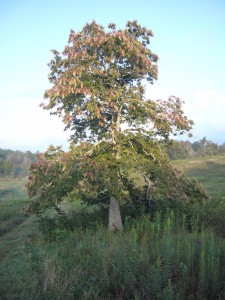
Sourwood tends to have a pyramid shape

Sourwood, Oxydendrum arboreum, grows from southwest Pennsylvania down the Appalachian chain just dipping into panhandle Florida.  It can be a tall tree in the middle of its range, smaller on each end.

Because of its acidic taste (from oxalic acid) the Cherokee Indians occasionally used it to cook food for the flavor. Spoon and combs were made from the wood as well as sled runners, arrowshafts and pipe stems. As for the edibility of young leaves there is some controversy.

Food Plants of North American Indians

Elias Yanovsky wrote a book in 1936 for the US Department of Agriculture called Food Plants of North American Indians. It was in part a response to the food shortages of the Great Depression in the 1920s and the Dust Bowl era of the 30’s. At least two of his entries have been criticized as doubtful. One is that he said some tribes ate Virginia Creeper. That is highly doubted. Virginia Creeper is considered toxic. In another entry Yanovsky said tribes in the southeast ate young sourwood leaves in salads. That, too, is doubted. Ethnobotanists like Dr. Daniel Austin say southeastern tribes did not as a matter of course eat raw vegetables, that is, they did not eat salads. In fairness to Yanovsky he was not an ethnobotanist and could have copied misinformation from other sources, like the Internet today.

Dr. Francis Porcher

The sourwood, however, did have many medicinal uses among the various tribes. The Catawba used it as an infusion for menstrual issues and menopause. The Cherokee used sourwood infusions to stop diarrhea. They also made it into a tonic for indigestion, nervousness, asthma and spitting blood. Francis Porcher, mentioned many times in my articles, was an American Civil War doctor and botanist. He wrote: “The leaves when chewed allay thirst. A decoction of the bark and leaves is also given as a tonic.” In the Old South it is a folk remedy for kidney and bladder issues, fevers, diarrhea and dysentery.

Related to the blueberry and in the Heath Family, the Oxydendrum arboreum is a monotypic genus, that is, it is the only member in its genus. Oxydendron (ox ee DEN drum) is from two Greek words, Oxy- meaning  “acid” or “sharp” and Dendron which means tree.  Arboreum ( ar BOR ee um or ar bor EE um) means “tree form” or tree-like. The sourwood is also called the Sorrel Tree and the Lily-of-the-valley-Tree because its blossoms are similar to the flower’s.

Carson Brewer

Carson Brewer, who so aptly described sourwood honey, was a columnist for the Knoxville News-Sentinel, a daily newspaper in Knoxville, Tennessee. He wrote for them for some 40 years then retired and wrote for 18 more before dying of pneumonia in 2003 just shy of his 83rd birthday. Brewer wrote several books. His best known is Hiking in the Great Smoky Mountains. The Tennessee Valley Authority, which eventually flooded the Little Tennessee River valley with the Tellico Dam, hired Brewer and his wife, Alberta, to write a history of the valley and those who lived there. That valley is now underwater. Their work, Valley So Wild: A Folk History, was published in 1975. It was the Tellico Dam project that made a small endangered fish called a snail darter famous and a household word at the time.

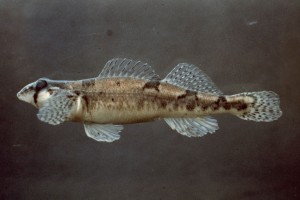
The damn busting, infamous Snail Darter

During the second half of the 20th century attitudes began to change about the use of dams and flooding valleys for power. The Tellico Dam was the turning point and the first dam halted (for a while) because the flooding would wipe out a species, the snail darter (Percina tanas) found only at that time in the Little Tennessee River. More to the point the three-inch fish was federally protected by the Endangered Species Act of 1973. The minnow had its day in court, the Supreme Court no less, and won. So the dam could be built — $100 million had been spent by then — the act was amended to specifically exclude the snail darter and it was moved to the Hiwassee River. The fish was upgraded from endangered to threatened on 5 July 1984. It was removed  from protection in 2022. The case was instrumental in the development of environmental law.

Green Deane’s Itemized Plant Profile

IDENTIFICATION: A deciduous, medium-tall tree growing to 30-60 feet, slender pyramid shape, some times oval, often with a curved or leaning trunk. Bark rusty-brown, smooth when young becoming rough and furrowed. Simple, alternating oblong leaves to 10 inches, rich green and glossy on top, sour taste, appear to fold in the sun and hang like weeping. They turn brilliant red, scarlet and purple in fall. Blossoms white, on long drooping stalks to 10 inches.  Small flowers are urn shaped, upside down, resembling blueberry blossoms.  Some find the blossoms fragrant.

TIME OF YEAR: Blossoms spring to summer, altitude can make a difference.

ENVIRONMENT: Prefers rich soil, mixed hardwood and softwood forests but is adaptable. Prefers full sun, some shade.
Hardy USDA Zones 5-9.

METHOD OF PREPARATION: Flower used to make jelly. Chewing leaves can reduce thirst.

{ 10 comments }

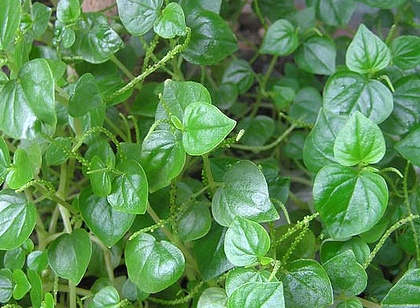
Peperomia pellucida, used for salads or tea.

Snowy Corthell Hall, then at the University of Maine, Gorham. where I spent most of my college years, photo by My View From Maine

I went to undergraduate school in Maine where winter lasts from about November 1st to October 31st. I’m fond of telling people I love summer in Maine… both days of it. With the majority of the year cold and green plants scarce I made a lot of terrariums to have greenery around. I was always raiding Skillins Greenhouse in Falmouth for plants. (Nice to know some 50 years later  they are still in business. Then again they opened doors in 1885.) And if you have never lived in snow you truly don’t realize how wondrous greenhouses are in the wintertime. Ten degrees outside and snow to your knees, warm and humid and earthy inside. Alive! Greenhouses were a source of joy and depression because they were beautiful and the promise of warm weather always months away.

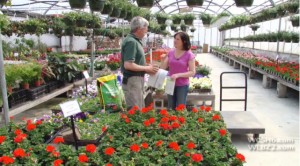
Terry Skillins owner of Skillins’ Greehouses being interviewed on gardening tips.

A plant I used often in my terrariums for a tropical look and got at Skillins was Peperomia. I got the houseplant version and there’s about a thousand species in the genus, two of which are commonly eaten, Peperomia pellucida (Greenhouse Tea Plant, Shiny Bush) and Peperomia maculosa (Cilantro Peperomia… guess what it tastes like?) Most of the species are from the tropical Americas but 17 hail from Asia. Most have flower spikes similar to a Plantago but are more showy, think inverted catkin.

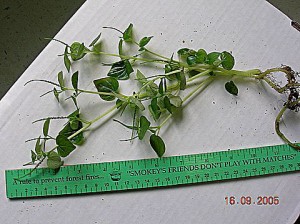
Peperomia pellucida is not a tall growing plant.

While the P. maculosa is used as a spice the P. pellucida is main fare for salads and as cooked greens.  This Peperomia has a good nutritional profile. A 100 grams portion of P. pellucida has approximately 277 mg of potassium. It also has: 1.1 grams carbohydrates, 0.5 gram protein,  0.5 gram fat, 94 mg calcium, 13 mg phosphorous, 4.3 mg iron, 1250 mg beta carotene and 2 mg ascorbic acid. Its leaves have also been used to make tea. Besides food the Peperomia pellucidahas quite a medical legacy.

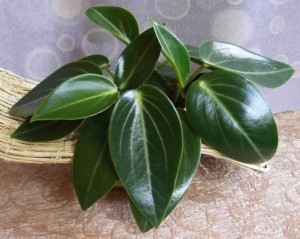
Peperomia maculosa is used as a spice similar to cilantro.

Historically the plant has numerous ethnomedicinal uses as an anti-inflammatory and analgesic properties. Peperomia pellucida has shown antibacterial activity against Staphylococcus aureus, Bacillus subtilis, Pseudomonas aeruginosa, and Escherichia coli. It is approved by the Philippines’ Department of Health for various uses. One of them is a decoction used to decrease uric acid levels (as a remedy for rheumatism and gout) and to treat renal problems. Boil 1 ½ cups of the plant with 2 cups of water for 15-20 minutes.) It is also used topically for skin disorders such as acne and boils. See Herb  Blurb below.

As for botanical name, Peperomia (pep-er-ROM-ee-ah) is two Greek words mashed together —  “Pepper” and “Same” — read it means “like peppers.” Pellucida (pell-LOO-see-duh) is Dead Latin for small and translucent, a reference to the leaves. Maculosa (mack-ule-OH’-sah) is Dead Latin for spotted or mottled, referring to small black dots on that species’ stems. Two related species that have edible leaves are Piper umbellatum and Piper stylosum.

Green Deane’s ITEMIZED Plant Profile: Peperomia 

IDENTIFICATION: Pereromia pellucida: Grows to one foot tall, stem initially erect, smooth, no hair, leaves fleshy and heart-shaped, smooth like candle wax, shiny light green, translucent, resemble pepper leaves but smaller. It has a very small bisexual flower growing from cord-like spikes from the leaf axils.Fruit as very small, round to oblong, ridged, green turning to black. One single seed with longitudinal ribs and ladder-like reticulation. The plant has a mustardy odor.

TIME OF YEAR: Year round in native habitat. Seasonal when temperatures are over 50/55 F.  Can bloom all year but favors the spring.

ENVIRONMENT: It likes damp woods, coastal plains, niches in rocks, plant nurseries and greenhouses. Best cultivated in a light, well drained rich soil with plenty of humus. Does well in shallow containers, likes terrariums. Coming from tropical rain-forest habitats, it prefers warm, humid conditions and needs a minimum temperature of 50 – 55°F  Besides it native range it can be found in Puerto Rico, the Virgin Islands, Alabama, Florida, Georgia, Louisiana, Texas (Houston area) and Hawaii; Mexico, West Indies, Central America, and South America. Peperomia maculosa is naturalized in Puerto Rico.

METHOD OF PREPARATION: P. pellucida: succulent leaves and shoots can be eaten in salads, used as a potherb, or cooked as greens. The leaves are also brewed into a tea. P. maculosa: The coriander-tasting leaves are used for seasoning usually with legumes and meats.

HERB BLURB

J Ethnopharmacol. 2004 Apr;91(2-3):215-8.: Anti-inflammatory and analgesic activity of Peperomia pellucida (L.) HBK (Piperaceae). de Fátima Arrigoni-Blank M, Dmitrieva EG, Franzotti EM, Antoniolli AR, Andrade MR, Marchioro M.
Source: Laboratório de Farmacologia, Departamento de Fisiologia/CCBS, Universidade Federal de Sergipe, Campus Universitário, São Cristóvão, SE CEP 49100-000, Brazil.

Abstract: An aqueous extract of the aerial part of Peperomia pellucida (L.) HBK (Piperaceae) was tested for anti-inflammatory (paw edema induced by carrageenin and arachidonic acid) and analgesic activity (abdominal writhes and hot plate) in rats and mice, respectively. Oral administration of 200 and 400 mg/kg of the aqueous extract exhibited an anti-inflammatory activity in the carrageenin test, which was based on interference with prostaglandin synthesis, as confirmed by the arachidonic acid test. In the abdominal writhing test induced by acetic acid, 400 mg/kg of the plant extract had the highest analgesic activity, whereas in the hot-plate test the best dose was 100 mg/kg. The LD(50) showed that Peperomia pellucida (5000 mg/kg) presented low toxicity.
PMID:
15120441
[PubMed – indexed for MEDLINE]

Introduction: Peperomia pellucida (Linn.) HBK (Fam. Piperaceae), locally known as Luchi Pata, is an annual herb (1) that is widely distributed in many South American and Asian countries (2-5). The plant is refrigerant; its leaves have been used traditionally in the treatment of headache, fever, eczema, abdominal pains, and convulsions (1). Evaluations of  antibacterial, antiinflammatory, and analgesic activity of P. pellucida were reported in literature (2, 6-7). Isolation of antifungal and anticancer constituents from this plant was also reported (8-9). Although the leaves of the plant is used traditionally in the treatment of pyrexia and its antipyretic related activities (such as antiinflammatory and analgesic activity) were found experimentally, its antipyretic potential has not been explored yet. In the present study an attempt has
been made to establish the antipyretic effect of petroleum ether and ethyl acetate soluble fractions of ethanol extract of the leaves of Peperomia pellucida. Pyrexia or fever is caused as a secondary impact of infection, malignancy or other diseased states (10). It is the body’s natural function to create an environment where infectious agents or damaged tissues can not
survive (10). Normally the infected or damaged tissue initiates the enhanced formation of proinflammatory mediators (cytokines, such as interleukin 1?, ?, ?, and TNF- ?), which increase the synthesis of prostaglandin E2 (PgE2) near hypothalamic area and thereby trigger the hypothalamus to elevate the body temperature (11). When body temperature becomes high, the temperature regulatory system, which is governed by a nervous feedback mechanism, dilates the blood vessels and increases sweating to reduce the temperature. When the body temperature becomes low, hypothalamus protects the internal temperature by vasoconstriction. High fever often increases faster disease progression by increasing
tissue catabolism, dehydration, and existing complaints, as found in HIV (12). t
Turk J Biol
32 (2008) 37-41
© TÜB‹TAK
37
Antipyretic Activity of Peperomia pellucida Leaves in Rabbit
Alam KHAN, Moizur RAHMAN, Shariful ISLAM
Department of Pharmacy, University of Rajshahi, Rajshahi 6205, BANGLADESH
Department of Animal Husbandry and Veterinary Science, University of Rajshahi, Rajshahi 6205, BANGLADESH
Received: 08.05.2007
Abstract: Antipyretic effects of petroleum ether and ethyl acetate soluble fractions of ethanol extract of the leaves of Peperomia pellucida (Linn.) HBK (Fam. Piperaceae) were investigated. Intraperitoneal administration of boiled milk at a dose of 0.5 ml/kg body weight in albino rabbit leads to pyrexia. Intraperitoneal (i.p.) administration of petroleum ether and ethyl acetate soluble fractions of ethanol extract of the leaves of P. pellucida at a dose of 80 mg/kg body weight significantly reduced the elevated body temperature of rabbit. This antipyretic effect has been compared with antipyretic effect of standard aspirin and the solvent used . Peperomia pellucida (Linnaeus) Kunth, Nov. Gen. Sp. 1: 64. 1816.

{ 24 comments }