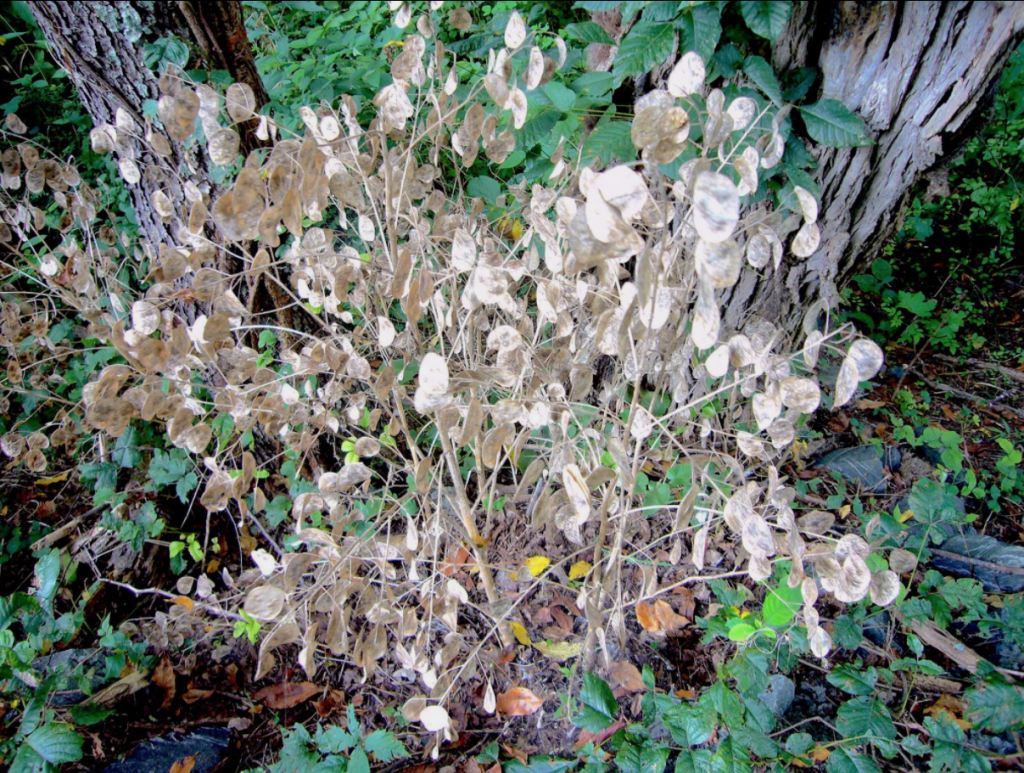
Self-seeded Moon Plant in North Carolina forest. Photo by Green Deane

It looks like a fake plant created for a low-budget space movie. It even has a good name: Lunaria annua, Annual Moon. It’s also edible. I first saw them in mile-high Beech Mountain, a city near Boone North Carolina. Then later I saw them growing on my cousin’s property in upstate South Carolina. 
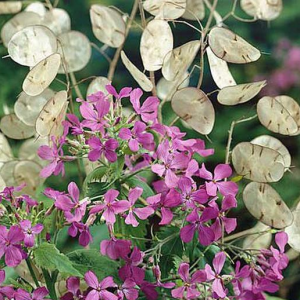
The blossom tell you it’s in the mustard family.

Lunaria annua (loo-NAIR-ee-uh AN-yoo-uh) is a purple-flowered native of southeastern Europe* — the Balkans — and western Asia. Its unconventional seed pods (silicles  SILL-ah-cle) prompted the species to be used as a garden ornamental. It’s been widely planted in the United States and Canada. It’s also widely scattered in Great Britain — introduced there 400 years ago, it was popular in the Victorian era. The species is listed as invasive in Australia (and the U.S.)  As you might also presume it is a popular in flower arranging. A relative, Lunaria annua var. alba, has white flowers, L. alba var. albiflora ‘Alba Variegata, is variegated with white trimming on its leaves. There is also a Lunaria rediviva which has oval seed pods and likes to be slightly damp. There are about a dozen plants in the genus. Lunaria is sometimes confused with Dame’s Rocket, Hesperis matronalis, which is also edible (young leaves, seedpods, flowers and seeds sprouted.) 
Lunaria annua seeds.

Other common names for Lunaria annua include Honesty, Silver Dollar, Dollar Plant, Money Plant, Moneywort, Moonwort, Satin Flower, and Kuuruoho (yes, that is spelled correctly.)  It was also once known as Lunaria biennis. The plant attracts butterflies, long-tongued bees and is disease/pest resistant. 

It was one of the first European flowers introduce into the American colonies where it was value for its striking seedpods and edible roots. Thomas Jefferson was growing them in 1767.  

Green Deane’s Itemized Plant Profile

Identification:  Two to three feet tall with alternate to opposite, oval to heart-shaped leaves. They are toothy, medium green and slightly fuzzy, pointed at the tip, upper leaves are stemless. Four-petaled purple flowers are in racemes above the leaves in spring. Flowers are replaced with flattened, paper-thin, silver-dollar sized fruit which become translucent. Several seeds are in the fruit and are easy to winnow. 

Time of year. As the plant has a long juvenile stage it should be planted in very early spring for a late summer or fall harvest. They can take a frost and temperatures down to 10.6 F. Biannual, it produces only leaves the first year and is a small plant that year; as a tall plant flowers and seeds the second year. As it reseeds you only have to plant it once. Soak the seeds in water a day hours before planting. 

Environment:  Edges and transition zones. Open woodlands, naturalized areas such as permaculture lots with native and non-native species, semi-shady gardens. It likes well-drained, rich soil, full sun in cooler climates, afternoon shade in warmer areas. It needs six hours of sunlight a day, an is hardy in zones 5a, 5b, 6b, 6a, 7a, 7b, 8a, 8b, 9b, and. 9a

Method of Preparation: The thick root is edible raw or cooked before blossoming. When the energy in the root is used to make flowers and seed the roots usually get tough. Cooked, pungent seeds are a mustard substitute. The seed is 30 to 38% oil, high in erucic acid, 44%, and nervonic acid, 23% (which is a base material in creating medicine for multiple sclerosis.) The long-chain oil itself is also a high-temperature lubricant. As with most mustards most of the plant is edible — leaves, flowers and unripe fruit — but are bitter. It is also believed to be high in vitamin C as most mustards are. Leaves are edible by rabbits. 

*To be more specific it is native to Albania, Bulgaria, France, Greece, Italy, Crete, Romania, Spain, Switzerland, and Yugoslavia. It has been introduce into: Alabama, southern Argentina, Austria, the Baltic States, Belarus, Belgium, British Columbia, California, Colorado, Connecticut, Czechoslovakia, Delaware, Denmark, Germany, Great Britain, Hungary, Idaho, Illinois, India, Indiana, Ireland, Kentucky, Madeira, Maine, Manitoba, Maryland, Massachusetts, Michigan, New Hampshire, New York, Norway, Nova Scotia, Ohio, Ontario, Oregon, Pakistan, Pennsylvania, Québec, Rhode I., Sweden, Tennessee, Ukraine, Utah, Vermont and Washington
{ 4 comments }

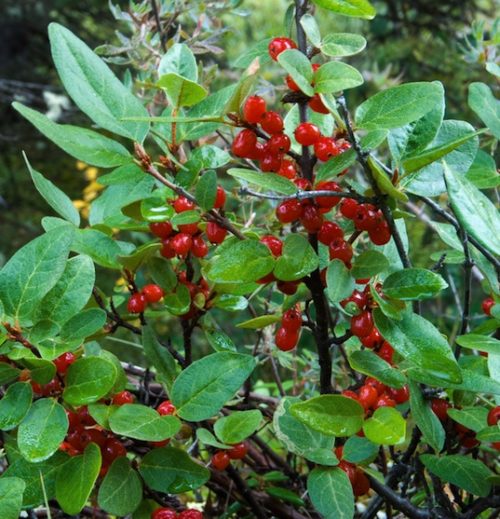
Shepherdia were an important Native American and First People’s food.

There are only three species in the genus Shepherdia, all in North America, and one brings up a good point. When you go up in elevation you often go north in flora and fauna. There are some northern plants that grow south on the tops of the Appalachian Mountains but no where else at lower elevations in the south. Two of the Shepherdia species grow mostly in northern states. But, one is in Utah and Arizona on the Colorado Plateau… which is 5,000 to 7000 feet. The plant thinks it’s further north than it really is. 

Some three dozen native groups depended on the species and with good reason. A hundred grams of Shepherdia canadensis has 80 calories, 0.7 grams of protein, 0.7 grams of fat, 16.6 grams of carbohydrates, and 5.3 grams of fiber. Vitamin C is outstanding and about three times your daily need, at 165.6 mg. Vitamin A in a separate report said it was 0.97 grams. The B vitamins are B1 (thiamin) 0.03 mg, B2 (riboflavin) 0.1 mg B3 (niacin) 0. 2 mg. Phosphorus is 21 mg, calcium 16 mg, magnesium 8 mg, zinc 1.4 mg, iron and sodium, 0.5 mg each, 0.2 mg manganese, 200 mcg copper and strontium 70 mcg. 

These berries get around. S. aragentea is in the western two-thirds of North America excluding Texas to Maine and southeast. Oddly it’s in one eastern county of New York, an escapee perhaps. Of all the west it is not reported in Washington state. S. canadensis is in all of Canada, the western third of the U.S. and the states north and east of Illinois. It’s in Vermont were I still have cousins living and didn’t quite get down to where I lived in Maine. Roundleaf Buffaloberry is found in southern Utah and northern Arizona.

Argentea is new Dead Latin for silvery. Canadensis of or from Canada. Rotundifolia means round leaf. The genus is named for John Shepherd, 1764-1836, curator at the Liverpool Botanic Garden.

IDENTIFICATION:

Shepherida argentea: Deciduous shrub to small tree 20 feet tall,  (20 ft) dense silvery surface on the bottom of leaves and young twigs. Older branches commonly tipped with a spine, leaves wedge-oblong, no teeth. Flowers small, inconspicuous, in clusters in the leaf axils, fruits are scarlet. Also called Silver Buffaloberry,  it’s high in pectin.

Shepherdia canadensis: Soapberry. Deciduous shrub under six feet, oval to lance-shaped leaves, smooth edges. Bottom of leaves and twigs covered with rust-colored surface, flowers small, green, inconspicuous, bloom in early spring, berries single or in clusters in leaf axils, orange to deep red, covered with small dots.  It also has a small amount of saponins so it can make a foam. Also called Buffaloberry it pairs well with Blackberries.

Shepherdia rotundifolia: Roundleaf Buffaloberry:  Unlike its relatives the S. rotundifolia is evergreen, has tightly packed silvery leaves, wooly below, and scruffy rough berries. 

TIME OF YEAR:  Shepherdia canadensis: Bitter berries in July to early August. Shepherdia argentea: Tart berries in in fall usually after a frost. Shepherdia rotundifolia fruits in late summer.

ENVIRONMENT: Open woods, thickets, rocks, shores. The species is a nitrogen-fixer. 

METHOD OF PREPARATION: Eaten raw, cooked or dried. Can be made into a juice, jam, jelly or used as a flavoring. Natives also dried, smoked and pressed into cakes. They were also whipped until they created a foam then sugar was added for something akin to whipped cream. 

{ 3 comments }

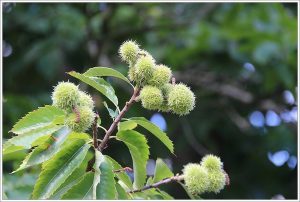
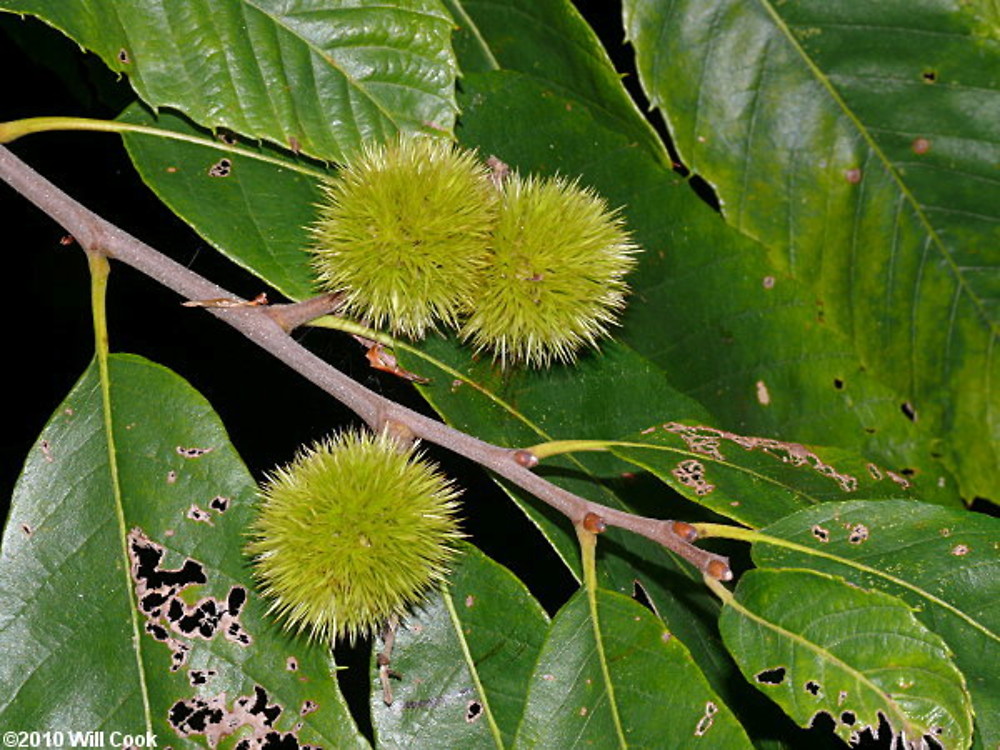
The little chestnut that survived. Photo by Will Cook, North Carolina Plant Photos.

One way to think of Chinquapins is they are small Chestnuts that survived. In the same genus as their bigger relative — Castenea — when the  blight wipeout the Chestnuts, Chinquepins suffered but some managed to endure. One can see the  Allegany Chinquepin (C. pumila) while hiking the Appalachian Trail. Their nut is about half of the size of their deceased relative but still worth collecting. We also know some of the nutrition of another edible Chinquepin, the Ozark Chinkapin (C.  ozarkensis.) 

Chinquapins pack a lot of nutrition.

Per 100 grams it has 443 calories, 18 grams of fat, 57 grams of carbohydrates, 13 grams of protein and 6 grams of fiber. The fat is 10 grams monounsaturated, 4 grams polyunsaturated and 4 grams saturated. Potassium is 77 mg, no sodium reported. A second report says they are 5% fat, 55 protein, 40% starch and 50% water with 4736 calories per kilo. European chestnuts, not affected by blight,  are the only cultivated and consumed nut that has vitamin C, about 40 mg per 3.5 ounce serving. 

In the Beech family the Chinkapin has been called them most  ignored and undervalued native North American nut tree. It has a sweet and edible nut and has been used for fuel, charcoal, fence posts, railroad ties and a coffee and chocolate substitute (as are the seeds of the Blue Beech, aka the American Hornbean, Carpinus caroliniana.)

 Just how many “Castanea” species there are is anyone’s guess. For example the USDA uses the name Castanea pumila for the Allegany Chinkepin. They say it is also called American chinquapin, C. alnifolia, C. ashei, C. floridana, C. margaretta, C. nana, C. paucispina, chinquapin, dwarf chestnut, Fagus pumila, and Golden Chinquapin. We are fairly sure C. ozarkensis is a separate species.  C. davidii, C. seguinii, C. mollissima and C. henryi are from Asia, C. creanata, Japan. To my knowledge all of them have edible nuts. Chinkapin’s native range is New Jersey and West Virginia, west to Missouri and Oklahoma, and south to Texas and Florida. It’s been planted in Wisconsin and Michigan. 

Forager emeritus Dick Deuerling once told me, some 30 years ago, that he found a chinkapin in Wekiva Springs state park, but not where in the park. I’d ask where but he died in 2013 (in July that year I went to three funerals, no wedding.)

Green Deane Itemized Plant Profile

IDENTIFICATION: Chinkapin is a small tree or large shrub that grows six to 15 feet tall. Twigs are densely hairy when young becoming shiny brown with reddish-hairy buds. The leaves alternate, are simple, short-stemmed, prominently veined, oblong with fine pointed teeth or bristles, and hairy on the lower surface. The fruit is a spiny bur with a single nut. Bur opens like a clam shell. 

TIME OF YEAR: Early September with some leeway for location.

ENVIRONMENT: It does not like limestone or sand dunes. Prefers mixed hardwood forests with pines and oaks on ridges and slopes, under 4450 feet. Heat tolerant but intolerant of salt spay or shade.  

METHOD OF PREPARATION: Shelled nuts eaten raw or roasted. 

{ 3 comments }

Wild Parsnip

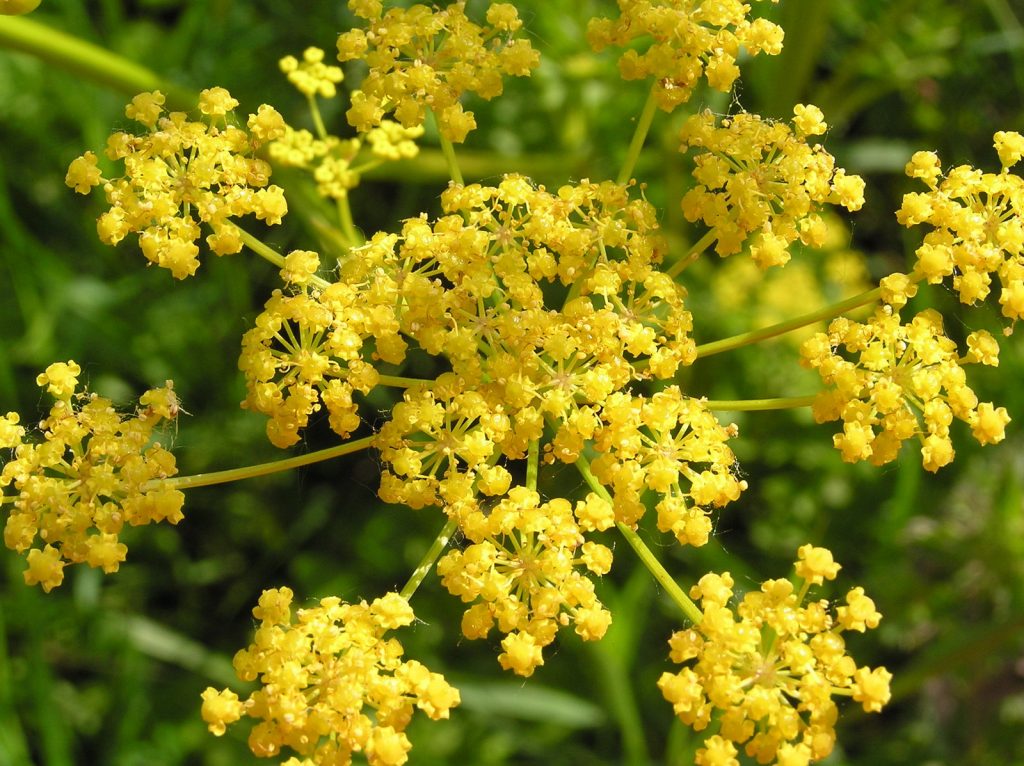
Wild Parsnip makes a flat-top yellow blossom.

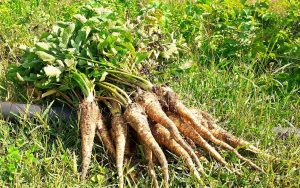
Wild Parsnip, Pastinaca sativa, is native to Europe but is found in all of North America except Alabama, Mississippi, Georgia and Florida. It’s a root vegetable closely related to carrots and parsley and has been cultivated since at least the early Greeks. It was part of the tribute the Germans gave to Roman Emperor Tiberius. Both English immigrants to America and French to Canada brought the plant with them. 

Be sure of your identification.

If we combine two reports we can get a good accounting of Wild Parsnip’s nutrient profile. A 100 gram sample has 76 calories, 1.7 grams of protein, 0.5 grams of fat (mono- and saturated) 17.5 grams of carbohydrates and two grams of fiber. Vitamin A is minor — 3 RE, but vitamin C is good: 16 mg a little over a third of your daily need. The B vitamins are B1 (thiamin) 0.08 mg, B2 (riboflavin) 0.09 mg, B3 (niacin) 0.2 mg, and B6 (pyridoxine) 0.85 mg.  The minerals are potassium 541 mg, phosphorus 77 mg, calcium 50 mg, magnesium 29.4 mg, sodium 12 mg and iron 0.7 mg. 

Tasty and nutritious so what’s the down side? It’s in the same family as Poisonous Hemlock so you have to make sure of the identification. Taste and aroma is not enough. By the account of victims Poisonous Hemlock root also smells and tastes like parsnip. That said Poison Hemlock produces white flowers on stalks creating a more rounded appearance like an umbrella. I tell my students a white umbrella made up of smaller umbrellas. Wild parsnip has yellow flowers on stalks producing a more flat-topped appearance. Wild Parsnip has celery-like leaves and deeply grooved main stalk that is green. Poison Hemlock has smoother stems if not splotched with purple and the leaves are more fern-like. More directly, if the plant you are looking at has white blossoms it is NOT wild parsnip.

What Pastinaca means is foggy. It can be from “pastinum” meaning food or to prepare the ground for planting a vine. If so then “sativa” is redundant as it means “sown.” Parsnip is from Pastinum which passed into Old French as pasnaie then into Middle English as pasnepe. The current ending -nip was added by mistake because folks thought it was related to turnips which it is not. 

Green Deane’s Itemized Plant Profile

IDENTIFICATION: A two-year plant, basal rosette of roughly hairy leaves, strongly aromatic when crushed. Leaves compound,  pinnated, broad, with toothed edges, leaf stems grooved, main stalk grooved, second-year stalk taller than first year. Blossoms yellow making a flat-top arrangement.  

TIME OF YEAR: This is a plant you have to identify this year and the harvest next year. The first year it is a basal rosette growing a tasty root. The second year it sends up a flower stalk. Flowering starts in May and can last to July or even October depending on climate and location. You can also harvest roots at the very beginning of year two. But once the plant is flowering the roots grow woody. 

ENVIRONMENT: It is rudual meaning it likes disturbed ground from abandoned fields to roadsides. It prefer a little dryer soil to a little wetter but it can some moisture.  

METHOD OF PREPARATION: Be sure of your identification. Check with a local expert. Roots raw, boiled, steamed, sauteed, mashed, pureed, baked used in soups, stews, sauces. Also made into beer and wine. Young leaves coked. Seeds used for a dill-like seasoning. Wear gloves and a long-sleeve shirt when harvesting just as you would cultivated parsnips. Sap on sweaty skin which is then exposed to sun can cause a rash that can last for months. 

{ 3 comments }

Lady Thumbs

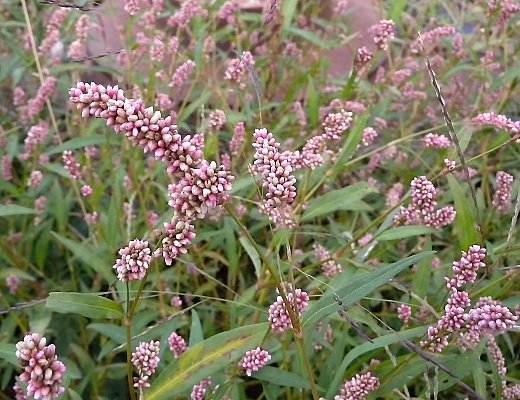
Lady’s Thumbs are closely related to Smartweed.

Where I teach classes in South Carolina — Honea Path — a weed that is prolifically under foot is Lady’s Thumb. Unfortunately the names of it and related species are constantly being changed and shuffled between two genera, Polygonum and Persicaria. This is understandable as the resemblance between the two groups is striking. Sorting out your local species requires attention to detail. Close is good enough as I am not aware of any toxic Persicaria though some may increase light sensitivity. As for edibility, test to determine if the leaf is mild or peppery.  The mild ones are eaten as a salad ingredient or pot herb, the spicy ones as a peppery or spicy green. 

From Eurasia Lady’s Thumb is among the most prolific of the group and is botanically known as Polygonum persicaria or Persicaria maculosa. Common names include Spotted Lady’s Thumb, Jesusplant, Smartweed, Devil’s Pinches, Virgin Mary’s Pinch, Herbe Traitesse, Red Joint, Red Weed, Red Legs, Redshank and more. As the stems can get red that explains that. The leaves often have a brownish spot in the middle — maculosa (mack-cue-LOW-sah) means stained or spotted — and that gave rise to the “pinches” as the leaf was pinched by the Devil, the Virgin Mary, and a Lady’s thumb. Herbe Traitesse refers to a tale in which a woman murdered her husband and wiped the blood off on the leaf leaving a stain leading to her detection. Some Gaelic-speaking folks called it Blood Spot. Other populations call it Lover’s Pride and Saucy Alice. A few folks were not as high-minded calling it Devil’s Arse-wipe.  

Other botanical synonyms include P. maculata, P. ruderalis, P. ruderalis, P. vulgaris, P. dubium, P. fusiforme, P. minus and P. puritanorum. Although Eurasian it was wildly reported in the great lakes region by the mid-1800s. This also might account for why various native people were reported using it in the late 1800s when early botanists were investigating such things.  When handling older and or peppery plants make sure to keep your fingers away from your eyes or they will smart hence another name: Smartweed. 

Names aside we do have some nutritional information for the Polygonum persicaria aka Persicaria maculosa (percy-CARRY-ah mac-you-LOW-sah). A 100-gram serving of fresh greens has 0.33 mg of B2 (riboflavin) 60 mg of vitamin C, and 12 RE of vitamin A. The same amount of cooked greens has 0.18 mg of B2, nothing else reported.  Some names suggest the plant might make a yellow dye so there might be some beta carotene which is the precursor to vitamin A. Also know Lady’s Thumb is on the weed hit list of many states either as a noxious weed or an invasive species. It invades 35 crops in some 50 countries. Not all things are bad, however. This plant provides “persicarin”  which might be used in treating severe vascular inflammatory diseases such as sepsis or septic shock. It can also remove more than 60% of nitrite from ground and surface water. The flowers attract bees, wasps, and syrphid flies. Many insects feed on the species including aphids, beetles, weevils, stink bugs, larvae of sawflies, larvae of several moths, copper butterflies and grasshoppers. Most mammals avoid the species at its peppery stage though the white-tail deer will eat young plants and or flowers thus spreading the seeds. Rodents also eat the seeds such as mice, squirrels and chipmunks. Canadian Geese have been seen eating the species as well and three turtles: Snapper, Painted and Slider. 

There are several native Persiaria some of which can resemble P. maculpsa among them the Nodding Smartweed (Persicaria lapathifolia) and Pennyslvania Smartweed (P. pensylvania.) They like similar habitats and have similar identifying characteristics.  P. maculosa has consistently shorter upright blossoms whereas P. lapathifolia has longer nodding blossoms. P. pensylvanica also has short upright blossoms but those of P. maculosa are usually shorter and more slender. P. lapathifolia and P. pensylvanica occasionally have a dark spot on the upper leaf whereas P. maculosa almost always has a dark spot.

And I saved this for last so not to confuse: Persicaria is from Dead Latin’s “persica” which means peach. Persicaria means leaves that look like peach leaves. 

GREEN DEANES ITEMIZED PLANT PROFILE

IDENTIFICATION: A weed to a yard high. Young leaves alternate, are lance-shaped, approximately two to six inches long, just over an inch wide and hairy on the upper surfaces  Older leaves are slightly hairy. Leaves taper to a point.  Leaves often have a purple/brown spot in the middle of the leaf. Stems are branched, often reddish in color and swollen at the nodes. A thin sheath encircles the main stem at the base of each leaf stem. Flowers are spikes at the ends of stems. Individual blossoms are small and usually pink but can also be white. The shiny seed is a disk to three-sided, brown or black. Tap roots are shallow. 

TIME OF YEAR: Warm weather, usually summer. If flowers from about May to October, depending on your climate. 

ENVIRONMENT: Lady Thumb prefers moist to wet waste ground, disturbed sites, meadows, stream banks, roadsides  and well-watered gardens. It prefers acid loam and does not tolerate alkaline soil.

METHOD OF PREPARATION: Non-peppery leaves in salads or cooked as a pot herb. Peppery leaves used as a spice. 


{ 0 comments }