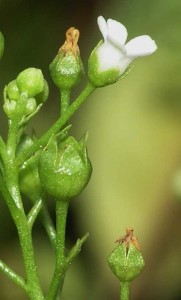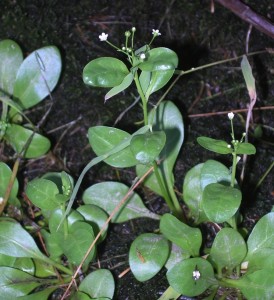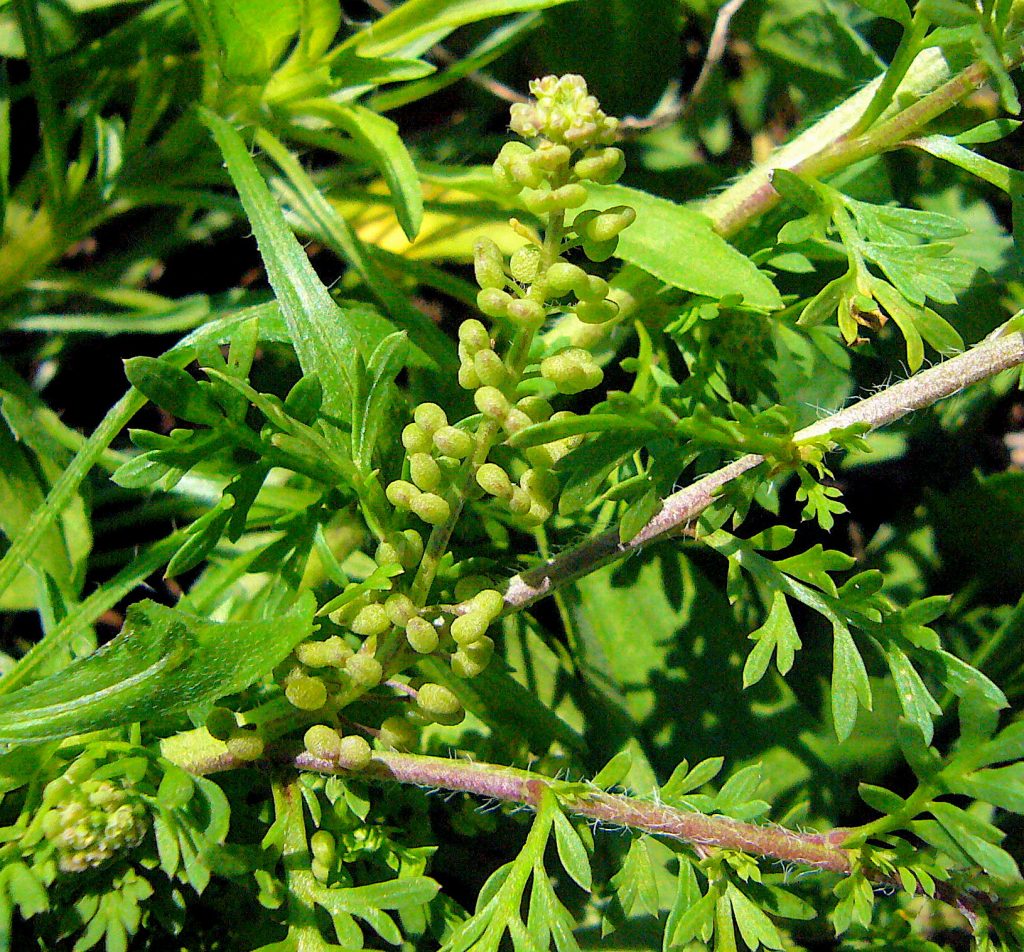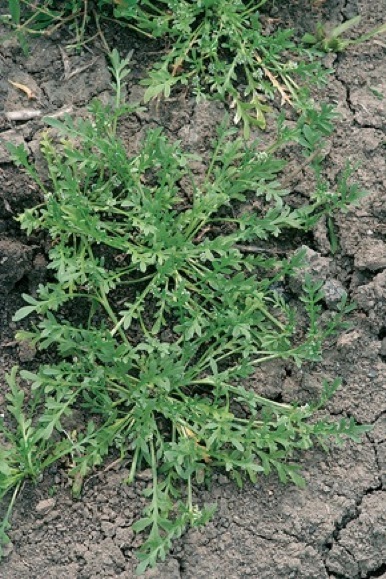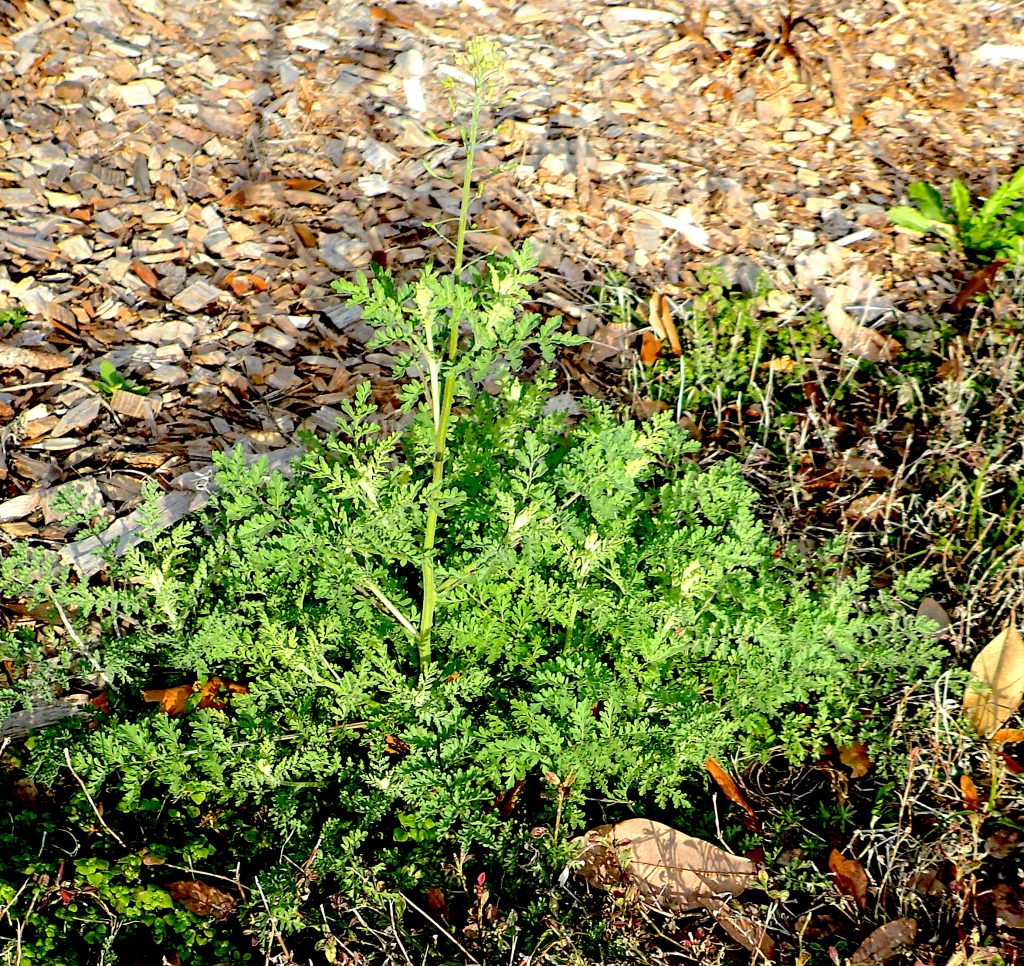
Western Tansy Mustard. Photo by Green Deane

Descurainia pinnata: Abandoned Seed

What shall we call this little member of the Brassica family? Western Tansy Mustard or Tansy Mustard? We could always opt for its scientific name: Descurainia pinnata (des-kur-AY-nee-ah  pin-AY-tah.)

I am hesitant to call it the Western Tansy Mustard because it definitely grows here in eastern Central Florida, that’s hardly west unless you’re living in Europe. It’s our native tansy mustard vs. a European import (which is why it’s called “western.”)

It shares many of the characteristics of a subset of members of that popular family: Small edible leaves, spicy seeds in pods, rangy growth, the ability to survive in dry areas, and four-petaled yellow flowers resembling a cross.
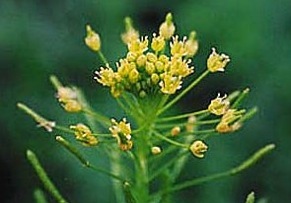
Blossoms of western tansy mustard

Other writers say older leaves of tansy mustard are edible cooked but bitter. They say as young spring greens it can be salty. I have found them to be neither bitter nor salty and edible raw as well as cooked though the raw texture is a bit cottony. The seed pods are an interesting nibble and can be pickled but they are tiny. The seeds are edible raw or cooked and have been used as piñole. The seeds can also be used to flavor soups, as a condiment ground into a powder mixed with cornmeal, used to make bread or to thicken soups and stews. In Mexico the seeds are made into a drink with lime juice, claret and sweet syrup. That’s a lot for such a minute seed. Medically natives ground up the seeds and used them in the treatment of stomach complaints. A poultice of the entire plant was used to ease the pain of toothache. An infusion of the leaves was used as a wash on sores.

The D. pinnata grows from Quebec to British Columbia, Florida to California, and south into Mexico including Chihuahua, Sinaloa, and Sonora. It was more used by Western Indian tribes than eastern because the eastern diet was supplanted by beans, maize and squash.

The Tansy Mustard was a major plant for various Indian communities. The Hohokam cultivated the plant, the Maricopa and Quechan baked the young greens in pits. They would alternate layers of greens and hot rocks then cover the top with earth. Of prime use, however, were the seeds, They were eaten by the Atsugewi, Cahuilla, Cocopa, Gosiute, Hopi, Kawaiisu, Keres, Maricopa, Mojave, Navajo, Paiute, Papago, Pima, and Quechan. Up to a century ago the seeds were still sold in large quantities near Indian villages. That’s rather amazing since the seed is about the size of the eye of a needle.

Typical preparation of the seeds was to collect them when ripe. The plants heads were shaken into baskets to collect the microscopic seeds. They were then mixed with water and eaten like a mush (they are a bit mucilagenous, perhaps why they settle tummies.) Another way was to grind them and mix with cold water and sugar, much as the modern drink is still made.

Interestingly the Pima also used the seeds to remove foreign objects from the eye. They would put one seed in the eye and it would bring out the offending debris, so they say. I’m not sure putting a mustard seed in the eye is a good idea. They can be spicy. Another non-culinary use was the Hopi mixed the ground seed with iron to make a pigment for pottery.

The Descurainia genus honors Francois Descurain, 1658-1740, a French botanist and pharmacist.  “Pinnata” is from the Latin word for “feather”, describing the finely cut leaves.  “Tansy” comes from the Greek word “Athanasia” meaning “immortal” in that its blooms last a long time. “Mustard” comes from the Latin word “mustum” which means “young wine” read tart, rank and or bitter.

Lastly, the Tansy Mustard is toxic to livestock in more than small quantities, especially if there is a lot of selenium in the soil, which suggest it sequesters selenium. It is difficult for humans, who are not grazers, to eat that much. Grazing cattle can go blind and die from it.

Green Deane’s “Itemized” Plant Profile

IDENTIFICATION: An annual cool-season forb to 2.5 feet high, usually single-stemmed, leafy, covered with fine, gray hairs. Leaves alternately along wavy stems, each divided into small segments. Flowers range from yellow to whitish, in long clusters at stem ends, four petals but oddly shaped. Very distinctive club-shaped fruit, long, round, slender, two-celled capsules filled with many small, waxy seeds. It’s a silique meaning it separates like a V-sign with your fingers but in between is a small tongue holding all the seeds.

TIME OF YEAR: Flowers January to July depending upon climate, seeds pods follow quickly.

ENVIRONMENT: Plains, hills, disturbed areas, does very well in sandy soil and the desert.

METHOD OF PREPARATION: Young leaves as greens or older leaves cooked. Young leaves and seeds pods as a trail side nibble or for seasoning or pickling. Seeds have many uses including drinks, breads, mush, thickener and flavoring. It picks up selenium from the soil. 
 

{ 6 comments }

Brookweed salad ingredient and source of vitamin C. Photo by Green Deane

Brookweed is an edible plant few know a lot about these days. Even Professor Daniel Austin, who managed to write 909 pages about ethnobotany, could only scrape up one paragraph.

Photo by Jan De Laet

Petals fuse part way down. Photo by Jan De Laet

Moerman does not mention the Brookweed in his book on Native American Food Plants. It escaped entry in Cornucopia II, the Encyclopedia of Edible Plants of North America, and Edible Wild Plants, the latter by Fernald who included some mighty off-beat species in his book such as Montropa uniflora, the Indian Pipes. Brookweed also managed to not be mentioned in the Journal of Economic Botany during the last 60 or so years. Most references skip over the genus (Samolus) going from Sambucus to Sassafras which is admittedly quite tempting. On the positive side the plant is also not mentioned in Plants that Poison People by Morton, Plants That Poison by Schmutz nor in the mystery writers’ bible Poisonous Plants of the United States and Canada by Kingbury.  Here’s Austin’s entry from page 596 of his book Florida Ethnobotany:

“This is another medical plant that Hogan (1978) found at the pre-Columbian Glades village at Ft. Center. Here, however, apparently is the only record of indigenous use of the plants in North America. Nearby in Cuba, Samolus is considered antiscorbutic and diaphoretic and is sometimes eaten in salads or as emergency food. (Roig 1945). Although no use is given for Samolus, its Huastec name associates it with an edible plant, suggesting that it, too, was eaten (Alcorn 1984.)”

Photo by Bruce Patterson

Low-growing in wet spots. Photo by Bruce Patterson, New England Wildflower Society.

Brookweed, Samolus valerandi, has some history as an edible in Europe (as old books say it is found in the Old and the New World and even in Australia.) It grows in watery conditions and can tolerate some salinity. At least one related species tolerates high salinity. Young leaves are soft, spinach-like. When very young the leaves are bland but quickly develop a bitter flavor, which might explain their absence from the dinner menu but found in the home pharmacy. Like many such greens they were tossed into salads with a lot of other greens. In Catalonia, for example, it is a very common salad addition usually with two to three other greens. When cooked they are used the same way, an addition to not the main flavor of. In parts of Africa it is famine food, that is, eaten when preferred food is not available.

Medicinally S. valerandi has been used as an astringent, a laxative and  for scurvy so we know it has some ascorbic acid (vitamin C) but we don’t know how much. A 2004 publication, Plant Resources of Tropical Africa 2, states the plant’s nutritional and medicinal properties need to be researched. Brookweed was also often used to heal wounds, rashes, chaps, and ringworm. Close relatives, the Pimpernels, were used for dropsy, epilepsy even rabies. Locally Wunderlin enumerates two Samolus in Florida, S. valerandi subsp. paraviflorus, aka S. floribundus, and S. ebracteatus also called the Limewater Brookweed. Interestingly the word “brookweed” has been around in English since at least 1624. As Florida is wet and there aren’t that many brooks the name “Pineland Pimpernel” is as good as any other.

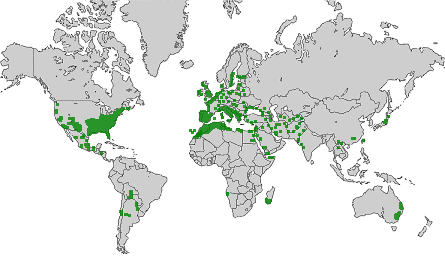
Worldwide distribution of Brookweed

Worldwide distribution of Brookweed

There are about a dozen species in the Samolus genus and there is a bit of a debate on what the genus name means. It could be from the Gaelic meaning “ointment” or “plant salve.” Other translations include “Good Pig,” “Healthy Pig,” and “Pig Food.”  Or Samulos might be Dead Latin for some plant the Druids used for pig medicine. Pliny the Elder reported that in the first century. Perhaps the Druid/Gaelic words came first and the Dead Latin is only echoing that use. Pliny also reported there were superstitions associated with the plant and that was used as medicine for cattle. It was harvested only while fasting, only with the left hand, and was not  put anywhere “other than the trough where it is crushed.” Translations vary but what he wrote was: “Druidae Samolum herbam nominavere – hanc et sinistra manufactory legiti a jejunis counter morbos sum boumque, ne respicere legentem -”  The Druids believed Brookweed could make one invisible. (Apparenlty the conquering Romans did not believe that.) Because of the plant’s common name back then some early botanists thought the plant was from the Greek island of Samos. That’s probably not true but inhabitants there did make vases that resemble the plant’s leaf shape, and the plant is common on Crete.

A portrait of Anne Platt as a young woman

A portrait of Anne Platt as a young woman

Valerandi is also from Dead Latin and means “full of strength.” The species was named after 16th century botanist Valerand Dourez of Lyon. An early publication, the Journal of British and Foreign Botanists, says Dourez was born in Lille, Flanders, and might have been related by marriage to the more famous botanist Johann Bauhin for whom Bauhinia is named. Though a botanist Dourez leaned towards the chemistry side. Today we would call him a pharmacist. His botanical travels included going to the Alps, Greece and Syria. In 1565 he married in Lyon then died there between 1571-75.  Samolus (Samole in French) was a tribute to Dourez by his French botanists friends. And there is also some disagreement whether his name is Valerand Dourez or Dourez Valerand.  I think this can be traced to a Victorian illustrator named Anne Platt (1806-1893)  who wrote and illustrated over 200 books. Though publicly very popular she was never accepted by the Good-Old-Boy botanists because

Photograph of Anne Platt as an older woman

A later photograph of Anne Platt. To read about the Victorian’s Language of Flowers click here.

she was self-taught. In 1855 she wrote Flowering Plants of Great Britain and mentions Dourez in Volume 3 page 52. Later she repeats herself (posthumously) on page 79 in an 1899 book called Flowering Plants, Grasses, Sedges, and Ferns of Great Britain. It seems Platt is the first one to switch the names in print calling him Dourez Valerand. Unfortunately a 1985 book copied the mistake. Platt also reported that some earlier authors thought Dourez (rather than the plant) was from Samos. That is how someone who was born in Belgium and lived in France becomes on the internet a Greek from Samos with a reversed name.

Ebracteatus means without bracts, parviflorus means small leaf. Samolus in English is said SA-moe-lus or SAM-uh-lus. Valerandi is said va-LAIR-ann-dee though some might be tempted to say val-er-ANN-dee. Common names in English are the Pineland Pimpernel, Water Pimpernel, Water Chickweed, Seaside Brookweed (the name the USDA prefers) Salt Bunge, Water Rose, Water Cabbage, Florida Limewater Brookweed, and Kenningwort, the latter a rare use meaning “ulcer plant.” There is some speculation that Shakespeare mentioned it in Midsummers Night’s Dream when referencing “Dian’s Bud.” The Germans call it  Samoskraut, Dutch Strandpungen and the Danes Strandsamel.

Green Deane’s Itemized Plant Profile:  Brookweed

IDENTIFICATION: Samolus valerandi, low to short, creeping perennial; stems branched or unbranched, erect, light-veined leaves a basal rosette of oval, alternate along the stem. White blossoms, cup-shaped, stalked, borne in lax racemes; five petals joined at half way. S. ebracteustus does not have any bracts, flowers are 5-7 mm wide, stem leaves do not extend into the inflorescence. S. valerandi has minute bracts near the middle of the pedicle, the stem leaves extend into the inflorescence, blossoms are 2-3 mm wide. Grows eight to 10 inches high. Now in their own family, Samolaceae.

TIME OF YEAR: Flowers May to September depending on climate, young leaves when present. Small pods ripen, darken then turn brown.

ENVIRONMENT: Slow growing. Watery places, wet grasslands, edges of streams, ditches, can thrive in salty conditions. Given a choice it likes to grow on wet gravel. Can reproduce by seeds or by leaf bud. Some report it is difficult to grow. Can grow submerged. The plant’s habitat is diminishing in France and in some areas is protected.

METHOD OF PREPARATION: Young leaves raw or cooked. I eat young leaves as a trail side nibble.

Special thanks to Josey for some information used.

{ 2 comments }
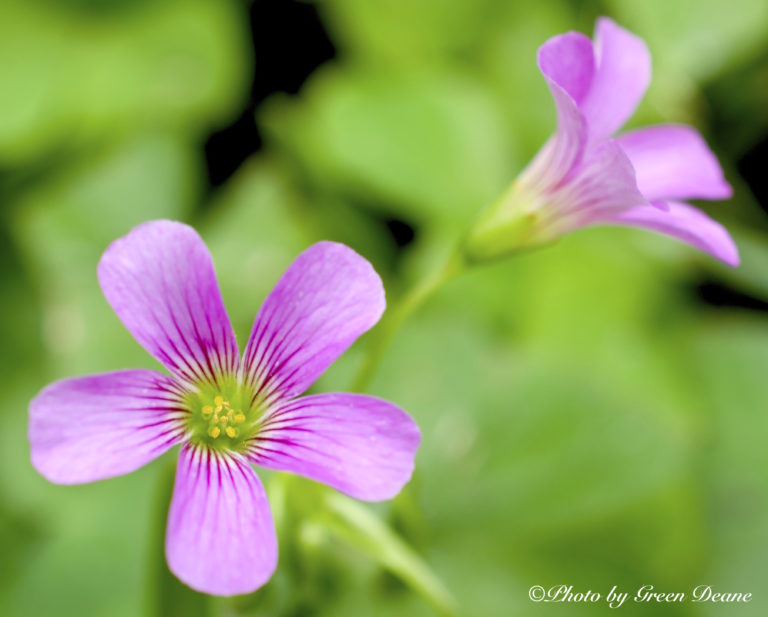
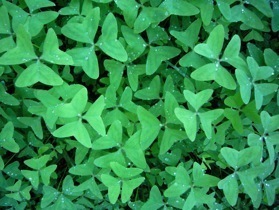
Oxalis have petals and can be pink or yellow. Photo by Green Deane

Oxalis have five petals and can be pink or yellow. Photo by Green Deane

Sorrels are like McDonald’s restaurants: No matter where you are on earth there’s one nearby.

That’s because the sorrels, properly Oxalises, comes from a huge family. What’s huge? There are some 850 different species of them, according to the Encyclopedia Britannica. No, that’s not a record. The biggest family is the Composites, you know, plants like sunflowers and daisies. There’s over 20,000 in that family, maybe more, no one really knows for sure. Still, an Oxalis (ox-AL-iss) is found at every location on the rotation except at the north and south poles. They are about as wide spread as mustards are. There are at least seven species in Florida, all edible, three of them rare — don’t eat those — and they have either pink or yellow blossoms, one of which has the good taste to sprout up in my garden. I live mid-state right on the line between temperate and subtropical so many plants said to be in the state are often 200 miles farther north in temperate or 200 miles farther south in tropical.

Oxalis is mistakenly often called clover

When you have a family of plants that’s 850-strong, and folks don’t know enough to eat them, you also get the other view: That the Oxalis is not a delicate, pretty little greenerific morsel but a pernicious ugly weed that uses up your water, fertilizer and garden space. Once an Oxalis gets a roothold in a garden, it’s there forever, which brings up a touchy point: Gardeners who complain the most about weeds are also usually the last group to consider eating the weeds.  It’s kind of like they are for controlled green but not natural green. To me an Oxalis in my garden is food I didn’t have to plant. As long as it’s growing where I want it to grow there’s no issue. If it isn’t, it’s not a weed: It’s dinner. Sorrel is the first wild plant I saw someone other than my mother or grandmother nibble on. A childhood friend of mine named Peter Jewett called it “sour grass” a common name for it. We used to play on a small island in a small brook in the Maine woods. It grew profusely there and was the fort’s “food supply.”

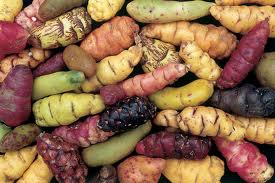
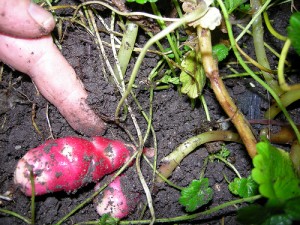
Here in Florida our several versions keep changing names: O. articulata, corniculata, debilis,  latifolia, macrantha, triangularis and violacea. O. corniculata used to be O. stricta, O. debilis was corymbosa. The rare ones are O. articulata, triangularis, and violacea. All parts are edible including the root bulb, which is succulent and can be sweet. Above ground it tastes much like rhubarb but not as tart. The C. violacea occasionally has, in the words of Merritt Fernald, author of Gray’s Manual of Botany, “an icicle-like water-storage organ or fleshy root.” In other parts of the world, Oxalis tuberosa is popular not only as a green but as a root vegetable. 

Oxalis roots are popular as a vegetable in New Zealand

Sorrel is from the High German word “sur” meaning sour. Oxalis is from the Greek though the accent is on the end: ox-al-IS, base word (Οξύς, pungent) The Oxalis is mildly tangy because of …oxalic acid… now there’s a surprise. Articulata (ah-tic-you-LAH-ta) is jointed, Corniculata means, creeping, much branched like a mat, debilis is weak, Latifolia means broad leaved,  Macrantha large flowered, Violacea (vye-o-LAY-see-uh)  like a violet, Triangularis, triangle shaped, and Tuberosa (too-ber-ROW-sa) means tuber. Oxalises can grow individually or in colonies, and if you have one there will be colonies. They are refreshing to nibble on, are nice additions to salads, and can be made into an ade. Their tangy flavor is both positive and negative. A little is good, but a lot when eaten uncooked, to excess, can leach some calcium out of your bones. (Yes, you would have to consume it like a force-fed lab rat for months, but it can happen.) Kids can eat too much as they do green apples and get a tummy ache from it. Watch their consumption.

Oxalis root in situ

Cooking plants with oxalic acid reportedly renders them harmless, and that’s what has been done with other plants containing oxalic acid, such as docks and sheep sorrel, both Rumex and in the buckwheat family. This is particularly true if any form of calcium is used — milk for example — or included in other food. A good use for this plant is stuffing that trout you just caught and are cooking over the fire.

Every book on wild foods warns us not to consume too much oxalis acid, but that’s to keep the accursed lawyers happy. ( Shakespeare was right.) It is true that folks with kidney stones, gout and the like should not over-consume oxalic acid. Yet, when was the last time you read or heard of such a warning for tea, parsley, rhubarb, carambolas, spinach, chard, beets, cocoa, chocolate, nuts, berries, black pepper and beans? They all have oxalic acid as well, but no dire warnings are given with them. The French are not succumbing from sorrel soup slurping. As my Greek ancestors used to say some 3,000 years ago, μέτρον άριστον, [ME-tron A-ri-ston] all things in moderation.

Lastly, the Internet calls Oxalies “clover” which is completely wrong. Different genus, different shape if you look closely.

Below is an Oxalix Cooler recipe from Sunny Savage

Oxalis Cooler

1 quart water

1/2 cup Oxalis leaf/stem/flowers/seedpods

1 Tablespoon agave nectar or honey

dash of salt

Mix all ingredients in a blender. If possible, let sit overnight in refrigerator and enjoy!

Green Deane’s “Itemized” Plant Profile

IDENTIFICATION: Perennial growing to ix inches, three leaves, some times very delta shaped, other times round or lance shaped, depending upon the species. Pink and or yellow blossoms in Florida

TIME OF YEAR: Grows and flowers year round in Florida, July to September in more northern climes. Very prolific in February and March in Florida.

ENVIRONMENT: Anywhere moist but well drained, lawns, woods, trails, parks.

METHOD OF PREPARATION: Leaves and stems in salad, or made into ade or soup. Use as a stuffing for fish and chicken or ferment like a sauerkraut.  If you  cook oxalis best to use a glass or ceramic pot. Like all plants with oxalic acid should be used in moderation. Some people may be allergic to it. The juice can be used to coagulate milk for cheese making. See my article on rumex.


{ 60 comments }

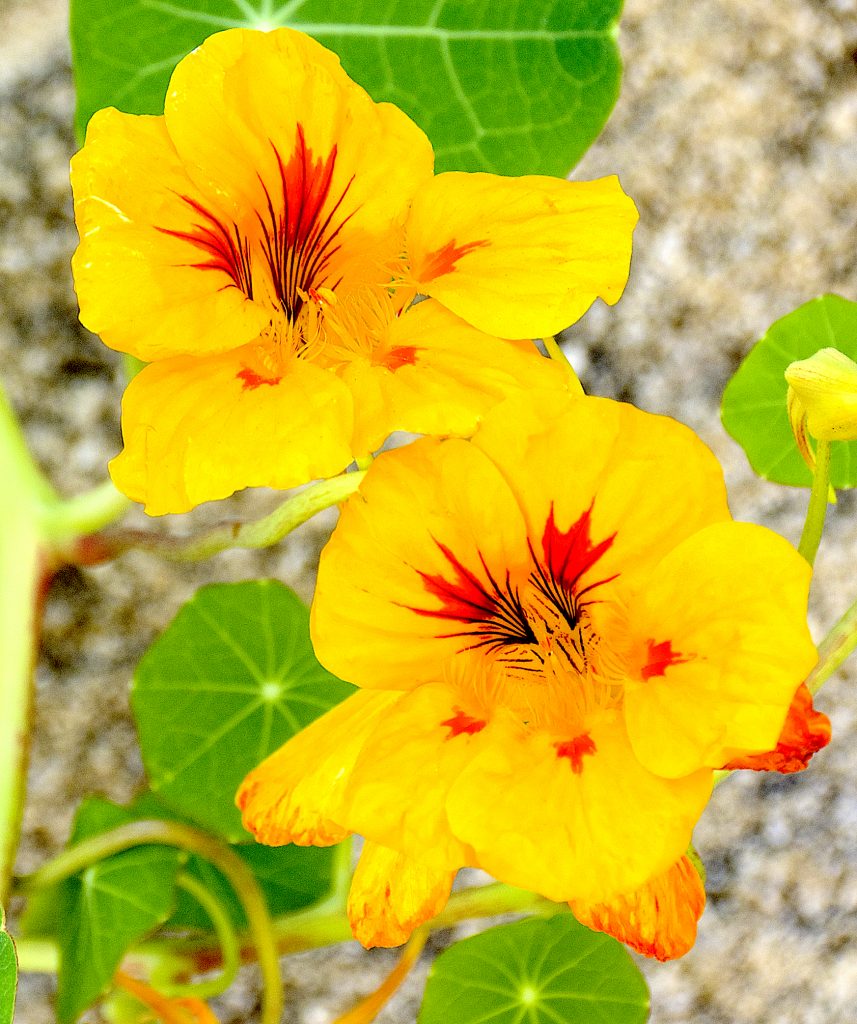
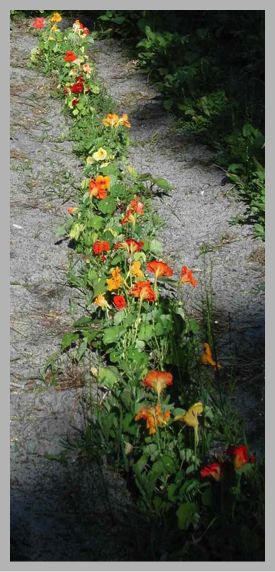
Nasturtiums are originally from Peru. Photo by Green Deane

Nasturtiums: Peppery Peruvian Natives

Naturalized garden plant

Do the peppery Nasturtiums make your nose twitch? Then you know how they got their common name. “Nasturtium” in Dead Latin means “twisting nose.”

Nasturtiums are among the most well-known edible flowers. Their leaves and stems are edible, too, but peppery. You can steal a snack or two out of a flower bed as long as you know the flower bed does not have any pesticides on it. Locally they like our mild-winters. 

Nasturtium’s botanical name is Tropaeolum majus (trope-ee-OH-lum MAY-jus). It comes from the Dead Latin word tropaeum or trophy. That comes from the Greek word tropaio, meaning prize. Food used to be given to winners in athletic contests. The word for food in Greek is trofima.  Anyway, a yellow-flowered Nasturtium twining up a post reminded Linnaeus —the fellow who started naming plants — of the practice used in ancient times of displaying shields and helmets of slain soldiers on the trunk of a tree at the scene of a battlefield. Majus means big, large or great. By the way, Latin was chosen to name plants because it is a dead language. No large group of people are speaking it as their native tongue so it is not evolving. Unlike the older, still living language of Greek, Latin is static.

Leaves and seeds are peppery

Nasturtiums came to North America the long way. Discovered in Peru in the 1500’s, two species were taken back to Spain as a vegetables.  It was a Dutch botanist who took the then short plants and developed the twisting vine Linnaeus named. Soon they were being grown for their flowers as well and spread across Europe. Then they came to North America with immigrants as early as 1759. Nasturtiums were also known as Indian Cress or Capucine Cress, in reference to the shape of the flower that was also similar to Capucine monks’ robe hoods.

Thomas Jefferson

Thomas Jefferson planted nasturtiums in his garden from at least 1774 on. He pickled the seeds and categorized the Nasturtium as a fruit along with the tomato (which is botanically a fruit but legally a vegetable. That came from a US supreme court ruling in the 1890s and involved different taxation rates for fruits, vegetables, and seeds. Since tomatoes — and beans — were used as vegetables rather than fruit and seeds, respectively, they were to be taxed like vegetables. ) While Nasturtiums are primarily cultivated they have escaped and naturalized in a few states and of course are wild in Peru.

Nasturtiums are easy to grow and aren’t picky about soil, light or water. Rich soil produces lots of leaves, poor soil lots of blossoms. Thus they are a natural indicator of the quality of your soil. The seeds, which germinate in a week to 10 days, are large so they make a good project for kid hands.

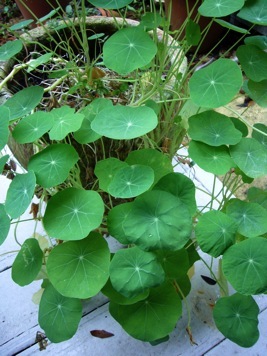
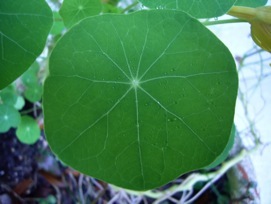
Nasturtium stems are pellate

Dwarf Nasturtiums add a butterfly-like rainbows of color to annual beds and borders (and attract humming birds which pollinate them.)  Trailing forms of Nasturtiums color fences, trellises, slopes and hanging containers. Aphids incidentally love Nasturtiums so organic gardeners like to plant them around the vegetable garden to “lure” aphids away from other plants.  Nasturtium flowers, leaves and immature seed pods can be added to salads. They are rich in Vitamin C. The immature pods can be pickled and the mature seeds roasted for a peppery snack or ground and used like black pepper. My mother loved to eat their seeds. I lacto-ferment the seeds for three days, drain, then put in the frig with a little sugar and chardonnay to cover. Very tasty but they smell horrible while fermenting.  

Like all wild plants with a good dose of oxalic acid they come with the warning not to eat them in large  quantities. Odd that warning is never given for domesticated plants with higher levels of oxalic acid.

Bouquet Salad

Dressing: 1/4 c. white wine vinegar or champagne vinegar, 1 T. Dijon mustard, 1C. vegetable oil, salt and pepper to taste, 1/4 C. light olive oil, 1 T. freshly squeezed lime juice, finely grated zest of lime.

Salad: 3 heads radicchio, washed and dried, 1 small bunch of chives, 1 lb. tender spinach, trimmed, washed and dried, nasturtium blossoms.

In a bowl, whisk together the dressing ingredients. Just before serving, toss, toss greens, chives and flowers with enough dressing to coat. Yield 8 servings.

Nasturtium Bundles

Gather medium size nasturtium leaves. Rinse with cool water and dry. Set aside. In a small bowl: mix 1 – 8 oz. package cream cheese, softened, 1 small can crushed pineapple, drained and 3 T. of any of the herb choices ( washed, dried and chopped): thyme, lemon verbena, lemon scented geranium leaves or flowers, basil, chives or rose petals – pith removed (white part at base of petal). After blending: With a knife, generously spread the cream cheese mixture on each nasturtium leaf, roll up and pile on a serving platter. Add nasturtium flowers as an accent.  Recipe created by Kelly Wisner.

Steamed Beets with Nasturtium

4 whole beets steamed

6 nasturtium leaves, shredded

4 nasturtium flowers

Dressing:

1/3 C olive oil

2 T balsamic vinegar

1/2 tsp salt of choice, plain or flavored

Steam peeled beets, covered, until just able to pierce them with a fork (about 30 minutes.)  Cool. Cut into bite sized wedges.  Whisk the dressing.  Shred nasturtium leaves and sprinkle on top of beets, drizzle dressing over all. Decorate with flowers.  Serves 3-4.

Green Deane’s “Itemized” Plant Profile

IDENTIFICATIOIN: Flower: Nasturtiums grow showy with spots of bright blossoms in masses of foliage. Leaves are round and scalloped, flowers funnel shape with a spur on the underside. They come in rich shades of yellow, orange, , pink, red and brown, dwarfed to climbing, a favorite of leaf miners.

TIME OF YEAR: Plant in spring and summer in northern climes, spring, fall and winter in Florida in southern states with successive plantings. Like rich soil but can grow in sandy areas with irrigation. Tolerate neglect

ENVIRONMENT: Usually found in gardens, flower beds and flower pots.  Make sure no pesticides have been used. They are naturalized in some urban areas.

METHOD OF PREPARATION: Peppery leaves in salads or out of hand hot snack. Flowers can adorn salads, seeds can be pickled and used like capers.


{ 8 comments }


Coronopus didymus, strong flavor, naughty name. Photo by Green Deane

   Coronopus didymus, C. squamatus: Smelly Pot Herbs?

Opinions are mixed on Swinecress. I think it’s a nice walkabout nibble and pot herb. I often find it in lawns in the cooler months of the year and take it home with me. Others think it stinks nauseatingly and you should put a clothespin on your nose while boiling it …many times. Now you know the spectrum of gustatory opinions.

Coronopus Squamatus

Swinecress is yet another micro-mustard one finds clinging to life in scattered little patches. Don’t let the size fool you. It is a tenacious plant in will-to-live and flavor. Actually there are two species in North America, neither of them native. Coronopus didymus probably came from South America and Coronopus squamatus (formerly C. procumbens) came from Europe.  They both have a moderate to strong mustard flavor and are used the same way. Sometimes the C. didymus is called the “Lesser Swinecress.” No idea why. Their main separating distinction is the fruit/seeds of the C. squamatus is lumpy and has ridges where as the C. didymus tends to be smooth.

While both are found scattered in the Eastern United States, C. squamatus is also sprinkled across Europe. It is found from Ireland and southern England over to near my ancestral grounds in Greece, the wetlands of Mt. Parnon in Peloponnisos. C. didymus is also found in Oregon, Arizona and California. In the latter two states it is a noxious weed. It’s also been introduce to South Africa and Australia

Calling these plants micro-mustards is not quite fair. When they live where they are walked on or mowed they indeed become tough little contenders. But, given all the things most plants like such as sun, water, good soil and not trod upon they can grow to over a foot hight. Oddly, they take up salt in their roots, up to 17 percent.  Those roots can be ground up and mixed with vinegar for a type of horseradish. Or they can be cooked and eaten. While I do not know so the roots might also be burned for the salt. Other plants are burned for salt.

Coronopus (kor-on-OH-puss) is from Greek and means Raven/crow’s foot, presumably because the ends of the leaves look like that. Not too many people look at crows’ feet these days, or Ravens’. Didymus (DID-ee-mus) means found in pairs, a reference to the seeds, as in two testes and indeed that is what the seed pod resembles. Squamatus (squa-MAY-tus) means with scale-like leaves or bracts.

By the way, there are no poisonous members of the mustard family, just pungent.

Green Deane’s “Itemized” Plant Profile

IDENTIFICATION: Coronopus didymus: An annual or winter annual, low, spreading, smooth to mildly hair, stems freely branching, low-growing with upward tips, many leaves, ovate to oblong, pinnatifid, segments narrow, dentate or incised, racemes many, lots of flowers, white petals. Fruit shorter than stalks, seeds in two inflated rounded sections. Coronopus squamatus similar, more leafy, basal leaves obvate to oblanceolate, very condensed flowers.  Seeds much rougher than C. didymus which are smooth.

TIME OF YEAR: C. didymus flowers spring to mid-summer. C. squamatus flowers in summer. In Florida, Swinecress a winter annual easily found in January.

ENVIRONMENT: Old fields, roadsides, along streets, vacant lots, disturbed sites, mowed lawns, often locally abundant.

METHOD OF PREPARATION: Depends on your taste and perception. Can be eaten raw. Most people boil leaves and stems in several changes of water as a pot herb. Seems excessive to me. I actually never cook it. Can be used to stuff other foods such as fish. Roots can be cooked or ground up and mixed with vinegar to be used like a horseradish. Do not add salt to the root until you taste it.


{ 5 comments }