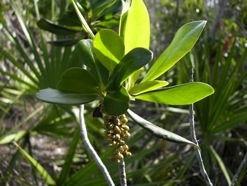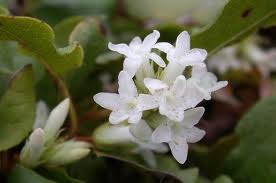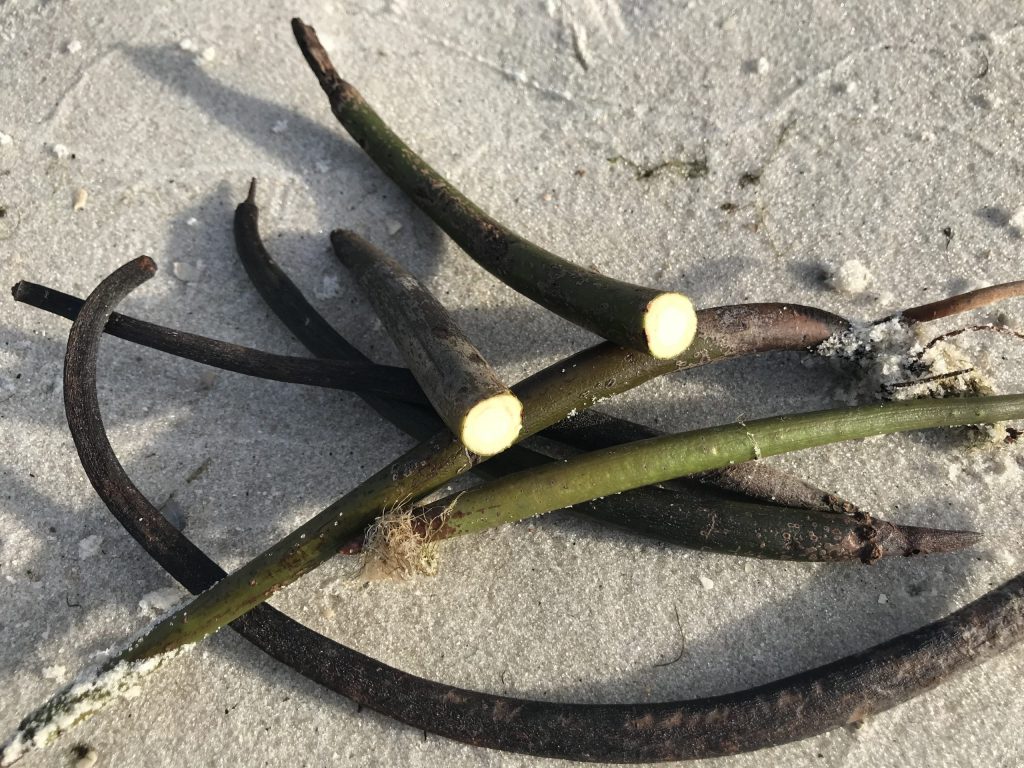
The inner starch of red mangrove propagules is edible cooked. Photo by Green Deane

Mangroves: Marvelous Muck Masters
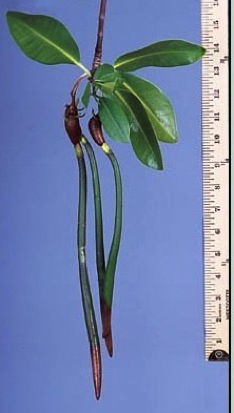
Red Mangrove cigar-like seed pod

I did an unknown favor close to 30 years ago that may stump some stuffy botanist in the near or distant future, and a mangrove helped me.

Mangroves are coastal trees that don’t mind wet salty feet. Well… that’s not exactly accurate. They tolerate salt. The Red Mangrove is found at or in the water, and endures flooding.  The Black Mangrove is found just above the water and can take occasional flooding well.  

Many years ago I lived in the center of the state (Florida) in an apartment complex that had swales. One particular swale always flooded and what ever bush the complex planted there died. On one of my foraging trips I brought back a Black Mangrove seedling, raised it a bit on my balcony then planted it with a stake in the wet spot. When last I checked it was still happily growing three decades later. Mangroves used to grow inland in ancient times but have been coastal dweller for eons. I can’t help but wonder if some day some researcher will find that tree, or its remains, and wonder how it got so far inland.
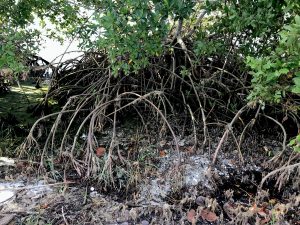
Red Mangrove roots help the tree “walk.”

The Red Mangrove is Rhizophora mangle (rye-ZOFF-for-ruh MAN-glee.) When one mentions costal bushes walking on water it’s the Red Mangrove that comes to mind. Their seed pods litter the beaches at certain times of the year. In central Florida they are bushes but the farther south one goes towards the equator the larger they become eventually reaching tree status. Its dried leaves make a nice tea with tannin, 11.68% tannin. The same leaves have also been used as tobacco and make wine, as can young fruit.  Further, its fruit is actually not a fruit at all but a propagule, an embryonic root. It starts out as a bud but grows somewhat like a curved, thin-ringed cigar and when dry can be smoked like one, if you snip off each end. You can also make a whistle out of it. The bitter inner portion of the same hypocotyl when green can be eaten as an emergency food cooked well in a lot of water. By the way, they can float for a year in salt water before rooting. Recent research shows extracts made from the bark of the Red Mangrove can reduce gastric ulcers, is antimicrobial and contains antioxidants. Red Mangrove twigs can be used to clean teeth.
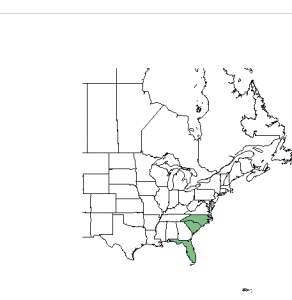
Red Mangrove distribution.

The leaves made into a meal make good cattle food (if calcium carbonate is added) and are 7.5% protein, 3.6% fat, 13.9% fiber and 2.8% carotene. Per 100 grams the leaf meal has 1.35 grams of calcium,  0.88 grams magnesium, 0.65 grams potassium, 0.14 grams phosphorus, 54 mg of iodine, manganese 30 mg, 15 mg of iron, 4.3 mg of zinc, 3.5 mg of copper,  ,13 mg of B1 (thiamin) 19 mg of B2 (riboflavin) B3 (niacin) 240 mg, B5 (pantothenic acid 5.3 mg) 32 mg of B9 (folic acid)  0.52 mg cobalt and 46 mg of choline. Amino acids in descending amounts were arginine, lysine, glycine, methionine and cystine. 

Supplemental 106-grain tablets were made of red mangrove leaves in the early 1950s. An analysis showed per 100 grams they had calcium 1.35 grams, iodine 53.60 mg, magnesium 880 mg, phosphorus 138 mg, potassium 650 mg, sulphur 790 mg, copper 8.30 mg, sodium 920 mg, zinc 4.30 mg, iron 15.20 mg, manganese 30 mg, boron 8.30 mg chlorophyll 2.24 mcg per gram, folic acid 0.68 mcg per gram, cobalt 5.20 ppm, fluorine 144 ppm and crude fiber 10.3%. 
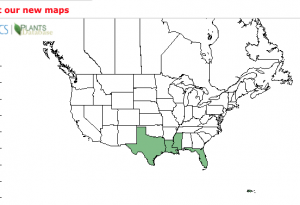
Black Mangrove distribution.

The leaves at one time were considered a source material for human protein but that was sidelined by the plant’s high tannin content. 

Its botanical name, Rhizophora mangle, is in part from Greek and part Taino. Rhizo means root; phora, from pherein, means to bear. Mangle (via Potuguese) comes from the word, mangue, which is what the Taino called the Red Mangrove. The word “mangrove” also comes from mangue.
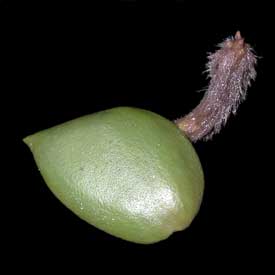
Cooked Black Mangroves propagules are edible, too.

The sprouting propagules of the Black Mangrove, Avicennia germinans, (av-ih-SEN-ee-uh JER-min-ans) can also be used as a famine food, if cooked. They are toxic raw and resemble huge pointed lima beans. The Black Mangrove’s leaves are often coated with salt, which makes collecting convenient should you be needing salt. Avicennia means “of Avicenna.” Avinenna was an Arabian physician in the tenth century AD. The genus was named after him. Germinans is germinating, starting to root while on the tree.

Traditionally NOTHING is edible on the White Mangrove, Laguncularia racemosa, la-gun-koo-LAY-ree-uh ray-sem-OH-sa.) Its bark has a long herbal history for treating various ailments. The shurb’s high tannin content makes it astringent. It was used as a fever tonic to treat scurvy, dysentery, and skin ulcers. It is reported to have anti-tumor activity.  Enthobotanical studies do not show native eating the leaves of the White Mangrove in the Northern Hemisphere. There is a report (Hocking 1997) that the leaves are boiled for greens in Scandinavia and Great Britain. Since they do not grow there they must be imported.  Laguncuiaria means like a Lagunculo, for its flask-shaped seed.  Racemosa is racime-like, think of a flower spike shaped like a tail.
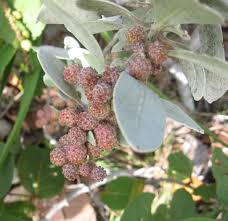
White mangrove fruit are not edible.

And pity the poor Buttonwood, Conocarpus erectus, (kawn-oh-KAR-pus ee-RECK-tus)  never viewed on its own. The Buttonwood makes a nice landscape tree, is high in tannin and can be used to make a smokeless, high grade charcoal. The wood of the C. erectus and C. erectus var. sericeus can be used to smoke fish and meat.  Conocarpus means cone shaped fruit and erectus, upright. Sericeus (suh-REE-see-uhs) means silky.

Warning: In Australia there is a white mangrove (Excoecaria agallocha) the sap of which can make you blind.

Green Deane’s “Itemized” Plant Profile
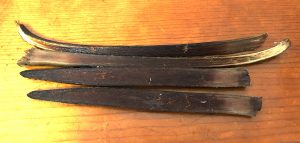
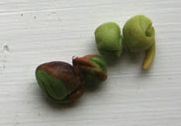
Red Mangroves propagule cooked.You scrape out the starch-like material.

IDENTIFICATION: The Red Mangrove has cigar-like fruit and ovate to lanceolate leaves slightly wider at the end. The  Black Mangrove, also called the Honey Mangrove, has seeds that resemble gigantic lima beans and small ovate leaves. 

TIME OF YEAR: Mangroves can seed all year but they favor spring. As evergreens the leaves are available year round.  

ENVIRONMENT: If you’re not standing in smelly tidal muck with all kinds of insects bothering you you are not in the right environment. Salty coastal areas of salt and brackish water.

METHOD OF PREPARATION: Red: leaves for tea, smoking or wine, fruit for wine, smoking, inner starchy core for survival food. Black: Sprouting seeds boiled, salt off leaves.
 

{ 13 comments }

Maples: How Sweet It Is

It’s amazing what you can do with two trees and a cow: Maple walnut ice cream. It was the prime ice cream of choice when I was young. It can still be found regionally, sometimes, and never overseas. Then I have to settle for chocolate ice cream, another marriage between bovine and bark.

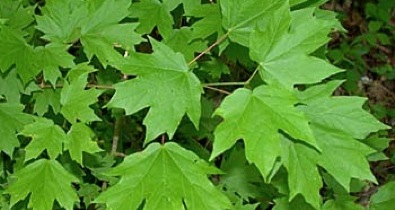
Maple leaf, think Canadian Flag

While maples are associated with colder climates, several species of maples grow in the South and at least four of them in Florida, two of them reportedly better for making syrup than the famous sugar maples of Vermont.

To anyone who grew up in northern climes, finding maples in Florida is a bit of a challenge because they aren’t the huge, craggy trees of up country. But, they are here; shorter, thinner, but just as welcoming to the forager. With one exception They all provide the same edibles: Sap, seeds, inner bark and sweet young leaves. (You did know there was more to the maples than syrup.)

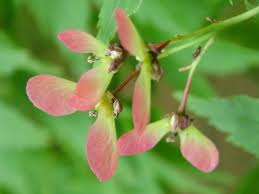
Maple seeds with wings

The four maples commonly found in Florida include the Florida Maple (Acer floridanum AY-ser flor-i-DANE-um) sugar maple (Acer saccharum  AY-ser sack-uh-RYE-num)  red maple (Acer rubrum  AY-ser ROO-brum ) and the Box Elder (Acer negundo AY-ser nuh-GUHN-doe)  with the first and last lauded for sugar production. There may also be a smattering of other maples as well, such as variations on the Southern Sugar Maple, the Chalk Maple and assorted imports such as Japanese maples. In usage, most maples are the same, no matter where they are.

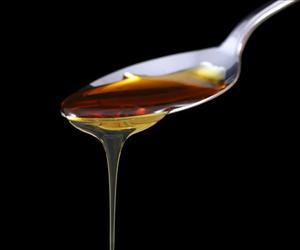
The most famous maple product is maple syrup. I never “sugared” as a young man but I had a neighbor who did, Bill Gowan, and I helped him often. He had about a dozen sugar maples, and seven kids to feed. He also heated and cooked with coal so there was always a hot kitchen stove to boil the sap down to syrup, a 30-to-1 reduction in a good year.  Every spring for many years I helped him collect the sap, a daily ritual that including emptying buckets brimming with the clear liquid. Inside the kitchen his wife, Maxine nee Lambert, kept a huge two-burner copper pot boiling all day long to reduce the sap, leaving their house very humid. For my labors I always got a quart of fantastic home-made maple syrup. That on buckwheat pancakes was probably as close to gastronomic heaven as I will ever get. 

The “Box Elder” is a Maple

All the maples will produce sap for sugaring, but they vary in amount and quality. The odd-man-out maple, one that does not look like a maple, is Acer negundo, the Box Elder. It  was more esteemed than the sugar maples and was a major source of sugar in the South. In fact, until sorghum and sugarcane were cultivated maple trees were the main source of sugar in the New World.  Somehow Europeans never discovered how to tap their own maples. Distilling the sap is a dissertation unto itself. Box Elder seeds are NOT edible They contain hypoglycin A, the same toxin that’s found in Ackee.

Regardless of species — there are over 200 trees you can tap including Birch, Hickories, Sycamore and Ashes — tapping trees is done the same way. You either bore a small hole into the foot-wide or more tree, on an upward slant, and tap in a hollow spigot. Another way is  driving in a half-tube metal spigot. Driving the metal spigot makes enough of a wound to get sap without drilling a hole. A bucket is hung from either tap and collects the sap. At the end of the season the tap or spigot is removed. Drilled holes are filled with a hardwood dowel. Next year you tap in a different spot.

Next on the list of maple edibles, in nutritional terms, are the winged seeds, actually samaras. To eat them you removed the wings and then parch, roast or boil them. Each winged helicopter pair produces two seeds. You can also eat them raw and should try one first. If it is bitter you can leach the seeds to reduce the bitterness. If they don’t taste good, take heart. Like acorns, they can vary tree to tree so try another one if they are not palatable. Again the seeds of the Box Elder (Acer negundo) are toxic. 

The inner bark, the cambium, is next on the maple nutrition list, the same bark that delivers the sap. It can be eaten raw, boiled or roasted. Indians also dried it then pounded it into a powder, as they did inner barks of several trees including pine. Left over fiber can be sifted out. Lastly, young leaves can be eaten raw or cooked. They are sweet and delicate. But like all greens, provide the least amount of nutrition. By the way, dry or wilted red maple (Acer rubrum) leaves are toxic to horses.They can have pyrogallol which inhibits the ability of red blood cells to carry oxygen. 

Euopeans never tapped their maple trees

Europeans never tapped their maple trees or sycamores.

Acer is the Dead Latin name for the Maple and literally means “sharp” perhaps because it was used to make spears and lances. Floridanum means Florida. Rubrum means red. Saccharum, sweet, and Negundo, which is from the Sanskrit word nirgundi which literally means “that which protects the body from diseases.” The Box Elder maple did not get that name because it was good at reducing disease but because it resembled another plant that does, the Vitex negundo.  The word “maple” started out as mapulder in Old Saxon then mapultreow in Old English then mapel in Middle English.

Maple Beer

Francois Andre Michaux, 1770 – 1855

The following was written by botanist F. A. Michaux, left,  in 1853, in his book “North American Sylva.” “Upon four gallons of boiling water pour one quart of Maple molasses [syrup] add a little yeast or leaven to excite the fermentation, and a spoonful of the essence of spruce: A very pleasant and salutary drink is thus obtained.” Francois is the son of  Andre Michaux, also a famous botanist, and for whom Gopher Apples got their botanical name, Licania Michauxii. Many Internet amateurs get the two botanists confused and say the photo at the left from 1851 is of the senior Michaux. Don’t think so. The senior Michaux died in 1802 some 20 years before the first photographs were made. To see a younger rendition of Francois read Gopher Apples.

Maple Seeds Taste Like Peas

Maple Seeds Taste Like Peas

To collect seeds run your hand down the branch stripping them. One at a time peel off the outer skin, what we called the “whirlygig” when I was a kid. Cut the end and squeeze out the seed. There is a seed on each “wing.” They resemble peas or beans. Taste some seeds, if they are not bitter enjoy them raw, or roast them, or even boil them. If they are bitter — that varies with species and when harvested — you will need to leach them like acorns either soaking in several changes of cold water or cooking in boiled water. To roast seeds put them in a 350 F oven for 10 minutes or less. You can also dehydrate the seeds. Roasted or dry seeds can be ground into flour. Third warming: Do not eat the Acer nugundo seeds. 

Green Deane’s “Itemized” Plant Profile

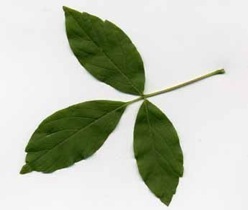
IDENTIFICATION: There are two groups of maples. One usually has opposite leaves, lobed, think Canadian Flag. The others have alder shaped leaves, ovals often with teeth. The leaves of the Box Elder can be  green and white mixed.

TIME OF YEAR: For sugaring and collecting inner bark, the spring with warm days and cold nights. Seeds in the late winter/early spring, young leaves when ever present, best in spring. Bark as needed. Here in Florida maples can be seeding in late December to early January. Much later in the spring farther north.

ENVIRONMENT: Southern maples like damp, moist soil, river banks. I know several that grow in the Wekiva River swamp. In northern climes, on forested hill and mountain sides.

METHOD OF PREPARATION: Sap has to be boiled to reduce it 30 to 50 times, seeds raw, parched, roasted or boiled without wings. Taste first for bitterness. Inner bark dried, pounded, then cooked. You can eat the wings if you don’t want to remove them but they cam be bitter and hard to digest.

HERB BLURB

Native American Indians used an infusion of maple bark to wash wounds, treat back or limb pains, hemorrhoids, postmenopausal ailments and as a vaginal wash.

{ 37 comments }

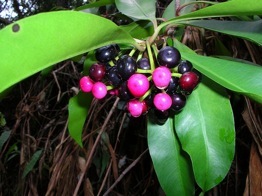
Marlberry, Ardisia escallonioides

Ardisias: Berries on the cusp of edible

The Ardisias are a confusing family in Florida.

Ardisia elliptica

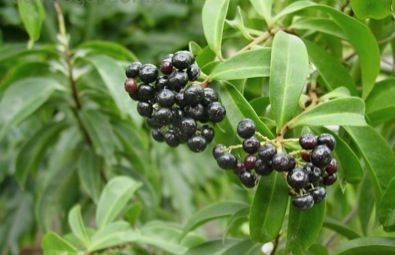
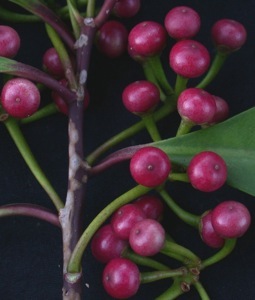
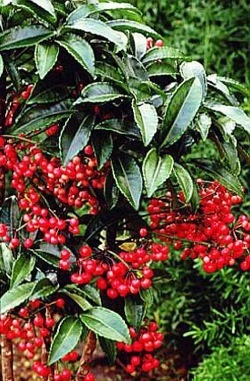
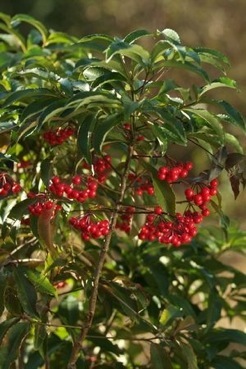
There is the native Marlberry  (Ardisia escallonioides) that has edible black fruit that ranges from bad to almost good. There is the invasive Asian, Ardisia elliptica, whose berries are edible but insipid. Another Oriental upstart has escaped and is occasionally found, the Ardisia solanaea. Its berries and young leafy shoots are edible. There is also the escaped Ardisea crispa, with edible shoots. Lastly there is the Ardisia crenata, which is not listed as toxic but some think it is potentially toxic. It is suspected of killing cattle in 2001 and 2007 in Florida. I ate the flesh off one seed and had no problem. It kind of tasted like a raw pea, but had the texture of a cooked bean. Neither appealing or offensive.

Ardisia solanacea

Marlberries, as you might of assumed by now, are not high on the foraging list. They should be placed on the cusp between forage food and survival food. But that is a matter of opinion, or how hungry you are. Some think the pulp of the marlberries taste close to blackberries, grapes and raisins. Others say they are unappealing and acidic. You eat the pulp only, not the seed.

Native marlberries (A. escallonioides) often occur naturally with Sabal Palmettos, the Cabbage Palms. Marlberries are found mid-state south with more representation along the coasts than inland. You’ll see it in the interior of dense, shady hardwood hammocks, usually under a canopy live oaks and cabbage palms. It is in the common shrub layer with Wild Coffee (Psychotria nervosa and Psychotria sulzneri) and American Beautyberry (Callicarpa americana.) See separate entires for those. It is very common Highlands Hammock State Park, and in hardwood hammocks in the Everglades.

Ardisia crispa

The Shoebutton Ardisia, Ardisia Elliptica, is on the state’s hit list. It is very invasive and the fruit edible as well, but not up to the already low standard set by the native Marlberry. Nibbling on the A. elliptica  and destroying the seed is being a good citizen.

Now, how do you tell the first two ardisia apart? Blossoms and leaves. The blossoms on the Marlberry (A. escallonioides)  tend to be in non-drooping white clusters (or pink) with purple lines and spots. The flowers of the Shoebutton (A. elliptica) are purple to violet or pink white and are found in small, hanging clusters.  The Shoebutton also tends to have narrow long leaves and the Marlberry wide long leaves, up to two inches wide.

A third Ardisia, the solanacea, is also found in South Florida and has edible berries as well. The tender, leafy shoots, parboiled, washed, drained and seasoned  are a favorite salad ingredient for the Thai in southern Yunnan, China.  The A. solanaceais a shrubs or tree to 20 feet tall, smooth, leaves elliptic or oblanceolate,

Ardisia crenata

papery, with conspicuous spotted. Fruit purplish red or blackish.

A. crispa, aka spiceberry,  also has edible young shoots. The berries range from purple red to black. Some internet sites say the plant is toxic but ethnobotanical studies show it was and is eaten in China. It’s a shrubs to about five feet, stems brown, scaly when young. leaf lance shaped, wavy, dotted.  Fruit reddish, globular. They last through the winter and spring.

On the “it’s anybody’s guess list” is the A. crenata. The state of Florida flatly says: “It is suspected that the berries and/or foliage are poisonous to livestock, pets, and humans.” As mentioned, I did eat the pulp off one seed and suffered no ill effects that I am aware of (for the researchers, adult male, 167 lbs. age 58.)  Once it puts on berries they can persist for a year or two.

Rapanea punctata

If that is not enough there is a relative of the Ardisias also in the woods, the Rapanea punctata. It looks similar but the berries are on the stems, like the Beautyberry (Callicarpa Americana.) The edibility of those berries is not reported but the Indians used the leaves to extend their tobacco.

Ardisia (ar-DIZ-ee-uh) is from the Greek word ardis, which means pointed, and refers to the plant’s anthers. Escallonioides (ess-kal-lon-ee-OY-deez) is for for Escallon, 18th century Spanish plant explorer Antonio Escallon who also has a genus named after him, Escallonia. Elliptica (ee-LIP-tih-kuh) means elliptical, or about twice as long as wide. Solanacea (so-lan-uh-SEE-us ) means resembling the Solanace family. Crispa (KRISP-un) means wavy or curled, as in the edge of the leaf. Crenata (kre-NAH-tuh) means scalloped, as in the edges of the leaves.  Rapanea (ra-PAN- ee-uh) is from the French Guianian name for this shrub.  Punctata (punk-TAH-tah) spotted, dotted with glands. Marl as in Marlberry is a shortened form of “marvel” because it can grow in poor condition.

Lastly, don’t confuse a red-berried Ardisia with any Psychotria, which have very prominent veins but smooth edges to the leaves.

Green Deane’s “Itemized” Plant Profile

IDENTIFICATION: Marlberry only: Shrub or small tree to 25 feet, whitish scaly bark, and purplish branch tips. Leave alternate, oblanceolate to elliptical, two to seven inches, leathery. Flowers small, white or pink with purple lines and dots, bell shaped, five lobed, fragrant, smell spicy, in showy terminal clusters.  Fruit round, dark purple, glossy, quarter inch wide, mealy, juicy, sweet, one seed, in dense clusters.

TIME OF YEAR: Flowers in fall, fruits in spring

ENVIRONMENT: Woodlands and hammocks

METHOD OF PREPARATION: Pulp of the fruit edible raw. Leaves can be mixed with tobacco as  an extender.


{ 3 comments }

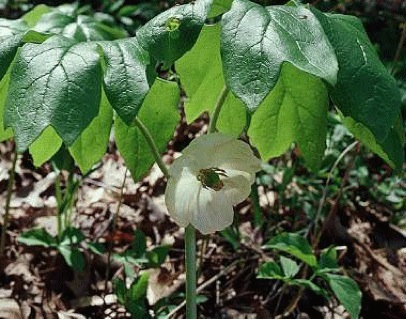
Mayapple, Mandrake, fruit edible when totally ripe, toxic otherwise.

Podophyllum peltatum: Forgotten Fruit

The first time I saw a mayapple I was certain something that strange had to be toxic, and it is, unless totally ripe.  In fact, all parts of the plant except the very ripe fruit are quite poisonous. Another plant which is like that is the Natal Plum. 

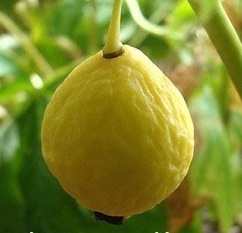
Ripe Mayapple

When unripe the Mayapple resembles a lime. Then it turns a soft yellow and wrinkles a little, see to the right. That is ripe. The rest of the plant is also often dying at that time as well. Trim off the ends, do not eat the seeds. If you cook with it remove the seeds first. Recipes below.

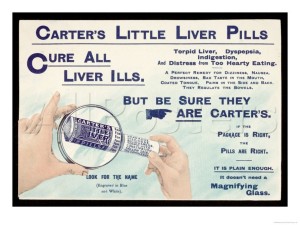
Other parts of the Mayapple have had a wide range of medicinal uses with native Americans. It is, however, a powerful plant and not to be used lightly: Natives also used it to commit suicide.  Two drugs are made from the Mayapple, etoposide and teniposide. Etoposide is for testicular and small-cell lung cancer, teniposide is used in conditions like brain tumors and infancy leukemia. For those of us old enough to remember “Carter’s Little Liver Pills”  Mayapple was a main ingredient that made the pills a laxative and had nothing to do with the liver at all.

Carter's Pills used Mayapples as a laxative.

Carter’s Pills used Mayapples as a laxative.

Its botanical name is Podophyllum peltatum (poe-doe-FILL-um pell-TAY-tum) and means “foot leaf like a shield.” The leaves resemble a duck’s food — it was once called that — and they tend to hide the flower and fruit, shielding it. The Mayapple usually grows in colonies in leaf-losing forests, meaning it likes to grow in the shade.  The taste is exotic, or peculiar, opinions vary

Other local names include: Raccoon Berry, Wild lemon, Ground Lemon, Hog Apple, Indian Apple, Wild Jalap, Duck’s Foot, Umbrella Leaf, and Wild Mandrake though it is not related to the Old World Mandrake, Mandragora officinarum. The Himalayan MayApple, Podophyllum hexandrum aka Podophyllum emodi, reportedly has edible leaves as well.

Green Deane’s “Itemized Profile

IDENTIFICATION: A perennial plant is 1–1½’ tall, some unbranched with a single leaf on a long stalk, others produce two leaves. Stalks light green, round, hairless. leaves, umbrella like, to one food long and across; palmately lobed, 5-9 lobes per leaf, deeply divided, hairless. Blossom a single, waxy, creme-colored flower with six to nine petal, below the leaves. Fruit egg-shaped, green when unripe turning yellow when ripe.

TIME OF YEAR: Blossoms in spring, fruit available in late summer depending on climate, July through September. Usually collected in northern areas when the trees are losing their leaves. Fruit that is ripening can ripen off the plant.

ENVIRONMENT: Moist forests, meadows, flood plains, forest openings, from Quebec to Florida, west to Texas and Minnesota. Most common in the mid-range of the Appalachians.

METHOD OF PREPARATION: Trail side nibble, the basis for a cold drink, jelly (add pectin) compotes, marmalade, pies and a sauce like applesauce. Mayapples can be canned and they freeze well. Do not eat the seeds. Remove them before cooking. Use them to grow more Mayapples. Over-eating can be a laxative. The jell around the seeds is edible as is the soft white inner side of the cut fruit peel. WARNING: DO NOT CONSUME WHEN PREGNANT.

Mayapple Jelly

1 3/4 cups Mayapple juice; strained

3 1/2 cups sugar

1/8 cup lemon juice

3 oz liquid fruit pectin or one dry packet

Wash ripe mayapples, cut away the stem and blossom ends, and any waste parts. REMOVE SEEDS. Cut the fruit into pieces and place in a large kettle with water to cover. Bring to a boil, then simmer until mayapples are tender, mashing during cooking. Strain the juice through a cheesecloth or let it drip through a jelly bag. To the strained mayapple juice, add lemon juice and sugar. Bring the mixture to a boil, stirring constantly, then stir in pectin. Again bring to a boil, stirring constantly, and boil hard until the jelly stage is reached. Remove jelly from heat, skim, and pour into hot, sterilized jelly glasses. Seal at once with hot paraffin or lid in hot bath. Double the recipe if you have plenty of mayapple juice. The amount used in this recipe is the yield of about 2 cups of sliced mayapples simmered in 3 cups of water. Yield: Four small glasses of pale amber jelly

 Mayapple Jam

5.5 cups ripe Mayapple fruit              7 cups sugar

1/2 cup water                                    1 package pectin

1/2 cup lemon juice                            dash of salt


Combine mayapples, water, and lemon juice. Bring to boil, cover over low heat, simmer for 20 minutes. Stir often. Add sugar and bring back to a boil. Boil hard for three minutes. Add pectin and salt and boil for one minute. Stir and skim off foam. Ladle into sterilized jars, seal with lid or paraffin.

Mayapple Punch

3 cups rip Mayapples fruit              1 cup sugar

3 pieces of ginger root                   1 quart ginger ale


Cut up Mayapples, REMOVE SEEDS. Put Mayapple pieces and ginger root in a saucepan, cover with water, and slowly bring to a boil. Simmer 25 minutes. Add sugar. Set aside to cool but stir occasionally. Pour through sieve and press pulp through mesh. Spoon into cups and fill cups with ginger ale. Stir and serve. Depending upon your tastes. Some think it tastes like an earthy banana or pawpaws. It makes excellent preserves and drink.  Since woodland creatures like the fruit as well it can be collected just before it is ripe and stored in sawdust until ripe.


{ 47 comments }

Mayflowers, Trailing Arbutus

Epigaea repens: Spring Sentinel and Nibble

It was an annual family ritual. Every spring when the snow had finally melted we’d go through the low Maine mountains picking the first bloom of the season, Mayflowers, Epigaea repens.

Green Deane as a sprout and mother Mae about 1951

Mind you, we didn’t eat the blossoms though they are edible. They make a pleasant and refreshing trail side nibble. The collecting was more primal. After a long, hard winter we just took the green and fragrant plants home as a reminder of spring. In fact, my mother had her favorite Mayflower haunts and we would visit them all in the course of the short season. She picked them because her mother picked them as did her mother’s mother.  Gathering Mayflowers is also where I first heard about “Robin Hood’s Barn.”

My mother said, “you’re certainly going around Robin Hood’s Barn to get there.” My father, driving, said he was. To which I asked about Robin Hood’s Barn. My mother told me to be on the look out for it. Never did see it. It took me years to learn that “going around Robin Hood’s Barn” was taking the long way around.

When I moved to Florida and smelled orange blossoms for the first time in the night air I thought they were Mayflowers. They are also known as Trailing Arbutus. In 1856 James Greenleaf Whittier wrote the poem, “The Mayflowers.”  It is below. Whittier had received a gift of Mayflowers on April 30th that year. A note with the flowers said, “You know the Mayflower with us is the flower, and all our people gather them at this season and send them to their friends who have them not. There is such meaning in the Mayflower to all descendants of the Pilgrims and to all lovers of freedom.”

Though Greek it so happens that through one great grandmother, May Eudora Dillingham, I am a Mayflower descendant and also a descendant of Susanna North Martin, who was hanged in Salem, 1692, charged with being a witch. One of May Eudora’s claims to fame — besides being a forager — was as a child she heard Abraham Lincoln speak. She said he had a high voice.

Epi means “upon” and gaea means “earth” Epigaea (ep-uh-GEE-uh) upon the earth. Repens (REE-penz) means crawling or growing along the ground, a low profile. Arbutus (ar-BRU-tus) means struggle. They are protected in some areas, such as Florida and New York.

One more personal note: My mother has a suspicion about cut flowers and they were never allowed in the house. The one exception was May Flowers.

Green Deane’s “Itemized” Plant Profile

IDENTIFICATION: Shrub to a few inches high, trailing, puts out roots at the joints, evergreen leaves, broadly ovate, 1 to 1 1/2 inches long, rough, leathery, with wavy margins and a point at the end. Flowers at the end of branches in dense clusters, white, with a reddish tinge, very fragrant, five petals form a star.

TIME OF YEAR: Flowers in April and May

ENVIRONMENT: Damp, shaded, mossy rocky woods; prefers moist, acidic soil, and shade. Found in Eastern North America, Central Europe, and Western Africa. Nearly impossible to transplant

METHOD OF PREPARATION: Blossom petals eaten fresh on the trail or in salads.


James Greenleaf Whittier

The Mayflowers

1856

        James Greenleaf Whittier

Sad Mayflower! watched by winter stars,

And nursed by winter gales,

With petals of the sleeted spars,

And leaves of frozen sails!

What had she in those dreary hours,

Within her ice-rimmed bay,

In common with the wild-wood flowers,

The first sweet smiles of May?

Yet, “God be praised!” the Pilgrim said,

Who saw the blossoms peer

Above the brown leaves, dry and dead,

“Behold our Mayflower here!”

“God wills it: here our rest shall be,

Our years of wandering o’er;

For us the Mayflower of the sea

Shall spread her sails no more.”

O sacred flowers of faith and hope,

As sweetly now as then

Ye bloom on many a birchen slope,

In many a pine-dark glen.

Behind the sea-wall’s rugged length,

Unchanged, your leaves unfold,

Like love behind the manly strength

Of the brave hearts of old.

So live the fathers in their sons,

Their sturdy faith be ours,

And ours the love that overruns

Its rocky strength with flowers!

The Pilgrim’s wild and wintry day

Its shadow round us draws;

The Mayflower of his stormy bay,

Our Freedom’s struggling cause.

But warmer suns erelong shall bring

To life the frozen sod;

And through dead leaves of hope shall spring

Afresh the flowers of God!

{ 5 comments }