Indian Strawberry, Potentilla indica

Potentilla indica: Mistaken Identity

One of the first things my uncle’s second wife said to me when I moved from Maine to Florida was “they have strawberries here with no taste.” And she was right, almost.

The Potentilla indica, (poh-ten-TIL-ah  inn-DEE-kuh)  the India Strawberry, indeed has little flavor but it’s not a Southern speciality. It grows in Canada.  In fact, it is found in most places except the Rocky Mountain states* and upper New England. Flavorless or not my cousins and I ate a lot of them.

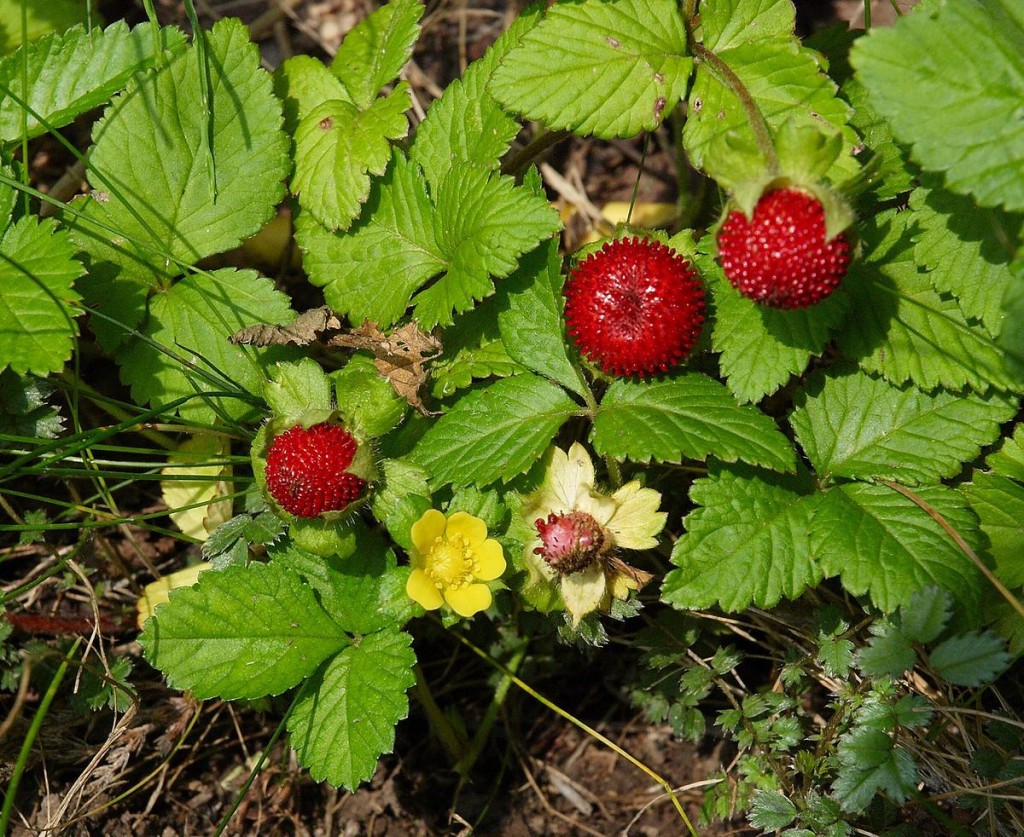
On first glance the P. indica looks like you have found yourself a brilliantly red, juicy strawberry. And that is probably the public relations problem P. indica has. It’s not what people expect so a lot of commentators dismiss it as worthless, but that’s a bit unfair. The fruit is 3.4% sugar, 1.5% protein and 1.6% ash. It has 6.3 mg of Vitamin C per 100 ml of juice.  An eight-foot patch will produce about 5.5 ounces fruit annually, about the same as wild strawberries, and you can cook the leaves as a green, or use them for tea. Some folks think the fruit has a hint of watermelon flavor. Others say it is sour so there may be some genetic diversity there, either in the plant or our taste buds. There is certainly no harm adding some of the plant to your wilderness stew.

Be forewarned though, there is descent into negative exaggeration. Many sites state the fruit is edible but tasteless. Others translate “edible but tasteless” into “not suitable for human consumption.” Some translate “not suitable for human consumption” into not edible. Others translate “not edible” into poisonous. Ph.d, herbalist and researcher James Duke, PhD., addressed the issue specifically in his “Handbook of Medical Weeds.” He says the plant is “often described as ‘poisonous.’ I have eaten hundreds and find the word insipid more accurate.”  As far back as 1914 author Harrison Garman, writing about weeds of Kentucky, said the fruit was edible and “their appearance leading one to expect them to be more palatable.”

I have eaten many and seem to still be here.  Some 50 years after I had swallowed my first Potentilla indica (then called Duchesnea indica) I read in John Wizeman’s SAS Survival Handbook the berries are “highly poisonous, sometimes fatally.”  I think there is an error somewhere or two different varieties for there is an Indian herbalist who calls the P. indica mildly poisonous and a treatment for cancer. In my experience the leaves, besides a potherb, dried make a nice tea. The berries can help stretch other berries when making jam and jelly. On their own they make a mild jelly or juice for those hot summer days.

There are …. increasing blooms… of inaccuracy on the internet. (A popular one at the moment is that wild lettuce, lactuca verosa, is an opium substitute. Which is shear nonsense.) As mentioned one pile of nonsense is that the Indian Strawberry is toxic. The FDA Poisonous Plant database puts that rumor to rest. It is not toxic.  Another is that it affects blood. There apparently is no research on that. Some herbal traditions say it increases blood flow and others that it decreases blood flow. There is, however, modern research that suggests the species can stimulate the immune system (in mice at least.)

Potentilla means strong, powerful, and the plant and many of its relatives in a family considered to have good medical value. Indica means from India though the plant is native to southern Asia (some also think it is native to North America… does it really make any difference?)

* In the fall of 2011 I received an email from “Becky” in Boulder, Colorado, definitely a Rocky Mountain state, and she said she uses Indian Strawberry as a ground cover. It not only thrives, she says, but is good at driving out other plants. Ground cover, food and gets rid of non-edible weeds. Not bad.

Green Deane’s “Itemized” Plant Profile

IDENTIFICATION: Low, trailing vine, roots at the nodes. Single flower on long stem,  five yellow petals are notched at tip, five sepals. Long-stemmed leaves have three blunt-toothed leaflets, strawberry-like fruit, seeds on outside.

TIME OF YEAR: Fruits in September in temperate climes, sooner in warm areas.

ENVIRONMENT: Prefers moist, well-drained soil, sunny location with passing shade, can be invasive, spreading freely by runners, more or less evergreen in southern ranges.

METHOD OF PREPARATION: Berries raw, leaves raw in salads, leaves cooked as a green, leaves dried for tea.


{ 52 comments }

Huckleberry, Gaylussacia frondosa


Gaylussacia: Huckleberry History

What’s the difference between a blueberry and a huckleberry?

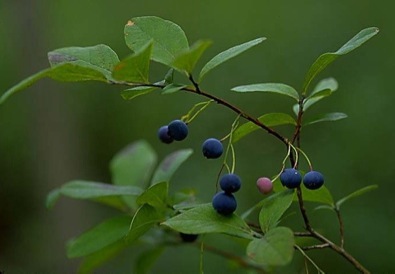
Gaylussacia dumosa

There’s almost an easy answer. The huckleberry looks like a black blueberry, and it has exactly 10 seeds inside. Also, if you have a magnifying lens with you the underside of the huckleberry leaves will have little yellow dots that sparkle. There are also blue huckleberries, but they still have 10 seeds and the leaves still have little yellow oil glands on the bottom of the leaves. The stony seeds make the huckleberries crunchier. If you want to get technical, blueberries are true berries whereas huckleberries are drupes, but they are also an exception to the drupe rule by having 10 seeds not one, like an olive.

Despite all that huckleberries resemble blueberries and they are used like blueberries, though they are often sweeter. Huckleberries, like blueberries, are in the heath family. There’s 50 species or so in the genus and are found in North and South America, most of them in South America.

Gaylussacia mosieri

Growing up in Maine, all the huckleberries I saw where about the same size in height as all the blueberries, and looked similar in leaf structure but they were black. Here in the South huckleberries can be small trees with large leaves. You have to look for the fruit and the gold spots on the underside of the leaves. That said there some small versions but I’ve rarely seen them. Locally there are the Gaylussacia frondosa, Gaylussacia dumosa, and Gaylussacia mosieri.

Huckleberry are food for deer, birds, rodents, insects, and bears. Huckleberries are one of the grizzly bear’s favorite foods, comprising up to one third of their diet.  Bears will travel great distances to find them. If you do go huckleberry picking be aware that you may be in some bear’s favorite patch. In fact I was holding a class one day with about a dozen students west of Deland FL. and I said we could encounter bear and we did in the huckleberry patch, a good-sized black bear who decided a dozen to one was bad odds.

Louis Joseph Gay-Lussac, 1778-1859

The species was named for French chemist Louis Joseph Gay-Lussac, 1778-1859. He discovered the law of combining volumes of gasses. The genus is pronounced Gay-lus-SAY-shee-uh. The species  dew-MOE-sa  (bushy shrubby)  fron-DOE-sa (leafy, fernlike) and moe-see-ERR-ee, named for Charles A. Mosier, 1871-1936, first superintendent of Florida’s first state park, the Royal Palm State Park.

The word “huckleberry” came from a mistake, according none the less than Henry David Thoreau. He said it came from hurtleberry which was a corruption of heart-berg, or hart’s berry. Hurtleberry was also Whurtleberry and Whurtles. Some folks still call blueberries/blackberries Whortles, Wurtles, Wurts and Hurts.  Even some botanical publications when talking about blueberries (Vacciniums) will call them huckleberries. (To read about blueberries go here.

Huckleberries where much used by Native Americans. In the Journals of Lewis and Clark, they wrote of Indians using dried berries extensively.  On reaching the Shoshone Tribe on 15 August 1805, Lewis wrote:

Meriwether Lewis, 1774 – 1809

“This morning I arose very early and as hungry as a wolf. I had eaten nothing yesterday except one scant meal of the flour and berries, except the dried cakes of berries, which did not appear to satisfy my appetite as they appeared to do those of my Indian friends. I found on inquire of McNeal that we had only about two pounds of flour remaining. This I directed him to divide into two equal parts and to cook the one half this morning in a kind of pudding with the berries as he had done yesterday, and reserve the balance for the evening. On this new-fashioned pudding four of us breakfasted, giving a pretty good allowance also to the chief, who declared it the best thing he had tasted for a long time. . .”

The tribes made rakes of salmon backbones to strip huckleberries off the bushes. They dried the berries in the sun or smoked them, mashed them into cakes and wrapped these in leaves or bark for storage.

Green Deane’s “Itemized” Plant Profile

IDENTIFICATION: G. dumosa is a small shrub seldom larger than two feet. G. frondosa grows larger to about five feet, but is sparely covered with leaves. They will have black to blue berries that resemble blueberries. Look for gold dots on the underside of leaves. They are tiny. You will need a lens. All huckleberries have these spots and ten seeds.  Flowers are bell shaped. G. frondosa is often tall scraggly, G. dumosa, tiny and hidden. G.mosieri to 3 feet, distinguished by the long glandular hairs on the hypanthium, bracts, pedicels, and twigs: 1-1.5 mm versus less than 0.5 mm for the other species.

TIME OF YEAR: Blooms in late May, fruit in the summer, June to August depending on area.

ENVIRONMENT: In northern areas bogs and wet sandy soils, in southern areas dry or moist sands. Here in Florida they tend to be a tiny bush in saw palmetto prairies and pine flat woods. However, the larger version can be found with more moisture and shade.

METHOD OF PREPARATION: Use like blueberries.

Hucklberry Pie

2 tablespoons flour

¾ cup sugar

3 cups huckleberries, washed carefully

Sift flour and sugar together, add berries and mix well. Pour into pastry-lined pie tin, moisten edge of dough with water, cover with top crust and make openings for steam to escape. Press pastry well over edge and trim. Bake in moderately hot oven for about 45 minutes or until crust is brown. (If cannedberries are used, measure a scant ½ cup sugar.)

USDA Forest Service 1954:40 The Lookout Cookbook

{ 13 comments }

Controversial Hyacinth Bean

 Hyacinth Bean: Purple Protein, and More

I’ve never understood the brouhaha over the Hyacinth Bean. Is it edible or is it not?

A monograph in the Journal of Economic Botany (1962, Vol 17:146-153) states on page 150 in reference to the Dolichos lablab:

“For food, usually other varieties of Doliehos which have tender pods are grown, but they require better soil and more water. The bean of Dolichos [lablab] from Angola is eaten in that country, as well as in the vicinity of Val de Pahnas. It was introduced by letting neighbors harvest the pods, of which they could keep half as payment for their labor. Beating the dry pods with a stick will easily free the beans. On the farm, the maize-threshing machine was used. As food, the beans can be prepared in many different ways. They are tasty and eaten like other beans or as a salad, though they have to be cooked longer than ordinary beans.”

Thus the beans are edible. They just have to be cooked longer than other beans, and for good reason. But, the issue does not stop there. In Edible Wild Plants of Eastern North America (Merritt Fernald and Alfried Kinsey 1958) it states on page 256:

“The ornamental hyacinth bean, with showy purple or white flowers in long and interrupted spike-like clusters and large pods about one inch broad, is cultivated chiefly for ornament southward and has escaped to roadsides and thickets northwards to the District of Columbia and Ohio. In the Far East, where it is native, the young foliage, tender young pods and fresh inflorescences are eaten either raw or steamed, while the beans are cooked.”

And in The Encyclopedia of Edible Plants of North America by Dr. Francois Couplan (1998) he states on page 252:

“Originally from tropical Asia, the plant is cultivated on our continent, mostly for ornament, and is found as an escape in southern regions. Young leaves, flowers, and tender, immature pods are edible raw or cooked. The ripe seeds are eaten cooked, either boiled or roasted. In Asia, they are made into noodles. The Hyacinth Bean is cultivated as a vegetable throughout the tropics. Many local species are used as food in tropical Asia, Africa, America and Australia.”

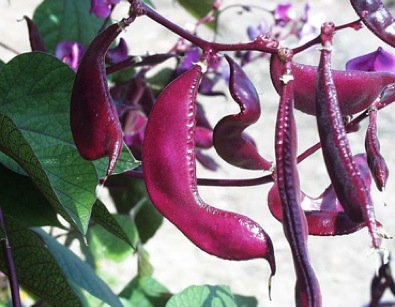
Immature pods

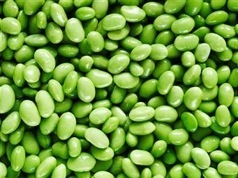
So, what’s the catch? There is one: Mature and dry beans have got a high amount of cyanogenic glycosides in them. Not good for you. Mature or dry beans must not be eaten raw. They have to be cooked. That means boiling soft raw mature beans or roasting as heat drives away the toxin. If they have dried — read they are hard — that means soaking overnight then boiling them a long time in a lot of water. Or, boil unsoaked dry beans in a lot of water twice. Actually, that is what one often has to so with many dried beans. And the older any bean is the longer you have to cook it.

Dry and Fresh Beans

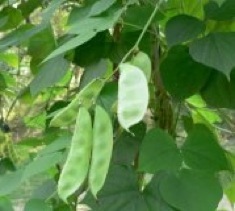
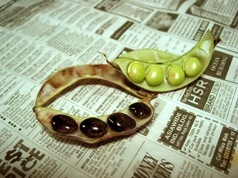
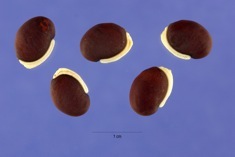
So there is a toxin and some judgement is needed. If I have fresh mature beans — like the green ones right — it’s a long boil in a lot of water or a roast. If I have dry mature beans — also right — it’s a soak and two boils. When you cook the bean it has a very strong bean odor and it looses its color, as a lot of beans do.  Very young pods with immature seeds can also be boiled and eaten. Also, do NOT drink or use the boiling water.

Thus the Hyacinth Bean, aka Bonavista Bean, is suitable for the herb pot or the bean pot. Here’s another reason why: The leaves are more than 28% protein, 12% fiber, 7% minerals and 7% fat, eaten freshed or dried. They are an excellent source of iron and magnesium as well as a good source of phosphorus, zinc, copper, and thiamin. Beyond that, sprouts are edible and the cooked root is full of edible starch. You can even ferment the beans as with soy or make tofu. See recipes below.

Fresh Hyacinth Beans

There are also several cultivars, emphasizing this or that quality, such as red flowers or longer beans or larger roots. Two common ones are Ruby Moon, and White. Two cultivars widely grown as crops are ‘Highworth’ from India, which is early maturing with purple flowers and black seeds. ‘Rongai’, from Kenya, is late-maturing with white flowers and light brown seeds.

We’ve known, in writing, since the 700s that the bean was edible. As mentioned above it was affirmed in 1958 by nationally known experts, mentioned as edible in a scholarly journal in 1962, in various publications since then, and in an encyclopedia in 1998 written by another PhD. And yet, one can find articles less than a year old on the internet saying the bean or the blossom is not edible. Those people just do not do their homework.

Mature dried beans

Botanically the bean is Dolichos lablab or Lablab purpureus. Dolichos (DOE-lee-kos) is from the Greek “dolikhos” meaning long or elongated. Purpureus (pur-PUR-ee-us) means purple. Lablab (LAB-lab) is the aboriginal name for the bean.

I planted the bean several years ago on a guy-wire. I grew well but not greatly, but I also left it alone to see how it would do.

Green Deane’s “Itemized” Plant Profile

IDENTIFICATION: Purplish green leaves, each with three leaflets, each 3 to 6 inches long, shaped like a broad oval or loose triangle, attractive bean-like flowers, purple, white, rose, reddish in a flower cluster on short stalks along a long main stem. Vine can reach 10 feet long in one season, 30 feet over a years.

TIME OF YEAR:A bsent of a frost or freeze the bean will flower within three months of planting and fruit for most of the year.

ENVIRONMENT: Likes full sun, moist soil, will not tolerate shade.

METHOD OF PREPARATION: Numerous. Young leaves edible fresh or dried, young pods with immature seeds, edible cooked. Flowers and sprouts edible raw or cooked. Older non-dry beans cooked. Dry beans soaked and cooked in two changes of water. Older beans, leaves and pods strong in flavor and texture. Young and tender is better and safer. Roots cooked.

Hyacinth Bean Curry

By Bhakti Satalkar

The list of ingredients for this recipe are indeed long. However, it will not take very long to make the curry.

Ingredients

* 1 cup peeled and soaked hyacinth beans

* 2 onions, chopped

* 3 tomatoes, chopped

* 2 tbsp coconut paste

* ½ tsp ginger paste

* ½ tsp garlic paste

* ½ tsp fennel seeds

* 1 tsp chili powder

* 1 tsp coriander powder

* ¼ tsp turmeric powder

* 1 tbsp oil

* 2 to 3 Curry leaves

* Coriander leaves and mustard seeds for seasoning

* Salt to taste

Method

* In a blender, blend coconut paste and fennel seeds together.

* In a pan, heat oil and add mustard seeds, onions, ginger paste, garlic paste and turmeric powder.

* Saute the onions, till they are translucent.

* Add tomatoes and continue to stir.

* Add salt as per taste and continue to stir.

* After the onions and tomatoes are well cooked, add coriander powder and chili powder to the mixture.

* Now add peeled beans and fry well.

* After 5 to 7 minutes, add coconut and fennel paste and water to the mixture.

* Cover with lid and let it cook for 10 to 12 minutes.

* After the beans are well cooked add chopped coriander leaves and serve hot.


Hyacinth Bean Rice

By Bhakti Satalkar

I often make this rice. This is the recipe I use, when I come back late from work. You can alternately make the rice in the slow cooker as well.

Ingredients

* 1 cup rice

* ¼ cup soaked and peeled hyacinth bean

* ½ tsp chili powder

* ½ tsp turmeric powder

* ½ tsp coriander powder

* 1 tbsp grated coconut

* ½ tsp fennel seeds

* ½ tsp mustard seeds

* 1 tsp oil

* Salt to taste

Method

* In a pot, heat oil.

* When the oil is hot, add mustard seeds to it, followed by turmeric powder, coriander powder, chili powder.

* Stir the mixture well.

* Then add the soaked and peeled hyacinth beans and let it cook for a minute.

* In the meantime grind, coconut and fennel seeds together.

* Add the coconut, fennel paste to the mixture and stir well.

* Add soaked rice and let it cook.

* Serve hot.


Hyacinth Bean, Eggplant in a spicy gravy Recipe

By Srivalli, cooking4allseasons@gmail.com

Ingredients Needed:

Hyacinth beans, 1 cup

Eggplant, – 2 medium

Onions – 2 medium

Tomatoes – 2 medium

Chili powder – 1 tsp

Coriander powder – 1 tsp

Salt to taste

Oil – 2 tsp

Coriander leaves for garnish

For Tempering

Mustard Seeds, Urad Dal – 1/2 tsp

Curry leaves – few


For the ground Masala:

Fresh Coconut – 2 -3 tbsp

Green Chili – 1 – 2 (as per taste)

Fresh Coriander leaves – 2 -3 tbsp

Cloves – 2 -3

Cinnamon – 2″

Ginger Garlic paste – 1/2 tsp


{ 35 comments }

Sorting Out Species

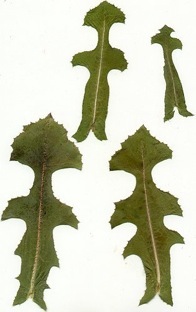
Sorting out wild lettuce is one of the more difficult foraging tasks and may require you to watch a plant all season. Complicating the issues are different leaf shapes, presence of hair or spines, and many closely related edibles.  This page is an aid to identification. See other lettuce entries for more information.

Lactuca floridana, Woodland Lettuce

Lactuca floridana, Woodland Lettuce

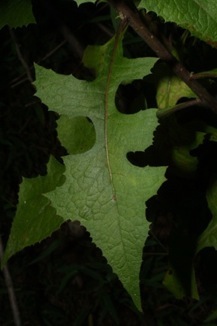
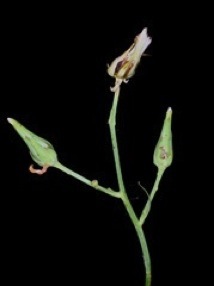
Lactuca floridana: Woodland Lettuce, triangular leaf stem (V-shaped) pure white sap, usually a line of hair on the bottom of the mid-rib of older (lower) leaves. Stems, to seven feet tall, purple on lower portions, smooth, single from base, branching inflorescence.  Blossoms look similar to chicory, 11 to 17 petals, no central disk. Leaves – alternate, long petiole, not clasping the stem. Basal leaves toothed, pinnately lobed, to six inches long and 3.5 wide, lateral lobes round to lance-shaped terminal lobe arrow-shaped. Vase-shape blossoms have overlapping vertical bracts with purple tips.

Click here for more photos of Lactuca floridana.

Lactuca canadensis, Canadian Lettuce, Yellow Lettuce, Wild Lettuce

Lactuca canadensis, Canadian Lettuce, Yellow Lettuce, Wild Lettuce

Lactuca canadensis: Canadian Lettuce, Yellow Lettuce, Wild Lettuce,  Similar to L. floridana, but notable differences.  Leaf stems triangle (V-shaped) yellow flowers and a milky sap that quickly turns beige. Line of hair along bottom of leaf midrib. Leaves lobed, often sharply so, ending in a lance-shaped point. Younger leaves less lobs, pointed, often wavy. Leaf edges not spiny. Can be clasping. Some variations have small sparse hairs on and along the underside of the entire main leaf. Can have basal rosette first year, stalk the second year. While blossoms are yellow they also can be pinkish on tips. Blackish, flat dry seed with only one obvious line on each side.

Click here to see more photos of Lactuca canadensis.

Lactuca scariola, L. serriola

Lactuca scariola, L. serriola

Lactuca scariola, aka, L. serriola, and prickly lettuce, leaves alternating, grasping the stem, lobed or not, six inches long, 3 inches wide, distinct white midrib, hairless, whitish, edges spiny, bottom of midrid had numerous spines, quite prickly. Leaves have terminal lobes larger than lateral lobes, entire leaves usually oblong.  Leaves often have red around the edges. Ray flowers yellow, no disk.  Sap is pure white, and can be irritating. Plant will turn leaves toward the sun and often be on the same plane (vertical.)  The plant resembles the spiny sow thistle (Sonchus asper) but has a solid stem where as sow thistles have hollow stems. Also the sow thistle does not have spines or hairs along the underside of the leaf midrib. Modern Greeks call this petromaroulo.

Click here to see more photos of Lactuca scariola.

Lactuca graminifolia, Wild lettuce

Lactuca graminifolia, Wild lettuce

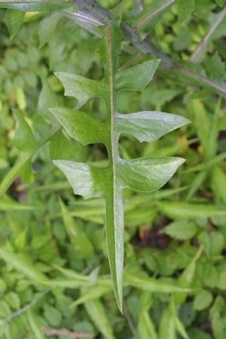
Lactuca graminifolia: Wild lettuce with skinny glass-like leaves, some teeth/lobes on basal leaves. Bluish or white ray flowers, not disks. Found in dry fields and woods, to three feet tall. Smooth, greenish to reddish, milky sap.

Lactuca virosa is not included for a few reasons. It is an edible European species and rarely found in North America, just a half dozen isolated spots. It is NOT a wild opium or a good pain killer. In the 1930s America assumed a world war was coming and because of said opium sources might disappear. So the government hired two French researchers to investigate reports that L. virosa was a good opium substitute. They reported it was not. Resent research in Iran reached the same conclusion. The internet, which is managed basically by boys, is rife with reports of how wonderful L. virosa is. Like most wild lettuce a lot of dried sap and or an extract might help one sleep but it is a near failure as a pain killer, meaning a little effect with some people.  Indeed, to get any effect from the natural plant would require eating many pounds of it at one time, such as ten or 12 pounds, traces of hyoscyamine might be the offending chemical. A small amount in a meal does nothing except provide some magnesium. Virosa means toxic in dead latin, as folks in the past knew to only eat a little at a time or it could make them ill. Ignorant internet juveniles took it from sickness inducing to getting high.


Click here to see more photos of Lactuca graminifolia.

{ 20 comments }

Byrsonima lucida: Food and Medicine

Byrsonima lucida

The Locusberry rises to the occasion.  When the soil is poor it is a foot-high tree. When the soil is good, it can be ten feet high. And much father south, it’s a grown up tree.

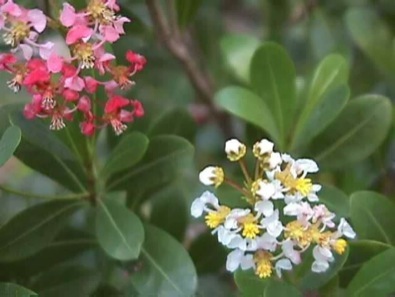
The variability of the Locusberry, Byrsonima lucida (bur-SO-nim-uh LOO-sid-uh) doesn’t stop there.  When it first flowers, the blossoms are are white. Then they turn to pink and then to crimson. This is an interesting strategy: The different colors attract different butterflies to assure pollination. Also the oil glans on the underside of the petals change color from green to yellow.  Bees visit the blossoms, but not to pollinate per se. They take oil from the glands to make their nests. The fruit turns from green to red-brown, or brown-red,  and persists on the tree. Some think they taste like cranberries, others think they taste soapy.

There are over 135 different Byrsonima from southern Mexico to southeastern Florida, the Caribbean down to Brazil. B. crassifolia (krass-ih-FOH-lee-uh) is considered the best.  The fleshy fruits are called nance and are an underutilized crop in Latin America. In Brazil they are called muruci. The fruits are also important to wildlife including the Golden Conure, moth-butterflies, the Tehuantepec Jackrabbit, an endangered species, and the Florida Box Turtle which thinks the seeds are just great and does its best to spread them around. Byrsonima is from two Greek words, Byrsa meaning hide, and nema, meaning thread. It is a reference to the bark of some of the species. Lucida means bright. clear, lustrous, crassifolia, thick leaves. The bark is often used as a dye which appears to also be antibacterial. .

 Green Deane’s “Itemized” Plant Profile

IDENTIFICATION: Shrub or a small tree to 25 feet, smooth light brown bark, leaves opposite, spatulate to obovate, one to two inches long, thin, glossy above, dull below, flowers white or pink changing to yellow or rose, five petals, half inch wide, terminal clusters. Fruit oblong or cylindrical, close to an inch long, dark purple or black.

TIME OF YEAR: Nearly all year

ENVIRONMENT: Rocky pine lands and hammocks

METHOD OF PREPARATION: Ripe fruit edible raw.  They can be made into juices, wine and even ice cream, but only if you find a good tree and you like the taste.

HERB BLURB:

They have been used medicinally. The bark makes a cough medicine and has been used to treat tuberculosis and other bronchial issues. The berries are antidysenteric and astringent. With some of species the bark and berries are mildly laxative. Some are diuretic and emetic. They have also been used against syphilis.

{ 0 comments }