Spurge Nettle

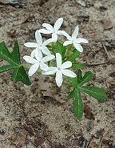
2011″ Cnidoscolus stimulosis:   Can the leaves be boiled and eaten like other species in the genus? I personally know of two account of folks who mistook the C. stimulosis for a common nettle, either juiced it and drank it raw, or cooked it and ate  it raw. Amounts were not conveyed. It may be a possible green and raw food source. Also, is the root of the C. texanus edible and are the seeds of the C. stimulosis edible?

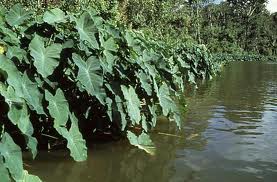
Aquatic Taro

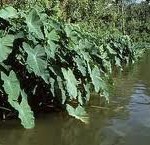
The common taro invading Florida’s Florida’s waterways is an aquatic variety that does not set roots of any size but its stolons might be pickable and its greenery boiled and maybe made edible. There are reports of said in Vietnam. Up date 2022 I dgr up a smallcorm. it was pepper raw After roast ing an hour at 350F.  It was still peppery/ 

Rosary Pea

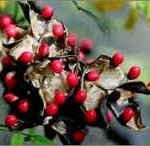
The deadly rosary pea may be edible if heated above 45º C, or boiled for 45 minutes to an hour.

The Dioscorea alta may have only single leaves when young and then later develops opposite leaves.

Albizia julibrissin

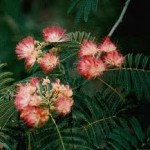
Are the seeds of the Albizia julibrissin edible? I received an email from someone who said his grandmother used to serve them. He wrote in part: I have very fond memories of this tree, it’s flowers, leaves, and especially it’s seeds. My grandmother had several of these trees in her yard and I would harvest baskets and baskets of the seedpods whenever I was staying with her. I remember sitting with her in the evenings peeling open pod after pod scraping and collecting the seeds as we went. She would warm me up a flower tortillas place maybe half a cup of seeds on the tortilla, squeeze lemon, and dash salt over them roll it all up and hand it over to me. She called them “Waches” though (In Spanish). The only Ill effect that I ever noticed from eating the seeds was that it gave me really bad breath. I don’t think I have ever seen the seeds for sale in any modern grocery store but, I have seen them being sold in local markets (especially in Mexican neighborhoods.) But as you see below another readers suggest he is mistaken with the acacia tree.

Virginia Creeper

Is the sap from the Virginia Creeper and or the Pepper Vine drinkable? (Parthenocissus quinquefolia and Ampelopsis arborea respectively.)  At least on man on the internet reported he drank the Virginer Creeper sap with no ill effect. There is also a few reports the berries of the latter are edible where as other reports make them fatal.

Tobacco Hornworm

Can dried Manduca sexta that fed on tobacco be used to thin blood because of the nicotine content?

{ 4 comments }

Insubstantial roots and lots of calcium oxalate

IS WILD TARO IN FLORIDA EDIBLE?

August 2011

Is the wild taro in Florida edible? In one word, no. In two… may… be….

It is doubtful the roots of the Colocasia esculenta var. aquatilis — the taro clogging Florida’s waterways — can be reasonably rid of their acid content. The young leaves, however, might be made subacid.

Background:

Edible taro has calcium oxalate that has to be eliminated by cooking before eating, either by boiling or baking or drying. There may be other chemicals at work as well under the acid umbrella which may mask what is actually happening.

Interestingly, recent academic assertions suggests the edible, cultivated taro, Colosasia esculenta is a descendant of the Colosasia aquatilis, not the other way around. If that is the case the cultivated version should more properly be named Colocasia aquatilis var. esculenta

I think the state of Florida makes an essential mistake when reporting the effects of the escaped taro on the state’s waterways. The tenor of the articles are that C. esculenta was imported and encouraged. Then it escaped and is clogging the water ways and, by the way, its roots have an acid and must be prepared correctly.

If the “wild taro” in Florida’s waterways is an escaped C. esculenta one should be able to cook it to the point of being non-acid. Cooking instructions for C. esculenta  are boil roots and or leaves 45 minutes. This definitely does not work with Colocasia esculenta var. aquatilis.  And that would make sense if in fact their lineage is reverse, that the cultivated less-acidic taro is a tamer version of the “wild” very acidic taro.

On two occasions I collected “wild taro”  (C. aquatilis) from the St. John’s River in Sanford and the Wekiva River, at the Wekiva Marina. Boiling those chopped tiny roots for two hours in three changes of water did not eliminated the acid. Baking root chips for 30 minutes at 350F didn’t either.

Thus far I have:

1)  Boiled peeled young roots size of large marbles for  one hours, still acidic, which means burning the lips, tongue, mouth and inner skin of the elbow and finger webs.

2) Boiled various sizes of root sliced, none more than 1/4 thick or 3/4 inches across. Those I boiled for two hours in three changes of water at 30, 60, and 90 minutes, total actual boiling time 150 minutes (the other 30 minutes heating the water to boil again.) All parts, even small pieces, still were acidic. If it were C. esculenta the acid should have been gone by then. Thus Colocasia esculenta var. aquatilis is made of sterner stuff (said cole-oh-KAY-shah. ess-kew-LEN-tah variation a-KWA-ti-lis.)

3) I have baked peeled thin chips (like home-made potato chips, raw taro root rebels against slicing on a mandolin ) at 30 minutes at 350F, small, dark brown chip (incinerated) no immediate hint of acid. Larger tan chips at 30 minutes at 350F produce, after chewing, a hint of nasturtium odor and tingle to the nose and then mouth burn within half a minute. A mouth rinse with lemon juice put the fire out but my mouth was mildly sore for several hours.

4) Chips baked for an hour at 350F became cinders. I have not tried a slow, low roast for several hours. A tiny root baked unpeeled for three hours at 350 had no immediate burn on inner elbow skin. It was too unappealing for a mouth test. So much for the roots.

Another  next step is to roast large roots on moderate heat for two hours then grate them. Then  soak them for a full day changing the water often. We’ll see how that works. It is similar to what the aborigines do in Australia with a yam that has calcium oxalates in it, except they stick the roasted, grated yam in a river for a day to leach.

5) Young leaves (under six inches inner clef to tip) boiled one hour with a change of water at 30 minutes, still acidic. Boiled for two hours in three changes of water no apparent acid, but petiole (stem) near blade (leaf) was still acidic. Repeated minus stem: Boiled two hours, water changes at 30, 60 and 90 minutes, total boiling time 150 minutes (30 to heat water after two changes.)  Young leaves treated that way appear to lose their contact acid. Taste mild, if not pleasant, no oral burn. Did not consume. Edibility of the leaves of Florida’s version is unknown. Even if long-boiled leaves are edible the energy expenditure for the energy/nutritional value gained would be quite negative.
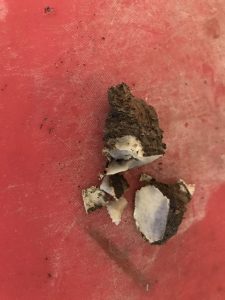
Cooked Colocasia esculenta var. aquatilis photo by Green DSeane
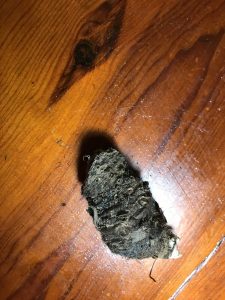
Uncooked Colocasia esculenta var. aquatilis. Photo by Green Deane

6)I dug up a small corm, April 2022. It was peppery raw. After roasting an hour at 350F  it was soft and flavoful but still peppery.Perhaps what natives did with other plants with calcium oxalates is bury it and build a fire over it for several days.  

7)  Another possibility is to try drying the leaves, and or leaves and petioles separated. See below.

8) Internet searching produced a Japanese monograph (1)  in 2002 about  C. aquatilis in northern Vietnam. In the abstract it states: The uses and habitats of C. esculenta var. aquatilis were linked to the agroecosystems of the delta. The plant was frequently found around canals and farmers’ ponds in the delta, and its petioles and stolons were harvested for human consumption and pig fodder.

Petioles and stolens, read stems and spaghetti-like rootlets. This might be worth more investigation, and it would have been nice if methods of collection, preparation and cooking were included.  I did not cook any stolons, using corms only, and I tried the top of only one young petiole.

First, the stolons are hard to clean, or at least the ones found in the Wekiva are, mucky like cattail roots. Next, of course, is the conflict between their report and my own experiment. I found long-boiled boiled leaves non-acidic and the stem (petiol) acidic. They make no mention of leaves and say the stems are edible. Of course the state of acid and edibility are two different issues, perhaps related but not necessarily so. Even if the Florida version could be rendered acid-less that is no indication of edibility just absence of acid. 

(1)  Tropical agriculture: Japanese journal of tropical agriculture Japanese journal of tropical agriculture: Vol.46, No.4(20021201) pp. 247-258 Vol.46, No.4 (20021201) pp. 247-258:     日本熱帯農業学会 ISSN:00215260 Japan Society for Tropical Agriculture ISSN: 00215260

{ 28 comments }

Practicing Homelessness

There are less Christmas parties this year than in the past, with economic conditions reducing the usual yuletide cheer. Still, there are some traditions. Former employees of a company I used to work for meet annually for a seasonal get-together. It’s a time to catch up, confirm that nearly everyone is still unemployed, and promise to keep in touch.

I was chatting with eligible Hillary, who, if I were half my age, would not be safe. As usual the topic came around to activity with wildl edible plants, and other things, too.

“What you’re doing,” she said, “is practicing to be homeless.”

Her comment took me by surprise and intrigued me. While not true in reality — a least not yet — it was an astute observation. On reflection, my answer would be both yes and no. If I were homeless now I think I could find tastier and better food in the evening dumpster behind a restaurant than in the woods across the road. So there are two kinds of homelessness to consider, being homeless while society is functioning, and being homeless when it is not functioning. In fact, some 35 years ago I knew a bum who basically lived off restaurant toss outs. His name was Major, and he got all his tobacco needs from cannibalizing cigarette butts tossed away in ash trays.

If Hillary was thinking about no society then she was quite right. Without intending so I am practicing to be homeless, but not foodless. There is no doubt I — or you — could live off wild foods, especially if we toss in a fish, bird or rat fairly often, though I suspect cat and dog would be the more common meat. It would not be a diet of choice, and would only vary by the season rather than by the meal. If you dig up a 20 pound yam it has to be eaten or preserved. But, it is doable.

On more reflection, foraging food is a matter of degrees. A depression could reduce the number of restaurants with food to throw a way, and the competition for any scraps that made it to the dumpster could be intense, if they got to the dumpster. So perhaps foraging is a spectrum, the restaurant dumpster on one end and the woods on the other. More to the point: If Hillary had made her comment five years ago, it would have sounded silly. Today it doesn’t.

I’ve never really worried about food. A tent over my head has always been the more pressing issue. Perhaps it is time to reconsider both.

{ 0 comments }

Foraging After Dark

I took a residential walk this evening to identify trees after dark. Yes, after dark. Now why do a silly thing like that?

I know someone who has his foraging students draw the plants they are studying, even if they can’t draw. The purpose is to accentuate the important elements of identification. Wandering around trees after dark is much the same thing.

Aromatic pine needles

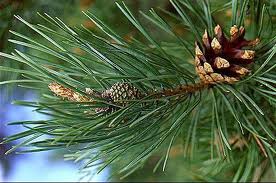
Pines are fairly easy to identify after dark in a residential setting, meaning a few street lights now and then. There are seven species that grow locally, Slash Pine being the most common. The foliage, needles, is a good giveaway, and the pine aroma. But more than that pines grow tall, which is their downfall. They don’t have roots that spread out like the oak. They send down a tap root so the pine stands like a brittle spear in the ground. When tropical force or hurricane winds blow the pine shatters.

Large rough leaves

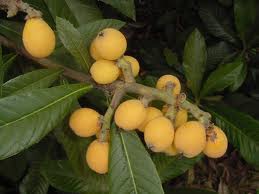
Then there was the loquat, an import from Asia. There are two varieties, each with long rough wrinkled leaf, with many herbal uses. Some of them blossom in the fall, some blossom in the spring, who knows why. But the leaf and fragrant blossom gives it away to the touch and nose.

The nose is the detective after dark. I found far more Laurel Cherries than I thought, many of them quite large. How can you identify them after dark? Break a leaf and smell it.  If you smell almond you have the laurel cherry, except it is not almonds you smell but cyanide.  Can that leaf kill you? One might, several can.

Live oaks are everywhere locally but I found a Black Jack Oak. How can I tell? I held the leaf up to the street light. It was shaped like Casper The Ghost holding, his arms out tapering at the ankles. The Water Oak is similar except Casper is not holding his arms out.

A unique leaf

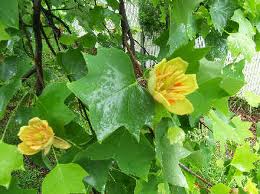
An odd leaf shape also helped identify the Tulip Tree, which has nothing to do with tulips. It is also called a yellow poplar but it is not a poplar. It has a large leaf with two short arms and a square end, slightly indented. The Sweet Gum was the only star leaf of the evening.

There was an Arbor Vite, a cedar masquerading as a lawn tree. The vertical branch growth and aroma gives it away. Aroma also gave away the many camphor trees. It is hard to believe no camphor tree here  more than 138 years old, which is how long ago they were introduced locally.

The crape myrtles are naked smooth so they are easy to identify, as are the well trimmed viburnums, landscape trees that require a lot of attention but produce nothing but green leaves.  The square hedges are Japanese yew. The seed is toxic but the aril is edible.

In the dark the Norfolk Pine, which isn’t a pine, and the Monkey Puzzle tree look similar. One careful touch, however, is all you need. The Norfolk Pine is, comparatively, soft and the Monkey Puzzle Tree well-armed with sharp leaves.

Pointy Holly

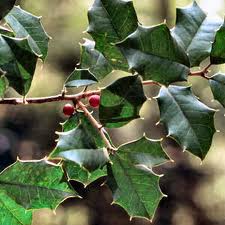
The conundrum of the evening was a holly. That it is a holly is not the issue, but which holly. Is it the American Holly, which can be made into a caffeinated tea, or the English Holly, which has some uses? Best guess, the American Holly, roundish leaves not bent and distorted as English Holly can be.

Oddly, I see few palms, which are easy to identify in the dark. They are also more grass than tree. One would think in a Central Florida neighborhood palms would be accented. I actually see more sagos than palms. Sagos are deadly. They are also cockroach high rises but they look nice in the daylight. That reminds me of what one does not see after dark, all the imported ornamentals that are usually quite poisonous.

Florida’s natural landscape is a resource. Coiffured lawns are usually toxic plant sites. Most plant poisonings occur in your own yard, followed by your neighbor’s yard. It is rather bizarre that when we left behind farming we surrounded our homes with poisonous plants. Most ornamentals are colorful. After dark they are but shadows among the real plants.

{ 0 comments }

Foraging before there was botany had to be a lot easier than after botany. Someone showed you what was edible and that was that. Of course somewhere back along the line a few thousands years there was some experimentation but for most of human history it foraging was a case of eat like mom ate, or the tribe.

I grew up in an area where fiddlehead ferns were a Rite of Spring, if not one of the endearing hold overs from the past. When I moved to Florida I didn’t leave that behind but there are less fiddleheads here and harder to find. Also, where it is green most of the year spring greenery just isn’t as significant as it is in the gray north.

Sword Fern Tubers

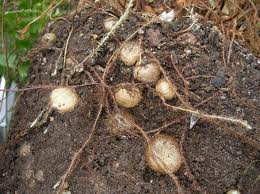
The other displeasure was personal: My yard in Florida was filled with a non-edible fern that took over everywhere there was some shade. And as much as I could tell it never produced a single fiddlehead either. I knew the fern well because I was always digging it and its tubers up, moving them or tossing a few.  In eight years it has survived one hard freeze and cover virtually half my open space, the reducing mowing. The fern was also the only fern on the exotic pest list of the state of Florida. That alone should have been a clue.

Sword Fern,

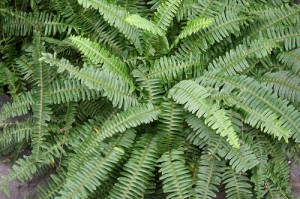
My fern is Nephrolepis cordifolia, a non-native “Boston” fern that showed up in Florida from somewhere in the 1930s. It caused quite a stink in that it was, and is, often sold in place of the native fern Nephrolepis exaltata, the Sword Fern.  But of the five Nephrolepis in Florida only the cordilfolia had tubers.  That should have been the second clue.

I recently bought a Florida fern book because I simply wanted to know more about them.  There’s around 160 different ferns in Florida and they ain’t easy to tell apart. Determined to expand the choice of fiddleheads, I was looking for edible ferns on the internet when I hit on one page that said the tubers of the N. cordifolia were edible.

Edible? None of my 40 books had said that but I did find a botanical study in Nepal on the nutritional elements of the same fern. It was also written up in a book but that particular page is not available on the internet. So I am left with the phrase the tubers of the N. cordifloia “are eaten fresh and roasted.” And in time I learn so they are, and now that lawn of non-edible ferns has purpose again.


{ 3 comments }