sadfsafasdfasdf

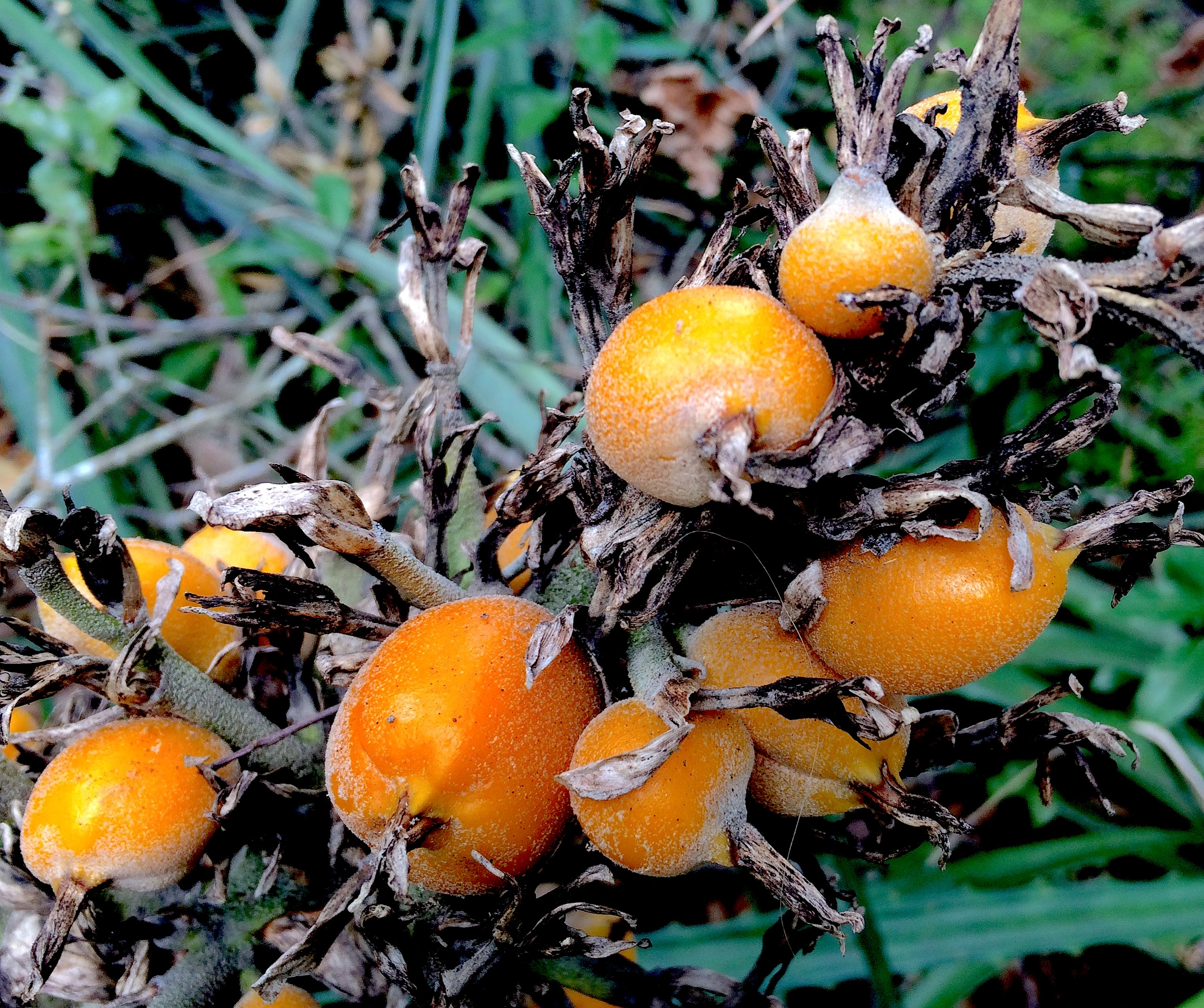
The edibility of Wild Pineapple fruit varies person to person. Photo by Green Deane

Bromelia pinguin: Wild Pineapple

I took the picture above while out bicycling on a Christmas Day, 2008. But, didn’t identified the object de green until the next Thanksgiving.

Officially the United States Department of Agriculture says the Bromelia pinguin (bro-MEEL-ee-uh PIN-guin) does not grow in Florida, yet I have seen it thriving in four different untended places at least 130 miles apart, Mead Garden, West Orange Bike Trail at Ingram Road, Boulware Springs Gainesville and Colby Alderman Park southeast of Deland. What made it hard to identify was that it looked like three different plants. First guess was a Bromeliad. It also resembled a cactus, which did not help. It has stem spines pointing in two directions and I got several vicious wounds collecting samples. The fruit also looked like those of a pindo palm, but I was fairly sure it wasn’t a palm. All in all it was a conundrum.
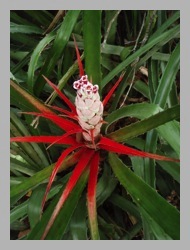
Pineapple that doesn’t exist blossoming in April

After several false starts I was back where I started, in the Bromelaid family. It was a Bromelia pinguin. Then I ran into the usual language problem, but with a little twist. The larger family, Bromeliads, is named for Olaf Bromelius, a Swedish medical doctor and botanist. Bromelia, however, is from the Greek word meaning food, “broma.” Pinguin is from “penguis” Latin for stout or strong, a reference to using older leaves for cordage. While it is clever that the Bromelias are Bromeliads the names aren’t directly related. In Spanish its common name is pinuelo or pina salvaje. The natives called it karatas, and is often called wild pineapple. Many of the 48 different Bromelias have food uses.

Native to Central America it is cultivated and escaped in Florida, the Caribbean, Puerto Rico and Hawaii.  It has long leathery leaves arching about a yard high and five feet long. They are usually about 120 degrees from each other forming a spiral around the plant. The leaves act like troughs directing water and nutrients down to the center of the plant where they are absorbed. The water stored there is so acidic it eats mosquitos, adding more food for the plant. The leaves have savage hooked, sharp spines that can point toward the base of the plant or away. Each plant produces 10 to 75 yellow fruit on a spike, each with 30 to 50 shiny black seeds. Besides man and other large mammals they are the favorite food of the red land crab, karatas.

The ripe fruit, which clings like Hercules to the stalk, can be eaten raw or cooked and is used to make a tart drink but see the caution below.  I do not recommend eating it raw, or more specifically undiluted. The raw fruit can be extremely acidic and can burn the lip, tongue and throat. It needs to be diluted. The new leaves and flower stalks can be cooked like vegetables as can the flowers (with stinging hairs removed.)  Medicinally the juice of the fruit has been employed for many uses from treating intestinal parasites, fevers, oral ulcers and to induce abortions. Older leaves fibers have been used to make cloth, fishing line, nets and string.  A 100g sample of new growth is 92g water, 158 mg calcium, 50 mg phosphorus, 0.51 iron, 0.029 thiamine, 0.041 mg riboflavin, 0.382 niacin and 34 mg ascorbic acid. In Mexico the fruit are boiled and peeled before eating. 

The fruits of the B. nidus-puellae, B. alta  B. karatas, B. balansae, B. comosa B. plumieri, and B. chrysantha are also edible. The pineapple used to be in this genus.

One more note of caution: There might also be “meat tenderizer” in the juice of the Wild Pineapple. I know if I eat it my tongue and mouth feel fuzzy for a few  hours, as if chemically shaved. But I also know people who can eat them without any oral effect. I recommend being careful with the plant from an edible point of view. Other Bromelias respond well to roasting.

Green Deane’s “Itemized” Plant Profile

IDENTIFICATION: A  pineapple-like plant with large sword-shaped dark green leaves with alternating curved spines on their edge.  It has many wooly red-orange flowers then elliptical yellow berries. The spines are vicious. Do not wade into a patch of Wild Pineapples.

TIME OF YEAR: Whenever in blossom or fruit. The plant flowers then fruits then dies

ENVIRONMENT: Prefers shade and well-drained soil.

METHOD OF PREPARATION: Flowers (stinging hairs removed) young shoots, stalk and core as a cooked vegetable. Fruits raw or cooked but I highly recommend not eating the fruit raw as it can be very acidic. In Mexico they cook the fruit then eat them.
{ 46 comments }

Willow, medicine and famine food

Salix caroliniana: Nothing Would Be Finer

The willow is not prime eats. It’s not even secondary eats. In fact, it is famine food, but, willow can also cure your headache and other pains, so it’s worth knowing about.

The inner bark of the willow is edible, though you probably will have to boil it a few times to make it so. In Scandinavia it was dried, pulverized and mixed with flour to make bread. Don’t be surprised, even sawdust has been added to flour to make bread. In 1918 William Edward Fitch, M.D., wrote in his book “Dietotherapy” that:

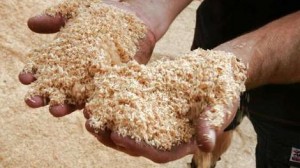
The right sawdust can be added to bread and other food.

“In Sweden and Norway sawdust is sometimes converted into bread, for which purpose beech or some wood that does not contain turpentine is repeatedly macerated and boiled in water to remove soluble matters and then reduce to powder, heated several times in an oven and ground. In this state it is said to have the smell and taste of corn flour…. During the present European war it is claimed that Germany has reported to the use of sawdust in bread making.  A friend of the author, traveling in Germany and Switzerland in 1916, was presented with a loaf of this bread which was being used as food for the English and French prisoners.”

Alfred Packer, 1842-1907

Young willow shoots, buds and leaves are also edible but very bitter (and high in Vitamin C.) Boiling is the method commonly used to make them more palatable but they can be eaten raw if you can eat them. In fact, during a trial in Colorado in 1886 a prospector, Alfred Griner Packer, testified his party got lost in the winter of 1874. They went without much food for nine days and then ate first their moccasins. After that they ate willow buds. Lastly, they ate each other though Parker changed his story three times. The jury thought it murder not survival or self-defense and sentenced Packer to 40 years. He was pardoned after some 17 years, worked as a security guard for six years then died in 1907.

So, they ate their shoes before willow buds, then came each other. That doesn’t put willow too high on the food chain. What about curing headaches?

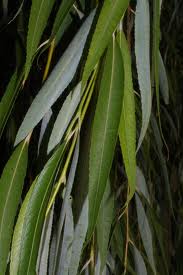
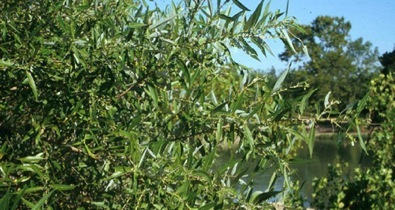
Wilows have long, thin leaves with tiny teeth

Hippocrates, who was around when the Acropolis was being built, knew that chewing leaves of willow reduced pain for childbirth, and in fact he prescribed it. In North America at least a dozen Indian tribes used willows to relieve fevers, aches, and pains. The willow’s “salicin”  was the inspiration to make aspirin.  For 60 years in the 1800s scientists tried to make an artificial aspirin that did not upset the stomach greatly. They succeeded in 1893.

You see, when a person eats a willow leaf or some of the bitter inner bark the stomach provides the acid to make it salicylic acid, the pain reliever. But artificial salicylic acid is really tough on the stomach. Eventually they found acetylsalicylic acid, and that is basically the aspirin of today.  Back then the Bayer company was a dye maker. One of its chemists, Felix Hoffmann, figured out how to mass produce aspirin.  The chemical eases pain by depressing parts of the central nervous system. Aspirin is a made up name. It comes from the ‘A” in acetyl chloride, “spir” from Spiraea ulmaria (the plant they derived the salicylic acid from, Meadowsweet) and ‘in’ which was a familiar name ending for medicines then.

Willow bark can be a source of tannin, black dye, and cordage. The white willow yields cinnamon-colored dye. In most areas where the willow grow locals also used it to make baskets, cages, fishing gear and even horse bridles. Different willows offer different parts for consumption from oozing sweet sap to root tips, Check out your local willow.  The weeping willow, a standard ornamental, is also useable. Incidentally, the growing tips soak in a little water make a natural rooting/growth hormone for plants.

The common willow here is Salix caroliniana (SAY-licks kair-oh-lin-ee-AY-nuh.) Salix is the ancient name for willow, possibly from either Gaelic “suil” or “seileach” tree or or willow tree, or from another part of the world Akkadian “salihu” sprinkler of water.  Caroliniana means of the Carolinas, read North America.

Composer Ann Ronell

“Willow Weep for Me” is a popular song composed in 1932 by Ann Ronell. It’s now a jazz standard though Frank Sinatra did a ballard rendition. Ronell was romantically involved with George Gershwin at the time and there is an amazing striking similarity in the song to Gershwin’s bluesy style. Some think Gershwin wrote the song for her and gave her the rights. That is entirely possible in that the song is unmistakenly Gershwinesque. However, in her defense Ronell studied with the famed Walter Piston, the leading composition teacher of the day. His books on composition were standard instruction for generations of music students. She wrote film scores among many things and was more than capable of imitating Gershwin. It just might be the song was her gift to him. More than a generation later Peter and Gordon, and, Chad and Jeremy both recorded their own version of the song as did the aforementioned Sinatra and Etta James, whose recording is far different than Frankie’s.

Green Deane’s “Itemized” Plant Profile

IDENTIFICATION: Leaves alternate, simple, lanceolate 5 to 8 inches long and 3/8 to 1 inch wide.  The margins are finely toothed.  Upper surfaces smooth,dark green, lower surfaces whitish; stems strong, long, limber. Flowers are catkins emerging at the same time as the new leaves; silk-tipped seeds released from small pods that split in the spring. The Carolina Willow has yellow glands on the tips of the teeth on the leaves — you will need a magnifying glass. It also has at the base of young leaves leaves that resemble mouse ears.

TIME OF YEAR: In southern climes, year round, northern climes spring to fall.

ENVIRONMENT: Likes it feet wet in fresh water

METHOD OF PREPARATION: Shoots, buds, young leaves boiled. Expect them to remain bitter. Inner bark edible as a famine food. Different willows, however, produce different edible parts and more than listed here. Investigate your local willow. Native Americans chewed or boiled tea from the leaves and inner bark to relieve fever, toothache pain, arthritis, and headache.


{ 15 comments }

Oats worthy of sowing

Chasmanthium latifolium: Edible Wood Oats

Most people discover Wood Oats by mistake. They’re traipsing through the forest, come across a plant, and wonder “What are Sea Oats doing here?”

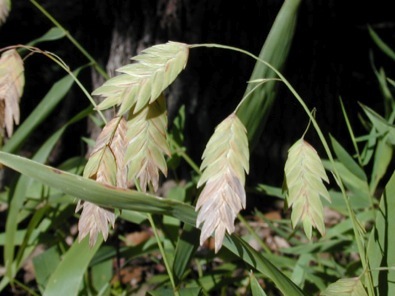
Wood Oats look very similar to Sea Oats except shorter, growing two to five feet tall, not three to eight. They are used the same way as Sea Oats, after windowed as a grain for cereal or ground for flour.  Neither plant, however, is a true oat. They are also no longer in the same family, per se. They were both Uniolas but now Wood Oats are a Chasmanthium. Sea Oats (see separate entry) are still Uniola paniculata but some are moving it, too, into the Chasmanthium clan. Think of it as a botanical warlette.

Edward Palmer (1831-1911)

Edward Palmer (1831-1911)

Wood Oats are native to southeastern North America. They grows in rich woods, along streams, rivers, and in flood plains. They’re a common ground cover in bottomland forests, sometimes growing in colonies. They do not grow near the sea. Wood Oats are found from Arizona to Florida, north to Pennsylvania, west to Michigan, then southwestward through Iowa, Nebraska, and Oklahoma. Additionally a relative that was thought extinct, now called  Distichlis palmeri, is being raised for commercial grain use in Australia. It was a staple of the Cocopah Indians in the desert southwest of the United States. The species named after plant explorer Edward Palmer not to be confused with Ernest Jesse Palmer who also had a lot of plants named after him.

Botanically, Wood Oats are Chasmanthium latifolium (kas-MAN-thee-um  lat-ah-FOL-ee-um) which means “gaping flower fat leaf.”  Chasme and athner are Greek for “gaping” and “flower.”  Latifolium is Dead Latin for fat leaf. The plant used to be Uniola latifolium. Chasmanthium latifolium and Uniola paniculata have so many common names I made the decision to call them by where they grow, Wood Oats because they grow in woods, and Sea Oats because they grow by the sea. It makes things a lot easier to remember. Perhaps Distichlis palmeri should be called Desert Oats.

Should you like the flavor and want to grow your own, Wood Oats are easy to raise. Give them moist soil, plenty of sun, and stand back. There are about six Chasmanthium species in the eastern and central  United States and northern Mexico. Three alone in Texas. Wood Oats are the only species under cultivation and none of the other Chasmanthiums look like Wood Oats (excluding Uniolas.)  One should also note there are no toxic native grass seeds in North America but be on the look out for ergot infection and some toxic non-native grasses. Ergot manifests itself as a fungus spur on the seed head ranging in colors from black to pink to green.

Lastly,the Wood Oats’ leaves are a host plant for Linda’s Roadside Skipper, Amblyscirtes linda.

Green Deane’s “Itemized” Plant Profile

IDENTIFICATION: A perennial, clump-forming grass, wide leaves, nodding clusters of flat, oat-like seed heads, two to five feet,   clump spread two or more feet, leaves are about one inch to eight inches long, flat, terminating in a sharp point. Leaves has distinct cross veining. Flowers flat clusters, spikelets, to two inches long, one wide, spikelets hang on thread-like stems in loose, open panicles above the leaves. Leaves and flower heads turn tan in autumn, reddish-bronze winter.

TIME OF YEAR: Blooms summer to fall, seeds summer to fall. Spikelets turn from green to tan to bronze

ENVIRONMENT: Moist but not water logged soil, full sun, will tolerate some shade.

METHOD OF PREPARATION: Winnowed grain as cereal or ground to make flour.


{ 6 comments }

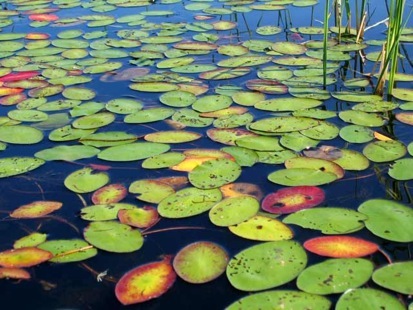
Water Shields, note oval in shape, no slit

Brasenia schreberi: Palatable Pond Weed

The Water Shield is edible. The problem is getting it sometimes. It likes water … up to six feet deep. On the good side, this is one aquatic plant that is found throughout all of North America and is edible from top to bottom.

On first glance it is easy to mistake the Water Shield (Brasenia schreberi) for a young Nuphar lutea, or yellow pond lily. They like similar wet environs. However, the Water Shield does not have a split leaf and the Nuphar does, or at least notched. Also, the stem of the Water Shied attaches to the middle of the oval floating leaf. I say floating so you don’t get it confused with the American lotus, which also has a round leaf with the stem attached in the middle. However, the lotus has leaves out of water whereas the Water Shield leaf is always floating.

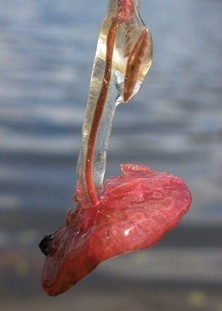
The Water Shield always has clear gel on leaf and stem

The Water Shield can also be confused with the Fragrant Water Lily, Nymphaea odorata, or Floating Hearts, Nymphoides peltata, and several pond weeds such as the Potamogeton.  But only the Water Shield is covered by a clear gel coating on the underside of the leaf and stem.   Remember you are looking for an oval, floating leaf with the stem attached to the middle, no clef AND the leaf and stem have a gel coating.

The creeping rhizomes and young leaves were used for food by Native Americans. The Japanese use the young leaves and stems in salads and miso soup. The starchy roots can be peeled, boiled and eaten or dried and stored or dried then ground into flour. But they must be peeled or they are too bitter to eat. Nutritionally per 100g weight the Water Shield has 135 calories and is 9.5% protein; 2.7% fat; has 24.3 carbs; 1.4 grams fiber; 122 mg of calcium;  311 mg phosphorus; 27 mg Iron:; Vitamin A; 27 mg; thiamine; 135 mg; niacin, 0.41; vitamin C, 0.5 mg.

The Water Shield is also a habitat for fish and aquatic insects. Where there is Water Shield there is usually good fishing. Its seeds and vegetation are eaten by waterfowl. While found throughout most of North American including Alaska it’s also found in Central America, Cuba, Africa, East Asia and Australia.

The Brasenia (bruh-SE-nia) genus is named for Christoph Brasen, 1774, a Moravian missionary and plant collector in Greenland and Labrador. Schreberi, (shri-BER-ee) is Latin for, “of Schreber, or Schreber’s”. It is named for German botanist Johann Christian Daniel von Schreber (1739-1810), a student of Linnaeus.

 Green Deane’s “Itemized” Plant Profile

IDENTIFICATION: Water Shield leaves are oval with long, reddish leaf stalks are attached at the centers of the leaves. Its submersed parts and undersides covered with a jelly-like substance, flowers are small, dull purple, and emerge from the water on a stalk. They are not showy.

TIME OF YEAR: Best time to collect the roots is autumn to spring, leaves when young

ENVIRONMENT: Shallow ponds, lakes, slow-moving streams to six feet deep. Make sure the water is wholesome.

METHOD OF PREPARATION: Young leaves and stems raw or cooked, roots peeled, boiled and or dried and ground into flour.


{ 14 comments }

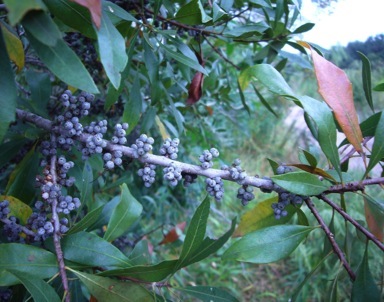
Ripe Wax Myrtle Berries

Myrica cerifera: A Tree That Makes Scents

Wax Myrtle was the natives’ minimart of the forest.

Need some spice? Drop by the Wax Myrtle tree. How about a little something for the peace pipe? Drop by the Wax Myrtle tree. Are the mosquitoes bothering you? Drop by the Wax Myrtle tree. Want to see a Tachycineta bicolor? Drop by the Wax Myrtle. Tree Swallows in winter love it, eating the berries in a whirlwind. If you’re a birder other winged-ones that like the high-energy berries include the Bobwhite, Wild Turkey, Wablers, Vireos, Kinglets and the tiny Carolina Wren, which is more tail than bird.

Native Americans used the leaves for seasoning as we would a bay leaf. The berries were used for seasoning as well but sparingly as they are waxy. Grind them and use like pepper. Though used as a seasoning, that was not the wax myrtle’s main value: The berries when boiled yield a green wax that is excellent for making candles. Indeed, that is reflected in the tree’s name Myrica cerifera, MEER-ih-kuh ser-IF-er-uh.

Cerifera means “wax bearing” going back to the Greek word Keri for the small bees wax candles used in church services. Myrica is Greek myrike (μυρίκη) which was the  Greek name for the  “tamarisk” a tree that is aromatic like the wax myrtle. The aroma of the wax myrtle’s leaves can keep mosquitos away. Rub the leaves on you. The natives smoked the leaves for the same reason.

Also called the bayberry, as in Bayberry candle, the tree was used extensively by the natives for a variety of ways including as a pain killer, a pick-me-up, a diuretic, emetic, febrifuge, tonsil gargle, for headaches, stomach aches, to kill worms  and for dysentery.

And least you think your life has not been touched by the wax myrtle, its leaves are used to improve the foaming of beer. Think of that the next time you enjoy a stein of suds.

Although the berries are strong, they can be eaten fresh off the tree. They can be preserved or even made into a wine. If you don’t have a M. cefera near you don’t despair. There are others in North America and around the world of various uses. In fact some in Asia and Africa had edible leaves. M. gale fruit and leaves have been used to flavor soups, stews, roasted meats, and seafood. They have also been used for tea. When used to help beer foam the brew is often called Gale Beer. M. californica, M. heterophylla, M. pensylvanica, M. pusilla, and M. rubra have also been used like the M. cefera.

Southerners liked the Myrica (MEER-ik-uh) so much they changed Myrica to miracle and call it the Miracle Bush.

Green Deane’s “Itemized” Plant Profile

IDENTIFICATION: Large shrub to small tree, depending on climate, to 10 or 15 feet, six to nine feet across. Olive to gray-green alternate leaves, simple, half an inch to 1.5 inches long. to half inch wide, bayberry scent when crushed. Leaves are smooth on top, hairy below with orange scent glands on both sides. Berries in attached clusters to stems and branches, fall through winter, BB size,  light green to bluish-white strong bayberry scent.

TIME OF YEAR:  Leaves year round, berries in the fall and winter

ENVIRONMENT: New Jersey to Florida, west to Arkansas and Texas and down in to Central America. It will grow under almost any conditions. It makes a nice bush for xeroscaping as it needs no attention.  It can be planted as far north as Rhode Island. Tolerant of salt spray and wind.  First cultivated in 1699

METHOD OF PREPARATION: Leaves as is for seasoning, berries ground like pepper. Berries boil to collect wax. Some herbal applications use the bark of the root (which is said to induce labor.) The leaves have been used to smoke mullet.


{ 25 comments }