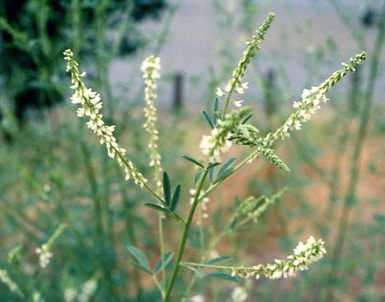
Sweet Clover, M. alba, has a hint of vanilla flavor

Melitotus: Condiment to Tea to Blood Thinner

When I was growing up we owned horses. Lots of horses. And they eat a lot of hay in the winter. Lots of hay. Several tons each (which also has to be shoveled away after… ah… processing.)

So we hayed every summer, loose hay. While most kids had a summer break I went from the classroom to the hay fields for at least 13 summers. School in the fall was a welcomed relief. I remember two things clearly from all those summers in the hay fields: Running over ground hornet nests — they weren’t pleased — and the smell of blood thinner.

Frank W. Schofield

Did he say blood thinner? Yep, blood thinner. And many of you have smelled it too, that sweet aroma when you drive by a field of newly mown hay.  What you smelled was coumarin in the making, mostly from the Sweet Clover. It’s the plant’s version of coumadin, Warfarin, rat killer… blood thinner. Actually, the story is more complex and I think an interesting one.

In the early 1900’s the common feed for bovines was Sweet Clover, a native of Europe, introduced to North America in the 1600’s. Over the first 30 years or so of the 20th century farmers would find cows dead in a pool of blood. Frank W. Schofield, left, a Canadian veterinarian, had described “Sweet Clover Disease” in 1924 but there was no explanation for it. (By the way, Schofield was no social slouch and was very much involved in the independence movement for Korea.)

Professor Karl Link who developed Warfarin, and an assistant.

In February 1933, Ed Carlson, a farmer from Deer Park, Wisconsin, took one dead heifer, a bucketful of still unclotted blood and 100 pounds of old Sweet Clover to the university looking for answers. It was depression times and Carlson couldn’t afford the loss of a heifer (50% of his stock then) nor even the hay. Karl-Paul Link, right, professor of agriculture with a speciality in chemistry, agreed to research the issue. Link was … different, empathetic, an emotional maverick. I suspect today we would call him bipolar
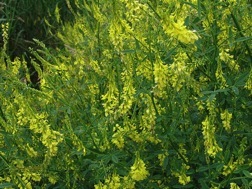
Melilous officinalis can be white or yellow

 Link with the help of PhD students Harold Campbell, Ralph Overman, Charles Huebner, and (later Nobel Prize winner) Mark Stahmann, found coumarin, an anticoagulant, with the Sweet Clover. However, Sweet Clover does not make the thinner. A mold on the clover does. That particular hay year, 1932, was a wet year and the mold very active. Link had discovered what was killing the cattle and steps were taken among cattle owners to reduce their consumption of moldy Sweet Clover. This is why clover should be harvested fresh and mold free, used or immediately dried to prevent molding. (Note to self: Mold also gave us penicillin.)

As fate would have it more than a decade later Professor Link, who had tuberculosis, went on a six month sabbatical to a sanitarium for his health. While there he read about the problem of rodent control and he hit upon the idea of using coumarin to kill rats. He developed and patented in 1947 Warfarin (part of the name comes from Wisconsin Alumni Research Foundation which funded his work. In time he also gave them the patent.)

Technically coumarin does not “thin” the blood. It lengthens the time it takes to clot, that is, it inhibits the production of Vitamin K1 which is a clotting agent.  The antidote for coumarin is Vitamin K1. That can be given by a doctor or vet or can also be found in foods such as leafy vegetables, cauliflower, broccoli, spinach and some herbal teas.

Link, who was also known as a very eccentric dresser, suffered from his tuberculosis and died from it in 1978 (as did a Greek grandfather and aunt of mine in the 1950’s.)  His little-known role in the discovery of one of the most common anticoagulants, has been called… wait for it… “The Missing Link.” Schofield the vet, born in England in 1889, died in Korea in 1970 and is buried with honors there.

So what of Sweet Clover, Melilotus alba, M. indica, and M. officinalis as forageables?
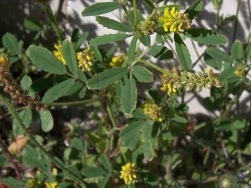
Melilous indica, of India

The young leaves can be eaten raw, preferably before the plant blossoms. They are bitter and aromatic, usually used as flavoring in salads. The whole plant thoroughly dried can be used to make a tea with a hint of vanilla. The seeds can be used as a spice. Fermented or moldy clover should never be used. Lastly excess consumption can make you throw up. Use carefully and sparingly. Some people report getting a headache when they smell the plant.

Melilotus means honey lotus, from two Greek words, the later the name of a Greek plant possibly clover, or meaning fragrant like the lotus. Alba means white and indica of India. Officinalis does mean official. But in ancient Rome that meant it was sold in a medicinal shop approved by the state. So it means medicinal. The Sweet Clover is also called Sertula in Greek, which is now a separate genus.

Some botanists think M. alba and M. officinalis are the same species, just a white version and a yellow version.

Green Deane’s “Itemized” Plant Profile

IDENTIFICATION: Two to five feet tall, floppy flowers 1/8 inch long, white or yellow, annual or biennial, branching occasionally, often lanky. Light green stems are round or furrowed on all sides) smooth. Leaves alternate, trifoliate,  sparsely distributed along the stems, petioles up to one inch long. Grayish leaflets to one one inch long and a third across. Hairless, toothy along the upper margins, and oblong or oblong-ovate, small narrow stipules at the base of each trifoliate leaf’s petiole. The middle leaflet has longest petiole, side leaflets nearly sessile.

TIME OF YEAR: Flowers in March in Florida, June to September in northern climes

ENVIRONMENT: Roadsides, waste places, vacant lots, lightly wooded areas, weed meadows.

METHOD OF PREPARATION: Leaves raw in moderation, used for flavoring in salads, seeds used as a spice, usually the plant is dried and used for tea.
 

{ 10 comments }

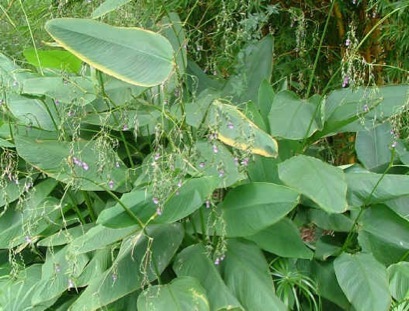
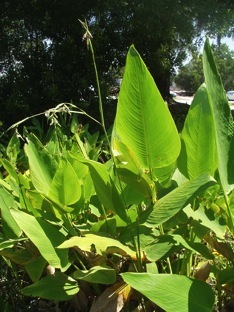
Large leaves of the Swamp Lilly used for cooking

Thalia geniculata: Swamp Wrap

You won’t find the “swamp lilly” in many foraging books. For a big plant it receives little attention.

 Thalia geniculata (THAL-ee-yah gen-ik-yoo-LAH-tuh) comes from a good family, closely related to the gingers.  It’s easy to identify, grows year round, and the forager has many uses for it. But several things conspire against the Swamp Lilly. First, its edible root turns pink when you cook it and tastes swampy. Not exactly the best asset to have, then again, not too many people are eating it. And as one of its other name implies, Alligator Flag, it likes to grow where alligators grow. That make collecting a tad more dangerous and limits its range. So what is the Swamp Lilly’s claim to fame? You can cook with its leaves.

Roots taste like swamp water

Most of our ancestors who foraged daily to stay alive didn’t have pots and pans. They would often wrap foods in leaves to cook them, and to keep them clean from the ashes. This was particularly true of any bread-like food. In fact  “tamales” used to mean any food wrapped in leaves then cooked. While many foods can be cooked over a fire, cooking wrapped food in the embers extends the use of the fire and often allows the use of local spices.

Swamp Lilly leaves can grow up to eight inches wide and two and a half feet long (so catch a big fish.) They were also used to boil cornbread-like mixtures. Like the banana leaf and many others, the Swamp Lilly leaf can also be used to carry food. Young leaves are reportedly edible. I haven’t tried the leaves yet. When cooked the little roots resemble cooked shrimp, but not in flavor. They are swampy, just as alligator meat is swampy. Botanical researchers say Swamp Lilly was highly used during war times. The raw root does has medicinal uses from an antiseptic to a stimulant.

The Swamp Lilly, an appellation used in Panama, has many common names, including Alligator Flag, Red Flag and Fire Flag. It’s called a flag because alligator movements in the swamp makes the large leaf wave, showing the lizard’s location. Botanically, the Swamp Lilly is named after German physician Johannes Thal,(1542-83) though “thalia” has an allusion to the muse of the same name that presided over comedy.  Geniculata means “many knees” and refers to the plant’s many jointed stems. Those stems are used for basket weaving in Africa. There are seven species in the genus, only a few like their feet wet.

 Green Deane’s “Itemized” Plant Profile

IDENTIFICATION: A giant herb with a short root and many string-like roots, five to nine feet tall. Leaves long-stalked, lance shaped to oval, blunt point at apex, rounded a base, bright green, smooth. Flowers in pairs, rose-purple, dangling, fuzzy bracts, stems zigzag.

TIME OF YEAR: Year round

ENVIRONMENT: Swamps, ponds, lakes, low spots, sides of rivers.

METHOD OF PREPARATION: Young roots boiled, turning pink. Swampy flavor. Young leaves edible. Older leaves used for cooking other foods. To make the leaves easier to wrap with, wilt them by holding them close to the fire.  The flowers and base of the stem are reported as edible cooked. I have not tired them yet.


{ 1 comment }


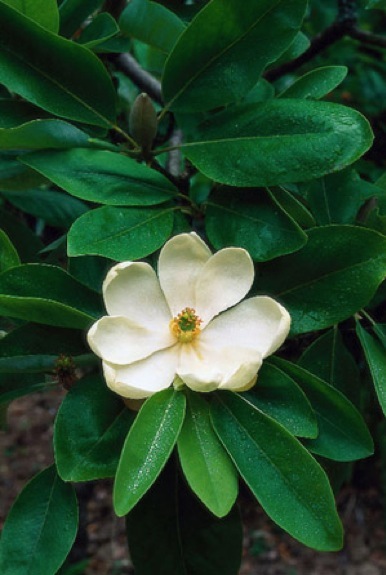
The Sweetbay has large, waxy blossoms

Magnolia viginiana: How Sweet It Is

Let’s say you want or need to trap a beaver. First you need a trap, but then you need to bait the trap. And then the question becomes, what do you bait a beaver trap with?  There is an answer: Magnolia virginiana.

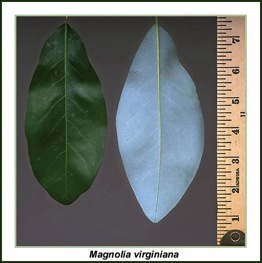
The silver is caused by little hairs

Beavers find the fleshy roots of the “Sweet bay” irresistible, a preference that was not missed by early colonists to North America. Beavers aren’t the only ones who find the tree a source of a meal. Deer and cattle like the leaves and twigs. It can be up to 25% of their winter diet. Squirrels, white-footed mice, turkeys, quails and songbirds like its fruit. Humans make a tea from its leaves and use them to flavor soups and stews.

Among those who consider such things the leaves of the M. virginiana are considered slightly inferior to those of the Perseas in flavor, though they are used the same way (to see an article on the Perseas elsewhere on this site click here.) While the Perseas have a more complex flavor profile the Sweetbay appeals more to the nose with a hint of vanilla. It is also a more attractive, larger tree. And the truth be told, the Sweetbay is a whole lot easier to identify than the Perseas. The lance-shaped leaves are a rich green on top and a solid silver on the bottom. When the wind blows, the tree flashes a handsome metallic sheen. That glimmer is caused by minute white hairs on the young leaves, which can be rubbed off.

Pierre Magnol, 1638-1715

The aromatic wood is soft, even-grained and very easy to work. Besides trapping beavers, it’s used for veneer, boxes, containers, tool handles, furniture, lumber and plywood. The Sweetbay ranges from Glouster, Massachusetts, to Florida to Texas, though it is most common in South Carolina, Georgia, Florida and Alabama.

Besides the Sweetbay the leaves of the Magnolia grandifolia can be used for seasoning (slightly bitter) and the petals of the blossoms pickled in a vinegar and sugar solution to make a condiment. Interestingly the Magnolias are related to the smaller papaw, but much younger say the botanists.

Two other magnolias are worth mentioning, M. hypoleuca and M. kobus. The young leaves, flower buds of the M. hypoleuca are boiled and eaten as a vegetable. Older leaves are dried then sprinkled on food as a flavoring. Whole dried leaves are filled like small boats with food then grilled. Leaves used that way are not eaten but they impart their flavor to the food cooked in them.

The flowers and buds of the M. kobus are also boiled and eaten. Older leaves are eaten or used to make a tea. The leaves are also dried and powered and used as a seasoning.

As for the scientific name, Magnolia (mag-NO-lee-ah)  is named after French botanist Pierre Magnol, 1638-1715, who was the physician of King Louis XIV of France and was the director of a botanical garden at Montpellier and also a professor of Botany at Montpellier. Virginiana (vir-gin-knee-AY-nah) means of North America. Grandifolia means large leaves. Hypoleuca (high-poh-LOO-kuh) is Greek that means “under white.” Kobus (KOE-bus) is the native name for that magnolia.

 Green Deane’s “Itemized” Plant Profile

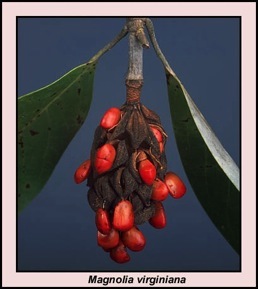
Seeds are not edible

IDENTIFICATION: The Sweetbay Magnolia is a tree to 90 feet, with an open crown of sparse branches. The farther north the smaller the tree. Its leaves are simple, alternating, oval to oblong, four to six inches in length. Its bark is gray-brown, smooth and tight. the thin leathery leaves are smooth and shiny green on top, white below.  The fruit is an aggregate that releases many flat. oval, red seeds (not edible.)

TIME OF YEAR: Year round

ENVIRONMENT: It is found in swampy areas, wet soil and along streams and ponds.

METHOD OF PREPARATION: Leaves can be used to make a tea or use like a bay leaf to flavor soups and stews or make a marinade.


{ 20 comments }

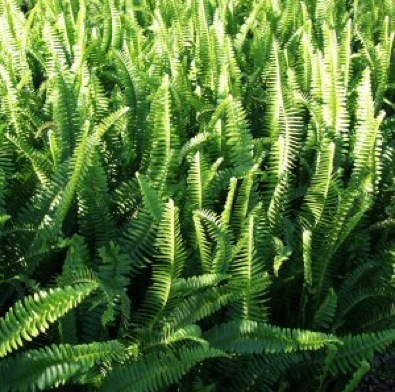
Sword Fern’s Water Storage Swelling

Nephrolepis cordifolia: Edible Watery Stolons

Edibles are often right under your feet, or my feet as it were.

I had a yard of non-edible ferns. If you like fiddleheads that’s an irritation. That irritation in time lead me to buying a regional fern book to seek out more fiddleheads than I already knew. To make sure I could ID ferns well I started with the ones in my yard, Nephrolepis cordifolia. From the other side of the world they were first found growing in Florida beside a road in Sumter County in 1933.  They have since covered much of the state.

Sword Ferns From Nepal Found In Florida in 1933

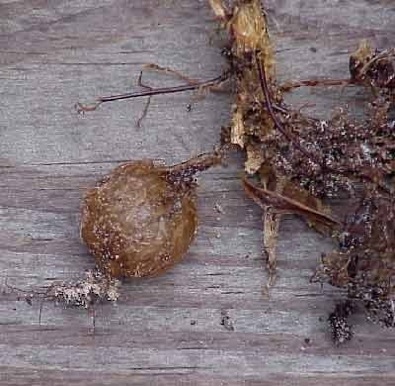
As the N. cordifolia does not produce much of a fiddlehead I ignored it for some eight years as it spread, covering half my property.  The identification was rather easy in that of the five Nephrolepis in the state the cordifolia is the only one with marble-size stolons growing off its roots. In fact when I wanted to move ferns to a new spot I often planted the stolons. I thought nothing of them.

My research led me to a scientific paper on the plant from Nepal, Nutrient Analysis of Nephrolepsis, Kathmandu University Journal of Science, Engineering and Technology, Vol 4, No 1 (2008). A team not only tested the Nephrolepis cordifolia for nutritional content but reported children there eat the stolons raw all the time, apparently their favorite wild snack. The team recommended the stolons be investigated as a potential commercial crop. After rechecking my plants I suddenly realized I had thousands of ferns with edible stolons.

This was a win win in disguise. Florida put the N. cordifolia on the state’s plant pest list, the only fern of about 100 to make it. The state doesn’t like it because the fern is squeezing out the native Nephrolepis exaltata, which is a commercial product.  While many ferns species have useable rhizomes only two Nephrolepis  have swolen stolons and both are edible, N. cordifolia  and  N. undulata.  What that means is if you have a Nephrolepis and it has stolons you have an edible. If you don’t live in pan-tropical regions around the world, no problem. There is probably a pot of sword ferns in any number of businesses and lobbies near you. Gently pull the fern root mass out of the pot and look for stolons. If it is a sword fern (Nephrolepis) and it has stolons, it is edible.  Often the N. cordifolia is sold as the N. exaltata because folks don’t know the difference. So you could have fern stolons near you.

Research on the Nephrolepis can be confusing. While online references say there are about 30 species of Nephrolepis in the world a recent study suggests 19 or so, read some consolidation and parsing happened.  There still may be some future sorting out in that not all agree there are 19 species.  A Florida botanist is quoted on a site as saying there are four species of Nephrolepis with stolons. I contacted him and he flatly denies ever writing or saying any such thing. That is why contacting primary sources is important. While the Internet might be  a place to start your research. It is not the place to end it.

Nutritionally the stolons of the N. cordifolia are 13.42 percent carbohydrates, 1.34% protein, 1.25 percent starch, 14.88 percent crude fiber, 6.53 ash, 0.75 percent calcium and trace phosphorus. They’re also about 96% water. They can range in color from cream to yellow to dark tan or brown. To me they taste similar Jerusalem Artichokes with the same crunch, a varying amount of astringency, water and potato-like earthy aroma. From the plant’s point of view the tubers are for water storage. The fern is often an epiphyte growing on other plants, most noticeably on palm trees. The stolons can provide water for the dry spells.

Nephrolepis (nef-roh-LEP-iss) is Greek and means kidney shaped scales, referring to the shape of the spoor packets on the back of the fern’s leaf.  Cordifolia (kor-di-FOH-lee-uh) means heart-leaf. Where each leaf (pinnule) attaches to the stem (rachis) there is a little protrusion that looks like the bottom of a heart.  Identifying ferns is often nearly microscopic in nature. You definitely need a hand lens at least 10x and a lot of patients.  The plant is native to Australia and the Himalaya areas. It is found in the Society Islands, New Zealand, Puerto Rico, Hawaii, Florida, Georgia, Alabama, and protected pots elsewhere. If you have a “Boston Fern” in might be the N. cordifolia. Look for the stolons. See my video on said.

Other ferns species with reportedly edible tubers include Angiopteris evecta, Diplazium esculentum, Cyathea medullaris, Pteris esculenta, Gleichenia dichotoma, and Marattia alata. Pteris aquilinum and Aspidium filix tubers have been used to make beer. Tubers are usually starchy and much larger than stolons.

Green Deane’s “Itemized” Plant Profile

IDENTIFICATION: A medium-sized, medium-green, Boston/sword Fern, tapering to both ends,  producing below ground scaly round  stolons. Leaves pinnate, fertile and sterile fronds similar to three feet long and three inches wide; petioles to eight inches long, Forty to 100 leaflets on each side, oblong-lanceolate with a heart shaped lobe stem end of leaf; leaflet entire to slightly toothed, underside spore packets kidney-shaped

TIME OF YEAR: Tubers are available year round. The plant produces a horizontal root (rhizome.) Off the rhizome are wiry roots, stolons. Growing on the stolons will be the fuzzy hairs. I think calling them “tubers” is not exactly correct, more like water storage units, swollen stolons.

ENVIRONMENT: Shady areas, lawns, waste ground, limestone ledges, wet places, roadsides, in palm trees.

METHOD OF PREPARATION: Eaten raw, out of hand. If you roast large ones in a slow oven the turn into sweet, chewy lumps. Small ones keep their shape but turn to a powder inside that tastes like coffee. Young stolons (which are green with white hairs) are the least astringent, the darker and older the stolons the more astringent.


{ 28 comments }


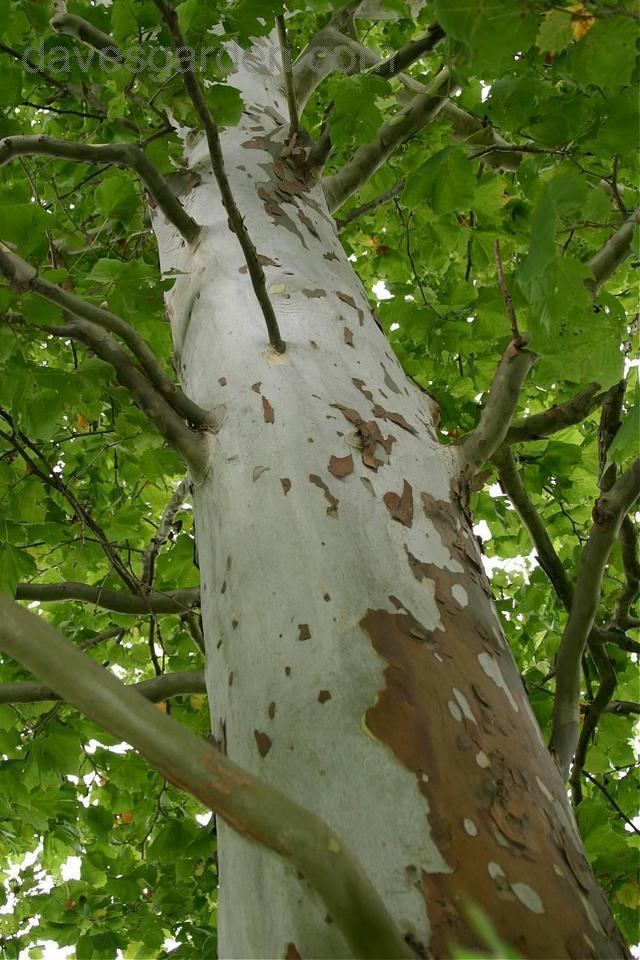
Sycamore has distinctive bark

Sycamore has distinctive bark

Sycamores: Not Just Another Plane Tree

Sycamore trees are not high on the edible list, unless you’re in need.

Actually, sycamores, Platanus occidentalis (PLAT-uh-nus ock-sih-den-TAY-liss) get a bad rap. Though they grow big and showy, landscapers don’t use them because they can have a lot of tree diseases. Homeowners don’t like them because they shed piles of maple-like leaves and disrupt underground lines. Woodworkers don’t care for the wood because it tends to hold water and twist when it dries. But that is one reason why we like it.

The sycamore is full of drinkable sap, read water when you need it. The sycamore can also provide a maple-like syrup as well, but you’ve have to boil many gallons of it to get syrup or sugar.  Knowing there is always a source of drinkable sap/water nearby has its advantages.

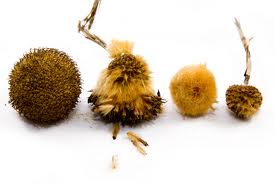
Sycamore seeds

To the forager, or the bushcrafter, another advantage of the sycamore is its light-colored wood can be used to make safe utensils such as wooden spoons, forks or skewers. Historically it was made into boxes to hold food as well as fruit and vegetable baskets.  Other early uses included barber poles, wooden washing machines, lard pails, Saratoga trunks, piano and organ cases, phonograph boxes, and broad paneling in Pullman train cars. It has been used for butcher blocks for many years because it is hard to split, as well as flooring, handles, and pallets. Incidentally, there is a second sycamore of interest but it only grows in California and Mexico, Platanus racemosa. Chunks of its bark can be use for a coffee substitute.

And while it may never come to this, sycamores can grow so large they have hollow trunks and many a settler sought long-term shelter inside a sycamore. It was not uncommon to house a pig to a horse inside a living sycamore. At one time two brothers lived for three years inside the hollow trunk of an American Sycamore. One can believe that given the size of the champion sycamore tree in the United States. It’s in Jeromesville, Ohio, and is nearly 50 feet around at the base (582 inches at 4 1/2 feet high.) It is 129 feet tall and has a crown spread of 105 feet.

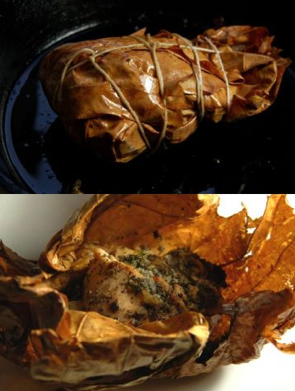
Mia Wasilevich using the fragrant sycamore leaves as a wrap to keep lambsquarter seed stuffed rabbit leg moist.

Mia Wasilevich using the fragrant sycamore leaves as a wrap to keep lambsquarter seed stuffed rabbit leg moist.

And just as the tree is human friendly it is kind to animals as well. Sycamore seeds are eaten by some birds including the purple finch, goldfinch, chickadees, and dark-eyed junco. The seeds are also eaten by muskrats, beavers, and squirrels. Hollow sycamores can provide dens for black bear. Cavity nesting birds that call the sycamore home include the barred owl, eastern screech-owl, great crested flycatcher, chimney swift, and the wood duck. In fact one bird uses the tree rather cleverly.

If you look at a sycamore of any size you will often see a line of little holes in the bark, made by the Sapsucker. And while the Sapsucker likes sweet sap it has an ulterior motive. After the bird flies away insects come to feed on the sugary sap. The bird then returns and eats he bugs. Clever bird. Hummingbirds also eat the seeping sap.

The naming of the sycamore is a rather complex affair. Sycamore is from two Greek words siga and mora which  mean “Fig and mulberry.”  First there was a fig tree in the Middle East called Ficus sycomorus, the Sycomore Fig of Bible fame. The American sycamore’s leafs and round seeds were reminiscent of the Sycomore Fig, thus it was called Sycamore. It’s botanical name is a combination of Greek and Dead Latin.  Planatos (plane) was a Greek name for the tree, and occidentalis means “of the west” to separate it from similar European trees. Greeks also call the tree Daphne, a strange little word. Depending upon the accent in Greek it can be the tree and an area of Athens that once had an insane asylum, and where we get the word “daffy” in English. Racemosa means cluster and refers to the seed cluster of the California sycamore.

Also, according to Herodotus, the Greeks owed some of their success to the charm of the plane tree. In 480 BC, invading Persian King Xerxes camped his army in a grove of those trees. The king was so enamored by them that he put off his march for a few days. This delay helped lose Xerxes the war, and Greece went on to build the Athenian Empire.

The American sycamore is sometimes confused with the several other trees in the same family that are similar in appearance. If the tree has single seed pod, it is the sycamore. If there are two seed pods together, it’s a London planetree. If there are 3-5 seed pods, it is an Oriental planetree which has the seed pods hanging like beads. Those seed pods when dry have a coating of tiny hairs and can irritate air passages, so handle them carefully. However, that same hair makes excellent tinder.

Green Deane’s “Itemized” Plant Profile

IDENTIFICATION: Tall tree resembling a maple with mottled bark, leaves palmate, large, eight inches wide and long or more, with three lobes, glossy green on top, paler underneath. Non-edible fruit, a brown cluster.

TIME OF YEAR: Sap availability depends on location, year round in warm areas.

ENVIRONMENT: Grows best on sandy loams or loam with a good supply of ground water, typically on the edges of lakes and streams. Found in eastern North America, except the California Sycamore.

METHOD OF PREPARATION: For the American sycamore, the occidentalis, sap, tap like a maple. For the California Sycamore, the Racemosa, put chips of the bark and root in hot water. One thing the sycamore cannot be used for is smoking food.  It gives a foul flavor to the food.


HERB BLURB

Native Americans used Platanus occidentalis for a variety of medicinal purposes, including cold and cough remedies, as well as dietary, dermatological, gynecological, respiratory, and gastrointestinal aids


{ 78 comments }