Seablite, one of my favorite greens

Suaeda linearis, maritima: Edible Blite


While most people find Sea Blite next to the sea, I find Sea Blite on the other side of the barrier island, on the inland coastal waterway. Actually, Sea Blites, Suaedas, can turn up in the strangest of places.

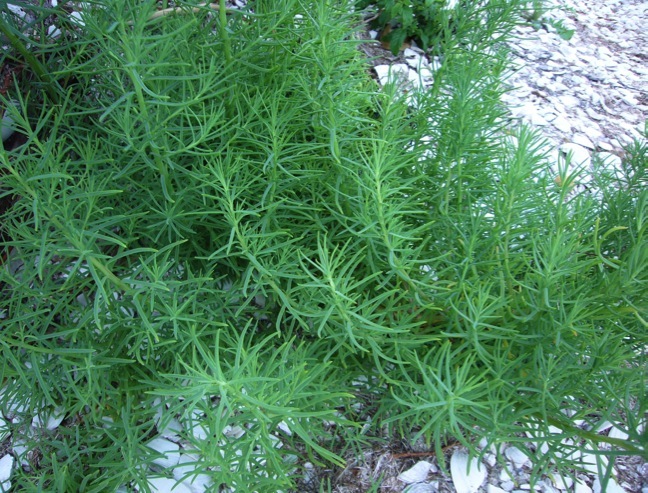
The Southern Sea Blite, Suaeda linearis, (above) is found on the coast from Texas to Maine but not quite to Canada. The Annual Sea Blite, Suaeda maritima, (right) is found from Virginia north into eastern Canada but also two western counties in Florida, a county in the middle of Kentucky, one northern county in Washington, southern Alaska, and Manitoba. Suaeda californica, a marsh plant, is found in four counties in California and is not pictured because it is quite rare. Suaeda calceoliformis, the Pursh Seepweed is found peppered about all of North American except the old South, Iowa and Vermont. Formerly called S. depressa, it is no doubt in more places than that for the government maps are often decades out of date. Also edible in western North America are S. nigra, S. occidentalis, and S. palmeri. Elsewhere in the world they eat S. australis, S. corniculata, S. fruiticosa, S. glauca, S. japonica, and S. salsa.  In some areas the Suaeda is common, in others rare, so check out your local form and condition. Generally said, when a plant in the Suaeda genus is near the ocean it is a Sea Blite, when near salty water or land elsewhere, it is a Seepweed. All are related to the Chenopodiums if I remember correctly.

Suaeda is the Latinized version of the Arabic name for this genus, said soo-EE-duh. Linearis (lin-ee-AIR-iss) means narrow and maritima (mar-ih-TEE-muh) of the sea.  Californica (kal-lee-FOR-ni-ka) means of California and calceoliformis (kal-see-oh-lee-FOR-mis) refers to the plant’s flower that is shaped like a little shoe. Pursh is probably for Frederick Traugott Pursh (1774 -1820) a German-American botanist. Blite came from Blight which is a discoloring. S
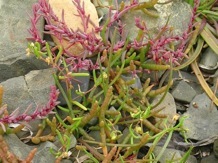
Suaeda calceoliformis

S. californica and S. calceoliformis were eaten by western Indians, usually the young shoots and leaves, often combined with cactus. The seeds and leaves of the S. Linearis are eaten. Young shoots of the S. maritima are the prime edible of that plant, lightly steamed. Generally said inland version prefer salt lick areas and the like. As with many salt-tolerating plants, they often become tinged with red sometime in the season. While they can be eaten on their own, which sometimes requires boiling twice in fresh water to reduce the salt, they are also used as flavoring with other plants. Young shoots can also be picked as used alone or eaten as a relish.
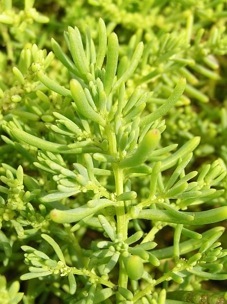
Saueda maritima

Imported from Europe, the Suaeda maritima is a bushy coastal annual, pale green with a whitish cast. Leaves narrow or almost cylindrical, long and fleshy. It has pale green flowers, blooming from July through October. You’ll find it dotting the higher parts of the beach. It can grow in gravel, sand, among rocks and around boulders. It’s a soft plant, often low-growing. The leaves are tiny, round, and pointed, reminding one of a spruce. Yellow-green flowers can be found at leaf axils. It can be bitter when cooked.

Suaeda calceoliformis is an annual herbs, low to erect, green to dark red,hairless, stems crawling to erect, green to dark red, usually striped, simple or branched. Leaves narrow, flatish. Flowers irregular, seeds like a tiny lentil, brown, dull. Flowers summer through fall, found in salty soils also around salted roads, salt piles, salt lakes et cetera.

Sea Blite is one of those plants that when you taste it your ancient food-detecting systems says “this is real food.” A lot of wild forageables are an acquired tastes. Fortunately Sea Blite, particularly S. Linearis, has the taste and texture of good food. I am surprised it is not mentioned more often and it should be a commercial crop. Its great green prime here in Florida starting around March.


Green Deane’s “Itemized” Plant Profile

IDENTIFICATION: Suaeda linearis, annual or perennial herb to three feet tall, branched, succulent, light green to almost white stems, leaves narrow, pointed, triangle shaped, almost, fleshy, to two inches long. Flowers have five lobes. Seed is glossy black, small.

TIME OF YEAR:  Flowers August to September, seeds September to October

ENVIRONMENT: Salt marshes, beaches, dunes,

METHOD OF PREPARATION: Leaves and stems refreshing to quite salty, depending on where collected and when, but can be eaten raw or cooked, sometimes requires a change of boiling water. It is absolutely excellent boiled. Boiled first-year tips are delicious and if known better would lead to the plant’s extinction. Can be used as a flavoring for other foods, seeds can be ground into mush or used to make bread.


Sea Blite and Sour Cream Salad

Four cups Sea Blite leaves, stems, or flowers, cooked, drained and chopped.

One tablespoon sugar

One cup sour cream

Three tablespoons grated onion

Two tables spoons vinegar or lemon juice

Two hard-cooked eggs, diced

Salt optional

Blend all ingredients and chill for two hours before serving. Serves four to six.

 Garnished Sea Blite

Four cups chopped Sea Blite

Six slices of bacon, chopped and friend crisp

Two tablespoons grated cheese, such as Parmesan

Two tablespoons vinegar, preferable a wine or light vinegar.

Boil or steam the Sea Blite. Drain and combine with remaining ingredients. Add some bacon fat if desired. Serve hot, serves four.

Sea Blite Chicken Soup

Two chicken breasts

Two quarts of water

One cup of Sea Bite leaves, washed and chopped

Three carrots diced

Two scallions chopped

Two celery stalks chopped

1/4 teaspoon each rosemary, thyme, and parsley flakes

One clove of garlic minced, or to taste.

One half cup Parmesan cheese or the like.

Boil the chicken in water for 30 minutes, remove chicken and cut into bite-size pieces, add all ingredients but cheese to the water and cook 45 minutes. Add cheese, serve.
 

{ 12 comments }


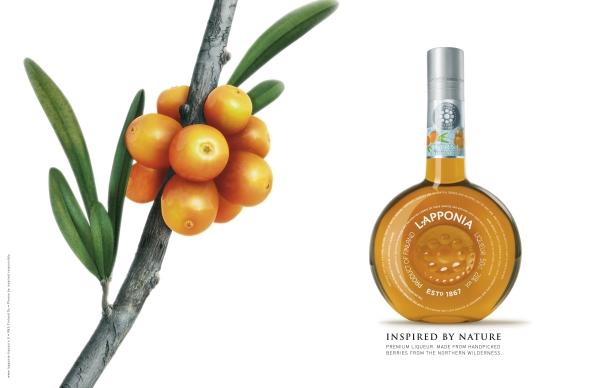
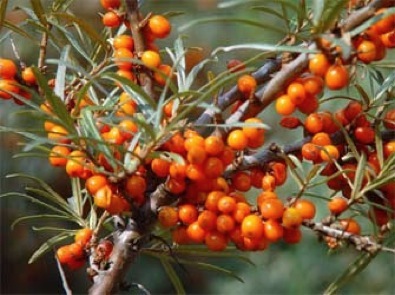
Ripe Sea buckthorn Berries

Sea Buckthorn: Sour Source of Vitamin C

If you are collecting Sea Buckthorn you’re probably cold.

Just as some edibles are found only in tropical areas, some are found only in temperate climates and the Sea Buckthorn is a prime candidate. It grows Canada, Great Britain, Europe, Russian, Mongolia, China and Japan. Usually near the sea, if found elsewhere it is a posing as an ornamental. It can be planted in the northern United States.

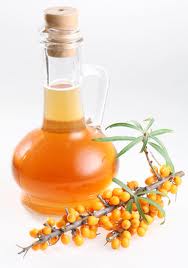
Medicinal Sea Buckthorn Oil

The Sea Buckthorn’s claim to botanical fame is that its berries, which are rich in Vitamin C, stay on the shrub way into winter. In such northern climates it was often the only source of Vitamin C to be had in the winter time and has more Vitamin C than strawberries, kiwis, or even oranges. In fact, the Sea Buckthorn is a powerhouse of nutrients.

It is estimated that the Sea Buckthorn by itself could provide all the Vitamin C requirements for everyone on earth. China alone has 2.5 million acres of Sea Buckthorn, none on the sea I might add. It is also rich in vitamins E, B1, B2, and several anti-oxidants. In fact, it has over 100 healthful constituents and is one of the most nutritious berries on earth. And while the berry is potent the plant seemingly knows it and protects them with vicious thorns.

There is no elegant way to collect Sea Buckthorn berries. Orange, juicy and fragile, you clasp the branch (to go with the thorns) and then strip the branch of the berries. They will break and release their juice which you will catch in a container. It is messy work but a lot can be collected in a short while. Then you must separate the seeds, thorns and other debris from the juice, either by hand or a strainer. Once cleaned, you’re ready to go.

Sea Buckthorn Booze

The juice of the Sea Buckthorn is too acidic for most people to drink fresh. But it is used to make jellies, marmalades, sauces, and liqueurs. Buckthorn booze is probably the most common top-shelf Russian gift. The juice can be used by itself or added to other juices. Some think it resembles passion fruit, others pineapple (after a lot of sugar is added. It is very tart with malic acid, the same acid that makes apples tart.)

Medicinally there are written records of it being used as early as 800 AD. Oil from the seeds are used to treat a variety of skin diseases and injuries. Cosmonauts use it for radiation burns.

Juice of the Sea Buckthorn

Botanically known as Hippophae rhamnoides, the Sea Buckthorn is closely related to the Elaeagnus genus which is found from temperate areas to tropical climes. (See separate entry on Silverthorn.) It is also called “Sallow Berry” because it can stain yellow, and the Sandthorn. There are actually five species.

Rhamnoides (ram-NOY-deez) means buckthorn-like. Hippophae (hip-POFF-uh-ee) however means “shining horse’ or ‘giving light to a horse.’  The name comes from the ancient Greeks who noticed horses fed Sea Buckthorn leaves had shinier coats and were healthier. The leaves contain 15% protein. No wonder Sea Buckthorn was the reported food of Pegasus, the famed winged horse.

 Green Deane’s “Itemized” Plant Profile

IDENTIFICATION: Thorny shrub, leaves pale silvery-green, lance shaped, 1.5 to 4 inches long, about 1/4 inch wide. Dense orange berries — egg-shaped drupes — along the stem. Single seeded. Under some conditions the Sea Buckthorn can reach tree height.

TIME OF YEAR: Blossoms in March or April, fruits September and October, fruit persists to March. Can survive temperatures from 45 below zero to 104 F.

ENVIRONMENT: Open well-watered spaces, coastal areas, is a non-legume nitrogen fixer

METHOD OF PREPARATION: Numerous. Tart juice is used to make jelly, sauces, juices, marmalade, liqueurs.


{ 7 comments }

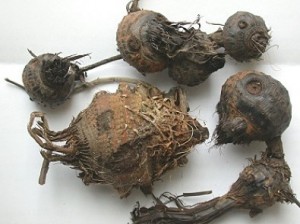
Sea Club Rush roots ready for processing

Scirpus maritimus: a Tough Root to Crack

If you mention Sea Club Rush among foragers they give you a very blank stare. Understandably so. It was a fall-back staple in Europe that has naturalized itself worldwide and along North American shores from Prince Edward’s Island to Texas, and California north. It’s even managed to make its way up to Arkansas, Kansas, Utah, North Dakota and Saskatchewan so I suspect it is elsewhere as well.  It is found in estuaries and salty marshes but can also in fresh water and other damp areas often with cattails.

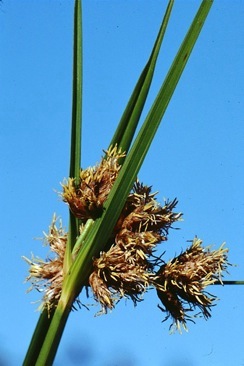
Seed head, all sedges have edible seeds

Most Scirpus tend to be swampy characters with usually soft starchy and sugary roots and stems. (See Bulrush Bonanza elsewhere on site.) Sea Club Rush, Scirpus maritimus (which has many other botanical names as well ) bucks that trend. It can tolerate salty water and has a tough root.  The root is quite fibrous and woody and usually requires flaking or grinding to be palatable. This raises issues.

Calories in and calories out is the name of the foraging survival game, today and in the ancient past. So the Sea Club Rush while a fun affectation when foraging is a hobby is another matter if you are surviving off the wilds. In the distant past it had to be a fall back plant because it requires a lot of labor to make it edible.  The speculation is other available starchy staples were preferred and the Sea Club Rush was only used when another staple was not available. Here is why.

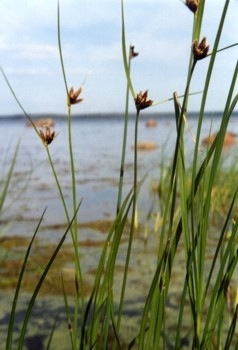
Sea Club Rush

First you have to collect and trim the roots. Then they have to be pounded to remove the red outer bark. Once cleaned they have to be crushed into flaky bits, or ground into powder. That requires time and considerable energy, and if that is all muscle power, lots of calories. However, once processed they can be used in many ways. I suspect ancient foragers didn’t bother themselves with niceties. You can dehusk it, and grind it and mix with egg to make a tasty damper. But it can also be eaten raw if you have the jaw, teeth, stomach and hunger to do so. Timing would be a key in that when young and small they are tender and have a coconut-like flavor. As they age they become tough. While most focus on the root, the seeds can also be ground into flour. They are the only Scirpus seeds that float.

Scirpus maritimus is found in northern temperate and arctic Europe, England, Ireland, the Channel Islands, north Africa, west Siberia, north west India, Asia, Japan and aforementioned North America. Whether in Australia and New Zealand is a bit of debate. Found in Great Britain it is found in Surrey, Berks, and Middlesex, along the Thames, in Cambridge, Huntingdon, Worcester, Warwick, Stafford, Montgomery, Perth, in the Hebrides, and from Ross and Skye.  Scirpus (SKIR-pus) means sharp and maritimus (mare-ree-TEE-mus) in or of the sea.

Green Deane’s “Itemized” Plant Profile

IDENTIFICATION: A three-sided perennial sedge growing to a yard high, hardy to zone 6, Flowers monoecious, either male or female, both sexes can be found on same plant, in dense clusters, seed is three sided, shiny, flattened. Long leaves keeled with channels.  Leaves were used for basketry.

TIME OF YEAR: Flowers from spring to summer, seeds ripen summer to fall, but that can vary greatly with climate and salinity. In fact in some places it can flower and grow in winter if the weather and salinity are right.

ENVIRONMENT: Tolerates most soil — likes sand — and can grow in salty areas, cannot grow in the shade, requires moist or wet soil and can grow in water, can tolerate maritime exposure, along the seashore, in shallow tidal rivers, ditches and ponds near the sea, never in the shade. Can be found above the high water mark and on dunes. Roots usually no more than a foot down. Can be found in salty desert watering holes.

METHOD OF PREPARATION: Root (actually tuberous rhizomes)  raw or cooked, starchy, usually dried and ground into a powder, roots form tubers at along their length, new plants form at these tubers, young tubers white and starchy, coconut nut flavored, turn brown then black and woody with age. Seeds ground into flour. Young shoots of most Scirpus are edible. Probably all Scirpus roots can be eaten. Known to be edible are the roots of S. acutus, S. paludos, S. fernaldi, and S. robustus. Stems of S. fluviatilis  peeled and eaten in Asia, S. lacustris and S. validus seeds are also eaten.


{ 3 comments }

Source of Mauby, Colubrina elliptica

 Colubrina elliptica: Mauby has Moxie

First there was Moxie, then Mauby… actually it was historically the other way around though few until now would know that.  You read it here first.

Ted William for Moxie

Moxie is a soft drink invented by a fellow Mainer Augustin Thompson living in Lowell, Massachusetts in 1876. It is the official drink of the state of Maine, as of 2005. (There is an annual Moxie Chugging Challenge in July. Thanks for the tip off, Kate.) Moxie was the nation’s first soft drink and brilliantly marketed by Frank Archer. “Pioneering” marketing would be an apt description. At one time around WWI, Moxie out sold Coca Cola. However, Moxie did not advertise during the first Great Depression and never recovered its huge market share.

First sold as a medicine, then as a soft drink, Moxie’s still available. President Coolidge liked Moxie as did comedian Ed Wynn and songster George M. Cohan. Slugger Ted Williams was a spokesman for the drink and the oh-so-correct writer “eb white” drank it.  He wrote: “Moxie contains gentian root, which is the path to the good life.” The Moxie formula has been changed at least three times and probably originally had cocaine in it as did Coca-Cola.

Coolidge toasted his presidency with Moxie

Drinking Moxie is a rite of passage for most New Englanders. The initial flavor is similar to root beer — sweet — but then a vigorous bitter aftertaste kicks in and makes itself to home. To like Moxie you have to like bitter flavors. That would be the end of the Moxie story while on the way to talk about Mauby. But there may be more to it than Thompson simply inventing Moxie one day in New England.

You see Augustin Thompson was going to become a doctor. However first he was in the Maine Volunteer Infantry in the Civil War, became a captain, and saw action at the siege of Port Hudson in Donaldsonville, Louisiana, as well as minor action at Fort Pickens in Pensacola, Florida. To the point, he served in the Deep South. Later he was given the rank of lieutenant colonel by an act of Congress… that took Moxie.

Augustin Thompson

After the war he went to what was then a homoeopathic medical school in Philadelphia, graduated with honors at the top of his class, and settled in Lowell, Mass., setting up a practice in 1867. Within 20 years he was the most popular doctor in New England and had the largest client list. But he had a different ambition: Selling his “nerve tonic” Moxie. Patent medicines said to be based on native formulas were hot back then — the back-to-nature health movement of its day. Early marketing says he released tonic as a syrup in 1884. As a syrup it was to be taken before meals to aid digestion. Thompson got a trade mark for it in 1885 as a carbonated beverage.  As a drink it was a “refreshing” tonic. In 1906 Moxie was forced to drop medicinal claims, three years after the doctor died. Now enter Mauby.

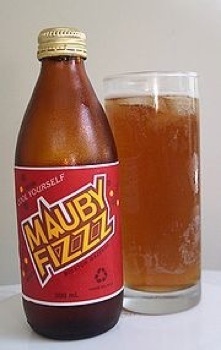
Maubry Fizz probably preceded Moxie

Mauby is a drink strikingly similar to Moxie but is made from one of two related trees native to Florida and the Caribbean. Mauby is sweet and bitter, made as a concentrate or a fizzy drink, and is taken to aid digestion. Mauby, or at least the trees it comes from, are mentioned by botanists as early as 1760 and Mauby was certainly a drink among Blacks by the Civil War in Louisiana and Florida.  The intrigue does not stop there.

A mysterious Lieutenant “Moxie” supposedly brought Dr. Thompson some ingredients from South America and it was from them the soft drink was born. According to an early bottle label, Moxie was named after said Lieutenant who discovered the active ingredient, “a simple sugarcane-like plant grown near the Equator and farther south.” But Dr. Frederic Cassidy, editor of the Dictionary of American Regional English, said he thought the lieutenant and the plant may be inventions. No Civil War record of a Lieutenant Moxie has ever been found. Cassidy suggested Thompson could have gotten the name of his tonic from a plant called a moxie-berry (Chiogenes serpyllifolia.) It is one of the very rare white berries one can eat. The Algonquins called it Maski, the cognate for Moxie. It was used by atives and settlers, to make a medicinal tea. There are several “Moxi” place names in New England and Thompson could have easily adopted the name. And since Moxie is close to Mauby, it was a good fit.

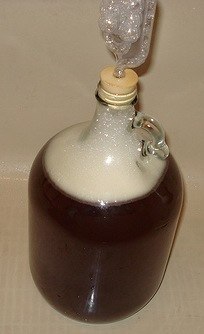
Fermenting Mauby

Mauby/Moxie, Thompson serving in Louisiana and Florida, a mysterious lieutenant, secret ingredient from South America… Is there a connection between Mauby and Moxie? It’s not an unreasonable question. If no connections then there are certainly several coincidences.  Interestingly, Dr. Thompson called his concoction a delicious blend of bitter and sweet, exactly what the aficionados of Mauby call it today. Both Mauby and Moxie taste similar to root beer with angostura bitters added.

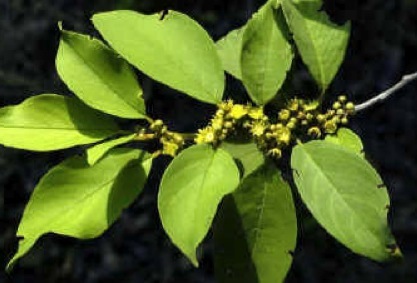
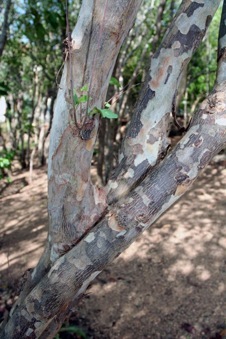
Commercial Mauby is made from the Snakewood Tree, botanically Colubrina ellliptica. Locals also call it Nakedwood, Greenheart, Hogplum and a long list of other names in modern and ancient languages. We will go with Snakewood because its bark kind of grow in a wriggly manner as do its stamens.  Colubrina (kho-lew-BREE-nuh)  is Latin for snake-like” Elliptica (ee-LIP-tih-kuh) refers to the oval leaves of that tree, read twice as long as wide. Arborescens, (ar-bor-ESS-enz.) means becoming woody, tree-like.

Snakewood bark makes Mauby

Snakebark makes Mauby

To make Mauby the bark is brewed with spices and brown sugar. Skimmed of froth, yeast from a previous batch is added and only allowed to ferment a day or two, preferences vary. Some don’t ferment it at all, other let it become a full-blown truly bitter beer. Usually it is served as a home-made soft drink. Think of it as a Caribbean comfort food with each family handing down its own recipe. Besides being a bit of family legacy it is a very popular commercial product sold on the streets and for home use. There is also some suggestion it can lower high blood pressure.

When you read the Mauby ingredients in the recipes, particularly of the second one, remember the description by commentator and Moxie fan Danny Schlozman of what Moxie tastes like: “The sarsaparilla tones come to the fore, although not quite so strongly as in root beer — one might claim a resemblance with ginger ale. As these flavors recede, vaguely fruity flavors (think cough syrup, say the detractors) combine with an overtone of wintergreen to produce a spicy mouth-feel. Finally comes the vaunted aftertaste, powerfully bitter with a hint of cinnamon and a touch of nutmeg.”

When President Warren Harding died in 1923,  Vice President, Calvin Coolidge, was at the family farm in Vermont bailing hay. The telegraph message arrived at 2 a.m. with the news. John Coolidge, Cal’s father and justice of the peace, swore in his son as President of the United States. They toasted the event with Moxie(it was during Prohibition.)

Moxie, Snowe and Bush

For the recipes below you can get the bark at Caribbean or Puerto Rican markets. You can also buy concentrate but it is considered more bitter and medicinal tasting. If you collect the bark in the wild, it comes off the tree easily with no harm to the tree because is exfoliates all the time. The preferred tree is C. ellliptica however C. arborescens can be used the same way. The latter is rare so be careful.

At right is former President George W. Bush with US Senator Olympia Snowe of Maine and a Moxie T-shirt. There is a bit of a connection between Green Deane and Senator Snow. When just a child, Senator Snow lost first her mother then a short time later her father. She went to live with her uncle and his wife Maria Karantzalis whom Olympia called “Thia” which means “aunt.” Maria is a cousin of Green Deane on his grandmother side, Anastasia Karantzalis, from Konakia, Greece, in The Mani.

Here are two recipes, the quick and the involved:

Quickie Mauby

Ingredients:

1/2 oz Snakewood bark

2 short cinnamon sticks (about two inches, as sold)

3 quarts Water

1 tablespoon Orange Peel

4 clove Cloves

Directions:

Boil the bark, orange peel, cinnamon spice and cloves in one cup of water for about 10 minutes. Let cool and add water and sugar. Brew for about 5 minutes. Strain and place in jug, refrigerate for two days. Serve chilled. Non-alcoholic, non-fizzy, which is the most common way served.

More involved Mauby

Flavor Ingredients:

1 ounce dry Snakewood bark

2 sticks cinnamon (short)

2 bay leaves

2 tablesppons fresh rosemary

2 teaspoons dried marjoram

2 pods star anise

2 cloves

1/4 tsp. grated nutmeg

3 cups water

Bring the three cups to a boil and simmer all ingredients for 10 minutes,

Strain, saving the bark. Put strained liquid into a container that will hold

three gallons. Add the boiled bark.

Sweetening ingredients

4 cups sugar

10 cups water

Heat the four cups of sugar in 10 cups of water. You can use white sugar, brown sugar or half and half. All brown sugar imparts sweetness and another layer of flavor.  Allow it to cool. Pour into the three gallon container. Use a half a cup of starter from a previous batch (that you fed and kept in the frig) or add a packet of beer yeast. Yes you can use bread yeast, but it will change the flavor slightly. If you are going to use bread yeast, bread machine yeast works better. Put on a fermentation lock or cover with a clean towel. You can bottle it in a day, two is recommended, some wait for five days. If you want it fizzy you will have to use bottle made for holding pressure, such as champagne bottles, or sturdy plastic soda bottles. If you don’t want it too fizzy, keep the caps loose enough to let gas escape. Store in the frig. Serve over Ice.

Green Deane’s “Itemized” Plant Profile

IDENTIFICATION: Scrub or tree to 60 feet, with orange-brown bark, flaking in loose, curling scales, old trees have deep, serpentine furrows. Leaves alternate, ovate to elliptic, tapering to a blunt tip, two to four inches long, thin and soft. Flowers, small, greenish yellow, five petaled, fruit a scarlet capsule, three lobed, to a quarter-inch wide, one black seed.   C. arborescens  has brown fuzz on its branches, leaves and flowers, and a purple-black fruit.

TIME OF YEAR: Year round

ENVIRONMENT: Hammocks

METHOD OF PREPARATION: Bark of either made into drink called Mabi Champan in the Virgin Islands. Leaves from C. arborescens can also be use soap.


{ 12 comments }
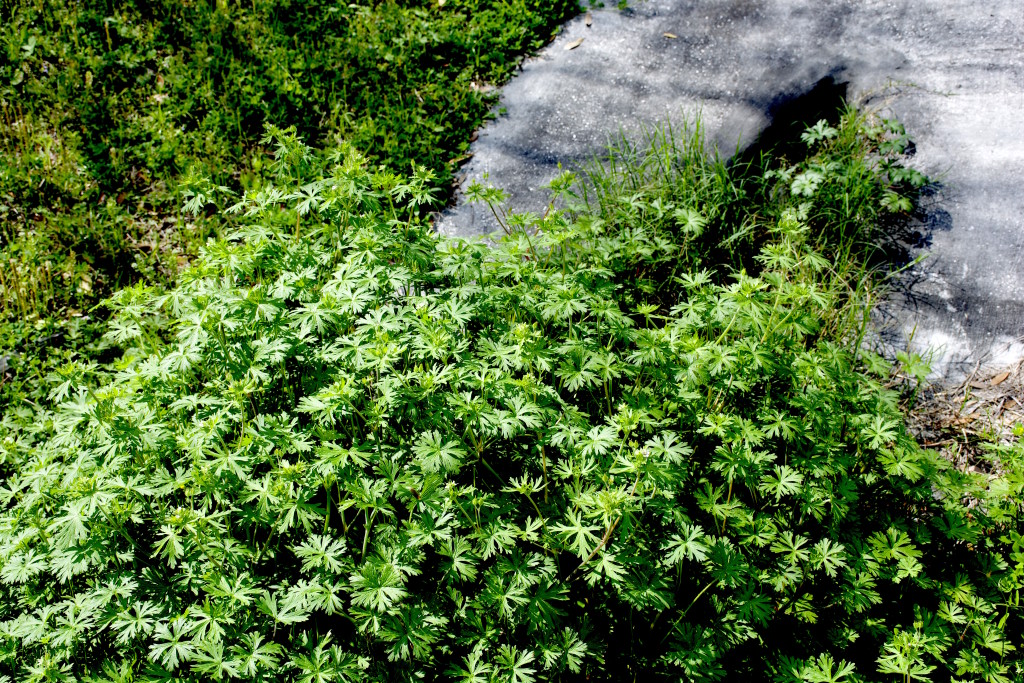
A two-foot high mound of Crane Bill's readying to blossom. Photo by Green Deane

A two-foot high mound of Crane Bill’s readying to blossom. Photo by Green Deane

Erodium circutarium, Geranium carolinianum: Two Bills You Want to Get.

Stork’s Bill

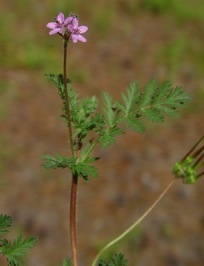
Stork’s Bill is one of those little plants that’s not supposed to grow locally but does here and there. Native to the Mediterranean area, it came here with the Spaniards and later proliferated with the planting of alfalfa, whose fields it likes to inhabit. Now it’s naturalized throughout North America. In northern states and Canada. It’s an annual. In southern and southwest states, a biennial. It is particularly common in deserts and arid grasslands.  Colorado calls it a noxious weed.

Scientifically Stork’s Bill is called Erodium cicutarium (er-OH-dee-um  sik-yoo-TARE-ee-um.)  Erodium is from the Greek word Erodios, meaning heron — now there’s a surprise.  Cicutarium — Latin — means resembling the genus Cicuta, the Poison Hemlock, and it does. The significant difference between them when young is the Stork’s Bill has hairy stems. The Poison Hemlock is not hairy.  Don’t mistake the two. Poison Hemlock is deadly. Remember, Stork’s Bill has hairy stems and a basal rosette. The entire plant is edible raw or cooked, and of course as usual, young and tender is better than old and tough. Though in the geranium family when picked young it has a flavor similar to parsley.  Another name for it is filaree.

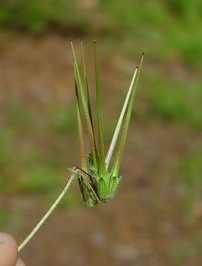
Seed pods look crane-ish

At least three native groups picked up on the plant and included it into their diet, the Blackfeet, Shoshone and the Diggers. Man is not the only one who favors the Stork’s Bill. Besides grazed upon by cattle, sheep and goats, the seeds are collected by various species of harvester ants. The seeds are also loaded with vitamin K and have little tails that coil and uncoil with changes in humidity, burying the seed. The seeds are also eaten by upland game birds, songbirds, and small rodents including kangaroo rats. The Brown Argus butterfly also feeds off the plant. And as it is often a very lowly plant the desert tortoise finds it a meal as well. That low growth pattern also lets you find it in lawns as the mower can pass over it.

Incidentally, the Stork’s Bill has a few other claims to fame. The entire plant can be used as a green dye and does not need a mordant to set the color. The old styles (tails on seeds) are humidity sensitive and can used in hygrometers and as weather indicators. Also the powdered plant has been dusted on watermelon seeds prevent disease.

Crane’s Bill, or Cranesbill

The leaves of the Erodium moschatum (er-OH-dee-um  MOSS-kuh-tum) the Musky Stork’s Bill,  are also edible but bitter. Moschatum means musky. It is found from Delaware north, in South Carolina, and the West Coast of the US and Arizona.

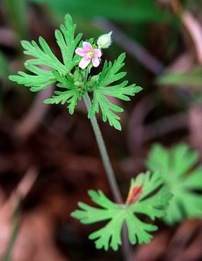
Once the Stork’s Bill is in bloom and seeding don’t confuse it with the Cranesbill Geranium (Geranium carolinianum) which is a Florida native.  The Cranesbill looks like the Stork’s Bill except it has palmate leaves. While it is edible it is very bitter. You can eat it raw or cooked.

The common names Crane's Bill and Stork's Bill are used interchangeably.

The common names Crane’s Bill and Stork’s Bill are used interchangeably.

The G. carolinianum is a miniature version of the G. maculatum. It has a history of medicinal uses. The whole plant, but especially the roots, is astringent, salve and styptic. It can be used as a gargle for sore throats. The plant is high in tannins, which is why it is bitter and used for diarrhea. A medicinal tea can be prepared by boiling 1–2 teaspoons of the root for ten to fifteen minutes in 2 cups of water. One can drink three or more cups per day. A tincture (approximately 1/2 teaspoon) can also be take three times a day

Geranium is from the Greek word geranion which means crane. Carolinianum means from Carolina but has come to mean mid-range America. Maculatum (mak-yuh-LAY-tum) means spotted.  Also called G. bicknellii (bick-NELL-ee-eye.)

Green Deane’s “Itemized” Plant Profile

IDENTIFICATION: Stork’s Bill: Hairy, sticky, sprawling, stems hairy with short white hair and have bright pink five-petaled flowers, in a loose cluster, they often have dark spots on their bases, leaves reddish green, pinnate, fern-like, arranged in two ranks, one on either side of the midrib, to four inches long, seed pod long, shaped a stork bill that bursts open into a spiral when ripe, seeds have little feathery parachutes. Usually ankle high, grows to 12 inches in warmer areas . MAKE SURE THE STEMS ARE HAIRY!

TIME OF YEAR: Flowers February to October, depending upon climate, early spring in south, late spring in north, Seeds are available late summer to fall. It over winters well and often is the first green you will see after the snow melts.

ENVIRONMENT: Desert areas, grass lands, rangeland, prairies, roadsides, sandy soil, inland and onthe coast, dunes, lawns. Prefers sunny areas and non-acid soil.

METHOD OF PREPARATION: While the entire plant is edible, usually the leaves are eaten. Lightly steamed leaves is the best method of preparing them, or boiled in slightly salted water. Can be chopped and added to salads raw.  The root can be chewed like a gum.

HERB BLURB

Stork’s Bill: A leaf tea has been used to induce sweating and is diuretic. The leaves were also soaked in bath water to treat rheumatism. Plant contains tannin, is astringent and a hemostatic. It has been used for uterine and other bleeding, roots and were eaten by nursing mothers to increase milk flow, externally used as a wash on animal bites and skin infections. A poultice of the chewed root has been applied to sores and rashes. It is reputed to contain an antidote for strychnine.

{ 27 comments }