Scarlet Gourd

Coccinia grandis: Cucumber’s Versatile Kin

I was riding my motorcycle one day when I rumbled over a raised railroad track in an industrial area and to my immediate right above a greenery-covered security fence I caught a glimpse of what I thought looked like Turk’s Cap blossoms, but not quite. Turk’s Caps is a bushy mallow that doesn’t grow too tall and I had to look up to see these “blossoms.”

I turned around, parked, and wandered over for a closer inspection while a few workers wondered why a motorcyclist was looking at a plant. The blossoms  were not Turk’s Cap, Malvaviscus penduliflorus, which tend to stay closed taking the shape of a seashell called an Olive. No, these weren’t even blossoms. They were red fruit, ovoid to ellipsoid, about two inches long, 3/4 an inch wide through the middle. I had never seen them before. Nearby were several green ones with white stripes end to end. The large blossoms were five petaled and white. The key, however, was the vine. It looked like a cucumber.

It took some digging but I found it, Coccinia grandis. There was no doubt I had the right plant. As is too often the case, the United States Department of Agriculture maps said it did not grow here… That further confirmed to me I had the right plant. (If you have studied USDA maps you know exactly what I mean. They are inaccurate and woefully out of date.)

Called Ivy Gourd, Scarlet Gourd, Thai spinach, Kovai, Tindora (and a host of other names) the young leaves and slender tops of the stems are cooked and eaten as a potherb, in soups, or as a side dish, often with rice. The young and tender green fruits are eaten raw in salads, or boiled, steamed, fried, added to dishes like curry or soups or even fermented. The ripe, scarlet fruit is fleshy, on the sweet side, and eaten raw. It can also be candied. The fruit is often available in speciality markets and is very common in India. There are two varieties, both bitter and sweet (with no visible differences) and several cultivars both bitter and sweet. A second species, C. quinqueloba, has leaves that are edible cooked, often with Bidens pilosa, an old standby for foragers.  The fruits of the Coccinia rehmannii are edible and its starchy tuber is eaten after roasting. The leaves of Coccinia trilobata are a famine food. With the bitter ones usually only the young leaves and tips are used.

The green fruit of the C. grandis resembles a small, smooth pointed cucumber or long little watermelon. It is packed with seeds inside and while the skin is not tough but has just a little more resistant than a cucumber. The fruit grows red from the inside out. It is possible to have it reddish on the inside and not yet red on the outside. When green it is ever so slightly sour very much like a Melothria pendula, another wild member of the cucumber clan. When fully ripe it gets very soft.

Said kok-SIN-ee-uh GRAN-dees, (Big Red) the plant in the lab has shown anti-oxidant, anti-triglyceride, and anti-bacterial activity and is useful in the treatment of jaundice. It’s also been used to treat abscesses and high blood pressure. C. grandis has been introduced as a food crop in several countries in Asia, as well as Australia, Pacific Islands, Africa, the Caribbean, and the southern United States. It is found in at least Florida, Texas and Hawaii and probably other unreported warm areas.

Ripe Ivy Gourd is high in beta-carotene, has vitamins A and C, but low on the glycemic index. Per 100 g edible portion, the fruits contain: water 93.5 g, energy 75 kJ (18 kcal), protein 1.2 g, fat 0.1 g, carbohydrate 3.1 g, fiber 1.6 g, Ca 40 mg, P 30 mg, Fe 1.4 mg, thiamine 0.07mg, riboflavin 0.08 mg, niacin 0.7 mg, ascorbic acid 1.4 mg. See recipe on bottom and my video.

Green Deane’s “Itemized” Plant Profile

IDENTIFICATION: C. grandis: Stems mostly hairless, green and longitudinally ribbed when young, becoming white-spotted when older and eventually woody, tendrils simple, in the axils. Leaves alternate, simple, broad, ovate, 5-lobed, heart-shaped, stem has 3-8 glands near the base; inflorescence usually solitary, axillary flowers.  Corolla deeply divided into 5 lobes. Stamens 3, present as staminodes in female flowers. Fruit a smooth, striped green turning bright red, ovoid to ellipsoid about two inches long.

TIME OF YEAR: Can produce year round

ENVIRONMENT: Agricultural areas, natural forests, planted forests, disturbed and waste areas.

METHOD OF PREPARATION: Young leaves and slender tops of the stems are cooked and eaten as a potherb, in soups, or as a side dish, often with rice. The young and tender green fruits are eaten raw in salads, or boiled, steamed, fried, added to dishes like curry or soups or even fermented. The ripe, scarlet fruit, is fleshy, on the sweet side, and eaten raw. It can also be candied

Recipe courtesy of Show Me The Curry.

http://www.youtube.com/watch?v=ULMWk9XhURU

Prep Time: 15 minutes
Cook Time: Approx 20-25 minutes
Serves: 4

Ingredients:

Tindora – approx 1 1/2 lbs, sliced
Oil – 1 Tbsp
Mustard Seeds – 1/2 tsp
Cumin Seeds – 1/2 tsp
Asofoetida (Hing) – pinch
Turmeric Powder – 1/4 tsp
Green Chilies – to taste, finely chopped
Coriander Powder – 1 tsp
Cumin Powder – 1/2 tsp
Red Chili Powder – to taste
Salt – to taste

Method:

1. Heat Oil in a medium non-stick pan on medium heat.
2. Add Mustard Seeds and allow them to pop.
3. Add Cumin Seeds and let them sizzle.
4. Add Asofoetida, Turmeric Powder, Green Chilies and Tindora. Mix well.
5. Add Salt, Red Chili Powder, Coriander Powder and Cumin Powder.
6. Mix well, cover and cook until Tindora are tender. Stir every few minutes to cook evenly and prevent burning.
7. When Tindora are tender, uncover and cook for an additional few minutes to lightly brown them.

Tips:

1. In a time crunch, use the slicer blade of your food processor to roughly chop/slice the Tindora.
2. Cleaned and cut Tindora freeze well.
3. Be careful when salting Tindora. They tend to shrink and become a little salty and tangy.

{ 41 comments }

Jack-in-the-Pulpit

Arisaema triphyllum: Jack and Jill and No Hill

For a little plant there’s a lot to write about with the Jack-In-The-Pulpit. Where does one start? What does its name means? How about its ability to change sex?  And of course the misinformation about it on the Internet. Let’s cover it all.

The name “Jack” has many meanings. One is a nick name for John. Another means “male” as in jackass. It has also be used for sailor (Jack Tar) Steeple Jack (laborer) Jack of all Trades (a man who does nothing well) and Jack-O-Lantern who used to be the fellow who went through town carrying a lamp while crying out the time and curfews. Jack has also been a common term for the Devil. And so it fits with Jack-in-the-pulpit, a little plant with a devil hiding and mighty toxic sermon if not prepared correctly.

As for sex… the plant is a switch hitter, Jack sometimes, Jill sometimes. And as foragers we should know the difference because the edible part of the plant — when prepared correctly — differs between he and she.
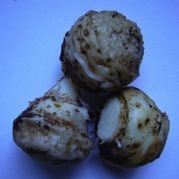
Jack-in-the-Pulpit corms

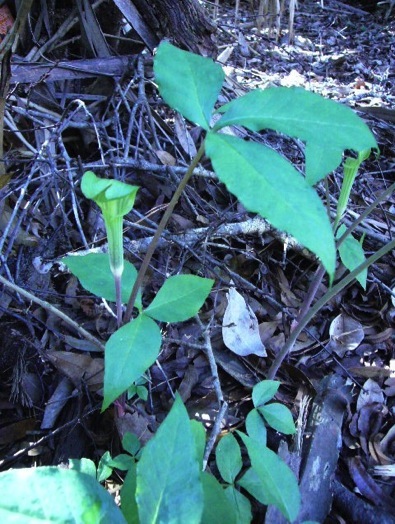
Jack-in-the-pulpits are perennials and grow each season from a corm, kind of like an onion. They can live to 100 years old. The shoot will have one stem or two. Each stem usually has three leaves if we are referring to the Arisaema triphyllum.  The pulpit, or spathe, is green, with white, brown or purple stripes.  The minister, or spadix, is usually a pale cream spike inside.

These plants are either a Jack or a Jill.  If you open the flower and look inside the female has a developing cluster of tiny green berries. The male does not. What difference does it make?

If the corm is packed with nutrients the plant will produce a spathe for a female flower with, usually, two stems for a total of six leaves. If the corm is young or depleted it will produce a spathe for a male flower, one stem and three leaves. This is not always true but is a common display.

If you find a female plant early in the season this tells you there should be a good size corm below — up to three years of storage in fact. If you find a male at the beginning of the season that tells you it is either a juvenile or was a female last year and the corm smaller.  So you don’t want to dig up the male early in the season but rather late in the season after he’s had several months to collect up energy in the corm. You don’t want to dig up the female late in the season but rather early. Exceptions: Very young plants with no corm tend to produce one stem and are small. In fact, most male Jacks are under 14 inches tall. Most Jacks over 14 inches tend to be Jills.
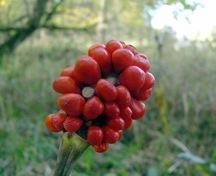
The berries burn, too

To recap: If the plant has one stem and three leaves it’s usually a male, two stems and six leaves a female.  Generally he has bigger corms at the end of the season, she has bigger corms at the beginning of the season.  You can also look down inside the spathe and tell if it is a he or a she. She will be making green bumps that will be future red berries. And what of that corm that the Indians called the “fire ball?”

In its raw state chewing on a corm will “burn” your mouth and swallowing it will poison you, while painfully probably not fatally though you may have a rash of kidney stones, which can make death seem a pleasurable alternative. The offending chemical is needle-shaped calcium oxalate crystals called raphides (RAF-ee-dees.) They sting painfully. If you manage to swallow untreated corms the raphides can “precipitate” in your kidneys, which is a fancy word for clogging them up. So don’t try to eat the corms raw. Don’t eat them dry if they produce a burning sensation in your mouth. The goal is to make them burn-free before consumption.
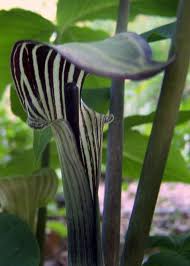
Plant showing spathe

Calcium oxalate, at the very least, causes intense discomfort. Tiny amounts can create the sensation of burning. In some cases it can lead to swelling of the throat and closing off of air. In larger doses, it can cause severe digestive upset, convulsions, coma, and death. Recovery is possible, but permanent liver and kidney damage can happen. The worst part is the effect even in the mouth can be delayed for a few minutes. This is why you must always try only a little after preparing it, chew it, spit it out, and wait ten minutes or more.

Scores of Internet sites that copy each other say boiling the corms makes them edible. That is very misleading.  When I read that I know the writer has never boiled a corm then tried it. I have boiled potato chip thin slices up to six hours and still had them burn some. Maybe at 12 hours, or the two day mark they stop burning, but for a third of an ounce of starch it is not cost effective.

I traced the boil comment back first to 1916 in an article by National Geographic Magazine, then to a Scottish book in 1875 called The Wealth of Nature, our food supplies from Nature. In the article about “Common American Wild Flowers” it talks on page 590 about “boiling the bite” out of the corms. But the writing style is affected and I think the phrase was used for its assonance sound than its accurate information.

The 1875 book, referring to the family in general, says an “Indian plant” can be roasted or boiled. There are also some references in other places to boiling the corms and then drying them. Someone may have presumed boiling was making them edible and drying was for storage. At any rate, the mistake is entrenched. Boiling for a day or more may work but I know for absolute certainty several hours does not do it. Drying is a far better choice.
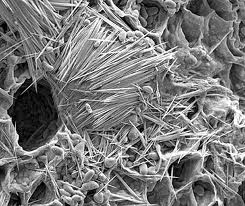
Raphides of calcium oxalate

Many “edible” plants have calcium oxalate and boiling them doesn’t get rid of it for them either, wild taro roots in Florida, for example. Why should it be different for Jack-in-the-Pulpit?  Dry heat breaks down the calcium oxalate. Short-term moist heat does not. Let me be succinct: Slice thin then air dry for three months or more. Slice thin and dry in a slow oven for three to seven days or so or in a food dehydrator.  One other option is to put them in the microwave.

While my results varied I have made some sliced corms edible after three minutes in my microwave, but some were still burning at five minutes, and 10 minutes tends to incinerate them, unless whole. Clearly air drying is the cheapest and produces the sweetest product. Nuking them produces a cooked nutty flavor but they go from edible to burnt crisps in seconds.

I’ve also sliced and dried them in my solar oven which reaches around 325F. It takes about three days of trying, 15 hours, to get them edible, and little energy is used. And all those times are precautionary times. Your times can certainly vary so carefully try your slices before consuming. Here’s how you do that.

To test them: Chew a quarter-inch square piece on one side of your mouth for a full minute then spit it out and wait ten minutes. And I mean chew for a minute and I mean wait ten minutes and I mean one side of your mouth (to limit the area that burns.)  The effect can be quite delayed. If the calcium oxalate is still present it will make one side of your mouth burn, and your tongue and lips. That can last up to a half an hour or so. If no burn, try a bigger piece the same way. If no burn then, you’re ready to go. You can eat the dry chips as is, or grind them up as a flour. If you air dried them they can be used as a thickener. If you dried them at over 150F they can be used as a flour but not as a thickener because the starch will have already been cooked. Some lemon or lime juice can reduce the burning sensation in your mouth.
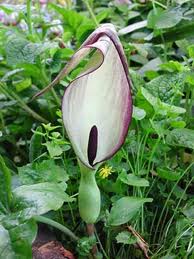
Arum maculatum

In a 1906 book (Studies of Plant Life in Canada by Catherine Parr Strickland aka Mrs. C.P. Traill — yes, two l’s)  she refers to a European relative of the Jack-in-the-Pulpit, the larger Arum maculatum, also called Cuckoo Pint. They were dried thoroughly then pounded or ground then tossed into water where the starch settled, a similar process to extracting starch from the cattail root. That starch was then pounded or ground a second time and put in water again. This was done until the visible impurities were all removed (the calcium oxalate already removed by drying.)  Then the water was poured off and the starch allowed to dry. She reported a peck of roots created a pound of starch. That starch was one time called Portland Sago, from Portland Island in Dorsetshire, England.  It was used like saloop, a drink popular in England in the 17th and 18th centuries before coffee and tea were imported. Ground A. maculatum powder was added to water until it thickened. Then it was sweetened  and flavored with orange flower or rose waters.  Because it would thicken it was also used as a substitute for arrowroot. However, the powder used for saloop and as an arrowroot substitute was from dried not roasted corms since roasting would cook the starch rendering it not useable as a thickener (the same issue with acorns. To use them as a thickener or binder they must be processed without cooking, that is, under 150F.)
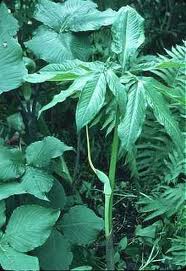
Arisaema dracontium

Catherine Parr Strickland then returned to North America in her book with the comment: “When deprived of poisonous acrid juices that pervade them, all our known species may be rendered valuable both as food and medicine; but they should not be employed without care and experience.”

Now, what about the berries? I have not tried them and they are listed as toxic, probably for the same reason the corms are. There are some references that say the totally dried berries are edible but I have not tried them so I cannot recommend them.

Besides careful humans the only other creatures to find food from the plant are Wild Turkeys and Wood Thrushes who eat the red berries. Those berries, by the way, were used by natives to make red dye. (And early settlers used the starch in the corms to starch their clothes.)

The plant, for all its warnings, is also a pain killer, as reported by Dr. Daniel Austin in his book, Florida Ethnobotany:

“When I was a professor in Florida, a mother and her young son came to me for “advice” about a science project that the boy was doing. He had apparently discovered independently that juice from the live plants applied to wounds stopped the pain. Since he was still in grade school, it seemed unlikely that he had scoured the old literature and learned that the natives of North America used the sap in the same manner. Regardless, he was doing an experiment that involved getting as many volunteers as possible to prick their finger with a needle and then apply juice directly from the plants. I, too, became one of his subjects with plants that they had imported from New England. We dutifully cleaned the instruments, drew the blood from the end of my finger with a needle, and then applied the juice. The pain stopped immediately upon contact with the liquid. They told me that each person they had tested had exactly the same reaction….”

The scientific name for my local Jack-in-the-Pulpit is straightforward. Arisaema  (ar-ih-SEE-muh)  is a combination of two Greek words, “Aris” or “aridos” which was a name used by Pliny for a small herb thought to be in this family, and “hiama” or “haimatos” meaning blood as some of the species have red/purple spots or stripes. Triphyllum  (tree-FIL-um) means three leaves.  There is a bit of a botanical argument where there is one species and variations or three species, or more. Incidentally, the A. dracontium (dray-KON-tee-um)  is used the same way. It has a long tip to its spathe and a different arrangement of leaves.

Green Deane’s “Itemized” Plant Profile

IDENTIFICATION: A flap-like spathe curves over the top of a funnel-shaped spadix. It can be green, purplish or striped. Leaves are long, ovate, usually three per stem. Fruit inside spadix looks like a cluster of little eggs, green at first later scarlet red. Corm is walnut-sized or larger, can have brain-like folds..

TIME OF YEAR: While available year round, gather in the fall or early spring or when dormant. Store in damp sand.

ENVIRONMENT: Likes moist forests and shade, bottom land, damp soil but not waterlogged.

METHOD OF PREPARATION: Only dry heat degrades the calcium oxalate crystals efficiently. Slice thin, dry for three months (in the sun is even better) or in a slow  oven or dehydrator for about five days.  In my experience boiling takes in excess of eight hours to make them approaching edible.  Once cleared of the acid the corms can be used like arrowroot or flour depending on how hot it was heated.

 

{ 29 comments }

Jerusalem Thorn, Parkensonia aculeata

Parkinsonia aculeata’s Thorny Past

As foragers we are indebted to past writers and at the same time constrained by them.

People who chronicled how Native Americans used food brought a lot of attitudinal baggage with them even as professionals. They would put food and activities into different categories that can leave us confused all these years later.

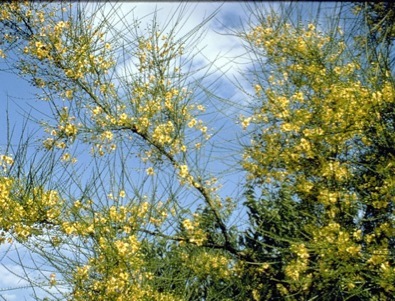
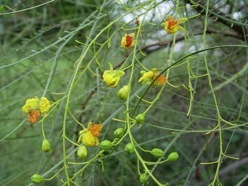
Jerusalem Thorn flowers

A good example is the Parkinsonia genus, with three species represented. One botanist will report that for one tribe a species would be a staple, another would report the same species was a famine food. Yet another will report it was eaten green and raw, another cooked until nearly burnt.

A few hundred years later we just don’t know why the reports vary. It could have been the botanist, or sometimes non-botanist reports. It could have been the time of year, or the weather that year. It could have been a mistake. And it also depended upon whom you found doing what. Even within a small group of professional foragers you will find multiple ways to make acorns palatable. So we end up knowing the seeds of three species in the genus of  5 to 12 (depending upon who is counting) are edible even if the how is a bit elusive. To confuse things more the Parkinsonias are closely related to the Cercidiums which they can hybridize with and which were also used for food. And… some Parkinsonias are called Cercidiums…. Botanists like to squabble a lot over genus and species names.

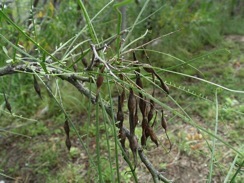
Jerusalem Thorn seed pods

Perhaps best known is Parkinsonia aculeata (park-in-soh-NEE-uh ah-kew-lee-AY-tuh, or a-kew-lee-AH-tuh)  also called the Jerusalem Thorn. It has no connection to Jerusalem but got its name the same way the Jerusalem artichoke did from corruption of the Spanish/Portuguese word girasol, meaning turning towards the sun.  P. aculeata has the greatest range in North America and is a common landscape tree as well as naturally occurring. Oddly, it is favored because it is so spindly. It can be planted in front of a large window and not obscure the view.  P. aculeata can be found from South Carolina to Florida and all states west at that latitude to California including Utah then south to as far as Uruguay. It is also found in the Virgins Islands, Puerto Rico, Hawaii, Australia, where it’s a troublesome weed in the northwest territories, as well as dry areas of Africa and Pakistan. (P. microphylla is found in California and Arizona. P. florida is found in those two states plus Nevada.)  The edible portion is the seeds, usually cooked sometimes raw.

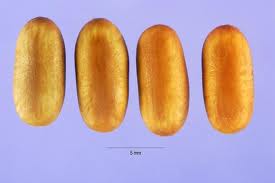
Jerusalem Thorn seeds

The Papago Indians used the P. aculeata seeds dry. They sun-dried them for storage and then parched them before eating them. Six tribes used the P. micophylla (aka Cercidium microphyllum.) The Mohave and Yuma parched the seeds until nearly burnt and considered them famine food. The Cocopa ground the dried seeds and used it as mush or to make cakes. The Papago sun-dried them before parching and considered the seeds a staple crop. The Pima ate them raw and the Pima of Gila River ate them raw or boiled. Five peoples used the P. florida (aka Cercidium floridum)  the Cahuilla, Cocopa, Mohave, Pima, and Yuma. The Cahuilla and Cocopa dried the beans, ground them into flour, and used the flour to make mush or cakes. The Mohave and the Yuma parched the seeds until almost burnt and viewed them as a famine food. The Pima, however, ate the green pods raw in the summertime.

John Parkinson, 1567-1650

The genus honors English pharmacist John Parkinson, 1567-1650. Parkinson was a predominant English botanist and apothecary to James I. He was a founding member of the Worshipful Society of Apothecaries and served as the Royal Botanist to Charles I.  He’s remembered for his two monumental works, Paradisi in Sole Paradisus Terrestris (Park-in-Sun’s Terrestrial Paradise, 1629) which describes the proper cultivation of plants, and, ‘Theatrum Botanicum (The Botanical Theatre or Theatre of Plants), the most complete and artful English treatise on plants of his time. Aculeata means prickly or thorny, microphylla is tiny leaf and flordium means free-flowering or many flowers.  Cercidium, sir-sid-EE-um comes from the Greek word cercidion, base word Kirkis, a weaver’s shuttle, in reference to the pod’s shape like a shuttle. The tree is also called Paloverde which  means “green stake.” It is a nitrogen fixer — if you’re a permaculturist — and has numerous medicinal uses among them boiling twigs to ease stomach pain.

Lastly, the Jerusalem Thorn had the fortune of growing in the right place, or we did. The vast majority of ethnobotanical information we have (read what the Native Americans ate and used) comes mostly from the western tribes. That’s because the original settlers in the east had little interest in cataloging what the eastern natives did for the most part. It took a couple hundred years before professionals took interest in such things and by then the western tribes were the ones still in tact.  That’s why we know how several tribes used the plant even if the uses contradict.

Green Deane’s “Itemized” Plant Profile

IDENTIFICATION: Small wispy tree or shrub. Flowers one inch wide, 5 petals. Top petal turns from bright yellow to orange as the flower ages. Flowers  followed by necklace-like, brown bean pods. Leaves bipinnately compound with 10 to 40 six to nine inch long leaflets, needle-like, green midribs, often quickly shed. Branches spiny, young bark can be green.

TIME OF YEAR: Blooms all year or in warmer months if temperate climate

ENVIRONMENT: Thrives in arid conditions, prefers neither too wet or too dry, with good moisture can become a 30-foot tree.

METHOD OF PREPARATION: Mature beans usually dried then parched. Can be used for mush or cakes. Some native ate the beans raw.


{ 2 comments }

Jumbie Bean, photo by Donald Simpson

Leucaena leucocephala: Food and Fodder

Professor Julia Morton, the grand dame of toxic and edible plants in Florida, had this to say about the Jumbie Bean:

“The plant is toxic to horses, donkeys, mules, and pigs, even to cattle, sheep and goats in quantity. People should not eat any parts raw.”

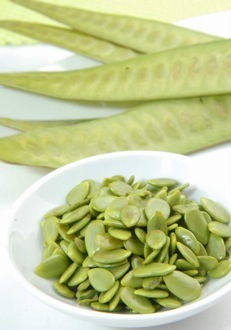
Cooked young seeds only

Not exactly encouraging. But she also says: “Young leaves, pods and seeds cooked and eaten, Mature seeds roasted and used as coffee substitute or adulterant.”  Thus we start our review of the Jumbie Bean, the Lead Tree, The White Popinac, the Leucaena leucocephala.

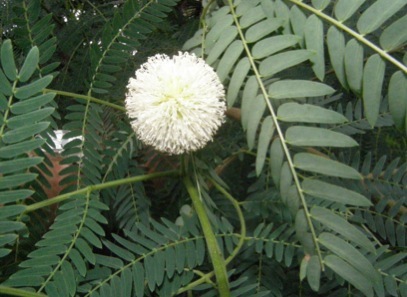
Let’s start with the name. No great inspirations there. Leucaena (lew-KAY-nuh) means to grow white, as to flower. Leucocephala (lew-koh-SEF-uh-luh) means white headed.  (Also lew-SEEN-uh.)

Also called Jumbay and the White Leadtree, this native of Central America has sporadically spread its way northwest and east from California to Florida and to the rest of the warm world. The Jumbie Bean was taken to the Philippines in the 1500’s by the Spanish, probably as cattle feed. It spread from there and has become “invasive” in Taiwan, Hawaii, Fiji and northern Australia. In the United States whether it is an invasive is a matter of debate and location.

A different attitude prevails in India where it is well-established and viewed as a resource. There it is used for firewood, fiber, lumber, charcoal and livestock fodder, the latter reported in 1998 which conflicts with Julia’s 1982 comment. Apparently the ruminant bacteria, Synergistes jonesii, helps to detoxify the fodder in multi-stomached animals. It was transferred from American stock to Australia, Africa and China starting in the 1980s to make the plant acceptable fodder in those parts of the world, as it is some 24% protein and loaded with proto-vitamin A. The stomach bacteria helps explain the advantage of multiple stomachs and why the rest of us with only one stomach and no S. jonesii have to cook the plant.

Starting to blossom

As for toxicity in the raw parts to non-cud chewing mammals, the culprit is mimosine, an amino acid.  Wet or dry heat reduces the acid.  If you don’t cook it Jumbie vegetation can make you sick and lose your hair, hence the old saying that it causes tails to drop off one-stomach horses.

On the positive side again the tree is a nitrogen fixer and grows very fast, as much as 10 feet a year, which is why it is a renewable firewood and good at preventing soil erosion.  It is also used as a shade tree for many commercial crops including  coffee, cocoa, quinine and vanilla. It is also used as a hedge to grow passion fruit on.  It might be fair to suggest that whether it is a resource or a pest is a matter of attitude.

Don’t confuse this with the False Tamarind which has twisted seed pods, not straight, and cluster of flowers not solitary ones.

Green Deane’s “Itemized” Plant Profile

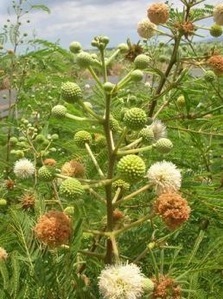
IDENTIFICATION: A shrub or tree to 60 feet, forked when shrubby, branching strongly after coppicing (cutting to a stump yearly.) Grayish bark and prominent lenticels. Leaves bipinnated with four to nine pairs of pinnae, variable in length up to a foot with a large gland at the base of the petiole, 11-22 pair , flowers numerous.

TIME OF YEAR: Depends on location. It can be year round in warm areas or summer time in more temperate areas.

ENVIRONMENT:Full sun, alkaline soil, enjoys humidity.

METHOD OF PREPARATION: Young leaves, pods and seeds cooked, usually boiled. Mature seeds roasted and used as coffee substitute or popped like pop corn. Dr. Morton say do not consume uncooked.  A related edible species is L. esculenta.

Lastly, Leucaena glauca and Leucaena latisilique are now Leucaena leucocephala. Cornucopia II disagrees with Morton and says  leucocephala young leaves, pods, and flower buds can be eaten raw, or cooked. Mature seeds but not dry seeds are eaten raw or cooked. Dry seeds are used as a coffee substitute or fermented into a tempeh like product. I’ve never tried them raw, preferring to err on Morton’s side.


{ 17 comments }


Jujube Tree fruit

  Ziziphus zizyphys: The Misspelled Jujube

If you don’t find the Jujube tree, it will find you. The Jujube is covered with long, sharp thorns. They hunt you down. They daw blood. They hurt. If I get within a yard of a Jujube Tree I somehow get skewered. Badly. Continuously. Inevitably.

Another little fact you are never told about the tree is if you plant it then move it the old roots, and the new roots where you plant it, will send up young shoots annually seemingly forever. You end up with a multitude of shin-high saplings puncturing your ankles. The Jujube is a pain but its fruit is tasty and versatile.

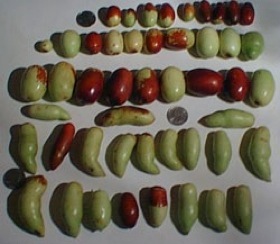
Jujube fruit varies in shaped

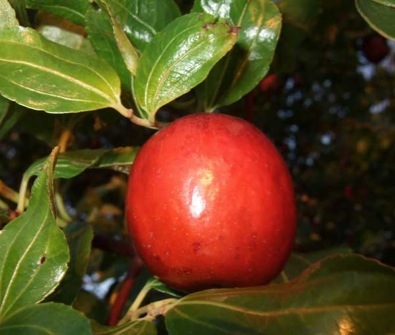
In the Buckthorn Family, the Jujube is distributed in warm-temperate and subtropical regions around the word. In the US it is naturalized in southern states from Georgia to California, excepting Louisiana and New Mexico but including Utah. Throughout the genus the leaves are quite regular and distinct. They alternate, are finely toothed, and have three prominent basal veins (coming from where the leaf meets the stem.) They also usually have two spines at the base of the leaf. The small flowers are chartreuse (yellow-green) with five petals. The fruit is a drupe, edible, that can range from green when unripe to yellow to brown to red or black. When green it tastes like and apple and has the texture of an apple. When ripe it is closer to a date in flavor and texture. A single stone contains two black seeds which are not eaten.

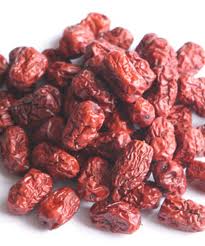
Fruit is often sold dried

The Jujube has been cultivated for over 4,000 years and there are some 400 cultivars, that is, specifically bred varieties. Native to China — it’s been called the Chinese date and Indian date — Jujubes got to southern Europe around the time of the Romans and to the United States in 1837. Starting in 1908 high-quality cultivars were also introduced, initially in Tifton, Georgia by the USDA.

The genus has an interesting naming history. It was originally Rhammus zizyphys. But 15 years later it was put into a new genus but misspelled as Ziziphus. Naming rules prohibit calling the genus and the species by the same  name. But since one was misspelled the name uniquely stands as Ziziphus zizyphus. There are many species including Ziziphus jujuba, where the common name comes from. It is said ZIZ-ih-fuss jew-JEW-buh (or SIZE-eh-fus.)

Ziziphus comes from two different words. Zizafun was the Persian word for the Z. lotus tree (Jujube.)  Phus is latinized Greek meaning “bearing.” So Ziziphus in English means Jujube bearing.  Jujube can be said two ways: JEW-jewb or JUJU-bee.

While Jujubes can be eaten out of hand they’re made into a wine, are cooked, and often are de-stoned and dried. A leaf extract, Ziziphin, alters taste perceptions of sugar in humans. It makes sweet things taste not sweet. Think of it as the anti-sweet. See recipes below. There are also numerous medicinal uses as well.

Green Deane’s “Itemized” Plant Profile

IDENTIFICATION: A small, deciduous tree to 40 feet usually with single trunk and rounded crown. Waxy leaves are simple and alternate, green on top, whitish green on bottom, in two rows on zigzaging twigs. They have hairy  stems, very fine teeth, and three prominent veins. The brown bark has vertical fissures. And while I say the tree has thorns they are rightly spiny stipules. Bottom line: At each leaf you will find a half inch to one inch long very sharp thorn. Beware!

TIME OF YEAR: Fruits late in to winter depending upon climate. The fruit do not all ripen at the same time.

ENVIRONMENT: Likes sunny locations and sandy soil. Like regular watering but is drought tolerant, hardy down to -25F but needs around 200 chill hours to fruit if planted in a warm climate. It does not like to grow in a container.

METHOD OF PREPARATION: Fruits are eaten raw, candied, made into drinks, and dried. They can eaten unripe, ripe and can be left to dry on the tree.  The ripe fruit is  very high in vitamin C.

Jujube Cake

1 cup sugar

1/2 cup butter

2 cups dried, minced jujube

1 cup water

Bring these to a boil then set aside to cool

2 cups wheat flour

1 teaspoon soda

1/2 teaspoon salt

Sift these together then add to the above mixture. Bake at 325° F

Candied Jujubes

Wash about three pounds dried jujubes; drain and prick each several times with a fork. In a kettle bring to a boil 5 cups water, 5-1/2 cups sugar, and 1 tablespoon corn starch. Add the jujubes and simmer, uncovered, stirring occasionally, for 30 minutes. Cool, cover, and chill overnight. The next day bring syrup and jujubes to a boil and simmer, uncovered, 30 minutes. With a slotted spoon lift jujubes from syrup and place slightly apart on rimmed pans. Dry in oven, or in sun for about 2 to 3 days. Check fruit frequently and turn fruit occasionally until the jujubes are like dry dates.

Jujube Syrup

Boil syrup remaining from the Candied Jujubes, uncovered, until reduced to about 2 cups. Use over pancakes and waffles. Store in the refrigerator. Other uses: Substitute the dried jujube wherever recipes call for raisins or dates.

{ 24 comments }