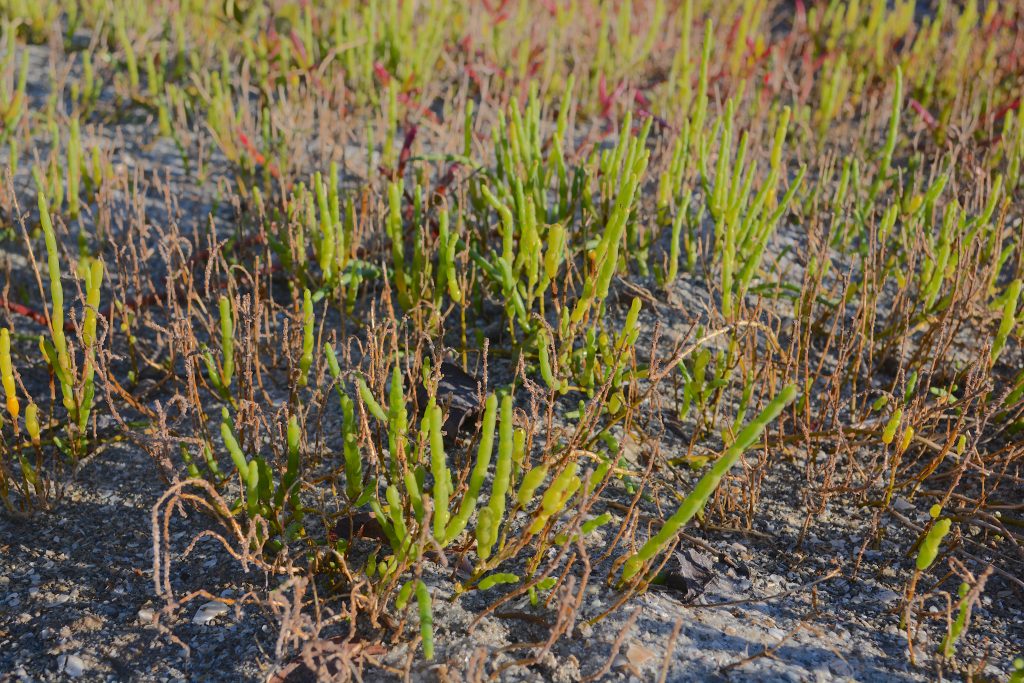
Glasswort, a tasty plant growing where others cannot. Photo by Green Deane

Salicornia bigelovii, Brackish Nibble

Glasswort does not sound like breaking glass at all, though it does crunch a bit.

Salicornia bigelovii (sa-li-KOR-nee-a big-eh-LOV-ee-eye)  has been used by most indigenous people around the world. Like many other salt-tolerating plants, it grows in salt marshes, on beaches, and among mangroves. They are native to the United States, Europe, South Africa and South Asia.

There’s significant commercial interest in glasswort in that it can be watered with salt water and can produce an excellent and nutritious oil. The raw seeds themselves are not edible because of saponins, but those remain with the meal when the oil is extracted. It is similar to safflower oil in composition, has a nutty flavor with a texture like olive oil.  An ash made from the plant was used in the manufacturing of glass, hence its name. Glasswort has also been used as a diuretic and an antiscorbuitic.  l like it raw in salads.

Jacob Bigelow 1787-1879

Besides foragers glasswort is the favorite of several butterflies particularly Lepidoptera species including the Coleophora case-bearers C. atriplicis and C. salicorniae, the latter which feeds exclusively on Salicornia.  Salicornia means salt horn, referring to the plant’s branches. And Bigelovii: It was discovered in the New World by American botanist, Jacob Bigelow, right, 1787-1879. Of course, native Americans discovered it long before Jacob did. Professor Bigelow’s other claim to fame was he established the first rural garden cemetery in North America, Mount Auburn Cemetery in Cambrdge and Watertown, Massachusetts. He was not fond of doctors and was a vocal critic of their practices.

A close cousin to the S. bigelovii is the S. virginica (ver-JIN-ni-ka) meaning “of Virginia” read middle North America. Essentially the main difference is while the S. bigelovii can be stout the S. virginica tends to be trailing and forms mats on the ground. It is not as esteemed as its cousin but can be cooked and eaten the same way. However, it can be stringy so some folks like to put the cooked vegetable through a strainer to get rid of some stringiness. Another local species is S. ambigua, common on the local west coast.

Called Pickleweed and Woody Glasswort (from the sound some think it makes when you walk on it) glasswort can be found New Hampshire to Texas and up the Pacific coast. Often it turns red in the winter and red parts taste more salty.  It has woody, jointed stems and leaves like fleshy sheaths. The flowers are extremely small, sunken into the joints, usually only the stamens visible.  Four to 18 inches in height, it usually forms dense stands, miniature upright forests in tidal areas.
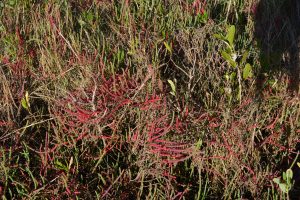
The more red the more salt. Photo by Green Deane

As with most greens, harvest when young and tender, or the growing tips. The entire glasswort grows woody as it ages, but in stages. You may find when you go to chop it that you have some with a thin woody core and fleshy on the outside. Just bend up those pieces and boil them any way. When they are done, the fleshy green exterior can be easily stripped of the inner light yellow wood. Toss the woody parts away. For raw in salads and as pickles pick the youngest parts possible and keep checking for a woody core, which you don’t want if you aren’t going to cook them. Older pink parts of glasswort can be used to make salt or for seasoning. Incidentally, the ash, which can be used for making glass and leaching lichen, is also good for making soap, especially if you don’t have hard wood ashes available for soap .

Green Deane’s “Itemized” Plant Profile

IDENTIFICATION: Glassworts are succulent, fleshy plants with opposite leaves and jointed stems, found in saline environments. Plant, 2 to 12 inches, erect, may turn red in winter. Leaves very small, scale-like. Flowers tiny, sunken into stem joints, commonly only stamens visible. Joints wider than long. Fruit small, succulent containing one seed.

TIME OF YEAR: All year round

ENVIRONMENT: Salt marshes, and along interior salt lakes.

METHOD OF PREPARATION: Young leaves and stems, raw, cooked or pickled. Oil pressed. Another species, S. perennis, is likewise usable after cooking but should be strained. Scalornia gets woody as it ages and is not edible.

HERB BLURB

Salicornia bigelovii Torr.: An Oilseed Halophyte for Seawater Irrigation

EDWARD P. GLENN 1, JAMES W. O’LEARY 1, M. CAROLYN WATSON 1, T. LEWIS THOMPSON 1, and ROBERT O. KUEHL 2. 1 Environmental Research Laboratory, 2601 East Airport Drive, Tucson, AZ 85706

2 Statistical Support Unit, College of Agriculture, University of Arizona, Tucson, AZ 85721

The terrestrial halophyte, Salicornia bigelovii Torr., was evaluated as an oilseed crop for direct seawater irrigation during 6 years of field trials in an extreme coastal desert environment. Yields of seed and biomass equated or exceeded freshwater oilseed crops such as soybean and sunflower. The seed contained 26 to 33 percent oil, 31 percent protein, and was low in fiber and ash (5 to 7 percent). The oil and meal were extracted by normal milling equipment, and the oil was high in linoleic acid (73 to 75 percent) and could replace soybean oil in chicken diets. The meal had antigrowth factors, attributed to saponins, but could replace soybean meal in chicken diets amended with the saponin antagonist, cholesterol. Salicornia bigelovii appears to be a potentially valuable new oilseed crop for subtropical coastal deserts.
{ 14 comments }

Edible Elaeagnus

First it was “poisonous.” Then it was “not edible.” Later it was edible but “not worth eating.” Actually, it’s not toxic but tasty, and easy to identify. It makes one wonder how some plants get so maligned.

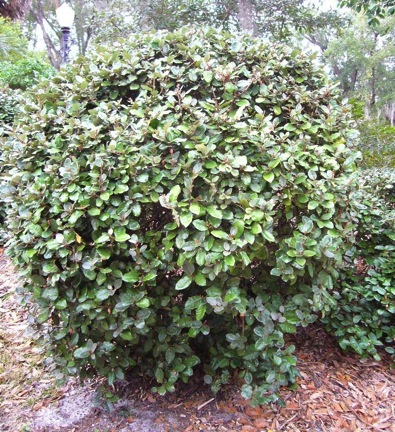
Elaeagnus pungens

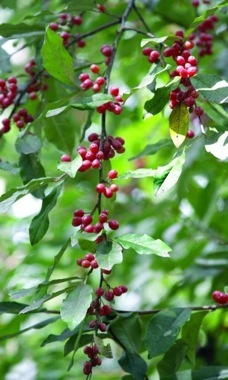
The Silverthorn, Elaeagnus pungens, came from China and Japan to North America  some 200 years ago in the early 1800’s. It’s an ornamental landscape plant often used for hedges and barriers. The Silverthorn is also closely related to the Autumn Olive and Russian Olive, both of which have edible fruit as well (E. umbellata, E. angustifolia.)

Perhaps the bad-mouthing also comes from the fact the Silverthorn has escaped cultivation. The shrub is found from Virginia south to Florida and west to Texas. It is also found at Smith College in Northampton, Massachusetts. Florida lists it as a Category II invasive exotic species. Seems to me the only civic thing to do is eat the weeds.

Evergreen, the Silverthorn is also called the Thorny Olive and the Thorny Silverberry. It blooms

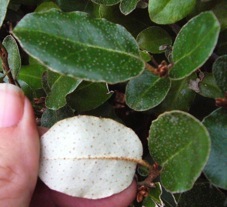
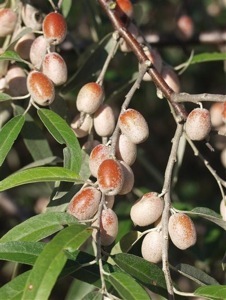
Silver back, rust-colored spots

around October and has edible fruit about February. Authors’ opinions on the berry, actually a fruit, range from toxic to edible but lousy. I find them sweet and tart at the same time, and very much worth eating. But you do have to get them ripe or they can be astringent. I have also reached the conclusion that folks who write books on landscaping actually hate the plants they write about. Personally, I look forward to Silverthorn season every year. Better, it fruits in the middle of our winter. Few plants do.

From a nutritional point of view the Elaeagnus has 17 times the lycopene than tomatoes. Yes, 17 times more.  The edible seed has fiber and omega 3 fatty acids but is on the bitter side. One can also eat the seed shell but I prefer not to. The plant is a nitrogen fixers which means it can grow in poor soil and provide nitrogen for other plants.

As for the common names, the bush does not really have thorns but rather sharp twigs that grow into branches. The berry-like fruit is red and silver/gold (from a distance it looks like red and silver but up close red and gold.) The botanical name is a mixed menu. Pungens (PUN-jenz) is easy. It means sharp or pointed. Reminds me of the punji sticks used in Vietnam. Elaeagnus is a bit of an amalgamation and Latinized Greek. It means “Sacred Olive.” Elaia = olive tree, agnos = sacred.  Why the genus was named that is anyone’s guess.

Russian Olive

Also edible are the fruits of the E. commutata, which is native to North America. Alaskan natives fried them in Moose fat.  E. multiflora, the climbing E. philippensis, and E. latifolia are also edible, the latter often cooked and or made into a compote. Many Elaeganus in their native range elsewhere in the world have edible fruit. The seed is also edible on E. umbellata.  The genus is closely related to the Sea Buckthorn. (See separate entry.)

The Elaeagnus clan was championed at one time by various official and unofficial plant groups as good for land and animal. Song birds in particular like the fruit. Turkeys, hens and bears do, too. But in recent years opinions have changed and now it is view as a competitor for native species and is on several states’ hit list. I’ve only seen it under cultivation.

Elaeagnus fruit has numerous uses. It can be eaten out of hand though they tend to be astringent if picked too early.  It can easily be made into fruit leather, juice, jam and jelly. You can freeze the juice and use it in yogurt or to make a tea. The fruit can be dehydrated as well. Several species have edible seeds.  I usually eat the kernel and toss away the hull.

Green Deane’s “Itemized” Plant Profile

Autumn Olive

IDENTIFICATION: Shrub 3 to 25 feet, leaves are lance-shaped, evergreen, simple or wavy edges, 2 to 4 inches long. Upper leaf surface is waxy green, often scaly. Lower leaf surface are silvery and scaly with brown dots. The leaves feel tough and grainy. Young branches on branches are thorny. The Fruit can be red to red with silver or gold glitter. The seed covering has longitudinal ridges.

TIME OF YEAR: Blossoms in fall, fruits in early spring. (The Autumn Olive fruits generally in late summer or fall.)

ENVIRONMENT: Full sun is preferred and good soil but it can grow in partial shade and poor soil

METHOD OF PREPARATION: Usually eaten out of hand. Can be made into jam, jelly, fruit leather, juice can also be used to make tea or flavor yogurt. Seed kernel is edible.


{ 36 comments }

Eryngiums: Elizabethan Eryngo Candy

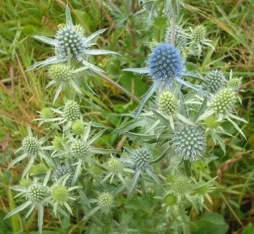
Eryngium maritimum

While the edible versions are not widely distributed in North America, Eryngo (ERR-in-go) was too pretty a name to be left off my edibles list.

The two edible versions are Eryngium maritimum and Eryngium campestre. They are in the carrot family and are used similarly. Both are sparely distributed whereas their more ornamental cousins in the same family are widespread.

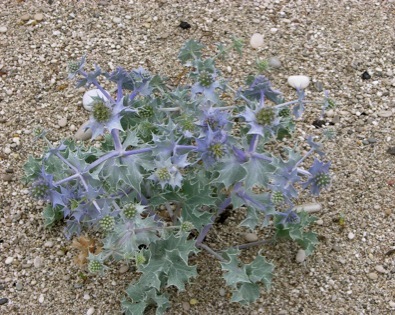
First E. maritimum, or the Sea Holly. On first glance when one sees the Sea Holly on the beach you think it is a lost thistle. The flower is burr-shaped but metallic blue, not pink white. It potential height, two feet, dwarfs the root’s potential depth up to…ah….down to 20 feet. No more than three is usual. Found naturally only near the sea it likes sand and is both a xerophyte and a halophyte, read it likes dry spots and salty spots.

Young leaves and shoots are blanched and prepared like asparagus. The roots were once sugared and sold as candy.  They were peeled, boiled, and cut into slivers which were twisted together and then covered with sugar. The English town of Colchester was famous for the candied roots for centuries. The candy was much sought after for colds, coughs, and as an aphrodisiac.  (An ancient recipe for candied Eryngo is below on bottom.) When the roots are boiled or roasted, they taste like cooked chestnuts and are quite nutritious.

Eryngium campestre

Eryngium campestre has skinnier leaves and branches. It is also green where as the E. maritimum is blue-green. The E. campestre can grow by the sea but prefers to be inland in dry areas. Called Field Eryngo, it’s found more often in Europe than England but is also naturalized sporadically in North America.

Eryngium (ear-WREN-gee-um) is the Greek name for the plant latinized. It may come from the Greek word ‘erugarein’ meaning ‘to cure belching.  Greek physician Dioscorides recommended the root to ease gas. Or it could come form ‘eerungos’, meaning ‘beard of a goat’. Plutarch recorded the effect of Sea Holly on goats: “It causes her first to stand still and afterwards the whole flock, until such time as the shepherd takes it from her.” Maritimum (mar-ih-TEE-mum) of or by the sea. Campestre (kam-PES-tree) means found in plains or similar flat or level places.

Green Deane’s “Itemized” Plant Profile

IDENTIFICATION: E. maritimus: spiny like a Holly, low growing but Thistle-like in appearance, bluish-green, stiffly hairy, spiny, leathery leaves, 3-lobed, folded. much-branched, numerous leaves, upper leaves clasping the stem, long thick roots. Flower heads, blue, are in heads with a whorl of stiff-colored bracts, spiny, petals narrow and deeply notched, turned down. E. campestre has slimmer or deeply cut leaves and stems and is green. It  grows more upright

TIME OF YEAR: Flowers July and August

ENVIRONMENT: One likes it by the sea, one inland in grassy areas, both like full sun.

METHOD OF PREPARATION: Young shoots and tips are blanched then eaten like asparagus. Young shoots can be pickled.  Roots can be candied, or boiled or roasted. The root is sweet but has little aroma. The plant is diuretic. Leaf juice was squeezed into ears to treat ear infections.

To candie orringo roots

Take fresh gathered oringo roots, set on a ketil of spring water, let it seeth, then put in ye roots & make them boyle as fast as a parsnep. Then cut them in ye midst & pick out theyr pith with a knife, then pill & throw them into a bason of aire water. Then wring them out of ye water & dry them with a cean cloth. Place them 3 or 4 together and tie them at each end with a third. Then take as much sugar as they weight & as much rose water & faire water together as will make a sirrup to cover them. Then set them over ye fire & dry them, after they are boyled in ye sirrup till it allmoste all boyled away & shaed in the bason to worke in ye sirrup. Then dry them by ye fire & box them for all ye year.

And creamed eryngo:

A 17th century recipe for ‘Eryngo cream’ by John Evelyn:: ‘Take halfe a pound of Eringo Roots and mince them very well then take an Ale pint of Creame sett them on the fire and boyle them with a piece of Isinglasse to thicken it boile a litle of it to trie the stiffnesses …

{ 4 comments }

 Oenothera biennis: Foraging Standby

Evening Primsoe

The Common Evening Primrose has long been a foraging standby and for a century or so was a common vegetable found in European gardens though it’s an American native….probably.

While the edibility of Oenothera biennis (ee-noh-THEER-uh  bye-EN-niss) is not in doubt much about the plant is. Linnaeus, who started naming plants in the mid-1700’s, said it was introduced to Europe from North America in 1614. But some modern botanists say it’s native to Europe and went to North America with colonists. Curious: For a plant that might have been native to Europe it certainly was not utilized there until after its discovery in North America. By the 1880s, however, the Evening Primrose was a common garden vegetable in Germany.

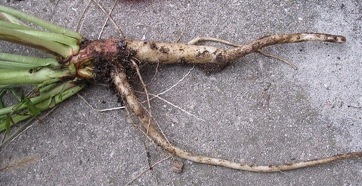
Evening Primrose root

The plant’s name also shrouded in a lexicographic fog. Oeno comes from the Greek word Oinos (said EE-nos which later went in to Latin and became vino. “Oi” in combination in Greek is always said “ee”.) Oinos means wine. Thera can mean catcher or hunter.  So in polite circles it is interpreted as a root that can absorb wine. There is speculation that ancient (European) hunters would give some wine-soak root to animals to calm them down.  I’m not sure that would work and might be a waste of good wine.

Pliny, 23-79 AD, had a different view of the word and wrote: “onothera, sive onear, hilaritatem afferens in vino” which translates into something like “ass catcher, a plant whose juice in wine causes happiness.” A 1601 translation read: “Oenothera, otherwise Onuris, an herb good also in wine to make the heart merry.”  The famous botanist Merritt Fernald in 1950 gave up and said it means “wine scented.”  Another interpretation is “wine imbibing.” Other views suggest it meant people believed the plant had ability to the calm ferocious man or beast. Biennis means two years, referring to the plant’s growth habit. Primrose means first rose, and since its blossoms open at night “evening” was added to common name a few centuries ago.

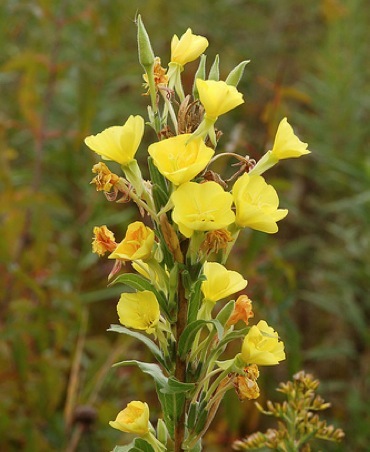
Blossom in normal light

During the first year there is only a rosette of basal leaves. Then the second year the plant sends up a tall stalk with alternative leaves and yellow flowers at the top. The flowers open quickly in the evening and, depending on the weather, usually fade by mid morning. The root of the first year plant, cooked, is edible, usually late in the season. Raw it will irritate the throat. Young leaves from the second year stalk were cooked as greens by the Cherokee indians (who first saw Europeans in 1540.)  Young second year stalks can also be peeled and eaten. That stalk dried makes a good drill for making fire. Leaves can be eaten if boiled more than once but they are usually tough and gritty. Flower buds can be eaten raw or cooked and the flowers added to salads.  The seeds are edible as well (those seeds can also remain viable in the soil for at least 70 years.)  Try all parts carefully and sparingly. They can bother the throat of some people even when cooked, and the taste may be acquired.

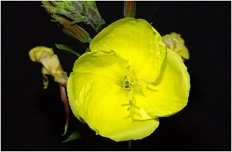
What some insects see, photo by Bjørn Rørslett - NN/Nærfoto

The young shoots of O. biennis, O. hookeri, and O. lamarckiana are edible raw. Roots of the O. hookeri have been eaten as well. The tough seedpods of the O. californica and O. nuttalli were eaten by the Indians as were the seeds of O. brevipes.  O. fruticosa leaves were used as a potherb and it grows throughout eastern North America. Young crown leaves of O. biennis can be blanched and used for salads. People aren’t the only ones who appreciate the Evening Primrose. A lot of insects also like it as well and O. biennis has ultraviolet markings to help the bugs land.

O. biennis is found throughout North America except Idaho, Colorado, Utah, Arizona, and Wyoming.

Green Deane’s “Itemized” Plant Profile

IDENTIFICATION: Lemon-scented, large yellow flowers at the top of a leafy, hairy stalk, stalks, often purple-tinged, erect, 2-6 ft. with leafy, branched stems from a basal rosette. Four-petaled flowers to 2 inches across open at night, close in the day.  Second year stalk has lance shaped leaves spiraling up the stem topped by flowers. Seed pod splits into four parts. There is great variability  in the plant but it rarely branches.

TIME OF YEAR: Young leaves, flowers and buds, in season, roots near end of first year, second year stalks early in season

ENVIRONMENT: Fields, prairies, thickets, waste ground, disturbed sites, cultivated areas, roadsides, railroads

METHOD OF PREPARATION: Numerous: Roots cooked, usually boiled, peppery. Young shoots – raw or cooked, mucilaginous and peppery. Flowers sweet, used in salads or as a garnish. Young seed pods – cooked, often steamed. The plant also has many medicinal applications.

{ 24 comments }

 Solidago Odora: Liberty Tea

Golden rod Photo By Green Deane

After the Boston Tea Party of 1773 the colonists had only one good alternative: Goldenrod tea, and not just any Goldenrod, but the Solidago odora (sol-i-DAY-go oh-DOR-uh.) It became known as “Liberty tea” and was even exported to China.

As a kid growing up 120 miles north of Boston I never thought of Goldenrod as a revolutionary potential tea. It was one of two blossoms that shaped my view of the world. In mid-May when the Lilacs bloomed I knew school was almost over for the summer. Who can ever forget the great joy that brought. And in late August the goldenrod began to bloom. Back to school. School always started the Tuesday after Labor Day. And to be fair that was usually exciting… for about a day.

Goldenrod is found throughout North American and you will read that nearly any goldenrod will make a tea, and that may be true if you have herbal applications in mind. But, leading the genus for a pleasant tasty tea is S. odora.  It’s one of 25 goldenrods found locally and grows from Nova Scotia south to Florida west to Arkansas and Texas. It has also traveled some.

Goldenrod was introduced into Europe some 250 years ago.  Solidago canadensisis now common in the wild there. In Germany  it is considered an invasive species, which brings up a word associated with this plant: Ruderal.

Goldenrod is known as ruderal species, that is, it is among the first to take advantage of disturbed ground. It grows so quickly it can often makes a cleared site fragrant and attractive. It has also has gotten some bad public relations regarding allergies, most of it undeserved. Its pollen is heavy, doesn’t travel well, and is not the allergen it was thought to be. Usually the problem is ragweed. Goldenrod has, however, been linked to cases of dermatitis. The leaves are also toxic to sheep. And although goldenrod tea is a wholesome beverage, a toxic fungus that sometimes grows on the leaves may poison tea made from infected leaves. So make sure there are no problems with the leaves you collect (don’t forget to look on the underside of leave you are thinking of using for tea.)

As a kid I remember it as a particularly smelly because it was a common plant to make into homemade and very inaccurate arrows for playing Cowboys and Indians. We Indians always won because unlike the cowboys with their fake guns we had Goldenrod arrows launched on alder bows. The alders were fairly smelly too. (I think that’s how the Cowboys knew where we were hiding.)

Of course bees use the Goldenrod as do butterflies and oddly woodpeckers. Bees make an excellent honey from the Goldenrod. The butterfly’s dependence is totally different.  The butterfly lays an egg. The eggs becomes a larva that form a gall. Then certain parasitic wasps lay eggs in the larva in the gall. Woodpeckers, apparently experts in finding hidden food, peck open the galls and eat the growing insect inside.

Also know that the Goldenrod is not just another smelly flower with a pretty face. Thomas Edison experimented with goldenrod to make rubber, which it exudes naturally. In the 1930’s he managed to get 12% rubber out of each plant and Henry Ford gave Edison a Model T with tires made out of Goldenrod rubber. Edison turned his rubber research on the Goldenrod over to the government which carried it on until synthetic rubber was discovered during WWII. That ended Goldenrod as a source of rubber. However, its rubber is very strong and long-lasting, meaning better than synthetic rubber.

The Goldenrod is the state flower of Kentucky, Nebraska and South Carolina. It used to be the state flower of Alabama but was replaced with the camellia. Goldenrod also the state herb of Delaware. You didn’t know some states have State Herbs? You do now.

Solidago is from Latin and means to strengthen. This is in reference to the medicinal uses of the plant. Odora means fragrant.

 Green Deane’s “Itemized” Plant Profile

IDENTIFICATION: Goldenrod is a perennial, 2-5 ft tall, hairy stems, alternating stemless single-veined narrow dark green leaves, smooth or hairy margins, pointed tips, 1-4 inches long becoming small towards the top, and smells like licorice when crushed (from small glands.) Dense  golden-yellow flowers, late summer to mid-fall,  in branched clusters at the tops of the stems. Goldenrods hybridized, so you night not be able to identify the exact species. You want to find a Goldenrod whose leaves smell like anise.

TIME OF YEAR: Leaves anytime, blossoms late summer to fall. Flowers yield a deep yellow dye.

ENVIRONMENT: Naturally prefers poor sandy soil but grows well in fertile soil. Will also grow in clay, full sun or semi-shade but will do better on a reasonably fertile site.

METHOD OF PREPARATION: Dried leaves and flowers to make tea. Make sure the leaves are fungus free. A toxic fungus can grow on the leaves. Some report the seeds of several species were used as food.  There are herbal applications. Roots smell and taste like raw potatoes.

HERB BLURB

Solidago odora  leaves and tops (picked during the flowering period) have been used to make herbal medicines for a variety of disorders, including digestive and urinary problems, wounds, ulcers, and cancers. Hocking, 1997, reports S. canadensis was used as a carminative, diuretic and stimulant. Other uses included:  Boiled in water for a syrup for treating colds; an oral poultice made from leaves was placed for a toothache; a poultice the roots to soothe burns and boils; a tea for bruises; a salve for insect stings and saddle sores on horses.


{ 25 comments }