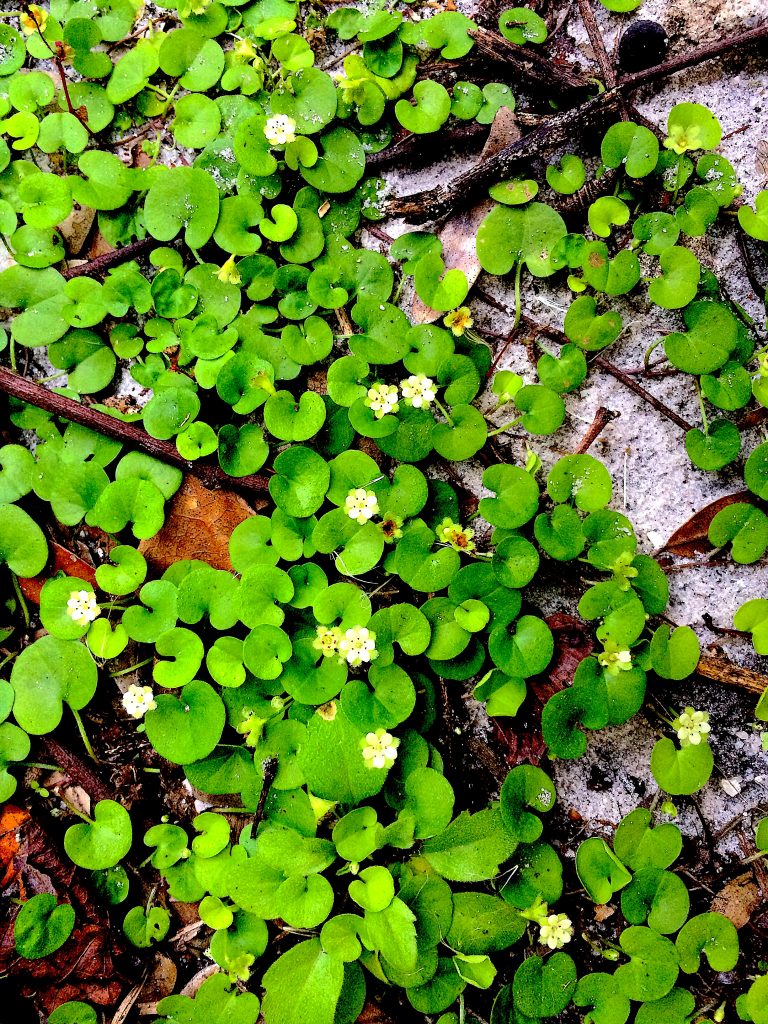
Pony Foot in blossom. Photo by Green Deane

Are they edible? 

That is often asked about a little lawn plant called Pony Foot, or Dichondra carolinensis. I think they are bitter and medicinal, others toss them into salads. My herbalist friends call them a “liver tonic.” But, since they are bitter it is better to mix them with other greens — as one does chicory — rather than using them as the main ingredient. 

Pony Foot might have antibacterial properties. Photo by Green Deane

This underfooter spreads by means of runners and they taste a lot better without the runners.  The species is also used as a ground cover in shade. I’m not sure why the plants were called Dichrondra which means two hearts. Reni– or nephri— (meaning kidney shaped) would have been far better. Its leaves do alternate but they are far more kidney-shaped than heart-shaped. They are also have a slightly off-side funnel shape (a basal notch.) Usually dime-size I have seen them more than an inch across. Pony Foot is often found with two other edibles, Dollarweed, which has a stem attached to the middle of the leaf, and Gotu Kola which has a spade-shaped leaf but rounded teeth on the margin and the stem is hairier.

A 1905 report suggested that Pony Foot extract with glycerine was good against bacteria associated with diphtheria.

Green Deane’s Itemized Plant Profile 

IDENTIFICATION: Low-growing, leafs dime to half dollar size, kidney-shaped with the stem forming a slight funnel indentation on one side, blossoms white

TIME OF YEAR: All year in the warmer areas of its range, spring to fall in the cooler climes.

ENVIRONMENT: Lawns or under spreading trees. Likes open areas or near water .

METHOD OF PREPARATION:  Edible raw, can be cooked, as a tea (dried and concentrated) is said to be medicinal. 

{ 0 comments }

Oyster Mushrooms

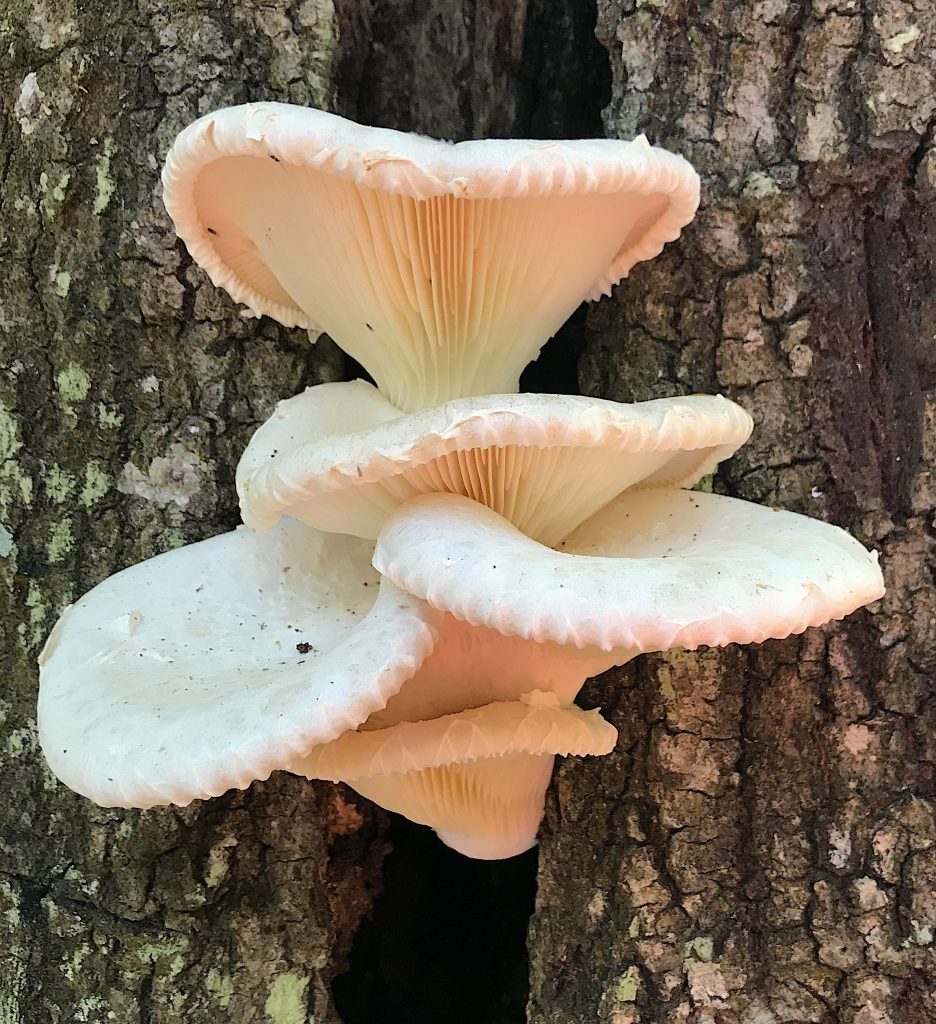
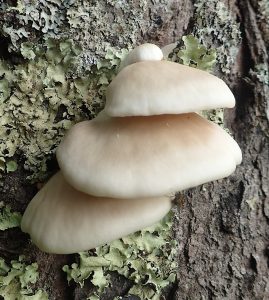
Oysters Mushrooms are often prolific. Photo by Green Deane

Oyster Mushrooms fall into that category of a wild food so good that it’s also cultivated. It is also one of the six to eight fairly mistake-proof mushrooms for folks to hunt for. There are several edible species. As with any mushroom and indeed any wild plant, check with a local expert first. 

These tend to be cooler weather fungi. I find them on dead or doomed hardwood trees, usually oak. They’re called Oyster because of their shape not taste. They’re about the size of an oyster shell (which I dug a lot as a young man in the mud flats of Maine.) They also usually have a gilled stem that is off set.  It is rare for me to find one or two Oyster Mushrooms. Usually there is a whole tree trunk of them. The exception are occasional solitary species in warm weather growing palm stumps. 

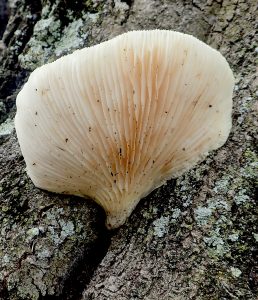
If they have a stem it is usually off-set. Photo by Green Deane

Curiously mushrooms are more closely related to humans than plants. They make vitamin D, one reason to eat them. And things that bother us can bother them so if they are healthy there’s probably no bad environmental toxins involved. As for nutrition 100 grams of fresh oyster mushrooms have 33 calories, 3.13 grams of protein, 0.41 grams of fat, 6.09 grams of carbohydrates and 2.3 grams of fiber. There is 1.11 grams of sugar and it is glucose. No vitamin C reported and barely any vitamin A, 2 mcg RAE or 48 IU. Vitamin D, however, is 29 IUs of vitamin D (0.7 mcg of that D2.) The B vitamins are B1 (thiamin) 0.125 mg, B2 (riboflavin) 0.349 mg, B3 (niacin) 4.956 mg, B5 (pantothenic acid) 1.294 mg, B6 (pyridoxine) 0.11 mg, folate 38 mcg, choline 48.7 mg, and Betaine 12.1 mg. The minerals are potassium 420 mg, phosphorus 120 mg, sodium and magnesium 18 mg, calcium 3 mg, iron 1.33 mg, zinc 0.77 mg, copper 0.244 mg, manganese 0.113 mg, and selenium 2.6 mcg. 

Oyster Mushroom also have ergothioneine an antioxidant which might decrease inflammation. They also have lovastatin. Pleurotus ostreatus means “sideway oyster” a reference to the general shell shape and the stem or pseudo-stem usually to one side. Two others we see are Pleurotus pulmonarius and Pleurotus populinus. (Lung shape and inhabiting populars.) P. pulmonarius can be seen in warm weather and P. populinus likes populars.)  

Green Deane’s Itemized Plant Profile

They like hardwoods, usually oaks. Photo by Green Deane

IDENTIFICATION: Shelf-like clusters, usually numerous, kidney or fan shaped or nearly round mushroom to six inches across, can be greasy when young, pale to buff, edge can be rolled in some, gills run down the short stem or pseudostem or no stem, gills are close. Spore print white to lightly yellow or lilac. 

TIME OF YEAR: Late fall to spring (though in Florida some species grow on dead palms in the summer.) 

ENVIRONMENT:  on logs, living trees or dead standing trunks. Usually hardwood, occasionally conifers. I have seen them on Magnolia virginiana and Sycamores.

METHOD OF PREPARATION: Cooked any way you like. They have a slightly chewy texture, the flavor ranges from mild to nutty to seafood-ish. Very versatile in the kitchen. They have been cultivated for more than a century starting in WWI.

{ 2 comments }

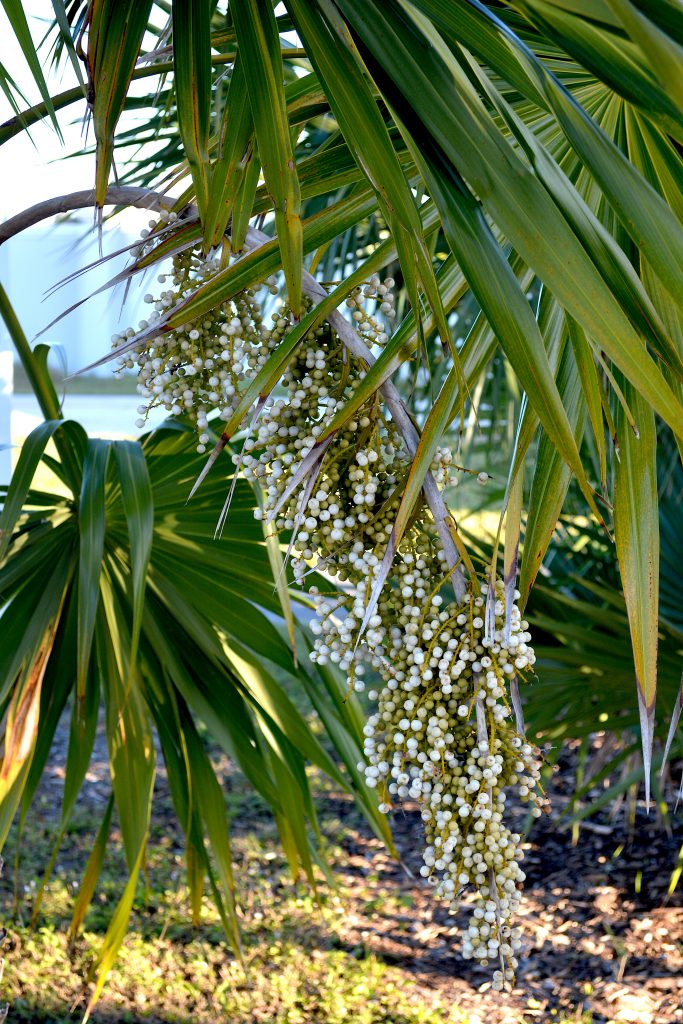
The white fruit of the Thrinax radiata, Florida Thatch Palm. Photo by Green Deane

Almost all white berries are not edible. Is there half-a-dozen on earth that are? It seems we have two in Florida, the White Indigo Berry, and Florida Thatch Palm. 

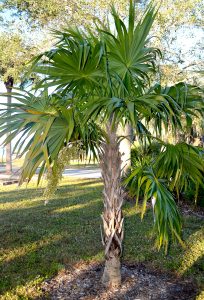
The Florida Thatch Palm might be found more in landscaping than in nature.

On teaching trips to south Florida I saw a palm with small white fruit. Twice I tasted them. No particular flavor but more importantly no burning from calcium oxalates which is usually the first sign a palm fruit is not edible (same with most large-leaf “elephant ears” and the like.)  It is Thrinax radiata, the Florida Thatch Palm, so called because it was used to thatch hut roofs (which also suggests it was more prolific in the past.) Its fibers and netting have been found in pre-Columbian sites on Marco Island. It was used for rope into the 19th century.  On page 670 of Florida Ethnobotany by the late Dr. Daniel Austin he writes: “Fruits are sweet and edible.” Then he says “the fiber has been used to stuff pillows and mattresses.”  Like many palms it’s had several names Cocothrinax martii, C. radiate, Thrinax floridana, T. martii, T. multiflora and T. wendlandiana. It grows on southern coast of Florida, the Florida Keys, Bahamas, western Cuba, Cayman Islands, Jamaica, Hispaniola, Puerto Rico, Honduras,  Nicaragua, the eastern coast of the Yucatan Peninsula in Mexico and Belize. This palm likes it warm. The one I see regularly — planted — is in the southeastern corner of Bayshore Park in Port Charlotte (which in theory is out of its range.)  

Thrinax means “trident” in Greek, referring to the shape of the frond center where the leaves radiate hence radiata.

Green Deane’s Itemized Plant Profile

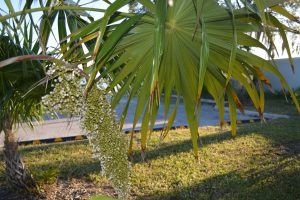
The fronds are circular. Photo by Green Deane

IDENTIFICATION: It’s a slender, slow-growing palm that can reach 30 feet but is usually much shorter.  The trunk is matted with fiber between old leaf bases. The base often has protruding roots. A fan palm it usually has between 12 and 20 frond. Fronds are green above with yellow ribs, lighter green or yellow green underneath with a distinct spear shape protruding from the frond’s center. White fruit. It differs from both the thatch palm (Leucothrinax morrisii, syn. Thrinax morisii) and the silver palm (Coccothrinax argentata) by lacking the silvery white leaf under surfaces. When grown in full sun the canopy is globular. When grown in shade the fronds are widely dispersed with an open-air canopy.

TIME OF YEAR: Fruits continuously but produces the most in the spring. 

ENVIRONMENT:  Salt, wind and drought tolerant. It tolerates high ph. Can survive temperatures down to 26F.  Does not appear to be bothered by Ganoderma Butt Rot. 

METHOD OF PREPARATION: Seed pulp is reported as edible. I never found them worth eating. Its roots and shoots were considered tonic and restorative. 

{ 0 comments }

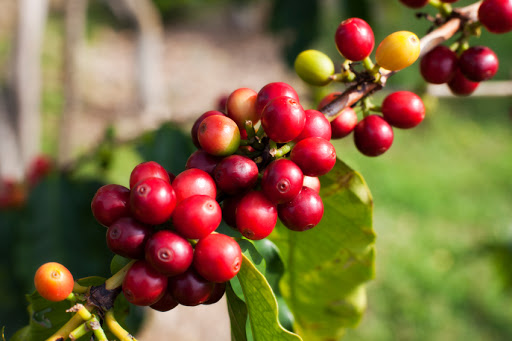
Coffee Cherries are edible and nutritious.

Coffee is a weed? Absolutely and out of control in places like Hawaii and Sri Lanka. More to our point if you ate the Coffee Cherry before you ever head or knew about the beverage you probably would have never roasted the seeds. You would have just eaten the fruit and look forward to it every year.  

It sounds odd to say but sometimes you eat a food that just doesn’t seem like food. It’s not substantial or satisfying. The Coffee Cherry — the fruit the coffee “beans” come from — tastes like real food, substantial. Your pallet recognizes it immediately and says “this we will eat again.” 

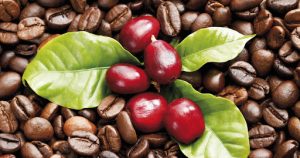
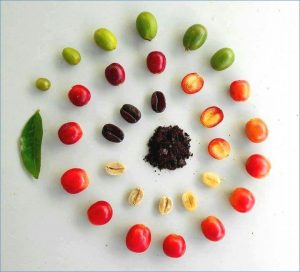
The unripe seeds called green coffee beans  are roasted for coffee.

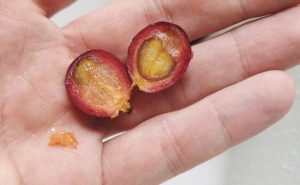
Actually the fruit can be divided into three parts: The outer skin, the pulp and the seeds (usually two seeds but not always.) The pulp is sweet and contains a small amount of caffein. The skin can be plain or a little bitter though I have not tasted one like that. It actually reminds me of a Cocoplum. Some people don’t like that fruit from a texture point of view. The Coffee Cherry fruit is slightly tough on the outside and a bit slimy on the inside. The pulp can also be dried and made into a “flour” that is used more like a seasoning than a flour. As millions of pounds of it are thrown away every year they are trying to find ways to use it. It’s full of polyphenols most of which is chlorogenic acids, ten times greater than what you get from the beverage 

The Coffee Cherry itself has 144.9 calories for 100 grams. That delivers 51 grams of fiber, 425 mg of calcium, 333 mg of magnesium, 49.6 mg of iron, 15.7 mg of sodium, 530 mg of caffeine and 22 mmol of antioxidants.  We see them in my foraging classes in Orlando and West Palm Beach.

Coffee Cherries: Good food or pulp fiction?

Not only can you grow your coffee you can grow decaf. One strain of C. arabica naturally has very little caffein. The usual C. arabica has 12 mg of caffeine per gram of dry mass this strain has 0.76 mg per gram but the same flavor. Coffee was originally grouped with Jasmines because of the flower’s aroma. And you can make a tea out of the leaves which also has some caffeine. The plant is native to a strip across the widest part of Africa. The drink has been made for perhaps 600 years. 

The genus Coffea is new Dead Latin for Coffee. The word “Coffee” came from the Dutch ‘koffie” which came from the Ottoman Turk’s “kahve” which came from the Arabic “qahwah” which referred to a type of wine really meaning a beverage that could make you less hungry and or give you energy. Arabica is from the Greek Arabikos meaning Arab or Arabian. Canephora is from the Greek Kanephoros which means basket carrying.  The Caryatids — maidens — carried a basket on their heads holding sacred objects for feasts and the like.

Green Deane’s Itemized Plant Profile

IDENTIFICATION: A shrub or small tree to 30-some feet. Open branches, well-spaced. Leaves are opposite, simple elliptic-ovate to oblong, four inches long,  long, glossy, dark green. The flowers white, in axillary clusters. The seeds are a round drupe like an olive but with two seeds, ripens to bright red or purple. 

TIME OF YEAR: In some areas year round, in other seasonal often in winter. Locally in the fall. Do you live where it doesn’t freeze and you want a shrub that you can plant in the shade? C. arabica is a good candidate. 

ENVIRONMENT: Likes it cool and elevation but many coffee plantations are in warm areas and at sea level. 

METHOD OF PREPARATION: Fruit out of hand or prepared in various ways or dehydrated. Tea from the leaves.  

{ 3 comments }

Dulse for Dinner

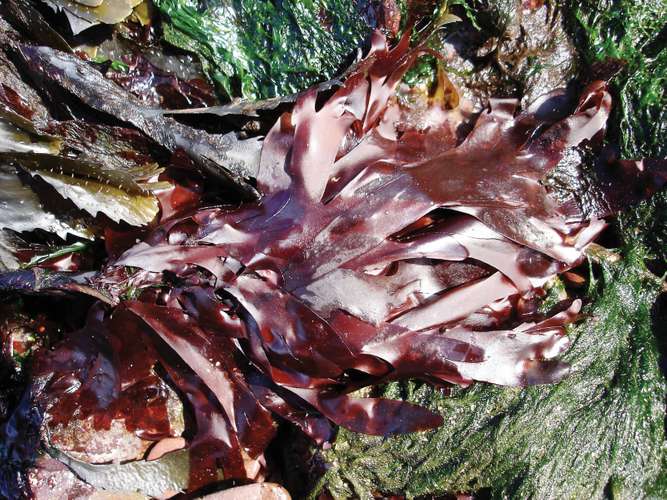
Dulse is full of Iron and Vitamin B12

Foragers tend to ignore seaweed. Granted you need to be near the shore but they are often low on the list when they can be so nutritious. They apparently aren’t alone: In Native American Food Plants by Daniel Moerman he lists only one group, “Alaska Native” as consuming Dulse. Eating it on the northeast coast seems to have been mostly by immigrants from the British Isles who traditionally ate it back home.
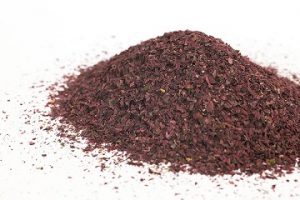
Dulse powders and stores well.

I grew up four miles from the sea and saw Dulse often. Indeed, my mother as a kid rowed around most of the islands off southern Maine from Brunswick to Portland as did I as a teenager.  I used to go sea bass fishing with an old story-teller named Hap Davis. He couldn’t swim and I often wondered what we would do if we ever sunk. The water’s perpetually cold and the islands always too far away.  

Moerman writes Dulse “…leaves air dried and stored for winter use… added to soups and fish head stews… eaten fresh or singed on a hot stove or griddle.”  If I remember correctly one saying of northwest natives was: “When the tide is out the table is set. “  And when these shore-dweller ate Dulse what did they get? A huge serving of potassium, some 7,000 mg per 100 grams dried. Said another way dry Dulse is 7% potassium. 
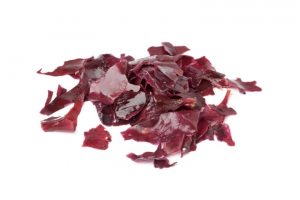
Immigrants were fond of Dulse as they ate it in the British Isles.

Nutty-flavored here’s the rest of the nutritional line-up dried: Calories 323, protein 19.1 grams, carbohydrates 59.5 grams, fat 0.6 mg, vitamin C 4.8 mg, and vitamin A 2 IUs, Chlorine 7500 mg, sodium 1740 mg, magnesium 450 mg, calcium 375 mg, phosphorus 360 mg, zinc 71.1 mg (quite high as is) iron 11 mg, manganese 4.5 mg, and copper 4 mg. The B vitamins are B1 (thiamin) 0.23 mg, B2 (riboflavin) 0.76 mg, and B3 (niacin) 5.4 mg.  Fresh there are some variations: Protein 1.8 grams, carbohydrates 6.1 grams, vitamin C 38 mg, and vitamin A 285 IUs. Chlorine 1306 mg, magnesium 60.1 mg, calcium 48 mg, zinc 0.8 mg, manganese 0.6 mg, copper 0.2 mg, and molybdenum less than 0.1 mg. The B vitamins are B1 (thiamin) 0.63 mg, B2 (riboflavin) 0.51 mg, and B3 (niacin) 0.2 mg. While there are more minerals dry there is far more vitamin C fresh. Some nutritionists, which we got along without for a very long time, say Dulse has the most iron of all food.

A USDA page for Dulse nutritions says 100 grams (we’ll presume dried) has 22500 mcg of iodine which is 22.5 mg or nearly a quarter of a gram of iodine which is a lot. It also has 6666.67 mcg of vitamin B12 which is 6.66 mg still a lot. Your daily need is 2.4 mcg.  A little dried Dulse daily would fit that need. Laver and Sumac, elsewhere in this book, also provide vegetarian sources of B12.

Palmaria (paul-MARE-ree-ah) means “deserving of a palm” that is outstanding, masterful, good. Palmata (paul-MAH-tah) is hand-shaped.  Dulse in English is Dead Latin through Spanish. It means sweet smelling or sweet scented. 

Green Deane Itemized Plant Profile

IDENTIFICATION: Rosy to reddish-purple, to a foot and a half long, grows from tiny disk-shaped foothold. Fronds thin, stretchy, irregularly lobed, kind of resembles a hand in shape. 

TIME OF YEAR: Late spring to November. Tides are usually lowest at either new or full moons. 

ENVIRONMENT: On rocks and shells from middle to sub-tidal zones in very cold to temperate waters, both hemispheres, in North America both northern coasts.  

METHOD OF PREPARATION: Fresh or dried (and unlike Laver, elsewhere in this book, Dulse is not rinsed before drying.) Use is salads to soups, dried added to relishes to bread, deep fried or ground into a powder for seasoning. 

{ 0 comments }