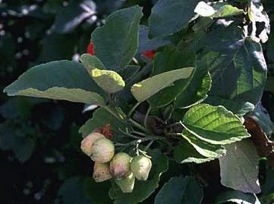
Citharexylum fruticosum: Edible Guitar

The Fiddlewood tree is not high on the list of edibles. As some authors state, only kids eat the fruit, lots of seed, sparse on pulp. But it has some personal history to me — remotely — and is also a medicinal tree.
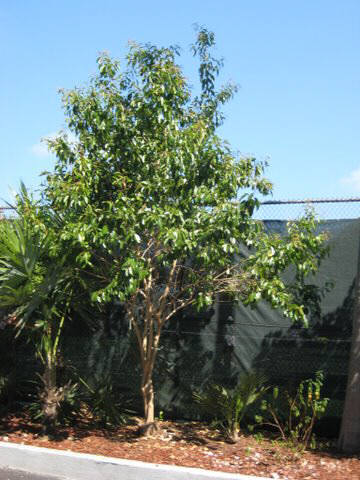
Fiddlewood, Citharexylum fruticosum

First edibility: The fruit resembles red wild cherries when unripe, and perhaps that is where the first disappointment arises. Like the Indian Strawberry the association implies something it is not. (The same thing happens with the Suriname Cherry.)  And the taste of the Fiddlewood fruit when ripe is not great. It depends on how hungry you are though opinions vary. Many like it. The fruit has two stones, is sweet and is available all year in its native range, which is where it is warm

The botanical name is Citharexylum fruticosum (sith-ar-RECKS-sil-lum  froo-tick-OH-sum) a name that can take us on quite a linguistic journey because “cithera” means guitar. So why is it “fiddlewood?”  Almost directly translated the botanical name means “lyre wood shrubby”  Put in better terms it could mean “guitar wood tree” or more directly  “shrubby kythera.” (KITH-ah-rah)  Kythera (a lyre is kythara, kith-THA-rah) is also the Greek word from which we get “guitar” … kith-THA-rah… get-TAR…see it? Hear it? The Fiddlewood tree is also called the Guitar Tree. To explain it all we have to go to Greece.
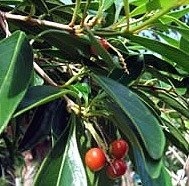
Unripe berries are reddish

One can navigate by sight from the western end of Crete northward to the southern tip of the Greece mainland in The Mani, where the Spartans lived. Cretans and Maniotes call themselves First Brothers and have much in common in dress, cooking and customs.  From Crete’s Gramvousa Peninsula you can see Little Kythera, some 20 miles away. Little Kythera (Antikythera) sits on a fault line and a few decades ago part of the small island rose 20 feet, a change that is still quite visible today. That is also where a brass sextant of sorts (the Antikythera Mechanism, below right) was found in 1901 proving celestial calculations with an instrument was possible two thousand years ago. Little Kythera as of this writing has 44 permanent residents. They want people with kids to move there and will provide housing.

Antikythera Mechanism

Incidentally, the ferry in season, see photos below, lands twice a week at Little Kythera doing the nautical equivalent of a “touch and go.” The football-field-long ferry backs up to the dock, lowering the gang way as it backs up. The very moment the gang way is over the dock it drops. All things going off or on do so in about a minute. The gang way lifts a few inches and the ferry leaves immediately, cranking the gang way up the rest of the way while over open water. The docking, exchange, and departure takes less than five minutes. While there look south, you can see where the earthquake lifted part of the island.

From Little Kythera you can see Crete to the south and Kythera to the north, taller but farther away. And Kythera is indeed shaped like a lute or a guitar. A large island, it has some 3,000 permanent residents plus an airport. Interestingly, some 100,000 Greeks in Australia claim ancestry to Kythera and try to return at least once a year, in the Greek summer, which is conveniently the Australian winter.  Kythera is the birth place, so to speak, of Aphrodite. The island was first inhabited by the Minoans and then the Phoenicians, both of whom wanted the Murex, a tiny shell fish whose tiny anal gland was the only source of royal purple dye in ancient times. How they discovered that is anyone guess.  From Kythera one can see Little Kythera to the south and to the north the southern tip of the main land called Peloponneus, specifically “The Mani” from where we get the word “maniacs” in English because of how tenaciously they fought. It is one area of Greece never occupied by the enslavingTurks or the starvation-imposing Germans.

If you take the day-long ferry from Crete it lands at Little Kythera, Kythera, then on the mainland at the little city of Gythio, whose sole industry in the past was collecting the royal purple as well… there’s about 10 square feet of ruins there right beside the road.  Gythio was also the home port of the Spartans and the area where this writer’s family comes from.
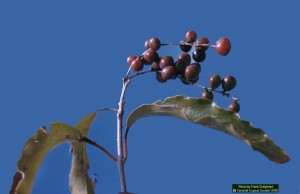
Ripe fiddlewood berries are black-ish

Now which came first, the instrument then the naming of the island or the island and the naming of the instrument is a debate. But, kythera …kythera…came to mean lyre and from kythara we got guitar and from that we got the fiddlewood tree. How? When Linnaeus was naming plants the English words “violin” or “fiddle” were not common in his time plus he preferred classical names. He knew the wood was used to make musical instruments so he named it  “guitar wood shrub” Citharexylum fruticosum. That got stretched into Guitar Tree and then Fiddlewood Tree. Now you know.

The most common name for the tree in the Caribbean islands is “old woman’s blisters” read it’s used for a lot of ailments. Boiled twigs and decoctions are used if you’re chilled. When mixed with Strongback and Spoonbush it is used for sores. Boiled with mahogany, lignum vitae, Doctor Club roots, Snowberry and papaya latex, it was used to aid indigestion… or perhaps create it…. Also beware… insects of all sorts love the tree so you will encounter them, in numbers. The fruit plup is edible but not prized. Do not eat the seeds.

Green Deane’s “Itemized” Plant Profile: Fiddlewood Tree

IDENTIFICTION: Citharexylum fruticosum: Shrub or tree to 30 feet, short trunk or several trunks, erect branches, compact. Leaves opposite, oblong to oval, with pointed or notched tip, to six inches long, glossy, yellow-green leathery, with orange stalks. Flowers white, tubular, five lobed, 1/8 inch wide, fragrant, in hairy clusters to six inches long. Fruit half-inch wide, brown or orange red when unripe, purple black when ripe. Sweet, two seeds.

TIME OF YEAR: All year

ENVIRONMENT: Coastal pine lands and hammocks

METHOD OF PREPARATION: Ripe fruit edible raw, but not great.  Do not eat the seeds.

Backing up to the dock at Little Kythera, Photo by Green Deane

Right, backing up to the dock at Little Kythera, Greece. The ferry comes by twice a week in season, south to Crete one day, north to the mainland the next. Below left is Kythera showing the “neck” of the guitar.  The large picture is the small city of Gythio, home port of the Spartans and of this writer’s ancestors in the villages of Karea to the southwest and Konakia to the northwest.  A small island just a few hundred feet off to the left of Gythio was where Paris and Helen spent the night consummating their love, starting the Trojan War, or so the romantic story goes.
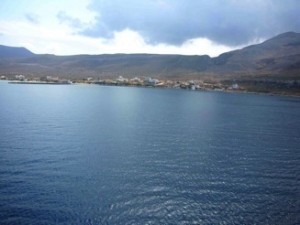
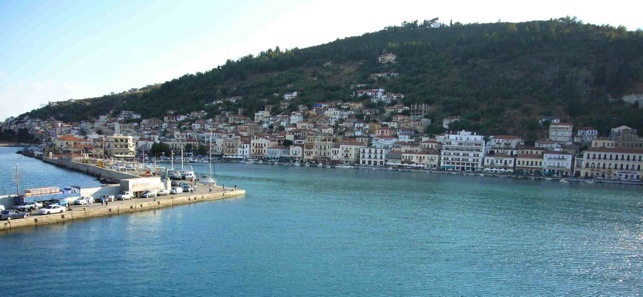
Gythio, Greece
 

{ 6 comments }

Wild Ficus: Who Gives An Edible Fig?

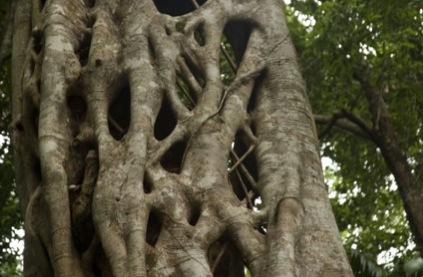
It’s only 90 miles to the east coast, and 117 to the west, but the Strangler Fig and Banyan trees will grow farther south and on each coast but not here in Central Florida. One is a native, and one came from India, but they’re cousins none the less, figs as it were, and in the greater Mulberry family. You didn’t know figs and mulberries were related? You do now.

Strangler Fig

The trees take over in similar ways. The Strangler Fig often starts as an epiphyte, a seed “deposited” by a bird in the top of a tree. The fig sends a root down to find earth. Once it does It slowly takes over the tree, enveloping it, sending down more roots. In time it becomes a huge tree. Usually the original victim simply dies and disappears. Those who study such things say the tree can take over its victim because it grows more roots than it’s victim.

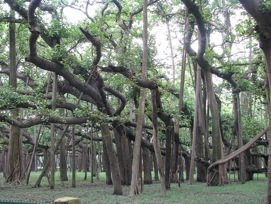
The Banyan “walks.” The first time you see one you are amazed. The horizontal branches send down vertical “prop” roots that grow into trunks. The tree simply keeps growing out and down, covering acres. Nearly everything under its shade dies.

The Florida fig is Ficus aurea, FYI-kuss AR-ree-ah, or FEEK-uss AW-ree-ah, Ficus is an old Latin name for the tree or fruit and probably comes from the older Greek word for fig, Siga (SEE-gah and earlier sykon.)  Aurea means golden, referring to the figs’ color when ripe. The Miccosukee and Creeks people called the tree a phrase that gets translated into the “sticks to you” perhaps a reference to the latex sap. They ate the ripe fruit, used the stems for arrows, made bowstring and netting out of the bark of the roots. They used latex to treat wounds. That latex can also be used to curdle milk for cheese making. The Natives also used the dried latex like gum.

One Banyan Tree

The Banyan tree is also a fig, now called Ficus benghalensis (ben-gal-EN-sis) meaning from Bengal. The largest is in India and covers four acres. It has a circumference of about a half a mile, is some 80 feet high and has  3772 aerial roots reaching down to the ground. (2880 in 2008) It is said it can shelter 2,000 people.

The reddish fruit of the Banyan tree is not toxic per se but they are barely edible, the worst of famine food. While its leaves are said to be edible, they are more often used as plates and for wrapping food. Fig leaves are also used to impart flavor to fire cooked foods. Some fig leaves in some areas are cooked and eaten. There is only one original reference to  the leaves of the F. benghalensis as being edible so I would view it as suspect. I would want more independent confirmation before I tried to eat one. But, I would cook with it and wrap with it.  The Banyans grow in the warmer areas of the United States including Florida, Texas, Arizona and Southern California.

A third fig in Florida is the Shortleaf Fig or Ficus citrifloia. As its name implies it has leaves similar to citrus trees. The one-inch fruit goes from yellow to dark red when ripe. It is edible but not prime — tasteless actually — and is not improved by cooking. 

On a personal note, I have a real fig tree in my front yard that is at least 80 years old, and probably much more, from the Azores. Of course, the fig would not be allowed in the United States now but it got here when folks weren’t concerned about such things. The grandfather of a friend married a Portuguese woman back in the 1930s. She was from the Boston area but her family was directly from the Azores, Portuguese being their first language as in my family Greek was. Either she or her relatives brought a cutting from a fig tree in the Azores to Florida via Boston and planted it next to their house in DeLand, Florida. Some 70 years later the original slip, now an aging tree, was losing a battle with dry rot so I took several slips off the tree and got them to root. The tree is gone now but at least four of those slips are still growing and are now trees themselves. They grow big green figs similar to the Kalamata figs of my ancestral home, the Mani, in Greece. That tree, or it clones, has been in the presence of a lot of human life. How old was it on the Azores before a slip was taken? We’ll never know. That slip endured several thousand miles at sea and then a slow 1,200 mile drive down the east coast of the United States. It grew next to the house where Vern Gifford raised two kids, saw numerous grandchildren and went quickly while in his 90s. And the tree lives on.

Also edible: Ficus auriculata, fruits;  Ficus benjamina, ripe fruit; Ficus carica, ripe fruit; Ficus capensis, fruit, young aerial shoots eaten as a vegetable, bark is chewed with cola nuts to alleviate thirst; Ficus elastica, fruit and young leaf shoots cooked. This is the infamous “rubber plant” in home and offices around the world; Ficus glomerata, young shoots cooked, Ficus hirta, very young top shoot eaten raw, ripe fruit edible; Ficus insipida, fruit sometimes good to eat; Ficus lacor, young shoots and sour leaves eaten raw or cooked. Fruit also edible; Ficus laevigata, ripe fruit; Ficus palmata, fruit edible, unripe figs and leafy young shoots boiled and fried and used as a green vegetable; Ficus pseudoplama, young leaves are eaten raw in salads or cooked as a potherb. Fruits also edible; Ficus pumila, ripe fruit; Ficus racemosa, ripe fruit edible, unripe fruits pickled, young shoots eaten raw or cooked; and, Ficus sycomorus, fruit edible, leaves eaten in soups.There are at least a dozen species of Ficus in Florida, all have edible fruit.

Two factoids: Figs are pollinated by a wasp that crawls into the developing fruit. Its “blossoms” all face inward. And the fig tree, called “sycamore” in the Bible, was a common wood for caskets back then. It is the most common ancient casket wood found today.

Green Deane’s “Itemized” Plant Profile

IDENTIFICATION: Strangler fig:  Tree to 65 feet, milky sap, orange twigs, smooth gray or light brown bark, flaking, many aeriel roots. Leaves alternate, stalked, oblong, oval or elliptic, pointed or wedge shaped, two to five inches long, leathery, dark glossy above, paler below. Fruit stalkless, yellow when unripe, dark red when ripe, about one half inch wide. In the state of Florida there is about a dozen species of wild fig, In cluding Ficus Benjamin (a common liberated office plant.) 

TIME OF YEAR: All year

ENVIRONMENT: Hammocks, pine lands, old residential areas

METHOD OF PREPARATION: Raw fruit out of hand. Latex as chewing gum. Banyan leaves can be used as plates and to wrap food.


{ 24 comments }

Caryota: Fishy Toxic Palms

Often the botanical name of a species tells you nothing about the plant. Magnolia comes to mind. It’s a person’s name. However “urens” does enlighten, Caryota urens specifically.

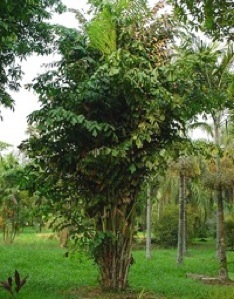
Multi-trunk fishtail palm

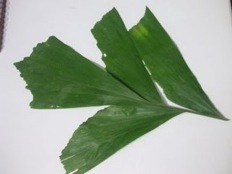
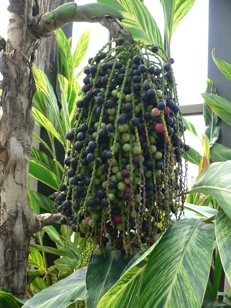
Caryota urens is the Fishtail Palm, so called because the bi-pinnated leaves resemble the back end of a fish.  Urens means “stinging” and the fruit does contain a chemical that does sting. That said, the kernel of the fruit is edible but it has to be cleaned completely of the stinging outer flesh.

One of the odd thing about the genus is when it fruits the trunk the fruit is on dies. The single trunk Caryota urens grows fast and lives to between 20 and 25 years old but when it fruits, that’s the end of it, though it can take years to die. The multi-trunk species, Caryota mitis does better and grows a source of more trunks. But, they too die, fruiting from the top down.

As a forager I am used to being told this or that species is toxic. This was one so-called toxic plant that was true. However, that did not keep natives from using this palm. The primary product of the genus is a sugar substitute called kitul honey or jaggery. The juice from the flowers is boiled in a large wide-mouth vessel making golden syrup. The fruits have raphides of calcium oxalate and are not eaten. The seed kernel is edible, however.

Fish tail looking fronds

The growing tip of the palm is also edible as is the palm heart. The sap can also be fermented. Leaves are used for animal fodder, being 2% protein and 9.3% fiber. The sheathing leaf bases provide a strong fiber for brushes. Wood is used to make spears and used like gutters or pipes to carry water.

There are about 15 species of Fishtail Palm, C. urens is used the most. C. mitis has become an invasive in Florida. The botanical name, Caryota, (kair-ree-OH-tuh) is from Greek and means “nut.” Urens (UR-ens) means burning.  Mitis (MIT-iss or MY-tis) means soft, referring to the sheathing leaf bases particularly found on the smaller species.

 Green Deane’s “Itemized” Plant Profile

Seed pulp is toxic, the kernel is edible

IDENTIFICATION: Fronds resemble fish tails. Inflorescences can grow to 10 feet long emerging at the nodes, from the top of the palm down.

TIME OF YEAR: Fruits after 15 to 25 years then continuously until it dies.

ENVIRONMENT: Prefers rich, moist soil and much sun but can tolerate some shade and dry conditions.

METHOD OF PREPARATION: Sap is boiled into a syrup or fermented into wine or a spirit. The growing tip of C. urens is edible as is the heart and young leaf shoots cooked. The seed kernel of both are also edible but the pulp of the fruit of both is not. The bud of the C. mitis is edible after cooking but remains bitter.

{ 14 comments }


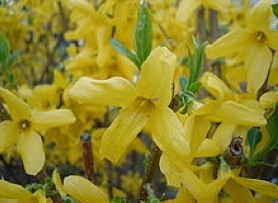
Forsythia

Foraging For Forsythia

If you study the eating habits of Native North Americans you learn one thing quite quickly. They weren’t mono-green eaters. What I mean is, they usually didn’t eat just one green species of plant at a time.

Today when we have a meal we often have one green food, say string beans or spinach. That serving comprises the entire green portion of the meal. The Natives simply did not do that. It was a leaf here, a blade there, a shoot from over yonder, all mixed in together. From such meager foraging a meal is made. And while the Forsythia was not on their menu it’s one of those little edible you usually mix in with other things.

For a very common ornamental that has also liberated itself there is nothing about the Forsythia as an edible plant in my entire library, which is now around 100 books plus papers, DVDs et cetera. Yet the blossoms are edible raw, though they can be slightly bitter. They add color to salads and are a cheery garnish. The very young leaves are also edible raw but that’s iffy as they contain some of the glycoside Phillyrin, and it’s debatable just how nasty that is. Very young leaves have also been added to soups. As you can see the key is “very young leaves.” I suspect we know these things because some folks in were very hungry for anything green in the spring after long winters.

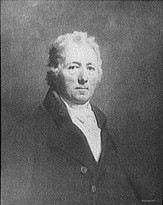
William Forsyth 1737-1804

The Forsythia genus is named for the Scottish botanist William Forsyth. He was the royal head gardener and a founding member of the Royal Horticultural Society. He is also credited with (intentionally) building the first English rock garden. As a bit of genealogical history the British entertainer Bruce Forsyth is a descendant of his.

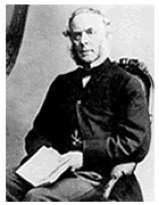
As a native to China the Forsythia was introduced to the rest of the world by fellow scotsman Robert Fortune, below right, a famous/infamous plant hunter. It was Fortune who single-handedly smuggle the plants and know-how to make tea out of China establishing it in India, a bit of botanical espionage from which China has only recently recovered. After 250 years China now leads India in tea production. Fortune, who did not know much Chinese or botany did so disguised as a Chinese peasant. And now you know why the British drink tea. They had wars with China but India was their colony. So they planted tea in a friendly place, or occupied place. Views vary.

Robert Fortune 1812-1880

There are about a dozen species of Forsythia, depending upon who’s counting and if you include at least one hybrid. Most of them are native to eastern Asia but one is native to southeastern Europe. There are also many cultivars including dwarf and compact forms. F. suspensa, the weeping Forsythia, is an important herb in Chinese medicine and has been used for at least three thousand years, perhaps four. Called lian qiao it’s unripe yellow fruit and seeds are ground together. Lian qiao is used internally for chills, fevers, headaches and externally for burns, infections, rashes and the like. Lab tests show the seed to be anti-inflammatory (Rouf et ali 2001 and an anti-oxidant (Schinella et ali 2002.) But a 1991 study of 102 raw pharmaceuticals used in traditional Chinese medicine (Yin X et ali)  suggested lian qiao might be potentially cancer causing, perhaps that glycoside issue again. In 2009 (Wang F.N.,  et ali) found three new glycosides in the F. suspensa bringing the total to nine. Forsythia extracts are used in commercial products treating dandruff, acne, and athlete’s foot … Sticking with just the blossoms in a seasonal salad seems wise.

Like the Eastern Redbud (pink) and the Chickasaw plum (white) the Forsythia blossoms on naked branches before its leaves appear, giving us a seasonal flame of yellow. Each of those species use the massive show of color (and ultraviolet markings) to attract early pollinators. Forsythias are found in most urban areas but they have also escaped cultivation making them quite easy to find in spring. Just look for small yellow flowers and no leaves. A tree with no leaves and large yellow blossoms might be the yellow tabebuia which has little use unlike its relative the pink tabebulia. 

Oddly, or perhaps understandably, gardeners have a love/hate relationship with the Forsythia. For a fortnight every year it is the darling wherever it grows. Then it is rather boring for 50 weeks.  But that doesn’t deter some people. There is a Forsythia festival every year… the second week in March… in… Forsyth, Georgia, about one hour south of Atlanta. If the weather is bad the festival goes on anyway. Forsythias wait for no one. (And yes, there is a Miss Forsythia pageant.)

 Green Deane’s “Itemized” Plant Profile

IDENTIFICATION: Forsythias have narrow, dark green leaves with a lighter underside, in opposite pairs, the margin is serrated. There are also a large number of variegated and golden leaved varieties. Yellow flowers, four narrow petals at right angles form a short tube. One to three flowers per node.

TIME OF YEAR: Your spring

ENVIRONMENT: Sunny, well-drained soil, may need extra watering in dry spells

METHOD OF PREPARATION: Blossoms raw, or cooked but usually raw, slightly bitter. Very young small leaves raw or cooked. Exercise caution with the leaves.

HERB BLURB

Below is the abstract of a study in its entirety. Perhaps something is lost in the translation, or I am reading it wrong. But, the last sentence seems to say don’t worry about phillyrin or forsythiaside in the tissue of the dog you are about to eat because the dog eliminates them from its system quickly. (No, I am not kidding….)

Pharmacokinetics of phillyrin and forsythiaside following iv administration to Beagle dog. Li YX, Peng C, Zhang RQ, Li X, Jiang XH.

Chengdu University of Traditional Chinese Medicine, Sichuan, China.

Abstract

The objective of the present study was to firstly investigate the in vivo pharmacokinetics of phillyrin and forsythiaside in beagle dog. On I.V. administration, a rapid distribution was observed and followed by a slower elimination for phillyrin and forsythiaside. The mean t(1/2Z) was 49.99, 34.87 and 43.81 min for 0.19, 0.70 and 1.43 mg/kg of phillyrin, and 60.90, 64.30, 57.99 min for 0.62, 1.39 and 5.52 mg/kg of forsythiaside respectively. And the AUC(o-t) increased linearly from 36.51 to 160.22 microg x min/ml of phillyrin and from 50.63 to 681.08 microg x min/ml after the three dosage administrated. In the range of the dose examined, the pharmacokinetics of phillyrin and forsythiaside in beagle dog was based on first order kinetics. Although both drugs were widely distributed to various tissues in the dog, no concerns about extensive binding to tissues that may be consumed by the public should a dog be exposed to phillyrin and forsythiaside according to the rapid elimination.


{ 6 comments }

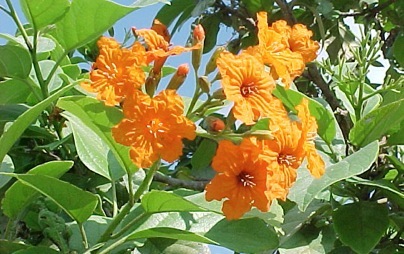
Geiger Tree, Scarlet Cordia

Cordia sebestena: Foraging Geiger Counter

Foragers eat the mild fruit of the Geiger Tree and care not about the particulars. Botanists care about particulars and can’t agree where it came from but they are pretty sure it is not a Floridian but in Florida it was named.

The Geiger Tree got it’s name from no less a person than John James Audubon. But, before I explain that, the record should be set straight about Jean-Jacques Fougère Audubon.

John James Audubon

He was born a French citizen in Haiti, went back to France as a boy then to the US at age 18 to avoid being drafted into the French army by Napoleon.  He learned English from Quakers and used “thee’s” and “thou’s” long since passe even then. That he was a bigger than life personality and an innovative artist is quite true and worthy of mention. His drawings did promote interest in nature. But you should know that the National Audubon Society is far more nobel than the man whose name they perpetuate.

The society not only had no substantial connection to Audubon but is an advocate of nature. Audubon raped nature. He kill scores, many times hundreds of just about every creature he ever drew. And that is not an exaggeration. He was not a protector of nature by any definition. A bad day was a day he did not shoot several hundred birds. He was a one-man extinction machine. Even by the standards of his day he was an excessive hunter when he did not have to be.  Conservation was not in his vocabulary. As an old man he changed his mind but I am not sure that has any value. It did not bring back the tens of thousands of the creatures he dispatched. Food is one thing, wholesale saughter is another. Since he was famous for his painting of birds it was a good marketing strategy for the nature group to call themselves the National Audubon Society. The irony is that the society is all about being good to nature while Audubon himself was all about being bad.

As for the Geiger Tree…  John H. Geiger was a sea captain, harbor master, salvager and pirate based in Key West, which at the time was the richest city in America. He made a lot of money legitimately and illegitimately and had a mansion there, though then the key was called Thompson Island. Audubon saw the Geiger House in 1832 while (hunting of course) and sketching 18 bird pictures. Geiger had reportedly planted two Cordia sebestena on the property — it is the prettiest of the genus. (I doubt a swashbuckling pirate would plant a pretty tree so maybe Mrs. Geiger deserves the credit. ) Audubon used one of them in a drawing prompting the tree to be called the Geiger Tree.  Audubon wrote:

“The Rough-leaved Cordia

This plant, on account of its large tubular scarlet flowers, is one of the most beautiful of the West Indian trees. I saw only two individuals at Key west, where we supposed, they had been introduced from Cuba. They were about fifteen feet high, the stem having a diameter of only five or six inches. They were in full bloom in the early part of May, and their broad deep green leaves, and splendid red blossoms, mingled with the variety of plants around me, rendered their appearance delightful. Both trees were on private property, and grew in a yard opposite to that of Dr. Strobel, through whose influence I procured a large bough, from which the drawing was made, with assistance of Mr. Lehman. I was informed that they continue to flower nearly the whole summer.”

Audubon, by the way, did not stay at the now “Audubon House” while in Key West.  He slept aboard the revenue cutter Marion.  The Marion and crew escorted Audubon and entourage plus his dog Plato around the keys and Dry Tortugas for six weeks in April and May 1832. They were the coast guard of their day and saw much action.

Geiger fruit edible raw or cooked

The Cordia sebestena (KOR-dee-uh seb-ess-TAY-nuh) has been planted through much of the warm world for its scarlet flowers and edible white drupes. While the fruits are edible their smell is better than they taste. Cooking improves their flavor some. They are also fibrous. The tree also has a long medicinal history. Where it is from is a debate, from Cuba to the West Indies to South America. The teapot tempest rages on. The fruit of the C. alliodora is also edible.

Cordia (which means late) was named for father and son German  botanists/pharmacists/physicians Euricius Cordus (1486-1535) and Valarius Cordus (1515-1544.)  Euricius (Heinrich in German) was a professor and the 13th son of a farmer named Urban Solden. As number 13 little Heinrich was called the “late one” or in Latin Cordu. He kept the name as a last name when he Latinized his name as many educated people of that age did, going from Heinrich Urban Solden to Euricius Codus.  His son, Valarius Codus, died at 29 of malaria while in Rome but had already established himself as an intellectual heavyweight of his age. His posthumous publications bolstered his reputation even more.  Sebestena is from Sebesten, a name given to a related tree with similar fruit.

 Green Deane’s “Itemized” Plant Profile

IDENTIFICATION: A small tree, usually under 25 feet, upright slender branches, leaves drop in cold or dry periods. They are alternate, ovate, pointed , sometimes slightly toothed near tip, five inches to a food long, three inches to half a foot wide, dull, rough hairy above, and pale and nearly smooth below, in clusters at the ends of branches. Flowers scarlet or orange, funnel shaped, five to seven lobes, slightly crinkled, one to two inches wide, showy flat terminal clusters. The calyx (fruit) is conical or pear-shaped one to one and a half inches long, white, pleasantly fragrant, with one or two large dark brown seeds.

TIME OF YEAR: Spring to late fall

ENVIRONMENT: Hammocks, sand dunes, landscaping

METHOD OF PREPARATION: Fruit is juicy and edible raw (not the seeds.) Cooking improves the flavor.


{ 2 comments }