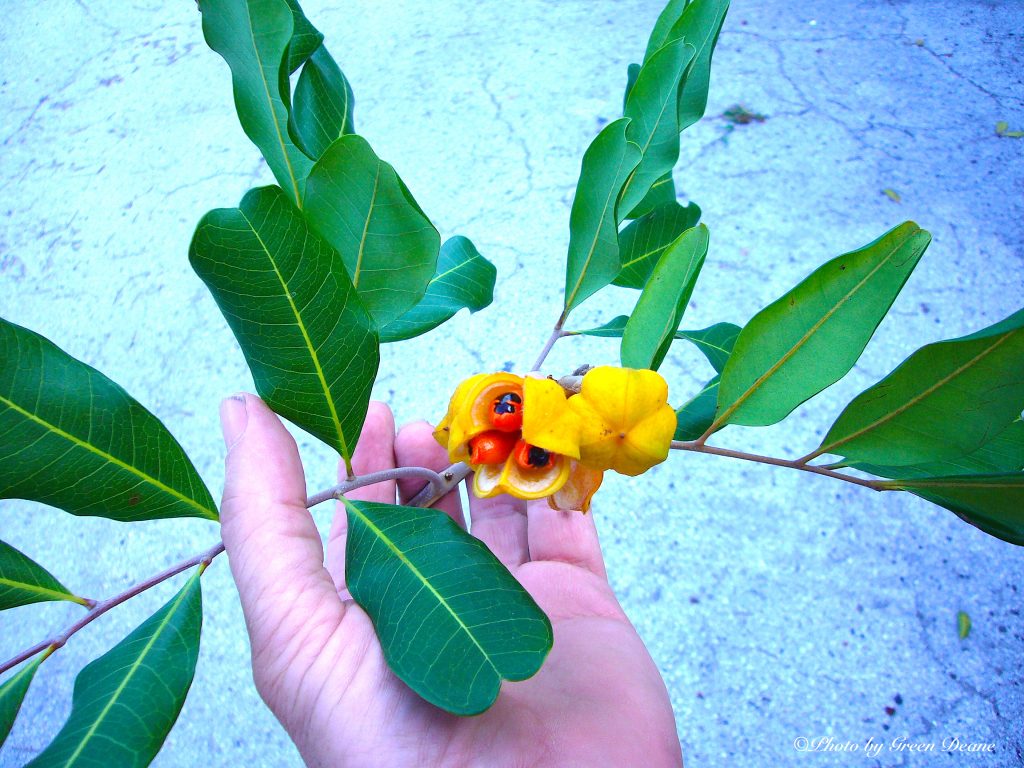
Juglans nigra and butternut, too!

Black Walnut, Juglans nigra

I didn’t see my first Black Walnut tree until I was in my 40s. It so happened that the two places I lived the longest, Maine and Florida, are on both ends of the tree’s range. I lived a little north of the range and half a state south of the range.

However, I visited Alexandria, Virginia for an extended time and one day while jogging along a park trail there was a walnut tree covered with green mana. I went back later that same day and carried home all that I could carry (and did so for several weeks.) Then came the hard work. Walnuts are delicious, but they don’t give up easily.

The walnut most people buy are actually Juglans regia, (JEW-glanz  REE-jee-uh) or “royal walnut.” They are also called English walnuts because English merchants popularized that particular nut, which is grown in the Balkans. You can find it from Greece to southwest China.  The North American walnut, which is smaller and tougher to crack, is the Juglans nigra (JEW-glanz NYE-gruh), the Black Walnut.

Written references to the walnut are some 4,000 years old. About 1795 BC, Hammurabi mentioned them in a code of laws governing food. The Greeks were the first to systematically improve the species they got from Persia. The walnut is in Greek mythology in the story of Carya.

The god Dionysus (Dennis the Menace) fell in love with her. When she died, he changed her into a walnut tree. The goddess Artemis (Dianah) told Carya’s father the news and he ordered a temple be built in her memory. Its columns, sculpted from wood, were in the shape of young women. They were called catyatides, or nymphs of the walnut tree. Three famous stone  Catyatides (and one cement substitute) are still standing at the Acropolis in Athens.  Carya, incidentally, is the genus for hickories and pecans.

From Greece walnuts went to Rome around 100 BC and from Rome to Spain and France. When they got to England is a bit of a debate, from 400 AD to the 1400’s but the Old English name for walnut also started around 400 AD.  The common walnut came to North America via the Spanish in California in the 1800’s. California leads the nation and the world in walnut production. Some 99% of the commercially purchased walnuts in the United States come from California, and 65%, almost two thirds of the walnuts consumed in the rest of the world come from California. The common walnut, J. regis,  lives to about 60 and grow, on average, to 60 feet.
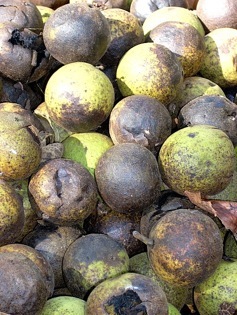
Black Walnut

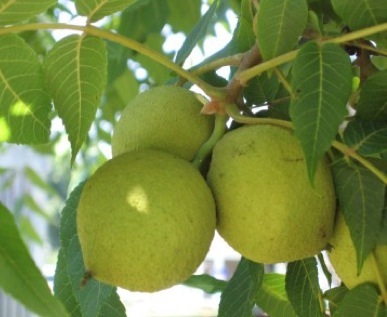
The American native, the Black walnut, J. nigra grows from New England west to Minnesota south to the Gulf of Mexico and across northern Florida. It can grow to 60 feet and can live past 100 years. Black Walnut trees are more valued for their wood than their walnuts. However the walnuts are used in baking, ice cream, and candy. The walnuts can be shelled into large pieces if soaked overnight in water. The nutmeat is crunchy and spicy.

A favorite of my family was the Butternut or White walnut, Juglans. cinerea. (JEW-glanz sin-EER-ee-uh.) It’s closely related to the black walnut and has oval-shaped nuts, with a thick shell with white kernels. The best flavored of the walnuts, it was prized in my family for homemade butternut ice cream. It was one of my mother’s joys in life. There was a butternut orchard nearby. The nuts are sticky, hull easily, and in three segments. And delicious. J. cinerea can grow to 100 feet  and live around 75 years and is the most cold tolerant of the walnuts.  Like black walnut trees, the roots of the Butternut tree release a phytotoxin that keeps many other plants from growing near it.

The Black Walnut is the most common walnut among foragers. They’re shaped like basketballs two inches in diameter and are usually ready for harvest in late summer or early fall.  Try to get the nuts off the tree if possible, and good ones on the ground. Remove the husk and let the nut dry which “cures” it. After curing they can be stored shelled or unshelled. Two pounds of walnuts off the tree will produce about a cup of nutmeat.

To process them, first do with the walnuts what you do with acorns. Put them in water and discard any that float. Kernel quality can be ruined by insects; darker than usual husks may be evidence of insect damage. The water test gets rid of most but not all of the bad nuts. (Check those floating walnuts for edible grubs.)

Hulling walnuts is dirty, difficult work. A dye from the husk can stains your hands, clothes, tools and work surfaces. If the nuts are dry you can pound the hull side to side with a hammer. You can also use a cement mixer with three parts nuts to one part water plus a handful of rocky gravel. Actually driving over them is dangerous in that the pressure can cause the nuts to pop out and hurt someone. Lastly, you can get a walnut sheller. After hulling, wash the unshelled nuts. Don’t compost the hulls because walnut hulls can suppress the grows of other plants. Tomatoes and apples, for example, won’t grow near walnuts.

After removing the husks walnuts have to be cured. Curing lets the walnut develop flavor. Stack the clean hulled nuts in shallow layers,  put in a cool, dry, ventilated area out of sunlight for two weeks. A nut is cured when the kernel breaks crispy with a sharp snap. If you don’t cure them correctly they will mold. Store at 60F or less.  Ideal humidity is 70%

When you’re ready to shell the walnuts, put them into hot tap water and soak for a day. Next day put them in hot tap water again for about two hours. Then shell. In a sealed jar in the refrigerator nutmeats can stay good for up to nine months, two years if frozen.
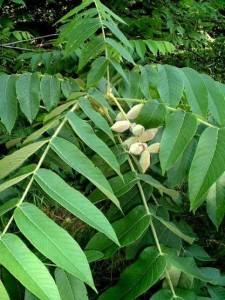
Butternuts

As for the scientific name Juglans… Carl Linnaeus, who thought up naming plants and who was the main man at doing so until he died, had a dirty mind. He was an R-rated professor. Many of the names he picked were not only risque — perhaps he was running out of ideas — but one wonders how he came up with some of them:  Amorphophallus titanum and Capparis cynophallophora come to mind.

Amorphophallus titanum means large shapeless penis — which seems a contradiction in terms.  Cynophallo… means  “dog penis.” So the plant’s name, Capparis cynophallophora, means “dog-penis bearing caper.” And while I am no expert on dog anatomy I have seen the latter plant and I have no idea what Linnaeus was thinking. Which brings me back to Juglans.

Linnaeus made up “Juglans” from “Jove’s glans”  meaning the end of Jove’s penis. Having collected a lot of walnuts I would have thought “Jugorchis” would have been more accurate (Jove’s testicle.)  And who said plants aren’t sexy?

Some food authors, who know little about language, say Juglans means “Jupiter’s acorn” which it does but that is still referring to the same part of the male anatomy for the acorn was named, or vice versa. Then they soft pedal and say Juglans really means “a nut fit for Jupiter.” Frankly, their ain’t no polite way around it and be accurate.  Linnaeus was the original dirty old man. As for the other parts of their name. Nigra is easy: That means black. Regia royal, and Cinera means “ash-colored.”  We still see those words in “regal” and  “cinder.”

The word “walnut” is G-rated and comes from the Old English phrase “wealh nutu” which means “foreign nut.” Variations of “wealh” are with us today as in Welsh” and the name ” Vlach.”   In fact, in some parts of England walnuts are still called Welchnuts. The walnut was foreign to the English of yore because it came to them via the Romans from what is today France. When Latin was still the language of the educated, and “walnut” has not been adopted,  it was called nux Gallica meaning  “Gallic nut” or French nut.

Lastly, the most unusual use of walnut oil: The ancient Egyptians used it for embalming fluid. I like it on salads.

Green Deane’s “Itemized” Plant Profile


IDENTIFICATION:

A large tree with compound leaves, alternately arranged on the branches. Each leaf has 15-23 leaflets; the terminal leaf is often missing; leaf surface is dull with a slightly hairy or downy texture on the underside.

TIME OF YEAR:

Late summer, fall. Husk changes from solid green to yellowish green. Press the hull of the walnut with your thumb; ripe nuts will show an indentation. Monitor over a six week period as nuts will mature over that time. Try to harvest off tree than the ground.

ENVIRONMENT:

Moist, well drained soil, along streams, in mixed forests.

METHOD OF PREPARATION:

Harvest, hull, dry (cure) nuts at least two weeks, soak before shelling. Nuts are cured when the are crispy and snap when broken. Use as regular walnuts. For another application see recipe below.


Walnut Liquor

25 dehusked green walnuts, about the size of home-grown apricots

3 cloves

1 stick cinnamon

peel of 1 lemon (yellow part only; no white pith)

1 quart of vodka, 100 proof

3 cups sugar

1/4 liter of cheap sparkling wine (alternative recipe)

1. Soak the walnuts overnight to draw out any worms and other impurities.

2. Quarter them and put them into a large jar with all other ingredients.

3. Place in a sunny spot, sealed, for at least 40 days; 2 months is better.

4. Shake every few days.

5. Strain and bottle the liquid. Let it sit for another month or two,

minimum. At that point it’s drinkable, but if you can, put a few bottles

away to age. After two or three years it really becomes something special.


Some make a second, less potent liqueur by adding 2 cups

of alcohol, a cup of sugar, and a bottle of cheap sparkling wine to the

solids you filter out of the mix. Let that mixture stand another couple of

months, shaking occasionally.

{ 66 comments }

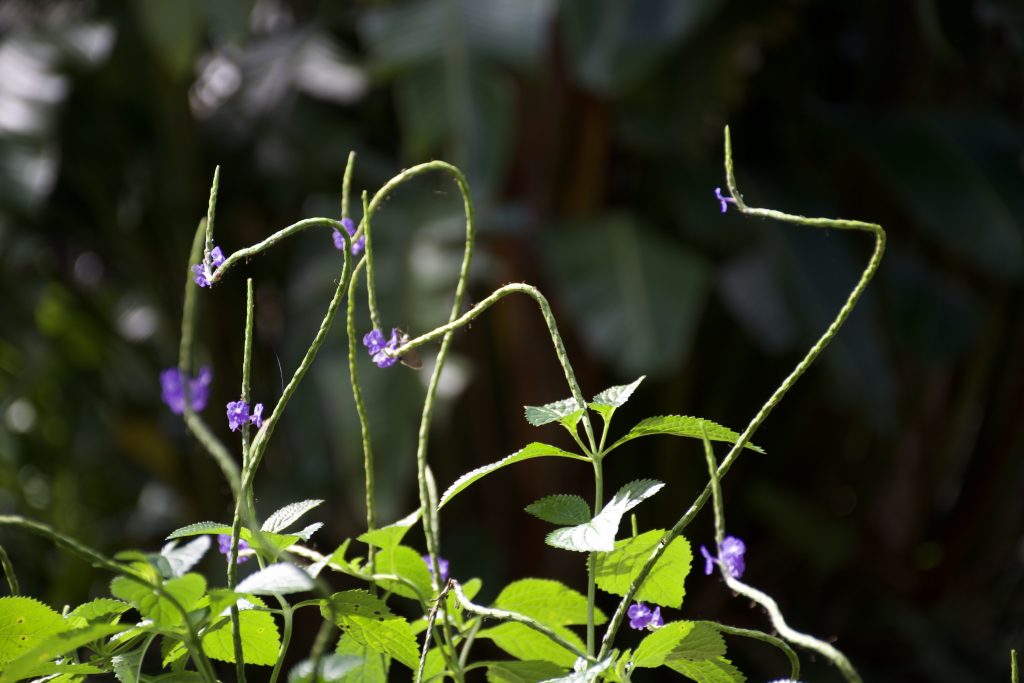
Tall Blue Porter Weed. Photo by Green Deane

Stachytarpheta jamaicensis: Near Beer

Should the civilized world come to an end and you have a hankering for a stout beer you’re in luck: You can make one from the Blue Porterweed, Stachytarpheta jamaicensis. And if a beer is not to your liking, then you can make it into a tea with a beer-like foam.

Porter is a dark brown beer on the bitter side. A stout is a strong porter. Porter’s Beer, Porter’s Ale, Porter House Steaks all go back to shops that serviced porters and laborers in England as early as the early 1700’s. The Central American brew made with the Blue Porterweed got its name by the dark color and bitter flavor of that ancient ale.

The tea side of the Blue Porterweed is better known. It was once exported from Brazil as Brazilian Tea and was also used to stretch “Chinese” tea. In fact it is still used in Brazil today. It is drank for taste or medicinally.

Beer and tea is not the plant’s only claim to fame, besides a long list of herbal uses (see the herb blurb below.)  It is a mainstay of almost every butterfly garden. Because of the plant’s growth habit of sending up a spike that then flowers out continuously it is butterfly fast food. Attracted to it are skippers, viceroys, monarchs, and queens, among many.

Tastes like mushrooms

Stachytarpheta is from the Greek words stachys meaning spike and tarphys which means thick or dense. This is reference to the flower spike.  How that is said is a bit of debate. In Latin they say steak-ee-tar-FEE-tuh. In Greek, which is what the words are, the first “A” would be short: stah-ee-tar-FEE-tuh.  Jamaicensis means of Jamaica — read Caribbean — and is said jah-may-CEN-sis. At any rate some think it got to Florida around 1700 from Jamaica and then butterfly gardens around the world.

How did they make the beer? No one seems to report that. The way to do it is make a tea of suitable taste and then add sugar and yeast, which is how the soft drink Root Beer started out, as root tea.

I learned from my good friend Ryan (husband of forager Sunny Savage and good friends of mine) that the blossoms taste like mushrooms. And they do! Delicately so. I’ve never found a reference for said but Ryan said they ate them in Hawaii where he grew up. I’ve tried them. Tasty and quite surprising.

A few words of caution: Don’t mistake Vervain, Verbena Officinalis, which has some edible parts, for Blue Porterweed. There is some resemblance but Vervain branches more freely, has plump bloom tips and the leaves are more lance shaped whereas the Blue Porterweed tends to have oval leaves, less branching, and has a long skinny flowering tip that is skinny to the end. Stachytarpheta urticifolia was historically used in Bangladesh to induce abortions. Research with mice in 2004 confirmed that effect. 

Green Deane’s “Itemized” Plant Profile

IDENTIFICATION:

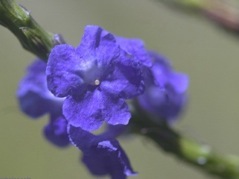
A low shrub that trails on the ground, tips rising up, no taller than a yard, usually much less, one or two feet,  stems angled, leaves opposite, oval to lance shaped, dark green one to four inches long, edges distinctly toothed. Five petal blue flowers grow on a spike, a few at a time opening only one day. There are several related species: Remember, it is a short plant with blue flowers. If it came from a nursery it is probably NOT the right plant.

TIME OF YEAR:

Year round, spring to fall in more northern climes.

ENVIRONMENT:

Sand dunes to pine forests to scrub land and even occasionally wetlands. Naturalized in Florida, Alabama, Hawaii and Puerto Rico. Found in seasonal flower gardens

METHOD OF PREPARATION:

Dry the leaves, use like Chinese tea, or brew beer, blossoms as a trail side nibble. You can also use the spikes as a flavoring ingredient like a bay leaf.

HERB BLURB

2003 Abstract: The anti-oxidant effects of ethyl acetate (EAcE) and n-hexane extracts (nHE) of dried leaves of Stachytarpheta jamaicensis Vahl. (Verbenaceae) on the reactive oxygen species (ROS) generating during the respiratory burst of rat peritoneal macrophages were investigated. Only EAcE, at concentrations between 0.4 and 40 µg/ml, inhibited the extracellular release of oxygen radicals by resident peritoneal macrophages stimulated with phorbol-12-myristate 13-acetate (PMA). At concentrations above 40 µg/ml, EAcE inhibited the production of nitric oxide (NO) in macrophages stimulated in vivo with sodium thioglycollate then in vitro with lipopolysaccharide (LPS) and gamma-interferon (IFN-). nHE extracts at concentrations between 0.4 and 40 µg/ml did not scavenge O-2 generated enzymatically by hypoxanthine/xanthine oxidase (HX/XO) system, but EAcE at the same concentrations showed potent O-2-scavenging activity. At 40 µg/ml, EAcE also inhibited XO activity. These results suggest that the EAcE extract of S. jamaicensis may be a potential pharmaceutical value in treatment of immunopathological diseases related to oxidative stress.

{ 20 comments }

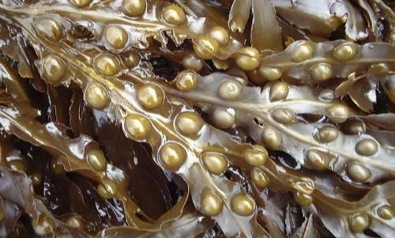
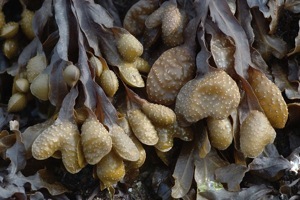
Bladderwrack in calm waters

Fucus vesiculosus: Edible Bladderwrack

Bladderwrack can wrack your brain.

Why? Because in some places it has bladders and is textbook perfect. And in others places it has few bladders and makes the pictures look wrong but also textbook perfect.  Why? Because the numbers of bladders varies with wave action. Less waves mean more bladders, more waves, less bladders. But best of all Bladderwrack is nutritious, edible raw and cooked. It’s also medicinal, and like many things that have a medicinal applications, the flavor is strong.

Bladderwrack in turgid waters

Also called seawrack and rockweed, it can be used sparingly in soups and the like, depending upon your like or dislike of the flavor. It tastes like salty fish. Bladderwrack can also be dried for future use. On dehydration it turns black. (Slow roasting after drying with a little oil until brittle helps.) In large amounts it can be laxative. And of course, it can be eaten raw though try to get it in ocean waters not fertilized by human waste.  It has also been used as fertilizer, being high in potassium, and also to smoke meat and fish.

Fresh Bladderwrack is green to orange to olive to brown, the brighter the fresher. Found between high and low tide, it  lives three years and is firmly attached to the bottom, preferably to rocks usually in northern waters. To my knowledge, all Fucus are edible, but they vary significantly in description and will grow in the same locale.  Consult you local expert. Sagassum used to be Fucus, such as the F. natans, but now has its own genus and is Sagassum natans (see my Sagassum entry.)

Fucus vesiculosus has been well-researched. It’s rich in dietary fiber, antioxidants and iodine. (In 1811 iodine was discovered in Fucus, the original source for it.) Bladderwrack lowers plasma cholesterol levels and has been used in anti-estrogen therapy, actually increasing the length of the menstrual cycle.   (See Herb Blurb below.)

Fucus (FEW-cuss) comes from the Greek word “phykos” (FEE-kos) meaning seaweed.  Vesiculosus (ves-see-kew-LOW-sus) is Latin and means with bladder. Natans (NAY-tanz) is floating. Fucus is sometimes incorrectly called kelp. In the past several seaweeds were burned to create soda ash which was called “kelp.” The seaweed kelp and the Fucus are different seaweeds.

Green Deane’s “Itemized” Plant Profile

IDENTIFICATION: A perennial attached sea-weed, with a hard flattish root,  frond ranges from a few inches to four feet in length, and to an inch in width, flat with midrib throughout length, occasionally twisted like a spiral, branches often notched at the end. Air sacks vary from the size, from a pea to a marble,  in pairs, at irregular intervals; sometimes 2 or 3 pairs are next to each other, rarely totally absent.

TIME OF YEAR:  Year round

ENVIRONMENT: Shoreline, between high and low tides, prefers protected areas. Found in northern waters, in the United States North Carolina and central California northward. Usually collected at low tide.

METHOD OF PREPARATION: Raw or cooked, boiled or steamed, can be dried, strong flavored.

HERB BLURB

Bladderwrack contains: Iodine, algin, mucilage, bromine, sodium, potassium, lutein, zeaxanthin, chlorophyll, cellulose,  mannitol, silicon, essential fatty acids, vitamin C, B-vitamins, beta-carotene, zinc, magnesium, selenium, manganese, iron, phosphorus, iodide, oleic acid, polyphenols, protein and fiber.


{ 14 comments }

Guapira discolor: A Blolly by Golly

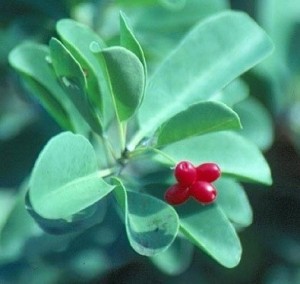
The Blolly confounded me when I first saw the tree for it was growing by itself in a park. The fruit is quite distinct, a red cylinder with a dimple at the end. I thought I could identify it quickly but didn’t. Then, as often happens, I was looking for something else and identified it.

Blolly fruit has 10 subtle ribs

This tree has long been associated with White Crowned Pigeons, particularly capturing them. Apparently they favor the berries and is their second most common food throughout the year; fig berries are dominate part of the year and Poisonwood berries the rest of the year.  Tanagers, catbirds, warblers… and Iguanas like them, too. The tree’s twigs, which are strong and flexible, were used to make wattle. That’s when you fill a frame with a lattice then mud it in.  Called Wattle and Daub, it’s a construction technique at least 6,000 years old and still in use in many parts of the world. Wattle and Daub making a comeback because it’s “sustainable.”

One little confusing aspect about the fruit is that it is faintly ribbed and has 10 ribs. But, you would not notice them if they weren’t pointed out to you. They usually are not obvious. Some writers mention them, some don’t.

Botanically, the Blolly is Guapira discolor (gwah-PEER-uh DIS-kol-or.) Guapira is a combination of two native words usually given as wa’bi rob which sounds closer than it looks. They mean “to eat bitter.” Discolor means two colors, which the leaves have. Blolly is from an English word, loblolly, which refers to thickets growing in moist depressions.  Blolly means thicket after its characteristic growth habit.

Dr. Daniel Austin in is professorial book “FLorid Ethno Botany” says on page 333 the fruit is edible. A Bhama based website (Levypreserve.org) says the fruit is “highly toxic, Do Not Eat.”

Green Deane’s “Itemized” Plant Profile

IDENTIFICATION:

A shrub or sometimes a tree to 40 feet, tallest known is 55 feet; compact, round crown, with many crooked trunks, leaves opposite or alternate, elliptical to obvate, light green in color, leathery simple, one to two inches long, one half to and inch wide, wavy edge, rounded or notched at the end, on slender stalks, grooved. Veins are obscure except for the central vein which is yellowish green and translucent when held up to the light. Leaves start thin and thicken.  Flowers funnel shaped, lacking petals, to a half inch long. Fruit,slender, oval, juicy, half inch long, red, 10-ribbed, one tan cylindrical seed.

TIME OF YEAR:

Summer and fall, farther south all year

ENVIRONMENT:

Hammocks, coastal shrub, pine lands, landscaping, mid-state south. Very common in Miami and the Cayman Islands. In the topics the tree is often covered with a green lichen.

METHOD OF PREPARATION:

Ripe fruit out of hand.


{ 0 comments }
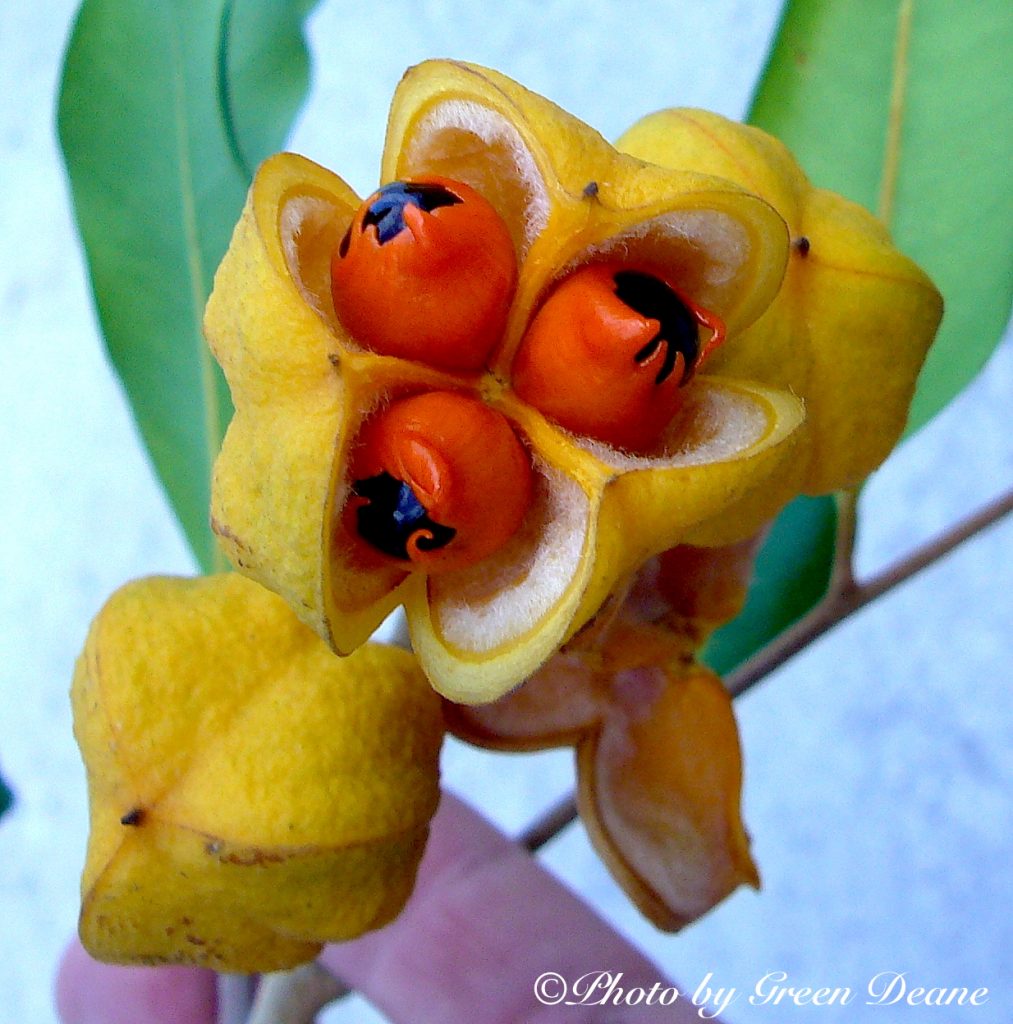
The arils on the fruit are reportedly edible.

Cupaniopsis anacardioides: An Aboriginal Treat

With a nickname of Tuckeroo, you know the Carrotwood Tree has to be from Australia, and it is. What foraging books in this hemisphere won’t tell you is that part of the ripe fruit is supposedly edible. (Many thanks to Lee Etherington at the www.bushtuckershop.com for doing some original Australian research for me. Please visit their site and watch the Bushtucker Man videos.)  That said, not all opinions agree on aril edibility and at least one source says the arils are not edible.

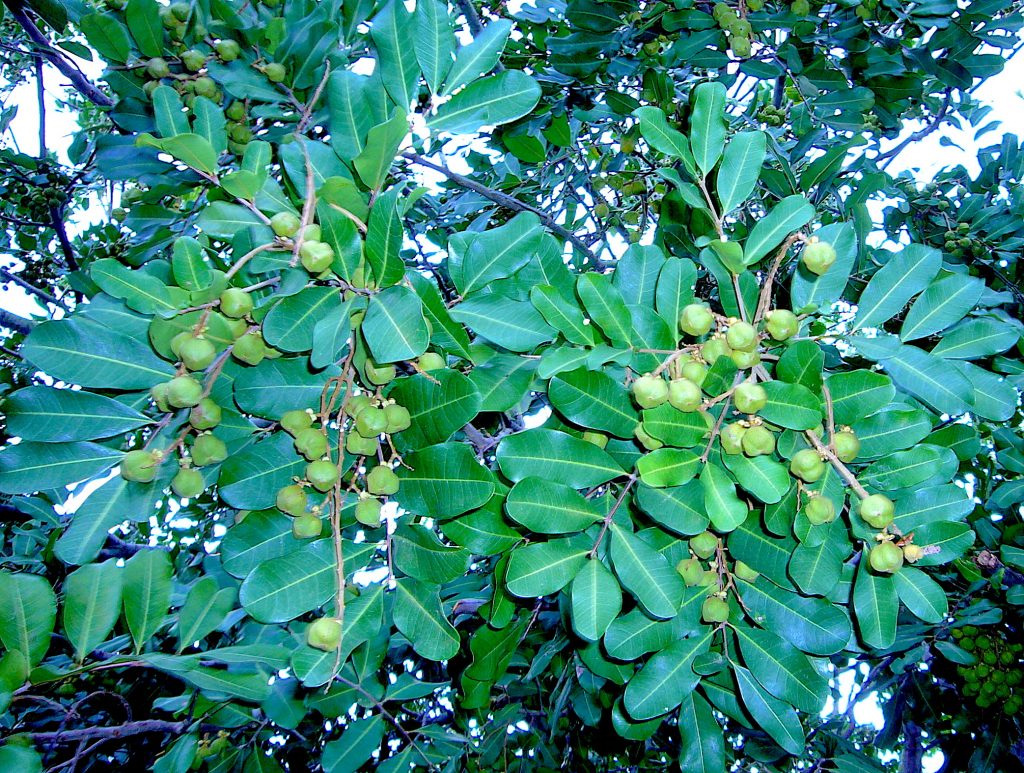
The leaves form uneven terminating pairs. Photo by Green Deane

Several governmental sources in Australia say the Aboriginals did indeed eat the ripe aril, some say it is toxic. I found it nearly tastless but it burns my mouth and upsets my stomach. I’m not sure how the Aboriginals considered it a treat. Perhaps I am missing a bit of information. In Australia the tree is also called the Cupania Tree and the Beach Tamarind. Botanically it is the Cupaniopsis anacardioides  (koo-pan-nee-OP-sis  an-nuh-kar-dee-OP-sis )

Carrotwood fruit attracts birds. Photo by Green Deane

One can find a lot about the evergreen C. anacardioides on the internet because it is on Florida’s hit list of invasive gawd-awful weeds. (I am beginning to suspect the best place to find edibles is on your state’s official weed list.)  The fruit  starts out green then turns bright yellow.  It’s a common tree on the east and north coasts of Australia and was imported in the 1960’s to Florida, Texas and California for landscaping. It has not become a pest in California. What caught my eye the first time I saw them was the distinctive shape of the fruit, three lobed comprised of six segments.

The tree’s status in Florida brings up several issues. You cannot own the tree without a permit, the state considers it so bad. Birds, of course, don’t apply for permits to eat the fruit. But then the political correctness kicks in. The state says there is no use for the tree. That is quite false. The wood is favored by wood turners and pricy. Seems to me cutting down the trees for turning reduces the population and generates income. The state just needs to sell the permits to harvest them.

Although called the Carrotwood Tree it wood is actually apricot to pink, close-grained and very tough. It has been used for lumber as well as turning. The tree can grow some 80 feed high and two feet through at the butt. Locally they are half that height and 20 inches thick.

Cupaniopsis means resembling the genus Cupania (which is named for Francesco Cupani, an 18th century Italian monk and natural scientist who wrote Hortus catholicus and is famous for his work with Lathyrus odorata.)  Anacardioides means resembling Anacardia (the genus name for Cashew.) Two resemblances…. they must of run out of ideas that day.  Several plants are called “tuckeroo” in Australia so make sure you have the right Tucheroo,  Cupaniopsis anacardioides.

One quick identification of the tree is the leaves are spatulate with a bit of an indentation at the end, and each branch ends in a pair of leaves slightly off set (whereas the Jambul tree end leaves are an equal pair.)

You can find them mid-state and south.

Green Deane’s “Itemized” Plant Profile

IDENTIFICATION: Small to medium tree to 30 feet. Leaves compound, 4-11 leaflets, glossy-green,  obovate to oblong, 5-15 cm long, 2-6 cm wide, end two leaves are always form a pair. Flowers yellowish, occurring in winter. Fruit orange, 15-30 mm diameter, short-stalked, three-segmented woody capsules up to 0.9 inches across that are yellow-orange when ripen and then dry to brown before splitting open to reveal three black seeds each covered by a yellow-red crust.

TIME OF YEAR: Flowers in Florida in late winter or early spring, January and February, with fruits maturing in April and May depending upon location, sooner farther south, later farther north.

ENVIRONMENT:Spoil islands, beach dunes, marshes, tropical hammocks, pine lands, mangrove and cypress swamps, scrub habitats, and coastal strands.

METHOD OF PREPARATION: Ripe aril eaten raw, not the seeds, not the pulp.  I know one source says the arils are not edible. I don’t eat them.

{ 23 comments }