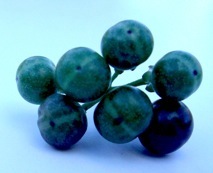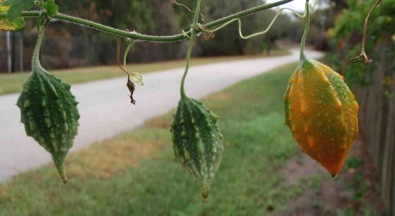
Bitter Gourd, edible only when green and cooked

Bitter Melon, Bitter Gourd, Balsam Pear: Momordica Charantia

If the Balsam Pear did not exist a pharmaceutical company would invent it.  In fact, there have been some ten studies published this past year about it, the latest as of this writing in February 2008 in the Journal of Food Biochemistry about its potential in diabetes treatment.

A very common, bitter vegetable in Asian cuisine,  the Balsam Pear, Momordica charantia,  is a natural drug store for diabetics and others. It’s not a pear at all but a fruiting gourd and vine that smells like an old, well-used gym shoe. Don’t say you weren’t warned.
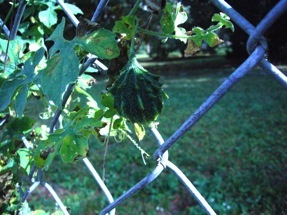
Young, green fruit are edible cooked

The warty gourd is edible when green (and cooked) but turns toxic/medicinal when orange ripe. It then splits characteristically into three parts, revealing red arils (fleshy seed covers).  The ripe seeds inside the arils and orange flesh of the gourd are toxic and can make one violently lose fluids from both ends, and induce abortions. The red arils around the seeds, however, are edible. And note this: The arils are 96% lycopene, which gives them their color. Just remember to spit out the seed from each aril.
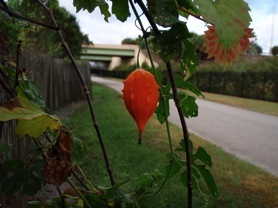
Fruit is toxic (or medicinal) when yellow or orange

M. charantia is found Connecticut south to Florida, west to Texas, also Puerto Rico and the Hawaiian Islands. Incidentally, the bitter melon has twice the potassium of bananas and is also rich in vitamin A and C.

The Latin genus name, Momordica, (mo-MOR-dee-ka)  means “to bite,” and refers to the jagged edges of the leaves, which appear as if they have been bitten. Charantia (char-AN-tee-ah) the species’ name, comes from Greek meaning beautiful flower.  It’s native to tropical regions of the world though no one knows where it came from originally, best guess Old World Tropics. Gray’s four-inch thick Manual of Botany, started in 1850 and revised in 1950, makes no mention of M. charantia in the United States but it is currently a serious crop weed in Florida and to 21 other crops around the world, bananas to soybeans. It’s a late comer to Florida or Gray was in the dark about it. In the Amazon, and as far away as India, it is used very much by local populations for food and medicine.  Apparently a  dynamic chemical factory, the M. charantia is being tested for treatment against cancer — leukemia in particular —  AIDS, as an analgesic, and to moderate insulin resistance. It is often called the vegetable insulin. It does not increase insulin secretion but “speeds up carbohydrate use of the cells by affecting membrane lipids.” Seems like the smelly gym shoe hanging on the fence has a great future. But, it is not for everyone: Don’t eat the vegetable if you’re hypoglycemic or pregnant. In diabetics it can lower blood sugar too effectively. It also reduces fertility in men and women.  And, it contains vicine: That can cause favism in people who have a variant glucose-6-phosphate dehydrogenase. (I presume if you don’t know what that is you don’t have it. Favism is a severe reaction to fava beans and or their pollen. Occurs most often in men of Mediterranean background.)
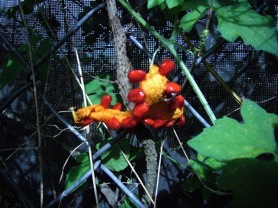
Red coating on the seeds is edible raw, but not the seeds

Cultivated versions of the M. charantia, also called Bitter Gourd or Wild Balsam Apple, are found in most Asian markets, and they, too, smell like an old gym shoe. The odor, thankfully, almost all goes away when cooked and the bitterness moderates, but does not go away completely. If you are not yet brave enough to pick your own, you can buy some or grow it yourself. There are many varieties and numerous recipes are on the Internet. The M. charantia is indeed bitter. Some cut up the vegetable and soak it in water, or salted water and or blanch it  to reduce the bitterness. (See recipe below.)
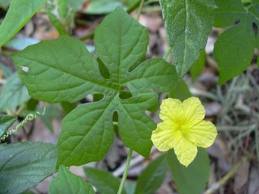
Bitter Gourd leaf and flower

While I have never seen an Asian family picking M. charantia off local fences here in Florida, I have seen many Hispanic families doing so.  Dr. Julia Morton, a plant professor in south Florida,  says besides the green fruit, the young leaves when cooked and drained are also edible and nutritious, with iron, phosphorous, calcium and vitamin C. I have never managed to get past the locker room bouquet to toss ‘em in a pot. The ripe fruit pulp has been used as a soap substitute, which should give you some idea of the flavor. In India and Africa the cooked leaves are canned like spinach. The fragrant flowers can be used as seasoning when cooking.

Incidentally, if you have a glut of green Bitter Gourds, you can slice them, partially boil them with salted water, then dry them, sun or otherwise. They will last for several months. You can then fry them and use as you like. Also, drinking the fresh bitter juice is recommended by some naturopaths. That ain’t going to be easy, it’s really bitter…. much easier to tell someone to do it than doing it yourself. Also there is one report that drinking vine juice killed a child. Caution is called for. 

REMEMBER: From my point of view as a forager no part of the Momordica charantia is to be eaten raw except for the red arils (and remember to spit the seeds out.)  No part, other than the arils, is to be eaten when ripe which is when it is turning from green to yellow to orange. Do not eat the yellow or orange fruit raw or cooked. It is medicinal and or toxic. That said let me qualify it some: I have met folks who eat the orange flesh raw and cooked but they have various medical goals which is beyond my pay grade and expertise. For that visit some herbalists publications or sites. Lastly, the green fruit is suspected in the poisoning of dogs and pigs.

Relatives: Momordica balsamina, which has longer spines on the fruit and can ripen to red, grows only in St. Lucie County in Florida and only a smattering of places in the southern U.S.  M. balsamina fruit can be pickled or after soaking used as a cooked vegetable. Young shoots and tendrils are boiled as a green. The seeds are eaten in cooked young fruit.  Momordica cochinchinensis produces a huge round fruit that is red when ripe. Young fruit boiled, not as bitter as M. charantia. Momordica dioica, small and roundish,  is more esteemed than the rest. It is not bitter but sweet. Fruits, shoots, leaves and roots are boiled for food. There are also at least seven commercial cultivars of the Momordica gourds

Green Deane’s “Itemized” Plant Profile

IDENTIFICATION: Momordica charantia: A slender, climbing annual vine to 18 feet with long-stalked leaves and yellow flowers where the leaf meets the stem. Young fruit emerald green turning to orange when ripe. At maturity, fruit splits into three irregular parts that curl backwards showing many reddish-brown or white seeds encased in scarlet arils.

TIME OF YEAR: Fruit, summer and fall in warm climates, fall in northern climes.

ENVIRONMENT: Love to climb, found in hammocks, disturbed sites, turf and ornamental landscapes, and citrus groves . It seems to be the most common vine on chain link fences in Florida.

METHOD OF PREPARATION: None of it ripe except the arils. Boiled green fruit (including seeds) leaves and shoots, boiled twice. Or, cut open and remove seeds and fiber and parboil.  Ripe parts toxic are too bitter to eat.  (An adult can swallow hole two ripe seed and not have much distress.) Young leaves and shoots are boiled and eaten as a potherb. Flowers used as seasoning.

HERB BLURB

Herbalists say the charantia has long been used to treat diabetes and a host of other ailments from arthritis to jaundice.

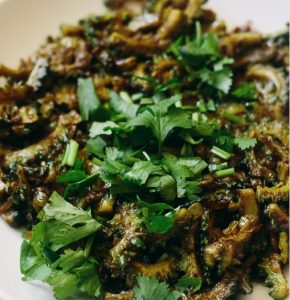
Karela Bhaji (Pan-fried Bitter Melon)

By The Domestic Man
  • Servings: 4
  • Difficulty: Easy

Karela Bhaji Pan Fried Bitter Gourd

1 lb Indian or Chinese bitter melon
1 ½ tsp salt, divided, more to taste
1 tbsp ghee
2 tbsp avocado oil
½ tsp cumin seeds
¼ tsp fennel seeds
1” ginger, grated
2 cloves garlic, minced
1 onion, finely chopped
½ tsp garam masala
½ tsp ground coriander
¼ tsp ground turmeric
¼ tsp kashmiri red chili powder
¼ tsp black pepper, more to taste
1 tsp amchur (green mango) powder
2 tsp coconut palm sugar
½ cup chicken stock
fresh chopped cilantro to garnish

1. Slice the bitter melon in half lengthwise; using a spoon, scrape out and discard the seeds and pith. Slice the melon into ¼” slices, then transfer to a colander suspended over a mixing bowl; sprinkle with 1 tsp of the salt and drain for 30 minutes. Gently squeeze and blot the melon dry to extract some of its bitter juices.

2. Warm the ghee and oil in a large skillet over medium-high heat until shimmering; stir in the cumin seeds and fennel seeds, and toast until aromatic, about 30 seconds. Stir in the garlic and ginger and saute until aromatic, another 30 seconds, then reduce heat to medium and add the onion, coriander, turmeric, chili powder, pepper, and remaining ½ tsp salt. Saute until the onion is softened, about 6 minutes. Stir in the bitter melon and chicken stock, and saute until the melon is tender and the liquid has mostly evaporated, about 10 minutes, stirring often.

3. Stir in the amchur powder and sugar; increase the heat to high, and pan-fry until any liquid has evaporated and the melon and onions begin to crisp, about 3 minutes, stirring often to prevent burning. Season with salt and pepper to taste, then serve garnished with cilantro.
{ 152 comments }

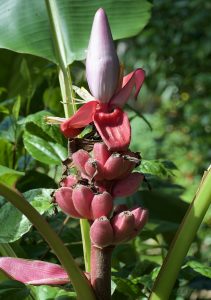
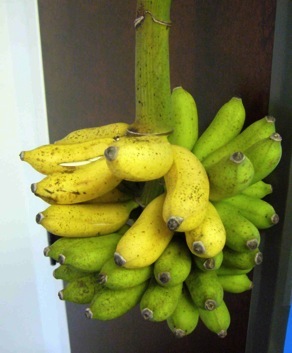
Home grown ripening banana hand, Photo by Green Deane

Bananas Trees:  Survival Food

Yes, everyone knows bananas are edible, as are their starchy cousins, the plantains. One doesn’t think of banana or plantain trees as weeds or a wild food but they are. More than that, as a survival food I know they can save lives. I’ve met several they’ve saved.

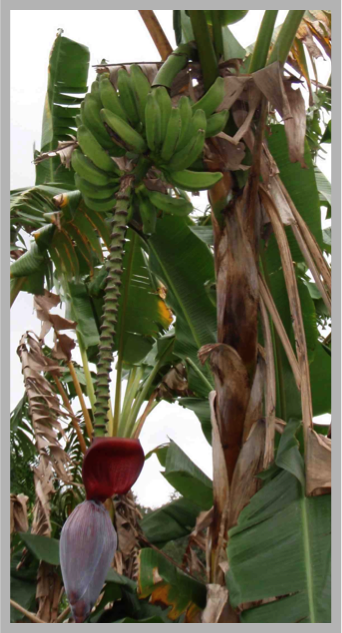
Banana tree and blossom. Photo by Green Deane

I had a friend who defected to the United States during the cold war. She did it while on tour as a national judo champion for Vietnam many years ago. She’s a pleasant woman, but not one to mess with for many reasons. She became a Judo champion in Vietnam after escaping Cambodia as an war orphan. The Khmer Rouge killed her entire family including cousins. At age seven she survived by traveling with other kids though the jungle from Cambodia to Vietnam living on whatever they could find for two years. There were just a few of them, none of them with any living relatives. They became their own family, and still are. In the jungle my friend learned that the banana tree provided more than just bananas.

Bananas are natives to Southeast Asia and are weeds. They’re also weeds in Florida. Many bananas have escaped cultivation, or were tossed in a compost heap and survived. I have planted a few cultivars and taken a few wild ones from hollows in abandoned orange groves. I have enough so that every year one or two will produce a stalk of fat, short, sweet citrusy bananas. Enter my friend: She still liked bananas.

As soon as one of my trees (correctly a pseudo-stalked herb) had a flower she lobed it off to take it home for a delicacy. She told me my tree will have better bananas if she takes the blossom. I let her have them. I figured if she still liked them then she can have them. She earned the hard way the right to enjoy life.

The flower can be eaten raw or cooked. More so, the banana edibles don’t stop there. The core (and root stalk) of the banana’s trunk is also edible. It is used, notably, in the Burmese dish mohinga. Banana stalks are available year round where ever bananas grow. Incidentally, a juice extract of the core is used to treat kidney stones. Also, the sap of the tree makes an excellent glue as is. And I should mention the leaves. Banana leaves are large, flexible and waterproof. They can be used as umbrellas. One can often find holiday food wrapped in them in Asian markets. Besides wrapping, they can be used to steam, roast, carry and pack food. They can be used as plates. They also contain a lot of oil and can be used like a frying pan to cook eggs.

And now a bit of botany. Bananas in the wild have seeds. Big seeds. There are about 1,000 different bananas and most of them have large, extremely hard seeds, from the size of a pea to the size of your thumb nail. More so, they also have bad tasting fruit. A natural mutation led to seedless bananas, but now the seedless ones are threatened by a fungus epidemic. In fact, in five years there might not be any seedless bananas. However, should you find a banana with seeds they can be ground into a flour. Should seedless bananas not disappear you can also make beer out of bananas… banana beer…No, I haven’t tried it, but I’m tempted.

There are two botanical names for most edible bananas. Commercial bananas are cultivars of the Musa acuminata. Musa (MEW-zuh) is from Arabic and means banana. Or, named for Antonius Musa (63-14-BC) a physician to the first Roman Emperor, Octavius Augustus.  Acuminata (ah-kew-min-AY-tuh) means sharp pointed, I imagine for the pointy fruit. Most of the bananas grown on private plots are cultivars of the Musa balbisiana (bal-bis-ee-AH-nuh) which was named for Giovanni-Batista Balbis, a 19th century Italian botanist. The word “banana” also comes from the Arabic word “banan” which means “finger.” One banana has about the same nutrition as a potato.

Incidentally, there are two known banana allergies. If you are allergic to birch you will probably be allergic to bananas, or vice versa. That seems strange but it is a fact. Also, folks with a latex allergy can be allergic to bananas.

As for my friend… the ones that survived the jungle escape, the ones with no family… They call each other “cousin,” and they keep in touch, visit, help each other, a “family” forged out of hardship, not kinship. Many of them now live in the United States. I’ve met a few… and argue with none.

The edible, cold hardy, Pink Banana, Musa velutina. Photo by Green Deane

After 17 years I need to add a new paragraph: Another local banana, more an ornamental, also provides fruit, Musa velutina. It produces pink bananas. When they crack open on the herb, they are ready to eat and have soft seed inside. They also escape via seeds and spread themselves around. Often someone how raised them toss them away and self-perpetuate. Unlike their relatives, they can take a light frost and fruit in 22 months not the usual 24.

Sauteed Banana Tree Stem

Banana-tree-stem  One pounds or so center core
Grated coconut – 1/4 of a coconut
Garlic cloves – 6
Chili powder – 1/4 tsp
Curry leaves – 1.5 teaspoons curry
Salt – to taste
Mustard seeds – 1/2 tsp
Coconut oil – 1 tablespoon

1) Peel off the outer layer of fiber from the banana-tree-stem and chop it into fine pieces. 2) Wash, drain and keep aside.
3) Heat half the oil in a pan. 4) Add mustard seeds and when they start to crackle 5) add the chopped banana stem pieces, curry, salt and chilly powder. For more yellow color add 1/4 teaspoon turmeric.  6) Cover with a lid and simmer until soft. This can take an hour or so. 7) Grind together the grated coconut and garlic in a mixer or blender. 8) When the stem pieces are almost cooked, add the coconut-garlic mixture to it and cook again with lid closed, till completely cooked. 9) When done, take off heat and sprinkle the rest of the coconut oil over the dish and mix. 10) Keep aside for a while with lid closed, before serving.

Banana Flower Stir Fry

* Banana flower – 1
* Lentils -1/2 cup
* Onion – 1 small
* Green chillies – 5 ( more /less according to ur taste)
* Garlic – 1
* Cumin powder – 1/4 tsp
* Turmeric powder – a pinch
* Coconut grated – 1/2 cup
* Oil -1 tbs
* Curry leaves
* Salt

METHOD:

* Cook the lentils, set aside.
* Remove the outside leaves (petals) until u get to the inside portion (cream edible portion) . Chop the edible portion finely . The chopped flower is in lumps because of the sticky fibrous material around it. To remove, apply a little coconut oil to your palm ,take a handful of chopped flower and rub to remove the lumps . Re-apply oil and repeat the procedure until you have removed all the lumps. Set it aside
* Dice the garlic
* Heat the oil in a pan and splutter mustard seeds. Add dry red chillies, chopped onion, green chillies, curry leaves and saute till the onions are light brown in color. Add the prepared flower, garlic, cumin powder, salt and turmeric powder . Cook it covered for 5 minutes in medium heat. Do not add any water. Add the cooked lentils and mix well. Cook for another 5 minutes until its completely dry. Note: Chopped banana flower can be soaked in milk to remove the bitterness.

Green Deane’s “Itemized” Plant Profile

IDENTIFICATION; Tallest herb on earth, often 12 feet high, leaves nine feet long comprised of upright concentric layers of leaf sheaths. Leaves can be to 12 ft (4 m) long and 3 ft (1 m) wide. The inflorescence is a long pendulous stalk bearing many purple bracts.

TIME OF YEAR: Year round in tropical and semi-tropical areas

ENVIRONMENT: Likes rich  soil,well watered, sun and warmth. Landscape plant, back yard decoration. Often escaped, discarded or abandoned.

METHOD OF PREPARATION: Fruit raw, or cooked. Stem core and rootstock cooked, seeds ground in to flour.  Banana leaves, stalks and skins can be burned to ashes to make a substitute for salt.  The leaves can be used for cooking.

{ 12 comments }

Century Plant: Edible Agave Americana

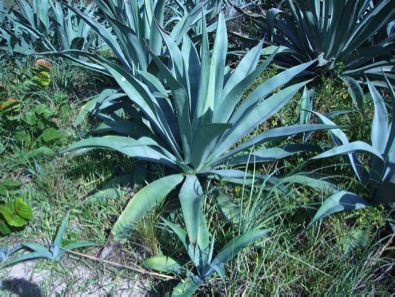
Agave Americana

Agave Americana

If you like tequila, thank a bat. If that’s not possible, thank a humming bird or a moth. Those three pollinate the agave from whence tequila comes as well as food and many other products.

Man has been harvesting and utilizing agaves for approximately 9,000 years. The huge plant comprised a huge part of primitive man’s diet. The most commonly known, Agave americana, is from Mexico as are most agave though there are two native to Florida. Closely related to lilies there are three major parts which are edible: Flowers, stalks or basal rosettes, and the sap. Leaves are a lesser edible part of the plant.

During the summer agaves can produce several pounds of flowers each, which can be boiled or roasted. The stalks before they blossom in summer can also be roasted and taste like molasses. If you leave a depression in the bottom after taking the stalk it will fill with sap, which can be used to make tequila. The root is caustic, so you need to handle it carefully, but once cooked for a couple of days it’s sweet.  Flower nectar can be used to make sauces or sugar and bottled will last up to two years. What can be eaten from each species differs significantly, this is just a general overview. Check out your own agave.

The leaves contain saponins and are rich in sap in the winter and spring. They can be roasted. You chew them then spit out the fiber.  The leaves can also be boiled and the juice used as a soup but test a little first. The leaves and juice can be too bitter to eat. There are over 200 agave species so make sure you have an edible one. Spine arrangement, length and shape help tell the species apart. The leaves of most make good cordage.

Warning: Raw agave juice can cause dermatitis via calcium oxalates raphides. DO NOT CUT WITH A CHAIN SAW.  WEAR EYE PROTECTION.

Many agave flower only once, putting up a tall stalk of aromatic blossoms and then dying. Most of the carbohydrates and sugar is in the body of the plant and the bases of the leaves, excluding the green parts. As the plant ages the amount of carbohydrates and sugar increases as does the plants palatability. While the foraging rule is often “young and tender” the opposite is true with agaves, old and tough are the best.

Miguel del Barco, a Jesuit priest at the Mission San Javier in the Sierra de la Giganta between 1738 and 1768, wrote a detailed account about how the natives used the agaves. They knew exactly when a plant was to flower and used hardwood tools to cut up the plants, favoring the upper part because it was the most tender and juicy for eating. After taking off the top they removed the leaves and then pit baked the plant.

That usually involved digging a hole, lining the hole with rocks, building a huge fire in the pit, and when reduced to ashes, putting the plant in and covering it to hold in the heat then coming back the next day to dinner. That ended up with some partially cooked agave and there is evidence some of them were also eaten raw.

In the Tehuacan area of Mexico a traditional way to have agave flowers is boiled and then mix with scrambled eggs. The Indians of Oaxaca also use the outermost leaf layer to make a covering to preserve and protect food

Because agave are so huge it’s difficult to call them something one would forage. More so, there’s a huge amount of food there. It might be viewed as an emergency food supply. Other than blossoms or the stalk, the best way to get one is when land is being cleared or redesigned. Then find a village to help you process and eat it.

The following species have been used for food in some way: americana, atrovirens, cantala, chrysantha, complicata, crassipina, deserti, palmeri, paryi, salmiana, scabra, shawii, sisalana, tequilana, utahensis. Avoid A. lechuguilla. It is known to be toxic and is found in Texas, New Mexico and northern Mexico. Sometimes it is planted as an ornamental. It is known to sicken sheep, goats, occasionally cattle but not horses.

The agave is also nature’s hardware store. Several produce fiber, razor strops, pens, nails, needles even didgeridoos. The raw leaves can be beaten for a foamy material similar to soap.

Agave (ag-AH-vee)  in English is from the Greek word Άγανος “AH-ghav-nos” meaning noble or illustrious, referring to the plant in flower. . Americana (a-mer-i-KAY-na) means of the Americas.

Green Deane’s “Itemized” Plant Profile

IDENTIFICATION:

A plant with no stem, thick, massive gray-green leaves from a basal rosette, to six feet long and a foot wide wide, sharp spines  sides and tip, side spines curved like fishhooks, tip spines to an inch long. Flower stalk branched, 20-40 feet tall, large three to four inch yellow-green flowers. Natural agaves have leaves that are one color. The Americana can have light horizontal bans on the underside. Cultivars of the Americana have two colors or stripes.  The edibility of cultivars is unknown to me.

TIME OF YEAR:

Leaves anytime, flowers and stalk when it blooms, age 10 in warm climates, age 60 in cold climes. Found in the southern US, Central America, Europe, South Africa, New Zealand and Australia.

ENVIRONMENT:

Well-drained, sandy, gravely soil, slightly acidic.

METHOD OF PREPARATION:

Many uses: Flower stalk and heart roasted, seeds ground into flour for bread or to thicken soups. Beer-like drink from sap, nectar as sweetener. Use varies from species to species, so get the correct usage for your species. Raw juice can be caustic. Caution is strongly advised.

{ 18 comments }

 Alternanthera philoxeroides: Exotic Munch

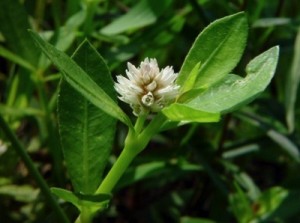
Alligator Weed or Alternanthera philoxeroides

Alligator Weed or Alternanthera philoxeroides

If you have alligators you have alligator weed. That’s a little odd because alligator weed is a native of South America where there are no alligators. But now Alligator Weed is found in the same waters as alligators, and many other places as well.

Introduced into the United States around 1894, it is an invasive weed in many states. It’s also a little-known edible though it is in the amaranth clan. One place it is eaten a lot is Burma but it does come with a warning.

One PhD expert says raw it tastes better than many salad greens and some in a salad is fine. In other words, when green it can be a garnish or a salad addition. Another says more than 100 grams dry weight ( 3.5 oz dry, which probably translates into a half a pound or more wet weight) might provide too much calcium oxalate, a bad dose. The point is don’t dry it and eat 3.5 ounces of it. Some raw in your salad is fine. Also cooking can reduce the calcium oxalate in greenery.

The botanical name, Alternanthera philoxeroides, means “alternate flower like the philoxerus.” It is said alter-NANTH-er-uh fil-oh-zer-OY-deez, or Alter-ann-THER-rah fie-lox-er-OH-deez. And indeed it does resemble the philoxerus but that is now called the Blutaparon vermiculare, which only grows near salt water. The A. philoxeroides can tolerate some brackish water.

There are many Alternanthera in warmer areas so key out the plant carefully. A. philoseroides is the most common. Four known edibles are A. ficoidea, A sessilis, A. sissoo, and A. versicolor.  A. sessilis is well-distributed in the U.S., A. ficoieda is rare.  A. versicolor is found in Asia. A sissoo is a common green in South America but must be cooked.

Green Deane’s “Itemized” Plant Profile

Identification

“A. philoxeroides: A perennial herb; stems creeping or floating, ascending towards apex, rooting at the lower nodes, branched, hollow, with a longitudinal hairy groove on 2 opposite sides.  Leaves subsessile or with petiole to 5 mm long, with a ring of white hairs between the 2 opposite leaf bases.  Lamina 3-13 x 1-3.5 cm, elliptic to oblanceolate or obovate, glabrous or slightly hairy near the attenuate base; apex obtuse or acute.  Inflorescences in upper axils, mostly 1-2 cm in diameter, capitate, white; pedicles to 9 cm long with 2 opposite longitudinal hairy grooves, occasionally heads shortly pedunculate and terminal.  Bracts 2.5-3.5 mm long, ovate-acuminate; bracteoles similar to bracts, somewhat smaller, persistent.  Tepals 5-7 mm long, oblong to ovate, acute or obtuse.  Fertile stamens 5; staminodes = stamens.  Style short, thick; stigma capitate.”  (Webb et al, 1988; p. 101).

Time Of  Year

Nearly year round

Environment

In fresh water, or on damp land, can also tolerate some brackish water.

Method Of Preparation

Leaves in small amounts raw, also as a cooked green.

{ 12 comments }
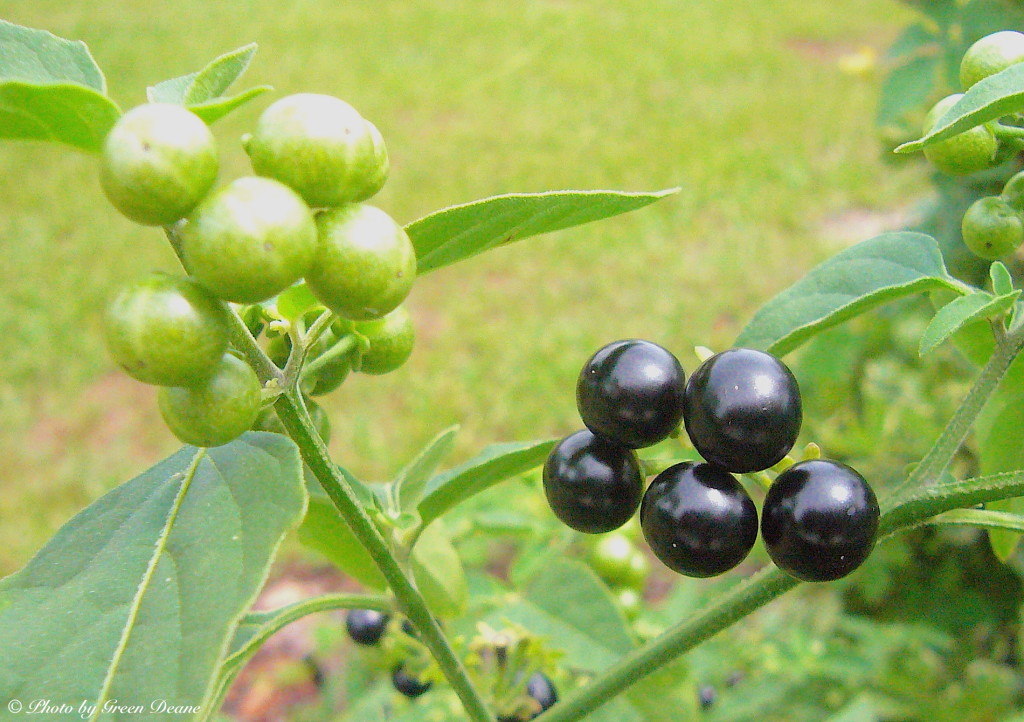
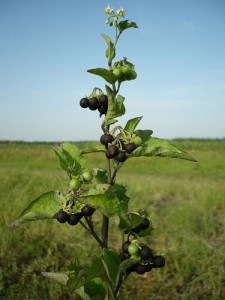
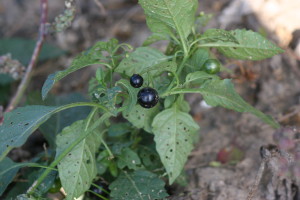
Green Solanum americanum berries are toxic. Totally ripe berries are edible. Photo by Green Deane

Green Solanum americanum berries are toxic. Totally ripe berries are edible. Photo by Green Deane

Solanum americanum: Food or Poison?

Anyone who’s done some foraging has seen the “Black Nightshade”  also called the “Common Nightshade” and (DRUM ROLLLLLLLLL) the “Deadly Nightshade.” It’s one to four feet tall, oval to diamond shaped leaves, with and without large blunt teeth, little white star-like flowers with yellow cores followed by green berries that turn shiny black, larger than a BB, smaller than a pea. Some foraging books will tell you it is very edible and the dangers overrated; some will say it will kill you, don’t eat it. I land on the edible side and I eat it.

But, to cover myself legally because there are a lot of fools with lawyers, I am not suggesting you eat any part of any wild nightshade.  In fact, let me include what Delena Tull Phd. writes in her book Edible and Useful Plants of Texas and the Southwest.

“The toxicity of the species is quite variable in different varieties and in different parts of the world. Euell Gibbons reports using the ripe berries in pies and numerous other references indicate that the ripe cooked fruit may be safe. Personally, I consider the whole plant potentially deadly and leave it alone. “

Delena’s book is well done and well-considered so her comment carries weight, though I was surprise to see her take that view. What that means is do not experiment on your own. Find a local person who knows if your “Black Nightshade” is edible and how.  Now for some extensive history, paraphrased as much as possible:

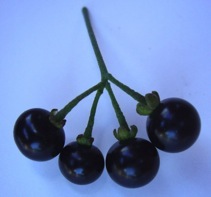
IMPORANT: Notice the berries are dull on the S. nigrum.

IMPORANT: Notice the berries are dull on the S. nigrum.

Solanum nigrum (soLAYnum KNEEgrum, the Black Nightshade) is found in the Old World, Africa to India and beyond. Its leaves are used as a green, boiled twice or more like pokeweed.  In Kenya four varieties of it grow and three are highly sought after. It is the prime potherb. The fourth variety is considered too bitter to eat. Of 61 greens tested in Africa, S. nigrum had the highest amount of vitamin A. In the region of India the plant has many names and is firmly in the human food chain and very popular. It is also in medical use.  Modern Greeks call it “Styfno. They boil the leaves then use them as the basis for a salad.

Now, back to North America.

When Europeans arrived they saw the native nightshades.  Because they resembled the Black Nightshades in the Old World they were considered variations of the Old World nightshades and were called … Black Nightshades … all of them.  But as time passed botanists had different opinions and the names were changed, or worse combined, such as Solanum nigrum var. americanum. Every botanist with an opinion called these plants what he thought they should be called.  What was once thought of as varieties of one native in North American ( S. nigrum) became many plants with many names. Then even more careful botanists got rid of some of the names and said they weren’t Black Nighshades at all and were not Old World variations.  In fact, some think the S. americanum (ah-mare-ree-KAY-num) isn’t even a native but is from Australia. On top of that, the Old World plant, the original Black Nightshade, became naturalized in North America as well.  So it became quite a muddy soup. Then there were reports of toxicity, which makes some sense if you were calling non-Black Nightshades Black Nightshades, essentially inducting non-edibles into the edible group.  To say it is a foggy, foraging family is an understatement. Even the pro’s profess confusion though I think they caused it. Native peoples had it sorted out well long before there were botanists.

There is no doubt Solanum family has toxic members. And the green berries of the plants mentioned here are toxic. They have killed a few children and at least one adult within record keeping. Livestock eating the plants/green berries in the field or dried in hay have been poisoned and or died. Yet, around the world for centuries many of the Black Nightshades are listed as edible if not highly esteemed. For the last quarter of a century, in particular, botanists have been writing about the names and toxicity when ripe and/or prepared correctly. Some still say yes, some still say no. Let’s look at our main three:

1) A native first called S. nigrum then S. nigrum var. americanum is now called Solanum americanum; 2) a variation of that S. americanum is called Solanum ptycanthum, (p-tic-ANTH-um) and 3) the Old World one is called Solanum nigrum. While they can all be found in most regions of the United States, the S. americanum favors the South, the S. nigrum the mid-west and the S. ptycanthum the north. However, the S. ptycanthum is the most wildly dispersed and reported in most areas. It also comes with less pedigree and is not reported in California.

199Some think S. ptycanthum is a North American native, some think it is a cross between the S. americanum and the S. nigrum. One author says the mature fruits might be edible. One serious scientific report says they fed ripe S. ptycanthum berries to rats for 13 weeks with no detectable problems. A third says the Native Americans, like the Cherokee and the Catabwa, ate the leaves of the S. ptycanthum and held them in high esteem. The latter appeals to me but if the S. ptycanthum is a hybrid with the old world S. nigrum and not a native, how long was it around for the Natives to discover it, use it, and hold it in high esteem?  Or do they think it is a hybrid from tens of thousands of years ago, just as they think the S. americanum originated in Australia? When details like that are left out one sometimes wonders how comprehensive some “botanists” are.

Since these three plants look very much alike what are the main features to sort them out (though the plants are highly variable)?

1) The S. americanum has green berries flecked with white. On ripening they turn SHINY black. They also grow in an umbel cluster, that is, the stems of the berries all go back to generally ONE central point.  The sepals do not adhere to the fruit. Berries have 40 to 110 seeds. The stem is NOT very hairy. The seedlings do not have maroon under their leaves. (Personally I also look for some blossoms with white petals bending downbut most of the blossom withwhite petals bending up.)

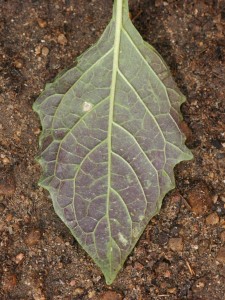
The underside of a S. ptycanthum leaf.

The underside of a S. ptycanthum leaf.

2) The S. ptycanthum looks the S. americanum except it has maroon coloring on the bottom of younger leaves, particularly sprouts. The berry contains 50 to 100 seeds. No doubt it is often confused as an adult with the S. americanum. This would suggest growing some of what you think are either S. americanum or S. ptycanthum and looking at the underside of the young plants. Some say the adult plant has some red under its leaves.

3) The S. nigrum has DULL black berries when ripe, and they tend to be larger than the other two. Also the stems of the berries do not emerge from one single point but are separated slightly on the stem, staggered like a spike. It tends to have 25 to 30 seeds, 1.8 to 2.2 mm long, but they can range from 15 to 60.

Though ubiquitous and plentiful I avoided the “Black Nightshade” for years because of their reported toxicity even when ripe. Then I learned of a local grocery store manager from Cuba who ate the ripe berries whenever he found them. With a living local guinea pig alive I had to give them a try.  My plant de trepidation was the S. americanum and I was careful, starting with a quarter of one berry at a time, then the next day half a berry et cetera, working my way up. They’re quite tasty.  I have not eaten a cup of them at a time or baked a pie like Euell Gibbons, but as a trail side nibble the ripe berries have proven quite edible, though the flavor varies from musty to sweet. They look black but are actually intensely purple, and probably full of anti-oxidants.

While I have not personally proven this to myself regarding all three species mentioned here — the S. nigrum is not that common  locally — some researchers say the stems and leaves of both the S. americanum and S. nigrum are edible after being boiled. And for reasons I will get to, I will add they should be boiled twice, at least 15 minutes each time.  These experts also say the berries of each are edible when totally ripe, either raw and cooked. As for the S. ptycanthum, the cooked leaves were eaten by Nnative Americans and, as mentioned earlier, in one experiment the ripe berries fed to rats for three months caused them no harm.

The young leaves of S. americanum — which you should boil at least once, maybe twice before the plant blossoms — are on par with the nutrition in Amaranth leaves but with less vitamins A and C. Per 100 grams edible young leaves contain: 190 calories, 4.7 grams of protein, half a gram of fat, 8 grams of carbohydrates. Other nutrients are calcium 210 mg, iron 6.1 mg, beta-carotene 1.9 mg, vitamin B1 0.14 mg, and vitamin C 40 mg. In the book Plant Resources of Southeast Asia they report the content of boiled leaves and young green fruit: 140 calories in 100 grams, protein 1.9 grams, fat 0.1 grams, carbohydrates 7.4 grams, calcium 274 mg, iron 4.0 mg, beta carotene 0.5 mg, vitamin B1(thiamin) 0.10 mg, and vitamin C 17 mg. 

While the  nutritional value of leaves have been reasonably researched data on berries of the American Black Nightshade is elusive. A large study of the family in Africa where S. americanum is consumed just happened to leave that species out. However, a commonly eaten relative, S. torvum, has this line-up for 100 grams of fresh fruit: 160 calories, protein 2 grams, fat 0.1 grams, carbohydrates 7.9 grams, calcium 50 mg, phosphorus 30 mg, iron 2 mg, vitamin A 750 IUs, vitamin B1 (thiamin) 0.08 mg, and vitamin C 80 mg.

Now, why boil the leaves twice? Three reasons. The first one came from a veterinarian report on the S. nigrum saying the toxicity varies plant to plant and season to season (though I think they were lumping them all collectively as Black Nightshade.)  As an example they cite the potato which produces toxic green skin potatoes sometimes depending upon the growing conditions. So while boiling once may work this year, it might not work next year. Next, in Africa they boil the leaves of the S. nigrum twice. How long they boil them is not reported. It was called “a while.”  Thirdly, I had a close friend boil until tender the leaves of the S. americanum. He did not boil them a second time because he thought he had the leaves of a totally different plant. He ended up with a headache. That says to me boiling once is not enough even if it is. The older the leaves get the more bitter and toxic they are, so foragers should collect younger leaves and tops and not eat it to excess. Let’s take a closer look at the plants.

Ripe S. americanum berries, edible

The Solanum americanum has alternating leaves that are hairy underneath, particularly at the edges. They are not reddish-purple underneath when young. They can be oval to triangular, no teeth or irregularly teethed. Flowers, five petals, white, have small anthers. The berries are speckled with white until fully ripe whereupon they turn black and shiny — shiny, that’s important. The berries are usually in a cluster, on several short stems originating from one point or nearly one point — one point, that’s important. The sepals do not adhere to the fruit.  It tends to have 40 to 110 seeds or more, 1 to 1.5 mm long. Here in Florida it fruits nearly all year long.

Unripe S. americanum berries, toxic

Professor Julia Morton, in her book, Wild Plants for Survival in South Florida,  says fully ripe berries of the S. americanum are edible raw or cooked. Young leaves and stems are edible cooked. The Mansfeld’s Encyclopedia of Agricultural and Horticultural Crops also says the cooked leaves and ripe fruit are edible.  Sam Thayer in his latest book, Nature’s Garden, also argues they are edible.  The leaves contain about 6990 mg of beta carotene per 100g.

The Solanum nigrum, one to three feet high, has dull black fruit — dull that’s important — and the fruit is larger than S. americanum. It can have up to 60 seeds though 15 to 35 is common. Unripe fruit can be light green to almost white.  The flower has large anthers, the sepals generally adhere to the fruit, and they are racemiform, that is, not all originating from one point but along the stem (peduncle) — that’s important. Its ripe fruit is edible as are its cooked leaves, according to Edward Schelling and Qi-sheng Ma, Department of Botany, University of Tennessee, as reported on page 223, Vol. 46, Economic Botany, 1992. The Canadian government also reports the berries are edible. Mansfeld’s Encyclopedia of Agricultural and Horticultural Crops reports the cooked leaves and ripe berries are edible.

So that’s fairly clear. Then along comes Solanum ptycanthum. The S. ptycanthum is very similar to the S. americanum but it is mostly hairless and may have leaves with purple undersides, particularly when young. Purplish undersides is important to identifying the young plant.  It is also called the Eastern Black Nightshade and the West Indian Nightshade.

The S. ptycanthum is an annual or short-lived perennial that will grow to a yard or so but usually is shorter. It tends to be well- branched in the upper parts and the stems are usually nearly hairless and smooth. Mature leaves alternate, they are pale green, soft, thin, almost translucent, oval to oval-lance shaped. Flowers are small, usually two to five grouped together in a small umbel-like arrangement (from one point) on a short stalk (peduncle) sticking out from the side of the stem rather than from the axil (where the leaf meets the stem.)  The flower is star-shaped, white or white tinged with purple with a yellow star, often streaked with purple when growing in cold temperatures. Looks like a potato flower but much smaller. The plant flowers from June until late autumn in northern climes. Fruits green at first but turning black, shiny and juicy when mature, 50 to 110 small flat seeds and 4 to 8 small, hard, irregular stone-like crumbs. Mature fruits of detach at the junction of the pedicel and peduncle (where the stem of the berry meets the stem it was growing on.) I’ve read no reports of the S. americanum having stone-like crumbs, which if true would be one more difference between the S. americanum and the S. ptycanthum.

For the record the leaves and young shoots of Solanum villosum (vee-LOW-some) are used as a leafy vegetable. Its berries are light green or yellow when ripe and the leaves are so hairy that they may feel sticky. Its berries are not edible as far as I know. The leaves of the S. guineense (gin-ee-EN-see) are also edible. And adding to the confusion is the Solanum retroflexum, fomerly Solanum burbankii. Its cooked leaves and ripe fruit are edible. As its old scientific name indicates, it is of hybrid origin. The plant was reportedly bred by Luther Burbank in the early 1900s and is a hybrid of S. villosum and S. guineense, though that may be in dispute. S. retroflexum is compact, typically growing to a height of one to two feet and can fruit when only four-inches tall. The fruit is dark blue-purple when ripe. Green (unripe) fruits are toxic.

Generally said a Black Nightshade plant can produce up to 178,000 seeds per plant. There are about 2,000 seeds to a gram. The plant can be propagated by stem cuttings. Under cultivation leaves and stem tops are regularly harvested.  The composition of 100 g edible portion of “African” nightshade leaves (I presume S. nigrum) is water 87.8 g, 39 calories, protein 3.2 g, fat 1g, carbs 6.4 g, fiber 2.2 g, calcium 200 mg, potassium 54 mg, iron 0.3 mg,  beta carotene 3.7 mg, ascorbic acid 24 mg. The dry matter content varies from 6–18 % depending on plant age, soil moisture and fertilizing. The protein is rich in methionine.

Solanum means “quieting” because some members of the family induce sleep. Americanum means of America, nigrum means black, and ptychanthum is from two Greek words meaning “folded flower.”  Villosum is hairy and retroflexum means bent backwards. Like the S. nigrum, the S. retroflexum has sepals that turn back away from the berry. Burbankii for Luther Burbank and guineense means from Guinea.

IDENTIFICATION:

S. americanum: Green berries speckled with white, fruit in a cluster radiating from one point. Shiny black.

S. ptycanthum: Similar to americanum but young leaves and shoots maroon under leaf, fruit has seeds and crumbs.

S. nigrum: Dull black berries, arranged along the stem.

TIME OF YEAR: Summer in northern climes, year round in warmer areas.

ENVIRONMENT:  Will tolerated sand and dry conditions but prefers well cultivated and rich soil. If it makes a tomato happy it will make a black nightshade happy.

METHOD OF PREPARATION: Ripe berries raw or cooked, young leaves, stem tops boiled twice, 15 minutes each time.

HERB BLURB

Bruised leaves used externally to ease pain and reduce inflammation, also  applies to burns and ulcers. Their juice has been used for ringworm, gout and earaches.


{ 123 comments }