https://www.youtube.com/watch?v=ld1rf2VO8pY
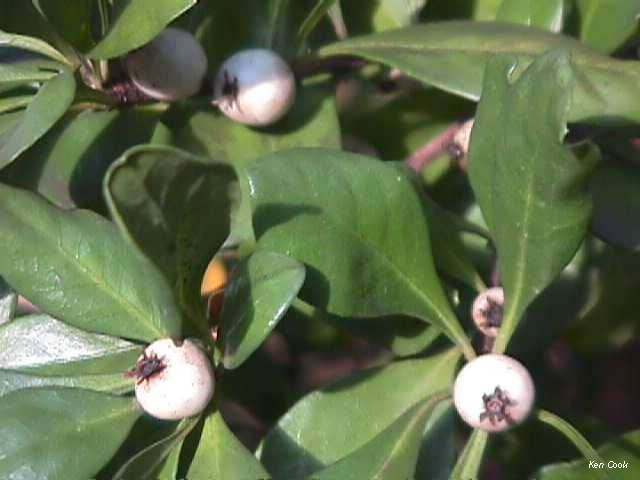
White Indigo Berries are among the very few edible white berries
Randia aculeata
The White Indigo Berry is not high on the food list. Dr. Daniel Austin, author of Florida Ethnobotany, has this to say on page 562:
“People not only note the edible fruits on R. aculeata but they also consume them from other species. However, edibility is variable and some think the fruit a last resort.” That said let’s move on with our overview of the White Indigo Berry.
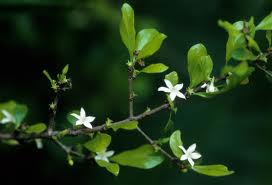
Five petaled, tubular flowers year round
Gardeners rate the shrub as one of the best for southern Florida. It’s six to 10 feet tall, evergreen, with spiny, leathery leaves that cluster near the tips of the branches. They are simple, two-inch leaves, no teeth, circular, veins are pinnate, read spreading out from a central vein. The leaves and stiff horizontal branching habit give the shrub a kind of geometric look. Small white tubular flowers are produced axillarily, that is where the leaf or branch stems meet the main stem. They are fragrant and occur all year. These in turn become fruit which is white, one of the rare exceptions as edible white fruit. However, the fruit is also almost black inside. Sometimes the fruit is ivory with a salmon blush. It prefers to be planted in full sun and has a high salt spray tolerance, so it is used a lot in coastal landscaping (hint, that’s a place to go look for it. )
Flowers produce a green fruit
The White Indigo Berry, in the coffee family, is also “transitional” which is a botanical way of saying some don’t have spines, some have large leaves, some have small leaves… the kind of stuff that makes botanists think they’ve found a new species when they really haven’t. It has had at least four botanical names, Randia mitis, Gardenia randia, Randia latifolia, and Randia aculeata var. mitis, and dozens of common ones including: Box-briar, Inkberry, Prickle Bush, Fishing Rod, Five Fingers, Goat Horn, Tintillo, Tintero, Palo de Cotorra, Arbol de Navidad, Sota-caballo, Resuelesuele, Cafe Cimmarron, Espino Cruz Crucete, Crucito, Maiz Tostado, Raboe, Peetsch-kitam, Cabai, Mache, Croc-a-chein, Bois-lance, Ti Coco, and Petit Coco. A few racy names reference the shrub’s stiff branches.
It ripens to white with 5 to 14 seeds and dark blue/black pulp
Randia aculeata is used as a Christmas tree in the Virgin Islands, and for fishing poles (remember those stiff branches?) It’s also the most fragrant shrubs found at Fort Zachary Taylor… never heard of Fort Zachary Taylor? It’s located in Key West. You wouldn’t think anything would be hard to find in Key West, but it is. It has three entrances, one for vehicles, one for bikes and one for pedestrians. Truman Beach is located there. (And if you like remote, visit Ft. Jefferson on the Dry Tortugas, 70 miles west of Key West. It’s the least visited of all national parks and where Dr. Mudd of the Lincoln assassination did time.)
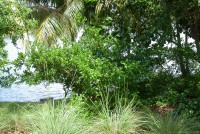
R. aculeata prefers full sun and dry soil
White Indigo Berry fruit is eaten out of hand but will turn your tongue blue. Natives used the pulp to make blue body paint. Beyond fishing poles its wood, interestingly, is used in the Netherlands Antilles for stirring guiambo soup (okra soup) and kadushi soup (cactus soup.) The stirring act is called Lele. Consider: Both of those soups are viscous, read slimy. The plant is an astringent. Maybe using an astringent stirring stick affects the texture or flavor of the similar soups, or nothing sticks to the stick. I don’t know but it is a guess. There are at least three other related species with edible fruit. Randia dumetorum, ripe fruits are eaten after cooking or roasting, Randia echinocarpa, fruits eaten raw, and Randia formosa. It’s fruit is yellow on the outside, black on the inside and taste like molasses or blackberry jam. Opinions vary. They are eaten fresh or used in drinks.
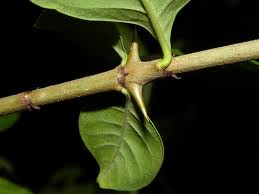
Watch out for the torns, often doubled at the end of a branch
As to the botanical name Randia aculeata, RAN-dee-uh ah-kew-lee-AY-tuh, Randia honors Isaac Rand, 18th century London apothecary and director of the Chelsea Physic Garden. Aculeata means prickly or thorny. It ranges from the Caribbean to Mexico, Central America, and South America as far as Colombia. The shrub is related to Wild Coffee and the Firebush, both of which also have edible fruit pulp but are not great on taste. However, the Firebush, Hamelia patens, does make good wine and syrup.
Green Deane’s “Itemized” Plant Profile
IDENTIFICATION: Dense, semi-thorny, stiff-perky, compact shrub to 10 feet tall, five feet wide, with opposite clustered simple toothless roundish leaves with stipules between the leaf bases, small white fragrant flowers, and globose fruits white on the outside but almost black on the inside, many seeds inside, an average of 8, tiny or about 18,000 to a pound
TIME OF YEAR: Flowers and fruits year round
ENVIRONMENT: Full sun, variable soil, some shade. Tolerant of coastal areas. Will not tolerate wet soil. Don’t look for this in a swamp or wet lawn.
METHOD OF PREPARATION: Marble-size fruit edible but not of great quality. They are, after all, used to make ink. The fruit is used in herbal medicine to control dysentery. The bark also has medicinal uses. Leaves are used in baths to treat infected sores. Stiff large branches good for fishing poles.
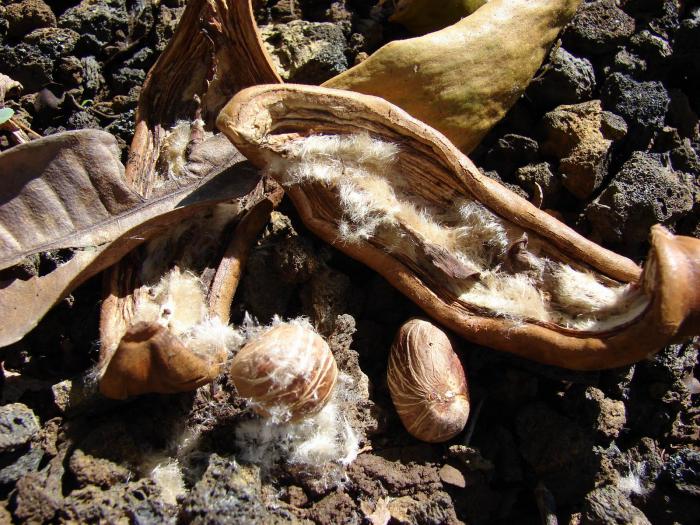
When pods burst open the seeds are ready to eat
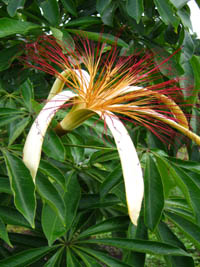
Resembles a peeled banana with red stamen
My foraging existence is slightly schizophrenic. I grew up in a northern climate, and I write about many northern plants, or it is accurate to say that the majority of the plants I write about are found in northern climes. Conversely I live in Florida, which is a different land altogether. Thus I am biclimatic, having spent ine third of my life in the north and two thirds in the south… thus far.
A 400-mile long state, Florida has three distinct climates, temperate, subtropical and tropical. I can go 200 miles north or south and find extremely different plant communities, species that will grow in one place but not the other. One reason why I expanded my classes into southern Florida was to learn more about the tropical there, and this tree is one of them, the Pachira aquatica, formerly Bombax glabrum and a few other scientific names as well. The nomenclature nonsense does not stop there with several common names for the Mallow Family member: Guiana Chestnut, Malabar Chestnut, Provision Tree, Saba Nut, Monguba, Pumpo, Money Tree and Money Plant.
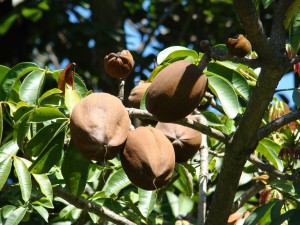
Pods can grow larger than a football
Pachira aquatica (pack-EYE-rah ah-QUAT-tic-ah) is native to Central and South American and quite at home in southern Florida and Puerto Rico. It’s also cultivated in southern California and Hawaii. Growing close to 60 feet in the tropical wild, it’s cultivated for its edible seeds that grow in a large, woody pod. Out of the pod the seeds are shaped somewhat like chestnuts and taste similar when cooked, hence the common name. They also are covered with many white stripes, making them fairly easy to identify. The seeds’ flavor when raw is similar to peanuts. They can be eaten raw or cooked, or ground into flour. The cooked young leaves and flowers are also edible.
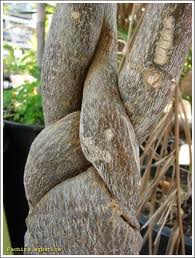
Ornamental trees are braided together
Calling the species the Money Tree or the Money plant is an innovation of the last 25 years or so. In 1986 a Taiwanese truck driver put five small seedlings into one pot and weaved them together as they grew. He inadvertently invented the next hot ornamental plant and business took off in Taiwan, Japan and most of eastern Asia. The braided tree is viewed as associated with profit and is a common plant found in businesses, often with red ribbons or other ornaments attached. By 2005 export of the braided tree was a $7 million business in Taiwan.

Eat out of hand or cook
Why think the tree brings good financial luck? Numerology is still alive and well. The leaves are palmate, with five large leaves which symbolize the five basic Feng Shui elements; Metal, Wood, Water, Fire, Earth. And there are five trees braided together to re-enforce the number 5.
The genus name, Pachira is a Guyana term and aquatica means water. The tree likes to grow in swamps.
Green Deane’s Itemized Plant Profile
IDENTIFICATION: A spreading tree to 60 feet. Greenish bark and shiny, dark green compound leaves resembling a Schefflera. Flowers from a foot long bud, usually hidden by foliage. Five cream-colored petals of the large flowers droop revealing red-tipped off-white stamens. Those change to football-shaped woody pods that can reach a foot in length and half a foot in diameter. Tightly packed seeds in the pod enlarge until about a half inch in diameter causing the pod to crack open. Easily started from seed.
TIME OF YEAR: Flowers late fall or early winter, fruits in the spring
ENVIRONMENT: Does best in areas of periodic flood, or if water heavily often. It does not like dry wind, may endure temperatures briefly down to 28F.
METHOD OF PREPARATION: Seeds edible when the pod cracks open, raw or cooked or ground into flour. Seeds raw taste similar to peanuts. Roasted or fried they taste similar to chestnuts. Young leaves and flowers edible cooked, usually by boiling.

“Yuck.”
That word has been in my mailbox lately, sprinkled through like spice on an entree. It reminds me of what a great language English is.
 English is not some frou-frou language of genteel nuances or unique sounds. And while it might have started out as German Lite it has borrowed so much from other languages that it’s the largest and most predominate tongue on Earth. But beyond that English is fit. It’s muscular, punchy, to the point. English has brawn. It works out, demands attention, and gets things done. Try yelling EXTINGUISH THE CONFLAGRATION instead of PUT OUT THE FIRE, and see where that will get you. Latin just can’t hold a candelabra to English.
 So yes, “yuck,” a taut, vigorous English word has been populating my emails of late. Why? The answer is the Acorn Grub film, the Bon Appetit film and my article on Palm Weevils. Eating insects or their lavae is, well, yucky. So powerful is that one word that several folks have sent just one word emails. Yuck is succinct. It tells me their mental state and their opinion. All of this reminds me of a commercial on the radio of late, in fact several times a day since we are entering our fall growing season.
 After some typical radio machinations a woman announces that she puts (let’s say) Weeds-Be-Dead on her garden so her husband won’t have to weed it for six months. Now she says she can enjoy her garden rather than always watching him weed. You and I know that many of those yucky weeds he’s removing are quite edible and should be in the kitchen. Weeding can be harvesting; the food is fresh, nutritious, and close to free.
 I am sure some folks who are eating dandelions once viewed them as “yucky.” Eating weeds is more than knowledge and experience. It’s also a matter of attitude… just as eating insects is a matter of attitude. One yucky attitude down, one to go.
It’s not the destination that’s important but rather the journey.
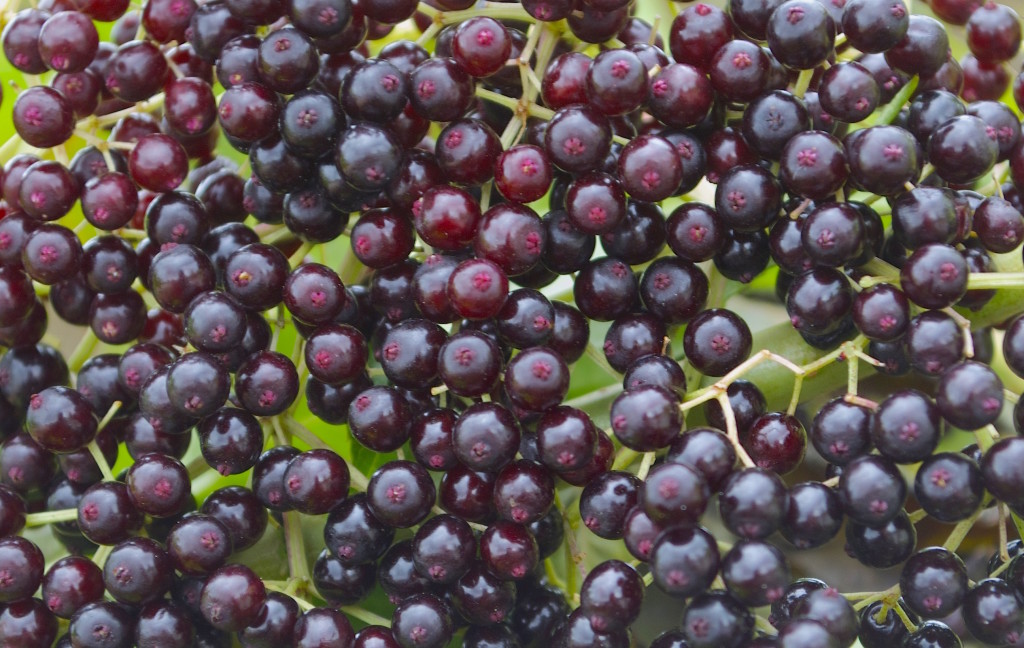
While some elderberries can be eaten raw some cannot and most improved with processing. Photo by Green Deane
Sambuca’s Fine For Elderberry Wine
Start your New Year off right with a glass of elderberry wine or elderberry blossom champagne. Don’t have any? Well, next year then.
I started mine off right: I bottled six gallons of elderberry wine, six gallons of cherry wine, and a leftover gallon of apple wine this morning. Most of the wine, but not all of it, made it into the bottles… As it should be. After all, it is New Year’s, and I am cooking a goose with wild rice stuffing (mixed with chopped pecans and tangerines right off the tree.) Alas, bachelors dine alone but well. Back to elderberries… Incidentally, I am writing now about only black or deep purple elderberries. Read about red elderberries at the bottom of the page.
Elderberries are easy to like. They’re user-friendly. Jam, jelly, pies, syrup, schnapps, brandy and wine can be made from them. The flowers are also edible and can be used in pancakes and muffins or just dipped in batter and fried. They also make a nice tea or a refreshing “Elder Blow Champagne.” Elderflower water is also used in perfumes and sweets.
Many writers say raw elderberries have an unpleasant taste. The ones in my yard do not, but that can change from location to location, shrub to shrub. Most agree that they do need to be cooked if you are going to eat more than just a few out of hand. That’s because they have a small amount of cyanide producing glycosides, which are released upon digestion, but so do loquats.
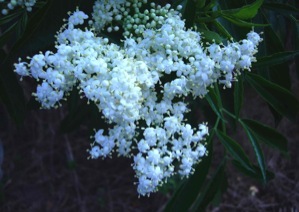
Elderberry blossoms, from fritters to champagne
Professor Julia Morton, who was the first, middle and last word about poisonous plants in warm climates, especially Florida, says the fully ripe black berries are not toxic and you can eat as many as you like. She adds, though, that their flavor is moderated by drying. And in fact, I have a large jar of dried elderberries and sprinkle them on and in many things when cooking. Boiling or baking certainly takes care of any “toxic” issue as does drying raw berries. The Mikasukis Indians considered elderberries a scarcity food only. Incidentally, the elderberry bush sheds a lot of hollow stems that insects like to live in. Watch out for them on the plant and under your feet while picking elderberries. Oh, elderberries do not have thorns. If you think you have an elderberry and it has thorns you have a Hercules Club. Don’t eat those seeds without reading about them first.
As for my personal experience with black elderberries ….I don’t have a sweet tooth —which makes my Greek relatives wonder if I am adopted — but my favorite immediate use for elderberries is pies, though you have to add an acid like vinegar or lemon juice. The great thing about elderberry pie is it is seasonal and rare. You can’t buy one. It is not processed, edible non-food stuff we call food. It’s the real deal, and delicious with a texture similar to blackberry pie. If I have enough elderberries, I make wine. If in between, I make schnapps.
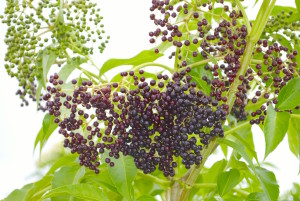
Green and partially ripe elderberries should not be eaten. Photo by Green Deane
I might add that Dr. Morton agrees with a 14th century European comment that young elderberry shoots may be cooked like asparagus and eaten. I haven’t eaten any elderberry shoots but I have plenty in my yard. About twenty years ago I went to a vacant wet lot and dug up a couple of young elderberry shrubs. They have grown into a clump of them in my yard. The odd thing is they don’t live too long, just two or three years each. But, they are always sending up shoots so the clump is slowly moving as new trees grow and old trees die off. The clump is migrating at about two feet a year to the north. There is a road in its path in about 10 years.
Elderberries are nutritious, are packed with antioxidants, and have more Vitamin C than oranges or tomatoes. They also have Vitamin A, calcium, thiamine, niacin, twice the calories of cranberries and three times the protein of blueberries. They put grapes to shame, and man is not the only consumer. Over four dozen kinds of birds like elderberries as well as the occasional rodent and butterfly. Bears really like them — ripe or unripe — and deer and moose will nibble on them.
The elderberry is in the honeysuckle family and have too many medicinal uses to mention here. They are one of the mainstays of herbalism and home remedies. Where ever it grows it has been the local pharmacy. Interestingly bruised leaves in water and soap (stirred some) is a good insecticide for plants you don’t eat. By the way, its botanical name is Sambucus canadensis (sam- BEW-kus kan-uh-DEN-sis).

Playing a “Sambyke”
Sambucus comes from the Greek word “sambuke”, a musical instrument believed to heal the spirit (In Europe Elderberry wood was used for making musical instruments.) Canadensis is from Canada, or northern North American. As for Elderberry recipes, there are hundreds if not thousands of them on the internet — books in fact — and you can look them up as need be but I will give you a hint: Freeze the cluster of berries, they will separate from their branches much easier and cleaner. And to not leave you totally recipeless, here is a concoction from the 1400s:
Take elderflowers and grind them in cow’s milk, add flour, heat until it thickens.
Seems they liked their recipes short back then. If you have just a few elderberries, a pound or so, try this,
Elderberry Schnapps:
(This presumes you have already rinsed and cleaned the elderberries of all stems. Remember the freezing hint.) Weigh the elderberries then put them in a clean glass jar with a tight-fitting lid. Whatever they weighed, cover then with half that weight in unflavored vodka, or more if necessary to cover. Tighten the lid. Let them seep in a dark place one to four weeks at room temperature, shaking now and then. Strain, discard the berries, and put the liquid in new, clean glass jar with a tight fitting lid. Age at least two months.
That is not unlike Loquat Grappa (see my Loquat article.) Now, if after all of this you are still with me a December 2006 study reported in the Journal of Medicinal Foods shows the elderberries in North America to have anti-cancer and antioxidant activity.
A friend surprised me one time by confusing in conversation the poisonous water hemlock with the elderberry. Since I know both plants well I never considered that they have a passing resemblance. One becomes a shrubby tree with berries, the other is a herb with a splotchy hollow stem. But, the leaves and umbrella-shaped flowers are similar to the new eye, especially young plants. While there are many differences the easiest one to remember involves the leaves. In the water hemlock the veins in the leaves run to a notch between the leaf’s teeth. The hemlock leaf is deeply serrated and the veins are very easy to see, and they run right to the bottom of a notch between two teeth. The elderberry has much finer serrations and veins in the leaves run towards the end of the leaf, or to a tooth tip, rarely to a notch. To read more about their differences click here.
Elderberry Wine
This is for one gallon of wine. For five increase ingredients except yeast.
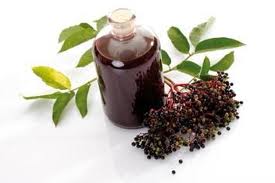
Elderberry wine is medicinal of course
3 lbs ripe elderberries
2 lbs fine sugar
3 1/2 qts water
2 tsp acid blend
1 tsp yeast nutrient
1/2 tsp pectin enzyme
1 crushed Campden tablet
Montrachet wine yeast
Wash the elderberries and remove the stems while rejecting the unsuitable ones. Boil the water and stir in the sugar until it dissolves. Put the berries in a nylon straining bag, tie it and place it in the first container. Mash the elderberries while wearing sterilized rubber gloves. Pour the boiling sugar water over them and cover. When this mixture has cooled to a lukewarm temperature, add the acid blend, crushed Campden tablet and yeast nutrient. Cover the primary container and wait for 12 hours. Stir in the pectin enzyme, cover the primary container once again and wait another 12 hours before adding the yeast. Stir daily for 14 days and gently squeeze the bag while wearing sterile gloves, re-covering the container each time. Drip drain the elderberries without squeezing and add this juice to the primary container. Rack the wine into a second container and fit an airlock. Store in a dark place and ferment for two months. Rack the wine again, top up and refit the airlock. Repeat this step two more times. Stabilize the wine and wait for 10 days. Rack the wine again, sweeten to taste and pour into bottles. Store the containers in a dark place for one year.
Red Elderberries
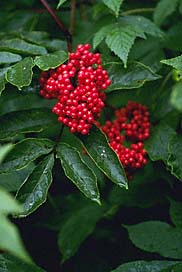
Red Elderberries, Sambucus racemosa
Some references say red elderberries are edible, some say they are not. Bradford Angier, a well-known Canada-based forager, said eating a lot of raw, whole, red elderberries gave him “digestive upsets.” Angier lived off the land for years at a time, so he is a man of practical information. Research does clarify this and says deseeded ripe, cooked red elderberries are edible. In Volume 30, Issue 6, of the June 2003 issue of the Journal of Archaeological Science, red elderberries are discussed. It says:
“In this article, we examine the use of red elderberry fruit at site 35-TI-1, a late Holocene village on the northern Oregon coast, where more than 68,000 seeds from this fruit have been recovered. Despite the fruit and its seeds being somewhat toxic, red elderberry was widely used both ethnographically and during earlier periods. Its ease of harvest, nutritional value compared to other fruits, and the need to remove its toxic seeds prior to consumption result in red elderberry being well represented in the region’s paleoethnobotanical record. Also, toxins in the seeds may inhibit their decomposition, allowing uncharred seeds to survive for several hundred years.”
Other researchers into “first people” diet also show they ate a lot of red elderberries — to the point of it being a staple —but removed the seeds. In another scholarly article for the Canadian Journal of Archaeology, vol. 28, 2004, pp. 254-280, it says:
Processing [red elder] berries follow[ed] operational steps including de-seeding, de-stemming, and mashing to a paste that was then eaten as a food, dried into cakes, or mixed with oil for storage (Grumet 1975: 299). Seeds of red elderberry have high levels of toxic cyanide producing glycosides and were removed after cooking or during consumption (Pojar and Mackinnon 1994: 70; Losey et al. 2003: 696, 701; Turner 1995: 14).
Three other authors say the Natives processed out the seeds before eating the cooked fruit, or spit the seeds out AND drank water to rinse the seeds out of their mouth AND drank more water than usual if they swallowed seeds. They also did not eat red elderberry “cakes” in the morning saying it created stomach ache. They waited until midday or later to eat them. And, if they ate non-ripe and or raw red elderberries they ate salmon afterwards, believing that prevented stomach aches. If this is all accurate, it suggests that ripe, cooked, seedless red elderberries are edible. The seeds contain cyanide-producing glycosides which in the gut change to hydrogen cyanide. This can cause upset stomach, diarrhea and vomiting. In large doses it can be lethal. You are on your own now, proceed with caution. Find a local expert through the Native Plant Society and ask about your local red elderberries.
Now, as if that is not enough know there is a “white” elderberry found in Australia. Its berries are white to yellow and unlike nearly all white berries they are edible. Botanically it is Sambucus (sam-BYOO-kus) gaudichaudiana (go-dih-shaw-dee-AY-nuh)
Oh….You can also make a pesticide from elderberry leaves. Boil half a quart of water and add about eight ounces of Elder leaves. Simmer the mixture for 30 minutes. Take another half a quart of warm water and mix with one tablespoon of castile soap or what soap you may have handy. Combine the soap water and the elder water and strain through a fine mesh or cloth. Use in a sprayer. It helps with attack from aphids, carrot fly, peach tree borers, and cucumber beetles. It can also be used against mildew and blackspot disease
Green Deane’s “Itemized” Plant Profile
IDENTIFICATION: Shrub to small tree, woody stem, fIve lobed flowers in clusters, white, five stamen, leaves pinnately compound, five to nine, toothed, opposite. Berries round, 1/8 of an inch, glossy, black.
TIME OF YEAR: Can blossom and fruit throughout the year in Florida but favors the spring and early summer.
ENVIRONMENT: Roadsides, thickets, damp areas, low hammocks, marshes, canal banks.
METHOD OF PREPARATION: When fully ripe black fruit can be eaten raw or cooked but go light on the raw ones. Drying berries moderates their flavor. See the warning above on red berries.
Elderberry leaves can be put in hot water with soap (be stirred) and then used as an insectide on plants.