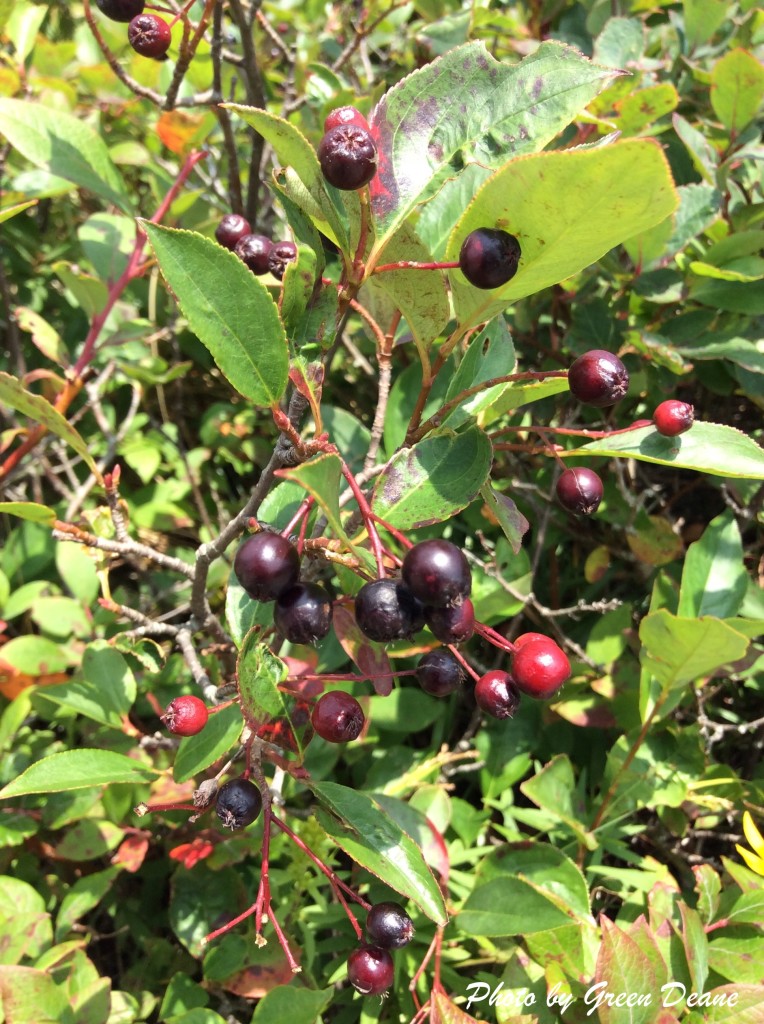
The bitter but edible berries of the Aronia Melanocarpa. Photo by Green Deane

The bitter but edible berries of the Aronia Melanocarpa. Photo by Green Deane

It’s a long ways from the mountains of Maine down the Appalachian Trail to the mountains of western North Carolina. It is also a long ways from ones 20’s to ones 60’s. These distances revealed themselves recently when I notice a plant while hiking in the Smokies.
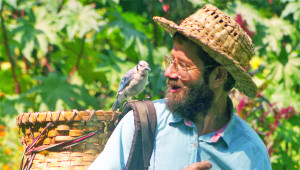
Doug Elliott in his yard with a Blue Jay Friend.

Doug Elliott with a Blue Jay Friend.

It was familiar but not familiar, a wrong plant in the wrong place I thought. But it was the right plant in the right place, kind of. The problem was I had 40 years of fog in my memory. Helping me sort out the mystery was Doug Elliott, edible plant expert, story-teller and long-time resident of North Carolina. He and his wife Yanna were kind enough to have me and my friend Kelly over to their place in a “holler.” Besides a close up view of their homestead and a taste of sumptuous food I got to ask Doug about my mountain-top mystery. ‘Sounds like an Aronia,’ he said, ‘with the unfortunate name of chokeberry.’ He got it right. The fog began to clear.
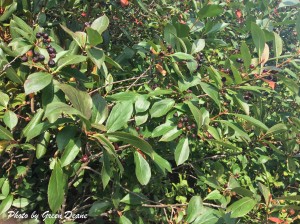
In high dry places the Aronia is usually the Black Chokeberry. Photo by Green Deane

In high dry places the Aronia is usually the Black Chokeberry. Photo by Green Deane

What confounded me is that the Aronia is generally thought of as a northern plant and quite common in my native state of Maine. And while North Carolina is not balmy in the winter it’s not the deep freeze New England can be… unless one goes up. Going up 1,000 feet takes you north about 700 miles in climate and season which effects the flora and fauna. Thus the Aronia is a northern genus but it creeps down the spine of the Appalachian Mountains, thriving in the cooler higher altitudes. It was until recently a much over-looked species. In fact, if a big pharmaceutical company could invent a plant it would be the Aronia.
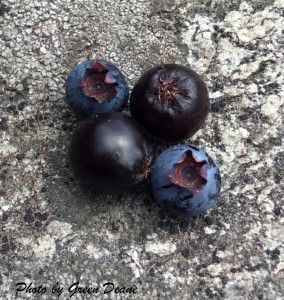
Two chokeberries compared to two blueberries (with crowns.) Photo by Green Deane

Two chokeberries compared to two blueberries (with crowns.) Photo by Green Deane

Much like Hawthorns botanists can’t agree on just how many Aronia there are though their numbers are dramatically far less than Hawthorns. There is a red variety, a purple variety, and a black one… maybe… and lot of commercial cultivars and a few natural hybrids and regional genetic differences. But the main point is their edible bitter berries are one of the richest sources of the stuff we — at the moment — think are good for us: Anthocyanins. They are water-soluble pigments that protect our cells from free radicals. Anthocyanins are the main reason, for example, why blueberries are blue and why they are good for us. In fact, Aronia berries have greater antioxidant activity than blueberries and cranberries (five times higher than each) and higher antioxidant activity than pomegranates, strawberries, cherries, even the vaunted goji berry. No fruit grown in a temperate climate has more antioxidants and flavonoids. Though bitter the berries can range from 12 to 20 percent sugar and per 100 fresh grams have 560 to 1059 mg of anthocyanins. It’s no wonder they are being cultivated in many states.
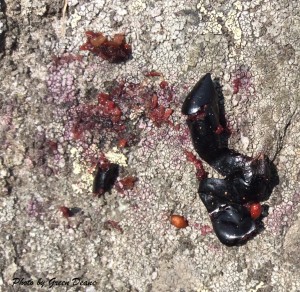
Aronia berries have one to five seeds. Photo by Green Deane

Aronia berries have one to five seeds. Photo by Green Deane

One species of Aronia, A. melanocarpa, has been well-investigated. It not only has anthocyanins but a host of potential positive chemicals including blue Malvidin, Caffeic Acid (an anti-oxidant also found in wine) blue Delphinidin, dark red-purple Cyanidin-3-Galactoside, and Epicatechin, an anti-oxidant found in chocolate. We may not be able to pronounce them but they are anti-… anti-bacterial, anti-viral, anti-arterial plaque, anti-cholesterol, anti-cancer, anti-flu, anti-E coli, anti-high blood sugar, anti-herpes, anti-HIV, anti-Crohn’s Disease as well as improving insulin production while protecting the liver and the stomach. No toxic effects are reported and the genus is naturally pest resistant. That’s quite a lot for a nondescript plant I saw on a mountain top.
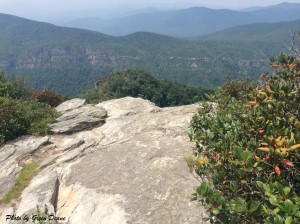
Typical environment for the Black Chokeberry in its southern range. The chokeberry is on the right. Photo by Green Deane

Typical environment for the Black Chokeberry in its southern range. The chokeberry is on the right. Photo by Green Deane

The common name chokeberry is self-evident. The berries are tart and bitter and it’s difficult to choke them down. But they can be made into jams, jellies, juice (by itself or blended) pies and other baked goods. They are also made into wine, stronger alcoholic beverages, pickles, flavoring for ice cream and yogurt and used as a natural food coloring. Among native Americans the Abnaki and Potawatomi ate them for food. Wildlife that live in them or eat the leaves or berries include the white-tailed deer, rabbits, ruffed grouse, sharp-tailed grouse and prairie chickens. The genus name comes from “aria” which is the Greek name for the mountain ash (Sorbus aria.) The red variety of the Aronia has red fruit similar to the red fruit of the Mountain Ash thus the base word was borrowed. Melanocarpa is also Greek meaning black fruit… So Aronia melanocarpa means by intent Red Fruit Black Fruit which is somewhat descriptive but not too inventive. Mountain Ash Black Fruit is just confusing. To get away from the name chokeberry, which people confuse with chokecherry, some have taken to calling it “Aroniaberry” but it hasn’t caught on. Some botanists also put them in the genus Photinia and that is by no means settled. Other botanical names for the Chokeberry have been Aronia arbutifolia (the red one) Aronia nigra, Photinia melanocarpa, Pyrus arbutifolia (red) Pyrus melanocarpa, and Sorbus melanocarpa. A. prunifolia and A. floribunda might be hybrids.
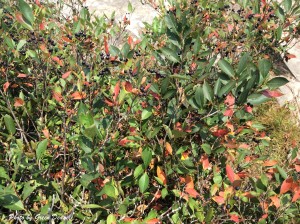
The Aronia can have attractive fall colors. Photo by Green Deane

The Aronia can have attractive fall colors enhancing their ornamental use. Photo by Green Deane

Here are some key identification differences between the Black Chokeberry and the Red Chokeberry:

The Black Chokeberry produces larger fruits that mature to purplish-black, while red chokeberry produces smaller fruits that mature to red;

Black Chokeberry’s fruits mature in late summer and then shrivel and drop, while red chokeberry’s fruits mature in fall and persist into winter;

Black Chokeberry is glabrous (not hairy) while red chokeberry is pubescent (hairy;)

Black Chokeberry plants tend to have a more rounded shape and remain more fully leaved to the base, while the red chokeberry is more upright and tends to be bare at the base;

The Black Chokeberry is naturally found in both wet and dry soils, while Red Chokeberry is found mostly in wet soils. On the mountain tops of North Carolina I saw only Black Chokeberries. Still confused? Know the black and red forms can hybridized. Several cultivars are also available. To be clear, while the research has been on the darker berries the red and the darker-colored berries are edible.

Green Deane’s Itemized Plant Profile

IDENTIFICATION:

Black Chokeberry: a multi-stemmed shrub, deciduous, eastern North American. Four to eight feet, can form dense colonies. Leaves alternate, 1–3 inches in length, 3/4–2 inches in width, oval but narrower at the base than near the tip, fine, regular teeth, top surface dark green, shiny with dark glands on the upper surface of the midrib. Lower surface lighter green, both sides non-hairy. Flowers have five white petals, many pink stamens. Berries 1/3 – 1/2 inch diameter, glossy and black when ripe, hang down in clusters from red pedicels, 30 or so fruits per cluster, one to five seeds each.

TIME OF YEAR:

Flowers open mid-May, fruits usually mature by August

ENVIRONMENT:

Hardy to USDA zone 3 which is to  -40 degrees F. Moderately tolerant of shade, prefers moist acid soils from low wet areas to dry sandy slopes meaning bogs, swamps, low wooded areas and clearings as well as dry rocky slopes, bluffs and cliffs. Also found beside roads and power line rights of way. Tolerant of salt spray, drought and soil compaction. While the Black Chokeberry can be found in wet and dry conditions the Red Chokeberry is usually found in wet conditions and rarely in dry areas. The red variety is more tolerant of heat. The genus is found in the eastern half of the United States, New England south and west to Texas, down the Appalachian Mountains to Georgia and reportedly into north Florida. Aronias can be used in landscaping and some have brilliant fall foliage.

METHOD OF PREPARATION

Can be eaten raw but bitter. Better made into jams and jellies, juice, wine and used in baked goods.
{ 25 comments }
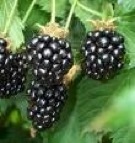
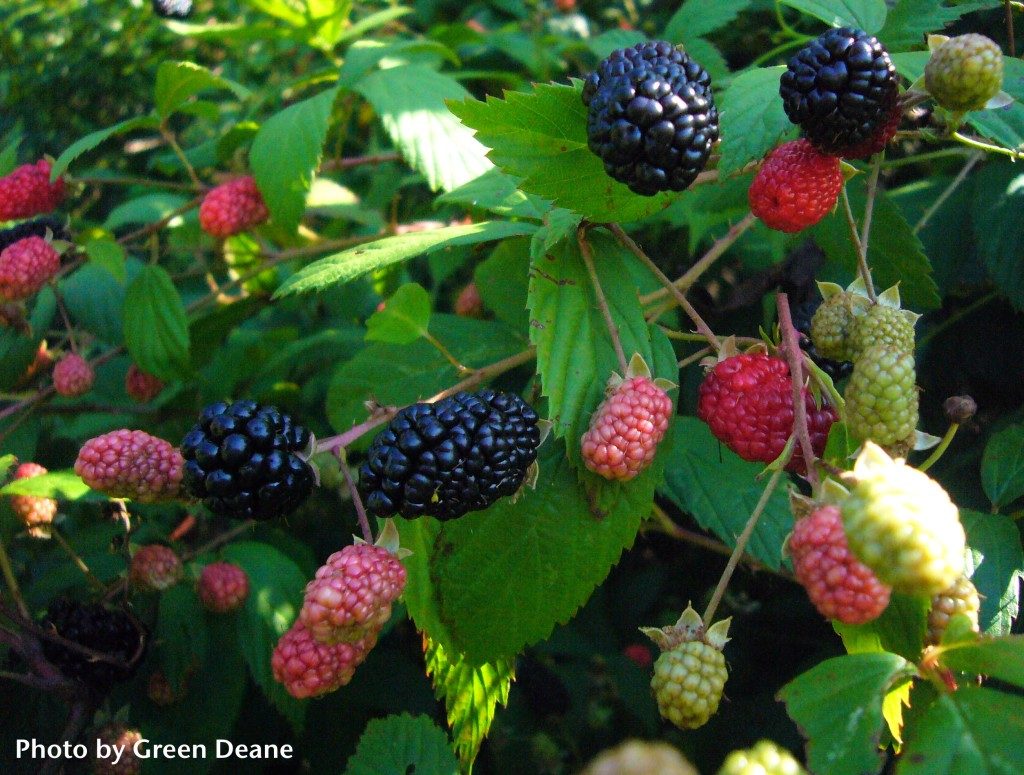
The center core remains when blackberries are picked making them slightly bitter. Photo by Green Deane

The center core remains when blackberries are picked making them slightly bitter. Photo by Green Deane

Blackberries: Robust Rubus, Food & Weed

Anyone who forages will eventually collect blackberries and blackberry scratches. These aggregate fruit are among the best-known berries in North American, if not the world.

As a kid I can remember collecting wild raspberries long before wild blackberries, though I don’t know why. Blackberries are standard foraging fair (see my article about Dewberries.)  What most people don’t know is that blackberries are a two-year plant, some say three years. The first year it sends up a tall cane, replete with thorns. The next year it flowers and has blackberries then dies. Some would add that the cane stays on another year and with its thorns to protect the patch. (I should add though that there are some naturally thornless blackberries.)

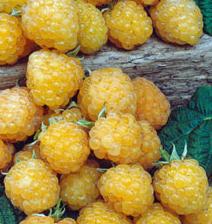
Ripe blackberries can be yellow or red but usually they are black.

Ripe blackberries can be yellow or red but usually they are black.

Blackberry leaves were in the official U.S. pharmacopoeia for a long time treating digestive problems, particularly diarrhea. Their dried leaves make an excellent tea even when you’re healthy. We presume blackberries have been eaten for thousands of years by native American tribes and used medicinally. The ancient Greeks considered the species good for ailments of the mouth and throat and for treating gout. Interestingly blackberries were found in the stomach content the Haraldskaer Woman, an iron age bog body found in Denmark in 1835 but killed around 500 BC. Her last meal was millet and blackberries. Scholars think her death was probably a religious ritual. The millet would have been standard Iron Age fare. Maybe the blackberries were a special treat. Those blackberries would have also put her execution in early summer, perhaps to ensure a good fall harvest by appeasing an agricultural god.

For all their antioxidants and vitamins blackberries will mold within a couple of days of picking if not refrigerated. Do not wash until time of use because that, too, promotes mold. They ripen around June in the south, July in the north, give or take a few weeks. Locally they can be ripe by early May or totally past season by the Fourth of July. Picked unripe berries will not ripen. Black berries are also a good source of potassium, phosphorus, iron, and calcium. The seeds have Omega 3 and 6 fatty acids. Blackberry buds can be used as a flavoring like capers.

Insects and wildlife like the blackberry as well. This includes honeybees, bumblebees, Little Carpenter bees, Nomadine Cuckoo bees, Mason bees, Green Metallic bees (my favorite) flies, wasps, small to medium-sized butterflies, skippers, hairstreaks, and several species of moths. Fowl like the berries such as the Greater Prairie Chicken, Wild Turkey, Bobwhite, Ring-Necked Pheasant, and various mammals from the bear to rabbit. In fact I recently saw a rabbit nibble on blackberry along a local bike trail.

In the rose family, just how many species of blackberries there are is anyone’s educated or non-educated guess. Some argue a few species with a lot of varieties and others argue for 250 or so species. Generally, ones that crawl are in one group and those that form canes are in another group. Then there are numerous unintentional and intentional hybrids, such as the Loganberry, Youngberry and the Boysenberry. Even the raspberry is a Rubus. The name, Rubus (ROU-bus) is the Dead Latin name for the blackberry and it means red hair.  There are several native local species. R. argutus, R. cuneifolius, R. flagellaris and R. trivialis (see the above Dewberry entry.) The ones I harvest annually I think are escaped cultivars in that they produce large, sweet berries consistently year to year.

Russia grows most of the world’s commercial blackberries, some 24 percent. Next is Serbia and Montegegro at 23%, the United States with 13%, Poland 11% and Germany 7 percent. Blackberries are native to every continent except Australia and Antarctica. However, in Tasmania and Australia the species are officially noxious weeds. Think about that: And edible plant on the noxious list. Must not be too hungry in those countries. In 2003 the Blackberry, Rubus occidentalis, became the official fruit of Alabama.

Lastly there is one interesting note about aggregate fruit. At least one expert says 99.99 percent of aggregate fruit are edible (such as blackberries, mulberries, logan berries et cetera.) Personally I would have liked to have seen listed the non-edible .01 percent.

Green Deane’s “Itemized” Plant Profile

IDENTIFICATION:

A woody shrub with canes that grow up but often bend over sometimes re-rooting. The canes grow the first year and fruits during the second year, then they die. Canes are 3-6′ tall/long; green at the growing tip, elsewhere brown or reddish brown with stiff prickles, straight or slightly curved. Can be an inch through at the base. Leaves alternate, usually trifoliate or palmately compound; long petioles. Leaflets up to 4″ long and 3″ across; can be twice as long as wide. Leaflet is usually oval with coarse, doubly serrate edges; may have scattered white hairs on the upper surface, lower surface light green and hairy.  Flowers, to an inch across, have 5 white petals and 5 green sepals with pointed tips; Petals longer than sepals, rather rounded, often wrinkly. Numerous stamens with yellow anthers. Blooms late spring to early summer for a month; little or no fragrance. Drupes, actually aggregate fruit, develop later in the summer;  ¾” long and 1/3″ across,size varies with moisture levels. Berries at first white or green eventually turn red then black. Seedy, sweet.

TIME OF YEAR:

Depending on climate, spring to late summer

ENVIRONMENT:

Full sun, neither too wet or too dry, mesic conditions

METHOD OF PREPARATION:

Numerous:; Fresh, frozen, canned, used for wine, making ice cream, juice, pies, jelly, jam, and best of all when eaten fresh on the trail.  Dry leaves can be used for tea. Leaves can be dried as is or fermented which improves the flavor significantly. Fermented or not they should be dried. Young shoots can be peeled and boiled in one or more changes of water. Running the fresh leaves through the rollers of a pasta machine is a good way to crush them for fermentation. Buds used like capers.

{ 65 comments }
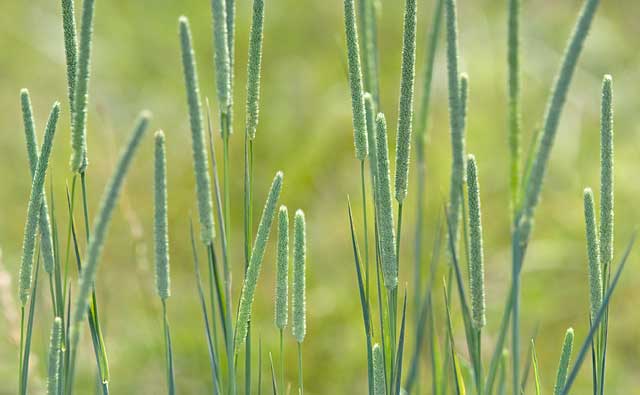
Timothy Grass, a good chew for horses and man.

Timothy Grass, a good food for horses and a sweet nibble for man.

That simple question has a complex answer: Yes, no, and maybe.  It’s a topic I explored in a recent Green Deane Newsletter and the basis for this article.

Strictly speaking we eat a lot of grass, but in the form of grain: Wheat, rice, rye, barley, millet, sprouts et cetera. What most folks want to know is can you eat the culms and blades (stems and leaves.) What you just read — culms and blades — is one of the impediments to learning about grasses; it has an argot all its own, a specific vocabulary worse than mushrooms. More so, often with grass key identifying characteristics can only be seen with a microscope. In fact I attended a grass seminar a few months ago in which the lecturing professor said if you want guaranteed employment become a grass taxonomist. He said they are very rare and very well paid.

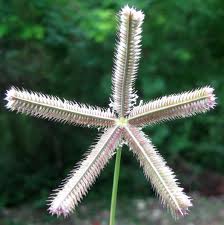
Crowfoot Grass

Crowfoot Grass

As for humans eating grass, we are not multi-gastric (or in theory large-gutted). We aren’t designed to break down the cellulose in grass to get out the nutriments. Cows have a four-chambered stomach for that purpose, horses have a huge large intestine, even the gorilla has a gut that can accommodate large amounts of vegetation. Humans don’t. However, what we can do is dry the grass, grind it into a powder and use it as a bulking agent in food, such as breads, soups and stews. We don’t get much nutrition from grass prepared that way but it does add to the sensation of satiety and reduces hunger. But there are even issues with that, such as how often. There is also the problem of cyanide.

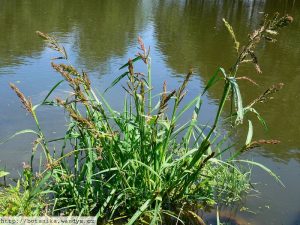
Barnyard Grass seed can be used like wheat.

Barnyard Grass seed can be used like wheat.

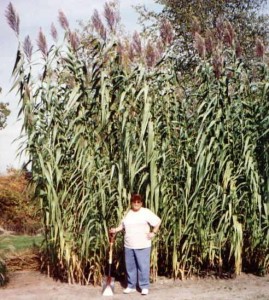
I have read and been told by those with Ph.D. after their name that all North American grasses are non-toxic. Many imported grasses, however, do have cyanide in some kind of chemical bond such as with hydrogen or sugar that gets separated on digestion. At the most basic level that means one has to know if the grass is native or not which also requires identification, and I’ve already mentioned grasses are a pain in the .. ah.. grass to identify. And while “natives” might not be toxic there are many grasses that seem to have very little edible value. The Andropogons come to mind which don’t seem to have any use beyond making crude brooms. As for common toxic non-natives Johnson Grass, a sorghum, is a good bad example. The large blades can be full of cyanide, depending upon the weather.  Crowfoot Grass is another. We eat the grain of Crowfoot Grass only after the plant has turned brown and the dry seeds are easily picked. Complicating the issue is that quite a few toxic grasses from Africa and Asia are naturalized in North America. Prime grain ones to look for are Sand Spurs, Barnyard Grass, and Panicums. Clover is not included here in that it is not a grass but in the pea family. Locally there is also sugar cane (non-native and native.) Sugar cane is easy to grow in warm areas but only for sugar which are empty calories but more energy than just the blades. Related native species are very fibrous and very low on sugar. Similar looking to sugar cane is Arundo donax , a controversial and wild-spread invasive in many areas of the United States. I have found only one reference to the plant’s rhizomes as edible (cooked) which makes me suspicious, and it definitely is not native, another reason to be cautious. While Arundo donax leaves and shoots are listed as edible practical experience says they are not.

Arundo donax is also called Oboe Grass because it's used to make reeds for woodwinds.

Arundo donax is also called Oboe Grass because it’s used to make reeds for woodwinds.

And now if you will permit, let me reminisce. I recently bought another book for my foraging library, A Guide to Florida Grasses, by Walter Kingsley Taylor, not the first book in my collection from this august author. I will say more about the book in newsletters to come. I spent an afternoon browsing through the guide and noted his entry on Timothy Grass. The picture alone erased more than 50 years and took me back to summers as a boy in Maine. That’s when I was impressed into service to harvest hay for our horses, most of it Timothy, Phleum pratense, a grass originally from Europe. Because of its high protein content and low dust factor it is preferred by horses. It is also good food for small rodents like Guinea Pigs, Chinchillas, as well as rabbits. We “hayed” every summer for some 20 years usually putting ten to 15 tons of loose hay into the barn. There is some irony in that most of the hay we got every year came from the Hayward Farm.

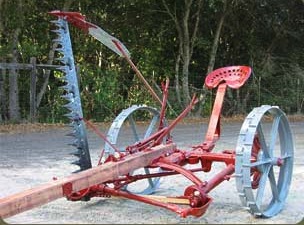
The main machine for cutting this hay was a horse-drawn sickle mower. Instead of two horses the tongue was extended four feet and was pulled by a stripped-down WWII Jeep, which I got to drive. As soon as I was old enough to reach the pedals I drove and dad operated the mower.  By the time I was legally old enough to get a driver license I had already driven thousands of miles in hayfields and across country roads. Most of my annual summer “vacation” was spent haying and driving.

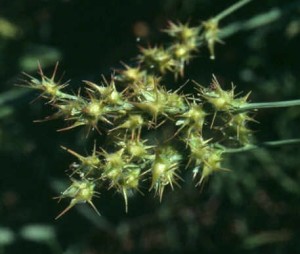
Sand burrs are are food that follow you home.

Sand burrs are are food that follow you home.

The problems of haying became common. The cutter bar would break a tooth, a triangle-shaped replaceable cutting edge held on by rivets, which we replaced red hot from our own forge. At least once a season, more depending upon how thick the grass or vetch was, the piston arm would break, as it was intended to do. It was a piece of ash, called a pitman — the tan wood in the picture lower right — that pushed the mower blade back and fourth being moved by gears turned by the wheels of the mower. It translated forward mower movement into horizontal sickle blade movement. When stresses got too much the wooden piston would break saving the rest of the machine from damage. Two other problems were common.

Sicklebar Cutter

Often the cut hay would wrap around each of the Jeep’s drive shafts, build up like a wad of cotton candy, get hot and catch on fire, not far from the gas tank. This required quick stopping, crawling under the hot vehicle, putting out the fire, then removing the tightly wound hay, often, ironically, with a blow torch. The other issue, beside unpredicted rain, was ground hornets. The Jeep, pulling the mower, would run over a ground hornets’ nest — at least one per field. They were never pleased about that. The hornets would instantly swarm under the Jeep, then emerge between the back of the jeep and the mower where they would find both of us and attack. It was an excuse to change gears and drive like hell… It must have been much worse when the mower was pulled by horses.

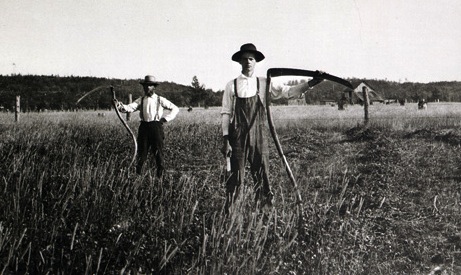
Father and son scything hay

In places where the terrain was too wet or hilly my step-father, who was built like a heavy-weight boxer and did box, would take out a scythe and cut it by hand. He had two grim reaper scythes. One with a long thin blade for hay and one with a short thick blade for brush. Once the hay was cut and sun dried we would winnow it with a Jeep-adapted horse-drawn rake. Then it was loaded loose onto a hay wagon I would drive home. The hay was lifted into the barn by a rope-operated hay fork pulled by the Jeep which my mother drove. My job on those oh-so-hot summer nights was to go up in the high rafters of the barn with 100 pounds of salt for each ton of hay. As each forkful of hay was dumped into the barn I salted it to absorb any moisture thus preventing it from rotting, getting hot and starting a fire. And then throughout the winter I had to shovel and cart the …recycled… hay to the manure pile. No wonder I was a skinny kid.

A modern “Ben Franklin”

And all the time — driving or shoveling — I had a stem of Timothy Grass in my mouth, chewing away enjoying the mild sweetness in the stem. It is a grass I would dry, powder, and use. Being a farm kid and chomping on Timothy was part of the same existence. It’s one grass that I know beyond any doubt. Timothy was unintentionally introduced to North America. In 1711 John Herd found the Eurasian native growing wild along the Piscataqua River near Portsmouth, New Hampshire. He called it “herd grass.” That’s almost clever. He talked it up and it was grown in southern Canada, New England area and New York. In 1720 a Timothy Hanson moved from New England to Baltimore and began to cultivate the seed and sell it.  He was the first person in the new world who grew, bagged and sold hay seed. George Washington and Benjamin Franklin were admirers of the grass and Franklin is credited with calling it “Timothy Seed” in a letter dated 16 July, 1747. The name was shortened to Timothy and it stuck. It is found nearly everywhere in North America and even in Greenland though here in Florida it is naturalized only in the Miami area. I sometimes wonder what my youth would have been like — and adulthood — had Messers Herd, Hanson, Washington and Franklin not known good grass when they saw and tasted it.

the-shape-of-things-to-comeWhile there is no shortage of people on the internet who say grass is edible and nutritious — one native group claims to only eat grass — the Irish Potato Famine of 1845-49 shows otherwise. Folks were reduced to eating grass yet they died, often with grass stains still on their mouth. Another problem with a grass is that it contains a lot of silica, which wears down teeth. Silica is also not good for our digestive track with a history of causing oesophageal cancer. There is some molecular evidence that our very distant ancestors ate grass, or things that ate grass. It’s a debate but those who study the topic say humans did not begin to advance greatly until they had good access to protein, meaning meat. These days grain, the other part of grass, is accused of contributing to bad health and obesity particularly in America. 

All that said grass blades can be dried and turned into powder to add to flour as an extender, or meat oaf or soups as filler that increases satiation. And the green color does provide chlorophyl which is at the center of the magnesium molecule. Magnesium is necessary for good health so even though grass blades and stems might not have a lot of calories they do have at least one chemical we need for good health.

Lastly, in the for-what-it-worth department, in Japan — where I lived for a few years — men who are not the expected Alpha Male type are called soushoku danshi—literally translated — “grass-eating boys.” If you sprout wheat grass you might want to be careful just who you tell.

So, are grasses edible? As I said, yes, no, and maybe.

{ 71 comments }
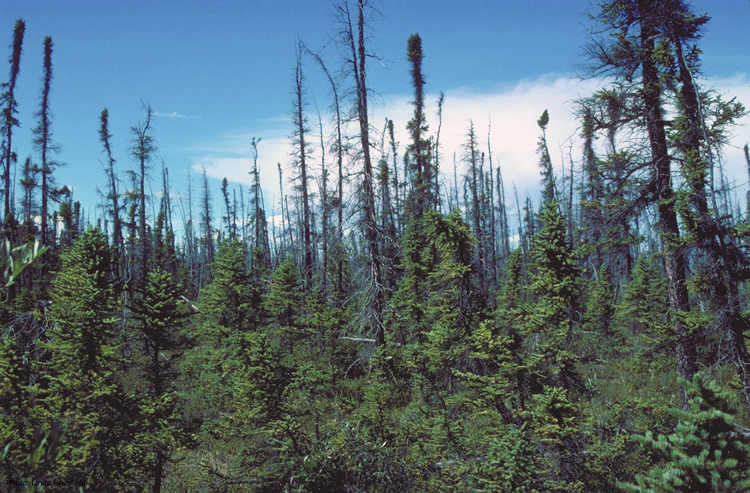
Typical Stand of Spruce Trees

Scruffy northern spruce is typically found in damp, cooler spots.

Real spruce gum is not easy to chew. It is not soft or sweet. Hard and crumbly is more accurate along with pieces of bark and bits of insects. But if you have good teeth and patience it will in time become a stiff gum. And if you leave it on your bedpost over night the gum turns hard and crumbly again.

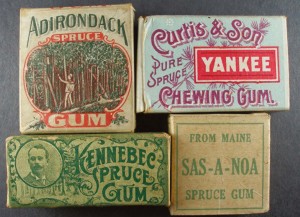
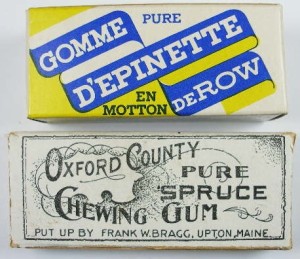
Brands of spruce gum. Photo by Northwoodland.org

Brands of spruce gum. Photo by David Fuller

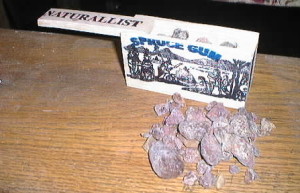
There was a time in America when you could buy spruce gum in almost any store, like other kinds of gum today. In fact it was the first gum sold in America. There were several brand including American Flag, Yankee Spruce, 200 Lump Spruce, and Kennebec. The original commercial version was State of Maine Pure Spruce Gum made by John B. Curtis and his brother in Bradford, Maine, about 30 miles north of Bangor. There was significant demand for debris-less gum and the brothers’ business thrived. Later they added beeswax or paraffin to the gum to soften it and expand their line. They moved their company to Portland around 1850 and had some 200 employees. From the mid-1800s to the early 1900s some dozen and a half companies were producing spruce gum. “Pickers” got paid up to a dollar per pound depending upon the quality. The technique was not unlike collecting pine pitch for making turpentine except the pitch was hard not soft. Some pickers collected thousand of pounds per year. Up until the 1980’s one could still by soft spruce gum from L.L. Bean. (I grew up in Pownal Maine, four miles west of the main L.L. Bean store.) That company no longer carries the product but the Naturallist does, by the box, as does Damn Yankee Company. Or, you can make your own. First you need the tree.

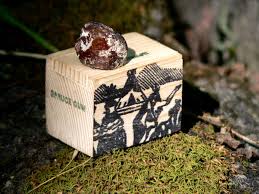
Hard resibn lumbs in a gum book. Photo by Naturallist.

Naturallist sells hard and soft spruce gum.

The Black Spruce, Picea mariana, is found in all of Canada, New England, and the mid-Atlantic States down to Pennsylvania. It is also found in the northern parts of the Great Lakes states excluding Indiana and Ohio. Some report you can find it in the higher, cooler areas of the Appalachians as far south as North Carolina. Red Spruce has also been used to make spruce gum and in fact you can use any spruce as long as it is in the Picea genus. Black Spruce was, however, considered the best source but that is debatable.

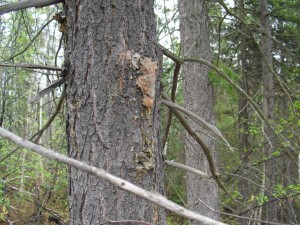
Spruce trees can weep a lot of sap.

Spruce trees can weep a lot of sap.

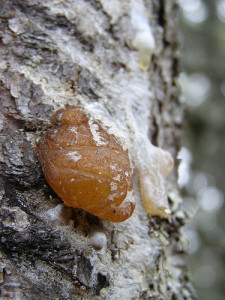
After finding a spruce you look at the trunk. Where ever there is damage to the bark there should be lumps of spruce sap, id est resin, or pitch. Breaks in the bark are caused by a variety of things from bear clawing to wind damage. The tree tries to repair the damage by covering it with sap. Some of the sap will be soft. We’re not interested in that for gum though it has other uses. It takes two to four years for the sap to harden into lumps, which is what we want. The texture can vary according to how dry it is. The color ranges from cream to yellow, pink to brown. It used to be said that “amber” resin was the best but I think that is folk lore on loan from maple syrup where “amber” is the best. The resin I always collected — by chance not choice — was dark amber which in turn made a light pink gum. Visiting several trees over a couple of hours can get you about a pound of hard resin. You don’t need that much. A small amount will do for experimenting.

Spruce resin can also be used to waterproof boats. Photo by Jamaka

Spruce resin can also be used to waterproof boats. Photo by Jamaka

The first step is to reduce the amount of woody pieces in the resin, such as bark and twigs. To do this you put everything in a heavy cloth (a canvas bag works well) and pound it until the resin has the texture of sand. Dry resin crumbles easily leaving the woody bits to be removed by hand. Soft resin only makes a gooey mess. After crushing a small screen works well in cold weather to separate the woody bits if you have good dry resin.  Step two requires some preparation. You will need a shallow metal pan for the hot resin to cool in. This pan needs to be wrapped in cloth which you will pour the hot resin through, further filtering it. You also need, preferably, a tall skinny pot to heat the resin in. It is best to use an old pan for this because you won’t be able to get all the resin out of the pot so the pot can only be used for making spruce gum.  (I learned this short-coming by using one of my mother’s favorite pots the first time.) The small brass pots used to make espresso by hand are good for this. A cast iron pan too pitted for frying works well, too.

Just the right size for a "chaw."

Just the right size for a “chaw” off the tree.

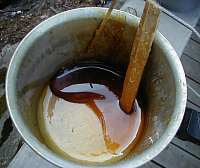
Put your granulated resin in the pot and add enough water to makes a slurry. Then heat slowly over low heat (remember, resin can catch fire easily or burn you badly if it gets on you while hot so be careful. This not a kid’s job.) In time the hot water melts the resin which will float on top. When all the resin has liquified pour it quickly through the cloth into the cooling pan. Some resin will stay in the pot which you can melt next time. It takes about a half hour for all the resin to harden. When it does remove the cloth and pour off the water. A tap on the bottom of the pan should dislodge the resin. Now you can break it up into chewable amounts. Store them in a dry place after sprinkling them with cornstarch to keep the pieces from sticking to each other. Confectionery sugar might be a good choice, too, but I don’t know as I’ve never had a sweet tooth.

sdfasf

Spruce Gum Wrapper, photo by David Fuller

Now comes the hard part. Spruce gum is brittle at first and will shatter into tiny pieces in your mouth. You must keep chewing the little pieces and keep collecting them into one piece. As the gum warms and is ground smaller it will turn into a piece of  gum and stay that way as long as it is warm. A large breath of winter air, however, can harden it, so keep it warm. The taste is… well… sprucy but it does moderate over time, harsh at first, almost sweet after several hours of chewing. And if you swallow it, it should cause no problems.

Damn Yankee Company also sells bite size pieces.

Damn Yankee Company also sells bite size pieces.

With all that said, I am sure the natives did not go to all that bother to melt the resin down and clean it just for gum. It’s a chore with modern equipment and would have been very difficult a thousand years ago when pots were hard to come by. However, the heated sap does make a brittle waterproof glue so maybe when treating their birch bark canoes they chewed some of the  resin. Personally I think they did what I mostly did as a kid: I just took a lump off the tree, crushed it with my teeth, spit out the woody bits as best I could, and just chewed. Your teeth will stick together for a while and the pitch flavor is intense but it does turn into gum that way.

Pickers put spruce scrapers on pole to extend their reach.

Pickers put spruce scrapers on pole to extend their reach. Photo by Adirondack Almanacs.

Not only did the Native Americans show the colonists how to harvest the resin they also used the soft pitch for sore and skin problems. It was also used to make cough syrup which is not that unusual of an idea in that pine pitch can be used the same way, usually mixed with honey. Below are some modern medical references testing the sap. Lastly, spruce gum even found its way into love. Many a picker was also a woodsman of differing trades, such as lumbermen or sawyers. They would often work all winter in the woods away from their sweethearts. Many of them would make gifts of little boxes with sliding tops to store spruce gum in called gum books. And, of course, they were also full of choice spruce gum. However, kissing someone who has been chewing on spruce gum would seem to me to be more along the lines of kissing a Listerine bottle than the sweet lips of poetry and romance.

Herb Blurb

Sipponen A, Jokinen JJ, Sipponen P, Papp A, Sarna S, Lohi J. 
Beneficial effect of resin salve in treatment of severe pressure ulcers: a prospective, randomized and controlled multi-center trial. 
British Journal of Dermatology 2008;158:1055-62

Sipponen A, Rautio M, Jokinen JJ, Laakso T, Saranpä P, Lohi J. 
Resin salve from Norway spruce – a potential method to treat infected chronic skin ulcers? 
Drug Metabolism Letters 2007;I:143-5

Rautio M, Sipponen A, Peltola R, Lohi J, Jokinen JJ, Papp A, Carlson P, Siponen P. 
Antibacterial effects of home-made resin salve from Norway spruce (Picea abies). 
APMIS 2007;115:335-40

Sipponen A, Jokinen JJ, Lohi J. 
Resin salve from the Norwegian spruce tree: a “novel” method for the treatment of chronic wounds. 
Journal of Wound Care 2007;16:72-74

{ 11 comments }
A frozen cranberry ready for winter eating.

A frozen cranberry, blueberry’s wet cousin, is still tart and tasty.

The thermometer was near zero one day when I was on ice skates collecting frozen cranberries.

asdfdsf

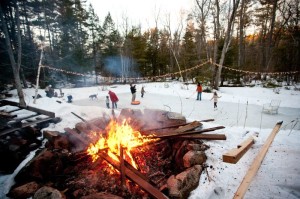
Bonfires and hot beverage make skating fun

The cranberries were conveniently above the ice just waiting to be harvested. I was on the north end of “Gowen’s Pond” in Pownal, Maine. It was at that end where water seeped into the pond to make the couple of acres we skated on every winter. It was also there where I once went skating at 52 below zero… the things you do when you’re a kid and there’s a huge bonfire going. I got chilblained hands and feet that night. More than forty years later air conditioning still makes my hands and feet itch.  (Yes, I now live in Florida and no, I do not have air conditioning.)

The water on that end of the pond wasn’t deep but it was moving so the ice could be shallow. Locals told a story about the farm next door that lost a cow through that ice one winter. I never did ask why the cow was out on the ice to start with. Maybe hungry and looking for cranberries.

sdfasdfasdfdsfs

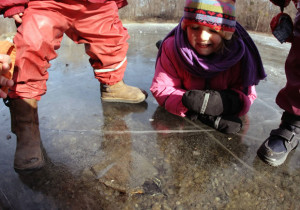
Many turtles stay active under the ice.

The pond had one little island. Very little. One person couldn’t stand on it… more like a stump. But it was always above the ice and had a bush on it. As I skated past it I saw a movement. It was a turtle swimming under the ice eating a little greenery from around the island. ‘Cranberries and turtle,’ I thought. Actually that turtle was spared but it did make me realize early on that one can forage in winter if you know where to look.

Of course, the real issue is what kind of winter? That can range from deep snow and rock-hard frozen ground to only occasional cool days. Finding wild food where there is no snow and little or no freezing is not difficult. It’s finding food in gawd-awful winters that is a challenge.

I am fond of saying food is where the water is. Whether you are referring to your yard, your county, state, region or country, the farther away from water you are the farther away from food you are. While that is true all year perhaps it is most critical in winter. Plants and creatures can be found near water in the winter.

asdfadsfadsf

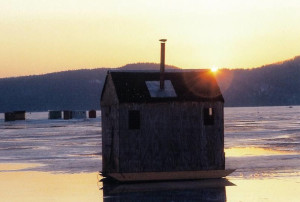
Ice huts are portable man caves.

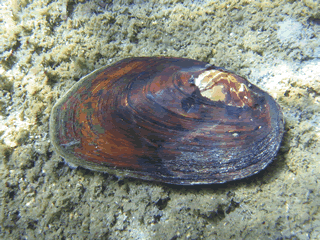
Everyone is familiar with or knows about ice fishing. In some northern areas it is not only a passion but a rite of passage. It can certainly put food on the table (as can hunting and trapping.)  But not everyone has an ice hut or other equipment to harvest food that can move. In that case look for shallow, open streams or with ice than can be easily broken They have fresh water clams in the shallows. They don’t move too fast. As a young man I fished the Royal River in southern Maine and was always bringing home the clams I found. They are a bit tougher than those from the bay and occasionally one would yield a black pearl. I usually had a well-deserving lass to give it to.

asdfdsfasdf

Freshwater clams are tougher than saltwater clams

Freshwater clams have to be handle carefully and cooked thoroughly but they are a good basis for a winter chowder. (The clams pick up parasites from land animal droppings requiring careful handling and cooking. Some clams are also federally protected so I’m sure you’ll check with local laws first.) Depending upon your stream or shallow pond you can also find crayfish and frogs (and turtles.) I should add that one of the advantage of aquatic turtles is that they do not eat toxic mushrooms. There is one instance where a person was sickened from eating a land turtle that had eaten mushrooms not toxic to it but toxic to humans.

asdfsf

Cattail shoots are edible raw or cooked.

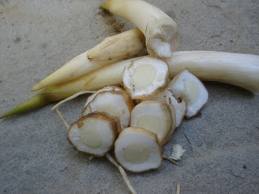
Open streams  or those with little ice can also produce cattail shoots and roots in winter. The shoots look like large dog’s teeth coming off the main root (actually horizontal rhizomes.) You can snap them off  — and the end shoot — eating them raw or toss them into the clam chowder. The roots are also full of starch. Getting it out is labor intensive and I think overrated as a flour. However a more calorie positive way is just toss the roots on a fire. That burns off the covering and the muck they’re usually in. That also cooks the starch in the fibrous middle. Then you open up the root and pull the fibers through your teeth to get the cooked starch off. It tastes like chestnuts, and there are no pots to clean.

ddsfsdfgdgdf

Groundnuts grow in a string in damp areas.

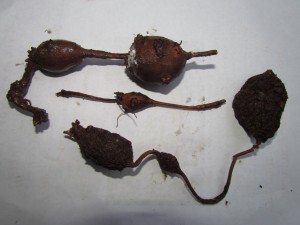
Also available stream side in winter are duck potatoes and groundnuts, the latter a good source of starch and protein. Duck potatoes grow deeper than groundnuts so they probably won’t be in any frozen banks but you do have to fish through cold water. Groundnuts are closer to the surface but still should be below the frost line or protected by water.  That’s a toss up. The good thing about groundnuts is they are unmistakable. Nothing else looks like them. While stream side also look for watercress, a plant that likes cold water. It’s a peppery member of the mustard family. Often found in winter streams, it can be a flavoring and/or a green to put into that clam chowder.

sdfasdfadsfds

Mussels were prime kid food when foraging 50 years ago.

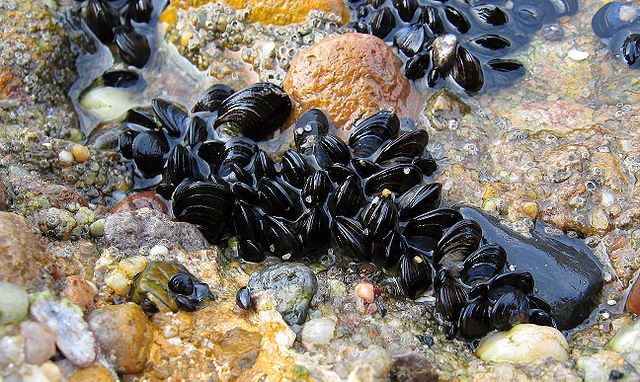
If you live near the ocean there’s a lot of food available in winter. The natives used to say that when the tide was out dinner was on. Not only are there a wide variety of creatures to be had but sea weed as well. Most seaweed in northern climates is edible except for one variety in the pacific northwest that has sulfuric acid. If you mistakenly bite into Desmarestia ligulata you will know it. The problem with seaweed is most of it is not tasty but semi-drying and frying can help. If the weather is not too cold edibles can also be found hiding in the seaweed or on the rocks, such as crabs. One of the more odd things is that 50 years ago mussel at low tide were ignored except by us hungry latchkey kids. Now they are gourmet fare.

yfgolgyuy

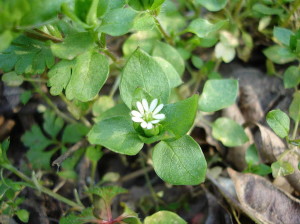
Chickweed thrives in cold weather.

Depending on how cold and how much snow there are quite a few other edibles possible in winter.  Sorrel can often last through a mild winter. Some radishes and wild mustards can take quite a freeze and stay alive and green as can any cabbage left over in your garden. Oyster mushrooms can be found anytime of the year even after warm weather has past. They don’t take freezing, however. Dandelions can survive the winter in snow but they undergo some chemical changes that make them more a famine food than a tasty find. Hardy little chickweed can germinate under snow so when the spring melt comes it is among the first green plants. Wild garlic and garlic mustard can can also be found in winter especially on south facing hills with little or no snow (so can some of the little mustards.)  If there been no snow plantagos (plantains) can also be found in winter along with clover.  But you have to be careful with clover. It can be a blood thinner. In some areas  Stork’s Bill, (Alfilaria) is edible in winter. Just as a matter of routine south facing hills are always worth investigating for edibles particularly in the winter. Don’t forget to (carefully) roll over logs to find wintering lizards and or snakes. Colorful salamanders usually are NOT on the menu.

iilgilg

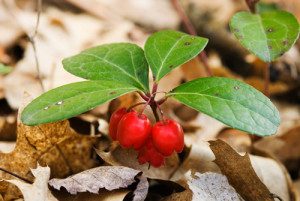
Cheery red and green makes Wintergreen easy to spot.

Just as I collected frozen cranberries don’t forget to look for rose hips, dried grapes and frozen wild apples (which are often better after freezing and cooking.) Hawthorn berries can persist into the winter as can persimmons,  mountain ash, wild plums (sloes) various edible Viburnum berries and Rumex seeds still on the stalk.  Partridgeberries are a common winter find as is wintergreen, which has edible berries and leaves for tea.  Where I grew up I always found wintergreen with berries in the spring snow. It was years before I learned the berries over wintered. The little plant is also medicinal. Most persistent grass seeds are also edible. There are no toxic native North American grasses.

pmp[mp[op

Birches offer several edibles.

You can also eat the inner bark (cambium) of true pines (best fried in oil. Boiling is the least preferred means of preparation.) Pine needles can also be used for tea. Also edible is the cambium of the Sweet Birch (Betula lenta). It can be eaten raw or dried or cooked. It also preserves well. Most lichen — such as Reindeer Moss — is also edible. But it is a survival food that needs to have its acid leached out first and even then it’s a food of desperation. Lichen such as is better used as an antiseptic.

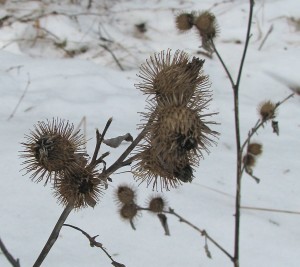
Finding Burdock in Winter is Easy

Finding Burdock in Winter is Easy

There are more winter edibles but much depends upon the conditions. Acorns can be food but if they are covered with snow that doesn’t help much, and they will be frozen, and they need to be shelled, and they need to be leached and… well, you get the idea: Labor intensive in the best of times. The long skinny  Burdock Root is edible but if the ground is frozen it can be a challenge to dig up as are Jerusalem Artichokes. Thistles, the kind that produces a large basal rosette with thorns that prick you like needles, also have an edible root raw or cooked. But the issue is whether the edible is buried in snow, and or is the ground granite hard?

In northern climates juniper berries can be used for flavoring… but not in the clam chowder. Juniper berries are used for bigger, gamey game… Elk and Moose come to mind…

{ 19 comments }