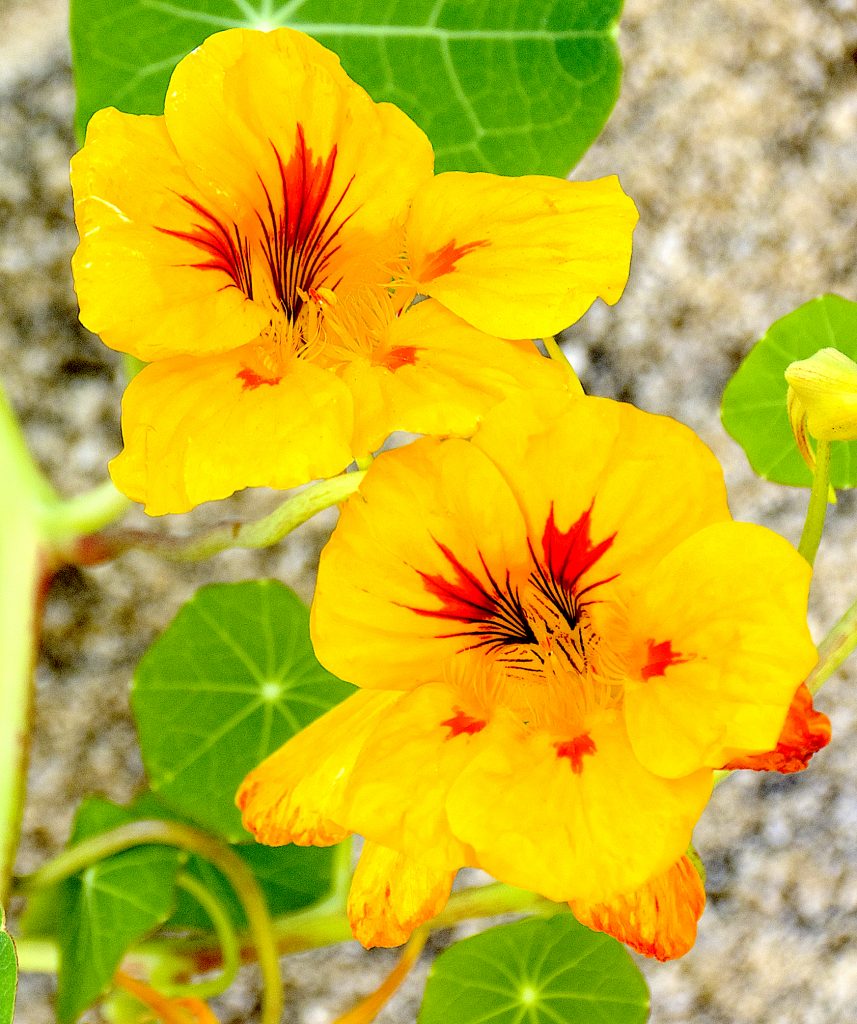
Nasturtiums are originally from Peru. Photo by Green Deane

Nasturtiums: Peppery Peruvian Natives
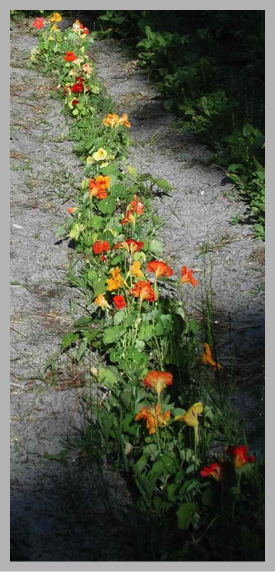
Naturalized garden plant

Do the peppery Nasturtiums make your nose twitch? Then you know how they got their common name. “Nasturtium” in Dead Latin means “twisting nose.”

Nasturtiums are among the most well-known edible flowers. Their leaves and stems are edible, too, but peppery. You can steal a snack or two out of a flower bed as long as you know the flower bed does not have any pesticides on it. Locally they like our mild-winters. 

Nasturtium’s botanical name is Tropaeolum majus (trope-ee-OH-lum MAY-jus). It comes from the Dead Latin word tropaeum or trophy. That comes from the Greek word tropaio, meaning prize. Food used to be given to winners in athletic contests. The word for food in Greek is trofima.  Anyway, a yellow-flowered Nasturtium twining up a post reminded Linnaeus —the fellow who started naming plants — of the practice used in ancient times of displaying shields and helmets of slain soldiers on the trunk of a tree at the scene of a battlefield. Majus means big, large or great. By the way, Latin was chosen to name plants because it is a dead language. No large group of people are speaking it as their native tongue so it is not evolving. Unlike the older, still living language of Greek, Latin is static.
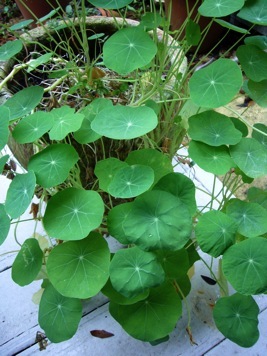
Leaves and seeds are peppery

Nasturtiums came to North America the long way. Discovered in Peru in the 1500’s, two species were taken back to Spain as a vegetables.  It was a Dutch botanist who took the then short plants and developed the twisting vine Linnaeus named. Soon they were being grown for their flowers as well and spread across Europe. Then they came to North America with immigrants as early as 1759. Nasturtiums were also known as Indian Cress or Capucine Cress, in reference to the shape of the flower that was also similar to Capucine monks’ robe hoods.

Thomas Jefferson

Thomas Jefferson planted nasturtiums in his garden from at least 1774 on. He pickled the seeds and categorized the Nasturtium as a fruit along with the tomato (which is botanically a fruit but legally a vegetable. That came from a US supreme court ruling in the 1890s and involved different taxation rates for fruits, vegetables, and seeds. Since tomatoes — and beans — were used as vegetables rather than fruit and seeds, respectively, they were to be taxed like vegetables. ) While Nasturtiums are primarily cultivated they have escaped and naturalized in a few states and of course are wild in Peru.

Nasturtiums are easy to grow and aren’t picky about soil, light or water. Rich soil produces lots of leaves, poor soil lots of blossoms. Thus they are a natural indicator of the quality of your soil. The seeds, which germinate in a week to 10 days, are large so they make a good project for kid hands.
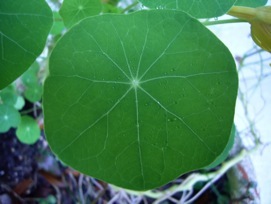
Nasturtium stems are pellate

Dwarf Nasturtiums add a butterfly-like rainbows of color to annual beds and borders (and attract humming birds which pollinate them.)  Trailing forms of Nasturtiums color fences, trellises, slopes and hanging containers. Aphids incidentally love Nasturtiums so organic gardeners like to plant them around the vegetable garden to “lure” aphids away from other plants.  Nasturtium flowers, leaves and immature seed pods can be added to salads. They are rich in Vitamin C. The immature pods can be pickled and the mature seeds roasted for a peppery snack or ground and used like black pepper. My mother loved to eat their seeds. I lacto-ferment the seeds for three days, drain, then put in the frig with a little sugar and chardonnay to cover. Very tasty but they smell horrible while fermenting.  

Like all wild plants with a good dose of oxalic acid they come with the warning not to eat them in large  quantities. Odd that warning is never given for domesticated plants with higher levels of oxalic acid.

Bouquet Salad

Dressing: 1/4 c. white wine vinegar or champagne vinegar, 1 T. Dijon mustard, 1C. vegetable oil, salt and pepper to taste, 1/4 C. light olive oil, 1 T. freshly squeezed lime juice, finely grated zest of lime.

Salad: 3 heads radicchio, washed and dried, 1 small bunch of chives, 1 lb. tender spinach, trimmed, washed and dried, nasturtium blossoms.

In a bowl, whisk together the dressing ingredients. Just before serving, toss, toss greens, chives and flowers with enough dressing to coat. Yield 8 servings.

Nasturtium Bundles

Gather medium size nasturtium leaves. Rinse with cool water and dry. Set aside. In a small bowl: mix 1 – 8 oz. package cream cheese, softened, 1 small can crushed pineapple, drained and 3 T. of any of the herb choices ( washed, dried and chopped): thyme, lemon verbena, lemon scented geranium leaves or flowers, basil, chives or rose petals – pith removed (white part at base of petal). After blending: With a knife, generously spread the cream cheese mixture on each nasturtium leaf, roll up and pile on a serving platter. Add nasturtium flowers as an accent.  Recipe created by Kelly Wisner.

Steamed Beets with Nasturtium

4 whole beets steamed

6 nasturtium leaves, shredded

4 nasturtium flowers

Dressing:

1/3 C olive oil

2 T balsamic vinegar

1/2 tsp salt of choice, plain or flavored

Steam peeled beets, covered, until just able to pierce them with a fork (about 30 minutes.)  Cool. Cut into bite sized wedges.  Whisk the dressing.  Shred nasturtium leaves and sprinkle on top of beets, drizzle dressing over all. Decorate with flowers.  Serves 3-4.

Green Deane’s “Itemized” Plant Profile

IDENTIFICATIOIN: Flower: Nasturtiums grow showy with spots of bright blossoms in masses of foliage. Leaves are round and scalloped, flowers funnel shape with a spur on the underside. They come in rich shades of yellow, orange, , pink, red and brown, dwarfed to climbing, a favorite of leaf miners.

TIME OF YEAR: Plant in spring and summer in northern climes, spring, fall and winter in Florida in southern states with successive plantings. Like rich soil but can grow in sandy areas with irrigation. Tolerate neglect

ENVIRONMENT: Usually found in gardens, flower beds and flower pots.  Make sure no pesticides have been used. They are naturalized in some urban areas.

METHOD OF PREPARATION: Peppery leaves in salads or out of hand hot snack. Flowers can adorn salads, seeds can be pickled and used like capers.
 

{ 8 comments }


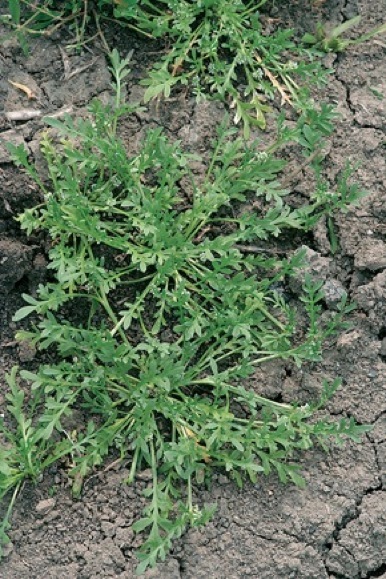
Coronopus didymus, strong flavor, naughty name. Photo by Green Deane

   Coronopus didymus, C. squamatus: Smelly Pot Herbs?

Opinions are mixed on Swinecress. I think it’s a nice walkabout nibble and pot herb. I often find it in lawns in the cooler months of the year and take it home with me. Others think it stinks nauseatingly and you should put a clothespin on your nose while boiling it …many times. Now you know the spectrum of gustatory opinions.

Coronopus Squamatus

Swinecress is yet another micro-mustard one finds clinging to life in scattered little patches. Don’t let the size fool you. It is a tenacious plant in will-to-live and flavor. Actually there are two species in North America, neither of them native. Coronopus didymus probably came from South America and Coronopus squamatus (formerly C. procumbens) came from Europe.  They both have a moderate to strong mustard flavor and are used the same way. Sometimes the C. didymus is called the “Lesser Swinecress.” No idea why. Their main separating distinction is the fruit/seeds of the C. squamatus is lumpy and has ridges where as the C. didymus tends to be smooth.

While both are found scattered in the Eastern United States, C. squamatus is also sprinkled across Europe. It is found from Ireland and southern England over to near my ancestral grounds in Greece, the wetlands of Mt. Parnon in Peloponnisos. C. didymus is also found in Oregon, Arizona and California. In the latter two states it is a noxious weed. It’s also been introduce to South Africa and Australia

Calling these plants micro-mustards is not quite fair. When they live where they are walked on or mowed they indeed become tough little contenders. But, given all the things most plants like such as sun, water, good soil and not trod upon they can grow to over a foot hight. Oddly, they take up salt in their roots, up to 17 percent.  Those roots can be ground up and mixed with vinegar for a type of horseradish. Or they can be cooked and eaten. While I do not know so the roots might also be burned for the salt. Other plants are burned for salt.

Coronopus (kor-on-OH-puss) is from Greek and means Raven/crow’s foot, presumably because the ends of the leaves look like that. Not too many people look at crows’ feet these days, or Ravens’. Didymus (DID-ee-mus) means found in pairs, a reference to the seeds, as in two testes and indeed that is what the seed pod resembles. Squamatus (squa-MAY-tus) means with scale-like leaves or bracts.

By the way, there are no poisonous members of the mustard family, just pungent.

Green Deane’s “Itemized” Plant Profile

IDENTIFICATION: Coronopus didymus: An annual or winter annual, low, spreading, smooth to mildly hair, stems freely branching, low-growing with upward tips, many leaves, ovate to oblong, pinnatifid, segments narrow, dentate or incised, racemes many, lots of flowers, white petals. Fruit shorter than stalks, seeds in two inflated rounded sections. Coronopus squamatus similar, more leafy, basal leaves obvate to oblanceolate, very condensed flowers.  Seeds much rougher than C. didymus which are smooth.

TIME OF YEAR: C. didymus flowers spring to mid-summer. C. squamatus flowers in summer. In Florida, Swinecress a winter annual easily found in January.

ENVIRONMENT: Old fields, roadsides, along streets, vacant lots, disturbed sites, mowed lawns, often locally abundant.

METHOD OF PREPARATION: Depends on your taste and perception. Can be eaten raw. Most people boil leaves and stems in several changes of water as a pot herb. Seems excessive to me. I actually never cook it. Can be used to stuff other foods such as fish. Roots can be cooked or ground up and mixed with vinegar to be used like a horseradish. Do not add salt to the root until you taste it.


{ 5 comments }


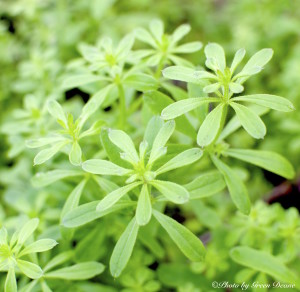
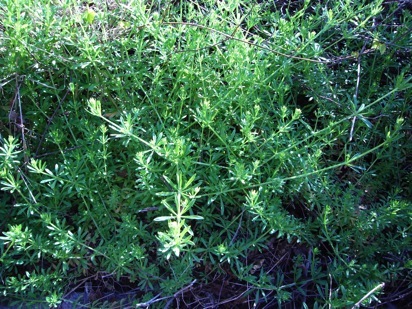
Galium gallops in and out of season. Photo by Green Deane.

Galium gallops in and out of season. Photo by Green Deane.

You don’t find Goosegrass. It finds you.

Goosegrass, Galium aspirine

Covered with a multitude of small hooks, Goosegrass, Galium aparine (GAY-lee-um ap-ar-EYE-nee) clings onto almost everything it touches. In fact, it clings so well you don’t have to take a bag with you to collect it. I usually just grab a bunch and touch it to my back pack. Instant stick. Indeed, the real headache with Goosegrass (aka Cleavers, Bedstraw, Stickywilly) is cleaning it of debris. It hates to let go of anything (which means a ball of it makes a good sieve.)

Young tips raw or boiled 10 to 15 minutes make an excellent green and the seeds roasted are one of perhaps two plants that actually makes a coffee-tasting coffee substitute (without caffeine.) Galium is in the same greater family as coffee. Older plants become laced with silicon and are too tough to eat, though I wonder if they would yield a lubricant of sorts.

Goosegrass is so called because geese love it along with most farm fowl and livestock. It is not, however, welcomed everywhere. Its seed are prohibited or restricted in Connecticut, Massachusetts, New York, and Vermont.  Kentucky calls it a threatening weed. The Canadian provinces of Alberta, British Columbia, Manitoba, and Saskatchewan list it as a noxious weed. Why not just call it lunch? There are no noxious weeds in countries that are starving.

Botanically Galium aparine means” milk seizer.” Juice from another member of the genus, Gallium verum, was used to curdle milk for cheese making.  Galium comes from the Greek word  γάλα  (GAH-la)  meaning milk. Aparine is from the  Greek verb  απράζω (ap-RAH-zoh) meaning to seize. Greek shepherds would use Goosegrass as a strainer for milk and other things. As a strainer you can bunch it up or make crosshatched layers.

Other colloquial names include: Clivers, Barweed, Hedgeheriff, Hayriffe, Eriffe, Grip Grass, Hayruff, Catchweed, Scratweed, Mutton Chops, Robin-run-in-the-Grass, Loveman, Tongue Bleed, Goosebill, and Everlasting Friendship.  The ancient Greeks called it philanthropon, “man loving”  from its clinging nature. It’s a fun plant to introduce to kids because it sticks to their clothes.

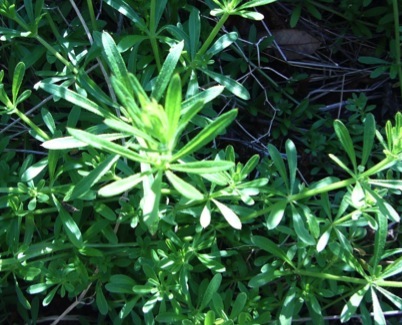
Goosegrass’ whorled leaves

Actually four Galiums are used somewhat regularly. Besides curdling milk the Galium verum’s blossoms were used for coloring and scenting cheese and butter with a honey-like fragrance. The flower tops are also used to make a refreshing drink. Galium mollugo, White Bedstraw, Revala, is one of 56 leaves added to a ritual dish in Friuli, Italy, and is now naturalized in the eastern US, the northwest but not the Deep South.  Galium odoratum is used for flavoring fruit cups and German Maywine. It is found in a hodge-podge of places in North America, part of the eastern US and Great Lakes area, part of the northwest, and Colorado. Check a USDA map for your area. The dried leaves are a tea substitute and the flowers are eaten or used as a garnish. Also listed has having edible leaves are: Galium boreale, Galium gracile, Galium spurium, and Galium triflorum. There’s also about a dozen endangered species, most of them in California. So, carefully identify your local Galium.

As one might guess the genus has been used for medicinal purposes. Dried Galium verum has some coumarin in it and has been used to treat bladder and kidney problems including stones as well as dropsy and fever. It also has citric acid (which makes it refreshing as a drink) and that might have anti-tumor activity. Some think it lowers blood pressure and is anti-inflammatory. It can also prevent scurvy. Native Americans used Galium pilosum to prevent pregnancy.  Goosegrass also strengthens your immune system and is good for you lymph system. During WWII children in Britain were paid to harvest Goose Grass (and other medicinal herbs.) It was used by pharmaceutical companies to make medicine to combat infections. 

Galium triflorum and Galium uniflorum were used for the flu and as a diuretic.  The Cherokee used Galium circazans for coughs, hoarseness, and asthma. For respiratory problems the Ojibwa used Galium tinctorium. Galium triflorum was the most used medicinally. They used it as in infusion for gallstones and a poultice to reduce swelling. The ladies also used it as a perfume and for washing hair.  The root of the Galium tinctorium was also used for a red dye.

Locally, that is in central Florida, two Galiums are common, the Galium aparine and Galium tinctorium. They are fairly easy to tell apart. Galium aparine, the for-certain edible, has six to eight leaves in a whorls at a node. It prefers dry areas. Its white flowers have four petals. The Galium tinctorium, the smaller of the two, has four to six leaves in a whorl and likes damp places. Is white flowers have three petals (sometimes four.) While it would be nice if the Galium tinctorium were edible I have found no reference that says it is. If you know otherwise please let me know.

 Green Deane’s “Itemized” Plant Profile

IDENTIFICATION: Galium aparine: A weak square stem plant covered with little hooks that bend back towards the bottom of the plant. Feels scratchy and will cling to almost any texture. Leaves small and skinny, usually in a whorl around the stem, eight leaves at a time, lowest leaves petioled and roundish; upper leaves sessile, narrowly oblanceolate. Minute  four petal-white flowers on small stalks where leaves meet the stem (axils). Fruit a tiny two-lobed capsule, covered with fine hooks.

TIME OF YEAR: May to July in northern climes, early March in Central Florida.

ENVIRONMENT: A wide variety, rich moist ground to upland scrub, woods, thickets, waste ground beside trails.

METHOD OF PREPARATION: Young shoots and or tip of older plants raw or boiled 10/15 minutes. Serve warm with butter or olive oil, sale and pepper. Or, let them cool and use them in a variety of ways, salads, omelets et cetera. Slow-roasted (low temperature) roasted ripe seeds when ground make a good coffee substitute without caffein. Older plans are not edible. Look for new growth in spring.

According to Professor Gordon Brown, Goosegrass is good for the lymph system.

{ 52 comments }

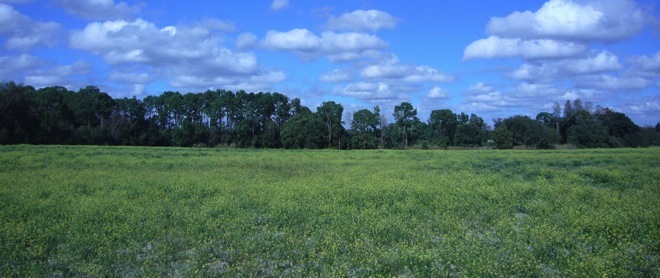
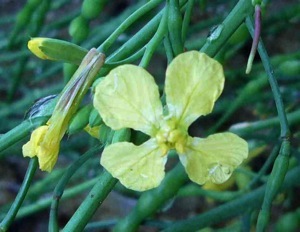
Field of Wild Radish near Tarpon Springs, Florida

Raphanus Raphanistrum: Radical Radish

Flowers are cross-shaped

The Wild Radish has an identity problem. It looks similar to it’s equally peppery cousin, the wild mustard. In fact, it really makes no difference which you have, both are edible, appear the same time and are used the same way. Both grow locally though I think radishs are more common. So, how do you tell them apart?

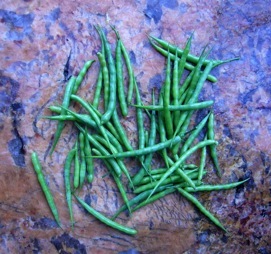
Seed pods are jointed

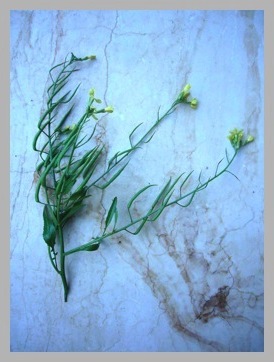
Wild radishes have singular flowers while mustards have a clump of flowers. The petals of the radish flowers are veined, mustard flowers are not. The seed pods of the radish are segmented, the mustard pods are not. Also wild radishes tend to grow to one or two feet high, maybe three. Wild mustards can four to six feet high. Usually just with a glance you can tell if it is a field of radis or mustards.

Blossooms and seeds are edible

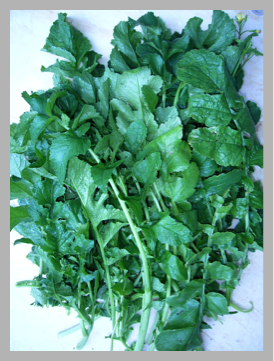
Like the mustard the greens of the wild radish make an excellent greens, boiled for 10 minutes or so in plenty of water. They are edible raw but can upset some tummies. In fact, many livestock owners consider the radish and the mustard toxic for the same reason, then again, cows have several stomachs to upset.  I have eaten boiled radish greens for years and find them one of the tastiest short-lived plants of spring. That’s the only flaw of the Wild Radish, it’s here for a few weeks and gone. Thus for a few weeks I am busy harvesting, blanching, and freezing as much as I can process.

Leave reduce significantly during cooking

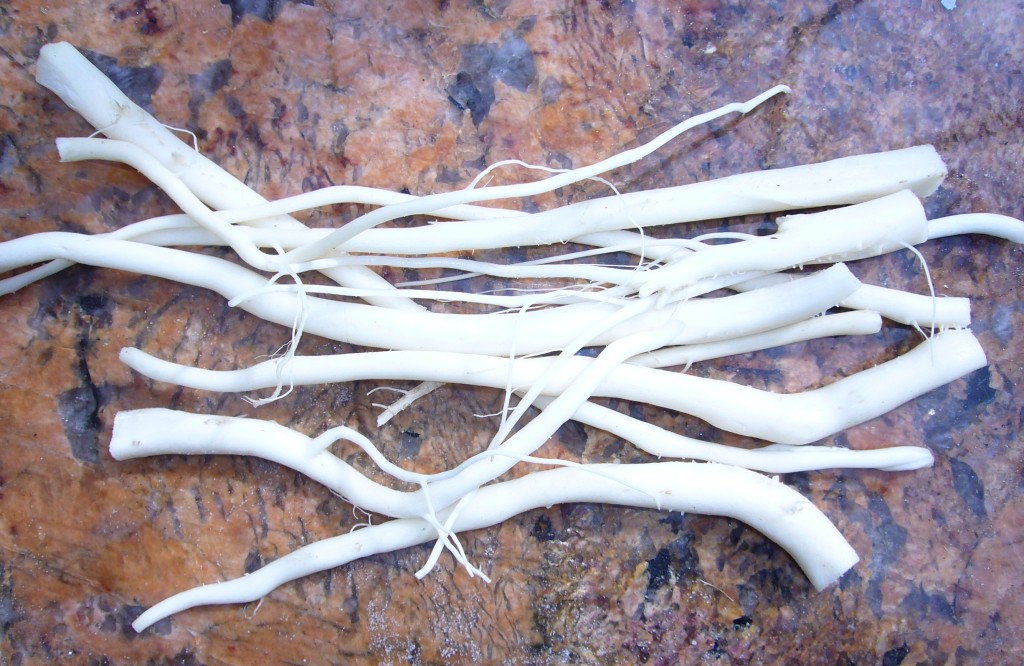
The blossoms are edible and the seed pods have many uses, from eaten raw to cooked to pickled.  Few mention the edibility of wild radish roots.  They are quite edible and remind me of kohlrabi in flavor, not a radish. They have vitamins B, C, rutin, and minerals.  The tough, outer layer peels off like a separate jacket, often coming off in strips the way colors wrap around a barbershop pole. What is left is the clean, smooth, inner core of the roots.  I dice them and cook them in plenty of boiling salted water for 45 minutes.  Depending upon their age, they can be occasionally be fibrous but still quite tender and tasty. They do, however, smell like radishes when peeling and can fill the house with a sulfur aroma when cooking. The cooking water may also turn light tan. I like them with salt, pepper and butter. Cooked, they are not peppery at all but rather mild.

Roots minus tough jackets ready for cooking

Also called the “Jointed Charlock” the Wild Radish’s name is a double take. Raphanus raphanistrum  (RA-fah-nus raf-ahn-ISS-trum.) Both come from Raphanis, a Greek word that means appearing quickly. It was the the Ancient Greek name for this vegetable. “Charlock” comes via Old English from the French word “cerlic” the name for the plant.

Green Deane’s “Itemized” Plant Profile

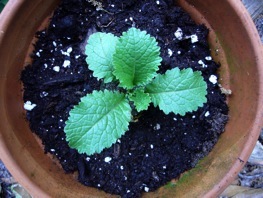
Young seedling

IDENTIFICATION: Flower: Four sepals, four petals, six stamen, 4 long, 2 short, pistil in middle; Flowers tend to be solitary and petals clearly veined. Leaves lobbed, tough, stem round. The pods of wild radish break in fragments to expose the seed while the wild mustard open straight down the middle to expose the seed. Pods stick out around the stem like a spiral staircase. Under a yard high.

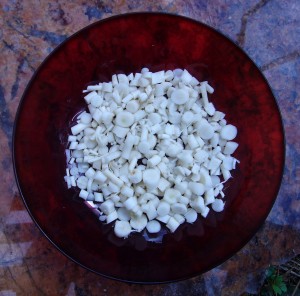
Chopping roots help cook them quicker 

TIME OF YEAR: Springtime to summer in northern clims, winter in Florida.

ENVIRONMENT: Well-drained soil, sandy to rich, old pastures, gardens, lawns, roadside

METHOD OF PREPARATION: Leaves as potherb, seeds for spice or flavoring, can use flowers to flavor vinegar. Some young leaves can be used raw in salads. Try a little first. Roots, peeled of outer core then boiled.

Recipe by Pascal:

Take 3 part apple cider vinegar, 2 parts white wine, 1/2 clove garlic, a bit of California Bay Leaf and Italian Spices, red chili and voila! Oh…and a dash of sea salt as well per jar. Canning it for 15 minutes (water-bath canning).

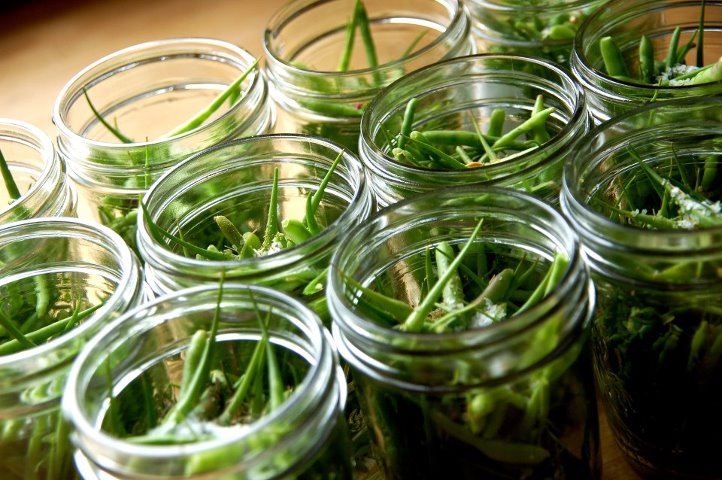
Wild radish seed pods ready for pickling (you can use mustard pods as well)

Wild radish seed pods ready for pickling (you can use mustard pods as well)

{ 19 comments }

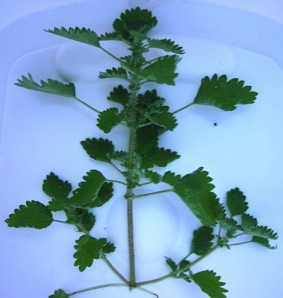
Urtica chamaedryoides: Nettle Knowledge

Stinging Nettles Know How 

I  was hiking one day when I saw what I thought was a mint I had not seen before. I picked a leaf and it bit me, badly. Welcome to the world of stinging nettles.

Florida’s Heartleaf Nettle

As luck would have it, I also picked the North American nettle that stings the worse, Urtica chamaedryoides (UR-tee-ka  kam-ee-dree-OY-deez) which is a combination of Dead Latin and Living Greek that means “burning dwarf.” Modern Greeks call the nettle Tsouknida.

Humanity has been using the nettles for thousands of years. Not only are they an excellent source of food but also cordage. They  also seem to be an element of grade-school torture, judging by all the videos on the Internet involving kids and nettles.

From the nutrition point of view, they pack a wallop as well. Stinging Nettles are rich in vitamin A, potassium, magnesium, and calcium. They are also high in protein and when cooked are very mild, tasting similar to spinach but slightly rougher. 

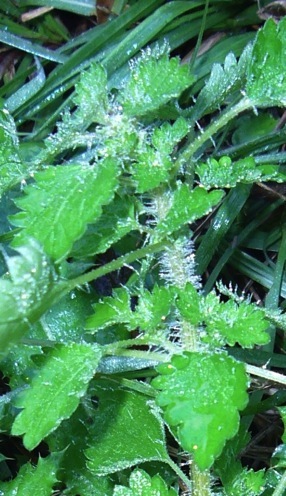
Stinging hairs cover the nettleSoaking, cooking, refrigerating, wilting or drying neutralizes the plant’s sting. And to be on the safe side the plant should not be eaten after flowering. It reportedly can irritate the urinary tract, which makes some sense as it is a diuretic as well. It also gets stringy as it ages. Cooked nettles can be used in a wide variety of recipes from polenta to pesto to soup. There is a recipe below. The water you cook the nettles in can be kept for tea or as a soup base. You can also dry the leaves and use them for tea as well.

The stems of the nettles contain blast fiber and have been used the same way as flax, Caesar weed, Spanish Moss, and retted similarly. (Retting is a means of rotting off the non-fiber material of the plant. ) Nettle fiber is more coarse than cotton, closer to burlap. Clothes have been made out of it and it was a fashion style recently.

As for stinging… I have been stung by a spurge called Cnidoscolus stimulosus and this stinging nettle (Urtica chamaedryoides.) While both bites are different I think the Urtica wins, so to speak.  With me the Cnidoscolus‘ contact begins to burn slowly and intensifies over an hour or so and then goes away completely by two hours. The Urtica hits, as Shakespeare said,  like a “hotspur” throbs, then lessens in an hour but stays painfully sore as a welt for several days especially after contact with water.  The juice of jewelweed or dock is reportedly a good treatment for the Urtica sting. Didn’t work.  The juice of a chewed leaf is also supposed to bring relief but I can say that absolutely does not for with me nor plantagos or urine (don’t ask.) A paste of baking soda did bring some relief.

There are some look-alike plants to the beginner. Two are the Pilea pumila and a new weed, the Fatoua villosa.  Neither sting. It is that simple. A third plant that does not really look like the Urticas but does sting is the aforementioned Cnidoscolus stimulosus. It has deeply palmate leaves and large white flowers, at least a half inch or more across.  You can see a picture of the Fatoua on the UFO page. The article on the Spurge Nettle is here.

One last word before the recipe. While folks can be allergic to stinging nettles they are also used to treat certain allergies particularly hay fever. Around the world nettles have been used for at least centuries to treat nasal and respiratory issues such as coughs, runny nose, chest congestion, asthma, whooping cough and in some cases tuberculosis. The roots are used as well as dried leaves. Apparently freeze dried leaves are the best.

Nettle Pesto

Ingredients

6 cups fresh nettle, blanched in boiling water for a minute, drained and roughly chopped, 2 cloves of garlic finely chopped, 1/3 cup  pine nuts, 1/2 cup grated Parmesan cheese, 1/3 cup olive oil, salt and pepper to taste.

Directions

Place the blanched nettle, pine nuts, Parmesan, a little salt and pepper, in a food processor. Blend the mixture until the mixture is smooth, or reduce by hand. While the motor is running, or mixing by hand, gradually pour in the olive oil until well distributed.

Green Deane’s :”Itemized” Plant Profile: Stinging Nettles

IDENTIFICATION: Urtica chamaedryoides: An unbranched weed one to several feet high, small inconspicuous flowers, fine bristly hairs all over the stem, leafstalks and underside of leaves. Very obvious. The bristles sting greatly when gently touched.  Manhandling the plant reduces the chance of being stung as it breaks the hairs before they sting. Mature stems can be used for cordage.

TIME OF YEAR: Spring and fall, depending upon the climate, during Florida’s winter into spring.

ENVIRONMENT: Moist areas, along streams and woodlands, nettles are found around the world.

METHOD OF PREPARATION: Leaves raw or cooked but eating raw requires much skill to reduce stinging. Usually young shoots and leaves are boiled 10 to 15 minutes.  Reserve the resulting water for nettle tea. Once cooked use like spinach or basil. Very nutritious. The cooking water is good as a tea or soup base. Dried leaves can be used to make tea. If you are on the trail you can use an alternative method of preparing nettles used by Ray Mears, an English wild food expert. He places the entire plant near a fire for a few minutes until it completely wilts, and that stops it from stinging. 


{ 66 comments }