Budget Cut Benefits

Two effects of the economic times are influencing foraging. First is an increase in the number of people who are putting food on the table by foraging. The other is an increase in edible weeds.

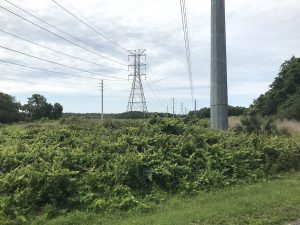
One result of tight budgets is that various agencies don’t have the money to pay for weed control. Wild edibles that were often kept at bay by regular mowing or spraying are now flourishing. Along the bike trail I have been using since it opened I’ve seen more edible than ever before. It is an interesting example of how less is more, as well as a 13,000-year-old lesson.

There was a time when no resources were spent controlling nature and nature provided ample food for man to survive. Then came agriculture, then cities and eventually a population that cannot survive without big agriculture. A century ago when most folks not only stopped foraging but started moving off the farm they planted non-edible plants about their homes and cities. They even allocated money to keep nature in check, as if nature was a green enemy. We went from being part of nature to opposing it. Nature went from being a provider to being a pain. We turned on something that has sustained humanity for eons. And more to the point, it was and is perhaps a pointless expenditure. Nature has far more resources than man and doesn’t need a bank account to get something done

Blackberries along the bike trail. Photo by Green Deane

The bike paths are just accessible now as they were last year. But less plants are being mowed or sprayed. Nature is responding and coming back with wild edibles: Ground cherries, peppergrass, blackberries, milkweed, yams, maypop, grain grasses.  We stop spending money battling nature and nature provides more food, for free, and I can still ride the bike path.  That strikes me as a win win win and a lesson not to be forgotten when the economy recovers.

{ 0 comments }

The Mesolithic Era is not a sexy topic that will win friends and influence people at parties. But, it is something foragers should think about. If you are a survivalist it is mandatory knowledge.

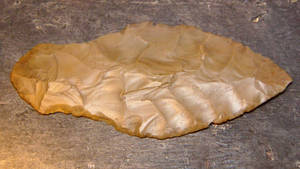
Flintstone Knife

Mesolithic literally means middle stone, or the Middle Stone Age. When exactly that was is a bit of a debate. Some places got metallurgy before others so it is a fluid definition. Let’s put it at 8,000 to 10,000 years ago for northern Europe and perhaps North America as well. Metallurgy might have migrated around the north polar regions after that.  More specifically, what we’re interested in is the time before man was using metal.  What does that have to do with foraging?

Well, everybody foraged back then. It was how one lived. In fact, most of your time was spent foraging, going from food source to food source. Throw in hunting and a few fights and you have your 9 to 5 Mesolithic day, though dawn to dusk might be more accurate. What can possibly be instructive about foragers 8,000 years ago? One consideration is how they cooked food without pots and pans. That brings us to fire.

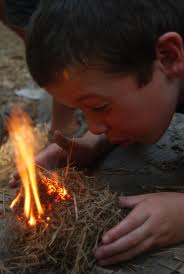
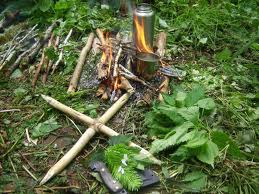
Making fire by hand

A camp fire is more than burning wood. Which wood, the size of the wood, and how the fire is made allows for great sophistication in cooking, particularly without pots or pans. Even in my youth with a wood cook stove in the basement, the kind of fire and wood was important.

If we were roasting potatoes, we wanted steady hot coals that put out a consistent heat for an hour or two. That usually meant a hard wood of medium size reduced to coals. If it was biscuits for breakfast it was a fire made of small soft wood, like pine. That produced a very hot but short fire, perfect for making biscuits and browning them in a few minutes.  Baking bread required large pieces of hard wood.

There is not only the fires to consider but the coals and ashes, the ground and local material such as stones and leaves to wrap food in or make mats out of. For example, the “traditional” New England Clam Bake is a method of cooking devised before there were pots and pans.

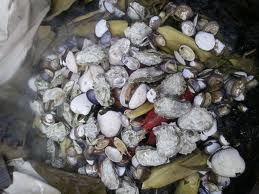
Clam bake

When I was a kid, we would go down to the Maine shore at low tide late on a summer afternoon. We’d wade out to an island about a half a mile from shore, getting quite muddy in the process. Once on the island we would dig a pit, line it with rocks, and build a big fire. Then we’d go looking for food…. crabs under seaweed, mussels, sometimes fish caught in tidal pools, clams in the mud. When the fire had burnt down, we toss all the stuff in the hot pit: Fish and crabs on top, cover it all with seaweed, then cover the seaweed with dirt. We’d then go play and or build a small camp fire nearby because we always spent the night.  In a couple of hours we’d shovel off the dirt and seaweed and have a feast.  In the morning we’d warm up what we hadn’t eaten and play until the tide was low enough to wade back to the mainland. No pots, no pans, no forks or knives. Fresh nutritious food.

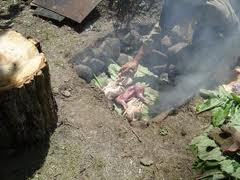
Roasting in the ground

Every time I collect a wild edible I ask myself how could the foragers of the mesolithic prepare it? Roots would be roasted, sometime in the fire itself, sometime beside the fire. Some roots were buried in the ground before the fire was started and not uncovered until the foragers were ready to move on days later. This was particularly so with roots in the Americas that had calcium oxalates in them that only break down with long dry heat. Some nuts were roasted in sand under a short hot fire. Depending on the fire and the food cooking could be in, around, over or under a fire.

Roasting nettles over open fire

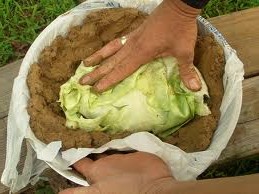
Some greens, nettles for example, can be wilted by the fire and made edible in a matter of seconds. Others have to be steamed.  Some small roots can be buried in the ashes and covered with dirt. Why dirt? Dirt locks out oxygen and keeps the roots from charing. If you buried a wrapped fish the sand will also keep it from charing. Baking was also possible if you had clay. The food was wrapped in grass or another suitable leaf, and all of it encased in clay. Then the clay “oven” was set next to the fire and tended, turned now and then to cook the food.  Eggs were wrapped in clay or had a small hole cracked on top and propped up in the ashes.

Wrapping fish in clay

Learning to cook like a cave man has several advantages. The first one is you know how to cook no matter where you are as long as you can make fire. The second is you don’t have to carry a lot of pots and pans to eat well. Third, such cooking forces you to think about the plant and ways to use it. And primary cooking is usually more nutritious. Fresh food, freshly cooked and into you not long after harvested is healthy. It is also leaving out a lot of the non-food stuff in processed food these days. Cooking fish and game is similar to plant materials. They can be roasted, steamed or baked. It depends on the food and the materials on hand.

If I am traveling light, I take one pot/pan for all possible cooking needs and a few spices. I forage along the way for meals. If I am driving to a site and camping, then I dig out my cast iron ware and set up a wilderness kitchen — ya gotta play now and then. The idea behind both methods of cooking is not to survive but thriving, not subsistence but living well while in the wilds.

Regardless of what wild food you cook or how you cook it, knowing how to prepare it without pots and pans brings useable knowledge and independence to your outdoor experience.  I’ll cover more techniques in the future.

{ 3 comments }

Looking for Lettuce

Lactuca virosa, much overrated

I like my hundreds of thousands of subscribers, and the email I get. Many of the questions I can answer or I can refer the writer to where the answer can be found. But….

One question I have answered hundreds of times — if not thousands — still constantly lands in my mail box daily. It’s about getting high off wild lettuce. I used to cut and paste an answer. Now I just delete the emails. Why the interest in this species? It can be traced to an exaggerated entry on Wikipedia (which if you remember correctly is not authoritative. I have found so many plant mistakes in “Wikipathetica” I have stopped correcting them. Forager Beware!)

Here’s the bottom line. The species in question is Lactuca virosa. It is a native of Europe, not North America. Officially grows wild in six places in the United States: One county in Alabama, Washington DC, and four counties in California. It could be more wide-spread that that. I’ve one subscriber tell me it grows in Georgia.  If you collect a lot of Lactuca virosa sap — not easy — dry it and ingest it you might take the edge off a toothache and fall asleep. A shot of vodka will do the same thing, is a lot easier to find and much cheaper in the long run. It does have medicinal uses but it is mostly a minor player.

Consider this: The U.S. military looked into it as a pain killer during WWII. It flunked. Lactuca virosa is so weak no one wants to outlaw it, even in Europe where it grows everywhere. On the other hand, there is a mint species growing near me that has a chemical in it that is the most abused chemical by physicians and nurses. No one is selling it as a high so it’s not plastered all over the internet….wait… how could I have been so stupid?

Maybe I can make some money here…This other plant is legal, but it grows all over the place locally…. I’d have to make it a scarcity somehow… I know… I could solar dry it (cheap) and call it “naturally processed to retain all of its potency” …. I could call it a little-known “ethnobotanical” (that’s what the lettuce sellers call their stuff.) I could hype it as a native and say this “mood enhancer” is the preferred recreational drug of choice among medical professionals…. and they know drugs! I could make a fortune…. Dang! I shoulda thought of this years ago….

I also know for a fact that many have considered making this mint member illegal — the drug in it is controlled — and the plant would be illegal if not for the fact it grows wild all over the place. That would be my financial downfall… I can’t realistically corner the market. The plant is prolific…. And the moment you educate your customers they’ll  be gone, picking their own stuff.  Oh well… one can dream of riches….

As for those of you who want to go find the European lettuce in the U.S. have at it… if you want to know where that lettuce grows, find a Google search window, type in Lactuca virosa USDA then scroll down and look at the map. Happy hunting… and please don’t ask me about it again….I’m going to go make me a cup of special mint tea… and relax…..

Recap: The Internet is rife with a multitude of pathetic claims that wild lettuce is akin to opium. That is nonsense. It is so good as an opium substitute at that wild lettuce is not illegal anywhere. Ponder that. A lot of dried sap might make one a little sleepy, but an aspirin — or willow — is better at pain relief. Research from the 1930s through the early 2000s shows it is lousy as a significant pain killer. If you are disparate and have nothing go for it. But if you are expecting pharmaceutical-grade relief it ain’t happening.

{ 11 comments }

It’s About Time

I spend a lot of time in the woods, and also afloat. Three things you should always know in such environments are the cardinal directions, time of day, and the weather.

I happened to have gotten the gene for divining time, distance and direction.  I can guess the time within 15 minutes, usually less, and estimate large distances to within a mile or so. I usually know which way is north, east, south and west. I’m definitely a vector person. I am well-grounded in time and space. About the only time I am ever befuddled is when I’m first in a building with no windows. (Yes, I know men don’t ask for directions, but that’s because we don’t want to be told where to go by women.) Minds, however, can get mixed up by events or trauma. Or one may have the responsibility of others. So I always carry a time piece. With that — digital or other wise — I always know for certain the time of day and which way is north.  I also keep my eye on the clouds. On a 24-hour basis you can be as accurate as the weather bureau just by watching the clouds.

You can tell the compass directions with any watch but I like my 24-hour wrist watch. I point the hour hand towards the sun and 12 o’clock is south, 24 o’clock is north, 6 east, 18 west. It is the opposite in the southern hemisphere. Simple, unless it’s daylight savings time, the subject of this rant.

I so dislike the time change that a few years ago I simply stopped doing it. I refuse to change times seasonally. I no longer leap forward in the spring and fall back in the fall. I do not change my schedule at all.  I eat at the same time, go to bed and get up at the same time, in short I do not change with the rest of the world. Personally, I really don’t care if we use solar time or daylight savings time permanently. It’s the flipping I can’t stand. After all, there are only so many hours of daylight and changing a clock does not create any more, or less.  So I stay on solar time, and I remind myself that the rest of the world is delusional thinking its an hour ahead of me.

I don’t watch TV so that doesn’t influence me. When worked for a company I simply went to work an hour earlier for half a year. I did not eat lunch on their schedule but rather mine. If I have appointments I do accommodate the “flippers.” But in my personal life, habits, and space, I don’t change. My clocks do not change. As I write my computer, slave to its programming, tells me it is almost 1900, or 7 p.m. The sun tells me nonsense, it’s six p.m. and time to feed Oliver Whitecat, my ever-faithful assistant and supervisor. More so, the atomic clocks that regulate time down to the millionth of a second don’t leap forward or fall back. They stay on solar time. The animals stay on solar time. Mother nature stays on solar time. Only humans play the silly game. Only the government would cut the bottom foot off a blanket, sew it on the top, and then argue the day is longer.

It feels good that the sun and my watch are in agreement. If I change it to daylight savings time, south would 11 instead of 12….truly bizarre, and then it would change again, even more nonsensical.  I am not a perfectionist but the sun at 11 just doesn’t work for me. 12 is just right. So I stay on solar time…. in tune with the cosmos and my location on the rotation. And when interacting with the world gone flipping mad, I just tell myself they are wrong. It all works out rather well….. almost.

The only problem is O. Whitecat. He knows when the rest of the world leaps forward, prompting him to demand to be fed an hour earlier. I don’t know how he knows but he does…. since he’s my laptop maybe he intercepts the time signal like the other computers do….

{ 1 comment }

The quick answer by most would be yes, the presumption being man ate raw vegetables for a long time and is better suited to them, and them to him. But, whether you are an evolutionist or a creationist the answer might be no.

I have a lot of vegetarians and raw food advocates among my subscribers and in no way is this meant to criticize the practice. A thought simply crossed my mind the other day — or was it a thought crossed my simple mind the other day? …Any way, it was about the topic and it raised a question I thought worth exploring. That led to two interesting possibilities. Setting aside the meat/no meat debate for the moment, let’s focus on vegetables.
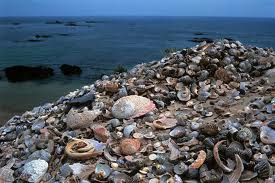
We know from mesolithic fire pits, middens, bathrooms, and chemical tests what ancient man ate in general some 8,000 years ago. Or if you prefer, what he was eating after he was created by God 8,000 years ago.  (That should take care of most time frames and religious sensibilities.)  We also know from grave remains ancient man’s general state of health (better than ours.)

What we know is he used fire and he ate the food with the most energy return for energy expended. Calories in, calories out. If he didn’t get more energy from the food he ate he had to call upon fat stores, and if no stores, he moved a little closer towards starvation. We also know foods he could have eaten raw, sea kale for example. It is more nutritious cooked because cooking breaks down the plant and makes the nutritional elements more accessible. From what evidence we have, he preferred cooked food over raw if he could cook it.
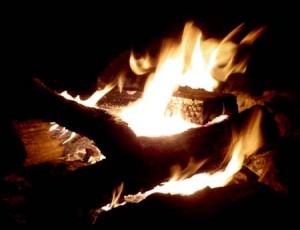
Man has been using fire for at least a quarter of a million years to close to million years, cooking with it for 200,000 years. (Or if you are a creationist, he’s been using fire since he was created 8,000 years ago.) Either way cooked food is part of the warp and weave of man, either genetically over hundreds of thousands of years, or by creation’s intent. I am not sure there is a scientific or a creationist basis for eating raw vegetables, or that they are better.  Consider:
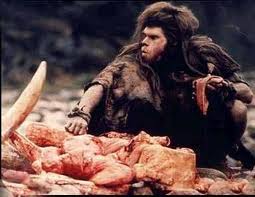
If you are a creationist raw vegan the argument is rather shaky: Man had fire from get go. He ate most of his food cooked then and now. For the creationist there isn’t much evidence man was a raw vegetable consumer.  For the evolutionist it is quite easy to see how those who ate more cooked food prevailed over hundreds of thousands of years and the raw food humans didn’t. During that time humans drifted physically towards being more suited to eating cooked food. Perhaps that is why we no longer have an active appendix: We’ve cooked food for so long it has no active second-stomach function. Looking at it either way I am not sure there is an “ancient” justification to eating vegetables raw. Which leads me to the raw vegetables, my original thought.

I receive a lot of emails from raw food advocate who want to expand their choices. Unfortunately I have some but not a lot to offer. There are a handful of wild vegetables one can eat uncooked but most of the ones we collect get cooked, particularly roots. I also noticed that nearly all raw vegetarians, or raw food advocates even if they are not vegetarians, eat almost exclusively modern foods raw. Carrots, bell peppers, cauliflower, scallions, cukes et cetera, all modern vegetables compared to what vegetables were eaten  8,000 years ago.  Not only that but the usual vegetables are modified and grown under modern chemical conditions, a debatable state as well.  So I ended up with:

1) An unsupported presumption that man evolved (or was designed) to eat raw vegetables, leading to 2) folks eating modern vegetable raw presuming they are good for you.  It may be that man 1a) used to eat raw but evolved to be better suited to cooked food, or 1b)  was designed to eat cooked foods,  and 2) that modern vegetables may not be that good for you. Indeed, most of the modern vegetables are the least-offensive descendants of ancient vegetables and as such might be inherently far less nutritious. I am sure the root of a Queen Ann’s lace has far less sugar than a modern carrot, its cultivated descendant.

Behind the raw food movement is the good idea we should not eat “processed foods.”  Processed foods tend to be found in the middle of the grocery store. Real food — not processed — if found around the edges of the grocery store. I am a strong advocate of eating like our great grandparents who ate real food compared to people today. Today most folks eat mostly processed foods. I know several young couples who never cook. But more to the point: Are raw vegans eating like their great grandparents, or their ancient ancestors? I don’t think so. It might indeed be healthier to eat raw modern vegetables but I don’t think the justification will be found in the past.  And while modern vegetables are not “processed” in the conventional sense, a modern hybrid bell pepper is as much a manufactured food as a box of cereal; wild apples are sour, not sweet like the domestic ones, ancient corn not sweet et cetera.

So where does this put this forager? Looking for wild food that has less chemical contamination than the agricultural product, and more nutrition. I am sure the sow thistles I eat off my lawn are wholesome, but I most certainly would not eat any off my neighbor’s lawn, a patch of decapitated grass pretending to be a putting green.  I’ll fight the ants for a persimmon or two if they’re not down hill from the interstate. “Wild” does not automatically mean “wholesome.” You need to exercise some judgment in our polluted world. Yet, despite the ravages of man, wild food is usually far more nutrition than their cultivated counterparts.
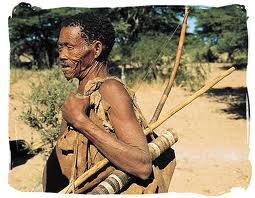
As for foraging, it puts my diet closer to that of the hunter gathers of some 10,000 years ago, a diet that we know was successful because we are here.  It is low in carbs, includes a variety of meats (lean and fatty) fish, seafood, wild fruit, roots, nuts and greens in season, grown with the help of Mother Nature not the chemist. And I tend to avoid white-colored food; rice, potatoes, pasta, white bread, just as I avoid white berries.  It’s a mesolithic diet, like my 300th great grandparents ate. They’re not alive now, so I know the diet is not prefect. But, I think it’s better than what nutritionists recommend now.

So, are raw food advocates really eating better? It’s a point to ponder.

{ 28 comments }