Galinsoga, “Gallent Soldiers” aka Quickweed grows up, it’s toxic look-alike crawls.


Galinsoga ciliata: Quickweed is fast food

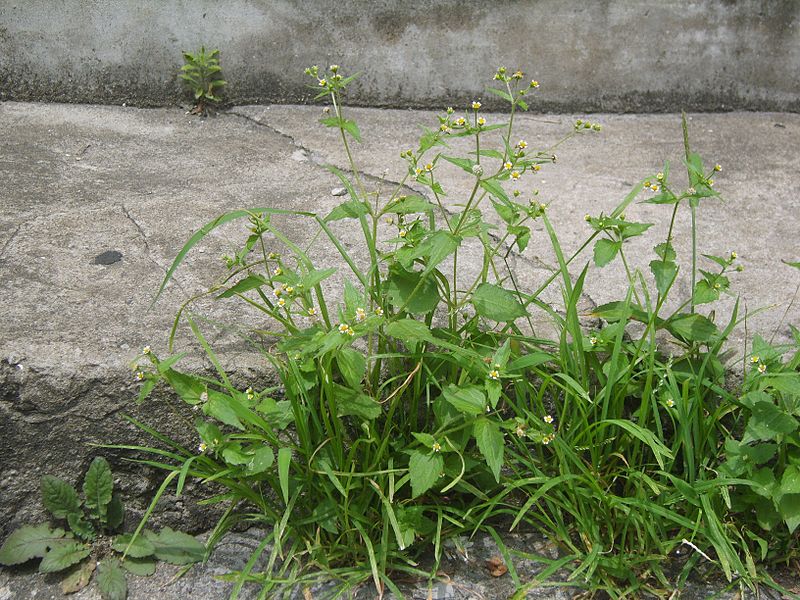
Quickweed does not look edible or gallant. In fact, it looks like a daisy that lost a fight. But it, and a close cousin, G. parvifolia, are good pot herbs. There is a potentially toxic look alike, Tridax procumbens, “Coat Buttons” which is more viney, and low growing except for flower stalk. Unfortunately the blossoms of Galinsoga ciliata and Tridax procumbens are nearly identical so you have to look at the rest of the plant to make sure you have the Galinsoga. It is found nearly everywhere in North America except the desert southwest (and sparingly in warm southern states.) 

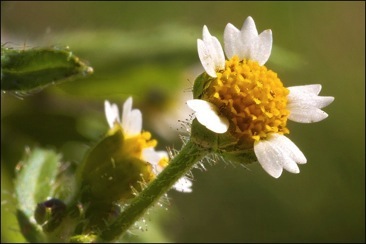
Galinsoga blossom

Beside roundish older leaves, Galinsogas have (usually but not always) five widely spaced petals with indented tips. A native of Central and South American, Galinsoga ciliata (gal-in-SOH-guh sil-ee-ATE-uh aka G. quadriradiata)  is a little plant that has gone a long ways. It was introduced to Kew Gardens in England in 1796 and not only has naturalized there but escaped to the continent as well. That makes some sense in that one plant in a season can produce 7500 seeds. As a new comer to not only the northern United States and Europe it does not have an extensive foraging history outside of its native region. However, as soon as it got to China it became a prime pot herb. The entire plant is eaten except the root. However the leaves are the best part. For an ugly little plant it has great taste. Pick a lot because it loses some size in the cooking.

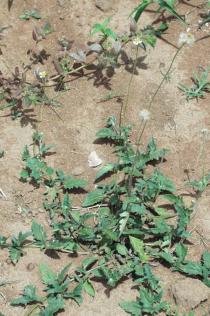
Low-growing Tridax procumbers: NOT EDIBLE

Nutritionally the leaves of the Galinsoga per 100g edible portions are:  88.4g water, 37 calories, protein 3.2g, fat 0.4g, carbs 5.2g, fiber 1.1.g, calcium 284 mg, magnesium 60 mg, potassium 58 mg, iron 5.3 mg, zinc 1.3. mg, carotene 4 mg, vitamin C 6.7 mg, thiamin 0.08 mg, riboflavin 0.21 mg, and niacin 1.21 mg.

Galinsoga was named after Mariano Martinez Galinsoga,  a Spanish physician and botanist in the 18th century. Ciliata means fringed with hair.  Parvifolia means small flowers. The plant’s nick name in England is “gallant soldiers.” In Brazil it is known as botão-de-ouro.  G. parvifolia is toxic to goats, apparently among the few plants that are.

Green Deane’s “Itemized” Plant Profile

IDENTIFICATION: Quickweed is identified by its opposite, oval, coarsely toothed leaves on opposite-branched stems. Its small flower heads have a yellow disk and five (or four) three-toothed white tiny petals (occasionally pink.) To two feet tall. Its toxic look-alike, Tridax, is ground hugging except for the flower stalks, see photo upper right. Remember, Galinsogas grows up, the entire plant. The Tridax grows low except for the flower stalk which grows up. Do not eat the Tridax. The blossoms resemble each other closesly so don’t use just the blossoms for identification.

TIME OF YEAR: May through fall in northern areas, nearly year round in Florida

ENVIRONMENT: Waste ground, cultivated areas, roadsides, gardens, dooryards lowland fields. However, it prefers damp rich soil with plenty of sunshine. (The government lists toxic Tridax as only growing in central and south Florida but eleven states consider it a “pest”: Alabama, California, Florida, Hawaii, Massachusetts, Minnesota, North and South Carolina Oregon, Texas and Vermont. ) 

METHOD OF PREPARATION: Cooked green. Put in boiling water for 10/15 minutes. Excellent with butter, salt and pepper.  Dried leaves can be used for flavoring. G. parvifolia being less hairy is used as a salad green as well.  The juice and leaf paste of the Tridax procumbens can be used to stop bleeding wounds.

{ 19 comments }

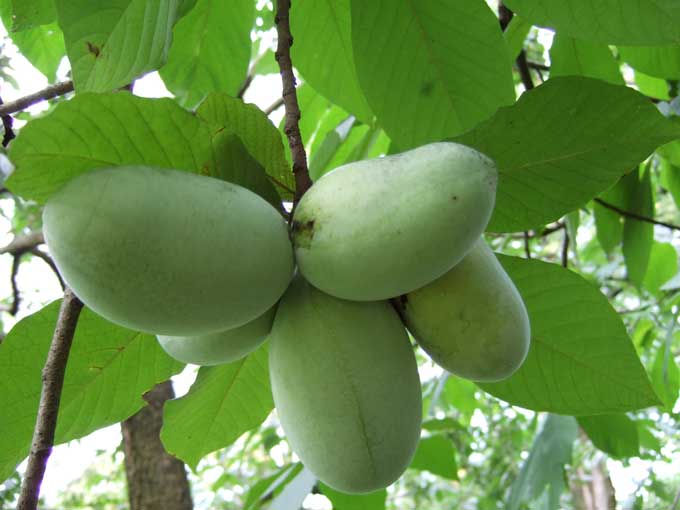
Pawpaw can be a dwarf shrub or a small tree

Pawpaw Panache
Asimina triloba

Finding your first pawpaw is a thrilling moment.

I can remember exactly where it happened and when. It was the summer of 1987 in Longwood, Florida, in The Springs, a gated community, along a nature walk. I happened to glance over and saw a pair of horribly stunted misshapen green pears. And as is often the case, once one gets the image of the plant in the head by meeting it in person, one begins to see them. Their most common appearance in Central Florida is along the margins of Interstate 4 in the Deland area, and of course, pastures.
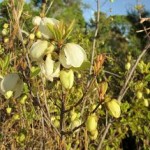
Asimina obovata

Wild pawpaws fall in the same category as gopher apples. The woodland creatures usually find them first so you rarely see a ripe one. The fruit is edible straight from the tree but palatability varies. There are two general types. One ripens early and is large with flavorful yellow flesh; the other is often smaller, ripens later, and has white, milder flesh. You can also divide pawpaws another way, Florida and all others. Florida’s pawpaws tend to be shrubs, if not dwarfs. They are: Asimina obovata, Asimina incana, Asimina reticulata, Asimina longifolia, Asimina pygmaea, and Asimina tetramera. Farther north one can find the Asimina triloba reaching small tree height and in the coastal areas Asimina parviflora. While I have not personally tasted them all Dr. Daniel Austin in Florida Ethnobotany says he presumes they are all edible.
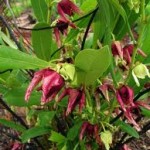
Asimina pygmaea

Pawpaws are rich in nutritional value, including high levels of vitamins A and C. The downside is they don’t ship or store well, on par with loquats. Also they severely nauseate some people, can cause a rash when handled, and the seeds contain a depressant.  Incidentally, the fruit is the largest native North American fruit and is heavy on the protein side.

Pawpaws are also a little difficult to cultivate. In fact, they are really hard to cultivate. They need a lot of pampering for a few years to get them started, after that they are quite free of problems. They also attract a wide variety of butterflies. Those who champion the cause of pawpaws think that if they can persuade nurseries to pay more attention to the plant it can be a commercial success. It has few pests so it can be grown organically with little fuss. There might be even pawpaws on your grocery shelf in a few years. That will depend upon the lawyers.
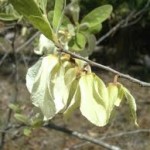
Asimina incana

Like all plants the pawpaw is a mini chemical factory. Natives used dried pawpaw seed powder to control head lice and pharmaceutical preparations today still use pawpaws for that. The leaves are diuretic and the bark yields a strong fiber for cordage.  It also belongs in a family of fruit trees that are suspected of inducing Parkinson’s Disease. That is currently being researched. Pawpaw has not been indicted but to a lawyer all that might be close enough to keep the fruit off the grocery stores shelves. You might have to forage for pawpaws or grow your own.  Which reminds me, historically, the pawpaw was under cultivation by natives east of the Mississippi when de Soto traipsed through in 1541. Chilled papaw fruit was a favorite dessert of George Washington. Thomas Jefferson planted some at his Monticello. I don’t recall of either dying from Parkinson’s.
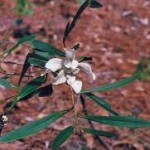
Asimina longifolia

As for its usual genus name, Asimina (uh-SIM-min-nuh) nearly any guess is as good as any other. My best deduction is the natives called the bush Assimin (“min” in Algonquin means food, still found in “persimmon.” ) Assimin would be fine enough but then European languages and writers get involved. The early French inhabitants of Louisiana, called the fruit “Asiminer” from which we get the genus name.  This is somewhat close to the Latin word for monkey, simia. That led to an early reference to calling the plant “monin” which was an old French word for monkey. That came from the Greek word for monkey, maimou. It changed through Latin into the romance languages as monin, mouninu, monnino, and monin. That leads folks to think the fruit had something to do with monkeys but I think it was just an assumption of one drunk botanist who thought Louisiana French were referring to a “monkey plant.”  Further, the pawpaw is North American and there are no native monkeys.

One Florida version is Asimina reticulata, (reh-tick-yoo-LAY-tuh) meaning the veins in the leaf have a net pattern. It can be found in slightly damp or occasionally damp areas. Another is Asimina obovata (oh-bo-VAY-ta) meaning egg-shaped leaves. It likes it dryer ground can grow twice as tall as the reticulata. The others are more or less reported, not the most common of shrubs. Locally pawpaws are rarely over four feet high whereas farther north the grow into trees. The A. obovata is listed as rare and the A. tetramera endangered.
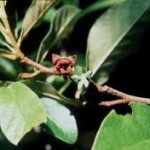
Asimina parviflora

One would think pawpaws would be a bit easier to explain, but no, and it also points to one of the problems of the cut-and-paste Internet.  Many say pawpaw (or papaw or paw-paw) is a corruption of the American Indian word papaya, a version or cognate shortened by the Spanish. That’s not too bad, no great stretch there. And that it came originally from native Americans seems reasonable. Others, no doubt copying the same wrong site, note that it is Indians then make a huge leap across the Pacific and say it is from the Hindi language, you know, near China… and then younger folks wonder why older folks don’t trust Internet Infants...
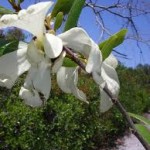
Asimina reticulata

Two aspects of the pawpaw I’ve found interesting is first it is in the Annonaceae family and closely related to magnolias though actually much older than the larger magnolias. The little ol’ pawpaw came first first. Next is that it is pollinated by carrion flies and insects attracted to fetid odors. Growers often put roadkill or rotting meat in their groves to attract the pollinating flies. Now there’s a tasty thought…

How to spell it… dictionaries are split, pawpaw, papaw… if you go back to the original it should be “papa” said pawpaw. In that regard papaw seems half-hearted. The USDA says pawpaw, Dr. Austin, ever sensitive to language’s influence on botany, went with pawpaw. Pawpaw eliminates mispronunciation, looks balanced to me and reflects the balanced sound the ear hears… always the musician…

logoAnd in case you wondered since 1994, Kentucky State University has served as the USDA National Clonal Germplasm Repository, for Asimina species, as a satellite site of the NCGR repository at Corvallis, OR.  There are over 2,000 trees from 17 states there on 12 acres at the KSU farm.  Researchers evaluate the genetic diversity contained in wild pawpaw populations so that unique material can be added to the KYSU repository collection to be used in breeding.  And for an unusual recreational and educational opportunity, visit the Annual Ohio Pawpaw Festival in September Lake Snowden in Albany, Ohio for three days of Pawpaw music, food, contests, art, history, education, sustainable living workshops and activities for the kids!  http://www.ohiopawpawfest.com/ .

And now a difficult paragraph. Pawpaw is in the annonaceae family, along with various custard apples, soursop, corossol, graviola, and guanabana. Some research indicates that long term high consumption of these fruits or herbal teas may foster a disease similar to treatment-resistant Parkinson’s. This has been studied in the custard apple group not pawpaw per se. But a similar chemical (acetogenin) is found in them all. In parts of the world where custard apples are available commercially, not just seasonally, large long-term consumption might increase the risk of cognitive impairment. In some area the species are used in herbal medicine. One fruit every five days for one year, or any consumption of Annonaceae herbal tea increases the risk of having severe symptoms and dementia. There is one case in the research literature involving one old man who ate a lot of them for more than two years. Using acetogenic researchers can induce problems in lab rats. There are too many variables to make any definitive conclusions, such as different cultivars, is the chemical in the skin, or pulp, both? Or is it linked to pesticides? There is also a possible genetic link. It might be wise if Parkinson runs in your family to avoid such fruits.

The researchers published: “We hypothesize that even low consumption of Annonaceae fruits, juices and herbal teas is potentially a new risk factor for cognitive impairment and dementia in tropical areas. We suggest that more restrictive public health preventive recommendations should be made regarding the consumption of Annonaceae products.”

Green Deane’s “Itemized” Plant Profile

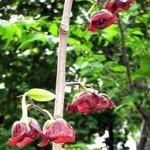
IDENTIFICATION: Shrubs or small trees, three to 40 feet, 15 common, evergreen in southern area, deciduous in northern area. Leaves alternate, simple ovate, smooth edge entire, length varies with species, flowers foul-smelling of rotting meat, single or in clusters, three large outer petals, three inner smaller petals, white to purple or red-brown. Fruit like cylindrical pears, misshapen, many seeds; green when unripe, maturing to yellow or brown, flavor similar to both banana and mango.

TIME OF YEAR: End of summer, fall

ENVIRONMENT: Rich bottom lands to rain-watered pastures, open areas, beside open areas. The two most common places I find it is at the base of tall pines or in cow pastures.

METHOD OF PREPARATION: Used like a banana, raw or cooked, as in baked desserts, ice cream, pastries, or in making beer. Don’t eat the skin and don’t eat the seeds. Chewed seeds will cause digestive problems, whole seeds usually pass through. Try only a very little at first. Some people have a very several allergic reaction to pawpaws.

 

{ 77 comments }

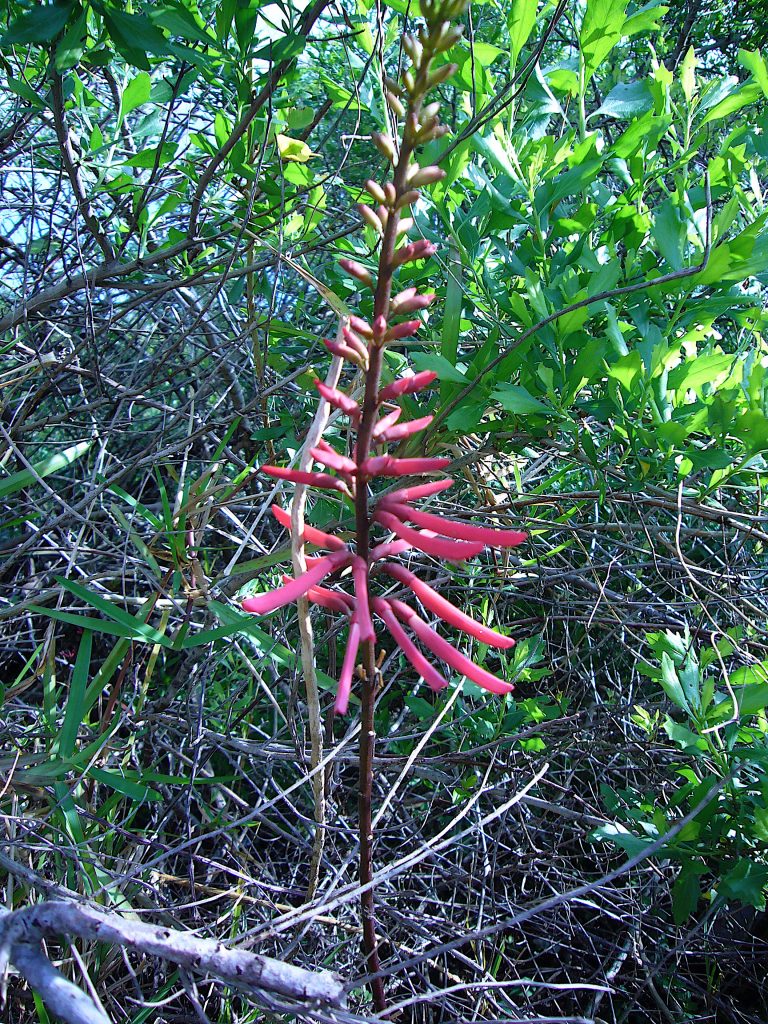
The Eastern Coral Bean is easy to spot this time of year. Photo by Green Deane

Erythrina herbacea: Part Edible, Part Not

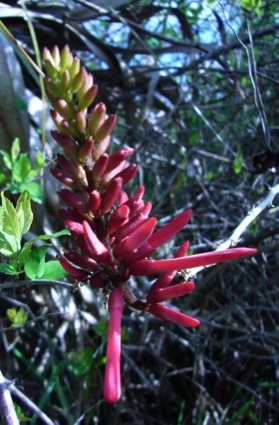
Eastern Coral Bean in blossom

The (eastern) Coral Bean is one of those damned if you do, and damned if you don’t kind of species.  Parts of it are edible, parts of it are toxic, narcotic and hallucinogenic. So there is a trade off: Very easy to identify, but harvest carefully.

The boiled flowers and young leaves are edible, cooked like string beans but in more water.  This semi-toxic plant is also quite healthy. A Japanese study published in the Journal of Natural Medicines, 29 Jan 2008, confirmed five antioxidants in the coral bean flower and found a sixth antioxidant. I boil mine for 15 minutes in plenty of water. They turn green and limp when cooked and reduce in size so collect a lot. The flavor is mild, like young spinach.

Coral Bean is a plant of the old South and into Mexico. But, it can grow not only across the southern tier of the United States but up the east coast to Maryland and up the west coast to Washington state. Out hiking it is always very easy to spot though in the wild it is rarely more than a spindly bush. However most people know the coral bean as a landscape plant and under cultivation and ideal conditions can reach 25 feet.

Cooked young leaves edible, but poor fare

It is one of those odd thing in the plant world that people interested in plants tend to view them three basic ways. One is the agriculturist who views them as a commodity.  There are those like foragers who tend to land on the nature side of things. They want to know where does it grow and can it be eaten. Then there are those who view plants like artistic elements to be put in a living canvas, the landscaped garden. I have a close friend like that. His property is as disciplined as mine is feral. He knows probably not a botanical name, nor which leaf he can eat, yet he’s a good husband of his plants and his yard a thing of beauty.  He works very hard at it.

A coal bean to him would be a bit of color, and color over time because a landscaped garden is an interplay of plants as the season progresses. To an agriculturist the coral bean is a source of costly contamination, especially the seeds. It is a weed, weeds cost money and they are thus called noxious and must be dealt with as some enemy. To me it is something to add to the herb pot if it is shy on content. And I suppose there is a fourth group that includes most people. They ignore plants even though their lives depend on them.

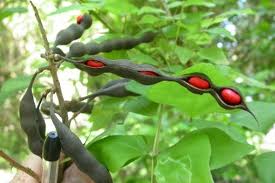
The seeds are toxic, do not eat

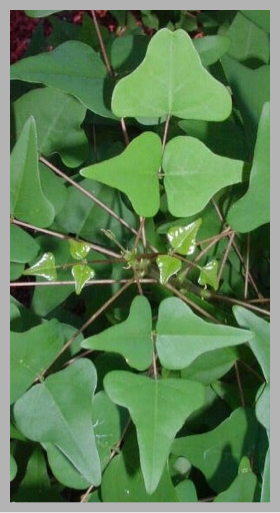
The coral bean is an interesting plant for many reasons, one of which is that it always turns it leaves towards the sun. Each petiole has three uterine-shaped leaves, two on short stems but all three stems have the ability to turn the leaf. And you will notice unlike most trees and more like an herb, the smaller leaves are in the middle. Those are the edible young leaves, and of course, the red blossoms, both cooked. The seeds are NOT edible. They have been used for beads, however, and played an important religious role for the Aztecs in auguring the future. In tiny amounts the seeds are said to be hallucinogenic.

As for the toxin, it is not great according to the data base of the state of North Carolina. It varies from according to age, weight, physical condition and individual susceptibility. Most of the reports involve kids eating the scarlet seeds. In Mexico the seeds are used to poison rats, dogs and fish. It is similar to curare and hypnotic. That the flowers and leaves are edible is confirmed by no less august authority than Dr. Julia Morton, who for most of her life was the final say on toxic plants in warm climates, such as Florida. In fact, she is one of the experts that authored the edible plant portion of the U.S. military’s survival guide. I like the flowers. Boiled they are a mild in flavor.

The flowers of the Erythrina flabelliformis (fla-bel-ih-FOR-miss, fan shaped) are  also reported as edible — very favored in Mexico — but I have not tried them.

As for the botanical name of the coral bean, Erythrina herbacea (air-rith-RYE-nuh hur-BAY-see-uh) …There are about 112 species in the genus Erythrina, which comes from the Greek word ερυθρος which means red.  The species name, herbacea in Latin means “grass, low growing, not woody.” It was named that because this particular plant is more herbaceous than others in the genus.  Many of the plants in the genus are well-known and used in the tropics and subtropics as street and park trees. Some are used as shade trees for coffee or cacao and can grow to a hundred feet high. In most of its range in the United State the Coral Bean is a bush. The common name might come from the fact the flowers are shaped like a form of red coral. It is also called the Cherokee Bean, who used a decoction of the root for various purposes including kidney and urinary blockage.

Besides brilliant color the Coral Bean’s second claim to fame is that it’s fast food for humming birds. They were made for each other and one of the quickest way to get hummers to your yard is to grow a Coral Bean, just keep the seeds away from the kids. Humming birds, by the way, follow routes, kind of like air corridors called traplinings, (for next time you’re playing scrabble….)

Other known edibles in the genus include E. americana, E. berteroana, E. fusca, E. rubrinervia, and E. veriegata.

Green Deane’s “Itemized” Plant Profile

IDENTIFICATION: Bush, three to sixteen feet, compound, uterine-shaped leaves lost in winter in cooler areas, kept in warm areas, herbaceous, bushy, can survive a lot of trimming. Stems have small, curves prickles, as do leaves. Flowers on leafless spikes  in early to early summer depending upon the latitude, young leaves throughout the growing season. Easily blooms in February in Florida. Occasionally blossoms in fall. In dry areas can keep blossoms after leaves have fallen

TIME OF YEAR: Broken shade, sandy woods, hardwood hammocks,  dry coastal tidewater  areas, roadsides

ENVIRONMENT: Usually an understory plant among other bushes. But I’ve also seen it grow in full sun. Become less common due to destruction of habitat.

METHOD OF PREPARATION: Boil young leaves and blossoms in ample water. Whether the blossoms are edible raw is a bit of a debate with one authority quoting another in a questionable reference saying yes. Be safe and don’t eat them raw. I know one can be eaten raw but beyond that I do know know. Besides containing harmful alkaloids, they contain antioxidants. Flowers turn mushy while cooking and loose their red color.

{ 29 comments }
Fireweed has a taste you will either like or definitely dislike. Photo by Green Deane.

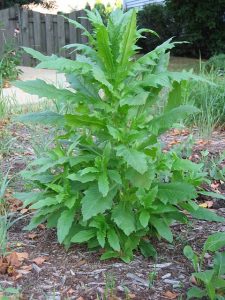
Erechtites hieraciifolia: Edible Pile Driver

Art Gallery Pension, Athens, Greece. Photo by Green Deane

When I go to Greece I always stay a few days in Athens to get used to the time change and visit in-town relatives (as opposed to out-of-town relatives.) I stay at the same little hotel — the Art Gallery Pension — on Erekthion Street. It’s a few hundred feet due south of the Acropolis and the Erechtheon, a shrine also atop the Acropolis (or Acropoli as the Greeks say.)  I also stay at the same pension a month or so later when I am ready to leave, to enjoy the Plaka night life after I’ve adjusted to the time change and to visit in-town relatives again. So when I see Fireweed’s scientific name, Erechtites hieraciifolia, though half a world away I am reminded that even after some two and a half millennia the language of the past is still with us, particularly with Greek in botany. More on that later.

Erechtheion, or in Greek Ἐρέχθειον

Opinions vary greatly on the Fireweed. Horrible, a choice edible, or toxic? Widely used in the past and the present in Asia this is not a dainty-flavored plant. While young leaves can be eaten raw and older ones cooked Native Americans did not use it for food but rather medicine. This might give us pause to be cautious. A 1939 study found the plant has pyrrolidines. That’s a group of chemicals that can damage your liver, permanently. Usually species with pyrrolidines are not eaten. Yet this plant has a history of consumption.

Fireweed (Erechtites hieracifolia) Photo by Green Deane

Merritt Lyndon Fernald, of Gray’s Manual of Botany and also co-author of Edible Wild Plants of Eastern North America, wrote twenty years after the above study: “There is no reason, except the odor, that prevents us from using it.” Dick Deuerling, author of Florida’s Incredible Wild Edibles, told me personally he only ate tasty wild foods and that did not include the E. hieracifolia, though he included it in his book.  Dr. James A. Duke author of the Handbook of Edible Weeds and a second book, Medicinal Plants, said he could not improve on the comments of Troy Peterson, author of A Field Guide to Edible Wild Plants who said of the E. hieraciifolia: “The strong flavor suggests this is an acquired taste.” Duke recommends we don’t eat it.

Fireweed, famine food or goumet delight?

Fireweed, famine food or goumet delight? Photo by Green Deane

That said I have a good friend who enjoys the flavor immensely, raw or cooked.  Here’s what one reader — below –had to say about it: “I’m honestly perplexed with regards to the culinary reputation of this plant. Every chef I’ve shown this plant to so far has been really impressed, in a good way. The distinct perfume and flavor goes amazingly well in multiple preparations. I did cold blanched greens Korean style with sesame oil and soy sauce, brown rice steamed with chopped fireweed and shiso, and a quick chutney pickle of peeled fireweed stems and leaf tips, poor man’s pepper, nasturtium leaves, chopped apples, cucumber and coriander. I also used it as a soup base with lamb’s quarter and nettle. One vegetarian cold soup with raw goat buttermilk and the cooked wild greens puree, and one with chicken broth. The blanched greens also went into translucent summer roll wraps with sauteed pickerelweed, plantain seed heads, chanterelles, venison and nasturtium flowers, to be served with the chutney.

Not a single person in the large class (22 students + wildlife center interns and instructors) found the fireweed to be less than delicious prepared by these methods. All of the above dishes vanished like snow on a hot griddle, and I had to go harvest more fireweed after class so there would be any left for my chef buddy to play with at his restaurant. They ate it all.

Identification is 100% certain; this is Erechtites hieraciifolia. Properly prepared, it is delicious, and all of the local professional chefs whom I’ve gotten interested in wildcrafted foods are pretty excited to work with this plant. It’s not at its best raw and unadorned, but a little kitchen tweaking and flavor pairing and it’s suddenly amazing.

All I can say is if other foragers don’t know how to use and appreciate this green, that just leaves more for me and my chef friends!”

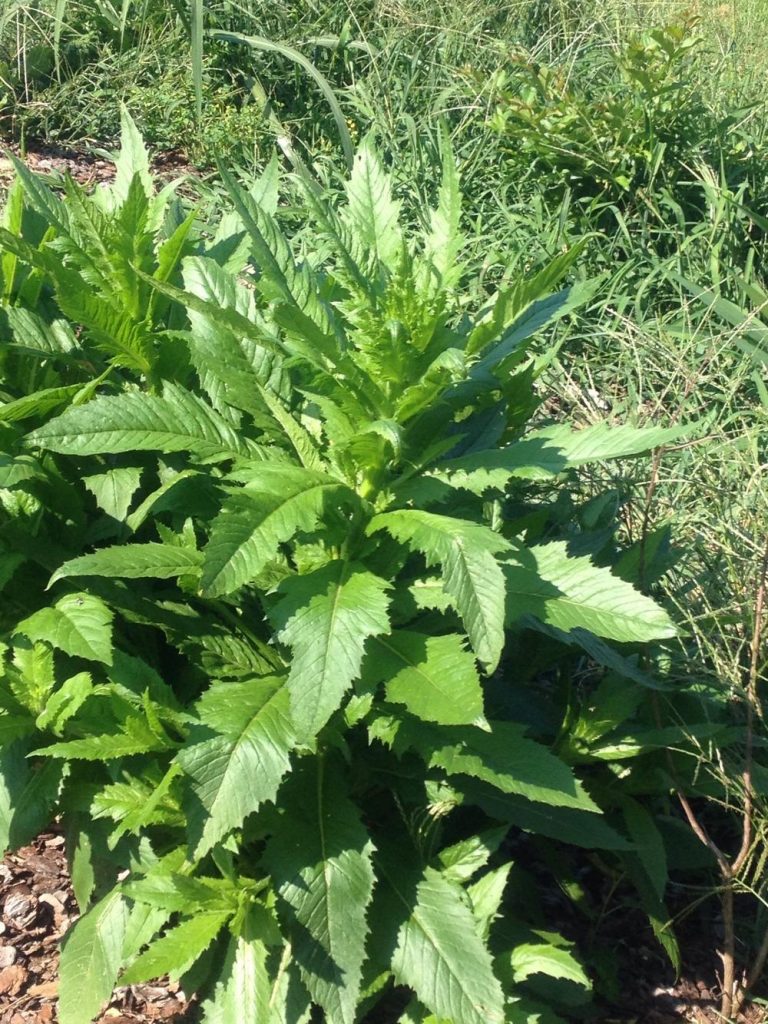
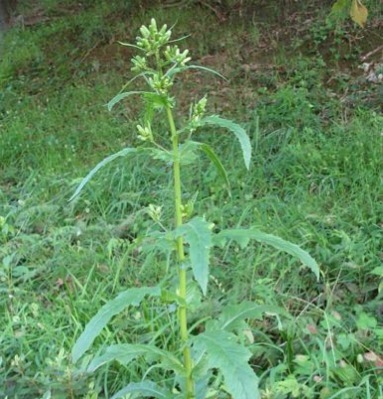
E. hieraciifolia has been viewed a famine food as the Caesar Weed (Urena lobata) is a famine food: Nutritious, common, and edible if you can get past this or that. With Caesar Weed it is texture, with E. hieraciifolia it is aroma and flavor though opinions do vary from ugh to delicious. These plants are plentiful in the spring and summer. Tall, rank and in your face, it is hard to misidentify a Fireweed. Foul or not it is as good as any other spring/summer green and is not unheard of in winter either. Perhaps the key is proper preparation. Fernald did not have a lot of chefs giving the green a try.

As to the scientific name, Erechtites hieraciifolia. The latter part, hieraciifolia, is easy: It means “having leaves like the hawkweed,” referring to the Hieracium (which itself means of or pertaining to priests.) But, Erechtites is more involved and botanists tend to not know their Greek. One, for example, will say the genus name may come from Erechtho, to break. Another says it might be for the fable early king of Athens, Erechtheus. Both close but no cigar. They need to read more of the Classics.

Ericthonius scaring maidens to jump off the Acropolis

The goddess Athena went to the lame blacksmith-god Hephaestrus. He was the tool maker for the gods. She wanted some weapons. (For sake of the story we will set aside why a goddess would need weapons or someone to make them.) Things did not go as she planned. Hephaestrus found her so enticing that he tried to overpower her and take away her virginity. She successfully resisted and he missed his mark, so to speak, leaving a deposit on her thigh. With a scrap piece of wool she wiped it off and threw the wool to the ground. That impregnated the earth, Gaia. Gaia gave birth to a son and took him to Athena who named him Erichthonius. Erextho means trouble and xthon means earth.  The name has come to mean “troubles from the earth” for a troublesome, ruderal weed that pops up after fires.  The transliterated spelling varies greatly. Erechtites was also the name of an ancient groundsel in Greece and was first used to describe a plant in 40-80 CE by Dioscorides (for whom the yam genus is named.)   King Erechtheus, who invented the chariot, was actually an early king of Attica not Athens but the region of Attica included Athens.

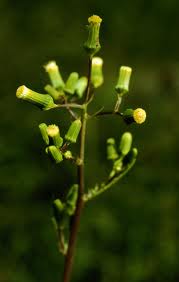
Erechtites hieracifolia blossoms. Photo by Green Deane

The plant has many local names as well besides Fireweed: Goat’s Chicory, Burn Weed, Stickers, Sun’s Ribs, Dog Weed and American Burnweed. There is also a second “Fireweed” a tall perennial (Epilobium angustifolium) in the evening-primrose family with spikes of pinkish-purple flowers. It is also edible. Our Fireweed has one other common name: Pilewort. Folks used Oil of Fireweed to externally treat their hemorrhoids. Fireweed puts out the fire.  A poultice of the leaves work well I am told. Fireweed also has some internal uses as well such as treating dysentery.

And I saved this for last. The pronunciation of Erechtites hieraciifolia, is eleven syllables: e-rek-TEE-tez  hee-eh-rak-ee-FO-li-a. I should mention that some folks remember Erechtites by starting with “Eric’s Teeties.” Clearly Greeks like long words. That is why it is easy to tell the difference between an Irish and Greek cemetery. When you drive by the Irish cemetery the stones are all tall and skinny with vertically engraved short names like Sean Ireland. Whereas all the stones in the Greek cemetery are low and long to accommodate Βασιλιος Σταβρος Τσαπατσαρις.

Green Deane’s Itemized Profile

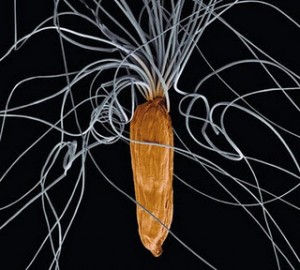
IDENTIFICATION: Erect annual to 80 inches, flower yellow to whitish, 1/3″- 2/3″ inches long; inflorescence flat-topped to elongated clusters of drooping heads, flowers barely open; fruit, a dry seed on a bright white fluffy powder puff. Leaf alternate, lance-shaped, sharply toothed, some times lobed. It has a … ah… distinctive aroma that once you know is unmistakeable.

TIME OF YEAR: Blooms early summer to autumn.

ENVIRONMENT: Dry to wet; open woods, partially disturbed sites, fields, lake shores. Often colonial.

METHOD OF PREPARATION: Tops, leaves, flower buds raw or cooked, including steaming and boiling.

* E. hieracifolia (L.) Raf. PYRROLIZIDINE ALKALOID: hieracifoline. Manske, Can. J. Res., 17B, 8 (1939)

{ 22 comments }

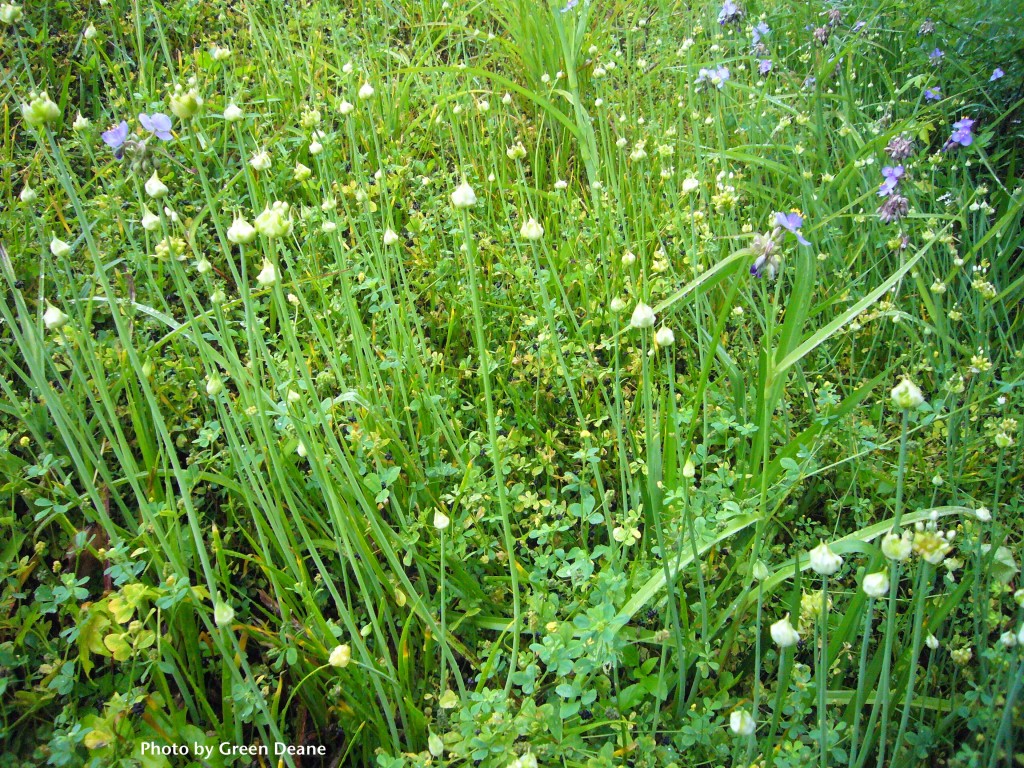
Wild Onions/Garlic and Spiderwort growing along the road near Ocala Florida. Photo by Green Deane

Wild Onions/Garlic and Spiderwort growing along the road near Ocala Florida. Photo by Green Deane

Allium canadense: The Stinking Rose

Your nose will definitely help you confirm that you have found wild onions, Allium canadense, AL-ee-um kan-uh-DEN-see. Also called Wild Garlic and Meadow Garlic by the USDA, walking through a patch raises a familiar aroma which brings me to a foraging maxim:

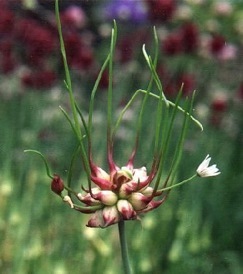
Wild onions/garlic, set bulblets on top

If a plant looks like an onion and smells like an onion you can eat it. If a plant looks like a garlic and smells like a garlic you can eat it. If you do not smell a garlic or an onion odor but you have the right look beware you might have a similar-looking toxic plant. For example, we have a native lily here in Florida that looks like an onion but has no aroma. It is toxic.

All parts of this particular Wild Onion/Garlic are edible, the underground bulbs, the long, thin leaves, the blossoms, and the bulblets on top. The bulblets are small cloves the plant sets where it blossoms. Harvesting them is a little easier than digging for bulbs but those are easy to find also. They’re usually about four inches underground. The bulblets are on the tippy top of the plant. It’s called both an onion and garlic  because while it is a wild onion it has a very strong garlic aroma.

Onions and garlic belong to the Lily family. The most common wild one is the Allium canadense. It has flattened leaves and hollow stems. On top there can be bulblets with pinkish white flowers or bulblets with sprouted green tails.  When it sets an underground bulbs they will be no bigger than pearl onions.  (See recipes below the I.T.E.M. panel.) They were clearly on the Native American menu though our local natives didn’t refer to them much.

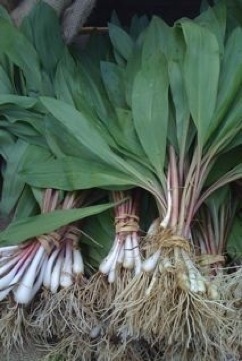
Ramps have wide leaves

It is often said the city of Chicago’s name is from an Indian phrase that means “where the wild onions grow.” That is quite inaccurate. Chicago is actually a French mistransliteration of the Menomini phrase Sikaakwa which literally means “striped skunk.” We would say ‘the striped skunk place.”  The skunks were there because Allium tricoccum (Ramps)  were growing there. Skunks know good food when they smell it (and are bright pets. Very common where I grew up.)  The nearby Des Plains River was called the “Striped Skunk River.” Incidentally because of man’s intervention that river now flows backwards from it original direction.

While northern tribes used the Allium species extensively there are few records of southeastern tribes using them, though various southern tribes had names for the onion.  Some of the tribes considered onions not edible. Ramps, A. tricoccum, (try-KOK-um) photo upper right, are also in the onion family, and very common in Appalachia. Farther north they are called “wild leeks.”  Unlike onions and garlic, ramps have wide leaves but are used the same way.

Allium was the Latin name for the onion. An alternative view is that it is based on the Celtic word “all” meaning pungent. “Alla” in Celtic means feiry. Canadense means of Canada, but refers to north North America. Tricoccum  means three seeds. Roman’s called garlic the “stinking rose.”

Allium canadense in large amounts can be toxic to cattle. Lesser amounts can flavor the milk as can salty fodder near the ocean.

 Green Deane’s “Itemized” Plant Profile: Wild Onion

IDENTIFICATION: Allium canadense: Grass like basal leaves, small six-petaled flowers, odor of onion or garlic, stems round, older stems hollow. Underground bulbs look like small white onions. Ramps, however, have two or three broad, smooth, light green, onion-scented leaves. Also see another article on a European import, the dreaded Garlic Mustard.

TIME OF YEAR: Depends where you live. Ramps in spring, onions through the summer, bulbs in fall. Locally we see bulblets in April then into the spring.

ENVIRONMENT: Like most plants onions like rich soil and sun but can grow in poor soil with adequate water. Leeks like rich leaf-losing woodlands and can grow in dappled shade. Locally all of the Wild Onions I’ve seen grow in damp places, or, places where run off gathers before seeping in.

METHOD OF PREPARATION: The entire plant is edible raw or cooked, in salads, seasoning, green, soup base, pickled. You can pickle them using red bay leaves, peppergrass seeds, and some vinegar

Recipes adapted from “Wild Greens and Salads” by Christopher Nyerges

Onion Soup On The Trail

Two cups onion leaves and bulbs

Two cups water or milk (or from powdered milk)

1/4 cup chia seeds (optional) or grass seed

four bottom end tips of cattails

A Jerusalem artichoke

Two table spoons acorn flour (or other flour)

1.4 cup water

Put chopped onions in 1/4 water and boil for five minutes. Add the rest of the liquid, cattail and Jerusalem artichoke. Cook at low temperature. Do NOT boil. When artichoke is almost done add flour and chia seeds. Mix. Salt and pepper to taste. Serves three.

Camp Salad

One cup onion leaves and bulbs

1/2 cup Poor Man’s Pepper Grass or Mustard leaves

One cup chickweed or other mild green

Two diced tomatoes

Juice of one lemon

Tablespoon of oil

Salt and pepper to taste

Collect onions, dice, add other green items torn into small bits, added tomatoes and other ingredients, toss.


{ 139 comments }