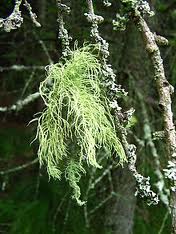
 As a seasoned life-long bachelor I had my pickup line all crafted and rehearsed, so I could say it naturally at the right moment when my Dream Lady came near. It was: “Have you seen any Usnea?”
Now I am sure you will all agree with me that is a great pick-up line guaranteed to set many a heart a-fluttering. The problem is I never found anyone to use it on today… or yesterday… or the day before. And perhaps that‘s the problem: Great pickup lines are pickupless unless there is someone around to sound them to.
Let’s face it, as pick up lines go there are few better. It’s understandable but unknowable so there is no short answer or dismissing. She has to stop and ponder what I said… and in that moment I explain.
“It’s a hairy lichen that grows around here. It tastes good, highly nutritious, and is a great antibiotic for battle wounds….or cat scratches” …. well… I suppose I could leave out the battle wound part if I ever get a chance.
 Perhaps I’m missing something but women exercise to feel better and look better and from what I hear, meet people. Yet on the exercise/bike/nature trail only twice in the two decades have I ever had a conversation with a woman. One asked me what the name was of the tree I was looking at (Black Cherry: Prunus serotina) and another was carrying a bromeliad. I recognized it. I knew exactly where she got it off the trail. It was a great conversation starter.
She was the right age, nice personality, and I found her quite attractive… and we talked plants for a couple of miles. I gave her my card and she told me her name… I recognized it as an old cartoon character… Brenda Starr….definitely lost that one. I went and collected some Usnea for the wound.
Here’s an essay I wrote in 2001 about bachelorhood:
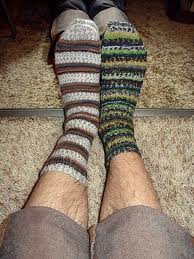 A bachelor, I have been told, is a man with no social commitments and unmatched socks. When I’m asked why I’m a bachelor, I tell the truth: I was born that way. And as a bachelor, I’m in good company. Most of the popes have been bachelors. Divorced men are also called bachelors, but what really is a bachelor?
Any male who’s never been married is a bachelor, but we don’t call 10-year old boys bachelors, though some women may call some bachelors 10-year-old boys. Young men in their twenties are technically bachelors, but it’s better to call them unmarried, which doesn’t convey the same nuance as bachelor. It’s as if men in their 20’s and early 30’s will get married, they just haven’t settled down or found the right person yet.
 Somewhere in the mid- to late-thirties, the word bachelor becomes quite appropriate. By one’s forties, one actually exceeds the word bachelor. By age 50, “confirmed bachelor” says it all though some people might use the more descriptive phrase “entrenched bachelor.”
I’m now past 50. I always intended to get married and have kids, but it didn’t happen. I did ask a woman to marry me way back in the psychedelic Dark Ages of the 1970’s. The diamond ring back then cost me a semester’s worth of tuition. We soon disagreed over attending graduate school, finances and whoever won the ’72 presidential election…. At least some one did clearly win. So now, when most men my age are grandfathers, I am, for better or worse, childless and – certainly for the worse — still dating. Being my age and dating creates challenging situations.
 It’s difficult, for example, to avoid having a family if I marry because most women my age have children or grandchildren. Nothing so far in life has made me feel older than the day I realized I was dating grandmothers. Another problem is younger, fertile women. If I were to become a father today, I would be retired before the child started high school, if I didn’t die from exhaustion first. I’d have to join OTHPTA, the Over The Hill Parent Teachers Association. Fortunately, younger women tend to take my age seriously and stay away, which is just as well. I’ve reached the stage in life in which when I think of going to bed, it’s really because I’m tired.
 One advantage of being a 50-plus bachelor is that 65-year-old moms have finally stopped trying to set me up with their 35-year-old, three-times-divorced daughters. The disadvantage of being a 50-plus bachelor is the 65-year old moms are now making passes at me. I’m really not ready to date great-grandmothers.
Fortunately, my well-intended friends have stopped trying to set me up. They have accepted my bachelorhood, kind of. Instead of working to match me up with women, they’re always trying to give me a pregnant dog or cat. There is something ironic about avoiding a shotgun wedding all one’s life to end up with a litter of hungry, bathroom-missing furry infants to care for. My pet-pushing friends say I need companionship, as if becoming the owner of fleas and a hair ball collection gives one comfort. My friends also seem to think I’m a good place to dump unwanted furniture because as a bachelor I don’t have a woman around telling me disintegrating lava lamps are ugly.
 While many women may be wary of a bachelor my age, men are not. That I have never tripped down the aisle has caused many a married man to call me his hero. The first thing a married man usually says is that he envies me, that there’s no reason to get married. He says he wished he never married and could still play the field. I don’t think my married friends realize the playing field was never level and that it tips strongly in her favor today. I also think my admirers are letting their imagination run wild. A balding, pudgy, grandfather-aged man with a flea-ridden house and fire-hazard furniture is not exactly a babe magnet.
I also remind my lamenting wedded friends that research definitely shows that as married men they will, on average, live far longer than I. Or, even if they don’t, it will at least seem that way. And to be frank, if I had to do it all over again, I would have married my first and perhaps only love. The ’72 election really wasn’t that important.
PS: I wrote that essay some 25 years ago, and little has changed. I’m now a 75-year-old bachelor, except I have kept my hair.