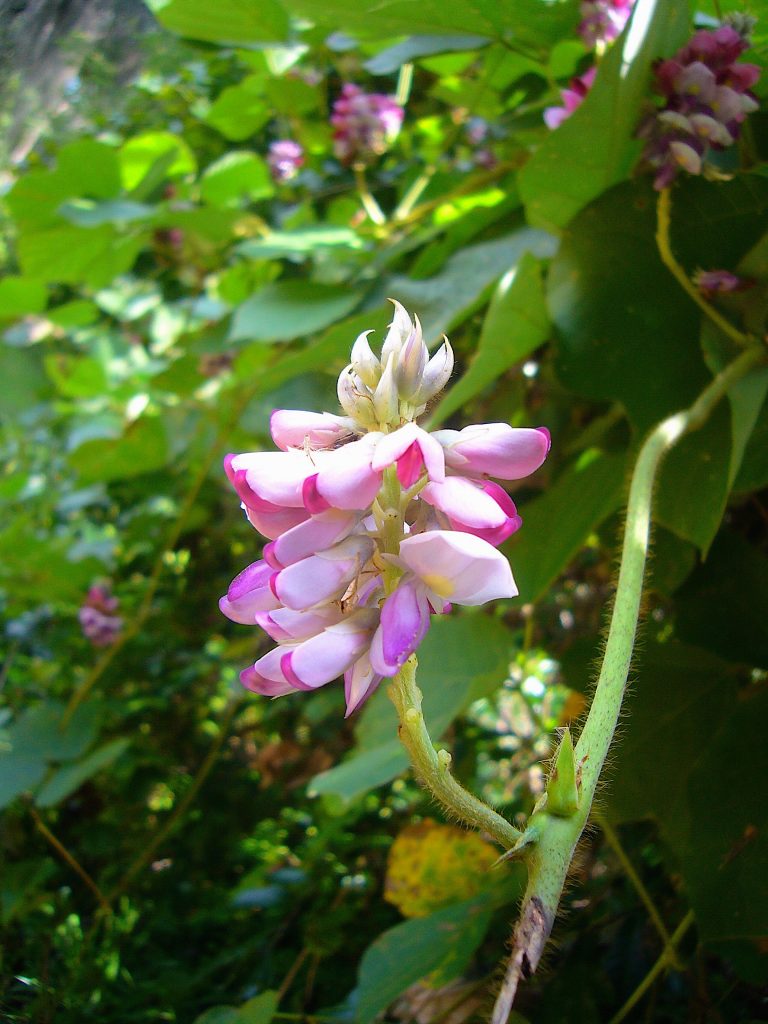
Kudzu, Pueraria montana var. lobata, the vine people love to hate. Photo by Green Deane

The state government tells me that the plant growing at the end of my street isn’t there.

It’s kudzu, the plant that grows so fast it can follow you like a puppy. It’s not a mile from here. And about eight miles further north I was collecting it some 20 years ago. Yet the government says it is not in this county. It also makes me wonder how the federal Department of Agriculture gets by.  I read the USDA plant distribution maps with a skeptical eye. I’m not sure they are updated every century. And if you write to them and tell them their map is wrong… they get very attitudinal. Kudzu, Ear Tree, Wild Pineapple… NONE of them grow here officially. The only thing worst than academic botanists who never get into the field is USDA agents who can’t tell a plum from a cherry.
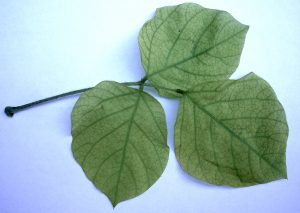
Kudzu leaves have hair on the edges. Photo by Green Deane

Rant over, Kudzu, Pueraria montana var. lobata, (pew-er-RAY-ree-u MON-tah-nuh var. low-BAH-tuh) is an extremely versatile plant. We just don’t use it enough. But know this: If Kudzu grows near you, you won’t starve. Indeed, economic times may make Kudzu valuable again. It’s not on menus yet but you may wish it were. A couple of years ago there’s was a Kudzu methanol car-fuel plant in the works in the U.S. but the plans stalled. The only thing about Kudzu I don’t like is the smell of the flowers in bloom: It smells exactly like the very cheap, very intense grape-flavored chemical gum kids chew. You can detect it from hundreds of feet away. Very strong, but good for identifying. If you like that aroma let your nose guide you. (I like the smell of grape, it’s that cheap artificial grape smell I can’t stand.  That’s what Kudzu smells like. Kudzu has no choice, so I don’t blame it. But the gum makers do have a choice and they make the wrong one. )

Kudzu was introduced into the United State in 1876 at the Centennial Exposition in Philadelphia, Pennsylvania. The exposition was to celebrate 100 years of the United States being an independent country. Japan built a garden using Kudzu. Then it was at an exposition in New Orleans in 1883. American gardeners fell in love.  By 1908 Kudzu was being promoted as a forage crop in Florida then it was widely distributed in the 1920s by a Florida nursery. (At one time they proudly displayed a ground zero Kudzu plaque.)  It was planted by the conservation corps during the Great Depression and Dust Bowl Era of the 1930s and in the 1940s the government was paying farmers $8 an acre to let it grow for soil conservation. (In 2008 dollars that is $134 an acre.)  It was called “the miracle vine” and cotton was no longer king of the south.
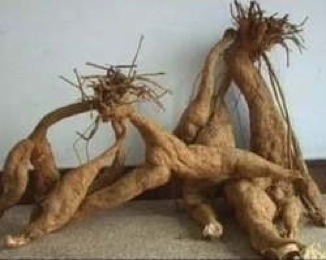
Removing root starch is labor intensive

But, by 1953 even federal employees suspected something was wrong. The government stopped paying to plant it. Kudzu can grow a foot a day and when escaped from cultivation, it can smother and kill an entire forest. By 1970 the government called it a weed and it’s been a “pest” ever since finally getting on the Federal Noxious Weed List in 1997, some 44 years after the alarm was raised.  A half a billion dollars is spent annually trying to contain it. Granted Kudzu is a problem, but “pest” or “resource” is a matter of attitude and policy.  It’s a huge amount of food not being consumed, a resource not being used. What would a country in famine do with those hundreds of thousands of acres of food? I doubt they would call it a noxious weed. Perhaps instead of sending dollars to the starving we should send them nutritious kudzu.
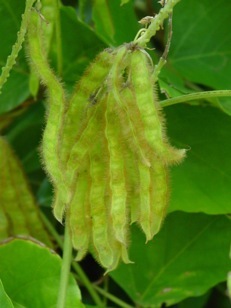
Kudzu’s pods and seeds are NOT edible

Kudzu can be eaten many ways. The young leaves can be consumed as a green, or juiced. They can be dried and made into a tea. Shoots can be eaten like asparagus. The blossom can be used to make pickles or a jelly — a taste between apple and peach — and the root is full of edible starch. Older leaves can be fried like potato chips, or used to wrap food for storage or cooking. With kudzu you can make a salad, stew the roots, batter-fry the flowers or pickled them or make a syrup. Raw roots can be cooked in a fire, roots stripped of their outer bark can be roasted in an oven like any root vegetable; or grated and ground into a flour to make a thickener, a cream or tofu. Kudzu is used to make soaps, lotions, rope, twine, baskets, wall paper, paper, fuel  and compost. It can also be baled like hay with most grazing animals liking it, especially goats. Only the seeds are not edible. And while the root starch is edible, it takes hours of pounding to get the starch out, as my friend Doug Elliott wrote in his book, Roots. 

Kudzu, to someone not familiar with it, does have a couple of look-alikes, such as the Desmodium rotundifolium, or the Ticktrefoil.  Kudzu has very hairy young stems, the D. rotundifolium does not… that and that Kudzu goes wild and outgrows it. The hog peanut, Amphicarpaea bracteata, may be mistaken for young Kudzu vines, but it does not have hairy stems or climbs into trees. The key is to look for hairy stems on the young Kudzu, and when it blossoms follow the grape aroma.

The word “kudzu” comes from the Japanese word “kuzu” which means vine. The name itself comes from a particular region of Japan where the people are also called Kuzu. It is not known which came first, the name or the people. Pueraria was named after the Swiss botanist Marc Nicolas Puerari who taught in Copenhagen. Montana means mountainous. Lobata means lobes. Sometimes the plant is called Pueraria lobata, skipping the Montana part. In China it is called gé gēn.

Kudzu is not a famine food but prime fare. We call it a weed because we are not hungry enough… yet. Recipies on bottom. By the way goats love Kudzu and it is by far not the most invasive species in the South. The Asian Privet is.

Green Deane’s “Itemized” Plant Profile

IDENTIFICATION: Kudzu is a climbing, semi-woody, vine that can reach up to 100 feet in length. Stems can reach the diameter of ½ to 4 inches, old ‘stumps’ can be nearly 12 inches across. Leaves alternate, compound with three broad leaflets to 4 inches across. Leaflets may be entire or deeply 2-3 lobed hairy underneath. Flowers are ½ inch long, purple, highly fragrant in long clusters. Flowers in  late summer, seeds pods brown, hairy, flattened, containing three to ten seeds.

TIME OF YEAR: Shoots in spring, young leaves anytime, blossoms July through October, roots best in fall or early spring.

ENVIRONMENT: Likes full sun, heat, plenty of water.

METHOD OF PREPARATION: Nearly too numerous to mention.  Most of the plant is edible in some way except the seeds and seed pods.  They are not edible.

Herb Blurb

In the Orient, it is used to treat dysentery, allergies, migraine headaches, diarrhea, fevers, colds, intestinal problems and angina pectoris, to help with the digestion of food and reduce blood pressure. Kudzu has been used successfully for centuries as a treatment for alcoholism, and this is a main focus of modern kudzu medical research today. Experiments with hamsters and rats, show that a compound in kudzu actually causes the repression of alcohol consumption. This research could have great value in the future for the treatment of alcoholism

 Kudzu Blossom Jelly

Spoon over cream cheese, or melt and serve over waffles and ice cream. The blossom liquid is gray until lemon juice is added.

4 cups Kudzu blossoms

4 cups boiling water

1 tablespoon lemon juice

1 (1 3/4-ounce) package powered pectin

5 cups sugar

Wash Kudzu blossoms with cold water, and place them in a large bowl. Pour 4 cups boiling water over blossoms, and refrigerate 8 hours or overnight. Pour blossoms and liquid through a colander into a Dutch oven, discarding blossoms. Add lemon juice and pectin; bring to a full rolling boil over high heat, stirring constantly.

Stir in sugar; return to a full rolling boil, and boil, stirring constantly, 1 minute. Remove from heat; skim off foam with a spoon. Quickly pour jelly into hot, sterilized jars, filling to 1/4 inch from top. Wipe jar rims. Cover at once with metal lids, and screw on bands.

Process in boiling water bath 5 minutes. Cool on wire racks. YIELD: 6 half pints.

Rolled Kudzu Leaves

Kudzu Leaves

1 can diced tomatoes

2 teaspoons salt

3 cloves garlic, cut in half

Juice of 3 lemons

Bacon Grease (optional)

Stuffing ingredients: 1 cup rice, rinsed in water

1 pound ground lamb or lean beef

1 cup canned diced tomatoes

1/2 teaspoon of allspice

Salt and Pepper to taste

Gather about 30 medium-sized young kudzu leaves. Make sure area has not been sprayed with chemicals.

Wash leaves. Drop into salted boiling water. Boil a 2-3 minutes, separating leaves. Remove to a plate to cool. Remove heavy center stems from the leaves by using a knife and cutting down each side of the stem to about the middle of the leaf. Combine all stuffing ingredients and mix well.

Push cut sides together and fill with 1 teaspoon stuffing and roll in the shape of a cigar. Place something in bottom of a large pan so that rolled leaves will not sit directly on the bottom of the pan. Bacon grease is great for seasoning.

Arrange Kudzu rolls alternately in opposite directions. When all are in the pot, pour in a can diced tomatoes, 2 teaspoons of salt, and 3 cloves of garlic, cut in half. Press down with an inverted dish and add water to reach dish. Cover pot and cook on medium for 30 minutes. Add lemon juice and cook 10 minutes more.

Kudzu Quiche

Makes 4-6 servings.

1 cup heavy cream

3 eggs, beaten

1 cup chopped, young, tender Kudzu leaves and stems

1/2 teaspoon salt

Ground pepper to taste

1 cup grated mozzarella cheese

1 nine-inch unbaked pie shell

Preheat oven to 350 degrees. Mix cream, eggs, kudzu, salt, pepper, and cheese. Place in pie shell. Bake for 35 to 45 minutes until center is set.

Kudzu Tea

Kudzu leaves

Mint

Honey

Simmer 1 cup of finely chopped Kudzu leaves in a quart of water for 30 minutes. Drain and serve with honey and a sprig of mint. If you prefer a sweeter taste use honey to sweeten the tea.

Deep Fried Kudzu Leaves

Pick light green leaves, 2-inch size.

Thin batter made with iced water and flour

Oil

Heat oil. Rinse and dry kudzu leaves, then dip in batter (chilled). Fry oil quickly on both sides until brown. Drain on paper toweling. Eat while warm.

kudzu powder

Kudzu powder can be prepared on a small scale from wild kudzu with little equipment. Roots no smaller than 1 1/2” in diameter should be harvested during the winter months, December through March. Kudzu root should be washed, cut into approximate one-inch thick slices and pureed in a blender with enough cold water to blend the root well. The puree should be strained and the solid fibers squeezed to extract all the liquid to be used for further processing. The remaining fibers should then be saturated with water, stirred, and strained again, collecting the liquid into the container with the other extract. The brown kudzu liquid should be filtered through muslin or lower grade cotton fabric and left undisturbed in a cool or cold location for 24 hours. The fibers can be composted and the brown liquid should then be discarded as grey water. The clay like substance remaining in the container should be broken up and mixed well, until thoroughly dissolved with clean water once again, and allowed to rest for 24 hours in a cool environment. The liquid should again be discarded and the starch redissolved into a second batch of clean water, this time leaving the mixture for 48 hours in a cool place. The liquid should then be discarded and the layer of gray impurities removed from the starch. The starch is then ready to be used immediately or can be dried to preserve it indefinitely. To dry the kudzu starch, place kudzu chunks on a tray or on layers of paper and set it in a cool, well ventilated place for 10 to 40 days until thoroughly dry. Store dry chunks of kudzu in a sealed container. The dry chunks of kudzu, when pulverized, become kudzu powder.

Kudzu Flower Wine

4 quarts water

6 quarts fresh kudzu blossoms

yeast

4 cups sugar 1 gallon jug 1 balloon

Pick kudzu blossoms when they are dry (mid-day). Wash in pan of water containing 1/2 cup vinegar to kill any bugs. Pour 2.5 quarts of boiling water over the blossoms and stir. Put a lid on the container and stir twice a day for four days.

Strain the liquid through a clean cloth. Press the blossoms to get all the liquid from them. Add four cups sugar. Dissolve yeast in lukewarm water. Pour the dissolved yeast into the liquid. Stir well. Transfer to a one-gallon jug. Add enough water to bring the liquid within 2 inches below the neck of the jug. Attach the balloon and secure it with twine or a strong rubber band. Place jug in a cool dark place that is between 60° F to 75° F.

Every other day gently loosen the balloon and allow the gas to escape and then replace the balloon firmly on the neck of the jug. In approximately 6 weeks the balloon will stop expanding and the wine is done. Strain the wine through a clean cloth and transfer it to airtight bottles. Allow it to sit for an additional two to twelve months before drinking.

Kudzu Root Sucker

In a survival situation, any kudzu root between 1/2 to 3/4 inches in diameter can be washed, cut at both ends to a length of about 6 inches, and then all the exterior bark should be scrapped off. The raw root can then be sucked on to gradually remove all its internal nutrients. Only suck the nutrients out of the root. The root is wood. Wood is NOT digestible. Do NOT eat the wood.

Kudzu Root Tea

The thin, tender young roots can be dug up, washed, diced, boiled, and strained to make a tea.

{ 74 comments }

Canna edulis

How many species of Canna are there? There used to be perhaps 100 but now there are 20 or so, plus one Scottish island with a …ah.. population problem. And don’t misspell it Cana with one ‘N’ or you will get a cremation society.

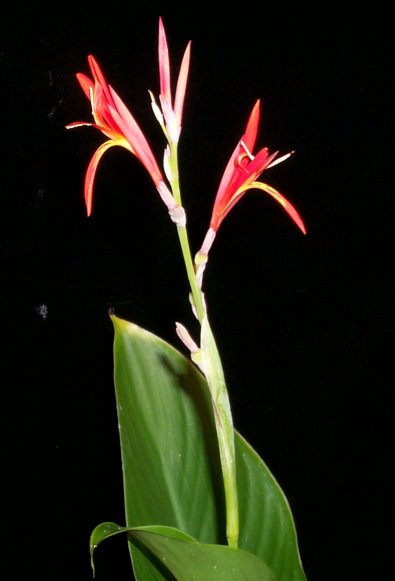
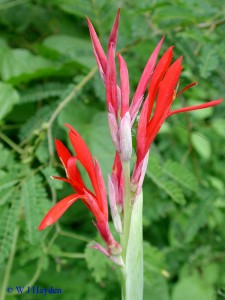
I lived with a Taiwanese family for a while, perhaps that’s where I got my skills at cooking down home Chinese food. They grew Canna, red blossom with skinny petals (well, blossom parts that look like petals.) See above. I thought at the time the flowers were Taiwanese Canna because they looked so different in blossom than Canna found in the southern United States, which has large fat blossoms of yellow or gold. My presumption was that Canna was Asian. Come to find out everyone thought that but Canna is originally from the Americas. It went east and west and then it came back and got discovered.

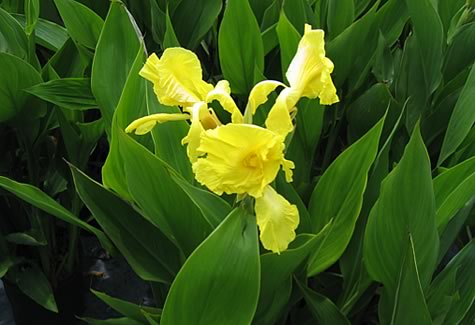
Golden Canna, Canna flaccida

Canna is called a lily in common terms — Canna Lily — but it is not a lily. It’s in the order of Zingiberales which includes ginger, bananas, and marantas. The resemblance is in the leaves. How it got to be called a Canna Lily is unknown though it can be a bit orchid looking and was once called the Orchid-Flowered Canna. One can also easily see the ginger relationship just as kids in a family can look similar. Its leaves are large and green, some times brown to maroon, occasionally variegated. Blossom color varies but usually favoring the red/orange/yellow range. Hybrids are often multi-colored. The blossom is rather odd in that what attracts our eye is often modified stamen (reproductive parts) rather than true petals. But I’ll call them blossoms for convenience. Like so many plants misnamed and renamed by personality-void botanists the genus proliferated with species and varieties and cultivars until it was a mangle morass of monikers. It took two botanists two careers to sort them from a big mess to a little mess. Here’s what happened.

Canna indica

Cannas are native to the warm areas of the Americas. They were taken to warm areas of southeast Asia, then called the East Indies.  From there they went to Europe. The first named species was Canna indica, which means Canna from India. In those days that meant from the West Indies but that was overlooked and the notion arose that the Canna was from the East Indies rather than the West Indies. More so, indica today mean from India not the West Indies. Subsequent botanists “discovered” Canna in Africa and Asia thinking it came from the India. Then they were “discovered” in the Americas, for a second time. It would be centuries before there was general agreement that Canna are native Americans and that scores of different Canna species was probably only one score. (Ya gotta love academics, like doctors, oh so right and oh so wrong.)

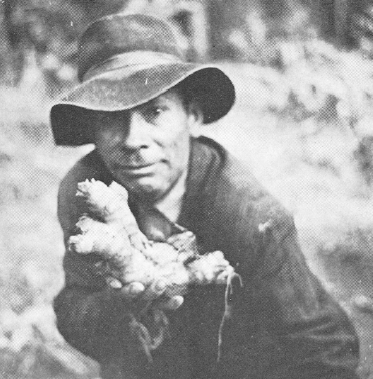
Canna edulis roots in the Andeas

So, what of the Canna, which parts can be used? If you believe everything on the Internet the entire plant is used, seeds to rhizome. Reality is a bit different. The seeds are tough. How tough? They can stay viable for 600 years and have been used for buckshot. That’s tough. Young seeds can be ground and eaten. Unfortunately references that say mature seeds can be sprinkled on tacos was not written by anyone who ever tried it this buckshot replacement. Cooked immature seeds, however, are edible. In some species the young shoots and leaves are a cooked green — usually boiled — and in some species the root starch is edible. In fact, it is the largest plant starch, molecularly speaking, and among if not the easiest to digest. Arrowroot starch, used as a thickener, comes from a relative of the Canna, Maranta arundinacea.

Canna indica purpurea rhizome

The best-known Canna for food is Canna edulis, also called Achira. It can have a rhizome clump two feet long. At harvest time the plant is three to six feet high with alternative leaves that are a foot long and almost half a foot wide. The unisexual flowers have orange red petals and three petal-like staminodia, each of different lengths. Those lead to a three-cell seed capsule with round black seeds. Its starch has been used for food for at least 4,500 years. Canna indica roots are edible, too, as are the rhizomes of Canna coccinea. C. indica It looks similar to Canna edulis but is shorter and has brighter red flowers.

Locally the edible member of the species is Canna flaccida,  KAN-uh FLACK-sid-uh, also called Golden Canna. It’s a showy, immersed native that typically grows to four to five feet tall. Golden Canna is found in small stands at the edges of marshes, swamps, ponds and lakes. It is found throughout the southern United States. It also has been hybridized and found in household gardens around the world. Golden Canna flowers are showy yellow and usually open in the afternoon. Hybrid Golden Canna flowers are orange tinged, or have large fat petals that are orange and red (compared to the skinny red species.) The three-inch-long flowers grow in clusters at the tops of long stalks. They attach in a spiral along the stem as do the leaves. The leaf shape is oblong to elliptic, tapering bases and pointed tips. Leaves can be two six inches wide and three feet long. Veins are parallel and sharply angled. The three-part seed capsule is rough to the touch turning black. Roots are long, thin, and white. Synonyms: Canna anahuacensis, Canna flaccidum, Canna reevesii. (That’s how they ended up with 100 botanical names, nearly everyone thought they had found a different species.)

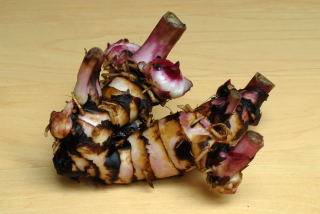
Canna root does not store well so it is best left in the ground until when you intend to use it, say within a few days. It can be eaten raw, or is often boiled. Best method of preparation is long baking. The roots are not peeled before or after baking. Once cooked they are slit and the soft, shiny starchy content scooped out. A lot of the starch can make you hiccup. In the mountains of Peru the roots are baked in ground pits with coals and hot rocks covered with dirt, usually 12 hours at least.

Propagation: Plant the small corm-like rhizome segments. Flowering plants have rhizomes tinged with purple, immature plants have white rhizomes flesh. Rhizomes of the Canna iridiflora are not eaten because it is among the few Canna that does not produce fleshy rhizomes.

Canna Island, Scotland

You will read that Canna means reed and is from a Celtic word. Partially true, and there is a Scottish island named Canna. But the Celtic word is from the Dead Latin word Canna which is from the Living Greek word Kanna. Kanna was a certain reed Greeks used to weave into mats and fences. And about Canna Island…

As detailed in my previous article it is an island, left, with about a dozen residents (in 2010)  though the Scottish government would like to increase that. The island had a rat population problem. A few years ago they got rid of the rats then had a rabbit  population problem because the rats weren’t around to keep the rabbits in check.  Bunny birth control eased that problem but the low human population remains a problem. The island is a tourist destination and at one time presumably had Canna, or more specifically local reeds.

Green Deane’s “Itemized” Plant Profile: Golden Canna, Bandana of the Everglades

IDENTIFICATION: Canna flaccida: Rhizomes fleshy. Leaves: sheath and blade hairless, narrowly ovate to narrowly elliptic, 20 to 50 inches long, base gradually narrowed into sheath, apex acute (pointed.) Inflorescences racemes, simple, bearing one-flower each, fewer than five flowers per inflorescence; Flowers pure yellow, pedicels short, sepals narrowly oblong-elliptic, petals strongly curve back, lobes narrowly oblong-elliptic, base sharply reflexed; three staminodes, broadly ovate, seed capsules irregular ellipsoid, seeds brown, nearly round.

TIME OF YEAR: Usually summer time. Roots should be harvested before the plant flowers.

ENVIRONMENT: Full sun, shallow water around six inched deep, open marshes, lake margins, ponds, savannas, ditches,  and inundated pine flatwoods. Although Canna is frost sensitive it also grows very fast and has been grown in extreme northern climates such as northern Alaska and Canada because of the long days.

METHOD OF PREPARATION: Canna edulis roots are either boiled or baked, or eaten raw. Usually they are slow roasted, usually 12 hours minimum, a good oven on low heat can do that in half the time. Young shoots are eaten as a green vegetable usually cooked but I have had one Hawaiian forager tell me he eats young shoots raw. Leaves can be used to cook food in. Immature seeds cooked. Starch can be used like arrowroot. Canna flaccida roots are usually ground and washed letting the starch settle. The water is then poured off and the starch dried then ground. Cooked Canna starch can be used to make alcohol. The stems can be used to make fiber.

{ 23 comments }
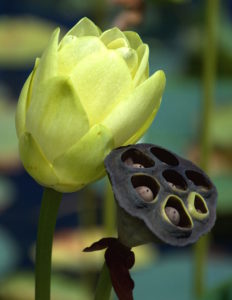
The lotus is the largest native blossom in North America. Photo by Green Deane

The lotus is the largest native blossom in North America. Photo by Green Deane

 More American than apple pie

Nature fights back.

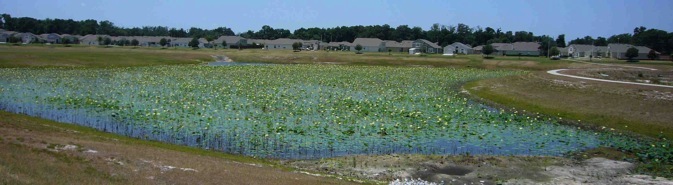
Much of Florida is giving way to housing. For several years I passed a large abandoned pasture with a dry lake bed. Then it was developed into a subdivision and the lake bottom lowered to accommodate the lower water table. For a while very little seemed to grow in the lake — typical subdivision nudity — and then from shore to shore it was covered with American Lotus, Nelumbo lutea (nay-LUM-bo LOO-tee-uh.)  When nature finds the right environment,  plants find their way there, or come out of dormancy.  Mostly likely the lotus seeds had waited decades to sprout.

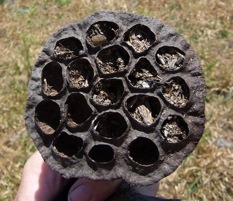
Lotus’ unmistakable seed pod

American Lotus was a main food source for Native Americans and it is basically found east and south of the Rockies plus parts of California. While the root, shoots, flowers and young  seeds are edible, it was the root the Indians counted on to get them through the winter. The popularity of the N. lutea no doubt has also led to its many common names: American Lotus, Yellow Water Lotus, Yellow Lotus, Alligator Buttons, Duck Acorns, Water Chinquapin, Yonkapin, Yockernut and Pondnut. Many of those names refers to the plant’s round, dark brown, half-inch seeds. Even its name is about the seed. Nelumbo is Ceylonese and means “sacred bean.” Lutea is Dead Latin for yellow. The species can produce more than 8,000 long-stem yellow flowers per acre and its empty seed pods are often found in flora arrangements. The stamens of the flower can be dried and used to make a fragrant tea and entire dried flowers are used in cooking.

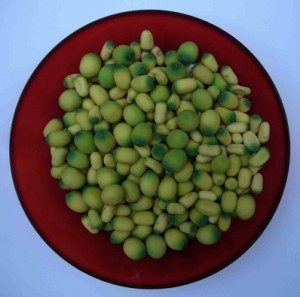
Fresh lotus seeds ready for cooking, photo by Green Deane

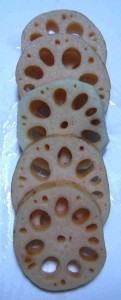
N. lutea likes to grow in shallow ponds and along the edges of slow streams with clean water. It propagates from seed or root.  The root is banana shaped and thick, sometimes reaching close to a foot long. When cut it resembles a wagon wheel in appearance. Unlike many “water lilies” the N. lutea leaves are round and not split, with the stem attaching to the middle of the leaf. Some leaves are on the water and some above it. The lotus is a favorite water plant among fishermen because unlike other water lilies the lotus does not grab fishing line in the clef.  The unopened leaves are edible like spinach and older leaves can be used to wrap food. Stems taste somewhat like beets and are usually peeled before cooking.

Root is similar to Oriental Lotus root

And while the N. lutea is not a day lily it is a two-day flower, the blossoms open one day, close for one night, open the second day then the petals drop off. The center of the flower grows and gets about three-inches across. It develops a seed pod with around 20 seeds and looks like a shower head.  American lotus seeds have bloomed after 200 years, some 400 years, and some in China were viable after 1,200 years. The seeds can also be boiled down and made into a paste. When combined with sugar it is often used in pastries. Lotus seeds range from about a half inch in length and third of an inch wide. The inside of the seed has a hollow canal running end for end with a little sprout inside that is too bitter to eat when seeds are mature. Mature seeds also have a good quantity of oil and can be popped. They can be eaten like peas when young. Boil in ample water 20 minutes, push them out of their shell, salt. They are delicious.  I think the plump green seeds when boiled taste similar to chick peas, with a little chestnut or corn flavor tossed in. Very, very tasty. Skinny seeds tend to be bitter. If the cooked sprout in the seed is bitter, don’t eat it, or if that doesn’t upset your stomach, enjoy. I seem to have a tender tummy. Older seeds can be ground in to flour.

Lotus leaves are not split. Photo by Green Deane

Lotus leaves are not split. Photo by Green Deane

There are about 1,475 calories in one pound of lotus flour. Lotus flour is approximately: 72% carbohydrate, 7.8% protein, 0.7% fat, 12.2% fiber, 4.0% water, and 3.3% minerals. Per 100 grams there are 63-68 grams carbohydrate (mostly starch), 17-18 grams of protein, only 1.9-2.5 grams fat; the remainder is water (about 13%), and minerals, mainly sodium, potassium, calcium, and phosphorus. Calories per 100 grams is about 350. It is also a good  source of protein, up to  19% with a one ounce serving of dried seeds providing 5 grams. The seeds are low in fiber and not a good source of vitamins but are a good source of oil. Half ripe seeds are delicious raw or cooked, and taste similar to chestnuts.

Blossoms stay open for two days. Photo by Green Deane

Blossoms stay open for two days. Photo by Green Deane

Lotus root is sweet and can be eaten as raw, sliced stir fried, or stuffed and is similar to sweet potato. Young lotus roots are good for salads while the starchy roots are good for making soups. The root discolors quickly when cut, so treat like an apple or pear as soon as it is peeled and cut up drop it into water with lemon juice or citric acid. It is often left to soak in water to reduce any bitterness. There are only two species of Nelumbo,  one in the Americas, yellow, and one in Asia, pink.  It is probably second only to the cattail as for usefulness and that is for two reasons. The roots can be buried deep and are best in the fall. Also the entire plant can be bitter so while it is edible raw it is far better cooked.

Culturally the lotus has been cited for thousands of years. It is found in the early art of  India, Assyria, Persia, Egypt and Greece. In India it was considered sacred. In ancient Greece the lotus symbolized beauty, eloquence and fertility. Idylls, a poem written by Theocritus of Syracuse between 300-250 B.C., described how maidens wove lotus blossoms into Helen’s hair on the day she married. The Egyptians placed a lotus flower on the genitalia of female mummies.

Lastly, in Japan some people think health-giving  juices can be extracted from the lotus by cutting leaves with 12-18 inch stems. They then pierce the top center of the leaf where the stem is on the other side, fill the cupped leaf with wine, and holding it overhead drink the wine through the stem. While it might be a picturesque party ploy I would think the bitter raw sap would take away from the moment.

Stir-Fried Lotus

Two pounds of lotus root, trimmed and peeled
Two tablespoons sesame oil
1.5 tablespoons sugar
1 cup sake (or pale dry sherry)
2 tables spoons dark soy sauce (or regular if you prefer)
1 teaspoon toasted sesame seeds
One small hot pepper of your choice, mine is one  chipotle pepper in adobo sauce
Optional: two scallions

Cut the lotus crosswise in quarter-inch slices. Soak in water, change until water runs clear.  Dry.  Heat sesame oil. Add lotus roots and toss for a minute. Add the rest of the ingredients. Stir continuously until reduce, about 10 minutes. Good hot and warmed up.

Green Deane’s “Itemized” Plant Profile

IDENTIFICATION: Large, showy yellow or pink flowers on long stems, leaves round, some floating, some out of the water, stem attaches to the middle back of the large leaf.

TIME OF YEAR: Roots year round though best in autumn, flowers in late spring or summer in Florida, later in northern climes, June through September.

ENVIRONMENT: Shallow ponds, edges of slow rivers, essentially fresh quiet waters.

METHOD OF PREPARATION: Numerous, all parts of the plant raw or cooked, root, seeds, unopened leaves, and stems. HOWEVER, all parts better seeped  in water and cooked to reduce any bitterness. Boiled greens, seeds squeezed out of their shell are especially tasty.  Dried flowers for tea or added to soups. Lastly, the wilted leaves — held next to a fire — can be used to wrap food in for cooking.

Acres of easy to pick American lotus

{ 98 comments }

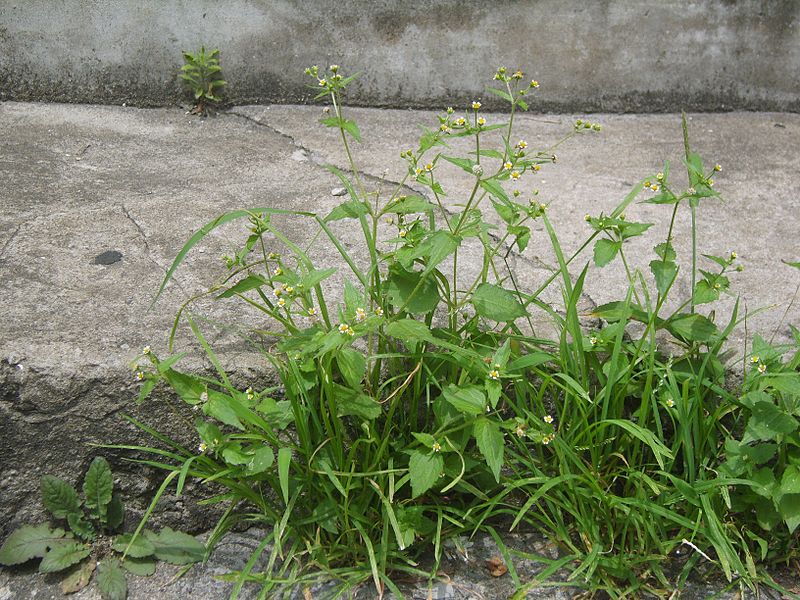
Galinsoga, “Gallent Soldiers” aka Quickweed grows up, it’s toxic look-alike crawls.


Galinsoga ciliata: Quickweed is fast food

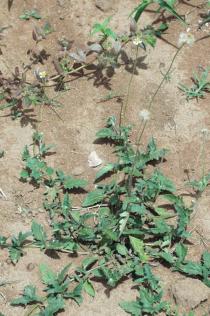
Quickweed does not look edible or gallant. In fact, it looks like a daisy that lost a fight. But it, and a close cousin, G. parvifolia, are good pot herbs. There is a potentially toxic look alike, Tridax procumbens, “Coat Buttons” which is more viney, and low growing except for flower stalk. Unfortunately the blossoms of Galinsoga ciliata and Tridax procumbens are nearly identical so you have to look at the rest of the plant to make sure you have the Galinsoga. It is found nearly everywhere in North America except the desert southwest (and sparingly in warm southern states.) 

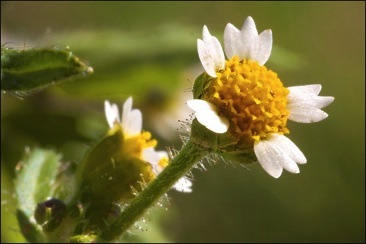
Galinsoga blossom

Beside roundish older leaves, Galinsogas have (usually but not always) five widely spaced petals with indented tips. A native of Central and South American, Galinsoga ciliata (gal-in-SOH-guh sil-ee-ATE-uh aka G. quadriradiata)  is a little plant that has gone a long ways. It was introduced to Kew Gardens in England in 1796 and not only has naturalized there but escaped to the continent as well. That makes some sense in that one plant in a season can produce 7500 seeds. As a new comer to not only the northern United States and Europe it does not have an extensive foraging history outside of its native region. However, as soon as it got to China it became a prime pot herb. The entire plant is eaten except the root. However the leaves are the best part. For an ugly little plant it has great taste. Pick a lot because it loses some size in the cooking.

Low-growing Tridax procumbers: NOT EDIBLE

Nutritionally the leaves of the Galinsoga per 100g edible portions are:  88.4g water, 37 calories, protein 3.2g, fat 0.4g, carbs 5.2g, fiber 1.1.g, calcium 284 mg, magnesium 60 mg, potassium 58 mg, iron 5.3 mg, zinc 1.3. mg, carotene 4 mg, vitamin C 6.7 mg, thiamin 0.08 mg, riboflavin 0.21 mg, and niacin 1.21 mg.

Galinsoga was named after Mariano Martinez Galinsoga,  a Spanish physician and botanist in the 18th century. Ciliata means fringed with hair.  Parvifolia means small flowers. The plant’s nick name in England is “gallant soldiers.” In Brazil it is known as botão-de-ouro.  G. parvifolia is toxic to goats, apparently among the few plants that are.

Green Deane’s “Itemized” Plant Profile

IDENTIFICATION: Quickweed is identified by its opposite, oval, coarsely toothed leaves on opposite-branched stems. Its small flower heads have a yellow disk and five (or four) three-toothed white tiny petals (occasionally pink.) To two feet tall. Its toxic look-alike, Tridax, is ground hugging except for the flower stalks, see photo upper right. Remember, Galinsogas grows up, the entire plant. The Tridax grows low except for the flower stalk which grows up. Do not eat the Tridax. The blossoms resemble each other closesly so don’t use just the blossoms for identification.

TIME OF YEAR: May through fall in northern areas, nearly year round in Florida

ENVIRONMENT: Waste ground, cultivated areas, roadsides, gardens, dooryards lowland fields. However, it prefers damp rich soil with plenty of sunshine. (The government lists toxic Tridax as only growing in central and south Florida but eleven states consider it a “pest”: Alabama, California, Florida, Hawaii, Massachusetts, Minnesota, North and South Carolina Oregon, Texas and Vermont. ) 

METHOD OF PREPARATION: Cooked green. Put in boiling water for 10/15 minutes. Excellent with butter, salt and pepper.  Dried leaves can be used for flavoring. G. parvifolia being less hairy is used as a salad green as well.  The juice and leaf paste of the Tridax procumbens can be used to stop bleeding wounds.

{ 19 comments }

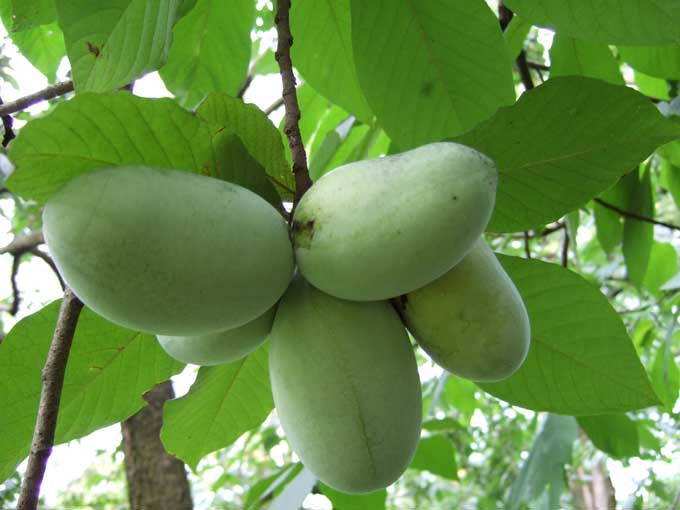
Pawpaw can be a dwarf shrub or a small tree

Pawpaw Panache

Asimina triloba

Finding your first pawpaw is a thrilling moment.

I can remember exactly where it happened and when. It was the summer of 1987 in Longwood, Florida, in The Springs, a gated community, along a nature walk. I happened to glance over and saw a pair of horribly stunted misshapen green pears. And as is often the case, once one gets the image of the plant in the head by meeting it in person, one begins to see them. Their most common appearance in Central Florida is along the margins of Interstate 4 in the Deland area, and of course, pastures.

Asimina obovata

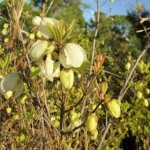
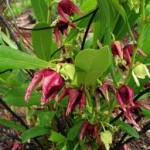
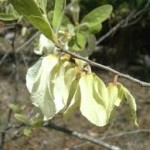
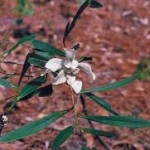
Wild pawpaws fall in the same category as gopher apples. The woodland creatures usually find them first so you rarely see a ripe one. The fruit is edible straight from the tree but palatability varies. There are two general types. One ripens early and is large with flavorful yellow flesh; the other is often smaller, ripens later, and has white, milder flesh. You can also divide pawpaws another way, Florida and all others. Florida’s pawpaws tend to be shrubs, if not dwarfs. They are: Asimina obovata, Asimina incana, Asimina reticulata, Asimina longifolia, Asimina pygmaea, and Asimina tetramera. Farther north one can find the Asimina triloba reaching small tree height and in the coastal areas Asimina parviflora. While I have not personally tasted them all Dr. Daniel Austin in Florida Ethnobotany says he presumes they are all edible.

Asimina pygmaea

Pawpaws are rich in nutritional value, including high levels of vitamins A and C. The downside is they don’t ship or store well, on par with loquats. Also they severely nauseate some people, can cause a rash when handled, and the seeds contain a depressant.  Incidentally, the fruit is the largest native North American fruit and is heavy on the protein side.

Pawpaws are also a little difficult to cultivate. In fact, they are really hard to cultivate. They need a lot of pampering for a few years to get them started, after that they are quite free of problems. They also attract a wide variety of butterflies. Those who champion the cause of pawpaws think that if they can persuade nurseries to pay more attention to the plant it can be a commercial success. It has few pests so it can be grown organically with little fuss. There might be even pawpaws on your grocery shelf in a few years. That would depend upon the lawyers.

Asimina incana

Like all plants the pawpaw is a mini chemical factory. Natives used dried pawpaw seed powder to control head lice and pharmaceutical preparations today still use pawpaws for that. The leaves are diuretic and the bark yields a strong fiber for cordage.  It also belongs in a family of fruit trees that are suspected of inducing Parkinson’s Disease. That is currently being researched. Pawpaw has not been indicted but to a lawyer all that might be close enough to keep the fruit off the grocery stores shelves. You might have to forage for pawpaws or grow your own.  Which reminds me, historically, the pawpaw was under cultivation by natives east of the Mississippi when de Soto traipsed through in 1541. Chilled papaw fruit was a favorite dessert of George Washington. Thomas Jefferson planted some at his Monticello. I don’t recall of either dying from Parkinson’s.

Asimina longifolia

As for its usual genus name, Asimina (uh-SIM-min-nuh) nearly any guess is as good as any other. My best deduction is the natives called the bush Assimin (“min” in Algonquin means food, still found in “persimmon.” ) Assimin would be fine enough but then European languages and writers get involved. The early French inhabitants of Louisiana, called the fruit “Asiminer” from which we get the genus name.  This is somewhat close to the Latin word for monkey, simia. That led to an early reference to calling the plant “monin” which was an old French word for monkey. That came from the Greek word for monkey, maimou. It changed through Latin into the romance languages as monin, mouninu, monnino, and monin. That leads folks to think the fruit had something to do with monkeys but I think it was just an assumption of one botanist who thought Louisiana French were referring to a “monkey plant.”  Further, the pawpaw is North American and there are no native monkeys.

One Florida version is Asimina reticulata, (reh-tick-yoo-LAY-tuh) meaning the veins in the leaf have a net pattern. It can be found in slightly damp or occasionally damp areas. Another is Asimina obovata (oh-bo-VAY-ta) meaning egg-shaped leaves. It likes it dryer ground can grow twice as tall as the reticulata. The others are more or less reported, not the most common of shrubs. Locally pawpaws are rarely over four feet high whereas farther north the grow into trees. The A. obovata is listed as rare and the A. tetramera endangered.

Asimina parviflora

One would think pawpaws would be a bit easier to explain, but no, and it also points to one of the problems of the cut-and-paste Internet.  Many say pawpaw (or papaw or paw-paw) is a corruption of the American Indian word papaya, a version or cognate shortened by the Spanish. That’s not too bad, no great stretch there. And that it came originally from native Americans seems reasonable. Others, no doubt copying the same wrong site, note that it is Indian then make a huge leap across the Pacific and say it is from the Hindi language, you know, near China… and then younger folks wonder why older folks don’t trust the Internet...

Asimina reticulata

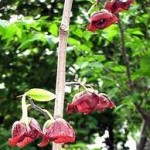
Two aspects of the pawpaw I’ve found interesting is first it is in the Annonaceae family and closely related to magnolias though actually much older than the larger magnolias. The little ol’ pawpaw came first first. Next is that it is pollinated by carrion flies and insects attracted to fetid odors. Growers often put roadkill or rotting meat in their groves to attract the pollinating flies. Now there’s a tasty thought…

How to spell it… dictionaries are split, pawpaw, papaw… if you go back to the original it should be “papa” said pawpaw. In that regard papaw seems half-hearted. The USDA says pawpaw, Dr. Austin, ever sensitive to language’s influence on botany, went with pawpaw. Pawpaw eliminates mispronunciation, looks balanced to me and reflects the balanced sound the ear hears… always the musician…

logoAnd in case you wondered since 1994, Kentucky State University has served as the USDA National Clonal Germplasm Repository, for Asimina species, as a satellite site of the NCGR repository at Corvallis, OR.  There are over 2,000 trees from 17 states there on 12 acres at the KSU farm.  Researchers evaluate the genetic diversity contained in wild pawpaw populations so that unique material can be added to the KYSU repository collection to be used in breeding.  And for an unusual recreational and educational opportunity, visit the Annual Ohio Pawpaw Festival in September Lake Snowden in Albany, Ohio for three days of Pawpaw music, food, contests, art, history, education, sustainable living workshops and activities for the kids!  http://www.ohiopawpawfest.com/ .

And now a difficult paragraph. Pawpaw is in the annonaceae family, along with various custard apples, soursop, corossol, graviola, and guanabana. Some research indicates that long term high consumption of these fruits or herbal teas may foster a disease similar to treatment-resistant Parkinson’s. This has been studied in the custard apple group not pawpaw per se. But a similar chemical (acetogenin) is found in them all. In parts of the world where custard apples are available commercially, not just seasonally, large long-term consumption might increase the risk of cognitive impairment. In some area the species are used in herbal medicine. One fruit every five days for one year, or any consumption of Annonaceae herbal tea increases the risk of having severe symptoms and dementia. There is one case in the research literature involving one old man who at a lot of them for more than two years. Using acetogenic researchers can induce problems in lab rats. There are too many variables to make any definitive conclusions, such as different cultivars, is the chemical in the skin, or pulp, both? Or is it linked to pesticides? There is also a possible genetic link. It might be wise if Parkinson runs in your family to avoid such fruits.

The researchers published: “We hypothesize that even low consumption of Annonaceae fruits, juices and herbal teas is potentially a new risk factor for cognitive impairment and dementia in tropical areas. We suggest that more restrictive public health preventive recommendations should be made regarding the consumption of Annonaceae products.”

Green Deane’s “Itemized” Plant Profile

IDENTIFICATION: Shrubs or small trees, three to 40 feet, 15 common, evergreen in southern area, deciduous in northern area. Leaves alternate, simple ovate, smooth edge entire, length varies with species, flowers foul-smelling of rotting meat, single or in clusters, three large outer petals, three inner smaller petals, white to purple or red-brown. Fruit like cylindrical pears, misshapen, many seeds; green when unripe, maturing to yellow or brown, flavor similar to both banana and mango.

TIME OF YEAR: End of summer, fall

ENVIRONMENT: Rich bottom lands to rain-watered pastures, open areas, beside open areas. The two most common places I find it is at the base of tall pines or in cow pastures.

METHOD OF PREPARATION: Used like a banana, raw or cooked, as in baked desserts, ice cream, pastries, or in making beer. Don’t eat the skin and don’t eat the seeds. Chewed seeds will cause digestive problems, whole seed usually pass through. Try only a very little at first. Some people have a very several allergic reaction to pawpaws.


{ 77 comments }