Pigeon Plums ripening

Coccoloba diversifolia: Seagrape Sibling

The first time you see a Pigeon Plum it will look familiar. In the same genus as the Seagrape it shares a family resemblance. In fact, it’s also called Pigeon Seagrape along with Dove Plum and Tie-tongue.

Like many plants (or siblings) who have a more famous relative the Pigeon Plum is in the shadow of the Seagrape (did you know Princess Grace Kelly’s brother and father, John Jr. & John Sr., were both Olympic gold medalists?) While both the Seagrape and Pigeon Plum can be eaten out of hand, the latter benefits from being allow to dry then rehydrated. The fruit is eaten or made into jelly or wine. The jelly tastes almost identical to apple jelly. Some folks in the Caribbean make the Pigeon Plum into a very potent distillation. Because of the astringency the berries store well but earned them the common name of Tie-tongue. They are often sold in Caribbean markets and were an important food for the Mikasukis Indians.

Botany Lesson Boardering On Boring: The scientific name of the tree is Coccoloba diversifolia ( koe-koe-LOE-buh dye-ver-sih-FOLE-ee-uh).  Coccoloba comes from “coccum” which is Dead Latin for “berry, and loba meaning lobe. Diversifolia means different leaves which in this tree can mean pointed tips or a round tips.  The leaf stems (petioles) also appear to wrap around the main stem with a clasping ring, a unique feature. The berry is actually an achene (ay-KEEN, not uh-KEEN) which is from the Greek ἀ + χαίνειν (HAY-neen from χαίνω, HAY-know) meaning to gape. As used it means a small dry, hard, one seeded indehiscent fruit. Indehiscent (in-duh-HISS-ent) means not opening at maturity (to release its seed or seeds.) Although the Pigeon Plum fruit and the Sunflower seed in a shell are very different — one fleshy and one hard — they are both indehiscent and achenes; there is a gap between the seed and its outside and the outside does not open to release the seed. I would add the fruit of the cabbage palm as well as an example of an indehiscent fruit and an achene. Another way of saying is “it looks like the seed shrunk inside.”

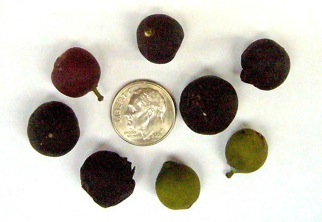
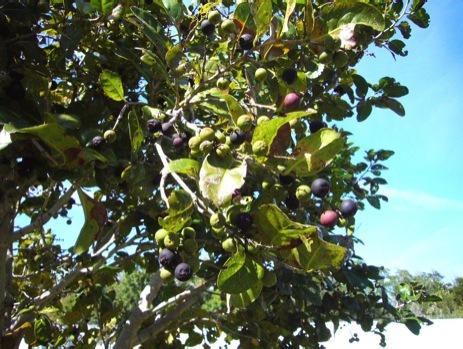
Green fruit, ripening fruit, dried fruit. Photo by Green Deane

The Pigeon Plum is an upright tree with dense leaves and evergreen but it can dump a lot of leaves around March putting on new red ones. Flowers are three-inch long racemes (spikes) in early summer turning into multiple 1/3 inch peach-shaped green fruit that ripen to dark purple that persist on the tree. While usually 25 to 35 feet at maturity it can grow larger. Young trees look pyramidal but then the tree usually develops multiple trunks which can make older trees look like rounded vases.

In the Buckwheat family this tree was used for centuries to produce a tannin called Kino that was used medicinally. Now it is mostly an ornamental plant producing what some call a marginally edible fruit. That is a bit puckish. If it were the only fruit in season and your only choice it would be a great fruit of many uses. But if one has hundreds of fruits most bred to be sweet and inoffensive then it becomes a marginal fruit. As mentioned, dried “plums” rehydrated are the best tasting. It is not unusual in non-commercial fruit trees that the best fruit are the ones you have to fight the ants for.

If modern man has taste issue with the tree, birds do not, especially pigeons and doves, which is why it is called Pigeon Plum and Dove Plum. Bird watchers know to find that tree to sight those birds. (An accessible specimen grows in Dreher Park in West Palm Beach, FL, just east of the Zoo.) More so, the fruit can ferment on the tree. Ethnobotanist Dr. Daniel Austin in his book Florida Ethnobotany reports seeing a Mocking Bird once drunk on Pigeon Plum fruit. Among the other wildlife that visit the tree are catbirds, robins, woodpeckers, small rodents and raccoons.

In Florida, you can find the Pigeon plum in coastal central and southern Florida from Brevard County south through the Keys and into the counties of Indian River, St. Lucie, Martin, Palm Beach, Broward, Miami-Dade, Monroe, Collier, and Lee. It also grows in the Bahamas, throughout the Caribbean, in Puerto Rico and the Virgin Islands.

Green Deane’s “Itemized” Plant Profile

IDENTIFICATION: Tree to 70 feet, usually half that size or less. Straight trunk compact head. Branches don’t droop. Bark light gray, on older trees flaking in large scales. Leaves, alternate, simple, no teeth, oblong to ovate, some blunt tips, some pointed tips, pinnate, evergreen, two to four inches long. Flowers creamy-white spike. Fruit dark purple. oval to pear shaped, in clusters, thin-fleshed, juicy, can be astringent, single hard seed resembling a Seagrape seed.  Mostly dark brown with pointed tip.

TIME OF YEAR: Fruits fall to winter

ENVIRONMENT: Full sun, can tolerate some shade, drought tolerant, can tolerate some salt, found mostly in coastal areas.

METHOD OF PREPARATION: Eaten raw, made into jelly, wine or distilled spirits. Raw fruit better if dehydrated some first, better cooked if rehydrated first.


{ 2 comments }

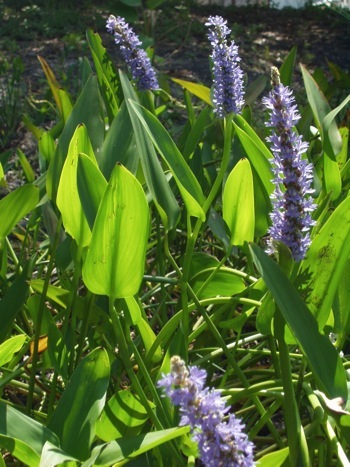
Pickerel Weed in blossom, Photo by Green Deane

Pontederia cordata: In a PR Pickerel

Pickerel Weed Primer 

 If the Pickerelweed could commiserate, it would find a friend with the Natal Plum. The Natal Plum has a deadly relative, the Oleander, which gets all the attention. The Pickerelweed’s close cousin, the Water Hyacinth, is arguably the most despised and expensive invasive weed in the world. While damning the hyacinth few praise the Pickerelweed.

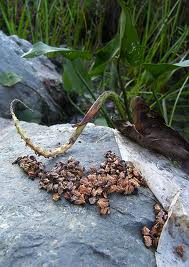
Pickerel Weed seeds and seed stalk

It’s found in eastern North America then down to Argentina. Also in Oregon and as an ornamental in Europe and elsewhere. It’s given short shift in many foraging books. Its seeds, however, are nutritious and can be eaten raw or cooked. They can be boiled like rice or roasted. Parched for a few minutes they are excellent. When dried they make a good grain for bread. Its young unfurled leaves can be eaten raw or boiled for about 10 minutes. Stalks are edible as well.

Two advantages of the Pickerelweed is that if it comes from wholesome water the leaves and seeds need no cooking. In fact where I live it is about the only source of starch that does not need to be cooked.

Deer are particularly fond of Pickerelweed, as are muskrats and pickerels in more northern climes. It’s been around long enough to have its own bee for pollination, the Dufourea novae-angliae, which visits this plant for nectar and pollen and does not visit any other plant. Several ducks also eat the seeds including Mallard, Black Duck, Green-Winged Teal, and Wood Duck.

Cordata means heart-shaped and Pontederia honors Italian physician Guilio Pontedera, who also kept the Botanical Gardens at Padua for 38 years. The name is said pon-tee-DEER-ree-uh kor-DAY-tuh.

Green Deane’s “Itemized” Plant Profile

Giulio Pontedera 1688–1757

IDENTIFICATION: Large plant to four feet, produces one spike of small lavender stalkless flowers, 50 to 100 of them. Long, heart-shaped leaves, or arrow shaped or lance shaped. The flower stem rises above the leaves except one leaf reaches up and grows behind the flower. Veins of leaf are parallel, J-curved, never with net-like veins between them.

TIME OF YEAR: Blossoms in summer seeds in fall, however in warm areas it can bloom from March to November.

ENVIRONMENT: It likes shallow water, a foot deep or so, either the edge of a slow moving stream, or ponds and lakes.

METHOD OF PREPARATION: Seeds, raw or cooked, parched, boiled or roasted, best collected when they fall into your hand off the plant. They make a good flour.  I like to lightly roast them and take them on the trail with me. Young unfurled leaves and stalks boiled.


{ 10 comments }

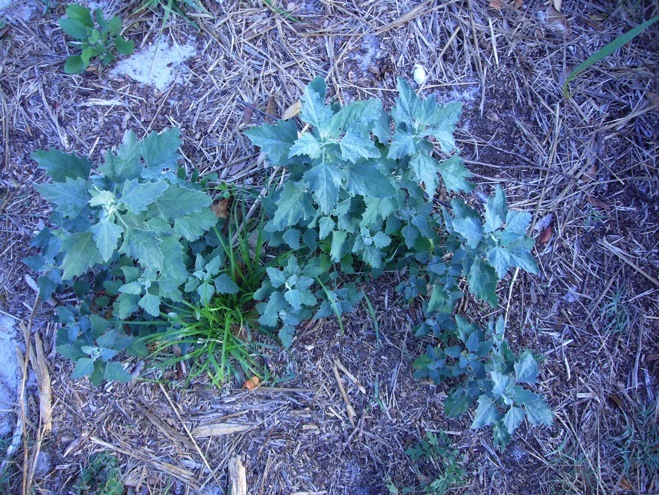
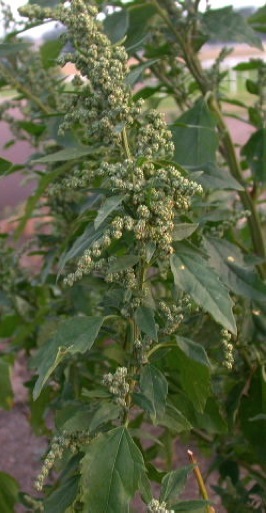
Young Pigweed, note the white dusting on the leaves

Chenopodium album: Getting Goosed!

My first recollection of Chenopodium album, pigweed, came around 1960 via a neighbor named Bill Gowan.

Mr. Gowan was what you’d call a wiry man; not tall, not muscular, but strong and an excellent gardener. He, and his wife Maxine Lambert, had degrees in agriculture and were making a good effort at running a farm next door raising a few thousand chickens and seven kids.

As was the case back then neighbors helped neighbors. He was over to our place working with us on some plumbing when he saw a huge crop of pigweed where the lawn was supposed to be. (Earlier that year my father had spread hay chaff from the barn on the dirt area set aside for lawn and grew a gigantic crop of wild mustard and pigweed but no grass.)

Pigweed seed spikes

As Mr. Gowan was leaving he stopped, chewed his pipe stem, slid back on one hip as was his habit, and remarked that the pigweed was very fine looking and would we mind if he took some home for supper? That caught my ears because I didn’t know they were edible. My father told him to take all he wanted and Mr. Gowan went over and yanked up four or five plants that were much taller than he was. He wrestled them from the hard soil and took them all home, stems and all. I can still remember the happy glee he had hauling them out and taking them away. He was a perpetualy skinny man of prodigious appetite so I’m sure he looked forward to them with his lips a-smacking. He never let them grow in his very neat garden. Pigweed ( Lambsquarters, Fat Hen ) is the fastest growing Chenopodium.  There are many members of the family: Don’t eat it if it has a strong varnish-like smell. That would be one of a few used for spice or medicine. (See Epazote.) Well… I say don’t eat it if it smells like varnish but in some countries they manage to get around Epazote’s odor and use it as a green as well as flavoring and medicine.

Here in suburban Central Florida it is difficult to find enough Chenopodium album (ken-o-POE-dee-um AL-bum) to make a meal out of. Not two miles from me used to be about 20 acres of it every year but now that old frozen orange grove is a coiffured upscale, fenced housing development. I haven’t even seen a single pigweed growing outside the big brick fence. I still see a Chenopodium now and then but usually just one straggling plant at a stop sign or the like.  To bad because it is a choice potherb, mild in flavor and nutritious. If you have the time the best place to find them now is in less-than-well tended orange groves.

That Chenopodium is an edible is not in doubt, leaves to processed seeds. It has been a mainstay of many for centuries. However, whether the extremely common C. album is a native to North America is something of a debate. Probably not. However C.  berlandieri (bur-lan-dee-ER-ee)  is native and is used the same way.  It was cultivated as long as 3,500 years ago.  Chenopodium means goose foot, referring to the shape of the leaves. Album (see photo on top) means white as the leaves often have a dusting of white making them unwettable. Pigweed can have up to 19,000 IU’s of vitamin A per 100g serving.

Among the known edible Chenopodiums are: bonus-henricus, californicum, capitatum, fremontii, leptophyllum, rubrum, urbicum. The next three are used as spices: C. ambrodioides, pueblense and botrys, though I think that is stretching the definition of spice.  They stink. Use sparingly. Also avoid the smelly medicinal C. anthelminticum. It’s in league with the previous three only stronger.

As for the name Lambsquarters… It has nothing to do with Lambs at all. In ninth century England (some say Scotland) the calendar was divided into four quarters. The one starting August first was called Lammas Quarter. It was then folks celebrated the wheat harvest. They ate a green, leafy plant then and called it Lambsquarters. 

Green Deane’s “Itemized” Plant Profile

IDENTIFICATION: Large plant, to six feet or more, often mealy early in the season, leaves very variable, diamond-shaped widest point usually well below the middle, narrowing to two straight untoothed sides making a V-shaped base, and with straightish toothed sides to the tip.  Flowers ball-like clusters arranged in spikes. The minute flowers have five green sepals, five yellow stamens.

TIME OF YEAR: Young shoots in spring, leaves summer and fall, seeds fall.

ENVIRONMENT: Waste ground to fertile gardens.

METHOD OF PREPARATION: Young leaves raw, older leaves sweated or boiled, seeds after soaking overnight and rinsed well to remove saponins on surface. Chenopodium is a nitrogen holding plant  and high in oxalic acid. Best avoided by those with kidney stones, gout or related issues.  Seed is 49% carbohydrate, 16% protein, and 5.88% ash. Water the seeds are soaked in can be used as soap.


{ 18 comments }

Pines are found around the world

Pines: Not just for breakfast anymore

Euell Gibbons became famous for asking, “have you ever eaten a pine tree?”
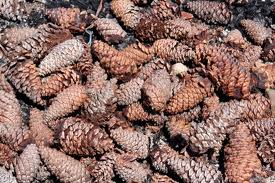
You want brown unopened cones with prickles

A lot of folks had a laugh over that, but perhaps Euell will have the last laugh. We all probably have an ancestor who ate a pine tree or part of it now and then. I know I did. And people may eat pine again. It’s a family with over 200 species and has served man well, famine food to ship masts. So much has been written about this family let me see if I can say a few things others haven’t.

Where ever there have been pines and people the people have depended on the pines. Besides food, they had and still have medical uses. Pines have been used for the making of stimulants, laxatives, diuretics and vermifuges, among many including Shikimic acid, the main crude ingredient in Tamiflu.
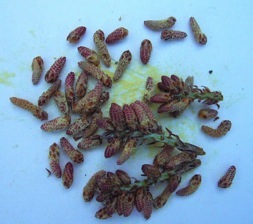
“male” pine cones and pollen

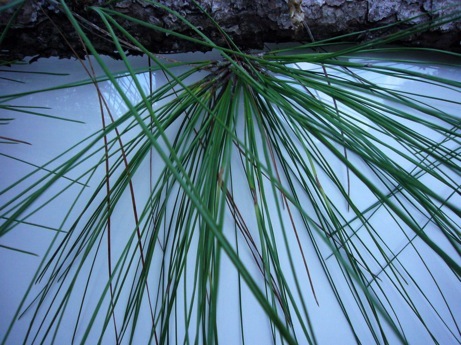
There are actually two groups of pines, softwood pines and hardwood pines. The soft pines have needles that are found in groups of five on twigs. Their wood is actually low in density. Hard pines have needles in groups of two or three per twig. Their wood is moderate in density.  This may seem like a technical distraction but often telling pines apart is very difficult and how the needles arrange themselves is important… unless you are making pine needle tea, then just put a few needles or the tip of a young branch in hot water and you’ll have a nice serving of Vitamin C. Pine needle tea saved many a sailor in olden days from scurvy. (Despite what some websites say, in tea form the pine needles are no threat to pregnant women. In fact let me explain that.)

The basis for this rumor is a veterinary study decades ago. If you are a cow and you eat many pounds of Ponderosa Pine needles you have a 5 to 8 percent chance out of 100 of having an abortion or still-birth. If you boil a huge amount of pine needles in water for hours down to a small amount of gross liquid and you drink it, then maybe it would cause an abortion. A few of needles soaked in hot water is no threat to anyone except for possible allergies. Here’s what famous forager Euell Gibbons had to say: “When I was a boy we used to eat ponderosa pine for pleasure . . . called it “slivers”. In the spring the bark is really gorged with starches and sugars and tastes quite sweet. It’s also high in vitamins.”

The cambium of the pine (between the bark and the wood) can be boiled or roasted as a famine food, and makes a reasonable flour. Fried in olive or coconut oil it’s actually tasty. The cambium near the base of the tree is better than the cambium near the top of the tree. That bit of advice always struck me as odd as if I would climb a pine to get a strip of bark off the top when the bottom is so close and handy. And of course nearly everyone has had a pine nut or two. Animals like the pine nuts as well, including squirrels, turkey, quail, and brown-headed nuthatches.

The collecting of pine nuts for human use is a debatable issue. Some 20 species of pine have nuts big enough to harvest for human food. If foraging is a hobby, then go ahead and collect a few (put the brown, unopened female cones near a fire to make them open and release the seeds.) If in a survival situation, however, one could expend more energy collecting pine nuts than energy gotten from the pine nuts so it is a significant decision to make when out of food. Female pine cones can weigh up to 10 pounds and be two feet long. The pinyon pine, where we get the familiar pine nut in the US, is the only pine with one needle per twig.
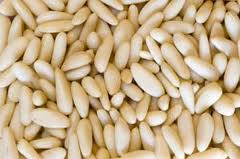
Most pine seeds are too small to eat

But, there is more to the pine than nuts, cambium, and needles. Like the cambium, the young male pine cones can be boiled and eaten. What is a male pine cone? Well, they are small, soft and papery whereas the female cones are woody and tough.  Male cones really shouldn’t be called cones. Technically they are microsporangiate strobili. Say that at a cocktail party and see how many conversations you start.  (Hint: micro-spore-WREN-gee-ate  stro-BYE-lee) The best I can do is that a male pine “cone” looks like a small cluster of toasted coconut bits shaped like orzo.  See picture, upper right. If you have a better description let me know.
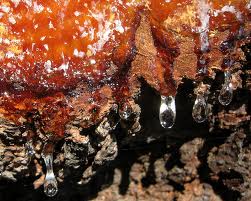
Indespensible pine pitch

Here is another little known fact: During certain times of the year my pickup is covered with a light yellow dusting. Starting in winter here and going into spring the pines have sex on their minds and the fellows are releasing pollen. For some pine pollen means misery from sniffling and sneezing. But pine pollen is more than just the mere powder of pine lust.

Pine pollen is a large particle, and since it depends on the wind, it can’t travel too far. It also has a waxy coating on it’s surface which makes it a minor allergy trigger, though a few folks are allergic to it. When the pine is pollinating other trees that are more significant allergens are secretly pollenating such as birch, cedar, oak and sycamore. Often folks who think they have a pine allergy are actually allergic to one or more of those other trees.

Which brings me back to pine pollen.  It has over 200 identified elements from vitamins to proto male hormones… yeah, it’s a guy food.  It’s been called the natural testosterone, androstenedione, but that is a marketing exaggeration.  It has about 27 nanograms per 0.1 grams of dry weight, not suitable for the bulking up weightlifters want, but available none the less. Putting the pollen under the tongue keeps it from being destroyed by the digestive system.

Androstenedione is an adrenal hormone produced in humans.  Reduce androstenedione by one molecule and you have  testosterone, which both men and women have in different amounts. Androstenedione can raise testosterone levels. The effect lasts about a day.  And this is how the Native Americans used it, for extra energy when they needed it. So when on the run, grab a little pine pollen. Pine pollen also seems to have a beneficial effect on the cardiovascular system as well.  How do you collect it? Put a sack over the microsporangiate strobili and shake, if it is the right time of the year, lick the hood of your car.

And what about shikimic acid and the flu? Processed shikimic acid prevents the flu from reproducing, thus reducing symptoms and the duration of the flu. The drug Tamiflu is made from the seed pods of the Chinese star anise tree which is 7% shikemic acid. Researchers have found that White Pine needles have enough shikimic acid, 3%, to make its extraction commercially viable.  Spruce also have the acid and it is presumed other pines do in varying amounts.

The English name pine comes from the Greek Pitus thru Latin Pinus (PIE-nus and PEE-nus)  by way of French “pin.” Contemporary Greeks say ;’ PEF-ko.” That takes us now to how the Greeks use pine, and that is to flavor a white wine called retsina.

Greeks have been making retsina for a few thousand years. It was an acquired tasted by accident. They stored their white wine in clay containers lined with pine pitch (to keep them from weeping.)  The wine took on the subtle flavor of the pitch. Now days, retsina comes in a wide range of flavors, from delicate to intense. I have several relatives who make it. One of my fondest memories of Greece was having cloudy, young, homemade retsina high in the mountains after a meal of kid roasted on an olive wood fire. There’s one other advantage to retsina: Take it to a party and no one will steal your wine. To make your own retsina the short way, put a pea-size piece of pine pitch  in a bottle of cheap chablis and let set in the refrigerator for a long time.

Young pine roots are edible as are stripped pieces of their bark. The bark can be seeped in water for its sugar and the water drank. Also, many pine trees have burls on a limb and those can be broken off and used as a throwing stick or mallets.

NOTE: The “Australian Pine” is NOT a pine. It can not be used like true pines.

Green Deane’s “Itemized” Plant Profile

IDENTIFICATION: Pines are evergreen and resinous trees growing to 100 feet tall, the adult tree has long needles in clusters of three to five up to 18 inches long.

TIME OF YEAR: Needles and inner bark available year round, young male cones and pollen in spring.

ENVIRONMENT: Pines grow well in acid soils, some on calcareous soils; most require good drainage, preferring sandy soils to accommodate a large tap root up to 12 feet.

METHOD OF PREPARATION: Needles raw as a nibble or in hot water for tea, or chopped and used like rosemary. Inner bark near base is edible, preferably cooked, can be made into a flour, very high in vitamins A and C, young male cones boiled, pollen eaten as is.  The core of young roots are edible raw when peeled of the outer bark. The young root bark can be seeped for its sugar content.

HERB BLURB

Icelanders of the 1400’s took pine sap mixed with honey to ease lung troubles. Oriental herbalists use pine knots as medicine, especially for arthritis.

Spatchcocked Chicken

Traditionally a spatchcock is a game bird that is prepared for roasting, broiling or grilling by removing the backbone and sternum of the bird and flattening it out before cooking. In this recipe the pine needles are used like rosemary.

3 ½ – 4 pound young chicken,

Sea salt and ground pepper

2 tablespoons young pine needles or shoots, minced

2 -3 tablespoons lime juice

Rinse chicken with cold water, dry. Remove extra fat, trim off wing

tips. Place chicken breast side down and using poultry shears cut along

backbone, starting at the neck. Repeat on the other side of the backbone

Spread the two sides apart and press down on the breast so that the chicken

lies flat. Season both sides with salt and pepper and lemon juice.

Build a charcoal fire on one side of your grill;. Place chicken skin side down at the edge of the fire with legs closest. Turn over when skin starts to brown. Turn and move chicken to the side of the fire and cover with a large  disposable aluminum pan. This creates a “mini” oven providing high heat off the direct fire. The  grill cover can be used, but the browning and flavor will be less. Cooking time varies, depending on the fire and the size of the chicken. Check the temperature at 20 minutes after turning. When the temperature in the thigh reaches 175 degrees, remove from the heat and let sit, sprinkle with chopped pine needles, loosely covered for 15 minutes before carving.

Pine Needle Tea

You can make pine needle tea two ways. One is to pull three or four needles off a tree and stick them in a cup of hot water. Wait a few minutes then enjoy with or without sweetener.

Or collected a handful of pine needles. Needles nearest the trunk are higher in Vitamin C. Chop the needles and put them into a tea ball. Bring water to a boil. Take off the boil. Steep the pine needles for 3-5 minutes. The tea is delicate.

Pine Infused Vinegar By Pascal Bauder
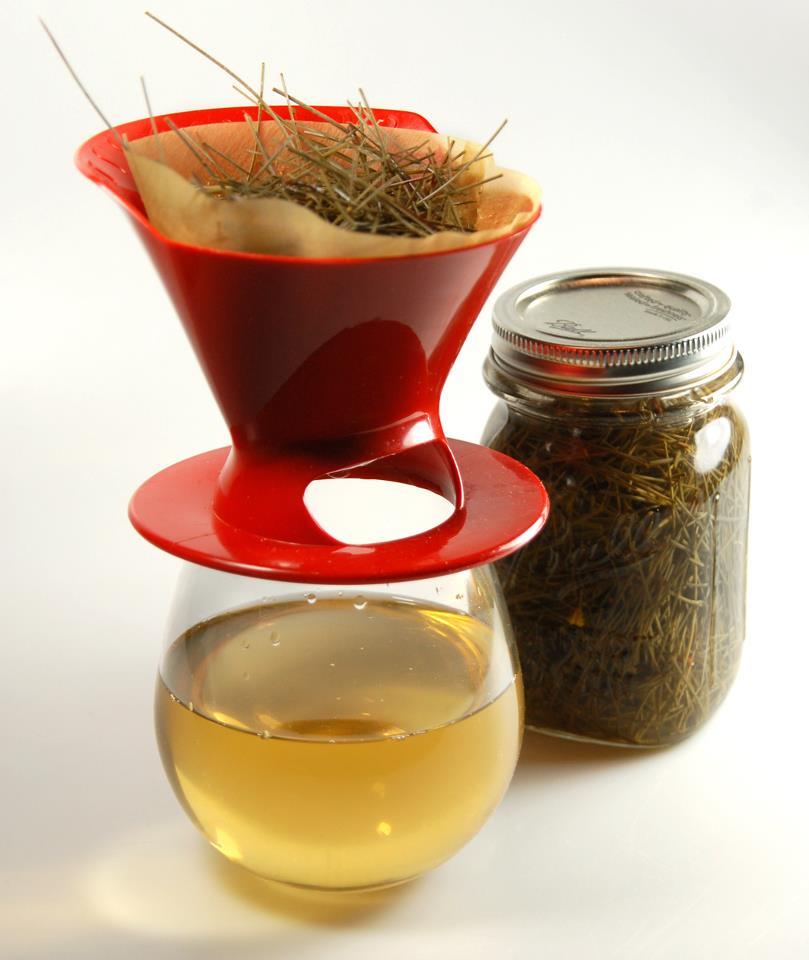
Pine Infused Vinegar, photo by Pascal Bauder

Pine infused vinegar: Apple cider vinegar and pine needles were placed in a jar for 6 weeks after water bath canning. The ratio is around 50% pine needle and 50% vinegar. Extremely sharp (pine needles have this lemony/tart flavor) so I also added some of my pine sugar (pine needles powdered with organic sugar) to it. It’s delicious, sort of sweet and sour with a pine touch. It was quite cloudy so had to filter it twice. Soon in a couple of restaurants in Los Angeles. For the vinegar infusion I used fresh needles and for the pine sugar I used dehydrated ones. So it’s a mix really. Just apple cider vinegar and pine was quite…sharp which is why I added the sugar.

{ 53 comments }

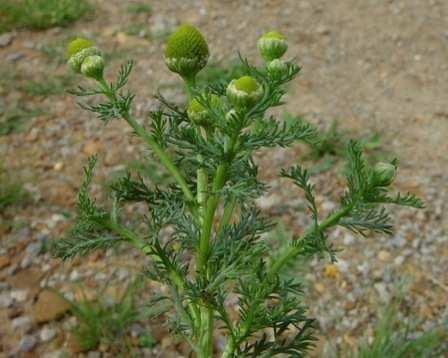
Pineapple Weed, Matricaria matricariodies

 Matricaria matricarioides for Your Tea & Salad

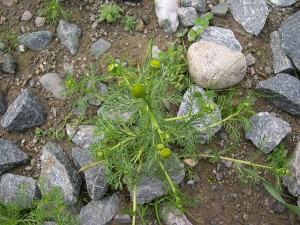
A hard-packed gravel driveway is the last place you would expect to find a delicate plant that makes an excellent tea and salad nibble yet that is where Matricaria discoidea* prefer to grow.

Every summer our driveway would be two glacial dirt ruts with a few plants struggling to survive in between. There I would find Pineapple Weed, the dominant plant of that micro environment along with struggling European plantains. Our horses, which were also our lawn mowers, always left the Pineapple Weed alone, all the more for me.

A familiar sight, Pineapple Weed in bare dirt.

A familiar sight, Pineapple Weed in bare dirt.

Kids do the most dangerous things and Pineapple Weed was one of the plants that I learned was edible from other kids. Actually, I learned quite a few that way. But, it was a different time, and era. We lived near to the wilderness in Maine with a lot of adults around who had foraged so the pass-along knowledge was good, though the identifications could be iffy.  Many years later I tried transplanting Pineapple Weed to Florida but it was just too warm. Not only that but my Native Plant Society friends would have disowned me had I succeeded.

If you are inclined to gather this edible, Pineapple Weed can be confused with young Mayweed Chamomile (Anthemis cotula) or possibly Dog Fennel (Eupatorium capillifolium.) Neither of these, however, smell like pineapple when crushed, so you always want to check for that. Mayweed and Dogfennel also grow much taller than Pineapple Weed which in some environments won’t even get two inches high. Additionally, Dog Fennel has a strong balsam odor. Its common name fennel reflects what its leaves look like, not how it smells. Dog fennel has external and limited medicinal uses thus should not be consumed.  Pineapple Weed, however,  is related to the common night-time drink, chamomile tea which is Matricaria recutita.

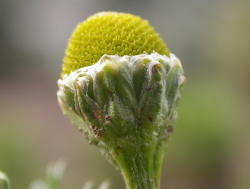
Note the lack of obvious petals.

Note the lack of obvious petals.

Matricaria matricarioides (mat-rik-KAY-ree-uh mat-ri-kar-ee-OY-deez…. mat-ri-kar-ee-EE-des in Greek)  is fairly easy to sort out.  Matricaria’s base word is Matrix, Dead Latin for womb but that translates into “mother” and is used to mean it has medicinal uses. In contemporary terms we might say it is the Mother Of All Herbs.  “-Oides” is Dead Latin’s version a Greek suffix which now means “look’s like.” It also tells you the naming botanist was having a bad day and couldn’t think of any thing really good to name the plant. So, matricarioides means “like the Matricaria.” So its name kind of means “mother herb like itself.” I think they could have done much better. Discoidea means disk. (disco-EE-dee-ah or THEE-sco-EE-dee-ah.)

Some people are allergic to this plant, so try carefully. It can also be used as an insect repellent.

(Some say M. matricarioides.)*

Green Deane’s “Itemized” Plant Profile

IDENTIFICATION: One or multiple flowers at the ends of the stems on short stalks, flowers cone-shaped, from 1/4 to 1/2 inch in diameter,  greenish yellow in color, finely dissected leaves with a sweet “pineapple-like” aroma when crushed. .

TIME OF YEAR: A late summer or winter annual

ENVIRONMENT: Dry areas, rocky soil, waste ground, nurseries.  Pineapple-weed is found throughout Canada the United States except for Georgia, Mississippi, Florida and Texas. As a cool weather plant it can be found in the northern areas of some southern states.

METHOD OF PREPARATION: Young flower buds in salads, or fresh or dried to make a tea. The entire plant can be used to repel insects.


{ 22 comments }