Lunch Drops In

Monkey Puzzle Tree seeds

My good friend Saul is a luthier, a man who works with exotic woods. He repairs premium wooden instruments. It is not unusual for him to be working on a Stradivarius or a Guarneri someone sat on. And for 30 years he thought the tree right outside his shop was a Monkey Puzzle Tree, Araucaria araucana (air-ah-KAIR-ee-uh air-ah-KAY-nuh.) That’s what it was sold as. It’s not. It’s a close relative, the Bunya Pine.  The falling cones from either, however, can still injure you.

The Monkey Puzzle Tree is from Central Chile and Argentina. But, it’s a common landscape plant in Florida and southern border states all the way to California then up the west coast. It is also cultivated in England and Ireland, In fact the tree’s name came from an incident in England’s Cornwall in 1850. The tree back then was rare in gardens and not widely known. The owner of a young tree at Pencarrow Garden was showing it off to a group of friends when one said “It would puzzle a monkey to climb that.” At the time the tree had no common name in English. It was first called the ‘monkey-puzzler’ tree  but ‘monkey-puzzle tree’ eventually caught on.

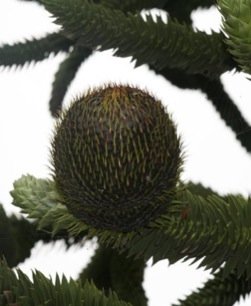
Cone of the Monkey Puzzle Tree

The point has been made that any monkey trying to climb the tree would likely be injured. Its leaves are more like ferocious reptilian spines than leaves. And, monkeys don’t live in the tree’s native range. However, dinosaurs did some 250 million years ago and there is some speculation that the ancient tree’s armament was to dissuade dinosaurs from lunch. Most surprisingly, it’s in the Pine family closely related to the Norfolk Pine, Araucarua excelsa (air-ah-KAIR-ee-uh eck-SELL-suh.) Like the Natal Plum and Chinese Elm, it’s an easy-to-find tree in temperate suburbia. They’ll be around for a while because some are at least 2,000 years old or more.

While found mostly among southern border states the tree is actually hardy and prefers cooler climates with some nice specimens in the Pacific Northwest states and British Columbia. It is a favorite display tree in Great Britain and grows well in Australia and New Zealand.  It does, however, take a male and a female tree to produce cones and seeds, usually a ratio of seven ladies to one fellow but I’d plant two guys just in case. The delicious seeds are edible raw or cooked. They are rich in starch and resemble an almond in size with a slight flavor of pine nuts.

The official tree of Chile, it was first found by outsiders the 1780s. It was named Pinus araucana 1782. By 1873, after a lot of botanical arguments, it became Araucaria araucana. The name Araucana comes from the native Araucano People who used the seeds of the tree in Chile. Sadly its numbers are dropping in its native range and has been protected since 1990.

Lastly, the seeds of the Araucaria bidwillii, (air-ah-KAIR-ee-uh bid-WILL-ee-eye) a native of Australia, are also edible.

Green Deane’s “Itemized” Plant Profile

IDENTIFICATION: Pyramid-shaped tree 90 to 130 feet tall, 3 to 4 feet in diameter. The branches grow horizontally in whorls of five in opposite pairs, drooping, stems brittle, bark corky; feathery leaves, pale green, compound, tripinnate; The leaf is an armor-like scale, triangular, oval to lance shape, 1 to 2 inches long, shiny green on both surfaces but surface marked with longitudinal lines, RAZOR SHARP. Male and female flowers. Male cones and female cones. Female cones are large, round, dark brown, develop in two to three years, 4 to 7 inches long, 3 to 6 inches wide, falloff at maturity; split in three when dried, 200 seeds are brown to orange, triangular in shape with papery wings, 1 to 1 1/2 inches long, the nut is long and narrow with 2 small even wings that are denticulate at the top.

TIME OF YEAR: When ever you find thefemale  cones on the ground.

ENVIRONMENT: Prefers well-drained, slightly acidic, volcanic soil but will tolerate almost any soil type. It produces the heaviest where there are cool summers.

METHOD OF PREPARATION: Seeds, raw or cooked. They can be boiled or roasted. Ground, they make a good flour substitute.

HERB BLURB

Resin from the tree is used to treat wounds and ulcers.


{ 26 comments }

Moringa wood is extremely brittle. Photo by Green Deane

Moringa oleifera ….Monster…. Almost

If you have a warm back yard, think twice before you plant a Moringa tree.

Is it edible? Yes, most of it. Is it nutritious? Amazingly so, flowers, seeds and leaves. Does it have medical applications? Absolutely, saving lives on a daily basis.  Can it rescue millions from starvation? Yes, many times yes. So, what’s the down side? They don’t tell you that under good conditions it grows incredibly fast and large, overwhelming what ever space you allot to it. It can grow to monster proportions in one season.
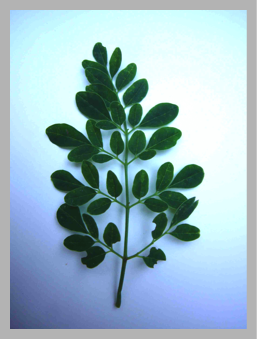
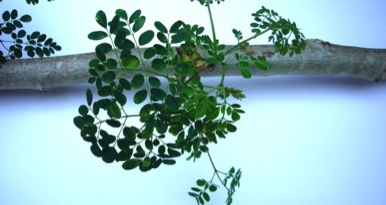
Leaves eaten raw or cooked

I live in central Florida exactly — and I mean exactly — on the line between temperate and subtropical. I have not experienced a hard freeze here in seven years probably because I sit on a hill and have a 30,000 gallon pool to moderate temperatures. Around year two I got two food trees, Katuk and Moringa. You can read about the Katuk in another article.

It is an understatement to say the Moringa grows more than 10 feet a year. I have two trees and every year I cut off 15- to 20-foot branches. They require constant attention. Despite their impressive growth pattern, they are extremely brittle. A man can easily break off a branch four inches through,…. It’s nice to feel like Hercules now and then.

The easy-breaking branches also lend themselves to a common-heard phrase in India when someone is being a little too demanding: “Don’t push me up a Moringa tree.” But, I will admit both trees withstood 100 mph winds three times in the hurricanes of 2004.

I want to impress upon you that my reference as to how fast this tree grows is a gross understatement, no matter how overstated it might seem. While gigantic growth is great for hungry poor countries, it is a significant headache for a suburban yard, even a 40-acre ranch.  Unattended, the tree grows into a spindly giant. If you don’t attend it twice a month you will have a monster on your property, and I have two of them, one self-seeded. Should you choose to grow it, just know what you are getting in for. Now days I cut both trees back to a three foot stump every spring, the same as where they are cultivated. These things grow so fast, I speculate you could get a crop of leaves off them in Northern Canada. Then over winter it inside.  It might make a real nice potted, pruned indoor tree for northern climes. That said, let’s view the virtues of the Moringa.

This tree is one of the world’s most useful plants. A native to the southern foothills of the Himalayas, Moringa oleifera  (mo-RIN-ga oh-lee-IF-er-uh) is cultivated around earth’s tropical belt. Moringa is grown for its leaves, fruits, seed, sap and roots. It provides a variety of food and medicine. The young fruits pods, called drumsticks, can be cooked many ways, often like green beans, and have an asparagus taste. A superior cooking oil comes from the seeds, and the light oil can be used to lubricate delicate mechanisms. The leaves are extensively used as a vegetable — I had a restaurant-owning Chinese friend who’s wife made a great soup out of them — and the roots are made into a condiment resembling horseradish in taste, but use it sparingly for it contains an alkaloid, spirochin. A blue dye can be made from its sap. Even a health drink is made from the tree. M. oleifera also might have a great future in water purification, a prime cause of illness in the world. And that is just the start of the amazing overgrown weed called “The Miracle Tree.”
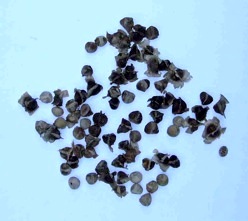
Dry moringa seeds

There is only one family of Moringa trees, and only 13 members, making it one of the smallest groups. Of all 13, M. oleifera is the one most cultivated and usually the one referred to when talking about the edible Moringa. The name Moringa comes from the Tamil/Malayalam word murungakka. A search using “murungakkai” will produce many recipes.  Oleifera means oil bearing. In the Philippines it is called “mother’s best friend,” in Florida, “the horseradish tree,” and in India “the drumstick tree.” In India it is an absolute must-have plant in the kitchen garden. In Thialand they are used as living fences.

From a food point of view, Moringa leaves can be used like spinach, though they are far more nutritious. Sorry Popeye. The leaves can be used fresh or dried into a powder. The leaves are an excellent source of vitamin A and C, a good source of B vitamins, and among the best plant sources of minerals. The calcium content is very high, iron is good enough to treat anemia — three times that of spinach — and it’s an excellent source of protein while being low on fats and carbohydrates. Said another way, Moringa leaves have seven times the Vitamin C of oranges, four times the calcium of milk, four times the vitamin A of carrots, three times the potassium of bananas, and two times the protein of yogurt. That’s quite a line up. The leaves also have the sulfur-containing amino acids methionine and cystine. Medically it is antibiotic and research shows it can be used to treat high blood pressure. A leaf tea is used by diabetics to help regulate their blood sugar. It is full of antioxidants, is anti-cancerous, and when eaten by mothers they give birth to healthier, heavier babies.  A 28 December 2007 study said a root extract is very anti inflammatory.

In fact, let me quote you an earlier abstract from Phytotherapy Research 16 Sept 2006:
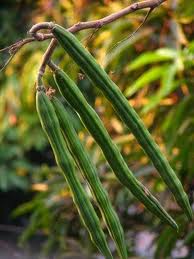
Immature moringa pods

Moringa oleifera Lam (Moringaceae) is a highly valued plant, distributed in many countries of the tropics and subtropics. It has an impressive range of medicinal uses with high nutritional value. Different parts of this plant contain a profile of important minerals, and are a good source of protein, vitamins, -carotene, amino acids and various phenolics. The Moringa plant provides a rich and rare combination of zeatin, quercetin, -sitosterol, caffeoylquinic acid and kaempferol. In addition to its compelling water purifying powers and high nutritional value, M. oleifera is very important for its medicinal value. Various parts of this plant such as the leaves, roots, seed, bark, fruit, flowers and immature pods act as cardiac and circulatory stimulants, possess antitumor, antipyretic, antiepileptic, antiinflammatory, antiulcer, antispasmodic, diuretic, antihypertensive, cholesterol lowering, antioxidant, antidiabetic, hepatoprotective, antibacterial and antifungal activities, and are being employed for the treatment of different ailments in the indigenous system of medicine, particularly in South Asia. This review focuses on the detailed phytochemical composition, medicinal uses, along with pharmacological properties of different parts of this multipurpose tree. Copyright © 2006 John Wiley & Sons, Ltd.

Now you know why they call it “The Miracle Tree.” It is being planted extensively in poorer areas of the world, some 400,000 trees in Rwanda alone.

To cultivate, soak the seeds for a day in water, plant in a peat pot. When six inches high, put in fertilized ground, and stand back!  When it is six feet high cut the top off, forcing side shoots. Hang the top upside down in the shade and let it dry. Then grind the leaves into powder.

Today, approaching Valentines Day, I did my annual Moringa cut back. It takes about four hours, not counting nibbling and seed saving. Every year I promise myself I will trim them more often and every year they rocket to the sky. But that’s really not a problem.  I just climb on the roof and collect dinner.

Green Deane’s “Itemized” Plant Profile

IDENTIFICATION: Slender tree, to about  35 feet; drooping branches,  brittle stems, corky bark; leaves feathery, pale green, compound, tripinnate; flowers fragrant, white or creamy-white, in sprays, 5 at the top of the flower; stamens yellow; pods pendulous, brown, triangular, splitting lengthwise into 3 parts when dry, containing about 20 seeds, pod tapering at both ends, 9-ribbed; seeds dark brown, with three papery wings.

TIME OF YEAR: In zone nine Florida, it leaves most of the year, with seed pods in the late spring and summer.

ENVIRONMENT: Originally from India, planted in frost free areas around the world. Naturalized in many areas. Grows best in sand soil, tolerates poor soil. It loves sun and heat and can be grown from seed.

METHOD OF PREPARATION: Leave can be eaten raw or cooked like spinach, young seed pods can be cooked many ways, seeds are edible, cooked flowers taste like mushrooms, and the roots can be made into an occasional condiment.



{ 435 comments }
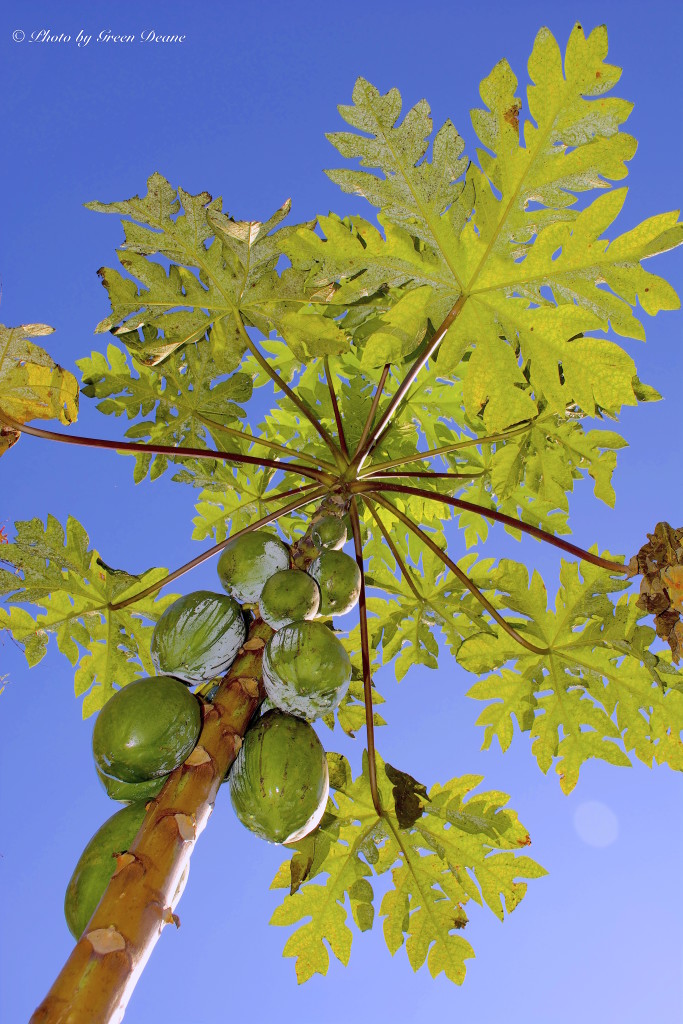
Papaya in fruit in January in Florida. Photo by Green Deane

Papaya in fruit in January in Florida. Photo by Green Deane

Carica papaya: Survivalist plant

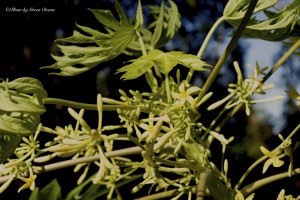
Papaya blossoms can be he's, she's, and them's. Photo by Green Deane

Papaya blossoms can be he’s, she’s, and them’s. Photo by Green Deane

Papaya comes from the grocery store, unless you live where it seldom freezes. Then it is another wild edible, naturalized in most warm areas. And there’s more to it than just the fruit. But first, what is it?

Surprisingly there is a debate whether the papaya (Carica papaya  KAIR-rick-uh puh-PYE-yuh))  is a tree or an herb. It seems to meet the expectations of both.  They fudge the difference and call it a giant herbaceous plant, one that can grow 10 feet a year and to 30-feet high.

My first introduction to papaya was a retired postman in Rockledge, Fl., who terraced his very small house lot to grow hundreds of papayas of all kinds and shapes. He was a home-spun naturalist who dug up mastodon teeth on the weekends and grew the largest papayas I’ve ever seen.

The seeds and young leaves are edible, too

Papayas can also surprise you. I grew one for about eight years but had a constant problem with papaya flies ruining the fruit. Yet papayas growing wild on the east coast at Turtle Mound survive elevation, frost, freezes and fruit flies. Like the banana the papaya is more than its fruit, which can be cooked when green or eaten raw when green or ripe. The young leaves and flowers are edible boiled, and the inner pith of the main stalk is edible raw. The roots are edible if boiled a long time. And if you run out of soapy washcloths the older leaves have saponins and can be used as a wash cloth.  Now, let’s go where few have gone.

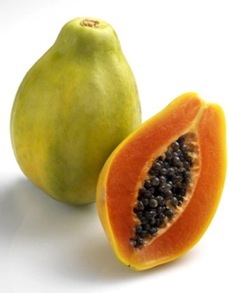
First, the papaya is a berry. Yeph a berry. And it is in the family as maypops, Passifloras, which makes sense as the leaf and fruit structure are similar. Most folks toss the black seeds away but they are edible, too.  They are peppery and can be used like pepper. They also stay viable for three years. Papayas are native to Central American and moved around the world with Spanish exploration in the 1500’s. Surprisingly the papaya did not get to Florida until the 1900’s from the Bahamas.  Not bad for a runt. You see, papaya was domesticated in Central America from weedy and almost inedible original plant. It has experienced significant changes in fruit size, growth habit, and flesh color under human cultivation. It was first mentioned in 1526 by Oviedo.

Papaya blossoms are pretty.

Papayas pack a nutritional wallop: Per 100 gram edible portion papayas are water 88%, calories 43, protein 0.6%, fat 0.1%, carbs 10%, crude Fiber 0.1% and provides of the of US RDA*  48% Vitamin A; 3.6% Thiamin, B1; 8.1% Riboflavin, B2; 2.2% Niacin; 80% Vitamin C; 2.4% Calcium; 1.6% Phosphorus; 3% iron; 5% Potassium.

The only real confusing thing about papayas is their sex and reproduction.  They are male, female and bisexual. The females and hermaphrodites make fruit but you need one male plant for every 10 of the others. On the male plant the flowers are on stems. On the female the flowers are directly on the main trunk  (see above.)

Carica comes from the Greek word karike, which was a kind of fig. The papaya was called that because of its fig-like leaves.  Papaya is what the Caribs called the papaya. Some times it is wrongly called a pawpaw or papaw.

Green Deane’s “Itemized” Plant Profile

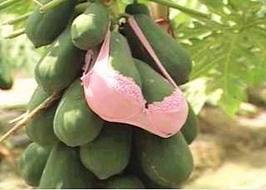
Papaya fruit are … ah…  educational

IDENTIFICATION: A large, single-stemmed herbaceous plant, to 30 feet, leaves are very large, up to 2 ½ feet wide, palmate (hand shaped) stems one to three feet. Trunk to a foot thick, with prominent leaf scars. Flowers waxy, ivory white on trunk Fruit larger to 20 pounds, oval to round, central seed cavity with black seeds. Fruit born on main stem, flesh is yellow-orange to salmon at maturity. Plants begin bearing in 6-12 months.

TIME OF YEAR: In tropical climes nearly continuously, in more temperate areas late summer through the winter if no frost or freeze.

ENVIRONMENT: An opportunist, it likes good soil, water and sun.  Trash heaps, middens, old homesteads, margins.

METHOD OF PREPARATION: Ripe fruit raw, unripe fruit cooked;  young leaves and flowers boiled, roots boiled a long time, inner pith of main trunk raw.


{ 23 comments }

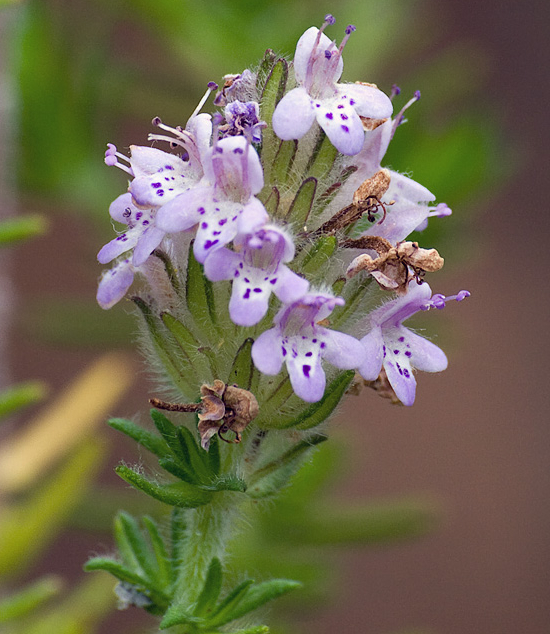
Florida Pennyroyal was once a dependable nectar crop, note the hairy leaves.

Florida Pennyroyal: Piloblephis rigida

You will thoroughly enjoy tea made by Florida’s native pennyroyal, or maybe even a Mint Julep Floridana.

An evergreen, pennyroyal is found only in peninsular Florida, a few western Bahamas islands, and maybe a foot or two across the state line into Georgia. It is unlike all other mints and is in a class all by itself, a family of one with the botanical name of Piloblephis rigida (pil-oh-BLEF-is RIDGE-jid-du.)

First it was called Satureja rigida, then Pycnothymus rigida and lastly Piloblephis rigida. Pilo in Greek is hairy, and blephis is eyelid, referring to hairs on the blossom. Rigida refers to the stiff branches.  For folks who’ve lived in more northern climes, the Florida Pennyroyal looks like a soft, green little juniper bush, minus the berries and sharp needle points leaves.

Make a tea and drives away fleas

The Mickosukee and Seminoles enjoyed brewing tea from it and flavored soups with pennyroyal. They also would put it in a small bag of it in a pet’s bed to repel fleas. Its oil has been used as an insect repellant.  It fact, it was considered a promising compound but the plant does not produce a consistent amount of the oil, some plants none at all.  More than that, the plant is rather scarce. It blooms primely November to April but can blossom all year. It used to be a good nectar producer for bees, but no longer is considered reliable. However, butterflies like it and it’s a tough and pretty plant for xeriscaping on acidic soil. Propagation is usually from root cuttings. The species is not easy to transplant. I’ve only seen it growing in a few places in central Florida, usually along paths or woods roads through palmetto/pine scrub. It is rare to find one plant by itself. While they don’t grow in colonies per se but they will line up along a trail or path.

Florida’s pennyroyal had a significant place among Native Americans, from the practical to the ceremonial. It was added to food after there was a recent death in the family, and was used as an emetic during religious ceremonies. It was prescribed for colds, fevers,  dermatological problem, sores and ulcers of the legs and feet, and chronically ill babies. Besides a flavoring it was also used like smelling salts to revive the unconscious.

Though called pennyroyal, it is not related to the common pennyroyal, Mentha pulegium. Florida pennyroyal carries, however, the same warning and should be avoided by those pregnant. Making tea depends upon personal preference. I use about a quarter teaspoon of dried leaves per cup of hot water. Adjust according to taste.

As for the English word “pennyroyal.” It started out in Latin as puleium, or flea bane — drive away fleas. From there it became pulex. Then the Normans changed it to puliol. Soon it was pennyroyal, and the Indians used it to drive away fleas… small world.

Green Deane’s “Itemized” Plant Profile

IDENTIFICATION: Five-lipped flowers, two up, three below, top petals pale purple, lower petals dotted purple, four stamen,  blooms all year, least in the hot summer months. Leaves opposite, numerous, thick, needle-like, evergreen. Stem woody, usually less than a foot tall.

TIME OF YEAR: Available all year

ENVIRONMENT: Usually found in the same environment as gopher apples, id est, dry sandy habitats, xeric sites, oak hammocks, sand hills, longleaf pine/turkey oak sand hills, sandy pine flatwoods, scrub, barrens, dunes and similar habitats.

METHOD OF PREPARATION: Fresh or dried leaves for tea for flavoring. An intense mint, use sparingly.


{ 6 comments }

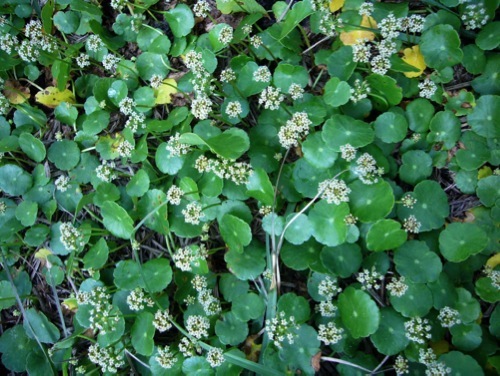
Pennyworts in blossom

A Pennywort For Your Thoughts

It’s one of those practices of civilization that plants with little flavor or calories — lettuce for example — are esteemed and popular, but, plants that can save your life have herbicides heaped on them. Case in point: Hydrocotyle bonariensis (high-dro-KOT-ill-lee boe-nar-ree-EN-sis) above, and its cousin, Centella erecta, (sen-TEL-la ee-RECK-tuh ).

In fact, a report in the Journal of Natural Medicines, 13 Feb 2008, found two new antioxidants in the Centella asiatica, discussed below, and presumably those are also to be found in the Centella erecta, below.

These perky relatives of the celery clan are prime invaders of southern lawns.  You can’t blame them. Florida lawns are nearly perfect conditions: Sunny above, damp below with only decapitated grass for competition. That’s a pennywort’s definition of heaven, or a coinwort’s definition. It’s also the dollar weed’s idea, too.  These “moneyworts” have many names and cash attached to their name, in more ways than one:  You can buy them in powdered form in the health food stores; as tea or soda in Asian markets, or on their produce stand; as a side dish in an Asian restaurant; or, change under your feet.  In fact, I win a lot of bets with pennyworts: It makes a lot of cents for me.

I learned long ago at social functions not to mention I’m a writer because someone always thinks their life story is fascinating and will sell millions of books if I would only write it, payment out of the proceeds, of course.  I’ve actually thought of telling people my occupation is robbing banks: I set my own hours, get to travel, I’m home on the weekends, I meet interesting people, the pay is good , I have federal holidays off and the vacations are long…. Anyway, every time I say I know a thing or two about weeds and can find something to eat in almost anyone’s lawn that is often followed by “prove it.”  In our manicured, raked and landscaped suburbs, the pennywort usually saves the day.  It may also save lives.

Plants are natural chemical factories. These weeds have a chemical, like celery, that helps the aorta and  blood vessels relax. They do that by increasing the amount of nitrous oxide available and that can lower blood pressure.  In India, Centella has been used for that purpose for some 3,000 years. Nice of modern science to confirm it.  The plant has a host of other properties as well from affecting blood cell development to wound care to reducing edema. It’s a little plant that can. By the way, Centella means “little coin” because the leaf surface is shiny and reflects light (and why all of the money names.) Erecta is upright. Hydrocotyle is from Greek meaning flat cup — the leaves can hold water — and Bonariensis translates into “of Buenos Aires” which is another way of saying South America, where they thought it came from originally.

The most common is the native pennywort, the round Hydrocotyle bonariensis, and the main lawn interloper. It’s about the size of a silver dollar under good conditions. Its stem attaches to the center of the leaf. Next is its close cousin, the Marsh Pennywort, or Hydrocotyle umbellata (um-bell-AY-tuh  which means with umbels.)  Equally edible, one often sees wading limpkins running across the top of floating masses of Marsh Pennywort, hoping to turn bug into bird. The Hydrocotyle bonariensis and Hydrocotyle umbellata are similar in appearance except the latter can easily grow far larger.

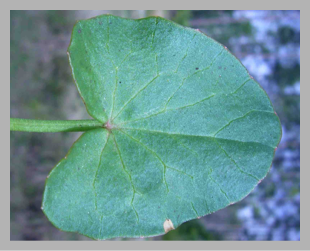
Centella erecta

The Centella erecta is smaller than either and less common. Its one leaf is shovel- or heart-shaped and the stem is attached off center. This particular wetwort used to be called Centella asiatica (from Asia)  but geneticists say the Centella in the southern United States is not exactly like the Centella in southern Asia, but they are so close only geneticists can tell them apart, or care to.  While not a native, Centella erecta has been in North America for perhaps thousands of years, hitch hiking on the feet of wading birds they think. Incidentally, Hydrocotyle mexicana is also edible.

In Asian cooking the Centella is often called Gotu Kola. It‘s used, for example, as a leafy green in Sri Lankan cooking. As the dish “mallung” it is a traditional accompaniment with rice and curry. It’s also served with vegetarian dishes such as parippu.  Charmaine Solomon, author of the Encyclopedia of Asian Food, says the Centellas:

“… have a slight bitter tang and are good to eat combined with shallots and lightly seasoned. Another way this leaf is taken is as a sweetened beverage. Look in the refrigerator section of large Asian grocery stores and there, among the canned soft drinks featuring tropical fruit juices, you will also find pennywort drink. The canned version does not appeal much in colour or flavour; but the drink made with fresh pennywort leaves is entirely different and very refreshing. Frothy and bright green, its piquant herb flavour sweetened by the addition of sugar syrup and poured over crushed ice, it quenches thirst and does you good at the same time. In Vietnamese areas, certain shops make it to order. If you have a supply of leaves, it is easy enough to make at home.”

If you are inclined to nibble some pennywort  or Gotu Kola you should do two things. First, make sure you have someone who knows what they are doing identify them, particularly the Gotu Kola. There are a couple of look alikes in Florida that could confuse a novice. And, more than that, as a water-loving plants they’re quick to pick up and store pollution and bacteria or that pesticide you put on your lawn. Collect them from clean places.

And penultimately, in folklore pennywort tea supposedly helped one Chinese master live to 256. It also helped a king fulfill his husbandly duties to his 50 wives….. That should make it disappear from lawns. Recent research says eating Gotu Kola right after a nuclear blast — as little as two leaves for an adult — will protect your DNA from radiation damage.

Pennywort Salad

From Encyclopedia of Asian Food

By Charmaine Solomon

2 bunches gotu-kola or

about 250 g/8 oz/ 2 cups leaves without stems

3 shallots or

1 small onion, finely chopped

Good squeeze lime or

lemon juice

1 sliced chilli (optional)

75 g/2-1/2 oz/1 cup fresh grated coconut

Salt to taste

1/2 teaspoon sugar

Wash well and strip leaves from stems. Shred finely with a sharp knife, combine with other ingredients and serve immediately. The flavor is slightly sour, slightly bitter. Some people prefer this salad to be lightly cooked, if so bring a tablespoon of water and 1/2 teaspoon salt to the boil in a wok or pan, add all ingredients and toss over heat briefly, stopping before leaves lose their green color.

Green Deane’s “Itemized” Plant Profile

IDENTIFICATION: Hydrocotyle bonariensis, very smooth glabrous, stems slender, creeping; leaves on long slender stems, leave scalloped and stem attached in the middle of the leaf.  With the Centella it attaches on the edge.

TIME OF YEAR: Year round

ENVIRONMENT: Any place wet to damp, lawns, parks, any place kept moist. Don’t collect them from ditches.

METHOD OF PREPARATION: Raw or cooked like any other green. Significant amounts raw can lower blood pressure.

{ 95 comments }