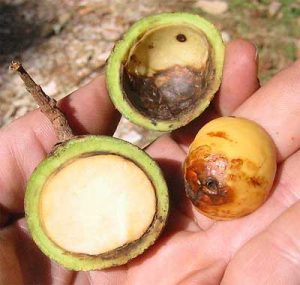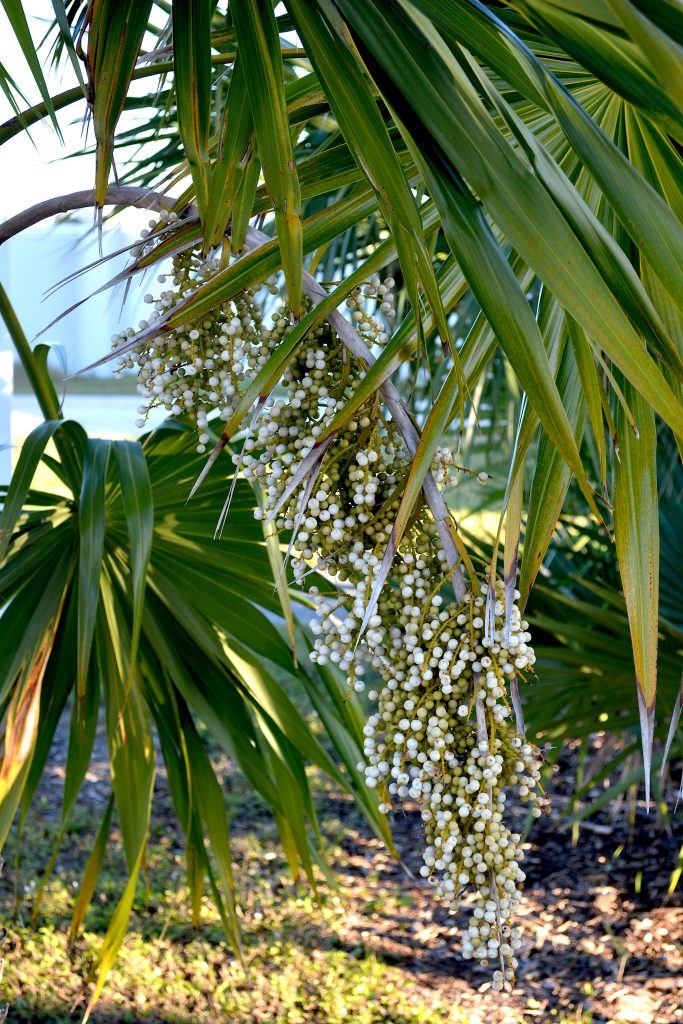
The white fruit of the Thrinax radiata, Florida Thatch Palm. Photo by Green Deane

Almost all white berries are not edible. Is there half-a-dozen on earth that are? It seems we have two in Florida, the White Indigo Berry, and Florida Thatch Palm. 
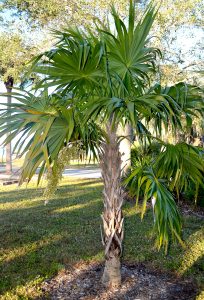
The Florida Thatch Palm might be found more in landscaping than in nature.

On teaching trips to south Florida I saw a palm with small white fruit. Twice I tasted them. No particular flavor but more importantly no burning from calcium oxalates which is usually the first sign a palm fruit is not edible (same with most large-leaf “elephant ears” and the like.)  It is Thrinax radiata, the Florida Thatch Palm, so called because it was used to thatch hut roofs (which also suggests it was more prolific in the past.) Its fibers and netting have been found in pre-Columbian sites on Marco Island. It was used for rope into the 19th century.  On page 670 of Florida Ethnobotany by the late Dr. Daniel Austin he writes: “Fruits are sweet and edible.” Then he says “the fiber has been used to stuff pillows and mattresses.”  Like many palms it’s had several names Cocothrinax martii, C. radiate, Thrinax floridana, T. martii, T. multiflora and T. wendlandiana. It grows on southern coast of Florida, the Florida Keys, Bahamas, western Cuba, Cayman Islands, Jamaica, Hispaniola, Puerto Rico, Honduras,  Nicaragua, the eastern coast of the Yucatan Peninsula in Mexico and Belize. This palm likes it warm. The one I see regularly — planted — is in the southeastern corner of Bayshore Park in Port Charlotte (which in theory is out of its range.)  

Thrinax means “trident” in Greek, referring to the shape of the frond center where the leaves radiate hence radiata.

Green Deane’s Itemized Plant Profile
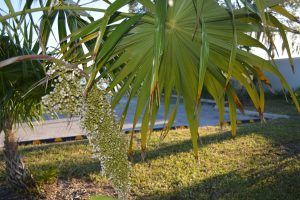
The fronds are circular. Photo by Green Deane

IDENTIFICATION: It’s a slender, slow-growing palm that can reach 30 feet but is usually much shorter.  The trunk is matted with fiber between old leaf bases. The base often has protruding roots. A fan palm it usually has between 12 and 20 frond. Fronds are green above with yellow ribs, lighter green or yellow green underneath with a distinct spear shape protruding from the frond’s center. White fruit. It differs from both the thatch palm (Leucothrinax morrisii, syn. Thrinax morisii) and the silver palm (Coccothrinax argentata) by lacking the silvery white leaf under surfaces. When grown in full sun the canopy is globular. When grown in shade the fronds are widely dispersed with an open-air canopy.

TIME OF YEAR: Fruits continuously but produces the most in the spring. 

ENVIRONMENT:  Salt, wind and drought tolerant. It tolerates high ph. Can survive temperatures down to 26F.  Does not appear to be bothered by Ganoderma Butt Rot. 

METHOD OF PREPARATION: Seed pulp is edible. Its roots and shoots were considered tonic and restorative. 
{ 0 comments }

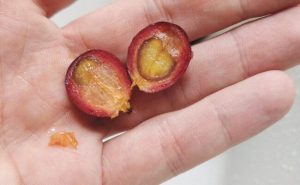
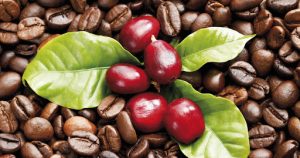
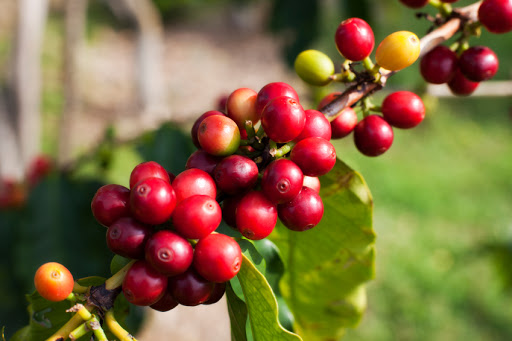
Coffee Cherries are edible and nutritious.

Coffee is a weed? Absolutely and out of control in places like Hawaii and Sri Lanka. More to our point if you ate the Coffee Cherry before you ever head or knew about the beverage you probably would have never roasted the seeds. You would have just eaten the fruit and look forward to it every year.  

It sounds odd to say but sometimes you eat a food that just doesn’t seem like food. It’s not substantial or satisfying. The Coffee Cherry — the fruit the coffee “beans” come from — tastes like real food, substantial. Your pallet recognizes it immediately and says “this we will eat again.” 

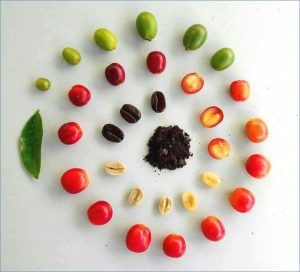
The unripe seeds called green coffee beans  are roasted for coffee.

Actually the fruit can be divided into three parts: The outer skin, the pulp and the seeds (usually two seeds but not always.) The pulp is sweet and contains a small amount of caffein. The skin can be plain or a little bitter though I have not tasted one like that. It actually reminds me of a Cocoplum. Some people don’t like that fruit from a texture point of view. The Coffee Cherry fruit is slightly tough on the outside and a bit slimy on the inside. The pulp can also be dried and made into a “flour” that is used more like a seasoning than a flour. As millions of pounds of it are thrown away every year they are trying to find ways to use it. It’s full of polyphenols most of which is chlorogenic acids, ten times greater than what you get from the beverage 

The Coffee Cherry itself has 144.9 calories for 100 grams. That delivers 51 grams of fiber, 425 mg of calcium, 333 mg of magnesium, 49.6 mg of iron, 15.7 mg of sodium, 530 mg of caffeine and 22 mmol of antioxidants.  We see them in my foraging classes in Orlando and West Palm Beach.

Coffee Cherries: Good food or pulp fiction?

Not only can you grow your coffee you can grow decaf. One strain of C. arabica naturally has very little caffein. The usual C. arabica has 12 mg of caffeine per gram of dry mass this strain has 0.76 mg per gram but the same flavor. Coffee was originally grouped with Jasmines because of the flower’s aroma. And you can make a tea out of the leaves which also has some caffeine. The plant is native to a strip across the widest part of Africa. The drink has been made for perhaps 600 years. 

The genus Coffea is new Dead Latin for Coffee. The word “Coffee” came from the Dutch ‘koffie” which came from the Ottoman Turk’s “kahve” which came from the Arabic “qahwah” which referred to a type of wine really meaning a beverage that could make you less hungry and or give you energy. Arabica is from the Greek Arabikos meaning Arab or Arabian. Canephora is from the Greek Kanephoros which means basket carrying.  The Caryatids — maidens — carried a basket on their heads holding sacred objects for feasts and the like.

Green Deane’s Itemized Plant Profile

IDENTIFICATION: A shrub or small tree to 30-some feet. Open branches, well-spaced. Leaves are opposite, simple elliptic-ovate to oblong, four inches long,  long, glossy, dark green. The flowers white, in axillary clusters. The seeds are a round drupe like an olive but with two seeds, ripens to bright red or purple. 
TIME OF YEAR: In some areas year round, in other seasonal often in winter. Locally in the fall. Do you live where it doesn’t freeze and you want a shrub that you can plant in the shade? C. arabica is a good candidate. 

ENVIRONMENT: Likes it cool and elevation but many coffee plantations are in warm areas and at sea level. 

METHOD OF PREPARATION: Fruit out of hand or prepared in various ways or dehydrated. Tea from the leaves.  

{ 3 comments }

Dulse for Dinner

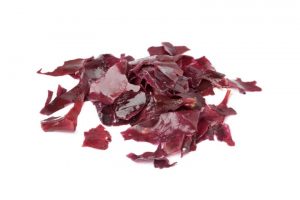
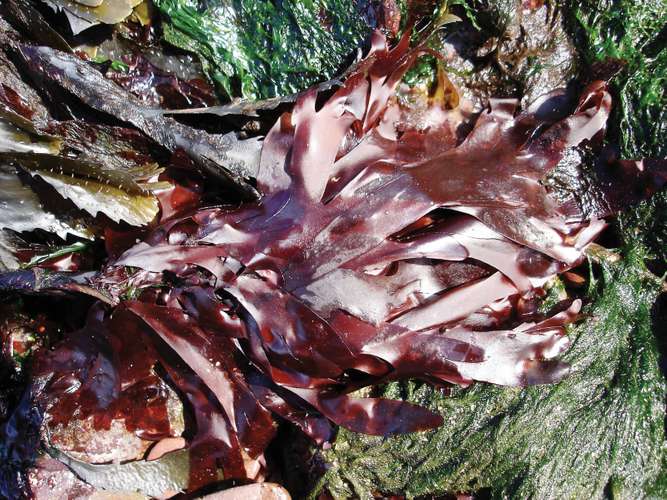
Dulse is full of Iron and Vitamin B12

Foragers tend to ignore seaweed. Granted you need to be near the shore but they are often low on the list when they can be so nutritious. They apparently aren’t alone: In Native American Food Plants by Daniel Moerman he lists only one group, “Alaska Native” as consuming Dulse. Eating it on the northeast coast seems to have been mostly by immigrants from the British Isles who traditionally ate it back home.

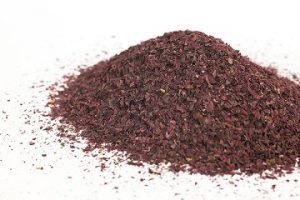
Dulse powders and stores well.

I grew up four miles from the sea and saw Dulse often. Indeed, my mother as a kid rowed around most of the islands off southern Maine from Brunswick to Portland as did I as a teenager.  I used to go sea bass fishing with an old story-teller named Hap Davis. He couldn’t swim and I often wondered what we would do if we ever sunk. The water’s perpetually cold and the islands always too far away.  

Moerman writes Dulse “…leaves air dried and stored for winter use… added to soups and fish head stews… eaten fresh or singed on a hot stove or griddle.”  If I remember correctly one saying of northwest natives was: “When the tide is out the table is set. “  And when these shore-dweller ate Dulse what did they get? A huge serving of potassium, some 7,000 mg per 100 grams dried. Said another way dry Dulse is 7% potassium. 

Immigrants were fond of Dulse as they ate it in the British Isles.

Nutty-flavored here’s the rest of the nutritional line-up dried: Calories 323, protein 19.1 grams, carbohydrates 59.5 grams, fat 0.6 mg, vitamin C 4.8 mg, and vitamin A 2 IUs, Chlorine 7500 mg, sodium 1740 mg, magnesium 450 mg, calcium 375 mg, phosphorus 360 mg, zinc 71.1 mg (quite high as is) iron 11 mg, manganese 4.5 mg, and copper 4 mg. The B vitamins are B1 (thiamin) 0.23 mg, B2 (riboflavin) 0.76 mg, and B3 (niacin) 5.4 mg.  Fresh there are some variations: Protein 1.8 grams, carbohydrates 6.1 grams, vitamin C 38 mg, and vitamin A 285 IUs. Chlorine 1306 mg, magnesium 60.1 mg, calcium 48 mg, zinc 0.8 mg, manganese 0.6 mg, copper 0.2 mg, and molybdenum less than 0.1 mg. The B vitamins are B1 (thiamin) 0.63 mg, B2 (riboflavin) 0.51 mg, and B3 (niacin) 0.2 mg. While there are more minerals dry there is far more vitamin C fresh. Some nutritionists, which we got along without for a very long time, say Dulse has the most iron of all food.

A USDA page for Dulse nutritions says 100 grams (we’ll presume dried) has 22500 mcg of iodine which is 22.5 mg or nearly a quarter of a gram of iodine which is a lot. It also has 6666.67 mcg of vitamin B12 which is 6.66 mg still a lot. Your daily need is 2.4 mcg.  A little dried Dulse daily would fit that need. Laver and Sumac, elsewhere in this book, also provide vegetarian sources of B12.

Palmaria (paul-MARE-ree-ah) means “deserving of a palm” that is outstanding, masterful, good. Palmata (paul-MAH-tah) is hand-shaped.  Dulse in English is Dead Latin through Spanish. It means sweet smelling or sweet scented. 

Green Deane Itemized Plant Profile

IDENTIFICATION: Rosy to reddish-purple, to a foot and a half long, grows from tiny disk-shaped foothold. Fronds thin, stretchy, irregularly lobed, kind of resembles a hand in shape. 

TIME OF YEAR: Late spring to November. Tides are usually lowest at either new or full moons. 

ENVIRONMENT: On rocks and shells from middle to sub-tidal zones in very cold to temperate waters, both hemispheres, in North America both northern coasts.  

METHOD OF PREPARATION: Fresh or dried (and unlike Laver, elsewhere in this book, Dulse is not rinsed before drying.) Use is salads to soups, dried added to relishes to bread, deep fried or ground into a powder for seasoning. 

{ 0 comments }

Wild Avocados

When avocados ripen is semi-predictable. Photo by Green Deane

Wild Avocados

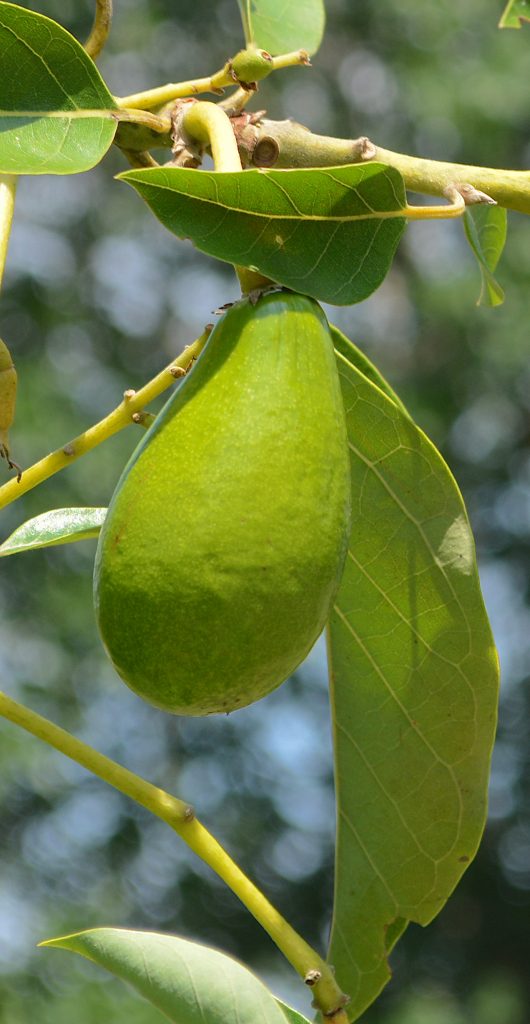
Yes, there are wild, weedy avocados. They have a huge seed and thin pulp. The Aztec did not eat the seed nor should you. 

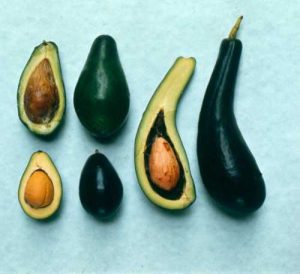
Actually there are several varieties of avocados and given a chance they will sprout from seeds. The majority of avocados I eat are from trees here and there not under cultivation. While there are some four dozen or more species of avocado perhaps the truest wild form today is Persea schiedeana. 

Wild avocados have huge seeds. Wild chimpanzees don’t eat them.

Called “aguacate de mono” or Monkey Avocado (and many other names) they range from ping-pong to baseball size, 100 grams to 450 grams. The seed is huge, the pulp is small. Like all avocados it does not ripen on the tree however it ripens quickly and can go bad within five days. In southern Mexico, Guatemala, El Salvador, Honduras, and Belize, the pulp is popular food and spread on tortillas and used in bean soup.

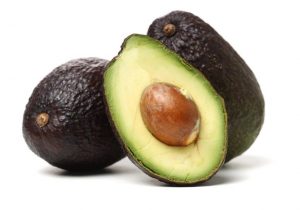
That said the Hass avocado — the small, wrinkly black one — is about 6.5 times the production of all the other varieties/species all together. But I don’t find naturalized Haas avocados so we’ll us the nutrition from a small green fruit like a Fuerte which is what I forage. 

Hass avocados outsell all other kinds put together.

Per 100 gram serving there is 120 calories, 2.34 grams of protein, 10 grams of fat, 5.6 grams of fiber 2.17 grams of glucose and a very tiny amount of fructose.  The minerals are potassium 351 mg, phosphorus 40 mg, magnesium 24 mg, calcium 10 mg, sodium 2 mg, zinc 0.4 mg, iron 0.17 mg, copper 0.311 mg, and manganese 0.095 mg. Vitamin C is 17.4 mg. The amount of B vitamins are small: B1 (thiamin) 0.021 mg, B2 (riboflavin) 0.053, B3 (niacin) 0.672 mg, B6 (pyridoxine) 0.078, pantothenic 0.931 mg, and folate 35 mcg. Beta carotene is 53 mcg, which is 140 IUs of vitamin A. There is some vitamin E, 2.66 mg. 

The avocado of the Aztecs, P. drymifolia, is quite different.

The Aztecs used anise-smelling avocado leaves for flavoring. They wrapped food in the leaves of P. americana drymifolia (PER-see-uh uh-mair-ah-KAY-nuh drim-if-OH-lee-ah.) As for drying and eating the pits… the Aztecs, no matter how hungry, did not eat the pits. My speculation is it interferes with the gut biome and made them ill but they didn’t know why. Persea is the name giving to some unknown ancient tree in Greece that was thought to have come from Persia.  Americana the american, Drymifolia is forest leaf or sharp/stinging/biting leaf. Schiedeana (she-dee-ANN-ah) commemorates German botanist Christian Julius Wilhelm Schiede (1780-1836) who collected plants in Mexico from 1828 to his death in 1836. A Tillandsia is also named for him.  

Green Deane’s Itemized Plant Profile

IDENTIFICATION: There’s huge variety with three “races” and 50 varieties. They are an evergreen tree with glossy leaves that can be 10 to 60 feet depending on which one, it can be low and symmetrical to tall and asymmetrical. The fruit can be black, green, and purple, round, oval, and pear-shaped. 

TIME OF YEAR: Depends on species and location. Different species in different climates can provide almost year-round production of fruit. 

ENVIRONMENT: This also varies with the variety. Some are more salt tolerant than others, some more cool tolerant. Sun, rich well-drained soil and water makes them all grow well. 

METHOD OF PREPARATION: A wide variety of ways from raw to used in cooked dishes.  Wild 

{ 1 comment }

Redflower Ragweed

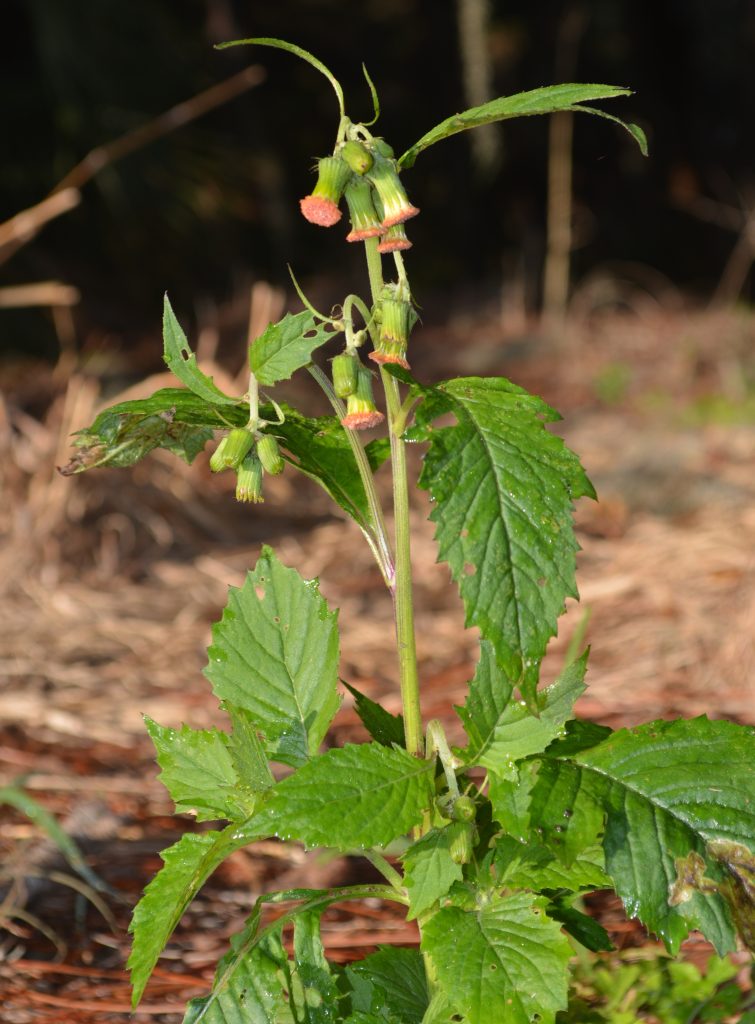
Redflower Ragweed. Photo by Green Deane

The first time I saw Redflower Ragweed I thought I was seeing two species at once some weird combination of Tassel Flower and Fireweed. It’s way too big and has the wrong leaves to be a Tassel Flower but the blossoms remind one of a Tassel Flower but the rests of the plant looks life Fireweed/Burnweed.  

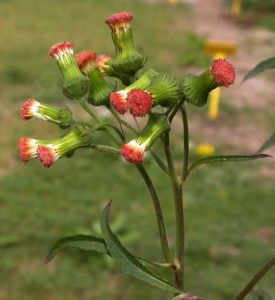
The blossoms do resemble the Florida Tassel Flower.

Redflower Ragweed isn’t a “ragweed” as most North Americans know the word. The common ragweed that launches a million sneezes annually is Ambrosia artemisiifolia. Redflower Ragweed is not an Ambrosia.  It is Crassocephalum crepidioides (kras-oh-SEF-uh-lum krep-pid-dee-OY-deez.) Crassocephalum is from the Dead Latin “Crassus” meaning “thick” and “kephale” which is Greek for head. Crepidioides is more mangle Greek. “-oides” in Dead Latin is mispronounced borrowed Greek and means “resembles.” Crepidioides means “resembles Crepis.” Crepis is from an old Greek word for a frilly funeral veil. It works its way into English via French as “crepe” paper.  So “thick head resembles crepe paper” is one way to interpret the plant’s name.” And even though it is called the Redflower Ragweed its leaves more resemble Fireweed/Burnweed, Erechtites hieraciifolius (which is an even more complicated, naughty story.)

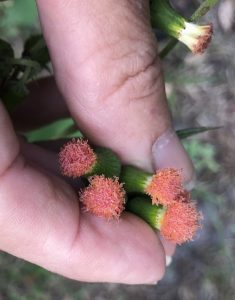
The petalless blossoms are not edible. Photo by Green Deane

This edible shows up in our winter time and lasts until spring or so. I’ve seen it in Largo but this weekend noticed it in Sarasota. It’s actually attractive as weeds go. Cornucopia II says of Crassocephalum crepidioides on page 37: “Ebolo, Okinawan Spinach, Young leaves and shoots are used as a potherb, fried, or mixed in Khao yam. The leaves are fleshy, tinged with purple and have a somewhat mucilaginous quality and nutty flavor. Has become quite popular on the island of Okinawa and in Hawaii In Thailand, the roots are eaten with chili sauce or cooked in fish curry. Tropical Africa. Cultivated.”

Nutritionally the plant is very high in potassium but also sodium. Its relative C. rubens (red) is also edible and higher in nutrition. 

Green Deane’s Itemized Plant Profile: 

IDENTIFICATION: Erect, sparsely branched, aromatic to 40 inches (100 cm.) Stem ribbed, leaves spiral around the plant, red cylindrical flowers, no petals, which droop as if the plant were low on water.

TIME OF YEAR: In warmer climes in the winter.

ENVIRONMENT: Where ever crops can grow. 

METHOD OF PREPARATION: Leaves and young stems cooked.  

{ 5 comments }