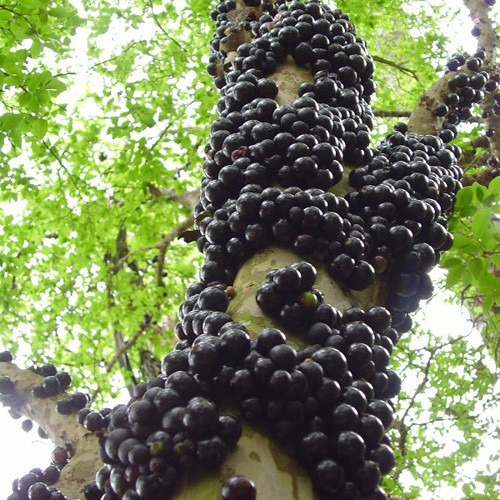
Jabuticaba fruit grows on the trunk and limbs of the tree.

In its native Brazil the Jabuticaba is by far the most popular fruit. The Dutch knew about it in 1658. Jabuticaba made it to California by 1904. It’s a common ornamental and there are many cultivars” Sabara, Paulista, Rajada, Branca, Ponhema, Rujada, Roxa, Sao Paulo, Coroa, Murta, and Mineira.  

Per 100 grams Plinia cauliflora fruit has 45.7 calories, 0.11 grams of protein, 0.08 grams of fiber, 0.01 grams of fat and 12.58 gams of carbohydrates. Vitamin A is absent but it has 22.7 mg of vitamin C which is about a third of your daily need. The B vitamins are B1 (thiamin) 0.02 mg, B2 (riboflavin) 0;02 mg, and B3 (niacin) 0.21 mg. Two minerals are reported: Calcium 6.3 mg and phosphorus 9.2 mg. 
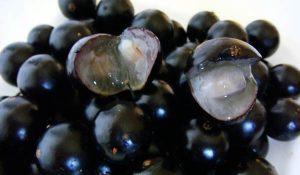
Called Myrciaria cauliflora a second name for the species is Plinia cauliflora.

It’s a short tree planted in warm areas of North American and a common ornamental in Florida and the Gulf Coast. One is reported to sustain an 18F freeze and continued to thrive and fruit. Jabuticaba means “like turtle fat” referring to the fruit pulp, or, it means “tortoise place.” Take your pick.  Myrciaria is from the Greek myrike (μυρίκη) which was the  Greek name for the “tamarisk” a tree that is aromatic. In English it means Myrtle. Cauliflora means cauliflower-like. Plinia is Dead Latin for filled, full, rich, whole, perfect, well-equipped. You might remember from history Pliny the Elder and Younger. 

Green Deane’s “Itemized” Plant Profile

IDENTIFICATION: Slow-growing tree, shrubby, usually not more than one two yards, profusely branched starting close to the ground, thin outer bark that flakes, evergreen leaves, glossy, leathery. Fruit on trunk and branches. Round or pear-shaped, tough skin, ranges from bright green to dark purple appearing to be black, slight muscadine grape flavor can be astringent. Pulp gelatinous, juicy, translucent all-white to light rose in color clinging to the seeds. Untrimmed trees fruit the best. The one you will see locally is probably the Sabara. From flower to fruit is four to five weeks. 

TIME OF YEAR: All year in warm areas but heaviest in March  and April or September. In some areas they fruit twice a year. 

ENVIRONMENT: Jaboticaba grow best on deep, rich, well-drained soil but also grow and bare in sand over  limestone. If you are going to plant some they should be 30 feet apart. They tolerate light freezes. 

METHOD OF PREPARATION: Out of hand. Squeeze the fruit between your thumb and forefinger. It causes the skin to spilt making the pulp easy to get at. The seeds are edible but not usually eaten. Once harvested they ferment quickly. They can be made into wine, jelly and jam how much skin to remove is a matter of personal preference as they have tannins. 
{ 1 comment }

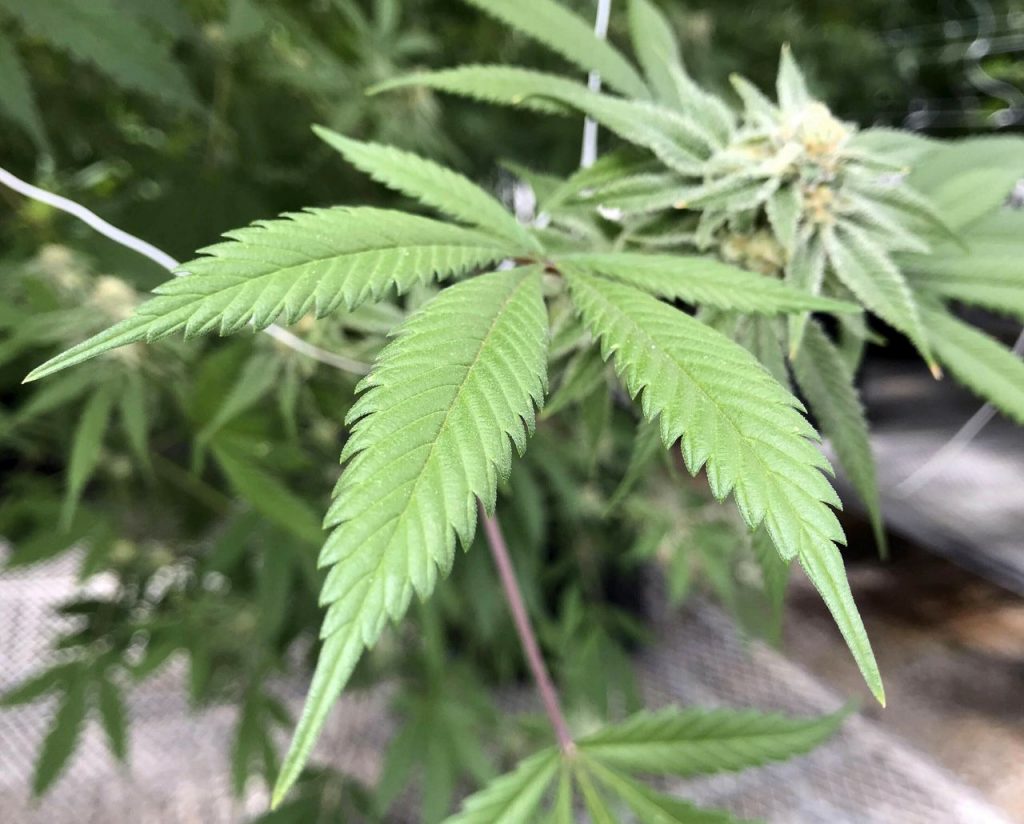
You can’t rummage around the woods as a forager without running into someone’s marijuana patch. Locally the most likely place to find said is on spoil islands, the ones created by dredging. Kids row out, have a party and toss away the seeds. What is not surprising those abandoned seeds grow into plants the kids don’t recognize as the same plant they are smoking. 
We don’t have a full nutrition panel for Marijuana, Cannabis sativa… yes it does have some nutrition. A 1991 book on indigenous diets reported 100 grams of seeds has a whopping 421 calories, 27.1 grams of protein, 27.6 grams of carbohydrates, 25.6 grams of lipids, 20.3 grams of fiber, 2.1 mg of B3 (niacin) 0.3 mg of B1 (thiamin) 1.7 mg of B2 (riboflavin) and half an IU of vitamin A. On the mineral side it has 970 mg of phosphorus, 12 mg of calcium, and 12 mg of iron. 

Actually the seeds are achenes and were cattle food in Europe after oil extraction. Most seeds contain 30% oil, according to a report in the 29th edition of the Journal of Economic Botany, July-Septmeber 1975. The oil was called “oleifera” which is now confusing as an important food tree has the same name, Moringa oleifera (elsewhere in this book.) 

The plant was originally put in the Nettle family then the Mulberry group and later Hops. Some think it might be related to Elms. The genus “Cannabis” comes form the Greek word κάνναβις (kánnavis.) That probably was Scythian or Thracian and most likely was borrowed from the Persian Kanab and (as is often the case) that probably came from India. Sativa is Dead Latin for “cultivated.”  While those in India and China long ago knew about the drug properties of the species the Greeks did not nor the Egyptians or Hebrews. There exists some hemp cloth from China that is perhaps 6000 years old. It was first cultivated in the Americas in 1545 in Chile, Nova Scotia in 1606 and 1632 in the Puritan settlements of New England. Among that study’s finding — they grew an experimental plot in Ottawa — was that fiber hemp can also contain drug properties.  

Green Deane’s Itemized Plant Profile

IDENTIFICATION: Needs no identification.

TIME OF YEAR: Summer in cold climates, year round in warm. Male plants die after shedding pollen, female are killed by frost. In cold Ottawa — for science — they grew 900 pounds on a half acre.

ENVIRONMENT: Like most plants sun, water, good soil. Despite it chemical armaments it can suffer from insect predation.  

METHOD OF PREPARATION: Numerous. 

{ 3 comments }

Black Calabash

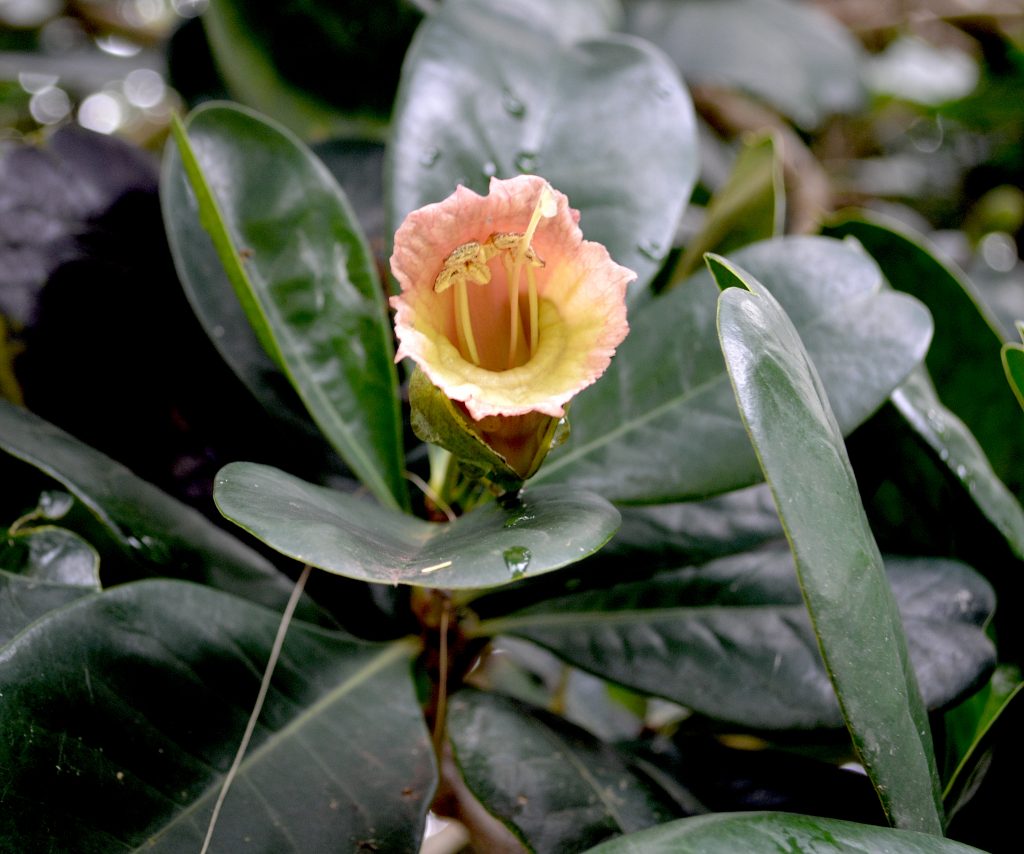
The blossom of the Black Calabash. Photo by Green Deane

It started with spotting a blossom while teaching a foraging class. There are so many edible plants that one is constantly learning. You can walk past one dozens of times before you notice it for some reason such as fruiting for the first time in your presence or in this case blossoming.

Fruit of the Black Calabash Tree

The location was a park that was designed and crafted close to a century ago by one county employee without a plant budget. So species were begged, scrounged and rescued from trash heaps from all over the place. One never knows what one will find in 100-acre Dreher Park though I doubt anything poisonous was intentionally planted there. 

A student asked what was the tree as it was blossoming. It was a large, dark-leafed tree with distinctive flowers. I had walked past that tree couple of dozen times over the last 14 years or so.  I admitted I did not know. After a few fits and starts Black Calabash seems right, Amphitecna latifolia (and if so it might be the most northern one identified in the state as there is a stand of them some seven miles south on the north end of Lake Worth. ) 

Reports vary on edibility. Most agree the black seeds are edible. One book, A Field Guide to Plants of Costa Rica, says the spongy white pulp is edible but does not mention the seeds which makes me cautious (in that the authors might confuse edible seeds for edible pulp.)  Other reports say the tree does not fruit often unless the blossoms are intentionally pollenated. We do know the skin was dried and used like cups. 

The blossoms get pollenated by chance.

Why doesn’t the tree fruit more often?Apparently it is pollenated by nectariferous bats of which there are none locally so birds do it accidentally. (I’m going to take some cotton swabs with me from now on and stimulate some blossoms.) Whether the tree is native or not is a botanical debate. Some think it is a critically imperiled native and others think it’s an exotic thankfully about to die off… and here you thought botany was mild-mannered and sedate.   

Amphitecna (am-fee-TEK-naw)  is from two Greek words, Amphi (all-around, on both sides) and teknos which is  “craft” or “skill.” Perhaps it takes a knack to open the fruit. Latifolia (lat-ih-FOLE-ee-uh) in present-day botany means broad leaves. In Greek it means “star hairs.” No, I can’t explain the difference. I blame drunk botanists. 

Green Deane’s Itemized Plant Profile

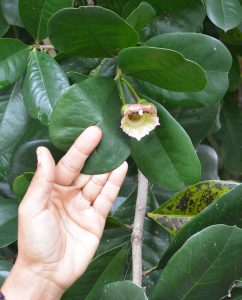
IDENTIFICATION:  Upright, densely-foliated, evergreen tree to 30 feet, dark-green, glossy leaves to seven-inches long,  two-inch long, purplish-white tubular flowers followed by shiny green, four-inch long fruit with a thin hard shell. 

TIME OF YEAR: Continuous.

ENVIRONMENT: High hammocks, well-drained, good soil. Full sun, little shade.  It will grow on shell mounds. Not salt-tolerant and subject to wind damage. Blow over easily. 

METHOD OF PREPARATION: Seeds are edible.  Opinions vary on the edibility of the pulp. The University of Florida states the fruit is “suited for human consumption.”

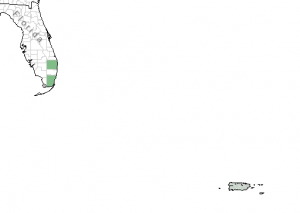
Distribution of the Black Calabash, south Florida to the Virgin Islands.

{ 0 comments }

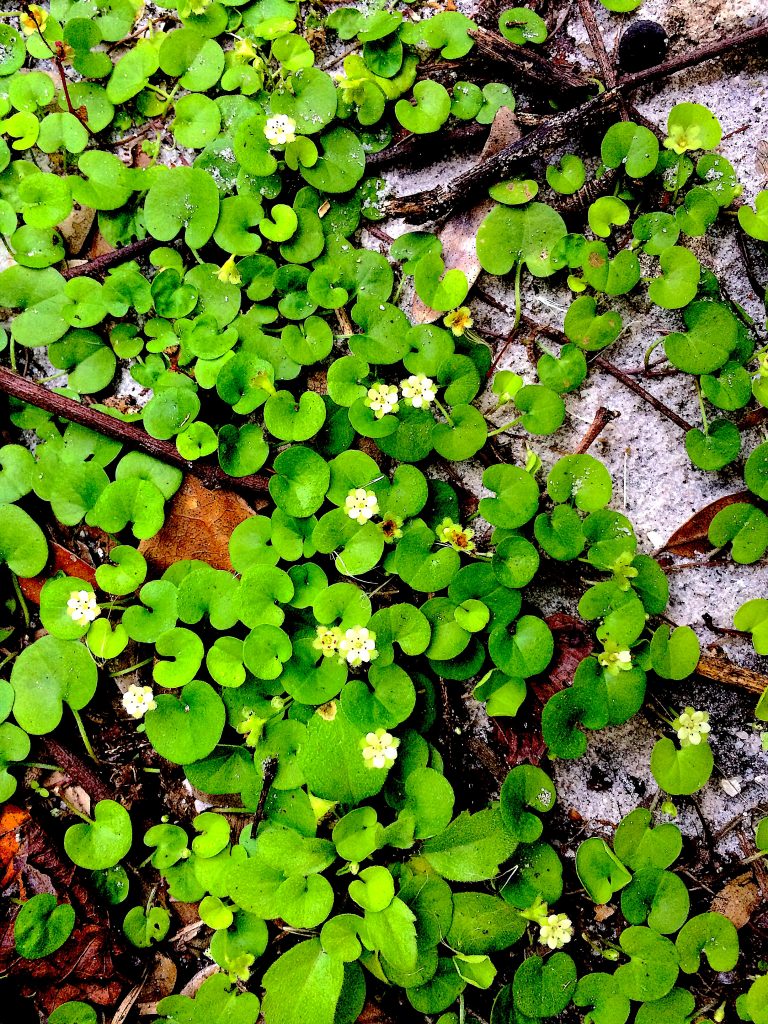
Pony Foot in blossom. Photo by Green Deane

Are they edible? 

That is often asked about a little lawn plant called Pony Foot, or Dichondra carolinensis. I think they are bitter and medicinal, others toss them into salads. My herbalist friends call them a “liver tonic.” But, since they are bitter it is better to mix them with other greens — as one does chicory — rather than using them as the main ingredient. 

Pony Foot might have antibacterial properties. Photo by Green Deane

This underfooter spreads by means of runners and they taste a lot better without the runners.  The species is also used as a ground cover in shade. I’m not sure why the plants were called Dichrondra which means two hearts. Reni– or nephri— (meaning kidney shaped) would have been far better. Its leaves do alternate but they are far more kidney-shaped than heart-shaped. They are also have a slightly off-side funnel shape (a basal notch.) Usually dime-size I have seen them more than an inch across. Pony Foot is often found with two other edibles, Dollarweed, which has a stem attached to the middle of the leaf, and Gotu Kola which has a spade-shaped leaf but rounded teeth on the margin and the stem is hairier.

A 1905 report suggested that Pony Foot extract with glycerine was good against bacteria associated with diphtheria.

Green Deane’s Itemized Plant Profile 

IDENTIFICATION: Low-growing, leafs dime to half dollar size, kidney-shaped with the stem forming a slight funnel indentation on one side, blossoms white

TIME OF YEAR: All year in the warmer areas of its range, spring to fall in the cooler climes.

ENVIRONMENT: Lawns or under spreading trees. Likes open areas or near water .

METHOD OF PREPARATION:  Edible raw, can be cooked, as a tea (dried and concentrated) is said to be medicinal. 

{ 0 comments }

Oyster Mushrooms

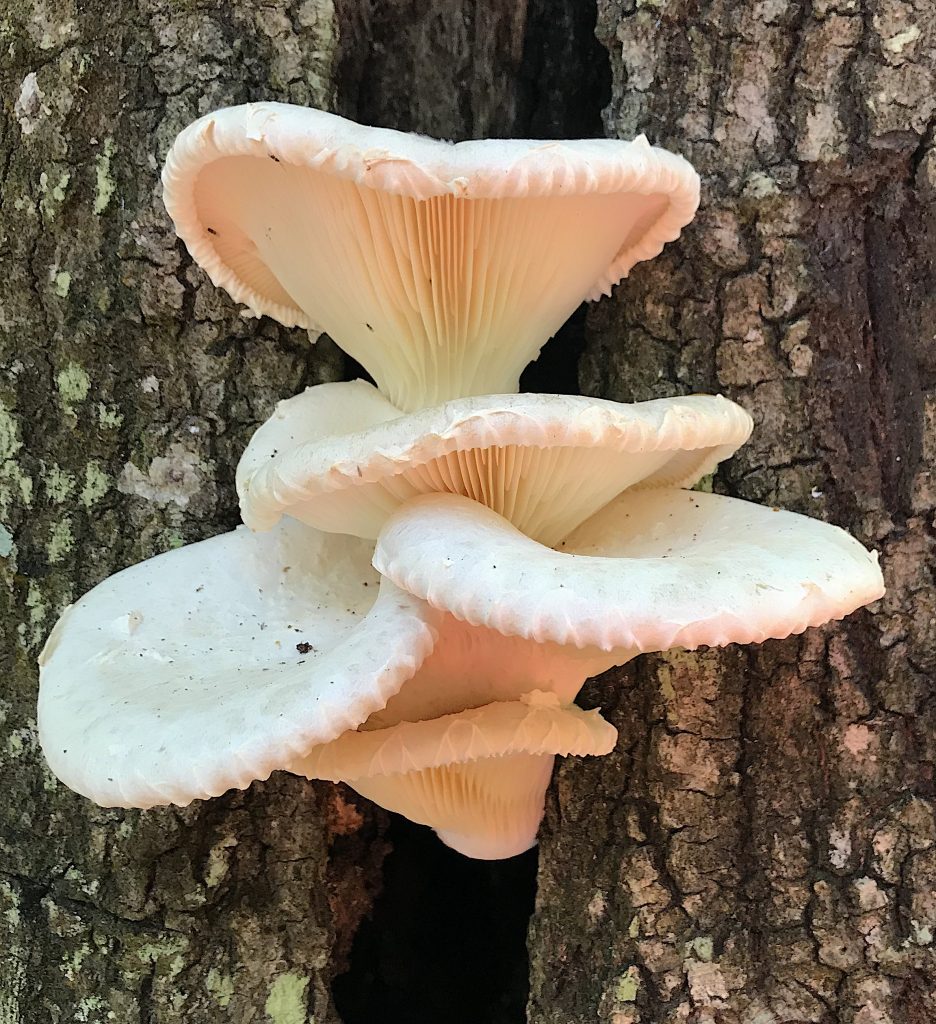
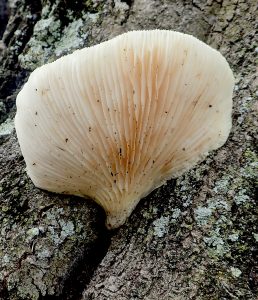
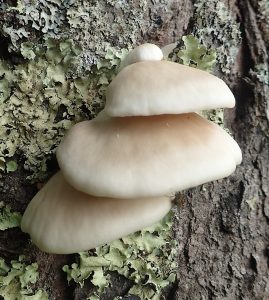
Oysters Mushrooms are often prolific. Photo by Green Deane

Oyster Mushrooms fall into that category of a wild food so good that it’s also cultivated. It is also one of the six to eight fairly mistake-proof mushrooms for folks to hunt for. There are several edible species. As with any mushroom and indeed any wild plant, check with a local expert first. 

These tend to be cooler weather fungi. I find them on dead or doomed hardwood trees, usually oak. They’re called Oyster because of their shape not taste. They’re about the size of an oyster shell (which I dug a lot as a young man in the mud flats of Maine.) They also usually have a gilled stem that is off set.  It is rare for me to find one or two Oyster Mushrooms. Usually there is a whole tree trunk of them. The exception are occasional solitary species in warm weather growing palm stumps. 

If they have a stem it is usually off-set. Photo by Green Deane

Curiously mushrooms are more closely related to humans than plants. They make vitamin D, one reason to eat them. And things that bother us can bother them so if they are healthy there’s probably no bad environmental toxins involved. As for nutrition 100 grams of fresh oyster mushrooms have 33 calories, 3.13 grams of protein, 0.41 grams of fat, 6.09 grams of carbohydrates and 2.3 grams of fiber. There is 1.11 grams of sugar and it is glucose. No vitamin C reported and barely any vitamin A, 2 mcg RAE or 48 IU. Vitamin D, however, is 29 IUs of vitamin D (0.7 mcg of that D2.) The B vitamins are B1 (thiamin) 0.125 mg, B2 (riboflavin) 0.349 mg, B3 (niacin) 4.956 mg, B5 (pantothenic acid) 1.294 mg, B6 (pyridoxine) 0.11 mg, folate 38 mcg, choline 48.7 mg, and Betaine 12.1 mg. The minerals are potassium 420 mg, phosphorus 120 mg, sodium and magnesium 18 mg, calcium 3 mg, iron 1.33 mg, zinc 0.77 mg, copper 0.244 mg, manganese 0.113 mg, and selenium 2.6 mcg. 

Oyster Mushroom also have ergothioneine an antioxidant which might decrease inflammation. They also have lovastatin. Pleurotus ostreatus means “sideway oyster” a reference to the general shell shape and the stem or pseudo-stem usually to one side. Two others we see are Pleurotus pulmonarius and Pleurotus populinus. (Lung shape and inhabiting populars.) P. pulmonarius can be seen in warm weather and P. populinus likes populars.)  

Green Deane’s Itemized Plant Profile

They like hardwoods, usually oaks. Photo by Green Deane

IDENTIFICATION: Shelf-like clusters, usually numerous, kidney or fan shaped or nearly round mushroom to six inches across, can be greasy when young, pale to buff, edge can be rolled in some, gills run down the short stem or pseudostem or no stem, gills are close. Spore print white to lightly yellow or lilac. 

TIME OF YEAR: Late fall to spring (though in Florida some species grow on dead palms in the summer.) 

ENVIRONMENT:  on logs, living trees or dead standing trunks. Usually hardwood, occasionally conifers. I have seen them on Magnolia virginiana and Sycamores.

METHOD OF PREPARATION: Cooked any way you like. They have a slightly chewy texture, the flavor ranges from mild to nutty to seafood-ish. Very versatile in the kitchen. They have been cultivated for more than a century starting in WWI.

{ 2 comments }