asdfsdfsdfdf

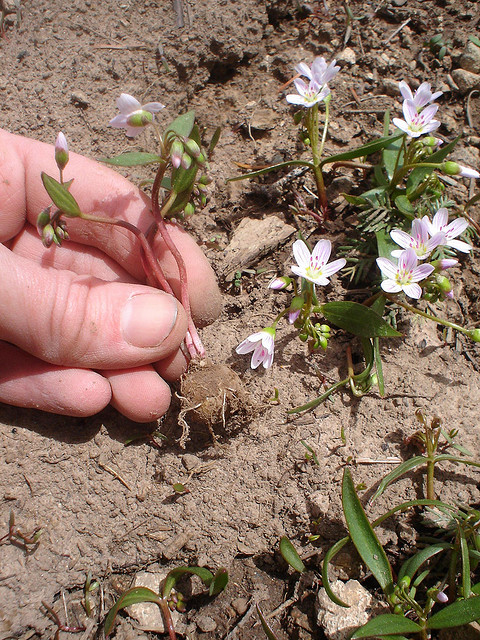
The entire Spring Beauty is edible, root to blossoms. Photo by BushcraftUSA.

The Spring Beauty is aptly named.
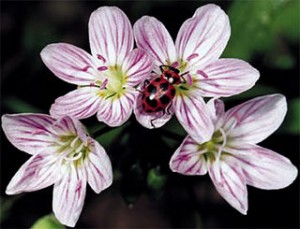
Claytonia virginica

Actually there are several “Spring Beauties” and most of them are edible in similar ways. We’ll focus on Claytonia virginica, a member of the greater Purslane family. It’s found in the eastern two thirds of North America starting with Texas heading north and east, not counting Florida, New Hampshire, Maine and Canadian points east of Maine. Other “beauties” mentioned are found in different areas of North America.
jhgkjhgkhjg

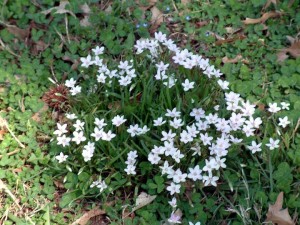
Spring Beauties can be plentiful or rare. Photo by Illinois Flowers.

The Spring Beauty, also Springbeauty, is a longtime standard for foragers. They are abundant in some areas, rare in others. Thus forage with some local consideration. True to its name the attractive wild flower is a sign of spring and easy to recognize from other spring blossoms. The white to pink petals have pink stripes, sometimes pale, sometimes bright, but pink stripes nonetheless. Each blossom also only has two sepals (leaves right under the blossom.) Lower leaves are strap-like varying in size and width. The plant grows small roots that remind people of tiny potatoes, hence the nickname “Fairy Spuds.”  At least one botanist said you can eat them “but their small size makes this rather impractical.” Famous forager Euell Gibbons clearly would disagree.

Euell Theophilus Gibbons 1911-1975

In his book “Stalking The Wild Asparagus” Gibbons wrote about eating them daily if not twice a day for several weeks. He said: “We tried them fried, mashed, in salads, and cooked with peas, like new potatoes. All these ways were completely successful, but, as regular fare, we preferred them just boiled ‘in the jackets.’ My friend grew so fond of this food that he was afraid he would experience withdrawal symptoms when the supply was exhausted.” While Gibbon’s friend thought they tasted like potatoes. Gibbons thought they were sweeter, closer to chestnuts in flavor.

The small roots, or fleshy taproots, of several species were eaten by the natives as well as the leaves. Those species include Claytonia acutifolia (Alaska) Claytonia caroliniana (eastern North America) Claytonia lancelolata (western North America) Claytonia megarrhiza (Rocky Mountains) Claytonia tuberosa (Alaska) and the aforementioned Claytonia  virginica.

John Clayton Memorial in Virgina

The genus is named for John Clayton, 1694-1773, who was a Colonial plant collector and tobacco farmer in Virginia. He came to the “colonies in 1715 to join his father who was an attorney. He became clerk of the courts for Gloucester County, Virginia in 1720, married Elizabeth Whiting and soon after that began to collect plant specimens and have eight kids, not necessarily in that order; three daughters and five sons, some involved in the formation of the United States. Clayton sent many plant specimens but no kids to Europe where the specimens were studied by scholars. In Clayton’s honor, Linnaeus named the Spring Beauty after him.

Green Deane’s “Itemized” Plant Profile: Spring Beauty

IDENTIFICATION: Claytonia  virginica: Perennial three to six inches high with flowers a raceme on the end of stems. Each blossom up to half an inch across, 5 pink-streaked white petals, 2 green sepals, 5 stamens with pink anthers. The flowers open when it’s warm and sunny, close when cloudy or at night. Pleasantly scented. The flower stems are weak, light green or reddish green, smooth. Basal leaves linear or linear-lanceolate, curving back, smooth along the edges, fleshy. Each three to six inch leaf has a single central vein, width varies. The leaves do not have stems. However, the leaves of the C. caroliniana which are ovate, do have a short stem. Roots resemble small potatoes more or less. If you see a lot of blossoms in something of a circle there may be a larger root in the middle. Roots are two to three inches underground.

ENVIRONMENT:  Prefers dappled sunlight in spring, moist to slightly dry conditions, rich friable soil. It can adapt to semi-shaded lawns if not mowed in the spring.

TIME OF YEAR:  This is a bit of an issue. They would be best harvested in the fall but they are hard to find then. And in the spring they use that stored energy to reproduce. You either have to know where they are or catch them in the early spring as soon as they can be identified. March to May.

METHOD OF PREPARATION:  All the parts above ground raw or cooked, roots cooked. Roots can be eaten raw but not the most pleasant of experiences. You also don’t have to peel them but they are better peeled. Gibbon’s “peeled” them by putting them in a basket and putting them under a water fall. A garden hose might work but I’ve never collected enough of them to give it a time-saving try. Peeling can also be easily done after cooking. Because of their size Spring Beauties take a while to collect. They are a treat, not a staple.
{ 16 comments }

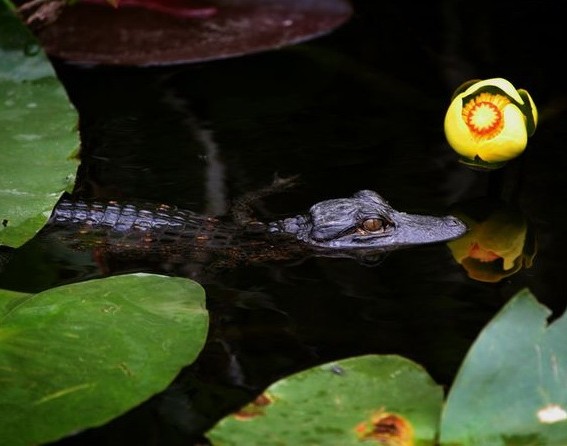
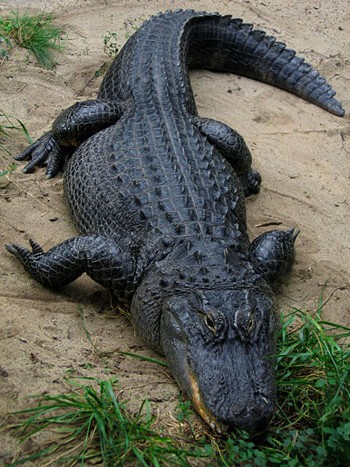
Young alligator swimming among nuphar leaves and blossom.

I caught a small alligator once. I was fishing for bass in a golf course water trap behind an apartment complex in Titusville, Florida (that’s west across the Indian River from the space center.) I had already caught a few bass.

They can run as fast as a horse. Can you?

I was using a six-inch rubber worm, which always worked well for me. I was dropping it on the edge of the pickerel weed. I felt a small tug which is exactly what bass do, then a stronger tug. I set the hook. Then the tug got real strong, nearly pulling the rod out of my hand then nothing. Broken line, I thought, so I started to reel in. It was then I noticed a three-foot alligator swimming towards me. As I reeled in my line it went taut again. The gator had my rubber worm and was returning it, in person. For a moment I entertained tender young alligator steaks… then came to my senses, broke the line and haul my bass out of there.

Another time a friend and I were canoeing up Rock Springs Run in my 18-foot Mohawk when we startled a sunning gator. The alligator made a high jump and a big splash and went under the front of the canoe. As I was in the back some 15 feet away I was not too concerned…  My friend, however, kept his soiled pants as a souvenir.

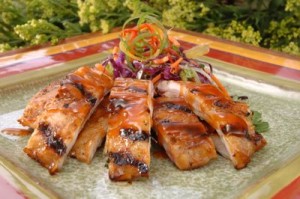
Gator ribs, a favorite at U of F tailgating parties

My last close encounter with the cold-blooded kind came only a couple of years ago. I was kayaking, again, up Rock Springs Run. The run varies, sometimes wide and shallow with no channel, at other times with a ten foot wide and deep channel. I was planning on heading upstream a few miles, turning around, then floating down while videoing plants, and eventually that is what I did. However, while going upstream I noticed two baby alligators floating on a Nuphar root. They were cute, about six inches long. I thought they would make excellent footage for my video.

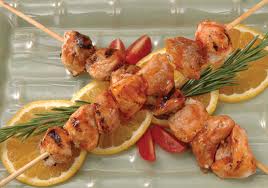
Gator-bobs warm from the grill

Since I noticed them as I passed the easiest thing to do was to stop paddling and just float backwards rather than turn around, let the current take me to them. By chance I happened to be wearing polarizing sunglasses that eliminated glare off the water. As I floated back toward the babies a huge alligator swam under the kayak and stopped between me and the little ones… I decided I didn’t need any footage of baby alligators. Reptilian mothers can be formidable, and she was longer than my kayak.

Not only have I encountered alligators in the wild but in the kitchen as well. I wish I could recommend alligator more wholeheartedly than I can. After all, I live in Florida and have had alligator many times prepared many ways.

Does it have a bad flavor? Not really. Is the texture off-putting? No. People say it tastes like chicken. If that’s the case than the chicken died from drinking a lot of swamp water. Alligator always has, to me, a bit of tooth and swampness about it. To your palate there’s never any doubt as to what you are eating.

Now, don’t misunderstand me. I eat everything, literally. There is no food I won’t eat. I don’t have any off-limit foods. In that regard I’m an easy dinner companion, guest, or co-pizza orderer. I eat everything. If you put a plate of gator in front of me down it goes, pass the Pickapeppa sauce please. These are just my observations about alligator.

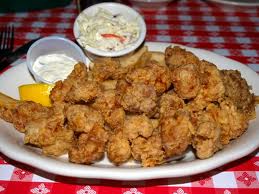
Deep fried gator nuggets and fixin's

The texture is more like our larger game fish, and the flavor is more towards an oily sea fish than grain-fed chicken.  Some “healthy meat advocates” say it tastes like mild white flesh fish, cod and tilapia and the like. I don’t know where they are getting their gator from but no gator I have ever eaten tasted that mild or delicate. Gator and sherry are not made for each other. Gator calls for accompanying flavors and seasonings to have some oomph to them. Marinades are your friend. (If someone introduces me to mild gator meat I will gladly rewrite the previous paragraph.)

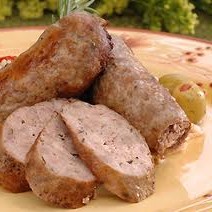
Gator sausage tops bear sausage

That said there are many things to recommend alligator meat. Here is a commercial view of gator meat: A four-ounce serving has 177 calories, beef 244. Alligator meat is 3% fat, beef is 12 though personally I think our anti-fat craze is not healthy. There is also the argument that alligator is more healthy than beef. That might be debatable. If caught in the wild, perhaps. If raised on a farm, perhaps not.  About 100,000 alligators are farm-raised whereas several million run wild from Texas to North Carolina. Louisiana and Florida alone total three million wild alligators. Locally one sees them all the time from golf courses to even walking along the Interstate, and dead on the Interstate.

The state of Florida is not so nutritionally generous. It says a 3.2 ounce serving (smaller than above) has 232 calories, which would make gator meat more caloric than beef. The state also says it is more fatty, 4 grams per 3.2 ounce serving putting it at 4% fat, not 3%. According to the state gator meat is nearly half protein. Alligator meat is usually frozen — cough cough — and sold as ribs, fillets or steaks. The latter two are cut from the tail which is the whitest and most tender of the meat. Other meat leans towards pork in color and texture.

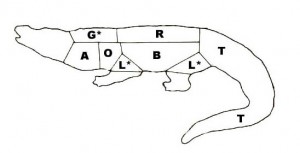
Eight cuts on an alligator, artist couldn't spell

Actually there are eight cuts on an alligator: Top of the neck G (this has to be cubed, stewed or beaten silly with a mallet.) The jaw, A, which is very tender, as is the tail meat, T. The lower neck meat, O, is like the top of the neck, read tough. The backstrap, R,  is tender. The body meat, B, average. Leg meat L must also be beaten into submission.

Mom's protective for a while

As you might surmise tail and jaw meat are the most tender and mild. The rest has to be tenderized, from pounding to cutting across the grain to cubing. Tougher cuts are also ground to make burgers, meat loafs, soups, stews and chili. Marinades can reduce bad flavors and increase desired ones. All yellow fat should be removed before freezing or preparing or you will really taste the swamp.

Americans are already eating alligator, from one to 1.5 million pounds per year at $8 to $10 a pound, not cheap. It is strongly recommended you soak any and all alligator meat in milk three hours before prepping and cooking it.  That reduces the swamp notes.

Alligator Nuggets by Bobby Flay

Chef Bobby Flay

Ingredients
•    1/2 pound alligator meat, cut into 1/2-inch cubes
•    Fish batter, for coating (see *Cook’s Note)
•    Cooking oil, for frying
•    Salt and freshly ground black pepper
•    Serving suggestions: various dipping sauces such as remoulade, mustard or cocktail

Directions: Fill a deep pot halfway full with oil. Heat to 360 degrees F. Coat the alligator meat with the fish batter. Fry for 2 to 3 minutes, until gator floats in oil. Remove and add salt and pepper to taste. Serve as an appetizer with remoulade sauce, mustard sauce, or cocktail sauce for dipping. * Cook’s Note: We prefer Golden Dip brand fish batter, but if store-bought batter is not available in your area you can substitute flour seasoned with salt and pepper.

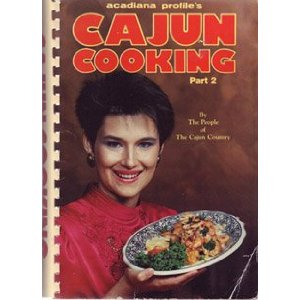
Fried Alligator, originally from Acadiana Profiles Cajun Cooking from the kitchen of South Louisiana.

Published in 1996, now out of print

1 to 5- pound piece of alligator tail, rinsed and chopped into 1 1/2 -inch pieces.
1 quart of whole milk.
1 small bottle of Frank’s Red Hot Sauce.
1/2 teaspoon sea salt.
1 large potato, boiled.
1 small bell pepper, finely chopped.
1 clove garlic, minced.
Salt and pepper to taste.
2 cups seasoned, bread crumbs.
Oil, for deep frying.
Marinate the alligator in the milk, hot sauce, and salt solution. Marinate should cover the alligator or place in zip lock bag and turn occasionally.
Place in the refrigerator for 24 hours. Drain
Dry on paper towel.
Grind alligator coarsely in food processor.
Mix coarsely ground alligator with boiled potato, bell pepper, garlic , salt and pepper.
Form into round balls and toss in seasoned bread crumbs.
Drop into hot oil and deep fry until golden brown, 3-5 minutes.
Drain on paper towel. Serve immediately.

Alligator Sauce Piquant by Rouses Louisiana’s Best
Ingredients:

 1/2 cup of flour,  
1 cup Rouses cooking oil, 
1 large. onion, chopped, 
1 garlic clove, chopped
, 1/2 bell pepper, chopped, 
1 large can of tomatoes, 
1 can of tomato sauce,  
3 cups water. 
Rouses salt and pepper to taste, 
1 pound of alligator, cut into one inch cubes, 
1/2 cup onion tops, chopped.
Directions: Make a roux by cooking flour in oil until medium brown. Add onion and cook until onion wilts. Add garlic, bell pepper, tomatoes, tomato sauce and water. Cook over low heat for 30 minutes. Add alligator meat, salt and pepper and onion tops; continue cooking until alligator meat is tender, about 30 to 45 minutes.

{ 14 comments }

Halloween Editorial

Halloween is the most debatable of non-holiday holidays. With a past that goes back to Roman times it became in the Christian era “All Hallows Eve,” the day before “All Saints Day,” November first. All Hallows Eve was traditionally a time to remember those who had died, a Memorial Day if you will, a remembrance and a time for contemplation. This is how the deceased theme became associated with Halloween.

I would not know this save for the fact some 40 years ago I was a foreign exchange student to Whitelands College (photo to right) which was then part of the University of London. Whitelands College, now luxury apartments, had 14 female students to every male student. The college took All Saints Day quite seriously along with St. Ursula’s Day. Saint Ursula is the controversial patron saint of virgins. One can understand why no one hears of St. Ursula any more.

Regardless of why Halloween exists it is not going to disappear anytime soon. More money is made by retailers during Halloween than any other “holiday” of the year far eclipsing even Christmas. All those candy sales add up. Sugar equals profit. More so Halloween has changed since even my college days.

Many years ago I worked as a writer for a national television network based on the Universal Studios lot in Orlando. Several large six-story sound stages were in a row on each side of a road, independent buildings. However, the road between them was covered by a huge canopy stretching from building to building, in effect keeping the road between the buildings out of the rain and sun. It was here large parades parked during bad weather or between shows. Indeed, every day during the fall season this is where the Halloween Parade floats could be found. You could walk past all eight to a dozen, up close, all protected from the weather. It was here I noticed how Halloween had changed.

We all know the traditional fare of Halloween: Jack O’Lanterns, witches, steaming cauldrons, goblins, ghosts, black cats, bats and skeletons. They evoke unseen forces and the spectra of the unknown, at one time very real concerns since nearly everyone once believed in witches. Folks lived much closer to death then than they do now. The mortality rate was high, families handled their own funerals, burial was local and many people had rituals regarding buried loved ones. The Greeks actually dug the deceased a year after burial to look at the bones and sooth the spiritual state of affairs. Skeletons were part of remembrance. And indeed in that Halloween Parade the traditional trappings of Halloween could be seen on one float… one. It was that which caught my attention, the traditional trappings.

Of all the floats in the Halloween Parade every year only one had the traditional elements of Halloween, and it was also always the most sedate of the floats. The rest of the floats were about psychological horror and blood. The rest of the floats were not about images of the past but of the present: murderers, killers, torturing, razor fingers and chainsaw dismemberment. The difference in the floats were stark and chilling. The past was about human fears whereas the present was about fictional horrors and the products of the dark side of our creativity. Halloween has moved from some very human concerns to some very twisted displays.

Six weeks before Halloween the local interstate billboards go up advertising the “holiday.” It’s a disgusting offensive onslaught every year and some people have tried to get it changed. Jack O’Lanterns, skeletons and ghosts are far too tame for these ads that you cannot avoid. The roadside billboards drip with blood, scream horror and glorify dismemberment (and then we wonder why children are violent.) The ads are offensive, sick perversions under the guise of free speech and entertainment. How did Halloween manage to sink into the social sewer like that? Even worse, these perverted images have worked their way into “clowning” with murderous effect.

Pugnacious

Gone is the holiday of my youth, a bit of fun and a simple costume out in the neighborhood collecting candy. Now the candy should be X-rayed and every child accompanied to every door. I can’t remember the last time a little witch has said “trick or treat” upon the opening of my door on Halloween. I see garish costumes from movies I most certainly wouldn’t want to see now ….or even when I was a sprout. I lament the loss of Halloween to Hollywood.


{ 10 comments }

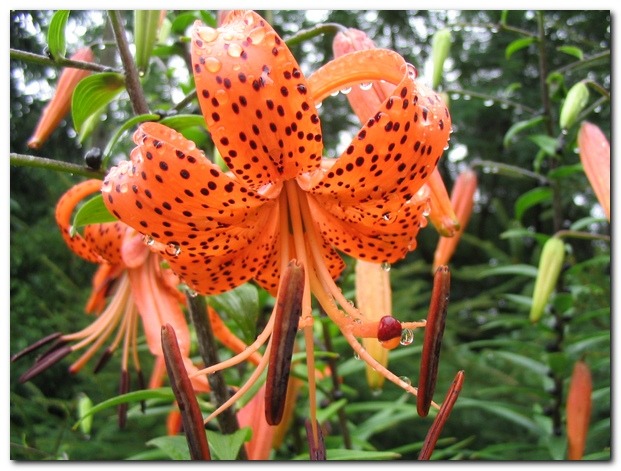
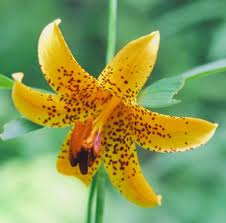
Tiger Lily, Lilium lancifolium

The word “lily” causes more confusion than four letters ought to be able to make. There are true lilies, usually not edible, some of them quite toxic, a few edible. And there are plants people call lilies which aren’t lilies at all, some quite toxic and some edible. The next layer of confusion comes from the fact many people call many different plants the same name, in this particular case, the Tiger Lily.

The Tiger Lily we’re interested in for the moment is Lilium lancifolium, a native of Asia and Japan but naturalized in the northeast quadrant of North America, and a few other places as well. Most of this Tiger Lily is edible by humans but all parts are toxic to cats. It causes feline kidney failure. In Asia and Japan this lily is grown for its edible bulb. Cooked it resembles turnips in flavor. Flower buds are eaten raw or cooked.

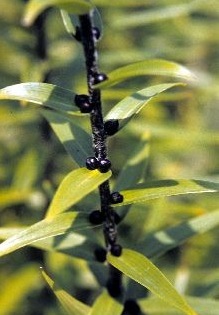
Note bulbils where leaves meet stem

This particular species does not produce seeds. Instead it produces little black bulbs (bulbils) where the leaves meet the stem. You can use those to propagate the lily or the tubers. However, by bulbil it takes three years for them to mature.

Now we get to the pseudo-controversy. All over the Internet there are dire warnings that the pollen of Lilium lancifolium (aka Lilium tigrinum) is toxic, that is, it will make humans throw up and generally be miserable. Oddly, none of the books in my library, except for one, mentions the pollen at all. Save for that one entry none of my foraging books mention pollen nor do any of my flower books mention it. In fact none of my books on poison mention Lilium lancifolium pollen regarding humans. The one reference I have to the pollen is found on page 512 of the Encyclopedia of Edible Plants of North America by Dr. Françoís Couplan. In reference to Lilium lancifolium and Lilium bulbiferum he writes:

“The pollen can be gathered in relatively important amounts and eaten as such or sprinkled over various dishes. It is nutritious and has a pleasant taste.”  The Internet seems to be in disagreement with Dr. Couplan, who has a PhD in ethnobotany. His encyclopedia was published in 1998.

Cornucopia II, which is a compendium of edible plants in the world, also published in 1998, says on page 144  of the Lilium lancifolium: “Flowers both fresh and dried eaten in soups, salads…” No mention of or warning about avoiding the pollen on fresh flowers. It would seem the Internet is at odds with Cornucopia II as well.

The Internet is rife with misstatements. The pollen-is-bad-for-humans warning could have risen out of the real threat it poses to cats. They lick lily pollen off their fur and often die from it. That warning could have morphed from fatal for cats to toxic for humans. There are previous examples with other plants.

Cow in methane capture experiment

Many sites in the last five years have published the warning that pine needle tea can cause abortions in humans, another leap from a known threat to animals to certain problem for humans. It started with an article in the Journal of Animal Science (J ANIM SCI 1992, 70:1604-1608.) In the article cows in or after their eighth month of pregnancy which ate several pounds of Ponderosa pine needles did indeed have abortions, the rate ranging from 5 to 8%. Non-pregnant cows were not affected. The article did not cause much alarm as the Internet was in its informational infancy in 1992. However, the United States Department of Agriculture issued a report on the Internet in 2006 — still on line — saying “Ponderosa pine grows in all of the states west of the Great Plains and in western Canada. Pine needles can be made available to cattle from slash remaining after logging operations, windfalls, or dried fallen needles. Discarded Christmas trees have been known to cause abortions in cows. Lodgepole pine (P. contorta), common juniper (Juniperus communis), and Monterey cypress (Cupressus macrocarpa) also contain isocupressic acid and may also cause abortions when eaten by cattle.”

One blog that same year mentioned the cow problem then made the leap by saying Native Americans knew long ago what modern scientists had only recently learned about pines needles and abortions. The blog added the element of Indian woman using pine needles for abortions — no reference given. Included in the blog was one additional comment about pines from the ancient Greeks and the warning was born. From there it proliferated over the Internet. Now pine needles cause abortions in humans, each reference becoming obligatory and more dire. Can you intentionally prepare pine needles to somehow affect a pregnancy in humans? Perhaps, though there seems to be no examples in the medical literature. Then again, too much of anything can probably affect a pregnancy, wine comes to mind. Intentionally preparing an intense dose of pine needles is far different than two pine needles sitting in hot water making a pleasant tea with Vitamin C.

In another example other sites have being saying the aril of the Momordia charantia is toxic to kids. It’s nearly 100% lycopene, not exactly a toxic substance. If it is toxic to children then maybe watermelon is, too. Professor Julia Morton, an expert on edible and toxic plants in Florida, wrote extensively about the species many times and never made mention of anything related specifically to children regarding Momordia Charnatia. I can remember finding the original site that said the arils were toxic to kids. Again, no reference was given. Last year I met a breast-feeding mom who ate them and kept right on feeding.

Lilium canadense

So, is the pollen of the Lilium lancifolium, toxic to humans? The books say nothing bad about it, Dr. Couplan says it tastes good and can be collected in quantity, the Internet says it is toxic to humans. Can we find a way that toxic view could have been proliferated? Yes, the plant is toxic to cats. It is a short leap for amateur writers to include humans.  I wrote to Dr. Couplan for his opinion on this. He wrote back saying he has consumed Lilium lancifolium pollen in small amounts with no known bad effects. Dr. Couplan asked for a reference on the purported toxicology of Lilium lancifolium on humans. I could not and cannot provide one because I can’t find one, published that is. As best I can tell it is Internet rumor and one reason why I prefer published references.

Among the native lilies of North America the cooked bulbs of the follow species can be eaten by humans: Lilium canadense, (now rare in some places) Lilium columbianum,  Lilium occidentale, Lilium pardalinum, Lilium parvum, Lilum philadelphicum and Lilium superbum. Yes. Superbum (soo-PER-bum) It means superb. Another edible Asian lily is Lilium bulbiferum.

Lilium is dead Latin for the Greek word Lirion, which means lily. Now days they’re called Krinos — meaning lily — which is also a brand of imported Greek food. That said, lilies get around. A few years ago I had the opportunity to visit the Palace of Knossos near Heraklion, Crete. In the museum is the famous “lily” vase, a fresco that dates back 3,500 years. A similar fresco in the same time frame is found on the Greek island of Thera, though it is better known as Santorini. The working theory is the volcanic eruption that essentially destroyed Santorini created a tidal wave that wiped out the Minoans at Heraklion a few hundred miles away. The Minoan civilization never recovered from that disaster. The frescos did.

Lastly, don’t you think it is odd that the plant is called the Tiger Lily not the Jaguar Lily? Jaguar are orange and have spots, orange tigers have stripes. Maybe the Tigris river had something to do with it.

Green Deane’s “Itemized” Plant Profile

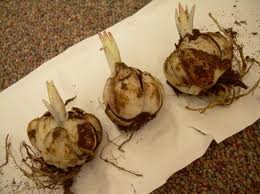
Lilium lancifolium bulbs

IDENTIFICATION: Bulbs widely ovoid, large scales. Stems minutely woolly, purplish, buds usually flat-sided, somewhat triangular in cross section. Leaves scattered, horizontal and drooping at tips; dark purple axillary bulbils; leaves lanceolate, often narrowly so, edges not wavy.  Flowers hang down, not fragrant; Turk’s-cap-shaped; sepals and petals curve back, orange with many purple-brown spots; stamens stick out, ends purplish,

TIME OF YEAR: Late summer

ENVIRONMENT:  Near damp places in urban areas, roadsides, railroad banks, buildings.

METHOD OF PREPARATION: Bulbs boiled, pickled, or used to make starch. Resemble parsnip in flavor. Flowers both fresh and dried used in soups, salads, omelets and rice dishes.

{ 24 comments }

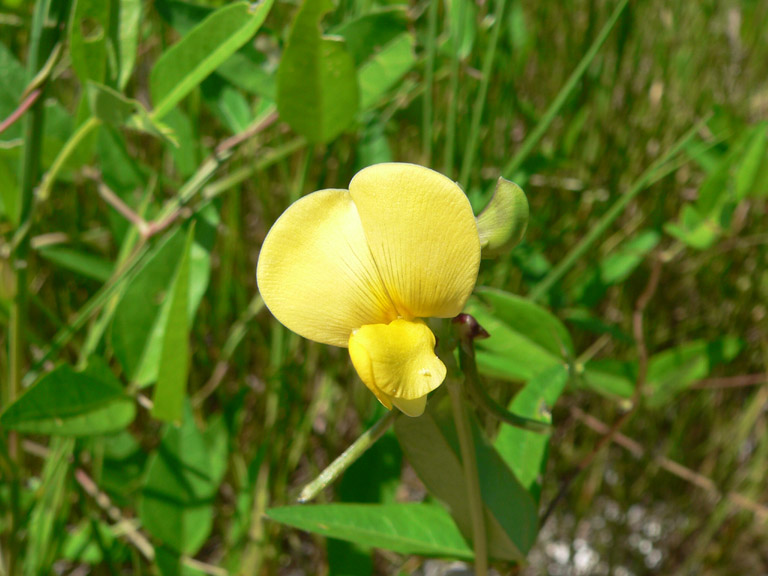
Hairy Cowpea, Vigna Luteola

It’s called a Cowpea but it’s not THAT cowpea, and it has a famous relative that no one calls by its botanical name.

So which Cowpea is it? Vigna luteola (VIG-nah loo-tee-OH-la) a twining vine found from Texas east through the Old South and then north to Pennsylvania. The famous cowpea is Vigna unguiculata, aka Black-Eyed Peas, the traditional New Year’s Day meal of southerners. And the even better-known relative they both have? Vigna radiata, or the Mung Bean. That means, yes ladies and gentlemen, that the Black Eyed Pea is not a pea but a bean, as is our cowpea. Let’s call  the Legume de jour  by a slightly different name, the Hairy Cowpea (because its pod is slightly hairy.)

Both the Black- Eyed Pea and the Hairy Cowpea are natives of Africa. At one time it was thought the Hairy Cowpea was the ancestor of the Black-Eyed Pea but now they think the “spontaneous” wild Black-Eyed Pea was the ancestor of the cultivated Black-Eyed Pea. Sounds incestuous and confusing.  And just how the African Hairy Cowpea got to the Americas, and is also native in the Americas by some accounts, is a bit of a botanical dilemma we need not worry ourselves about. Edibility not origin is our concern.

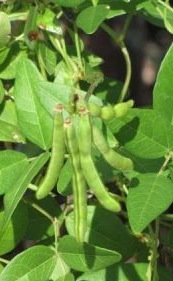
Vigna’s Hairy Pods

An article on the Hairy Cowpea was published in 2004 for PROTAbase, which is Plant Resources of Tropical Africa. It reported what many foragers know: The seeds and flowers are edible cooked. They report the flowers are eaten as a boiled vegetables in Ethiopia and Malawi. I eat them raw as a trail-side nibble. They taste like raw peas or green beans. Also in Malawi children dig up the roots, peel them and chew the roots to extract a sweet juice. Hairy Cowpeas seeds are boiled and eaten. The plant is about 17.5 percent protein and has high amount of the amino acid cystine. It is also good food for livestock. Another relative, the blue-flowered Vigna membranacea has edible leaves. They  are eaten after frying or boiling .

The genus is named for Professor Dominico Vigna, a 17th century Italian botanist and director of the botanical garden in Pisa. Luteola means yellowish. There are about 80 species in the genus. The report said nine years ago that the Americas’ Vignas would be moved into a new genus. Don’t hold your breath. It ain’t happened yet.

Green Deane’s “Itemize” Plant Profile: Hairy Cowpea

IDENTIFICATION: Vigna luteola, Twining or trailing perennial herb; stem up to 20 feet (6 m), hairy but hardly so. Leaflets alternate, groups of three like poison ivy;  leaves ovate-lanceolate to lanceolate, flowers in pairs at nodes,  yellow, much wider than long. Pod curved with short curved beak, slightly indented between the seeds.

TIME OF YEAR: Year round but favors summer, fruits in fall

ENVIRONMENT: Vigna luteola grows in wet areas, by lakes and streams, swamps and swales… the lawn you water too much

METHOD OF PREPARATION: Flowers and seeds cooked. Flowers raw but I would go light on them. Yellow blossoms in general tend to be laxative.

{ 5 comments }