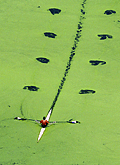
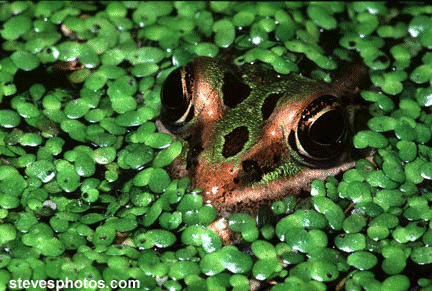
Frog in Duckweed, photo by StevesPhotos.com

A Weed Most Fowl

Do ducks eat duckweed? Yes and no. Do humans eat duckweed? Yes and no. Domestic ducks tend to eat duckweed, wild ones don’t. Humans can eat duckweed but …

Wollfia, Watermeal

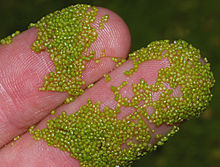
Generally said there are three genera of duckweeds: Lemna, Wolffia, and Spirodela. Let’s start with Wolffia globosa which is used as a vegetable in Burma, Laos and Thailand. Its flavor is similar to sweet cabbage.  Wolffia, which has the smallest blossom in the world reproduces quickly making it a sustainable crop if the water is wholesome, which is a significant problem. In the wild, duckweeds tend to grow in poor water. Wolffia is 20% protein (more than soybeans) 44% carbohydrates, 5% fat has vitamins C, A, B6, and Niacin. Also called Khai-nam (eggs of the water) and Mijinko-uji-kusa, Wolffia is naturalized in California, Illinois, Kentucky, Tennessee  and Florida. Unfortunately it is tiny, about 1/32 of an inch or the size of the eye of a needle. It’s a floating tiny disk with no root though it can have little hairs on its margin. It is so small it looks like meal floating on the water, hence its name watermeal. The tiniest and the tastiest. Best to raise your own in good water while keeping out lesser species.

Lemna minor

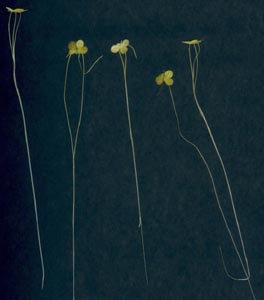
Lemna is much larger than Wolffia. It usually has three attached floating leaves (called fronds) and at least one vertical root root per frond.  Lemna, also called water lentils, is typically less than a quarter inch wide, some species an eight of an inch wide. Dried Lemna is used as cattle feed having up to 45% protein, 4% fat. Unfortunately, from the human point of view, it is also high in calcium oxalate. To quote Missouri Botanical Garden (www.mobot.org)

“Calcium oxalate is not a nutrient (nor a beneficial source of calcium), and it can be toxic in large doses.  Duckweeds can contain up to 2 — 4 percent oxalic acid equivalents by weight.  However, oxalate also is found in a great many leafy and very nutritious vegetables, including spinach, swiss chard and others.  In these edible vegetables, calcium oxalate is found in at levels up to 0.5 — 1 percent.  So, minimizing oxalate has the potential to make duckweeds more nutritious and digestible.

However, published reports of calcium oxalate levels in duckweeds are likely to be misleading. The late Vincent Franceschi (Washington State University) demonstrated that the calcium oxalate content of Lemna minor depends greatly on the calcium content of the water on which they are growing.  Elevated calcium in the water favors formation of calcium oxalate crystals, and their content can be lowered by growth on low-calcium medium.  It seems likely that placing duckweed on soft water for a reasonably short period could lower oxalate content significantly in a practical setting…

Harvesting Wolffia in Thailand

For people to eat duckweed, it would need to be grown under sanitary conditions.  In addition, it may be desirable to pay attention to the calcium content.  Evidence is now emerging that the absorption of dietary oxalate makes a major contribution to urinary oxalate excretion, particularly in stone formers.  There is a patent on a method to select duckweeds for human consumption.”

To all of that I would add that perhaps some experimenting is in order. Dry heat has been used to break down calcium oxalate in other foods, Jack In The Pulpit comes to mind. Sometimes moist heat works, as in taro. Cooking — boiling or roasting — would also kill any bacteria et cetera on or in the duckweed from the water (high nutrient water is often caused by… duck droppings.)  A second option, as some suggest, is to boil the duckweed, change water, then blend it. There is a practical side to that as well. Pistia stratiotes seedlings look similar, grow in the same place and time, and are the same size. They must be cooked.

Spirodela, Giant Duckweed, is not edible.

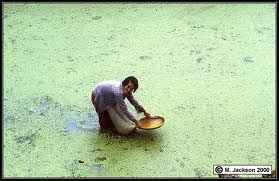
Duckweeds are found in quiet, nutrient rich wetlands and ponds. They require high levels of nutrients to “bud” which means if a pond has a lot of duckweed the pond has excessive nutrients. Duckweed does not like moving water or windswept water even if the nutrients are high. Duckweeds bud. Under ideal conditions one duckweed frond can produce 17,500 “daughters” in just two weeks. With such high reproduction rate duckweed can cover the surface of ponds in just a few weeks. That is also why it is being considered for biodiesel because it has five to six times the amount of starch as corn. Duckweed also provides shelter for frogs, snakes, fish, insects and crustaceans. Grass Carp and Koi eat it. Perhaps the best way to to eat duckweed is to eat what eats it.

Sculling through duckweed

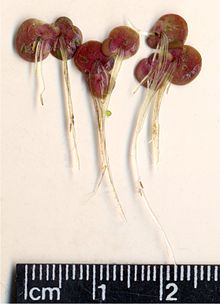
Giant Duckweed, Spirodela polyrhiza, was Lemna polyrhiza. There is one reference that says it has been used as food. Details are absent. I haven’t tried it. Giant Duckweed is frequently found growing in local rivers, ponds, lakes, and sloughs. In Florida, from the peninsula west to the central panhandle. It has two to three rounded leaves usually connected with each usually having several roots (up to nine) hanging beneath each leaf. The underleaf surface of Giant Duckweed is dark red. It can be easily confused with the exotic plant, Landoltia punctata. Landoltia duckweed is smaller than Spirodela polyrhiza, is more shoe-shaped, does not have a red dot on top, usually has only up to four roots, and sometimes has a red margin on the underneath of the leaves.  It is spotted, as its name suggests.

Wolffia (WOLF-ee-ah or wolf-EE-ah) is named for Johann Friedrich Wolff, 18th century German botanist and physician. Spirodela (spear-row-DELL-ah) is from the Greek spira (spiral) and delos (clear), referring to spiral vessels clearly visible through the whole plant. Lemna (and various spellings) in Greek means port, which usually has quiet water. In fact, near my grandfather’s village in the Mani is a town called Lemeni. It’s at the end of a long, bay surrounded on three sides by huge mountains, and a cute hotel clinging to a cliff.

One last point: Frankly I think using an old swimming pool or the like to raise duckweed in would be the best. In natural ponds duckweed tends to collect detritus. A handful of duckweed includes a quarter handful of debris. It can be an aquaculture crop but it would take some planning.

PS: The leopard frog is edible.

{ 81 comments }

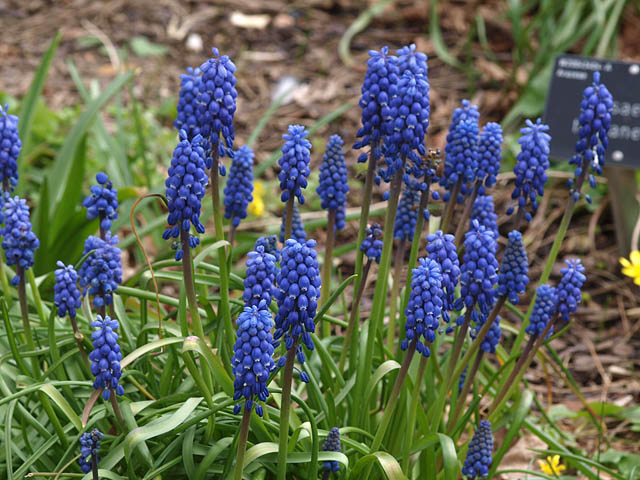
Muscari “Blue star”

There are dozens of edible species that are wild in Europe and cultivated or escaped in North America. Three related species with a multitude of names are quite popular in Europe but relatively unknown in North America though they grow there and are used in similar ways with some variation. They are the Tassel Hyacinth, the Musk Hyacinth and the Grape Hyacinth.

The Tassel Hyacinth

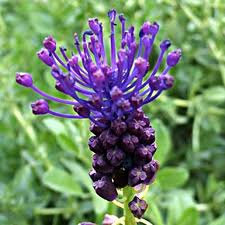
The Tassel Hyacinth, Leopoldia comosa, is used extensive particularly in Italian and Greek cooking. The bulbs are boiled then pickled or preserved in oil. They are thought to stimulate the appetite and are also diuretic. Interestingly wild ones are preferred over cultivated ones. It is “officially” found — read on United States Department of Agriculture  maps — in Pennsylvania, Maryland, Virginia, both Carolinas, Georgia, Tennessee, Kentucky, Ohio, Illinois, Missouri, Oregon and Washington state. They, like the other species here, can be found elsewhere but have not made the official USDA list. The Tassel Hyacinth naturalizes easily and can become invasive. It’s native from southeastern Turkey to Iran but was in the British Isles by the 1600s. Its flower stalk is up to two feet tall, pale brown urn-shaped fertile flowers on the lower half, blue flowers on the upper half. The blue flowers on top, pollinated by bees, resemble a tassel, hence the name. Depending upon the climate it flowers in mid-spring. In Greece it is called βολβοί (vol-VEE) literally “bulbs.” The Italians call them “lampascioni”, “lampasciuni” and “lamponi.” Leopoldia, (leo-POL-di-ah) honors of Leopold II, Grand Duke of Tuscany (1797 – 1870.) Comosa (kom-OH-suh) means “hairy”

The Musk Hyacinth

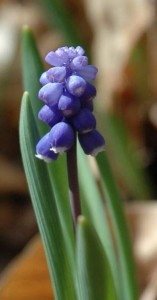
The Musk Hyacinth, Muscari neglectum, is used in a similar way but has urn-shaped blue blossoms. The blossoms are used as flavoring in Europe. The bulbs are also boiled then eaten. More so it was planted as a source of starch for ironing clothes. It is found in the eastern United States from southern New England to west to Michigan south to Florida then west to New Mexico. The species has had a lot of botanical drift and over the years nearly four dozen different names. The species grows in clumps to about a foot high, in full sun to partial shade, has a raceme of blue urn-shaped blossoms in the spring, Actually the lower blossoms are dark blue to black blue and the upper blossoms are brilliant bright blue. In Spain it is a favored blossom under olive trees. Muscari (mus-KAH-ree ) is from Greek and means Musk. Neglectum (nay-GLEK-tum ) mean “slight” or “overlooked.”

Indian Grape Hyacinth

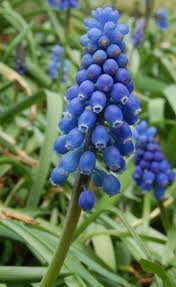
Blossoms of the Grape Hyacinth (Muscari botryoides) are also picked. They and the buds are pickled. It is naturalized in North America in a patchwork of areas including the eastern U.S. and Canada, the Pacific coast of the U.S. and Canada plus Texas, Utah and Nebraska. The high plains states and the desert southwest are left out as is South Carolina, Georgia, Florida and Louisiana. Like the other members of group the stems grow from an underground bulb. Leaves are basil, linear, hairless, grooved or “U” shaped in cross section. Flowers are a dense, terminal raceme, urn-shaped, blue. Again Muscari  (mus-KAH-ree) means Musk and botryoides (bot-ree-OI-deez) means in clusters like grapes.

Leopold II

The bulbs of the edible species are slightly bitter because of saponins, basically plant soap which is why cooking the bulbs is necessary if not changing the water once or more.

Filippo Parlatore

I cannot find a declarative statement why Leopold II, the last reigning Grand Duke of Tuscany, was honored by the genus. Leopoldia was established by the Italian botanist Filippo Parlatore (1816 – 1877.)
Leopold was Palatore’s patron, gave him the position of professor of botany and made him director of the botanical garden in Florence… good enough reason to have a genus named after you. The grand duke was also a founding patron of  L’Istituto Statale della Ss. Annunziata, the first female boarding school in Florence for well-born ladies. To his credit he also commissioned large public works and was the first to promote tourism to Tuscany.

A “Blue River” of Muscari armeniacum at the Keukenhof Gardens in Holland


{ 7 comments }

Cannibalism

Oddly there is a right way and a wrong way to commit cannibalism

There is no way to approach the topic of cannibalism without offending someone. Apologies offered. Cannibalism, the last great social taboo, is committed sometimes as a criminal act, sometimes to survive. Other times it is just bizarre as in a case reported 6 May 2012 in South Korea. There authorities cracked down on the smuggling of powdered baby flesh. Consumers bought the Chinese capsules for reasons ranging from fighting cancer to (yeph, you guessed it) improved sexual performance. The capsules sold for (in 2012 dollars) about $35 to $44 each.

In 1886 Alfred Packer was sentenced to 40 years for manslaughter that involved cannibalism. At the time it was the longest sentenced handed out in the United States. He was pardoned in 1901.

Criminals have long been associated with the practice of cannibalism, some by turn of mind others to conveniently eliminate evidence. Most criminal cannibals are loners and do not commit other crimes such as rape. Cannibalism was not unknown in sailing/shipwreck days. It was also practiced by various tribes for sundry reasons in tropical areas of the world, including the Caribbean and perhaps currently in remote Africa and south sea islands. There it is sometimes accompanied by a human wasting disease related to Mad Cow Disease, human spongiform encephalopathy (caused by nearly indestructible proteins that destroy brain cells.) Some equatorial tribes committed funerary cannibalism, that is, consuming their dead relatives to spare them the indignity of rotting. In fact, in some south sea cultures a young couple — a boy and a girl just past puberty — were feted in ceremony and then had sex in front of the entire tribe. A lean-to of heavy logs was dumped on them at the height of intercourse killing the couple. Their bodies were dragged out of the wreckage and then consumed, which is endocannibalism, within the group. As horrific as we may view this the natives did not. To them it was an affirmation of what many equatorial cultures viewed as the great circle, out of death comes life and that all eating is a eucharistic communion. To them it was a deeply religious act affirming their world and cosmological view. In North America Iroquoi tribes practiced ritualistic enemy-related cannibalism as late as 1838.

Cannibalism, or anthropophagy, is mentioned several times in the Bible, one of the more specific verses is II Kings 6:26-29. In the arts cannibalism was part of the genesis for the novel Moby Dick. The musical Sweeny Todd is based on the theme of cannibalism and, not unlike the capsules mentioned above, so was the 1973 movie Soylent Green. And one should mention the infamous Hannibal Lecter M.D. From a factual point of view group cannibalism has been decreasing for the last 100 years and individual cannibalism has been on the increase.

While socially condemned cannibalism is rarely specifically illegal. For example, Florida statutes do not mention “cannibals” or “cannibalism.” However, “a person who mutilates… or otherwise grossly abuses a dead human body commits a felony of the second degree…” A jury would probably agree cannibalism fits that law under some conditions. Setting aside for a moment legal, criminal and moral issues, does cannibalism save lives in difficult or emergency situations? The answer is yes and no. The issue is fat.
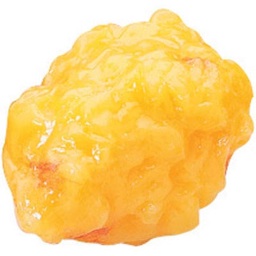
Humans cannot survive long-term without ingesting fat. We can live without meat if we eat well and get a balance of amino acids. We can live completely without carbohydrates if we have enough fat and proteins (meat or amino acids) to eat. In fact we can live for a long time on just fat and water. But, we cannot live without fat, and fat is the make or break issue with cannibalism in regards to survival. Even ancient man preferred fat, bone marrow, and brains over muscle meat as evidenced by how he butchered animals and his occasional fellow man.

The Essex’ crew resorted to cannibalism after being sunk by a whale.

If a group is starving together and are equally skinny eating one of the group is not going to help much or forestall death. Why? Because you have all been loosing fat together and have zero fat stores unless someone was more fat than the rest to begin with. Eating a person with little to no fat will provide proteins but not enough fat to survive. It is similar to documented cases of  “Rabbit Starvation” which is dying from eating only rabbit meat which has little fat.* Thus the Donner Party, which was stuck in the Sierra Nevada in the winter of 1846/47, resorted to cannibalism when it did little good, that is, after everyone had not eaten for a long time. (Though it should be mentioned some new research suggests they were not as cannibalistic as once thought.) The same situation as the Donner Party existed with the whaling ship Essex in the 1820s which was the inspiration for the novel Moby Dick. However, the Uruguayan Air Force Flight 571 that crashed Friday, 13 October 1972 was totally different.

Survivors of the Andes flight.

Of the 45 on board the plane that crashed in the Andes 29 survived only to see eight killed in an avalanche later. They were at 11,800 feet. The dead froze within a matter of hours which is what saved those who later consumed them; their fat stores were available. The living were not rescued for 72 days and then only after two managed to climb down in spring weather and walk out for help. Crash survivors who did not participate in cannibalism died of starvation.

James F. Reed and his wife, Margret W. Keyes Reed, in the 1850s, were survivors of the 1846/47 Donner Party.

Let’s look at some nitty gritty statistics from these two events. First the Donner party.  The survivors were on average 7.5 years younger than those who died; children between 6 and 14 had a much higher survival rate than infants and children under the age of 6 or adults over the age of 35. Then again, they were also cared for by the dying adults. No adults over the age of 49 survived. Deaths among males between 20 and 39 were “extremely high” at more than two out of three. Men metabolize protein faster, and women do not require as high a caloric intake. Women also store more body fat, which delays the effects of physical degradation caused by starvation and overwork. Men also tend to take on more dangerous tasks, and in the Donner case, the men before being snowed in were required to clear brush and engage in heavy labor, adding to their physical debilitation and less fat stores. Those traveling with family members had a higher survival rate than bachelors probably because family members more readily shared food with each other.
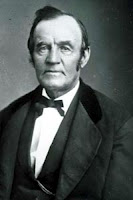
Thomas Nickerson, one of the Essex Survivors

The Essex case was similar regarding the men. It was an all male working whaling ship. When the ship was intentionally struck and sunk by a sperm whale all hands made to smaller boats. The men began to die almost immediately and at first they were buried at sea. Then the decision was made to save their bodies. When they ran out of bodies they drew lots to decide whom to eat and who would kill that person to eat. The captain, George Pollard, actually ended up eating his cousin. Still men died, and the boats got separated. In the end three men left on a island managed to live as did a few who remained in boats.

Roberto Canessa and Nando Parrado, 1974, who survived the Andes crash and walked out to save their friends.

In the Andes case all the final survivors were male as well but they were also the majority of passengers. Further most of the males were young men in top physical condition at the time of the accident, unlike the Donner Party who had been laboring against the trail for weeks. The Andes crash survivors also knew they had to eat their teammates and other passengers to survive. Fortunately those bodies had frozen fast and had fat (and bone marrow.)  A point to consider is all three groups of men had low fat stores, the athletes, the able-bodied sailors, and the men clearing a wagon train path. The most successful group, the athletes, were the only one with access to flash-frozen fat. They were also the youngest.

So, what do people taste like? The term “long pig” was coined just for that purpose. There has even been some speculation, by no less than the august commentator Christopher Hitchens, that the Semitic ban on eating pig is because the intelligent pig tasted like and sounded too much like humans, particularly in slaughter.  In 1910, the American anthropologist, A. P. Rice, reported how natives of the Marquesas Islands ritualistically killed their human captives, called exocannibalism, or outside the group.

“First, they broke their legs, to stop them running away, then they broke their arms, to stop them resisting. This was an unhurried killing, because the Marquesans enjoyed observing their victim contemplating his fate. Eventually, the man would be skewered and roasted.”  Eyes, brain and cheeks were regarded as delicacies by some cannibals.

While there are credible reports of native cannibalism as late as the 1970s, and perhaps even 2008, here’s an Australian account from 5 August 1865:

“… an observation of six males from the Kgut’dhirri (clan) … taken hold of a white male… was affronted by five of the Kgut’dhirri males… sudden movement of the sixth native who had come in from behind… attacker hit hard and cracked open his skull with the force of a large club… dead at the moment of striking despite the contortions of his body on the ground… With great haste, they took away his clothing leaving him naked on the ground…”

“… three of them produced sharp European knives… relieved him of his innards… arms and legs were trussed with vine in the manner of a captured iguana… in two swift strokes, cut away the victim’s appendices… held them high in his hand… gave forth a cry of victory… placed his trophy in a dilly bag… carried forth the poor soul’s body on a pole towards their camp… old women… examined the body… placed large logs on the fire… given a coat of grease to the body… the body was in place on the coals of the fire… knew of no other time or place where a white man was killed and eaten… “

And one from 11 June 1854: “… taken to cover overlooking a large camp of natives… was able to observe an orgy of utter revulsion… in a frenzied motion uttering sounds of madness… consumed a liquid resembling the content and color of blood… dark bodies were coated with much spillage… witness to a human feast… some ten corpses… ten more victims awaiting a similar fate… a victim brought forward… struck from behind… neck was cut… blood filled containers… head was severed and split… old men took possession of the brain, eyes and tongue… separate cooking stones… body was then gutted… heart was handed to the leader… placed also on the special cooking stones… strips of sweet meat were taken from the lower back… given to all the (old) men and placed on the stones… these parts are important… men gained the knowledge, the sight, speech skills, soul and the strength of the victim…”

“… the victors took portions of the liver and all of the male’s appendix parts… liver was eaten raw… the man’s prides were placed on the coals for roasting… body was trussed and hung on a frame above the coals. The odor drifting in the air was of burning flesh. When cooked, the arms and legs or preferred portions of those limbs were shared between the men… why such rituals are performed… told that the liver of a man resembled life because it was full of blood… quenches the thirst like water… eating of the male’s appendices passed on the prowess of the victim in his mating capacity… legs and arm pieces represented the strengths of the victim… all the males duly shared. The ritual of sharing the body was completed when the rest was left to the women and the children.”

There are many such gruesome reports and pictures.  Most recently in October of 2015 there was a news report from Argentina in which a 25-year old, one Leandro Acosta, was arrested on murder charges. He ate his step-father, Ricardo Klein, and said the 54-year old “tasted like pork, a tad salty but delicious.”

Modern scholars say “cannibalism” was misunderstood by European explorers who also used or consumed human flesh from blood to mummy remains to treat disease and… improve sexual performance… The scholars tell us the cultural clash was used as an excuse to colonize.

While that may indeed be true there are among the anthropophagy accounts, interestingly, the gastronomic view that people who use tobacco don’t taste good when roasted. Perhaps a skinny chain smoker has the greatest chance of not being dinner….

* In reference to “Rabbit Starvation.” That is a 20th century view. Rabbits are very low in fat unless you eat the brains (as most native populations did.) It is the modern habit of not eating the rabbit’s brain that leads to the view that rabbit is a low-fat food that will not sustain you.

{ 19 comments }

Gout Weed, Aegopodium podagraria

Gout Weed does not sound too appetizing. Nor do some of its other names: Ground Ash, Ashweed, Pot Ash, White Ash, Ground Elder, Dog Elder, Dwarf Elder, Garden Plague, Farmer’s Plague, Snow-on-the-Mountain,  Jack Jumpabout, Jump About, Goat’s Foot, Bull Wort, Bishop Wort, Bishop Weed, Herb William and Herb Gerard…

Saint Gerard Majella

Herb Gerard? I happen to know this one: Saint Gerard, 1726-1755. His gout was reportedly cured by the plant but it was tuberculosis that got him at age 29. He’s the patron saint of expectant mothers. Gerard was a man of the cloth for only three years but managed to make a name for himself. He was nominated in 1893 for sainthood for a miracle that helped a pregnant woman.  He became a saint in 1904. Another attribute was he named the day and hour of his death. What I would like to know is how he managed to get gout as such an early age?

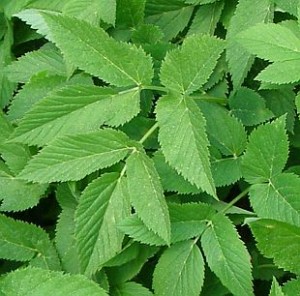
Usually compound leaves of three, sometimes five and seven

Gout Weed has a long history of medicinal use besides being cultivated for food. It was the main gout treatment. One theory is the clergy got a lot of gout because they ate better than most but reports about St. Gerard say he lived poorly, giving half of what he ever made to his mother and the other half to those more poor than he. All parts of the plant are diuretic. It has been used to also treat rheumatism, arthritis and bladder disorders. Some credit consumption of the plant, others external use in the area of the gout, such as crushing the root and holding it at the joint.

While it may have indeed been medicinal it was also a prime salad ingredient and pot herb in Europe. It is now naturalized in many areas of North America including most of Canada, the eastern United States excluding most of the Old South and West save for Oregon, Washington, Idaho and Montana.

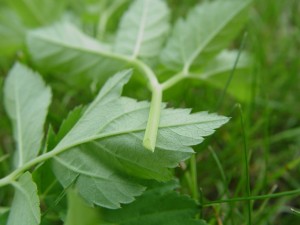
Note the veins of Gout Weed leaf terminate at the tip of a tooth. In the toxic hemlocks the veins terminated between the teeth.

The young leaves of the Gout Weed are translucent and shiny green. Tender and aromatic, they are excellent additions to salads as are young stems. When older they are often cooked with cheese. They have been added to fritters as well. In northwest Germany Gout Weed is made into grune suppe, green soup. As for taste, opinions are divided. You either love it or hate it. As a vegetable it is very prolific and spreads by rhizomes.

Botanically Gout weed, or Goutweed, is Aegopodium podagraria, ee-guh-POH-dee-um pod-uh-GRAR-ee-uh, or, ee-go-poh-DEE-um pod-uh-GRAR-ee-uh. The genus, Aegopodium, is from the Greek words “agios” meaning goat and “podion” which means little foot. Little Goat Foot, so named because the shape of the leaf resembles the shape of a goat’s foot. Podagaria is also Greek and  means “gout of the foot.”

DO NOT CONFUSE THIS PLANT WITH THE DEADLY TOXIC WATER HEMLOCK.

Green Deane’s “Itemized Plant Profile: Gout Weed

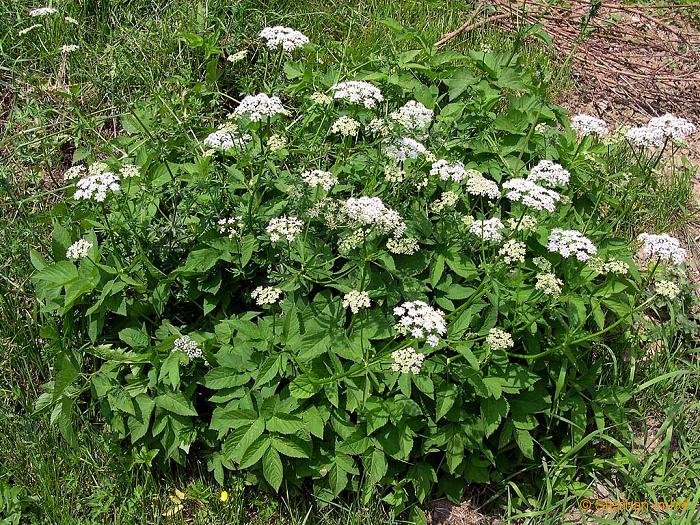
IDENTIFICATION: Small, white, five-petaled flowers mid-summer, arranged in flat-topped clusters a leafy stem up to three feet tall. Seeds small, elongate, similar to carrot seeds, ripen in late summer. Rhizomes — NOT EDIBLE — are long, white, and branching. Leaf veins terminate at the tips of teeth.

TIME OF YEAR: Late spring to early fall.

ENVIRONMENT: Gout Weed is very accommodating. It has no soil preference nor is soil acidity or lack there of a problem. It can grow in full shade to full sun but does requires moist soil. Makes a strong and invasive ground cover. Requires little maintenance.

METHOD OF PREPARATION: Leaves, raw or cooked, tangy,  reminds one of incense. Like many plants the leaves are best harvested before the plant blossoms. They can be added raw to salads, cooked in fritters, added to soups or used as a potherb.

{ 47 comments }

Edible Wild Flowers, Nature’s h’orderves. Photo by Blanche Cybele Derby.

Spring Beauty, Chickweed, Alpine Cress, High Bush Cranberry, Columbine, Hyssop, Musk Hyacinth, White Trout Lily, Yellow Adder’s Tongue, Aloe

Spring Beauty

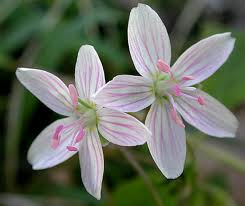
The Spring Beauty, also Springbeauty, Claytonia virginica, is a longtime standard for foragers. They are abundant in some areas, rare in others. Thus forage with some local consideration. True to its name the attractive wild flower is a sign of spring and easy to recognize from other spring blossoms. The white to pink petals have pink stripes, sometimes pale, sometimes bright, but pink stripes nonetheless. Each blossom also only has two sepals (leaves right under the blossom.) Lower leaves are strap-like varying in size and width. The plant grows small roots that remind people of tiny potatoes, hence the nickname “Fairy Spuds.” The flowers as well as the parts above ground are edible raw or cooked. There are several edible Spring Beauties. To see a separate article on site click here.

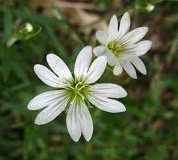
Chickweed, Stellaria, is not a blossom that comes to mind when one thinks of edible blossoms because one rarely separates the small blossoms from the rest of the chickweed before it becomes food. However, the deeply-lobed

Five-petaled chickweed

tiny five-petaled blossoms can be separated and sprinkled like white snow upon salads. Admittedly this is more for effect but isn’t that part of why we eat pretty flowers anyway? Also note the Native Americans did not let the weed’s small size deter them. They also used the minute seeds to make bread or to thicken soups. And of course, the rest of the chick weed above ground can be used as a potherb. It can be eaten raw if you like the flavor of raw corn.  Some folks just toss everything into a blender and make a green drink out of it. To read more about chickweed, click here.

Alpine Cress

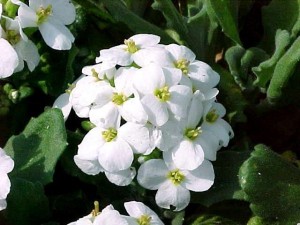
As the name suggests,  you have to go up to find Alpine Cress. It’s no flatland flower, and also as the name suggests, it is in the greater mustard muster. Alpine Cress, Arabis alpina, grows in the mountainous areas of Europe, north Africa, eastern Asia, and the Isle of Skye (Cuillin Ridge to be exact.) It is also found in North America including Kentucky, Virginia, West Virgina, Wisconsin, Michigan, New York, Maine, most of Canada, and Greenland, hardy little soul that it is. It likes to grow in damp gravel and screes. Not surprisingly it can be found in many places intentionally planted in rock gardens. The young leaves and flowers are a good substitute for cress. They are edible raw or cooked and are often mixed with other greens as a flavoring.

High Bush Cranberry

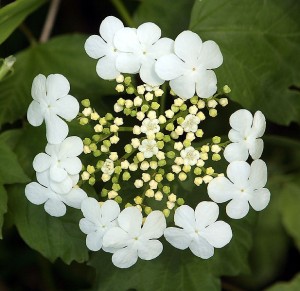
High Bush Cranberries are not cranberries but that’s all right because we are interested in the flower, though the fruit is edible, too. Actually Viburnum trilobum, not a Vaccinium, the High Bush Cranberry favors cooler climates, think the north half of North America, Europe and Asia. The blossoms of the High Bush Cranberry is rather odd in that it has sterile large flowers around the outside of the blossom and fertile tiny flowers in the middle. While both types of flowers can be used the larger outside ones are more practical and leave the fertile flowers to make berries. The flowers can be mixed with pancake or muffin batter or can be made into fritters.

Rocky Mountain Columbine

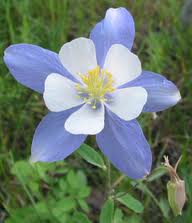
Sometimes within a genus there will be toxic species and edible species. The Aquilegia are that way. Most of them are toxic with alkaloids, four are not, one in east Asia, three in western North America. Thus making sure you have the exact species is quite important. Close is not good enough. Edible in North America is Aquilegia caerulea, the Rocky Mountain Columbine. The nectar-heavy flowers are eaten as a snack or tossed into salads. They also make a good jelly. The Hanaksiala Indians got nectar  from the blossoms of the A. formosa (Western Columbine) while the Miwoks boiled and ate the early spring greens of the A. formosa var. formosa (Crimson Columbine.) In eastern Asia the species is A. buergeriana, also called Yama-odamaki. Its sweet flowers are sucked for their nectar and also used in salads. The leaves are also edible. One other columbine might have edible uses. A. canadensis root was reportedly eaten by Native Americans.

Hyssopus officinalis

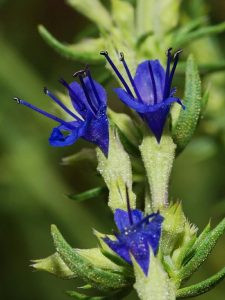
The Hyssop, Hyssopus officinalis, is quite well-known. The leaves and tops of young shoots are used to season soups, salads, pickles, sauces, custards meats, stews and dried for tea.  Its bitter-mint oil is used to flavor beer, liquors, and bitters. It is one of the main flavors in Chartreuse. Native to the Mediterranean, it is cultivated globally. What is not often reported is that the blossoms are edible as well, usually added to salads or made into syrup. There are several cultivars. The word Hyssop comes almost directly from the Greek word υσσοπος (EEs-so-pos.) It’s naturalized in the northeast quadrant of North America and North Carolina, Colorado, Montana and Saskatchewan.

Musk Hyacinth

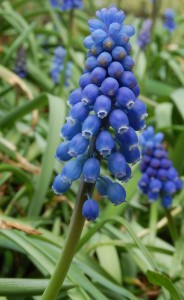
Often plants that are wild in Europe are cultivated in North America, making them difficult to classify. The Musk Hyacinth is such a plant. Botanically Muscari neglectum, the Musk Hyacinth has urn-shaped blue blossoms. They are used as flavoring in Europe. The bulbs are also boiled then eaten. Blossoms of the Indian Grape Hyacinth (Muscari botryoides) are also picked. It is naturalized in North America in a patchwork of areas including the eastern U.S. and Canada, the Pacific coast of the U.S. and Canada plus Texas, Utah and Nebraska. The high plains states and the desert southwest are left out as is South Carolina, Georgia, Florida and Louisiana. A close relative, Leopoldia comosa, the Tassel Hyacinth, is used extensive particularly in Italian and Greek cooking. The bulbs are boiled then pickled or preserved in oil. They are thought to stimulate the appetite and are also diuretic. Interestingly wild ones are preferred over cultivated ones. It is found in the upper south and mid-west of the U.S. as well as Oregon and Washington state.

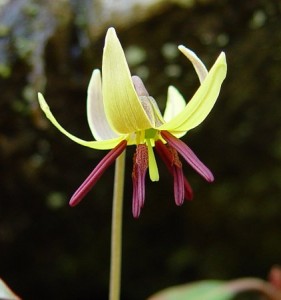
White Trout Lily

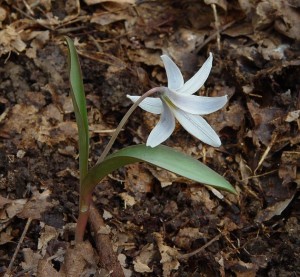
Our next two blossoms are in the same genus, Erythronium. The White Trout Lily is E. albidum and the Yellow Adder’s Tongue is E. americanum. First the White Trout Lily: Flower stalks, flowers, buds and the white bell-shaped flowers can be eaten raw or cooked. The young leaves are edible raw as well. They are crisp, tender, and tasty. However, the plant only has two leaves so if you are going to harvest them harvest only one leaf per plant. The bulbs are also edible after boiling. They are considered delicious. However, in large amount they can be emetic so consume within reason.

Yellow Adder’s Tongue

The Yellow Adder’s Tongue is slightly different. Like its relative its flower stalk, flower buds, and flowers are edible raw or cooked. The leaves can be eaten raw, such as in salads. Again, the plant only has two leaves so harvest responsibly. E. americanum bulbs can be eaten raw or cooked. They are crisp and chewy. However again, consume sparingly as they can be emetic. A third Erythronium, the European E. dens-canis, the Dog’s Tooth Violet, also has edible cooked roots. It is also the source of starch use to make pasta-like noodles or cakes. Leaves are eaten boiled. Don’t let the common name of the E. dens-canis — Dog’s Tooth Violet — confuse you regarding violets. Violets are in the genus Violas.  Violas do not have edible roots.

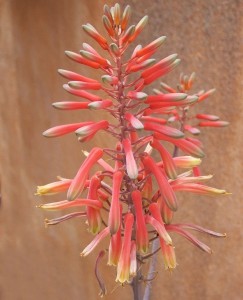
Aloe zebrina

The last flower to wrap up this “dekalogos” is the Aloe, but not necessarily the Aloe found in the health food store. Several Aloes have flowers with nectar that can be consumed, much like the nectar of the Tulip Tree blossom which starts part 19. Among the sippable blossoms are A. ferox and A. marlothii. A. zebrina has edible flowers and buds after being boiled. In Angola they are pressed into cakes. A. greatheadii flower buds are a delicacy after being boiled in three changes of water. There is no report on the edibility of Aloe vera flowers. But since that plant is medicinal, I would not eat them.

See Edible Flowers: Part Nineteen

{ 12 comments }