Helmet-like petals lend to the plant's botanical name

Lamiastrum is in the eye of the beholder.

If you want a ground cover that will grow in dry, shady places, Lamiastrum is exactly what you’re looking for. But it also likes sunny, watered places and is nearly impossible to eradicate after it escapes the dry, shady place you put it in. Formal gardeners love it or hate it with few opinions in-between. Foragers just eat it.
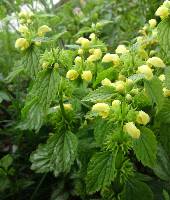
Lamiastrum galeobdolon

In the greater mint family, Lamiastrum galeobdolon (lam-ee-AS-trum ga-lee-OB-do-lon) is a native of southern Eurasia though it is particularly common in Great Britain. In the rest of the world it is commonly found in gardens, landscaping and is naturalized in a few states in North American. Among the places it has escaped cultivation in the United States are Washington, near Seattle where it is an official noxious pest, Northern California, northeast Minnesota, Michigan (including the University of Michigan Herbaium) Maryland, Pennsylvania, New York City, particularly Long Island, Massachusetts and Virginia (Fairfax County.) And to clarify, it is common in England, might be seen in southern Scotland, is found in Wales, and also north and east Ireland. It is also naturalized in New Zealand and Australia. Lower British Columbia is being invaded by L. galeobdolon variation florentium.

In fact let me list where it is native: Iran, Turkey, Azerbaijan, Georgia, Albania, Austria, Denmark, Finland, Sweden, England, Czechoslovakia, Germany, Hungary, Netherland, Poland, Switzerland, Belarus, Estonia, Latvia, Lithuanias, Russia, Ukraine, Bulgaria, Greece, Italy, Romania, France and Spain.
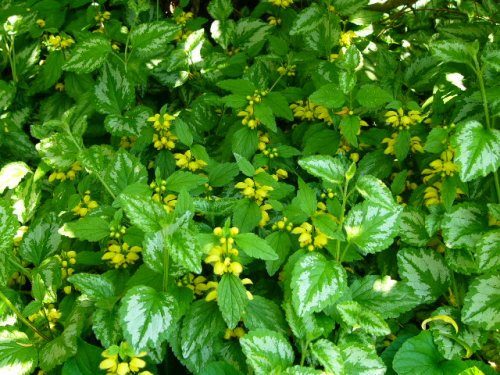
Lamiastrum galeobdolon Variegatum

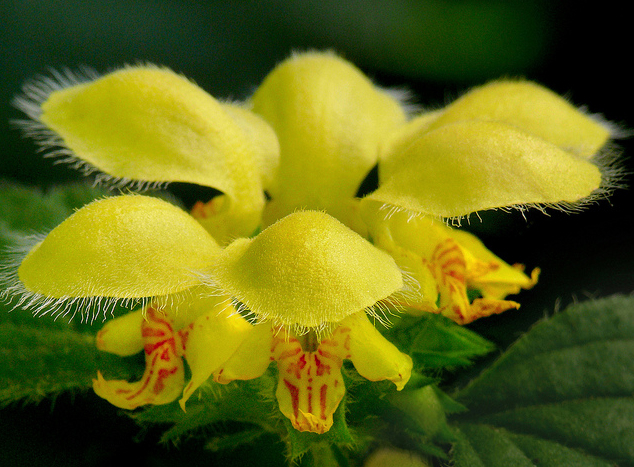
Also called the Yellow Archangle and Silver Nettle Vine, it’s been botanically bounced around. It used to be Lamium galeobdolon, making it a genus kin of Henbit, Lamium amplexicaule. Later it was Galeobdolon luteum. Now it is Lamiastrum galeobdolon, which means … this will not make much sense… Resembles a Lamium covered with a helmet with a fly’s sting… ya gotta love botanists and their attempts at Dead Latin descriptions. It is called “resembles a Lamium” because it looks like a Lamium or one of the Dead Nettle crowd. The helmet part probably refers to the upper flower petal. Where the fly’s sting came from no one knows though one should note “dead nettles” don’t sting. Maybe the red on the flower’s other petal looks like blood from a fly bite.
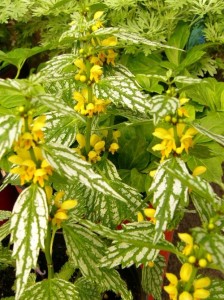
Herman's Pride

Depending on who’s writing there are one or two species or more, two or three subspecies or more, or two or three cultivars or more, and that might be relics of all the name changing, botanical egos and the ornamental trade. Herman’s Pride and Variegatum are variations of L. galeobdolon. There are scattered references to Lamiastrum montanum which is called in some places a subspecies of Lamiastrum galeobdolon or in others a species unto itself. It’s a tempest in an herb pot. At any rate, species or subspecies both Lamiastrum galeobdolon and Lamiastrum montanum have a flower spike with whorls of flowers. If it has eight blossoms it is the Galeobdolon. If up to 20 flowers the Montanum… for today at least… There is also a spattering of references to L. florentium, L. flavidum, and L. argentatum which all might be variations of L. galeobdolon. This may be overkill but L. Florentium is considered a variety of L. argentatum which is considered a subspecies of L. galeobdolon. Apparently Florentium and Variegatum are the same species. That is also the one inundating Seattle.
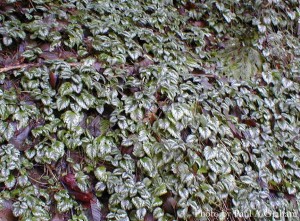
Lamiastrum galeobdolon ssp. argentatum

Herman’s Pride likes to clump and has green and silver variegations in the leaves very early in the season. Variegatum is similar to Herman’s Pride but the leaves are completely silver with deep green veins. Appearing to have a metallic finish, the leaves reflect sunlight and sparkle in the shade. Variegatum’s leaves are smaller, more narrow and pointed compared to other forms. While the Lamiastums resemble Lamiums they grow taller and faster and take more sun than the very seasonal Lamiums. Other than the Herman’s Pride variety they also create what appears to be a indefinitely spreading, vining mat, rooting where ever they touch the ground. There are many color variations.

Among several interesting aspect about the genus is deer don’t like to eat it, it can withstand a heavy frost, is extremely invasive, and can produce about 800 seeds per plant. While vegetative reproduction is the most common means ants are attracted to certain oils in the seeds and can carry them more than 200 feet from any seed bearing plant. For seeds to germinate they need to be moist and cool for six months, one reason why they grow well in England and why Seattle is Lamiastrum Ground Zero in the United States. (In Washington it is found in King, Kitsap, Sau Juan and Thurston counties as in the Mount. Baker Snoqualmie National Forest.)

Italy reports in 1985 from Centro CNR Per lo Studio della Chimica delle Sostanze Organiche Naturali c/o Dipartimento di Chimica, Universitá La Sapienza: The aerial parts of Lamiastrum galeobdolon subsp. flavidum two known iridoid glucosides, harpagide and 8-O-acetylharpagide, were isolated, together with a new iridoid diglucoside, 10-deoxymelittoside.

What’s an iridoid? It’s a bitter substance some plants produce to keep from being eaten. I said Lamiastrum was edible, not great. That said, like many close relatives in the mint family the Golden Dead Nettle is used as a green when young. Shoots and leaves are eaten boiled or sauteed in butter.

Green Deane’s “Itemized” Plant Profile: Golden Dead Nettle

IDENTIFICATION: Lamiastrum galeobdolon — Semi-evergreen perennial, evergreen in southern climates. Stems are erect, hairy, square like the mints,  and mat forming. Leaves are opposite, pointed, ovate to heart-shaped, one to three inches long and coarsely serrated; silvery with green veins and covered with short, fine hairs. They have a pungent odor when crushed… not exactly pleasant. Basal leaves lave long petioles. Flowers are yellow with brown spots and with a hairy ring inside, blossoms are 2-lipped, hooded, 3/4 in. long and in whorls in leaf axils; flowering June to July.

TIME OF YEAR: In northern climes shoots and leaves appear in spring, non-edible blossoms in June to July. In southern climates young leaves and shoots can be available year round.

ENVIRONEMENT: The Golden Dead Nettle is not fussy. It can grow in dry shady places or sunny watered spots. It thrives best in moist soil with partial shade.

METHOD OF PREPARATION: Young shoots and leaves, boiled or sauteed.
{ 2 comments }

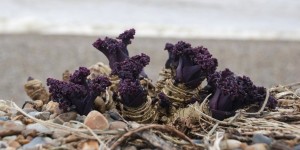
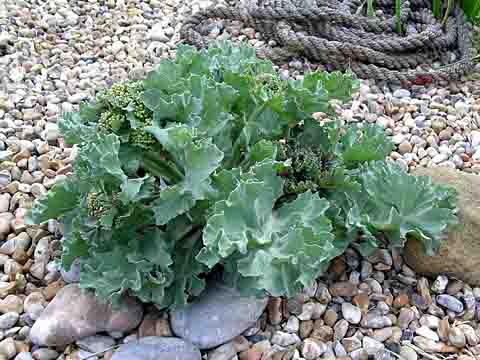
Sea Kale in seashore gravel

Sea kale is nearly the perfect primitive food. It’s difficult to imagine it not being on primitive man’s menu.

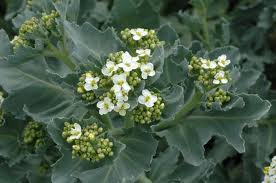
Sea Kale in Blossom, note four-petals per flower.

We know from middens that seafood was very popular with ancient peoples. Archaeologists think early man stayed on the shore because there is so much food there. Some coastal Indians of Alaska have a saying which in modern terms means: When the tide is out the dinner table is set. And while humans were foraging for clams, crabs, fish and other seashore edibles there was sea kale. The root is very nutritious and edible raw or cooked though more calories are available when cooked. The leaves are also nutritious and make a salad  ingredient or pot herb. The plant, which lives about a dozen years, makes an extensive root system with a lot of small roots that are easy to dig up. The root tastes good raw or cooked, has more starch than potatoes and some protein as well. The roots also travel well. Eat it today, or tomorrow, or a few days from now. It’s the original take out food.

Sea kale is mentioned in some of the earliest references to food. The Romans preserved it in barrels for sea voyages. Its high vitamin C content prevented scurvy.  Sea kale was cultivated in Europe from at least the 1600s until around WWII. Even Thomas Jefferson raised some in 1809. It’s been having a comeback of late in European restaurants. As for ways to eat it, Cornucopia II says on page 58:

Sea Kale roots and young shoots.

“The blanched leafstalks are eaten raw in salads, boiled, baked, braised or otherwise prepared as asparagus. When properly cooked they retain their firmness and have a very agreeable flavor, somewhat like that of hazelnuts, with a very slight bitterness. The leaves can be boiled until soft, minced, seasoned with garlic, and served as spinachy. Plants can be forced indoors for winter use. “ There is one cultivar, Lily White. Other common names are blue seakale, sea-colewort, scurvy grass, and halmyrides.

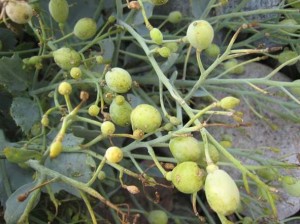
Blossoms give way to seed pods

There are also two other species, Crambe orinetalis and Crambe tataric. C. orientalis has a very thick root that is used as a substitute for horseradish. Young flower stalks can be prepared like broccoli. The seeds have an edible oil. C. tatarica’s young leaves are are blanched and eaten raw or cooked. Its root is thick and sweet and is eaten raw in salads or cooked, often seasoned with oil, vinegar and salt.

In the cabbage clan, botanically sea kale is Crambe maritima (KRAM-bee mare-rah-TEE-mah.)  Crambe is from the Greek “Krambe” meaning cabbage or crucifer. Maritima means oceanside. While the plant can tolerate salt and grows happily on the beach it can be raised in regular gardens. In the common garden it takes about 100 days to reach maturity.

Green Deane’s “Itemized” Plant Profile: Sea Kale

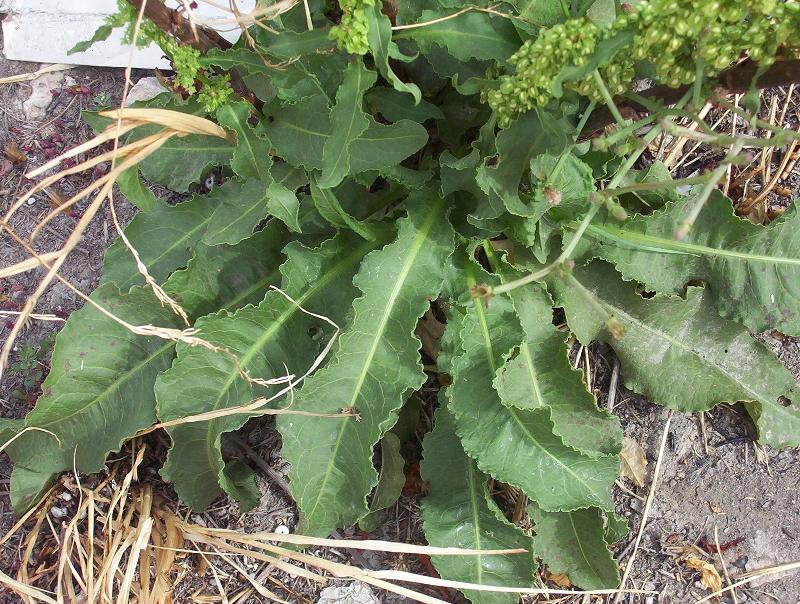
IDENTIFICATION: Crambe maritima, a perennial to about three feet tall and wide, leaves fleshy, smooth with purple veins, deeply lobes, wavy edges, hardy to zone 5 or colder, not frost tender, can be a summer crop down to about zone 8,  flowers from June to August, self-fertile.

TIME OF YEAR: Any time it is found. In the garden it’s slow to grow. While it can be eaten the first season it is best left alone until the third season. It will produce for about 10 years.

ENVIRONMENT: Found growing on the shore, coastal sands, in rocks, on cliffs, often near on the drift line. While most common in Europe it is naturalized on the coasts of California and Oregon and in many ornamental gardens.

METHOD OF PREPARATION: Many. The entire plant is edible raw or cooked, roots, shoots, stems, leaves, flower buds, pods. Young shoots are harvested when four or five inches long, crisp, and tender before leaves start to expand. Do not confuse sea kale with sea-kale cabbage, which is a different vegetable altogether.

Here’s a 37-second video showing Sea Kale. There’s no words or music but turn down your volume because of wind noises.

{ 19 comments }

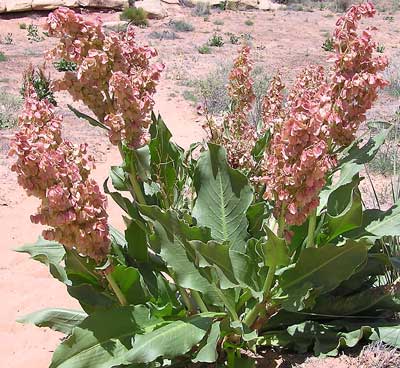
Rumex crispus, Curly Dock with unripe seeds

Harvard Professor Merritt Fernald

Mainer Merritt Fernald, who was the Harvard wunderkind of botany from around 1900 to 1950, said all of the 17 native Rumex species in North America were edible. He completely failed to mention most of them are so bitter it would take days of boiling to make them palatable, if ever.

Gastronomically there is a great divide in the Rumex family. Most are bitter, a few are tart. Those used for their bitter leaves alone include: Rumex arifolius, Rumex conglomeratus, Rumex crispus, Rumex hymenosepalus, Rumex mexicanus, Rumex occidentalis, Rumex salicifolius, Rumex venosus, Rumex violascens and Rumex patientia (the latter is cultivated in Europe and used like spinach.)  Used for their leaves and seeds are: Rumex rispus, Rumex obtusifolius (also called Butter Dock because it was used to wrap butter) Rumex patientia, Rumex pulcher, and Rumex sanguineus. Eaten for their tart flavor are: Rumex acetosa, Rumex acetosella, Rumex aquaticus var. fenestratus, Rumex articus, Rumex paucifolius, Rumex rugosus, Rumex sagittatus, Rumex vesicarius, and Rumex scutatus. The latter is too acidic to eat but is used for flavoring. It has one cultivar called the Silver Shield.  Rumex maritimus seeds can be made into mush, no ethnobotanical mention of the leaves. A couple of species split the difference, Rumex alpinus, whose stalks are used like rhubarb, and the previously mentioned Rumex hymenosepalus, also called Canaigre.

Rumex hymenosepalus, Canaigre

Canaigre is a large plant. Its stems and petioles were eaten by Native Americans like rhubarb (after much boiling.) They were made into pies and compotes. The boiled leaves are rated as an excellent green once rid of their bitterness. The roots are not edible but are 35% tannin, a good source of that material. The root was also used for mustardy to brown dye. Several attempts have been made to make Canaigre a commercial crop but never succeeded.

Rumex acetosella, Sheep Sorrel Leaf

The bitter Rumexes, or docks, have many medicinal application, from increasing red blood cell count to external use on wounds. Rumex juice is supposed to be good for stinging nettles bites but has not worked on me. The application I am most familiar with is using the long leaves of the Swamp Dock, Rumex verticillatus, as astringent bandages. Here in wet Florida the Swamp Dock — the only native — is the species spied most often except in winter or early spring. That’s when two versions of Sheep Sorrels sprout up , the previous Rumex acetosella, also known as Garden Sorrel.

The seeds of several docks can be harvested, cooked and eaten but they are not high on the foraging list, nor are the roots which are never eaten. However Euell Gibbons, the original Eat-A-Pine-Tree guy, had a use for the roots. In Stalking the Wild Asparagus after discussing forcing greens in the winter from dandelion roots he writes:

Euell Gibbons

“… take the front out of the box you are using, and lay the roots in tiers with the crowns facing the open side, sprinkling soil  between the layers of roots. This will form a stack with a backward sloping top and a rounded face which will bear the colorful leaves. Cover the roots well with soil, and leave outside until after a hard freeze. A few weeks after being brought into the warmth, these roots will begin to produce pale, translucent, curled leaves of all colors. Snip and wash these vegetables rainbows carefully to prevent bruising. Tastefully arranged on top of a salad they make a dish that looks almost too pretty to eat.”

Worldwide there are 190 to 200 Rumex, all in the Buckwheat family. Several are food for butterflies. There are rumblings among botanists to move the tart Rumex into their own and different genus. Don’t hold your breath.  Rumex comes from rumo, which is Dead Latin to suck, referring to the practice among Romans of sucking on the leaves to ease thirst. Modern Greeks call Rumex Lapatho. And now a new twist and an old recipe.

Twisted Dock

Twisted Dock

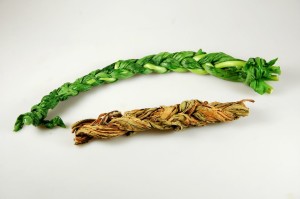
Fermenting Dock, by Pascal

I think I’m making some interesting new culinary discoveries with our humble Curly Dock. I bought this “Aveluk” from our local Middle Eastern store and it is a traditional Armenian dish. They basically sell dehydrated dock leaves which they
use to make soup. BUT…a simple dehydration does not really work, my own “avaluk” was still green after dehydration and did not taste the same. I think I know what the difference is. By making large strands and leave them hanging for a while, there is a fermentation going on before full dehydration giving it a special flavor. So with my next strands, I’ll just leave them hanging in the kitchen until dry. I did a quick test and I got the smell of cabbage after 3 days. Interesting… it’s all about details…

Aveluk Salad

From Food Planet

Ingredients: 
1 "tail" of aveluk,
1 garlic clove,
1 bunch of each: parsley, coriander, basil,
2 teaspoon white vinegar,
1 tablespoon of minced walnuts,
1 onion,
2 tablespoons of vegetable oil,
salt, pepper. 

Soak aveluk for 1 day in cold water, then boil it in salted water for 10 minutes, take out of water, let water flow down.

Fry onion with vegetable oil, then add aveluk, fry for 5 more minutes. Cool this mixture, lay out on the plate, add vinegar, green, garlic, salt, pepper, thoroughly mix, garnish with walnuts.

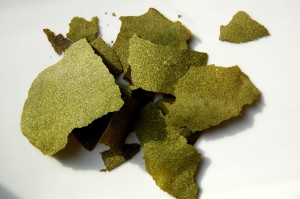
Curly Dock Nori

Curly Dock Nori

Also by Pascal, curly dock nori

100 gr (3.5 oz) Curly Dock Chopped
1 Garlic Clove
½ cup Water
2 Teaspoons Soy Sauce
¼ Teaspoon Salt
Blend everything and spread using a spatula on a silicone sheet.
Dehydrate at 160 degrees until fully dry.
{ 27 comments }

Topi Tambo, Gourmet Food Waiting To Be Discovered

A lifetime ago off the Maine coast at low tide there were many mussel shoals. The vertical tidal change near the rock-bound coast can be measured in several yards. At low tide you could “walk” off shore to many of the islands. That required slogging through smelly mud-broken-by-mussel beds, a mudless place to rest.

Mussel Shoal of Maine Coast

The best plan was to walk to an island at low tide on a Saturday afternoon, spend the night on the island as the tide came in, and then head back to the mainland the next afternoon at the low tide. We boys would build a fire, scavenge the shore for edibles including little crabs, trapped fish, clams and a few mussels. A traditional clambake followed using hot rocks and seaweed. We kept the fire going all night and slept in its glow. Do that today and several laws would have been broken and half the child protective service department would swarming over the place. We all know the headlines: CHILDREN ABANDONED ON ISLAND… video of my negligent mother being arrested at 11. Law suits would follow. Custody hearings et cetera … However, in hindsight what was special were the mussels.

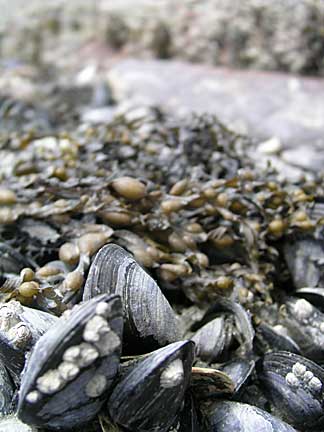
Mussels Near Brunswick Maine

They were very abundant and extremely easy to harvest. Other seafood took top billing but when the seaweed-covered rocks produced few crabs, into the fire pit went the mussels. Empty tummies must be fed. Normally the mussels weren’t eaten by most who thought themselves to be above eating the lowly bivalve. But go into a gourmet restaurant today and what’s on the menu? Mussels. And someday those same restaurants are going to discover Topi Tambo, a gourmet food only subsistence farmers still eat.

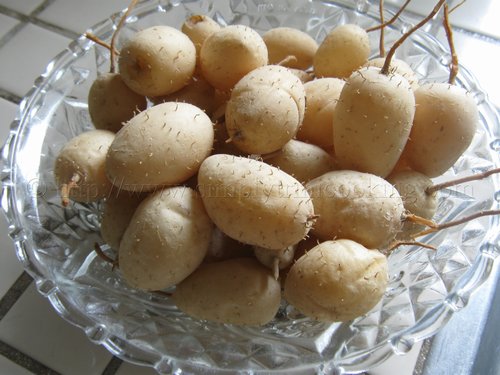
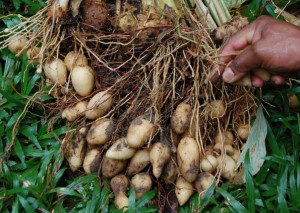
As mussels once were, one wonders why Topi Tambo has not been discovered by palate pioneers. The tubers when boiled remain crisp and have the flavor of sweet corn. Salting them increases their taste substantially. They can rival any hors d’oeuvres, make an excellent side dish or main entree. The leaves can be used to wrap food to give the food flavor and the young flower clusters are edible cooked.

Topi Tambo is harvested in the warm winter months

The only time of the year when the Topi Tambo shine is at Christmas when they are a traditional dish, though they are also sometime served on other religious holidays. They are boiled, peeled, salted and enjoyed. However, it is better to grow your own. In early 2012 they were selling for about $13 a pound. Imagine their cost when the gourmet markets find them. Exported to nearly every tropical region in the world, the little spuds have never taken off as a commercial crop despite their great gastronomic credentials.

Flowers Cooked Are Edible

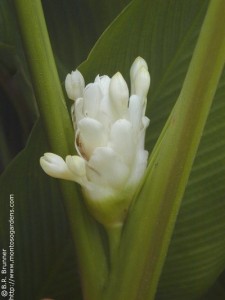
Botanically Topi Tambo are Calathea allouia. Calathea (kal-ATH-ee-um) means basket shaped, referring to the flower. Allouia (al-LOU-ee-ah) is what the Carib Indians called the plant. Leren is the Spanish term for the species,who wrote about it in 1562 and 1627. Other names include: Sweet corn root, touple nambours, alléluia, curcuma d’Amérique, dale dale, agua bendita, cocurito, lerenes, tambu, topinambur, topeetampo, topinambour, ariá, and láirem

Green Deane’s “Itemized” Plant Profile: Tipo Timbo

IDENTIFICATION: Calathea allouia: A herbaceous plant to three feet, ovoid or cylindrical, tuberous roots. Opposite elliptical leaves, to eight inches, grooved petioles. Flowers — greenish to yellow to white — are tubular in racemes. The plants bloom from June to August.

TIME OF YEAR: Perennial. Takes nine month to set a crop.

ENVIRONMENT: Full sun, ample water, high humidity, good soil but well drained. Does not like sand. Can tolerate temperatures down to 21º F.

METHOD OF PREPERATION: Tubers are boiled 15 to 30 minutes. They can be peeled then, or, the entire tuber can be put in the mouth and the skin removed and spit out. It is not edible. Flowers can be boiled. The tubers are about 7% protein and 15% carbohydrates.  Raw at room temperature they can be stored for three months. Refrigeration raw shortens their quality quickly. A tincture made from the leaves is diuretic.

{ 27 comments }

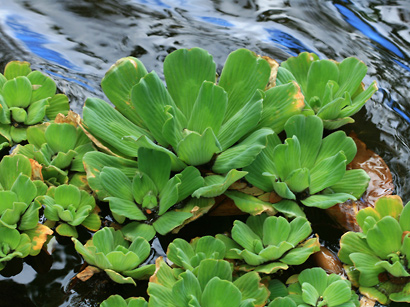
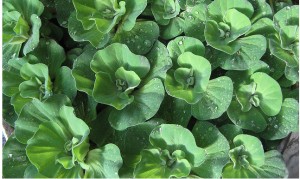
Water Lettuce, Pistia stratiotes

No one knows if Water Lettuce is native to North America or not. Botanists disagree with some saying it’s from Africa, a few South America. Explorer and plantaholic William Bartram came through Florida in 1764/65, spied the Water Lettuce, drew it and wrote what he saw:

 “…prodigious quantities of the pistia, which grows in great plenty most of the way [along the St. Johns River, Florida], and is continually driving down with the current, and great quantities lodged all along the extensive shores of this great river and its islands, where it is entangled… and… all matted together in such a manner as to stop up the mouth of a large creek, so that a boat can hardly be pushed through them, though in 4 foot water…”

Water Lettuce, A Famine Food, Must Be Cooked

The St. John’s is the only large river in the United States that flows north. (The Nile in Egypt flows north as do all the rivers in Siberia.) The St. John’s starts in earnest on the east coast of Florida at Lake Poinsett, not far from the Space Center and due west of Rockledge and Cocoa. Lake Poinsett used to be an ocean inlet and has skate in it that have adapted to the fresh water. The river then wends its way north between various limestone and other formations to exit at Jacksonville. We know Bartram got at least as far south as Orlando, which is a couple of hundred river miles upstream from the St. Johns’ outlet. As plants don’t float upstream how did the Water Lettuce get inland?

Pistia stratiotes distribution

As the rhyme tells us Columbus sailed the ocean blue in 1492. Water Lettuce is found in Africa. If the Water Lettuce came from Africa one would need to find a ship that was in fresh water in at least Northern Africa that then came to the new world carrying the plant with it. Water Lettuce would then get somehow up the St. John’s River, not exactly navigable by ocean-crossing sailing ships. Smaller boats with bits of Water Lettuce could have been rowed up stream. Indeed, one theory is that trade with St. Augustine, founded in 1565, could have introduce the plant inland. However, if I may wander…

Water Lettuce has many medicinal applications

In the early 1980s, some 30 years ago as I write, I interviewed a man called Roy W. Wall. He was at the time, if I remember correctly, 101 and lived to be 107. He still worked every day at the local hardware store which was on the inner coastal water way where the cities of Cocoa and Rockledge meet. In fact, he still walked to work. He told me that when he was a boy — in the 1880’s — the St. Johns river, which starts as a dribble perhaps 20 miles to the south west of Melbourne, would flood via Lake Poinsett all the way east to what is now U.S. Route 1 and the adjacent rail road tracks at Barton Boulevard. He said you could see from U.S. 1 what looked to be people floating on a sea of grass but were actually people polling boats on the flooded St. John’s. It is but a half-mile from that site to the intracoastal waterway. A small boat for exploring could have easily been carried from the intracoastal waterway to the St. John’s at Rockledge, with a plant or two with it. Or a bud or two could have stuck to clothing. Incidentally I asked Wall if he had any insight as to why he made it past 100 and he said he never worried about anything, a point his daughter then in her 70’sconfirmed. Roy Wall Boulevard in Rockledge is named for him.

Florida Ethnobotany

Dr. Daniel Austin in his massive book Florida Ethnobotany never mentions Water Lettuce. That tells us which side of that debate he is on. However it arrived, by ship, shoe or seagull (say that fast 3 times), it’s been clogging Florida waterways for over 350 years. It was also one of the first plants I investigated decades ago. Water Lettuce, aka Pistia stratiotes, is not high on the edibles list, but it is edible after cooking, usually boiling. In times of famine it has been consumed in India, China and Africa. More specifically it was recorded as consumed during the Indian famine of 1877/78, in the Sudan during famines and that the Chinese eat young cooked leaves. The problem is calcium oxalate. The plant is loaded with it, as are many other members of the Arum family.

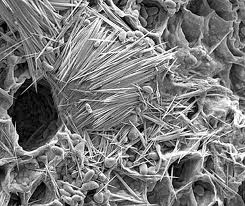
Calcium Oxalate Raphides

Calcium oxalate is in the form of crystals shaped like needles, raphides. Many plants have them, including some common edibles. The crystals mechanically burn the mouth and later can precipitate in the kidneys. Cooking can reduce the amount raphides, some with dry heat and others with moist heat. If you try to eat Water Lettuce raw it will severely burn your lips, mouth and tongue and more if you manage to swallow it. So don’t. If you do burn your mouth with some, immediate application of lime juice can ease the pain. If you cook it, try only a very small amount at first to make sure the burning element has been neutralized.

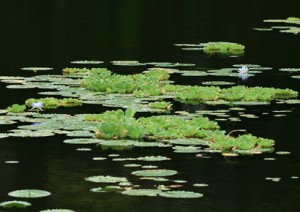
Water Lettuce, also called Water Bonnets, look like a floating open head of lettuce though the light dull green leaves are thick, ridged, and hairy. There are no leaf stalks, roots are light-colored and feathery. Flowers are inconspicuous. Linked plants can form dense mats, covering a lake shore to shore. They can stop boat traffic. I’ve had to tough my way through it many times with a canoe or kayak. It is considered a serious pest in Sri Lanka, Ghana, Indonesia and Thailand.

Studies indicate that Pistia stratiotes, a monotypic genus possesses diuretic, antidiabetic, antidermatophytic, antifungal, and antimicrobial properties. The botanical name, Pistia Strateotes is all Greek. Pistia (PIS-tee-ah) is from pistos, meaning water. Stratiotes (stra-tee-OH-teez) means soldier and was a name Dioscorides used for some Egyptian water plant, perhaps the same one.

Green Deane’s “Itemized” Plant Profile: Water Lettuce

IDENTIFICATION: A floating, stemless herb with a submerged mass of fibrous, hollow, feathery-hairy roots and an above-water rosette six to eight inches wide of light green spongy, wedge-shaped oval leaves 1.25 to 5 inches long, 5/8 to three inches wide. Six to eight vertical veins, rough-velvety, notched at the apex, inflated at the base where they can be .75 of an inch thick. Tiny white flowers, whorl of male above, single female flower below, on a spadix. Fruit green, slimy, with brown cylindrical seeds. Plant sends out runners from the tips.

TIME OF YEAR: Year round in warm climates

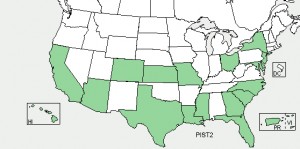
ENVIRONMENT: Floating in water or stationary in very damp soil. Water Lettuce is found in the Old South north to New Jersey and New York in protected areas, and westward to Texas, Arizona and California. Also present in Hawaii, Puerto Rico and the Virgin Islands. It’s found in some 17 states and will tolerate moderate freezing.

METHOD OF PREPARATION: Cooking more or less reduces the calcium oxalate. Try a little first, wait a few minutes to see if a burn develops. The usual method of cooking is boiling. Fresh juice can numb minor cuts.

Here’s a short video on the species by the state of Florida.

http://www.youtube.com/watch?v=zoZNBSD2KR4

{ 20 comments }