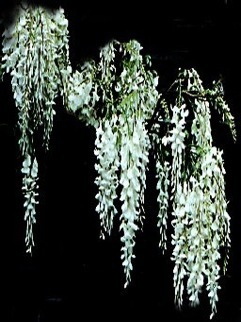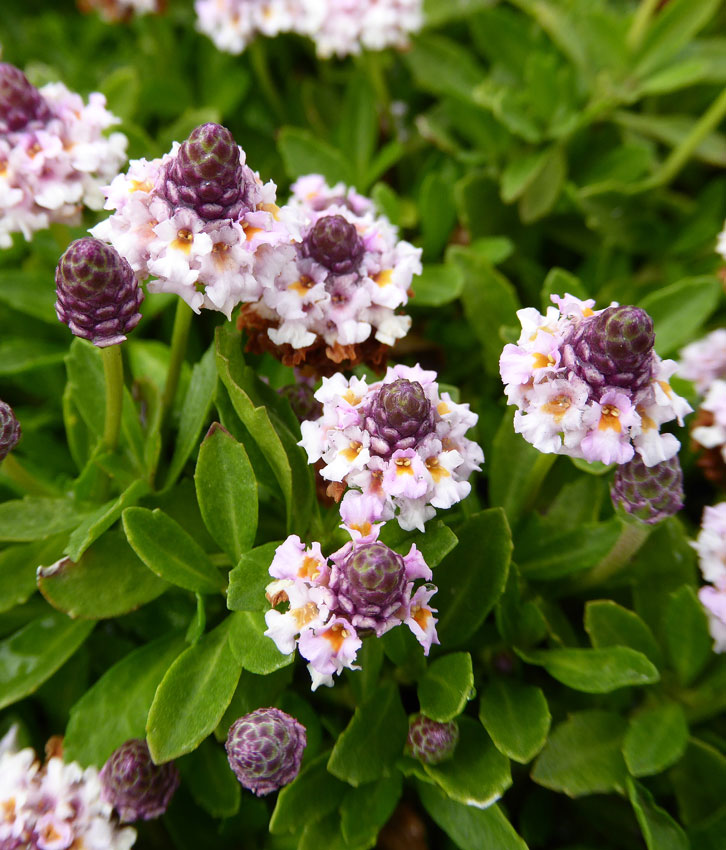
Frog Fruit was not always called Frog Fruit. Photo by Ron Wolf.

It’s only natural that humans are inventive with something that is uniquely their own: Language. A good example are those small vehicles towed behind large Recreational Vehicles. As they are towed and smaller they are called “toads.” An entire culture has evolved around towed toads. The same thing happens with plants.
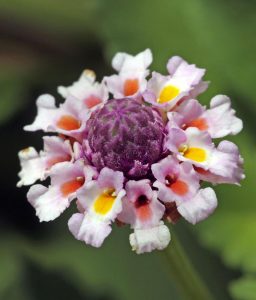
Many flowering clustering at the node. Photo by Ron Wolf.

Phyla nodiflora (FIE-la nod-dee-FLOR-ah) has at least two common names, Frog Fruit and Match Head. The latter is a more modern term and useage. Wooden matches were invented about 213 years ago.  “Frog Fruit” like a towed toad, is a turn of tongue but much older. It started out Fog Fruit. What farmers noticed 700 years ago was that after mowing the grass for hay other species quickly came up. Those were called Fog Fruit as meadows often had fog in the early morning. By a century later Fog Fruit and dampness were connected. It was but a short hop from Fog Fruit to Frog Fruit as that particular species like to grow in damp places where fog developed and frogs like to flop about. The reference “Fog Fruit” is first found in print in the United States in 1886 (the year one of my grandfathers was born.) 
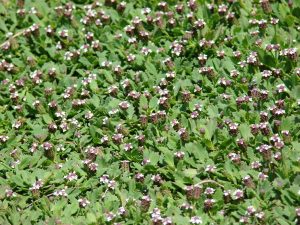
It is often found in mats.

To complicate matters there are actually four Frog Fruit locally, P. fruticosa, P. lanceolata, P. nodiflora, and P. stoechadifolia. The latter is woody so we can rule that one out easily. P. lanceolata is rare and found in only three counties in the spring and summer. P. fruticosa is also rare, reported in just one county, and is a tropical American native. That leaves P. nodiflora and the one you are most likely to find. Its leaves are widest above the middle. One major headache is the plant used to be in the Lippia genus and sometimes qualities of plants in that genus are ascribed to this plant now in the Phyla genus.  Plants in this genus have a long history of herbal use from treating rheumatism stimulating babies to walk. 

Phyla means tribe or clan. The genus was named that by Joao de Louriero, 1717-1791, because of the flowers are in a tight head. He was a Portuguese Jesuit missionary, botanist, paleontologist, and mathematician who spent several decades in what is now Vietnam. Nodiflora means flowers from the nodes.  As one might guess it also has a lot of common names among them Turkey Tangle, Sawtooth Frogfruit, Mat Lippia, Mat Frass, Capeweed and Creeping Charlie (as are many, many plants.) In the Verbena family it is the larval host for the Phaon Crescent (Phyciodes phaon), White Peacock (Anartia jatrophae) Barred Sulphur (Eurema daira) and Common Buckeye (Junonia coenia). Good nectar source for hairstreaks.

Green Deane Itemized Plant Profile
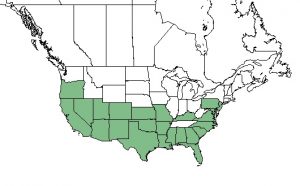
Frog Fruit Distribution in North America.

IDENTIFICATION: Mat-forming perennial with prostrate hairy stems. Stems freely branched, rooting at the nodes. Leaves opposite with a few large teeth towards the tip, leaf widest above the middle. Flowers rose-purple or white in t a head at the tip of a long stalk resembling a match head. 

TIME OF YEAR: All year

ENVIRONMENT: Damp lawns, beaches, hammocks, disturbed sites, marshes, wet pinelands and glades. Somewhat salt-tolerant. Likes sandy soil and limestone outcrops.

METHOD OF PREPARATION:  Leaves boiled (not that good) or dried to make a tea (tastes grassy.)
{ 6 comments }

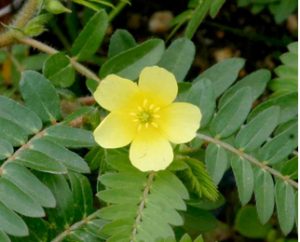
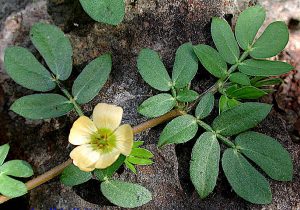
At first glance Big Calrop can resemble purslane. Photo by Green Deane

If you’re an adult with aging eyesight Kallstroemia maxima when first spied can look like purslane. A closer examination shows it is not. But they do bear some resemblance. While purslane is a prime wild edible (and also a commercial crop) K. maxima, aka Big Caltrop, is a famine food, or an acquired taste, whichever comes first. 

Tribulus terrestris is a close relative and marginally edible, too

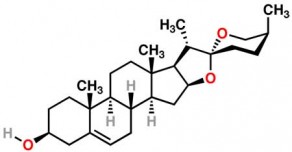
According to the botanical Gods there are 17 species of Kallstroemia, two local, K. maxima and K. pubescens. They are the next-to-last entry in Guide to the Vascular Plants of Florida by Wunderlin and Hansen. After Kallstroemia  is the genus Tribulus. T. terrestris, so-called Puncture Vine, is a questionable weight-lifting supplement. It has been implicated in gonad shrinkage. The usual explanation is T. terrestris — which is also marginally edible — provides testosterone thus the gonads do not need to make it naturally so they give up the ghost so to say and shrink… permanently. K. maxima has the basic birth control pill hormone diosgenin. As Kallstroemia and Tribulus are closely related I would not make it a habit to eat or use either a lot whether male or female.  

Big Caltrop leaves are bipinnate.

Daniel Austin, in his book Florida Ethnobotnany, managed to craft one full page on the species. We know it’s in the Zygophyllaceae Family which includes Lignumvitae. K. maxima is the most wide-spread in Florida with K. pubescens listed as rare and only in Franklin County though it is more common in tropical area.  We also know people in El Salvado and Colombia occasionally cook the young leaves of K. maxima for famine food. Medicinally the species has had many applications. It is a diuretic and a laxative. Crushed leaves have been put on boils and other sores. In Cuba concoctions are used to treat skin problems and as a decoction or a tincture for urticaria. In Venezuela it is used to treat abscesses and tumors.   The species is also known to sicken domestic animals and is very toxic to sheep.  However, it seeds are an important food for dove and quail. 

Diosgenin

As an aside I question the fogginess of several references regarding plant hormones. I was not allowed to take chemistry but it would seem  T. terrestris, which can stimulate testosterone production, is different than K. maxima which has diosgenin. That hormone was originally isolated in yams and used to make birth control pills. More to the point calling K. maxima “green viagra” as some writers do, would seem to be heading in the wrong direction with the wrong sex. The entire plant has been reported as a contraceptive for women. That’s quite chemical difference than being an analogue molecule for or stimulant for testosterone. Diosgenin can through several processes end up as testosterone but it can also end up estrogen. Big Caltrop and Puncture Vine might be all right as a food now and then but uses beyond that — such as dried and as a supplement or tea — should come under close chemical scrutiny.  

400-year old Caltrops

The genus is named for A. (Andrew?) Kallstroem who was a friend of the botanist Giovanni Antonio Scopoli for whom the genus Scopolia and the drug scopolamine are named. The name Kallstroem itself means “Spring River.” The common name, Caltrop, has a rich if not bloody history. It is a jack with three or four spikes that comes to rest with some spikes up. At least a thousand years ago it was thrown in front of advancing cavalry. “Caltrop” comes from calatrippe from the Latin calci —spur or heel – and trappa meaning trap… Or heel trap. And in Dead Latin the Romans called Caltrops… Tribulus which means “jagged iron.”    

Green Deane Itemize Plant Profile

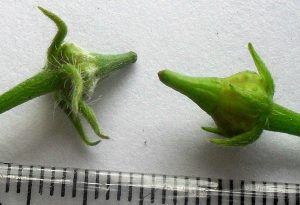
K. pubescens, left, has hairy seeds, K. maxima, right, does not.

IDENTIFICATION: Prostrate herb with ascending stem tips; leaves opposite, once-pinnately compound, even-pinnate; leaflet shape variable in detail, but generally oblong-elliptic with acute ends and asymmetric bases, especially so on the terminal leaflets; flowers axillary; petals yellow or pale orange; fruits spiny. Terminal leaves are usually cloven like a cow’s foot. The seeds of K. maxima are not hairy, the seeds of K. pubescens are. One give-away for me are the blossoms that form a chalice shape before opening fully. 

TIME OF YEAR: It grows and blossom all year except in the most northern regions where mild winter interferes. 

ENVIRONMENT: Open, disturbed habitats. That said I have seen it damp places that dry occasionally to dry spots that are only watered by rain. 

METHOD OF PREPARATION: Young leaves boiled. 


{ 1 comment }

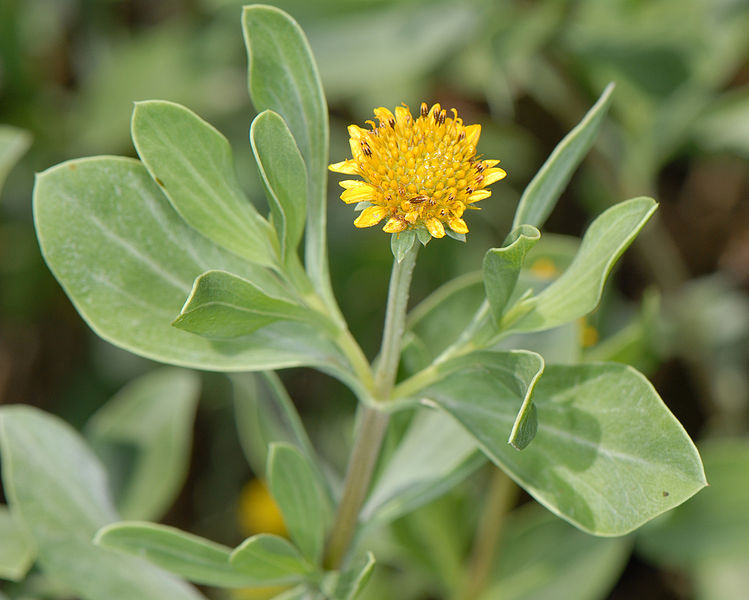
Sea Oxeye: Note the pointed green bracts directly below the yellow blossom. They are key to identification.

There are edible plants, and there are non-edible plants. Then there are those that sit on the cusp of edibility: Edible but not tasty, edible in small quantities, edible but with a horrible texture, edible but strong-flavored. That’s where one finds the bitter Borrichia frutescens, aka Bushy Seaside Tansy, Sea Oxeye, Bushy Seaside Oxeye, Sea Marigold and many other names in several languages. What can you eat? Leaves cooked or raw. 

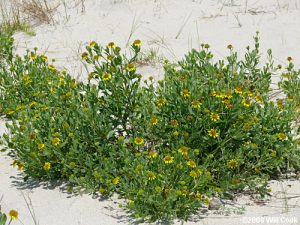
Typical Sea Oxeye display on the beach.

In his 909-page book Forida Ethnobotany Professor Daniel Austin managed to scraped up about one page worth of information on B. frutescens or what he called the Sea Oxeye. He begins by by describing the plants as colorful in salty area, both yellow blossoms and different hued leaves. He then descends into the common lament that two species (B. frutescens and B. arborescens) have been much confused in botanical literature. He notes that both were probably used the same way medicinally. The first medical reference to them is in the 1400’s. Uses include “boiling the leafy branches and talking the decoction for colds and coughs.” That same tea was also used for whooping cough, back pain, colds, chest complaints, asthmas and malaria. Most unusually an infusion of the leaves was widely considered an antidote for eating poisoned fish (ciguaterra.) 

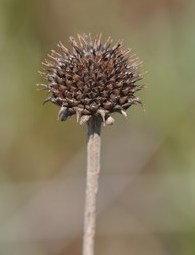
Sea Oxeye’s single blossom gone to seed.

Some references say both species have been used for food — or — folks have eaten one thinking it was the other. That’s a bit iffy as the two species are reasonably easy to tell apart —  if that is your goal.  They both have a bracts (leaf or petal-like growths directly below the blossom.) If the bracts are rigid and tipped with a spine they are B. frutescens. If the bracts are soft and not tipped with a spine they are B. arborescens. Also B. frutescens has gray leaves, B. arborescens green leaves in Florida. Elsewhere they can mix and match.  There is a third species as well, B. xcubana. It’s labeled rare and is found in Miami-Dade and Monroe counties (extreme south Florida and the Keys.)  Austin reports that B. xcubana is a hybrid between the two aforementioned species. Its leaves are intermediate in color — like both parents — and spines on the bracts are soft. 

As for edibility the references are sparse.  Cornucopia II reports for the B. frutescens: “The leaves are apparently eaten in salads or as a potherb.” Julia Morton did not mention the species in her book “Wild Plants for Survival in South Florida.” 

Green Deane Itemized Plant Profile

Identification: Stems usually erect, sometimes decumbent or arching. Leaves (at least mid-cauline) obovate or elliptic to oblanceolate. The single flowering head of is found on the ends of the main stem or branches of the plant. The ray flowers are yellow and the central disc flowers are brownish yellow. The heads are mature when the yellow ray flowers have fallen off, and the central disc flowers become dark brown and  very hard and sharp to the touch. Each disc flower produces a dark brownish-gray indehiscent (closed) dried fruit, an achene containing a single seed. The achene is short, 0.12-0.16″ and cone-shaped with three to four angles, each tipped with a sharp tooth.

Time of year: Flowers in late spring and or summer.  

Environment:  It is found in salt marshes, along dunes, at the wrack line and or in brackish locations. If covered by the wrack line it recovers quickly. Sea Oxeye grows on coasts from Virginia to the Yucatan Peninsula and also inland along the Rio Grande Vally. It is also found in the Florida Keys and has been introduced to Bermuda, the Bahamas and Cuba. 

Method of Preparation: Leaves raw (usually with vinegar in a salad) or cooked as a pot herb. 

{ 2 comments }

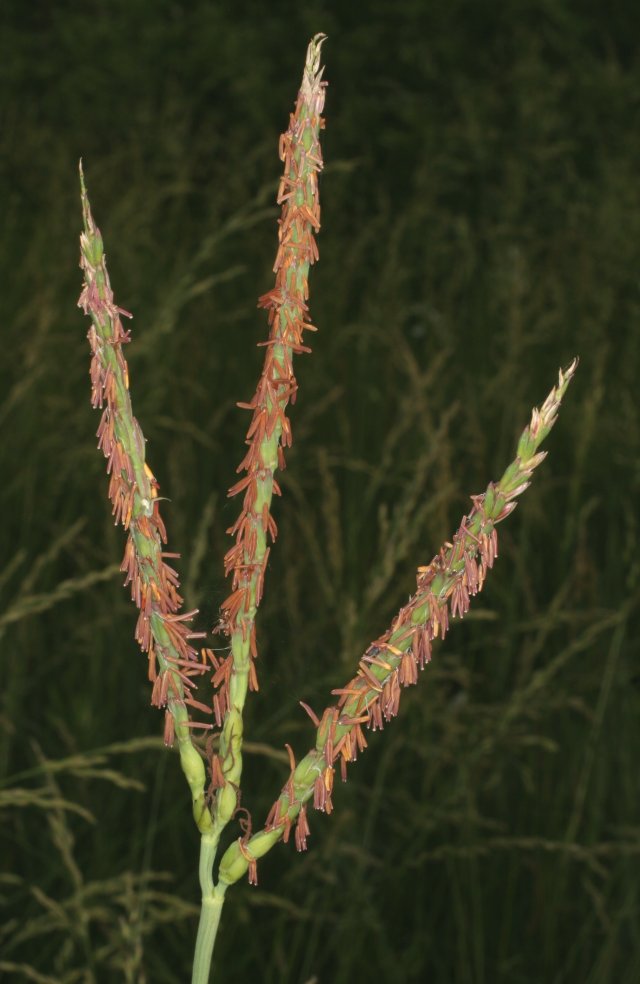
The showly male flowers of the Eastern Gamagrass, photo by Green Deane

At grass conferences I have been told more than once that there are no toxic native North American grasses (the problem are the imports.) Eastern Gamagrass (Tripsacum dactyloides) delightfully falls into the native description. And at 27% protein it’s one of the more nutritious native grasses if not the most nutritious.

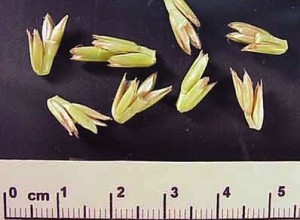
Eastern Gamagrass Seeds

Among its many names are Bullgrass, Eastern Mock Gama, Fakahatchee Grass, Gamagrass, Herbe Grama, Maicilo Oriental, Pasto Guatemala, Wild Corn, Zacate Maicero and Queen of the Grasses. Eastern Gamagrass is conspicoulsly absent from Native American Food Plants by Daniel Moerman. However, most of our ethnobotanical information on Native American foods is from western Indians and this is an eastern species. We certainly know the buffalo liked it as do cattlemen. They call it Ice Cream Grass because the cattle like it so much.  In fact over grazing by ranchers led to its replacement by other grasses and grains. (As a clump grass it needs to regenerate if grazed closely.)

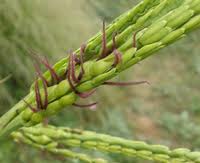
Female Flowers near bottom of spike

From our point of view the edible part is a tough yellow grain. Whether it can be used for flour depends upon availability. Left unmilled the grains will pop like Strawberry Popcorn. They can also be cooked whole like wheatberries or made into a gruel.

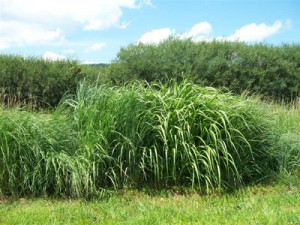
Eastern Gamagrass can grow nine feet tall.

The species can be found east of the Rocky Mountain states excluding northern New England. It is also native to Central and South America and the Caribbean.  The large clumps of grass can live to be 50-years old or more. Growing to eight or nine feet tall the leaf blades are flat and long, 12 to 30 inches and up to more than an inch wide. Leaves have a well-defined mid-rib near the stalk. Flower spikes are six to 10 inches long and are made up of several spikes, often three. Similar to corn it has separate male and female flowers but unlike corn each spike has both male and female flowers. Male flower are found on the top three-quarters of the spike and female flowers on the bottom fourth. (Look for gold rice-like bits on top of the spike, and  red-brown thread on the bottom quarter.) Technically it is male flowers on top with extruded anthers and cupulate fruit-cases on the bottom. One issue with the grass, however, is chill hours needed to germinate. Moist seed kept in cold storage for six to eight weeks germinate better than non-chilled seeds. There are two commercial cultivars, “Pete” and “Iuka IV.” Commercially a pound of seed costs about $20  if you order only one pound, around $17.50 per pound if you order a lot. There are 5,000 to 7,000 seeds per pound.

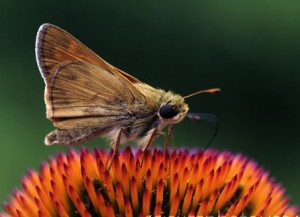
The Bunchgrass Skipper and deer like the species.

Flower spikes ripen from the top down. Seeds are produced from June to September. Yield is not high so it is a grain added to other mixtures unless one can find enough to make flour out of it. Efforts are underway to cross breed the plant to produce more grain but that will likely result in a hybrid with less protein content.

There is no agreement on what Tripsacum means. Many copied Internet sources say it means “polished” from the Greek verb Trivo, to polish or show signs of wear (the stem is smooth.) Frankly I think that is nonsense. I have a hard time getting triP… out of triV…  Not close even considering the Dead latin influence.  More so the usual botanical Greek term for polished is “gano” as in Ganoderma (polished leather.) Here’s a different view: The grains are tough. “Tripsis” in Greek — with a P not a V — means durable, tough. And “psakas” means grain or a small piece broken off. Put those together and bastardize them through Dead Latin and I can see easily Tripsacum. So I am going to say Tripsacum (TRIP-suh-kum)  means “tough grain.” Dactyloides (dack-ta-LEED-deez) means finger-like, referring to the flower spikes…. ghoulish long skinny fingers…

Deer like the seed as well and the plant is the  larval food of choice for the Bunchgrass Skipper butterfly. There is also a native Florida Gamagrass but it is confined to the southern part of the state, is much smaller, skinnier and endangered.

Green Deane ITEMIZED Plant Profile: Eastern Gamagrass

IDENTIFICATION: Tripsacum dactyloides, fountain-like clumps to nine feet tall, 4 feet wide. The leaves erect up to 2.5 ft long and an inch wide. Stems can reach six-feet long. Distinctive flowers spikes rise above the leaves on slender stems. Spikes have many tightly fused spikelets that take on the appearance of being ‘jointed’. When in flower the spikes appear to have golden grains of rice hanging from them. Leaves lack auricles but have a ligule that is a fringe of hairs. Rootstock is usually wider than the plant one reason for its use in land reclamation.

TIME OF YEAR: Flowers in late spring to mid-summer, seeds in late summer to fall. Frost colors the leaves red and bronze.

ENVIRONMENT: Moist areas around lakes, streams, swamps, ditches et cetera, full sun, fertile soil. Evergreen in frost-free areas.

METHOD OF PREPARATION: Winnowed seeds can be used like wheat. Seed will pop like corn.

{ 18 comments }


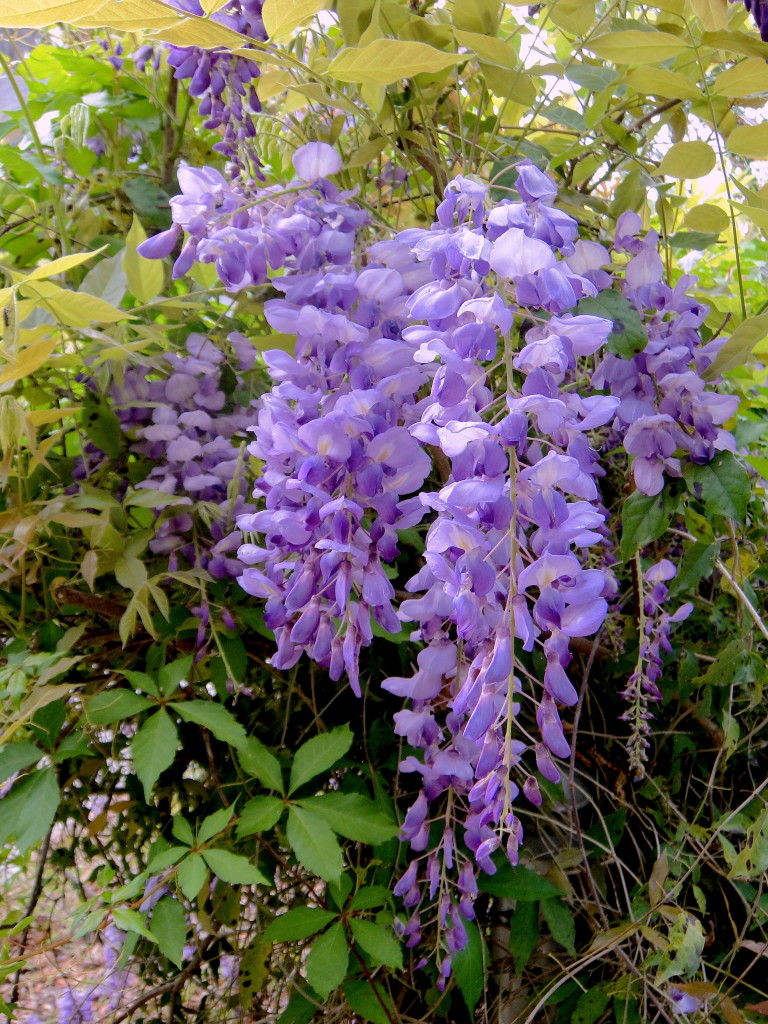
Wisteria sinsensis (Chinese Wisteria.) Photo by Kelly Fagan.

Wisteria sinsensis (Chinese Wisteria.) Photo by Kelly Fagan.

Wisteria, Wistaria

There is a duality to Wisteria, starting with those who think it’s an invasive weed and those who like to eat its sweet, fragrant blossoms.

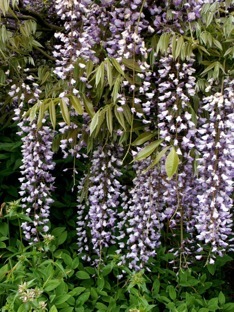
Wisteria floribunda (Japanese)

That dual nature is in keeping with the Wisteria which can also be spelled Wistaria. And how the genus got its name has two stories: Some say it is named after Dr. Caspar Wistar (1761-1818) physician, anatomist, vaccination champion and abolitionist. Others say it was named for Charles Jones Wister Sr., whose father, Daniel, paid for the voyage of the Empress of China which brought a Wisteria vine to North America from China. A former privateer built in 1783, the Empress of China was the first ship to sail to China from the newly independent United States. It also carried the first U.S. representative to China. Round voyage took 14 months. What they didn’t know was Wisteria was already here.

Wisteria frutescens (American)

Wiseria’s multiple personality continues with edibility. The blossoms of the plant are edible raw or cooked. The rest of the plant is toxic per se. In fact, as little as two raw seeds can kill a child. That is not uncommon for a member of the pea family which ranges from edible to toxic.

One of the most common of the 8 to 10 species of wisteria is Wisteria sinsensis, or the Chinese Wisteria, the one that hitched a ride on the Empress of China. It’s a vigorous, fast grower that doesn’t need fertilizer and fixes its own nitrogen. In fact, abuse improves blossoming as does pruning. It can live at least 144 years (as of 2014) some say hundreds of years and is consider an invasive species is some areas.  It has naturalized from  Maine to Florida and as far west as Arkansas. Not bad since its arrival in 1816. 

Wisteria macrostachya (Kentucky)

And while the Wisteria might have been named for the underwriter of the ship that brought it back from China there is a native Wisteria in North America, Wiseria frutescens. It has the smallest blossoms of the Wisteria clan. W. frutescens, the American Wisteria, has flowers that are not scented, and its seed pods are smooth not velvety. It is found Virginia to Louisiana down to Florida.  If you find smooth seed pods but lightly scented flowers you have the W. macostachya, or the Kentucky Wisteria, also a native (found in Louisiana, Texas, Kentucky, Illinois, Missouri and Oklahoma.)  To complicate things there is also Wisteria floribunda, from Japan. It is an escapee in the southern United States.

Wisteria venusta. White Wisteria blossoms are also edible

Now some qualifiers: In Japan young leaves of the W. floribunda (aka W. macrobotrys and W. multijuga)) are cooked and eaten, blossoms are blanched. The seeds are roasted. I have not tried that so I don’t recommend it. This holds true for the Wisteria venusta, or Silky Wisteria. It has white flower clusters six inches long, vine to 25 feet, 9 to 13 leaflets, counter clockwise twist. Its young leaves and young seeds reportedly cooked. Blossom have yellow blotch, AKA Wisteria brachybotrysThe seeds and leaves of the Wisteria japonica were used as a famine food — not recommended — and the flowers of the Wisteria villosa have been eaten.

As mentioned we almost know who Wisteria was named after. It is said Wiss-STEER-ree-ah. And while this is not too relevant it comes from the German/Old English word Wistar which means “steward of the food supply.”  Frutescens (froo-TESS-ens) means shrubby or bushy, Floribunda (flor-ih-BUN-duh) means free flowering, many flowers, and macrostachya (mak-ro-STAY-kee uh, or mak-ro-STAK, yuh) means large (flower) spike. Venusta (ven-NUSS-tus means beautiful, charming. Wisteria is considered a pest because it will climb on virtually anything in its path. When this includes other vegetation it also spells their demise. Some can grow to 100 feet long and 15 inches through.

 Green Deane’s “Itemized” Plant Profile

Dr. Caspar Wistar, 1761-1818

IDENTIFICATION: A leaf-losing perennial with pinnately compound leaves to 20 inches with 9 to 19 leaflets depending on species. Chinese Wisteria (W. sinsensis) has gray bark, velvety seed pods, jasimin-like fragrant flowers, twists counter-clockwise, 9 to 13 leaflets usually 11, vine can grow to 100 feet or more. flowering spikes to 12 inches.

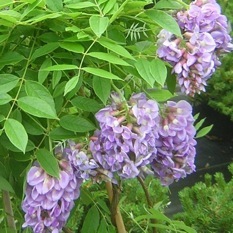
American wisteria (frutescens) has smooth seed pods, small flowers have no fragrance, clockwise twist, 9 to 15 leaflets, vine 20 to 30 feet, occasionally longer in old specimens, long-lasting flower spike five to six inches.

Japanese Wisteria (W. floribunda) has white stems, velvety seed pods, fragrant flowers, twists clockwise, up to 19 leaflets, vine grows to 30 feet, flowering spikes to three feet.

Empress of China Leaving New York Harbor, 1784

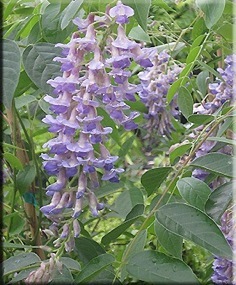
Kentucky Wisteria (W. macrostachys) has smooth or slightly velvety seed pods, small flowers, slightly lilac scented to no scent, counter clock twist (though I think that is a observational mistake) flower spikes to a foot, 9 to 15 leaflets, vine length 20 to 30 feet. The Kentucky Wisterias was once considered a variation of the American Wisteria. It blooms at a younger age than W. frutescens.

ENVIRONMENT: Full sun and well-drained soil, natives can tolerate some moisture and are found in coastal plains and along streams.

TIME OF YEAR: Depends on species and  location, mid-spring spring to early summer

METHOD OF PREPARATION: Blossoms raw or cooked, REMOVE THE STEMS!. The Japanese blanch their blossoms. Japanese Wisteria leaves boiled when young, seeds roasted, reportedly a chestnut flavor, leave also used for tea. None recommended regarding the Japanese Wisteria. Also raw seeds are toxic. The toxin is a glycoside which is usually a sugar molecule attached to a nitrogen molecule or the like and is stripped off during digestion.


{ 32 comments }