
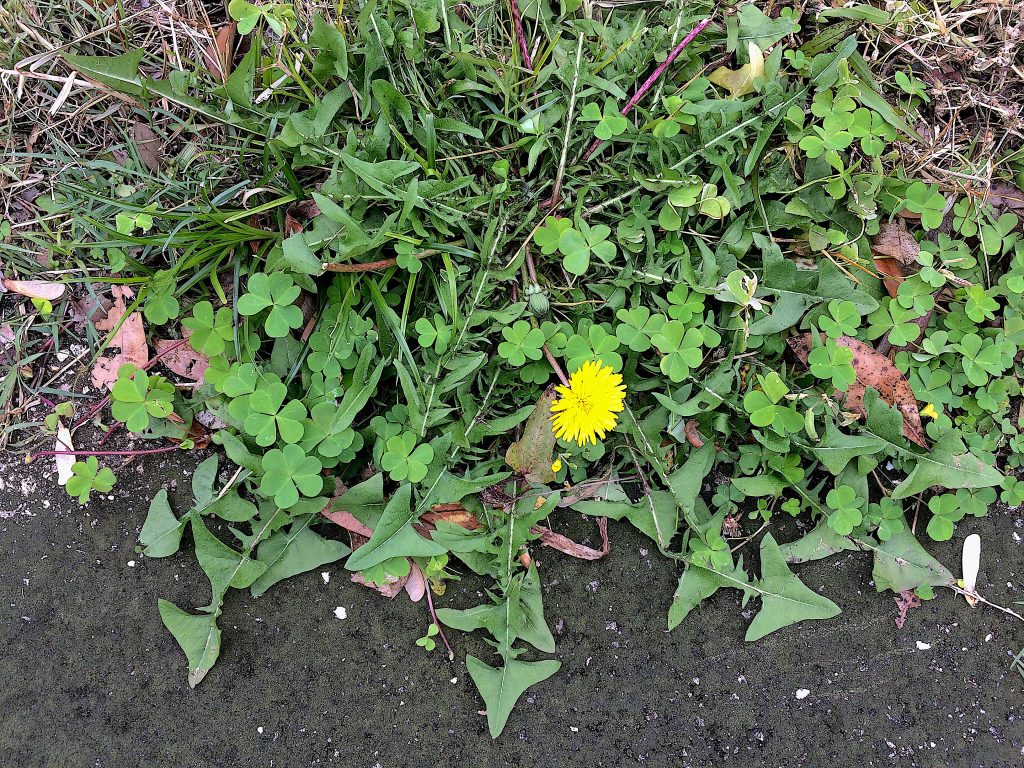
A sidewalk Dandelion and tart oxalises. Note Dandelions point away from themselves. Photo by Green Deane
When people ask me where can they find wild food I want to say “where can’t you find wild food?” On a short walk today there was, not a rare, but not-as-common as one would like winter edible, a Dandelion. And if you look closely there are some Oxalises in there as well, I suspect O. stricta. The key to finding wild edibles is to get the plant inside your head. It has to be as familiar to you as your friend’s face in a photo. You need what is called the “ability to disconfirm.” What is that? If you were going through a supermarket checkout line with a head cabbage but the clerk said it was a bunch of bananas you would disagree. If the clerk provided a reference sheet that showed a picture of cabbage but called them bananas you would still disagree because you know the difference between the two. You have the ability to disconfirm. You need that with wild plants and you get that way by studying them. An “app” is not an answer. It is better to own information in your head than rent it in your hand.
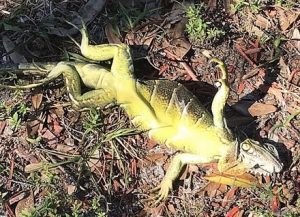
Chilled Green Iguana. Photo by Maxine Bentzel
Cold weather means different things to foragers in various parts of the country. For some it means finding cattail rhizomes in frozen ponds or fungi in the snow such as Oysters mushrooms. In part of Florida it means collecting Green Iguanas that have dropped out trees. When temperatures slides below 40 F. Iguanas slow down and stop. I’ve had them plop on the ground during winter classes in West Palm Beach. This past weekend we saw two Iguanas belly up in suspended animation. They are consider a delicacy in many parts of Central America and are raised for food. There was a report — whether true is difficult to confirm — of a fellow on Key Biscayne taking advantage of their cold-induced stupor. He reportedly collected several to take home to barbeque. He put them in his car… his cozy car… and while he was driving home they warmed up and weren’t happy causing an accident. You can read about eating Iguanas here.
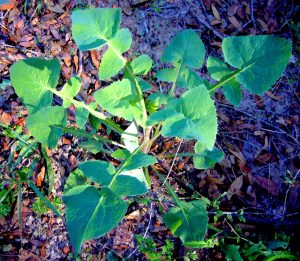
Common Sow Thistle. Photo by Green Deane
Sow thistles, abundant now, come in three varieties locally, all edible. The common sow thistle and the spiny sow thistle are found throughout most of the state and other parts of the country. The Field Sow Thistle is a northern resident that just gets into Florida. While Sow Thistles are here most of the year they prefer the cooler winter months and are easy to find. Of the two most populous sow thistles the Common Sow Thistle (Sonchus oleraceus) is the preferred. It’s edible until a fairly good size. It has smooth, soft leaves and often a bluish tint to its leaves. The Spiny Sow Thistle (Sonchus asper) is also good when gathered young. When older its leaves develop pseudo-spines which usually soften on cooking. But some people don’t like the texture. Don’t confuse Sow Thistles with true thistles or wild lettuce below.
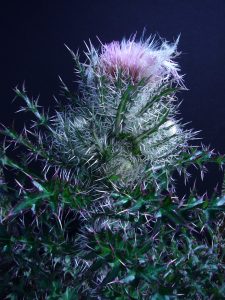
True Thistles draw blood. Photo by Green Deane
True thistles are mean. They produce either green basal rosettes with painful spines or basal rosettes with a fat tall stalk covered with needle-sharp spines and shaving-brush blossoms. When I was a kid we would pick the blossoms before they opened so we cold hang them up and watch them open into a ball of fluff like cotton. Best time to harvest them for food is when the rosette is huge or when the stalk is still small. Wild Lettuce— which is usually bitter — comes in several variaties. They, like the thistle, start out with what looks like a basal rosette then sends up stalk. Neither have spines. The lettuce leaf stalk is V-shaped. A single line of hair can be found along the underside of the main leaf vein. Those hairs can range from very soft to very stiff. The sap can be white, beige or white turning to beige. The leave width can vary, too. You can read about the sow thistles here.
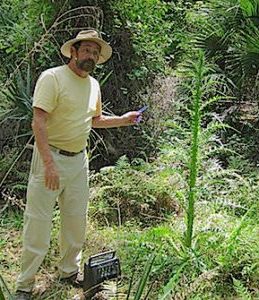
Foraging classes are held rain, shine, hot or cold. Photo by Nermina Krenata
Foraging Classes: This past week saw a cool class in east Orlando and a warm class in West Palm Beach. As one might expect wild mustard were plentiful and we also found some “real” chickweed, a fleeting winter visitor. This week, to cut down on the driving some, there will be a class Saturday in Altamonte Springs, northwest of Orlando, and a class in Jacksonville Sunday even if it is chilly.
Saturday, January 13th, Seminole Wekiva Trail, Sanlando Park, 401 West Highland St. Altamonte Springs, Florida 32714 (at the intersection with Laura Avenue.) 9 a.m. We meet in the first parking lot on your right immediately after the entrance.
Sunday, January 14th, Florida State College, south campus, 11901 Beach Blvd., Jacksonville, 32246. 9 a.m. Meet in front of Building D.
Saturday, January 20th, Spruce Creek Park, 6250 Ridgewood Ave. Port Orange, 32127. 9 a.m., at the pavilion. (First right after entrance.)
Sunday, January 21st, Bayshore Live Oak Park, Bayshore Drive, Port Charlotte. 9 a.m. Meet at the parking lot at the intersection of Bayshore Road and Ganyard Street.
Sunday, March 4th, Eagle Park Lake, 1800 Keene Road, Largo, FL 33771. 9 a.m. Meet at the pavilion by the dog park.
To read more about the classes go here.
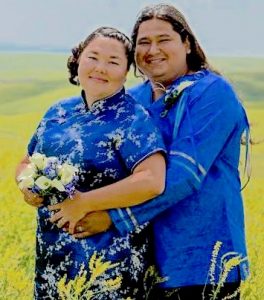
Keynote Speakers at the Florida Herbal Conference Linda and Luke Black Elk.
There are two conferences in February forager should be interest in: Earthskills in Hawthorn, and the Florida Herbal Conference near Lake Wales. I lead plant walks at both events. Earthskills is Feb 7-11 and the Florida Herbal Conference is Feb 23-25. Both are now accepting registration. You can register at Earthskills here. Because you read this newsletter you can get a discount for the Florida Herbal Conference. If you register for that conference between now and January 31 using the code FHC2018_GREENDEANE you can get a 30% discount. Keynote speakers this year at the Florida Herbal Conference are Linda and Luke Black Elk from the Standing Rock Reservation. Linda (of the Catawba Nation) is an ethnobotanist specializing in teaching about culturally important plants and their uses as food and medicine. She is a lecturer at Sitting Bull College in Fort Yates, North Dakota. Luke Black Elk (Thítȟuŋwaŋ Lakota) is a storyteller, grassroots activist, and traditional spiritualist. He has conducted research in water restoration, sustainable building design, and food sovereignty, and hopes to use these techniques to encourage a more traditional way of life among his people. Luke has lived on the Cheyenne River Sioux Reservation his entire life, becoming deeply involved in cultural and community activities. For more information about the Florida Herbal Conference go here.
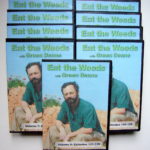
Green Deane DVD Set
All of Green Deane’s videos available for free on You Tube. They do have ads on them so every time you watch a Green Deane video I get a quarter of one cent. Four views, one cent. Not exactly a large money-maker but it helps pays for this newsletter. If you want to see the videos without ads and some in slightly better quality you can order the DVD set. It is nine DVDs with 15 videos on each for a total of 135 videos. Many people want their own copy of the videos or they have a slow service and its easier to order then to watch them on-line. The DVDs make a good gift for that forager you know especially on long, cold winter months. Individual DVDs can also be ordered or you can pick and choose. You can order them by clicking on the button on the top right hand side of this page (if your window is open wide enough.) Or you can go here.
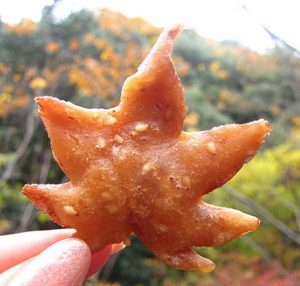
Deep-Fried Maple Leaf, more tempura than leaf.
If you look around nearly any lake or field now you’ll probably see trees ablaze with red, often long stretches of them taking up part of the horizon. Those are fruiting maple trees. Up north those spring seeds will be green, except on red maples (which incidentally are very toxic to horses.) When young, maple seeds can be quite sweet and eaten raw, or parched, or boiled. Usually the wings and hulls are removed first. By the time the wings have turned brown the seed is usually bitter so leaching, boiling and/or roasting might be needed. Some native tribes also sprouted the seeds for fresh greens after the long winter. In Japan one Maple species’ leaves are packed in salt for a year, rinsed, then cooked in tempura batter. Maples, of course, are also used to make syrup though that tends to be a more northern product although one of Florida’s Maples, the Box Elder, was used for syrup. To read more about maples click here
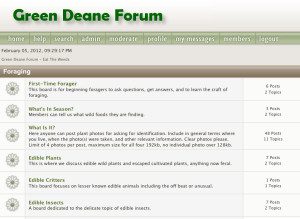
Green Deane Forum
Want to identify a plant? Looking for a foraging reference? Do you have a UFO, an Unidentified Flowering Object you want identified? On the Green Deane Forum we chat about foraging all year. And it’s not just about warm-weather plants or just North American flora. Many nations around the world share common weeds so there’s a lot to talk about. There’s also more than weeds. The reference section has information for foraging around the world. There are also articles on food preservation, and forgotten skills from making bows to fermenting food. One special section is “From the Frightening Mail Bag” where we learn from people who eat first then ask questions later. You can join the forum by clicking on “forum” in the menu.
This is weekly issue 286 and note there is one more article below.
If you would like to donate to Eat The Weeds please click here.
Full-Time Foraging
Can you survive off foraging? I am often asked that question and have been a consultant for individual, groups and shows who what to try it. While I customize my answer it usually contains similar essential things to consider. The quick answer is “yes” you can live off foraged food because humanity did so for a long time. But can you do that today and will you rough it like folks in the past or use a combination of yesterday and today?
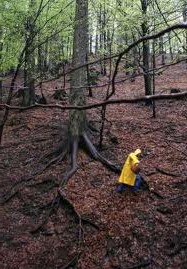 Before one gets into food particulars for living off just foraging there are many proforma questions that need to be answered. Is foraging legal in your area? Are there places you can forage, either private or public land? If you are going to forage and live off the land will you drink “city” water? Will you use electricity or gas to cook with? How about electric lights? Or are you going primitive? Is this a wood for heat, light and purifying water endeavor or will your foraged food be cooked on a modern conveniences under electric lights in air conditioning behind screens that keep out drive-you-crazy insects? Will you use a refrigerator? If you are you going to have a garden — either domesticated vegetables or intentionally planted wild species — will the local government let you? Do you know how to garden in your area? Gardening is more than just putting seeds in the ground and every area has different challenges. Will it be organic? Will you use old practices or things like modern fertilizer? What are the prime caloric staples in your area? Which creatures are the best to hunt or fish or trap? If you are going to eat creatures do you have the proper licenses and know the seasons? Will you make the hand line you fish with or is modern tackle allowed? Are trot lines or trapping legal? Those work while you do other things and can increase the chances of success.
As for food those who foraged for their daily sustenance also spend much time preserving food for the lean months. This brings up energy and daylight. There are only so many hours in a day and most of it will be expended getting food. Do you know how to dry or otherwise preserve food? And don’t forget things that evaporate time like illness, bad weather, and pests be they mammals, birds or insects which are also your prime competitors for wild food and garden crops. There is also the lack of variety or said another way your menu changes only with the seasons. Even if you can live off wild yams and fish every day after a few weeks that diet becomes torture. There are example of people who had only one thing to eat — even in abundance — but starved because they just could not eat the same food for another day. (Just as an aside my father during WWII has only cheese to eat for a month. For the rest of his life — some 66 more years — he never ate another piece of cheese.)
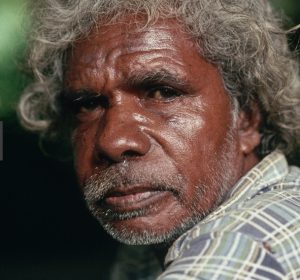 Are you going it alone or with others? Solo is hard. The Mountain Men of California went into the wilderness with 100 pounds of flour, 25 pounds of sugar, 10 pounds of salt, two horses, guns, ammo, fishing equipment and traps. Most of them died in their mid-30’s. Doing it all yourself wore them out and there were accidents and illness. In northern (warm) Australia there is a large area set aside where Aboriginals who want to live a hunter/gatherer lifestyle can. Those who do get 64% of their energy from things that move, and 36 percent from plants, essentially a two-thirds one-third division. Creatures are nutritionally dense and plants provide chemicals need for many metabolic processes. The Aboriginals also know the exact harvesting season of the animal or plant and are never too early or too late. They get maximum calories in for minimum calories out. They also have division of labor and help each other. Teamwork is essential as is efficiency.
Living off foraged food is more than just plant and animal knowledge. Besides being organized it also requires knowing how pure you are going to be. Are you going to use as few modern conveniences as possible, totally roughing it or a combination? Are you ready to do it every day with no time off? Will you try a pilot week first? A well-known forager tells a story a several teams being invited to live a month on some 700 acres. All they could take were the clothes on their back and one knife per person. Only a mother and daughter team made it the entire month. All the solos failed and bailed out by week two. What was mom and daughter’s secret? Beside knowing what they were doing, division of labor: “I’ll get the food and water, you get the firewood and start on tonight’s shelter.” The two greatest limiters are how much energy you have and how many hours of daylight you have. Those are critical make or break elements.
A few hundred years ago when there were no restrictions, tribes with many hands and a division of labor, living off the land was a living. Modern society puts a lot of restrictions in the way but eases other problems with electricity, clean water and a safe bug-free climate-controlled place to sleep. There are benefits and trade offs. So when I am asked can you live off the land the answer is yes. But you also have to know how you want to do it, how to do it, and have the personal wherewithal to do it.
Dean
Thanks for continuing your newsletter and education on the wild edibles of Florida. Your practical but methodical approach is, I think, what attracts so many folks to your teaching. I look forward to attending one or several of your classes one day and will continue to harvest under foot.
Wes
Dean, thanks for recommending “Weeds of Southern Turfgrasses”. It has GREAT pictures to help identify the many plants that grow in my yard. Yes, having a good picture is vital to me!
I love your answer to the full-time foraging. Most people just don’t understand that finding food takes up 90% of your time!