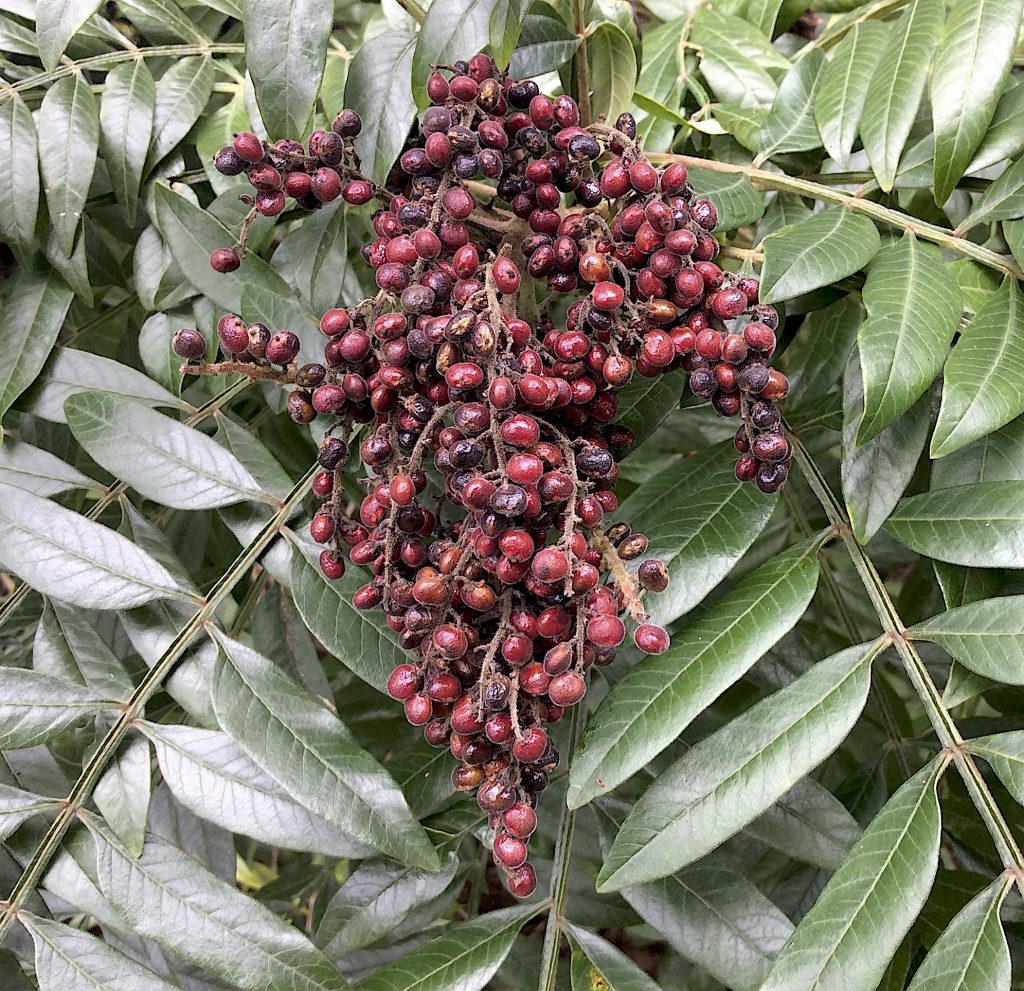
Winged Sumac, berries are tart like an apple. Photo by Green Deane
Our Sumacs are happy. Everywhere you go now they are sporting terminal clusters of garnet-colored berries. It is time to harvest Sumacs for use today or later. There’s a wide variety of Sumacs. Perhas 325 in the genus. Locally it’s the “Wing Sumac.” In other areas of the country it can be the Staghorn Sumac which I grew up nibbling in Maine. Shapes and quality vary but they always have terminal clusters of garnet-colored berries, give or take a hue. The berries have hair on them. And on the hair is malic acid, the acid that makes apples tart. You can rinse the acid off the acid and make a lemonade-like drink. The berries can be dried, their coating knocked off then ground and used as a spice. Surprisingly Sumacs are high in the B vitamins (including B-12) but rather low in ascorbic acid which is nature’s form of vitamin C.In the springtime the shoots can be peeled and eaten raw or cooked. If you are worried about Poison Sumac it grows only in wet spots, has a much different leaf, and when in fruit has white berries positioned farther down the stem, not terminal clusters. Also Poison Sumac leaves have bright red stems, see photo below left.
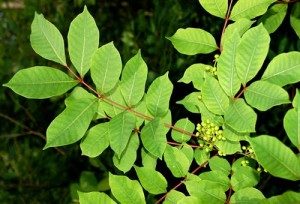
Poison sumac looks very different, wide leaves, green to white berries further down the stem. Photo by Green Deane
The hair’s tartness discourages creatures from eating the seeds. The acid is main reason why we harvest sumac, as it makes a delicious drink and reliable seasoning. Rain washes the acid off, leaving the seeds vulnerable. The shrub will, in time, replace the acid, but it takes weeks. Thus if we want to harvest sumac berries do so before any heavy rain or the rainy season. Dried clusters of sumac berries will stay tart for years, so harvest and store when you can.
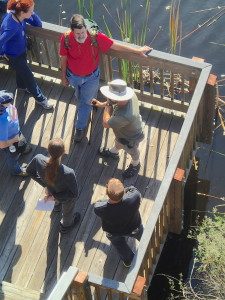
Foraging Classes are held rain or shine.
Foraging classes this weekend will have to keep an eye out for showers.
Oct 11, Mead Garden 1500 S. Denning Dr, Winter Park, FL 32789. Meet at the bathrooms. 9 a.m. to noon.
Oct 12 Spruce Creek Park, 6250 Ridgewood Ave. Port Orange, 32127. Meet at the pavilion. 9 a.m. to noon.
Oct 18th, Red Bug Slough 5200 S. Beneva Road, Sarasota. 9 a.m. to noon
Oct19, Eagle Park Lake, 1800 Keene Road, Largo, FL 33771. Meet at the pavilion by the dog park. 9 a.m. to noon
Bring cash on the day of class ($30 per adult) or click here to pay for your class. If cost is a hardship email me at: GreenDeane@gmail.com.
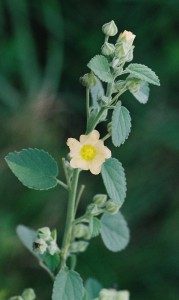
Sida cordifolia, photo by Green Deane
Is it Sida (SEE-dah) or is it Sida (SIGH-dah)? Either either it would seem… There are several members of the Sida genus locally and they blossom nearly all year. This weekend, however, Sida cordifolia was particularly happy. Taller and softer than some of the other genusmates, it’s a plant with a little bit of legal history. Plants in the genus tend to have ephedrine in them to varying amounts. Sida cordifolia, however, is the only Sida species mentioned in the Florida Statutes. If you make a pill using the plant it cannot legally be given to anyone under the age of 18. I doubt the problem is bootleg diet pills but rather youthful experimenting with ephedrine (an upper to use and old term.) Adults can apparently do what they want with the plant. S. cordifolia is not native. The species I see the most often is S. rhombifolia, which means diamond shape. The lower part of the leaves of that species do not have teeth on them. You can read more about Sida here.
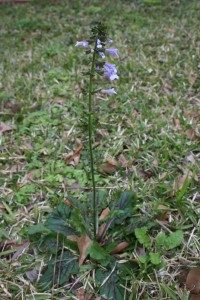
Lyre-Leaf Sage. Photo by Green Deane
In his book Edible Plants of North America, Francois Couplan writes on page 384: “the leaves of the S. lyrata, Eastern North America, contain an acrid principle and should not be ingested. They have been used to remove warts.” That said I know an herbalist who makes a tea from the leaves and a foraging instructor who cooks the young leaves and eats them. I’ve heard other reports of them being eaten. That can leave a person in a tough spot as to what to do with the plant. To eat or not to eat, that is the question.
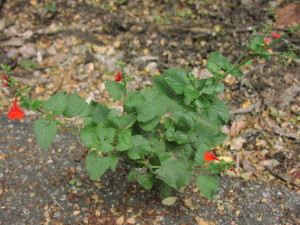
This sage made me wretchedly ill. Photo by Green Deane
Another example is also a sage, Salvia coccinea, also known as Tropical Sage, see photo left. A small piece of the blossom of this species — a very tiny piece, 1/8 inch square — made me horribly sick for several weeks. It attacked my stomach with viciousness and I was go-to-the-emergency room miserable. Coca-cola syrup and Pepto-Bismol combined were my salvation from doubled-over pain. I was actually “field testing” this plant for edibility at the time, one reason why I am very opposed to field testing. Yet, I know of two people who have eaten the young leaves with no problem. Perhaps it was a personal allergy on my part. I don’t know. But I do know I will never eat any part of that plant again. Ever. Lesson painfully learned. Yet it might be edible, or maybe some folks really do have cast iron stomachs. I know I don’t. (I inherited a tender tummy from one grandmother.) Eating this Sage is one of those “you’re on your own” kind of things.
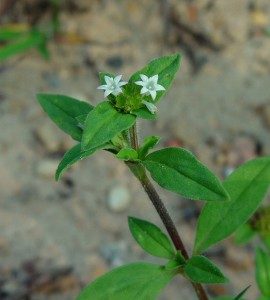
Richardia is generally not edible.
Another plant that falls into the crack between edible and not edible is Richardia scabra, aka Florida Pusley, see photo right. It is in a genus that has species intentionally used to make you throw up. In fact one is called Richardia emetica. That is not encouraging. Some people mistake R. scabra for chickweed, which is a Stellaria, a totally different genus. The plants vaguely resemble each other if one ignores several details and that fact that real chickweed only grows here in the winter time. R. scabra is a species for which I have never found any ethnobotanical references to regarding edibility. In fact it is one of three common plants that seems to have either not been used by the natives or somehow were not reported. The other two are Amaranthus australis and Hibiscus moscheutos. I know from modern reports that A. australis is edible but as for the H. moscheutos I have no idea though it comes from a very edible genus. Thus R. scabra is not on my site as an edible because I can’t find any historical reference to its use. Curiously the internet now calls it “edible.” I do know two people who mistook it for chickweed and ate it for quite a while. And I know two people who did not mistake it; they know it is a Richardia and they eat it from time to time. That might be a key element. Without any ethnobotanical reference perhaps a little now and then is okay but a steady diet of it is not. It is one of those unknown things. Sometimes eating little bits of this or that do not rise to the level of making you ill. I know a person who mistook Oak Leaf Fleabane (Erigeron quercifolius) for for Plantago major and ate some for quite a while without an apparent problem. And I have personally seen someone eat a leaf of Oak Leaf Fleabane against my advice. She was still standing at the end of class. So there are definitely edible plants, and there are definitely non-edible plants. But there can be some fog in between.
You get the USB, not the key.
All of Green Deane’s videos available for free on You Tube. They do have ads on them so every time you watch a Green Deane video I get a quarter of one cent. Four views, one cent. Not exactly a large money-maker but it helps pays for this newsletter. If you want to see the videos without ads and some in slightly better quality you can order the DVD set. It is nine DVDs with 15 videos on each for a total of 135 videos. Many people want their own copy of the videos or they have a slow service and its easier to order then to watch them on-line. The DVDs make a good gift for that forager you know especially on long, cold winter months. Individual DVDs can also be ordered or you can pick and choose. You can order them by clicking on the button on the top right hand side of this page (if your window is open wide enough.) Or you can go here.

Green Deane Forum
Want to identify a plant? Looking for a foraging reference? Do you have a UFO, an Unidentified Flowering Object you want identified? On the Green Deane Forum we chat about foraging all year. And it’s not just about warm-weather plants or just North American flora. Many nations around the world share common weeds so there’s a lot to talk about. There’s also more than weeds. The reference section has information for foraging around the world. There are also articles on food preservation, and forgotten skills from making bows to fermenting food. One special section is “From the Frightening Mail Bag” where we learn from people who eat first then ask questions later. You can join the forum by clicking on “forum” in the menu.
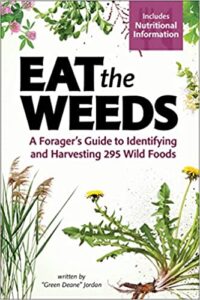
EAT THE WEEDS, the book, 274 plants, 367 pages, index, nutrition charts and color photos. It’s available in many locations including bookstores such as books a million, and Amazon. Most of the entries include a nutritional profile. It can also be ordered through AdventureKeen Publishing. This is weekly newsletter #646 If you want to subscribe to this free newsletter you can find the sign-up form in the menu at the top of the page.
To donate to the Green Deane Newsletter click here.