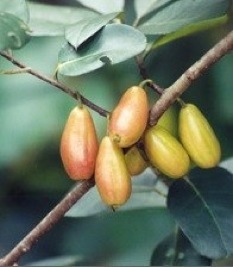
Strongback fruit

Bourreria succulenta: Soapy Fruit and Viagra

Botanists are feisty in their own way. The Strongback is a good example. Is it B. succulenta or B. ovata? One will say “succulenta” is right by international agreement, the other counters “succelenta” is the mere common term and it’s really “ovata.” Add to that about a dozen colloquial names and the teapot tempest steams on.

Strongback is a member of the Borage family and is another of those tropical fruit trees that sits on the cusp of edible non-edible, between forage food and survival food. Is usually found only in southern Florida and the Keys, good to know if you get stranded in the thousands of islands of Cape Sable. Fruit from several species in Bourreria genus are reported as edible. The Strongback is no exception but they taste on the soapy side.  A tea can be made from its bark.

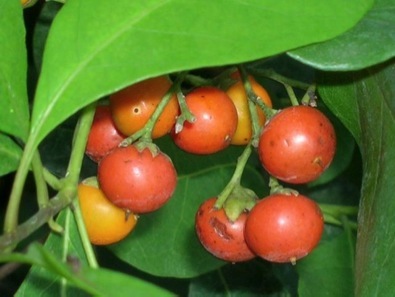
The sweet smelling flowers last through the summer and pea-size berries are red by October and persist on the tree. Butterflies and hummingbirds visit the tree as well as fruit-eating birds. Evergreen, as the tree ages its branches droop and remind one of a weeping willow. It is often found growing with other special locals including Marlberry, Wild Coffee, Orange Geiger, Palms and Jamaican Caper.

So why Strongback, not Strongbark? The tree, which is on the endangered species list for Florida, has been rumored for centuries to give men strong backs in the bedroom to do what needs to be done. While there has been no testing in the lab to support this the assertion is still made around the Caribbean (see Herb Blurb below.)  Polite folks incorrectly call it Strongbark.

Bourreria (bour-ER-ee-uh) is named for Johann Ambrosius Beurer, an 18th century German apothecary. Succulenta (suk-yoo-LEN-tuh) means fleshy, succulent, and ovata (oh-VAY-tuh) oval in shape.

Green Deane’s “Itemized” Plant Profile

IDENTIFICATION: A shrub or tree to 30 feet, with a buttressed base, narrow crown, reddish brown bark. Leaves alternate, broad ovals to 4.5 inches long, rounded or notched at the time, yellow green, glossy above, pale underneath

TIME OF YEAR: All year

ENVIRONMENT: Hammocks, moist rich soil

METHOD OF PREPARATION: Ripe fruit edible, a tea can be made from the bark.

 HERB BLURB

The tree has been used to cure thrush and other oral inflammations, a decoction with rum is considered an aphrodisiac in the Dutch Antilles, and the Bahamas, and Puerto Rico and Haiti and Dominican Republic and the Bahamas and also Cuba. It is often mixed with other trees for medicinal uses. Twigs are boiled with the Tabebuia heterophylla or Citharexylum fruticosum (Five Finger or Fiddlewood) to treat back pain or pain at the waist.  It was used to quiet nerves and treat kidneys. A shoot was boiled with Capraria biflora and Turnera ulmifolia (Ram Goat and Ram Goat Dash Along) to treat diarrhea. With Guaiacum sanctum (Lignum Vitae) it was used to treat headache, fever and stiffness in the arms and legs. A decoction with Thouinia discolor and Citharexylum fruticosum (Three Finger and Fiddlewood) was used externally to treat running sores in children.  The inner back was seeped with Swietenia mahagoni and Bursera simaruba ( Mahogany and Gumbo Limbo)  to treat low blood pressure. An emollient from the inner back was used to treat inflamed joints

{ 3 comments }

Cultivated Sugar Cane

 Saccharum officinarum: Sweet Wild Weed

Among the edible wild plants on this site are a few escaped fruit trees and ornamentals that have become naturalized. Let’s add another: Sugarcane.

I’ve grown sugar cane for several years in my yard, neglecting it actually. It grows happily just the same despite the fact I am more than 200 miles north of south Florida and on a dry hill. So that is the first surprise about sugarcane or Saccharum officinarum. It’s a tropical and subtropical plant, found from Florida to Texas as well as Puerto Rico and Hawaii. One does encounter it growing in the wild. It looks like very tall corn that has mated with bamboo.

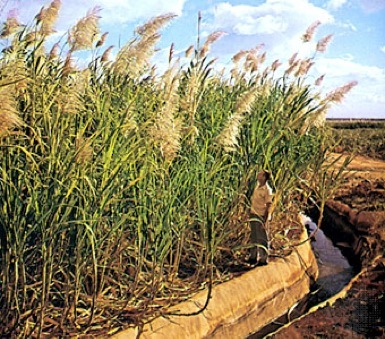
Sugarcane is actually a grass, a big grass — note the man in the picture above — and a perennial. There are a half dozen to three dozen species — botanists can’t agree –but that is kind of forgivable. Grasses are notoriously difficult to sort out, even when you know what it is. If you think it’s tough identifying mushrooms, try grasses for a real challenge.

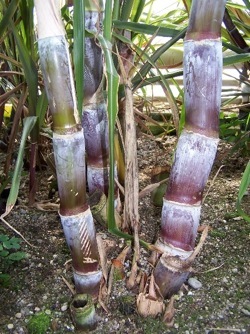
Bottom of Sugar Cane stalks

Let me give you two estimates which as first would seem wrong. There are about 195 countries in the world, and about 195 countries grow sugar cane. That’s can’t be because places like Canada and Sweden don’t grow sugarcane. There is a two-part explanation. The official number of countries is usually based on the membership in the United Nations. But several countries are not in the United Nations. Also sugar producers call some places countries that are not really countries, such as Puerto Rico and Bermuda. So two different measuring standards come up with the same answer — 195 — but their list of “countries” would be slightly different.

And while sugar cane is really mostly sugar — it is one of the most efficient plants there are — that’s not always a bad thing. In fact, sugarcane was included in military survival manuals because it is nearly impossible to misidentify and it does provide portable energy. You can use a stalk of it (a cane) as a walking stick and for food. You chew the end but spit out the fiber called bagasse (bah-GAS.) Once dry, bagasse burns well.

The clear sugar sap after processing is brown sugar, hence brown sugar is less processed sugar. Then it is bleached white. Also one can never get all of the sugar out of the sap and that becomes molasses, one of my grandmother’s preferred sweetener. She never used white sugar in her life. Any time anything called for sugar in went the molasses.

Sugarcane is probably from the area of India originally. Granular sugar was mentioned in writing some 5,000 years ago. It got to the Mediterranean Basin around 800 AD. Within 200 years there was hardly a village there that was not growing sugar cane. A sweet tooth is the one craving humans are born with. Sugarcane came to the New World some five hundred years later where it played a significant and controversial role, and still does.

Historical fact: Sugar was one of the first pharmaceutical ingredients, a sweetener to mask bitter medicine, hence the lyric… “a little bit of sugar helps the medicine go down.” There are generally three kinds of sugar cane grown, “chewing cane” “crystal cane” and “syrup cane.”

Saccharum officinarum (SAK-har-um of-fee-shee-NAR-um) means “sugar of the shops.” Officinarum comes from Latin and the Romans. Government-approved food and medicine in the Roman Empire were sold in designated shops. It was a standard of quality.  Thus something sold in a shop was what we would call the authorized version, or the official version, the real McCoy.  (See my article on Palmetto Weevils.)

Green Deane’s “Itemized” Plant Profile

IDENTIFICATION: Giant grass, eight to 20 feet, resembles corn, solid, jointed, juicy stalks, one to two inches thick, tough. Leaves three feet or more long, two to 2.5 inches wide, thick midrib, fine sharp teeth on the edges. Spikelet are white, hairy, plume like, two to three feet long. Can grow straight up or fall over.

TIME OF YEAR: This year’s sugar cane is usually harvested in November, but in a wild stand, nearly year round.

ENVIRONMENT: Moist, low areas as well as abandoned cultivations particularly in the Everglades.

METHOD OF PREPARATION: Stems are peeled and chewed for the juice. Or, they can be peeled, crushed and boiled for the syrup. Once a sweet syrup is obtained, or sugar, it can be used for many things, from making wine to fuel.


{ 16 comments }


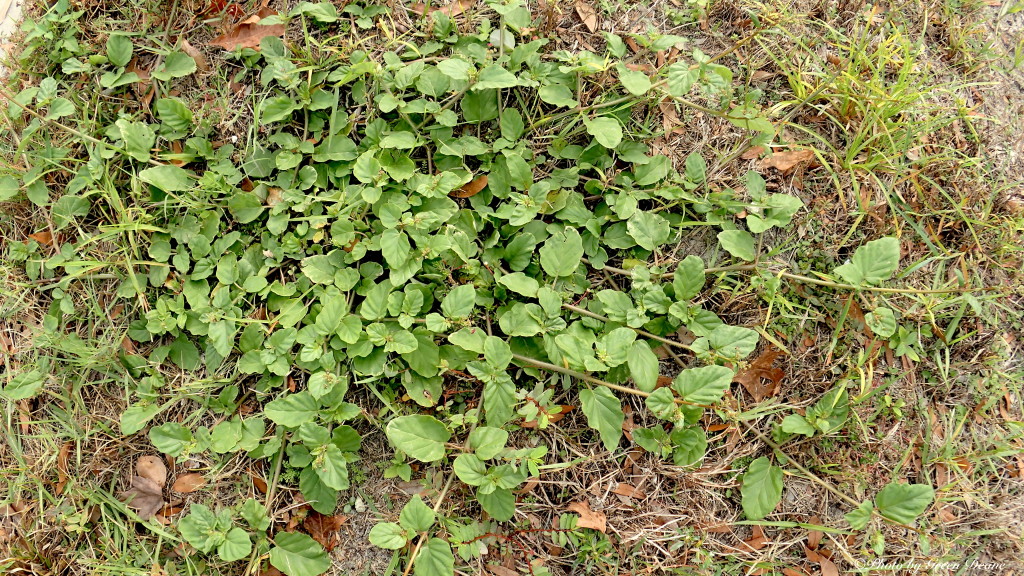
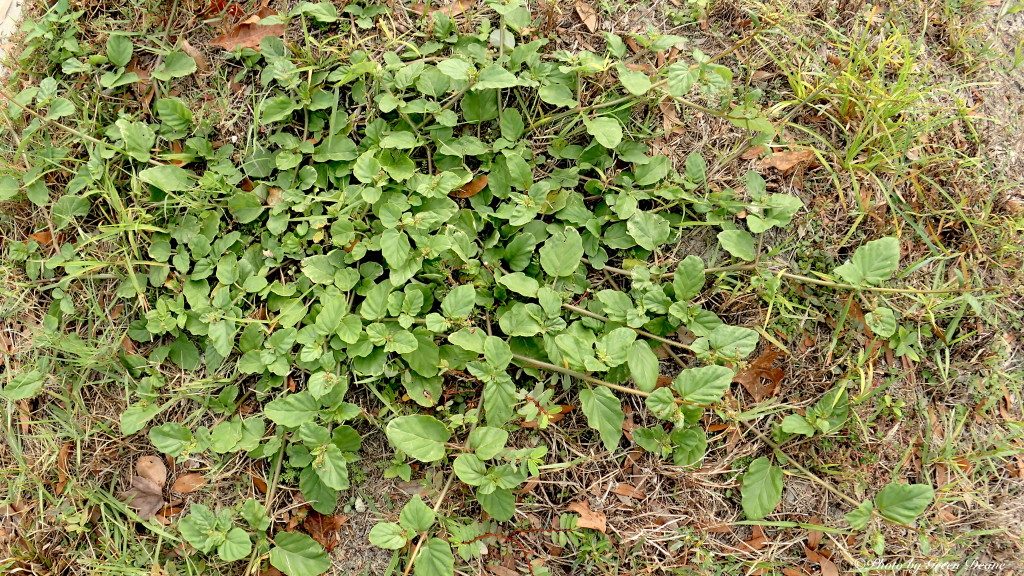
The Tar Vine's growth habit is to spread out. Photo by Green Deane

The Tar Vine’s growth habit is to spread out. Photo by Green Deane

Boerhavia diffusa: Catchy Edible

Some times you just can’t identify a plant. Some times you’re frustrated for a few days, other times for a few years. The Tar Vine eluded me for about 15 years.

I will admit to a short attention span, so over those years I would see this particular plant and tell myself to look into it but then I’d see something more interesting. More so, I was born with no patience and have even less now. But that’s off topic, so I’ll get back on track with a short story.

Way back in the mid-90s I knew an unusual fellow named Jose Gotts. I was a member of the local Native Plant Society at the time and went on many excursions with them. Gotts was one of their reigning individuals.
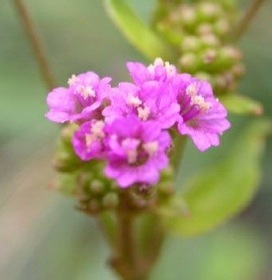
Tar Vine blossom, should be more on the rouge side

Picture, if you will, an aging roundish man, short, with an Algerian accent and horn-rimmed glasses, rummaging through the woods in Central Florida wearing only shorts. No shoes, no hat, no shirt. That was Dr. Gotts. Yes, doctor. He had a PhD and more in physics but was a botany professor. I never sorted that mystery out. I once asked him about the Boerhavia, though I didn’t know what it was at the time.  He told me he had been trying to figure out what that plant was for a long time. He called it Soldier Weed because, he said, it was found everywhere soldiers were. He didn’t know, and I didn’t know, so it was an easy plant to ignore for another day. More than a dozen years later it was brought to my attention by our next Euell Gibbons, Marabou Thomas, a young man on the fast track to greatness. You read that here first.

The problem with Boerhavia diffusa is that locally it rarely grows in wholesome places. One usually sees it eeking out a solar living in sidewalk cracks, or a gnarly rubble pile with trash and garbage. The Boerhavia diffusa is known by the company it keeps. For a plant found on the wrong side of the tracks, it has good side of the track nutrition.

According to a 2008 study championing underused wild edibles it contains saponins, alkaloids and flavonoids. It’s 82.22% moisture, 10.56% carbohydrates, has 44.80 mgs of vitamin C  per 100g dry, 97 mg of vitamin B3 and 22 mg of  vitamin B2. The mineral content per 100 grams is sodium 162.50 mg,  calcium 174.09 mg, magnesium 8.68 mg and Iodine 0.002 mg.  Leaf extracts suggests it has possible anti-oxidant activity. It is also medicinal. See the herb blurb below.

And now comes the botanical hanky panky. Whether the Boerhavia is one or two or 40 species is a bit of debate. Some say there are two species, diffusa and erecta, others say no, just one species with variations, others say 16 or even 40. From our point of view the tempest is irrelevant but its other names include: Boerhavia repens var. diffusa (L.) Hook. f., Boerhavia procumbens Banks ex Roxb., Boerhavia repanda Wall., Boerhavia adscendens Willd., Boerhavia paniculata Rich., Boerhavia chinensis (L.) Asch. & Schweinf., and Boerhavia coccinea Mill. When botanists get important they like to change the names of plants, arguing their descriptor is more accurate. All those names translates into, respectfully, the Loosely Spreading Boerhavia, the Upright Boerhavia, the Creeping Boerhavia, the Trailing But Not Rooting Boerhavia, the Boerhavia with leaves with wavy edges, the Ascending Boerhavia, the Boerhavia with flowers in panicles, the Chinese Boerhavia, and the Red Boerhavia.  All of them accurate but I don’t seen an outstanding one among them.

As for edibility the young shoots and leaves can be boiled, or made into a sauce. The root is bland, sometimes woody, but it can be roasted. Australian Aborigines ate the root raw but it can make your blood pressure rise and increase urination. The root is carrot like, some think tasting like parsnip, others say it is bland. You remove the tough outer skin before eating (it might be the skin that makes some reports say the root is peppery.)   The seeds can be cooked and ground into a powder to be added to other cereals when baking et cetera.  The plant itself has good food for cattle and rabbits and has been used to feed pigs in the United States.

In Australia the plant is also home to a caterpillar, Celerio lineata livornicoides, the Tar Vine Caterpillar, called by the Aborigines ayepe-arenye. It’s green with a black line down its back and a spike on the end. The Aborigines would squeeze out the caterpillar’s visera, cook the caterpillar, then leave it on a rock for a few days before eating it. I note that apparently nothing found it worth stealing in those few days. They also ate new cicadas raw or cooked.

The B. diffusa is called Tar Vine because it can stick to you and other things. In fact, the Aborigines would use it as a net to capture small birds and the like. Its Latin name (for the moment) is Boerhavia diffusa, boar-HAH-vee-ah die-FEW-sa. The species, diffusa, means loosely spreading. The genus was named for Hermann Boerhaave, a polymath of great reputation in his day.

Dr. Hermann BoerhaaveBoerhaave was a professor, physician, botanist, chemist, philosopher, reluctant clergyman, humanist, and math teacher who lived from 1668 to 1738. He was friends with the great Linnaeus and Voltaire and was a defender of Spinosa. Dutch himself, he knew German, English, Arabic, Hebrew and lectured in Latin. He also started the method of medical learning we now call interning.  He was in his day the most famous physician in Europe. In fact one letter mailed to him from China got to him addressed only with: “The Illustrious Boerhaave, physician in Europe.”  His home can still be seen. It is Oud Poelgeest Castle now a hotel but a tulip tree he planted still lives. He was also a sufferer of gout, lumbago, and very allergic to bees. An attack of said when he was a kid left him with an open wound on this thigh for five years. On his death it was rumored that he left a book containing all the secrets of medicine. When it was opened all the pages were blank except one which said “keep the head cool, the feet warm and the bowels open.”

Green Deane’s “Itemized” Plant Profile

IDENTIFICATION: Perennial, occasionally an annual, sometimes the base and taproot is woody. Stems loosely spreading, ascending, or erect, usually profusely branched, hairless or barely pubescent, leaves usually on lower half of plant, larger leaves with petiole, broadly lance shaped, or oval, or broadly oval, occasionally round, or wedge shape or even heard shaped, edges wavy, tip obtuse to round, flowers terminal. purplish red to reddish pink or (different species) nearly white.

TIME OF YEAR: Year round in warmer areas, summer and fall in temperate areas. Most commonly found in Florida, Georgia, South Carolina, Mexico, West Indies, Central America, South America, Asia, Africa, Indian Ocean Islands, Pacific Islands, and Australia. Also being reported in Hawaii.

ENVIRONMENT: Disturbed areas, waste places, roadsides, dry pine lands, scrub on tropical reefs, sidewalks.

METHOD OF PREPARATION: Young shoots, leaves, boiled. Roots raw or lightly roasted. Take the skin off before eating.

 

{ 8 comments }


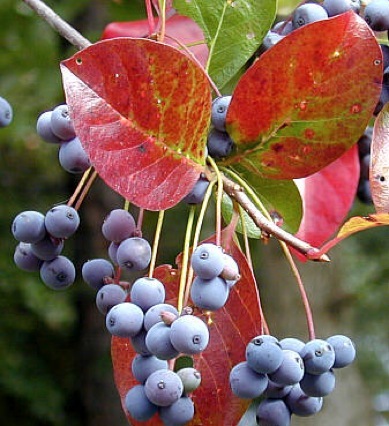
Black Gum’s fall fruit are sour and bitter

 Nyssus: Tart Botanical Tangles

The Black Tupelo is an old friend from around ponds where I grew up in Maine to around ponds (called lakes) here in Florida. (In Maine a lake must be 10 acres or larger to be called a lake, otherwise it is officially a pond. In Florida if you can’t throw a baseball across it, it is a lake. If you can it’s exclusive waterfront.)

Ogeechee Tupelo juice used like lime juice

Like many trees, the Black Tupelo, also called the Black Gum tree and the Sour Gum, barely makes it into the edible realm. The pulp of its fruit is technically edible, extremely sour and extremely bitter, which is why it is usually used in sweetened preserves. Its sibling, the Water Tupelo is likewise edible as is the Ogeechee Lime, another Tupelo. The juice of the latter is used like… lime juice.

Depending on who is doing the counting there are seven species in the genus, five in the North America, or nine to eleven total (and here you thought botany was a settled science void of monumental egos.) The most common one is Nyssa sylvatia, which is joined by Nyssa aquatica in the Southern states, or the Black Tupelo and the Water Tupelo respectively. While the Black Tupelos favor eastern North American then can grow quite well on the west coast of the U.S. The Ogeechee Lime (N. ogeche) however grows in a crescent from Massachusetts into the South, across the lower states, then up to southern Canada.

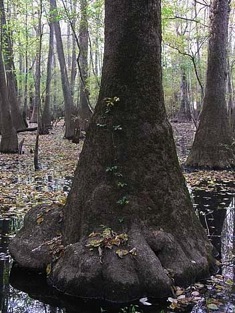
Water Tupelo’s broad base helps keeps it stable

Most have horizontal or hanging branches and broad alternate leaves and are either male or female. The Black Tupelo, which has many 90-degree branches from the trunk, likes to have its feet in damp dirt. The Water Tupelo prefers to be in water. The Black Tupelo is deciduous, slow growing to 50′ tall and 30’ wide. Over time it forms a flat top with horizontal branches that may droop. Its leaves are generally elliptical and arranged alternately along the stems. The leaves are 3”-6” long and 1.5”-3” wide, and can have a wavy edge. Flowers are generally small and not notable. The female of the species has half-inch long dark blue-black fruit in the fall around when the leaves turn scarlet, purple, and yellow.

A variety of the Black Tupelo is called the Swamp Black Tupelo (N. sylvatica, var. biflora.) It grows in swamps along the east coast and in the Deep South.  However some botanists think the swamp version is a different species and call it Nyssa biflora. And just to make that more complicated there is Nyssa ursine, the Bear Tupelo, which some think is a variety of N. biflora. So in this paragraph there might be one species and two variations, two species and one variation, or three species.

The Water Tupelo (N. aquatica), also called the Cotton Gum, or Swamp Gum, grows in — taah-daah — swamps of the southeastern and gulf coasts states and in the Mississippi River valley to southern Illinois. It grows in pure stands or in with bald cypress and other swamp trees. The Water Tupelo can reach 100 feet tall and its trunk is conspicuously enlarged at the base.

There is one aspect about the Water Tupelos range that prompts fascinating speculation. Its natural range comes down the east coast from the Carolinas, then diagonally across southern Georgia to the panhandle of Florida then west and up the Mississippi River valley. What’s intriguing about that is before there was a Central America (and thus no Gulf of Mexico say geologists) Florida was an island off Georgia. A channel — the Suwannee Channel — flowed north across what is now southern Georgia emptying in to the Atlantic. When the sea level dropped that low spot stayed wet but with fresh water and that is where one finds the Water Tupelo crossing Georgia into Florida. If that is a coincidence, it’s a good one.

The Ogeechee Lime (N. ogeche) is one of the rarer North American tupelo but has the largest range, from Cape Cod to the old South, across the southern US and then up the west coast to Washington State and southern Canada. It produces edible fruits. Often found in flooded sites in the southeastern U.S. the fruit is very sour and has been used as a lime substitute.

In the Dogwood family, Tupelos are also found in Mexico, China and Malaysia. They are famous for their monofloral (one flower) honey. Indeed the honey of the Ogeechee Lime doesn’t crystalize because of its high ratio of fructose to glucose. The center for Tupelo honey production is the Apalachicola River in the panhandle of Florida. Because of its rarity and singularity compared to other honeys it is a million-dollar business.

Tupelo wood, usually from the water tupelo, is pale yellow to light brown, fine-textured, strong, and hard to split when dry.  It is used for crates and boxes, flooring, wooden utensils, and veneers. The fluted base of the Water Tupelo is especially favored by carvers. Birds that feed off Tupelo fruit include the American Robin, Swainson’s Thrush, Gray-cheeked Thrush, Hermit Thrush, Wood Thrush, Cardinal, Mockingbird, Blue Jay, Red-bellied Woodpecker, Yellow-bellied Sapsucker, Flicker, Pileated Woodpecker, Eastern Phoebe, Brown Thrasher, Eastern Bluebird, European Starling, Scarlet Tanager, Catbird, Cedar Waxwing, and the  Crow.

The genus name, Nyssa (NISS-ah)  refers to mythical water nymphs, read a fondness for wet places. Nysa was a water nymph and nurse to Bacchus.  Sylvatia  (sil-VAHT-ee-kuh) means of the woods. Aquatica (ah-KWA-tee-kuh) is living in water. Ogeche (oh-GEE-chee) is from Ogeechee, which is Creek for “our mother.” That species was first discovered by the white man — William Bartram — on the Ogeechee River, which is the longest river in Georgia.

Green Deane’s “Itemized” Plant Profile

IDENTIFICATION: Considerable variations. Except for the N. ursine, the tupelo is a tree with horizontal branches at right angles, leaves simple, alternation along the stem. Some in damp soil, others in water, fruit from round and dark blue to long and dark red to blue. Sour. Flowers small. Species ranged from 5 feet high to 100 feet high. N. ursine is basically a shrub of limited distribution in a few counties of western Florida.

TIME OF YEAR: Fruits usually in September or October

ENVIRONMENT: Damp soil or in water

METHOD OF PREPARATION: Berries can be chewed like gum (without the stone.) Used to make preserved. The Ogeechee Lime juice can be used like lime juice.


{ 8 comments }

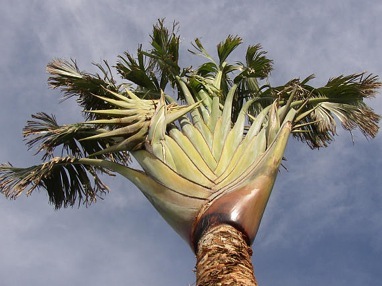
Traveler’s Plam is related to the banana and Bird of Paradise

Ravenala madagascariensis: Palm, NOT!

The Traveler’s Palm is reportedly known for providing wayfarers water, but it also has some food to offer as well.

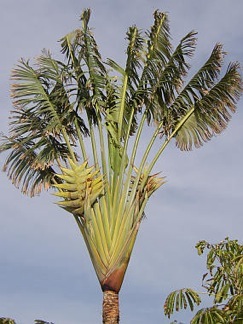
Traveler Palms are tall-growing.

Related to the bananas and the Bird of Paradise, the Traveler’s Palm does indeed capture water at the base of its fan-like leaves, up to a quart per leaf. But it is usually buggy and or fermented from various debris caught there. A thirsty traveler would have to be desperate and hopefully have something available to strain the water with.

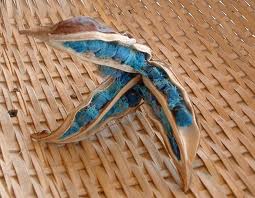
A better source of liquid is the sap, which can be tapped from the base of leaf stalks. It can also be boiled down to a syrup.  Young leaves of the palm are edible cooked, but bitter. The starchy young fruit is edible as well. Its other claim to edible fame is the fuzzy metallic blue aril on the seeds are edible though tasteless. The mealy oily seeds are also edible.

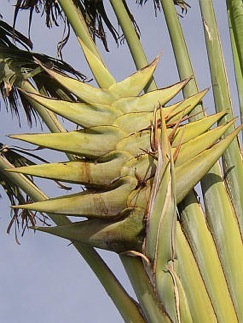
The distinct blossoms are easy to find. 


However, the oil content of the seeds and arils is 4% and 68%, respectively. The oils in composition is intermediate between palm oil and cocoa butter (oleic acid 39% and palmitic acid 34–42%.) As oil is very important and one of the more difficult foraging needs to meet.

One odd aspect about the palm from Madagascar is that it is the only species in its genus, Ravenala madagascariensis, like the Nandina and Florida Pennyroyal which is Piloblephis rigida. Ravenala is what the Madagascarians call the plant.


Green Deane’s “Itemized” Plant Profile

Mealy seeds contain nutritious oil

IDENTIFICATION: A large and erect palm-like plant that can grow to 75 feet tall and two feet through. It’s crown looks like a gigantic flat fan comprised of many 10-foot long banana-like leaves. Its large green fan-shaped flower are borne in cluster and can be  to three feet long. Leaf stalks have been used to make paper.

TIME OF YEAR: Year round.

ENVIRONMENT: Very adaptable but will not tolerate any salt conditions. Partial shade, or full sun.

METHOD OF PREPARATION: Seeds and arils raw or cooked, young leaves cooked, young fruit cook (but they get woody quickly.) Sap can be made in to syrup or sugar.


{ 1 comment }