Populus deltoides: Popular Poplars and Aspens
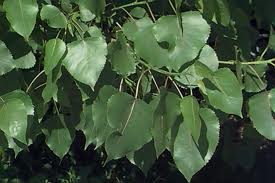
Eastern Cottonwood, Populus deltoides

I know where there is one (1) Eastern Conttonwood. For a popular Poplar it is not common locally. Fortunately edible Poplars elsewhere are numerous and well-distributed. But why only one poplar nearby? The answer is roots.

The Eastern Cottonwood is an impressive tree and was once planted as a favorite street tree and shade tree. Their roots, however, had the habit of entering drain and sewer systems, clogging them. This led to many municipalities banning the Poplar. Not exactly environmental progress.

There are some three dozen species of Poplar in the world, about 15 in North America. In New England where I grew up Poplars were considered a “trash tree” short-lived and not used for much though there was one large Balm of Gilead my mother favored by the horse pasture. It was noticeably bigger than the other Poplars, and lived far longer. Even as a kid I marveled at how the leaves of the genus quaked in the wind. Old Timers — which meant adults — used to say when the Poplars showed their silver it was going to rain. These same adults also never said “Balm of Gilead” as three words but rather one:  bah-mah-GILL-ee-id.

While Poplars and Aspens are in the same genus there are differences. Usually the winter buds of the Poplars are very resinous and have 12 to 60 stamens (the male part of the flowers.) The Aspens are only slightly resinous and have on 6 to 12 stamens.

Here in the south there are two Poplars and one Aspen, P. deltoides (the only local one) Populus heterophylla (found in northern Florida and the gulf states) and Populus grandidentata, found occasionally in North Carolina and Virginia.
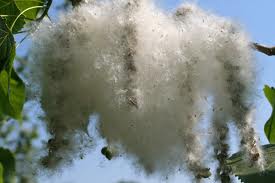
Seed fuzz inspired the name cottonwood

The so-called inner bark, the cambium, of the poplars listed below is edible raw. It was eaten not only by North American natives but peoples in Europe and Asia. The cambium was often cut into strips and boiled or dried, ground and mixed with flour to make bread and or mush. It is high in Vitamin C. The sap can also be drunk and the catkins of some species are also edible.

Among the edible poplars are the Populus angustifolia (Narrow Leaf Poplar) Populus fremontii (Fremont cottonwood which actually might be a P. deltoides variation or even P. deltoides v. wislizeni or P. deltoides v. monilifera) P. grandidentata (Large Toothed Aspen) Populus sargentii (Sargent Cottonwood) Populus alba (White Popular from Europe) and Populus tremuloides, (the Aspen of Colorado fame.)
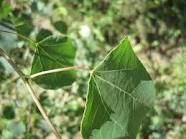
Populus tremuloides petiole

Medicinally the resinous, aromatic buds of the Populus balsamifera, Populus canadicans (aka giladensis) and Populus tremuloides are used as balsamic, expectorant and stimulant. The salve, used on burns and wounds is made by boiling the buds slowly in oil. The resin comes from a wax that coats the buds in the winter.  The wax coats the buds to reduce water loss. So, if you want to make a salve you have to collect buds in the winter.

As for the name, Populus deltoides (POP-you-los del-TOY-deez). Populus is latin for “people”  but can also mean a crowd or a multitude and in many places these trees grow in colonies. But scholars think it came from arbor-populi, meaning “tree of the people.” Deltoides means triangular, referring to the leaf shape.

Oh, the root wood of the Eastern Cottonwood was also used by the natives for drill and baseboard for friction fire lighting. Settlers used the logs to build stockades.

Green Deane’s “Itemized” Plant Profile

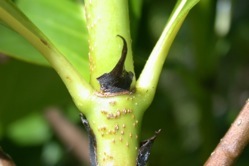
IDENTIFICATION: Eastern Cottonwood. Large tree  to 100 feet, trunk 5 feet through. Bark  silvery-white, smooth or lightly fissured when young, dark gray and deeply fissured on older trees. Twigs grayish-yellow, stout, with large triangular leaf scars. Twigs have a bitter, aspirin like taste. Winter buds slender, pointed,  to .75 inch long, yellowish brown, resinous. Leaves are large, triangular, to 4 inches long and wide, flattened base, coarsely toothed, the teeth are curved and gland tipped,  petiole is flat. Leaves are dark green in the summer, yellow in the fall.

TIME OF YEAR: Catkins on single-sex trees early spring. Male catkins, reddish-purple, to 4 inches long. Female catkins, green, 2.5 to 5 inches long, seed capsules in early summer, releasing numerous small seeds attached to cotton-like strands.

ENVIRONMENT: Likes to border streams and wet valley soil. In colonies of with willows, often first to inhabit new sandbars or bare flood plains.

METHOD OF PREPARATION: Inner bark edible raw or cooked. Roots dried for use in friction fire making. The wood is also used for boxes, crates, furniture, plywood, matches and paper products.
 

{ 2 comments }

Harrisia simpsonii

Harrisia Trio: Endangered Edibles All

Just as it is important to know what to eat, it’s as important to know what not to eat, or if you do, how to do it right.

The Harrisias are three endangered cactus, all with edible fruit. Let’s say you are in a mangrove swamp, your canoe has floated away because you didn’t watch the changing tide. You also didn’t have the good sense to tell anyone where you were going or what you were going to do on your month off.  Since no one lives within miles of you there is no cellphone tower nearby for your phone to work.  After a week of resisting the fruit of these endangered species you succumb to your hunger. You find up to 1500 seeds in each one. Spread the seeds around, give them to your friends with green thumbs after you’re rescued. You will be rescued because you now have a mission, to help the endangered species that helped keep you going. Just don’t tell anyone with a badge you ate the fruit of an endangered species… kinda like eating Spotted Owl eggs….

Harrisia fragrans

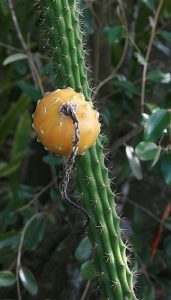
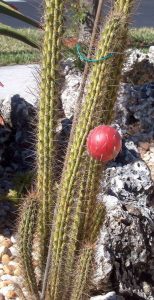
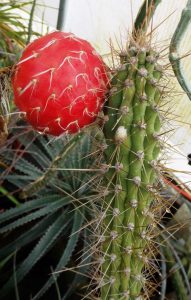
Other than DNA testing, the only way to tell the Harrisia simpsonii (above left) from the H. arboriginium (below) is the former has fruit that ripens to red and the latter to yellow. The sweet smelling  Harrisia fragrans (right) is rare because of development and is found in only one Florida County. And in the county it is found in only 10 or 11 spots. I became interested in the genus when I saw H. simpsonii while out kayaking on the Inland Waterway south of New Smyrna Beach, Florida. I thought it was an escaped ornamental. The red fruit stood out among the greenery, probably part of the plant’s strategy to attract creature attention and spread its seeds around.

Harrisia aboriginium

Harrisia (hair-RIS-ee-uh ) honors William Harris (1860-1920) of Jamaica who contributed greatly to our knowledge of the flora of that island. He was superintendent of the Public Gardens and Plantations of Jamaica.  Arboriginium (ab-or-RIJ-in-um ) has been found on pre-Columbian shell mounts and that is why it is called arboriginiumSimpsonii simp-SON-ee-eye) honors south Florida naturalist Charles T. Simpson (1846-1932. See Simpson Stopper.)   Fragrans (fray-granz) means fragrant.

Green Deane’s “Itemized” Plant Profile

IDENTIFICATION: Prickly apple and Apple cactus: Shrubby,  to 12 feet tall, on the ground or on shells or the like, sometimes vine like, often branched, one to one and half inched through, cylindrical,  with nine or 10 ridges, spines 3/4 to an inch long,  in groups of 6 or 12. Flowers nocturnal, funnel shaped, white, no odor. Young pointed buds are covered with hair. Fruit oblate, dull red or yellow.

TIME OF YEAR: Nearly year round

ENVIRONMENT: Hammocks, mangrove swamps

METHOD OF PREPARATION: Fruit edible raw

{ 1 comment }

Sea Oats

Uniola paniculata: Feeling your sea oats

Opinions vary on Sea Oats. Not on flavor. They taste good. The questions are, are they endangered or not, and which genus are they in?

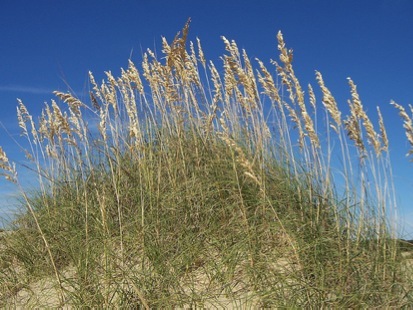
Sea Oats grow in abundance on shores from Texas to North Carolina and are quite edible. They are not on any endangered list but it is illegal to pick them in Florida and Georgia. Why? That is a good debate. They used to be in profusion but like ostrich feathers they were taken for decoration. While their number have dropped they are not really endangered per se.

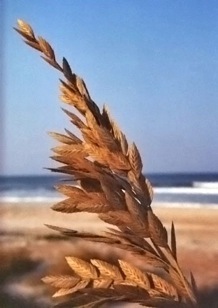
Sea Oat seeds

However, they are a desirable coastal plant –Sea Oats stabilize sand dunes — so they are talked up as endangered. They grow right up to the high tide mark and spread by underground rhizomes. Actually Sea Oats trap wind-blown sands that eventually mound to begin dune formation. A pioneering plant, they rapidly colonize and tolerates sea water and salt spray. They tend to be invasive via the root system but their seeds are often not viable. That should ease your conscience should you take some seeds to plant at home.

More so, any one who has studied beaches know beaches are in constant change and it is doubtful one species will halt the influence of the sea. In that beaches are always moving then perhaps Sea Oats are “endangered” just like beach houses are “endangered” but they are not endangered in the legal sense of the word. However, the official position is that this common plant is “endangered.”  Consider eating them in those two states only if your life is “endangered.” One compromise is buy some roots/seed and grow your own. They will flourish in your sunny back yard just as well as they will at the beach. Sea Oats grow to about eight feet high, are highly drought tolerant, and quite showy.

Botanically they are Uniola paniculata (you-NYE-oh-luh  pan-nick-yoo-LAY-tuh.) Uniola means one because the plants bracts are united. Paniculata refers to the plant’s flower clusters in panicles.  The grain was eaten by several native Indians, as was U. virgata (Limestone Grass) found only in the Caribbean. Virgata (vir-GA-tuh) means wand and the plant, unlike the U. paniculata, has a tight spike at the top. U. palmeri, now called Chasmanthium latifolium, is found inland in many US states. See separate under Wood Oats. ) Sea Oats are sometimes called Chasmanthium paniculata but whether they are in the genus Chasmanthium or Uniola is a botanical teapot tempest.

Uniola paniculata and Chasmanthium latifolium have so many common names I made the decision here to call them by where they grow,  Sea Oats because they grow by the sea and Wood Oats because they grow in woods. It makes things a lot easier to remember.

Green Deane’s “Itemized” Plant Profile

IDENTIFICATION: A perennial grass, creeping roots, stout stems, found in dense clumps 3.5 to 8 feet high, leaves long and skinny, tapering, slender tips curling like a ribbon, spikelets flat, oval, straw colored, clustered panicle, eight to 16 inches long, flat seeds enclosed.

TIME OF YEAR: Nearly year round

ENVIRONMENT: Sandy beaches and dune

METHOD OF PREPARATION: Seeds can be cooked as cereal, or ground and made into bread.


{ 19 comments }

Sesuvium portulacastrum: Maritime Munch

Young sea purslane

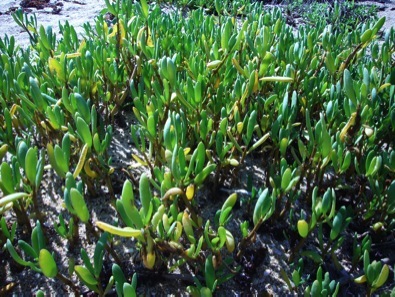
It looks like garden purslane on steriods growing in sand. And it grows all over the local beach, and other beaches in the South and as far north as the Delaware River in Pennsylvania.

Sesuvium portulacastrum (sess-SOO-vee-um por-too-luh-KASS-strum) was widely used by Native Americans. The stems were eaten raw or pickled, or cooked in two or more changes of water to reduce its saltiness. Often these days it’s found in Asians markets. One of the best-kept secrets of sea purslane is that it is a rich source of ecdysterone. Haven’t heard of ecdysterone? It’s an important chemical for molting insects and crustaceans. But, in humans it is reported to enhance athletic performance. That should make foragers out of jocks.

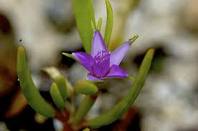
The blossoms stays open only one day

The lowly sea purslane forms an important and primary function in dune creation. Salt tolerant, it sets roots just above the high tide line. Sand-carrying wind hits the plant, slows slightly and drops the sand it is carrying. That helps build the dune and in time bring in other plants.

It is also found down the coasts of Mexico and South America to islands across the Pacific, Australia, Africa and Europe. As for Pennsylvania, it was found in Philadelphia county there in 1865, and presumed to still be thereabouts. On the west coast of the United States (and the salty desert southwest interior) your edible sea purslane is Sesuvium verrucosum.

It is a nice, salty, trail-side nibble. The word Sesuvium comes from the country of the Sesuvii, which was a Gallic tribe mentioned by Caesar. Why the plant was named after that is unknown. Portulacastrum means like the Portulaca, or purslane. In fact Sesuvium was originally put in the same genus as purslane but then got it own genus.

Sea purslane cooks up nice and tender, including the thick stems (remove old dead leaves first.) I’ve never found it too be salty. That said, raw, to me, it has a slightly bitter after taste, but not as strong as a raw yucca blossom. Actually it is a back-of-the-throat feeling that is between slightly puckery and slightly bitter… Easily ignored, and goes away. Cooked it looses that distraction. The older stems can be fibrous though tasty. I chew the pulp off the fiber and spit out the fiber.

Green Deane’s “Itemized” Plant Profile

IDENTIFICATION: Herbaceous perennial, thick, fleshy leaves narrow to slender obovate on succulent, reddish-green stems, branching regularly forming dense low-growing stands. Five-petaled flowers, small, showy pink, year round, Each flower opens for just a few hours each day. Leave up to more than an inch long.  S. maritima very similar  but leaves are no more than an inch long and are oblong to spatulate oblong.

TIME OF YEAR: Available year round

ENVIRONMENT: Along coastlines, grows on the ocean side of dunes to the high tide mark.

METHOD OF PREPARATION: Raw, pickled, cooked in two changes of water or more to reduce saltiness

{ 21 comments }

Genipa clusiifolia: An Acquired Taste

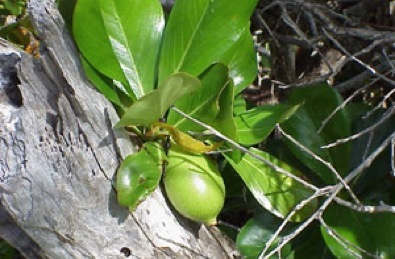
Unripe and ripe fruit

Like a Suriname Cherry, you’ll either find the Seven Year Apple edible or disgusting. In fact, a lot of folks can’t get past the looks of the fruit.

The Genipa clusiifolia (JEN-ni-puh kloo-si-FOH-lee-uh ) fruit is edible only when black ripe, and then only the pulp, not the seeds. It’s actually a berry the size of a lime. You “eat” it by poking a hold in the tough rind and sucking out the pulp. (Again, don’t eat the seeds, they will make you throw up.)  The flavor reminds some of prunes, others of liquorish. Many find it  just plain awful.

While the great majority of the plants on this site are available throughout much of America, this is a South Florida, Caribbean native. Its Caribbean cousin, the Genipa americana, is used to make a common drink among the islands.  (Nutritional information on G. americana below.)

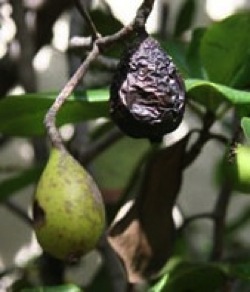
Fruit goes fromg green to yellow then spotted ending black and shriveled

Genipa is a latinized form of the Guyanian phrase nandi’pab meaning a “dark color on the chest.” It was used as a body dye among natives of South American.  A metabolite in the pulp (iridiod genipin) turns black on contact with human protein and lasts for about three weeks. When used on fabric it’s a blue/purple dye. Juice from the green fruit has been used externally to treat syphilis. Clusiifolia relates to the resemblance of the leaves to the Clusia, a common tropical, subtropical shrub.  For a century or so its name was Casasia clusiifolia (CASS-see-uh kloo-see-if-FOLE-ee-uh) and is still found under that name in many references. It honored a Captain General of Cuba, Louis de las Casas.

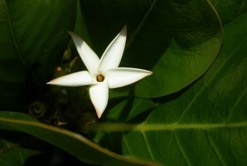
Seven Year Apple blossom

The common name, Seven Year Apple, is an exaggeration of how long the fruit takes to ripen, 10 months. The tree itself is in fruit year round. It’s the larval hose of the Tantalus Sphinx moth. As a tree, the wood is dark brown or reddish brown, closed grained, very heavy and hard. The bark is mostly smooth and gray. It provides cordage that can be used to make rough cloth. The wood, particularly of the G. americana,  has been used for spears, rifle stocks, shoe lasts, frames for sieves, barrel hoops, ammunition chests, boxes, packing cases, plows, tool handles, flooring boards, door frames and cabinetwork.

Stipules opposite leaves

The trees are in the Rubiaceae family and are closely related to the Gardenia; several Gardenia species were originally placed in Genipa genus. The metabolite genipin mentioned above is also obtained from the gardenia and is used in Chinese medicine to treat type 2 diabetes.

Evergreen, this shrub or small tree is one of Florida’s most exceptional native, salt-tolerant plants. It will grow right up to the first dune near the ocean. The leaves are glossy, leathery, and clustered near the branch tips. Flowers are clusters of white, pink-tipped blossom that show in spring and early summer. They have a very sweet, heavy fragrance. The fruits are green then yellow then spotted brown and finally black. While humans are divided on the taste of the Seven Year Apple mockingbirds love the emetic seeds and leave hollowed out black fruit skins hanging on the tree.

The fruit of the G. clusiifolia can be used like the fruit of the G. americana. In Puerto Rico, the G. ameriana is sliced up and put in a jar of water with sugar to make a drink like lemonade, occasionally it is allowed to ferment some. A concentrate is served with ice by street vendors. In the Philippines it is used to make jelly, sherbet and ice cream. The ripe pulp can be a substitute for commercial pectin. In rural Brazil they use it to make preserves, syrup, a soft drink, genipapada, wine, and a potent liqueur.

Food Value per 100 g of Edible Portion:  Calories 113, Moisture 67.6 g, Protein 5.2 g, Lipids 0.3 g, Glycerides, 25.7 g, Fiber 9.4 g, Ash 1.2 g, Calcium 40.0 mg, Phosphorus, 58.0 mg, Iron 3.6 mg, Vitamin B 0.04 mg, Vitamin B2 0.04 mg, Niacin  0.50 mg, Ascorbic Acid 33.0 mg, Amino Acids (per g of nitrogen [N 6.25]) Lysine 316 mg, Methionine 178 mg, Threonine, 219 mg, Tryptophan 57 mg.

Green Deane’s “Itemized Profile”

IDENTIFICATION: Shrub or small tree to 10 feet,  pale bark, leaves elliptical with edges recurved, two to six inches long, leathery, very glossy, clustered at the ends of branches. Flowers tubular, five white petals, an inch wide, often pink tipped and fragrant like jasmine. Fruit oval, two to three inches long, often dark spotted, then entirely black, jelly like pulp.

TIME OF YEAR: All Year

ENVIRONMENT: Can be found in the mainland, keys, coastal hammocks and sand dunes

METHOD OF PREPARATION: A hole is made in the fruit and the pulp sucked out. Do not eat the seeds. A drink can be made from the pulp. It can also be made into jelly and jam if you like the taste. The fruit is often used for fish bait.


{ 6 comments }