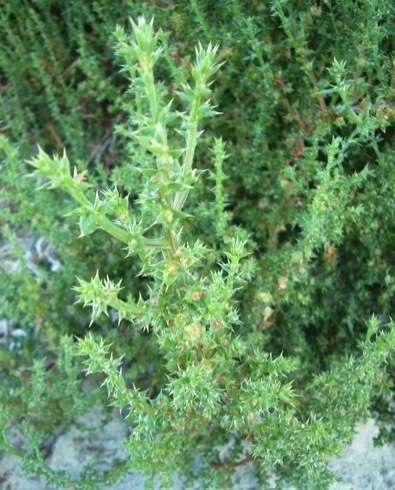
Soft growing tips are edible, photo by Green Deane

Salsola kali: Noxious Weed, Nibble & Green

When you first encounter a Russian Thistle it is the very last plant you would consider edible. Wiry, tough, sharp, pin prickly, irritating.  In fact, it kind of reminds you of a green sand spur on steroids.

However, the young shoots and tips of the growing plant are edible raw and actually quite palatable and pickable. Cooked like greens they’re even better. As the plant ages, though, it grows tough and formidable. Also called Tumbleweed and Windwitch, dried ones tumbling across the HD screen are now classic visual cues of desolation in Western-type movies.
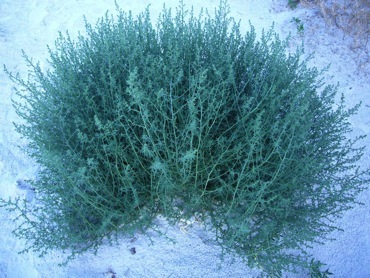
Growing in beach sand at Daytona Beach, Fla. Photo by Green Deane

The most reliable to eat is the Salsola kali  (SAL-so-la KAH-lee) which is believed to have arrived in the United States in the early 1870s in southern South Dakota. Some Russian immigrants moved to the town of Scotland in Bon Homme County. They had some Salsola seed in with their flax seed. By 1873 local botanists identified the new weed in town. By 1895 it had reached from the remote north middle of the country to New Jersey and California. That’s remarkable distribution in 30 years considering the plant had only summers to move.

Professor Lyster Hoxie Dewey, who worked for the US Department of Agriculture, said in two reports in 1893 and 1894 he knew how the plant was spreading: The trains. That may seem obvious to us now but back then it was hard work and good insight.  In Illinois he documented Salsola along railroad tracks and gave specific locations. The plant was not yet an “obnoxious weed” but Dewey saw the potential problem. He recommend railroad get rid of the plant wherever they found it and he theorized that by using the railroad and the wind the plant could be come a severe problem. Right man, right place, right observation, right idea, and completely ignored.

In fact, let’s give Dewey his due. People who got it right should be given some recognition. Lyster Hoxie Dewey (1865–1944) was an American botanist born in Cambridge, Michigan. In 1888 he graduated from Michigan Agricultural College where he went on to teach botany for two years. He was an assistant botanist for the United States Department of Agriculture from 1890 to 1902 and then botanist in charge of fibre investigations. By 1911 he was the U.S. representative to the International Fibre Congress in Surabaya, Java. Nice work if you can get it. His publications were mostly bulletins for the USDA on the production of fibre from flax, hemp, sisal, manila plants,  on the classification and origin of the varieties of cotton, and what brought him to our attention, investigations on grasses and troublesome weeds.

Some 117 years after Dewey’s Salsola report the current and perpetually out-of-date USDA distribution map shows Salsola to be in coastal areas only. However, it has been reported throughout the United States and Canada, particularly in dry and or salty areas including along northern (salted) roads, along fences/gullies in the plains states, and southwest deserts. Millions are spent each to get rid of it especially along highway right-of-ways. It can rapidly take over open land via up to 200,000 seeds per plant, the wind, and …yeph… the trains.

If your Tumbleweed is a Salsola but not the kali, you will need to verify its edibility with a local expert.  Elias and Dykeman (2008) say related species in the desert southwest of the United States are edible. This is where botanists let foragers down. They can’t quite decide if there is one species of Salsola ( the kali ) and a lot of varieties of that one species, or, if there are several species of Salsola. (Note: Edibility is usually not on the botanical radar either.)  If that’s not bad enough then one botanist thinks he can improve upon the name so we get different names for the same plant, or plants, or variety, or varieties. That turns it all into a linguistic morass meaning it’s tough to figure out if the plant you are looking is the plant they are talking about. Again, all the more reason to check with a local expert. You don’t need to know the name but you do need to know if it is edible….  Let me put it this way…. whatever the name is the one that grows on the sandy beach due east of me IS edible. Which species is it? Probably Salsola kali var. pontica. Three other Salsola that are known to be edible are S. australis, S. komarovi and S. soda.

Globally, Salsola kali et al is found in Afghanistan, Argentina, Canada, Chile, China, Egypt, Greece, Hawaii, Hungary, Indonesia, Iran, Italy, Japan, Lebanon, Mexico, Morocco, Norway, New Zealand, Pakistan, Poland, South Africa, Turkey, Western Siberia and Russia, where it is native to the southlands. In fact, more than a century ago Russia had to give up several development projects because the Salsola kali just plain got in the way.

Salsola is from the Latin salsa, and means “salted.” Kali (KAH-lee) has many meanings but the one that makes sense to me is Black because the plant was in high demand for soda ash and for that the plant had to be burned. The word also means “good” in Greek. In Hindu mythology, the goddess of destruction and creation is Kali. The English the word “alkali”  comes from the Arabic “al qaly” or “from Kali.” Oh, and here is brilliant botanical naming: Pontica (PON-ti-kah) means from Asia Minor, north of the Black Sea, where the plant is native. Talk about redundant….

Young plants make good fodder and grows well in low-water areas. In fact, when dry Salsola is a good source of fuel. It also has been used to make soap since Biblical times. Salsola soap can still be purchased around the Mediterranean.

Now some warnings: The plant, a relative of the Chenopodium, can contain as much as 5% oxalic acid thus folks who are sensitive to oxalic acid should avoid the genus.  It is also a severe allergen for some people. And if you eat it when it is too old the shape of the leaves — fat and pointed — will irritate your throat. Lastly, Salsola kali is a host plant of the Sugar Beet Leafhopper. This insect carries curly-top virus, a disease affecting sugar beets, tomatoes, and beans. This puts it on the farmers’ hit list.

Steamed Russian Thistle

Take two cups of shoots or tips (hint, they easily break off when bent.) Rinse and steam as is or cut them up and steam. Season with butter

Russian Thistle Broth

Five cups chicken broth

Two cups Russian Thistle tips or shoots

One potato or Jerusalem artichokes

One onion

Half cup parsley chopped

Half cup watercress chopped

3 cloves of garlic, chopped

One bay leaf

Simmer the potato or Jerusalem artichoke in the broth. Add chopped onion and garlic. Cut Russian Thistle into one inch pieces (this is to assure you have edible pieces and makes it easier to eat.) Chop parsley and watercress, add with the whole bay leaf. Simmer 20 minutes or until the potato et al is done.

Tumbled Rice and Russian Thistle

Four cups Russian Thistle

One cup rice

One cup mustard or radish leaves or any mild green

One teaspoon pepper

One teaspoon garlic powder

A third of a cup of jack or similar cheese shredded.

Cook rice. Steam Russian Thistle tips or shoots. After a few minutes add the rest of the greens to the thistle tips. When greens are cooked, mix with the rice, season, sprinkle with the cheese.  Serve hot.

Green Deane’s “Itemized” Plant Profile

IDENTIFICATION: Herb to five feet usually less than three, bushy, branching from base; upright or almost prostrate .Leaves and bracts fleshy, flatish, short,  tipped with sharp spines.  Flowers with 5 narrow whitish petals, solitary, unstalked. Older branches serpentine, purplish

TIME OF YEAR: Early summer locally, varies with locale, can be late summer to fall in other areas, some nearly year round.

ENVIRONMENT: Sandy areas, seashores, some desert environments, salty areas, beside northern roads because of salt, or western roads because of open space, railroad tracks.

METHOD OF PREPARATION: Young shoots raw or cooked, tips of growing plants raw or cooked. Its seeds are reportedly edible but I don’t personally know that.
 

{ 9 comments }

Sideroxylon: Chewy Ironwood

The Saffron Plum is not yellow or a plum, that is, it is not in the genus Prunus. And it is called a Buckthorn but it isn’t one of those either. And I learned it as a Bumelia, but sometime between 1996 and 1998 it became a Sideroxylon…Ya just got to love drunk botanists and their penchants for changing plant names.

Note the thorns on the Saffron Plum, Sideroxylon celastrina

In all fairness, Bumelia is not accurate for the species. It means “European Ash” and most of the trees in the genus do not really look like the ashes at all. Sideroxylon is better but not without issue. That means, in mispronounced Greek, Iron Wood. That is a common term for the Carpinus genus.  But Sideroxylon it is. (In Greek the word for railroad, σιδηρόδρομος, sidirodromos, means iron road.)

This species is another fruiting tree that sits on the cusp of edible, some Sideroxylon species have just edible berries and some species have just unedible berries. Nine are commonly mentioned as edible, or chewable at least: S. celastrina, S. foetidissimum, S.  laetevirens, S. lanuginosa, S. lyciodes,  S. reclinatum S. salicifolium, and  S. tenax. The S. tenax is rather rare in the wild but a native landscape plant. One used to live not 2.5 miles west from me where the land abutted an overpass over Interstate 4. A road crew dutifully took it down and the road since widened. However, I recently spotted one inside a locked cemetery about a mile east of me. 

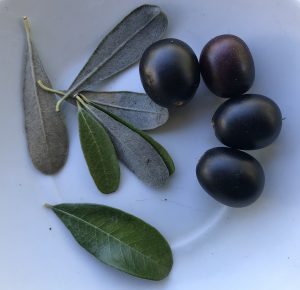
The fruit and leaves of a Sideroyxlon but which one? Photo by Green Deane

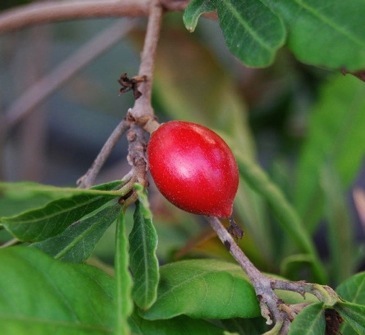
The ninth Sideroxylon received a lot attention in the 1970s and has occasional revivials, the Sideroxylon dulcificum. (now called in 2020 Synsepalum dulcificum.) You may not recognize the name but if you eat the berries — the Miracle Berry — for about a half an hour afterwards you cannot taste anything sour. You can eat a lemon after the berries and the lemon will taste sweet. It also counters a metallic taste some experience while undergoing chemotherapy.  The ability of the berries to alter taste perception was noted as early as 1725. It was touted as a possible “sweetener” in the 70’s and the role of the sugar industry — if any — in its demise is controversial. Tablets of the berries can be bought over the Internet. How they work is not known but one theory is that it temporarily alters the physical shape of the taste receptors on the tongue.

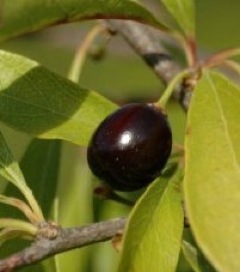
Sideroxylons have several traits in common, which means you can at least identify the genus. The species is the next challenge. They all produce a milky sap, all have simple leaves without lobes or teeth, and the leaves alternate along the stem. The leaves are usually small, dark green, and rounded to elliptical. The Sideroxylons are nearly evergreen, dropping leaves late and putting on a new crop almost immediately. Like Hawthorns they branch irregularly giving each plant “character.” Sideroxylons develop short unhooked thorns that are not aggressive. Their  flowers are small and white sometimes greenish white, some are attractive and some are aromatic. The fruit is dark purple, egg-shaped, oblong to round, juicy. The tree usually fruits heavily.  (By the way they are all anti-inflammatory as well.)

Ripe Saffron Plum, Sideroxylon celastrina

The fruits of the S. foetidissimum and S. salicifolium are gummy and acidic — think eating it as gum rather than a fruit. They can stick your lips together. If you eat too many it can burn the lips of sensitive individuals. Sap from the S. Salicifolium has been used as gum. The Sideroxylon celastrina (sid-er-ROX-il-on see-LASS-trin-a) is the one most recommended because it has the largest and best fruit. It is a coastal hammock tree and is found mid-Florida south and in south Texas. It is also called in many publications and websites Bumelia celastrinum (Bew-MEE-lee-uh see-LASS-trin-a.) Celastrina is also mispronounced Greek meaning resembling the Celastrus, or the Bittersweet.

Green Deane’s “Itemized” Plant Profile

IDENTIFICATION: A coastal shrub or tree but found inland, thorny branches, leaves narrow oblong, or spatulate, one to one and a half inches long, smooth, sometimes spine tipped, often densely clustered along branches. The flower is tiny, white, five lobes, in axillary clusters (where stem and leaf meet) fragrant. Fruit oblong or cylindrical, 3/4 inch long, dark purple or black.

Miracle Fruit, Sideroxylon dulcificum

TIME OF YEAR: Almost year round

ENVIRONMENT: Hammocks

METHOD OF PREPARATION: Ripe fruit eaten raw, but not the seed.

Sideroxylon dulcificum

{ 6 comments }

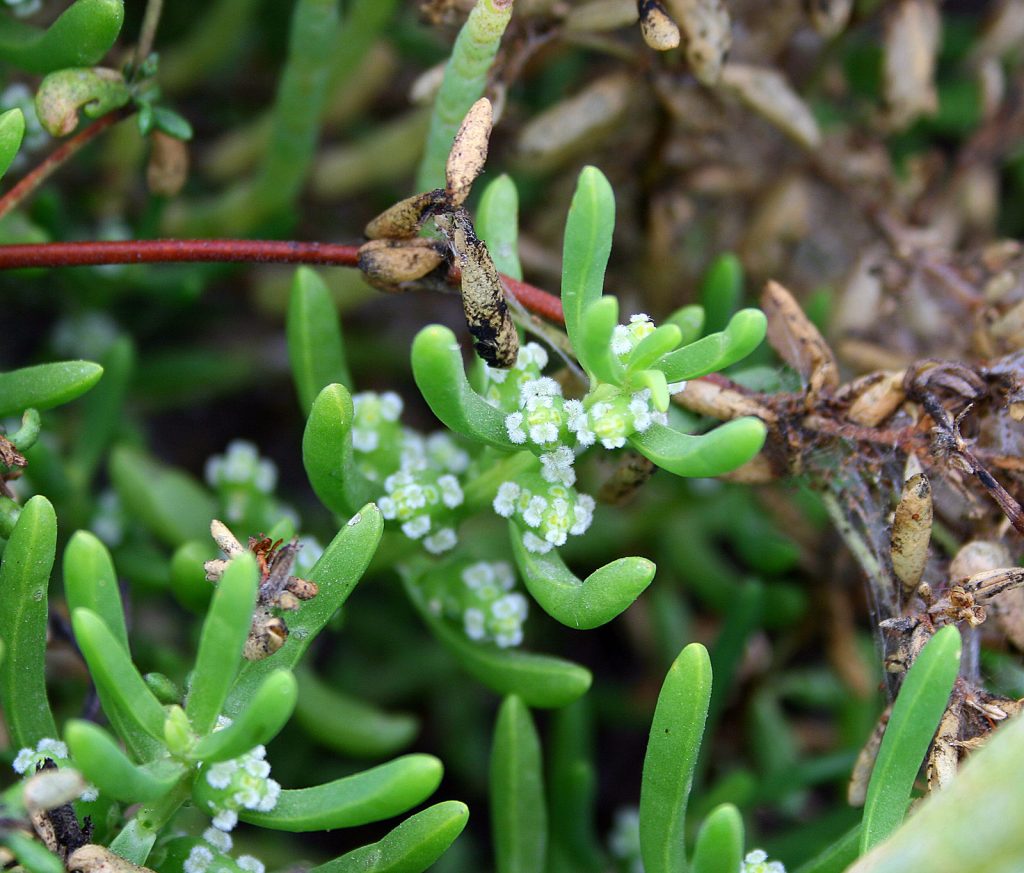
Batis maritima, pre-seasoned greens

Batis Maritima: Salt of the Earth

It has a dozen or more names, but no one is quite sure about its scientific name, Batis maritima, (BAT-is mar-IT-i-ma.)

Foragers call it saltwort, turtleweed, beachwort, pickle weed, smaphire, saimbhir, samapere (all mispronounced variations of St. Pierre)  barilla, saladilla, lechuga de mar, planta de sal, virdrillo, vidrio, herbe-a-crabes, banana di rif, and akulikuli kai. They also eat it.

B. maritima is a common shore plant around most of the warm areas of the Americas, Hawaii and Australia. There are only two species in the genus, the one in the Americas and the one in Australia. It has been used as a pot herb, puree and pickle. Some folks call it a pre-salted salad, since it is a plant that can tolerate salt and retains some.  It is not related to another plant called the Saltwort, Salsola. In some places B. maritima is considered endangered, in Hawaii it is a noxious weed.

Its seed oil might become a commercial product.

Ignored for centuries by the nutritional establishment, B. maritima has found some champions of late, not as a green per se but for its seed, which has an oil similar to safflower oil with antioxidants. It is also rich in protein plus the plant can tolerate salty ground so it is a potential crop on land that is now fallow by salt content. Saltwort also has a good amount of starch which seems to be of a small size suitable for, in the words of the researchers: “food thickeners, paper coatings, laundry starch, dusting powders, cosmetics, fat replacers, thickeners in the printing of textiles and biodegradable plastics. “  Yum. The ashes of the plant were also used once in make soap. Double yum.

As to why it is called Batis maritima Maritima means growing near the sea and as is often the case, there isn’t much debate over what the species name is, but rather the genus. Batis is from ancient Greek, it was the name of a couple of women in mythology. It was also the name of some seaside Greek plant Pliny mentioned.  It is presumed Latin Batis was rendered from Latin Batus, which means blackberry. That was stolen as usual from the Greek word Batos, also meaning blackberry, sometimes bramble. The next question is why blackberry? Well, as some people call it the “reef banana” referring to the shape of the small leaves, the fruit of the plant resembles blackberries somewhat, like the leaves bananas. Mystery maybe solved.

The only mystery I have about the plant is some references call it strongly scented, some mention no scent at all. I’ve never detected much of a scent. I can’t explain the discrepancy. One more thing, B. Maritima is also the favored food of large marine iguanas on the Galopagos Islands.

Green Deane’s “Itemized” Plant Profile

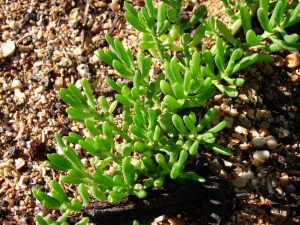
IDENTIFICATION: Evergreen, low shrub, six to 24 inches tall, flat growing where colonizing new mud, once rooted, grows bushy.  Leaves small, swollen, fleshy and narrowly club-shaped, can look like little bananas, bright green, but can also be reddish, flowers small, on spikes, flowering from mid summer to fall.

TIME OF YEAR: Year round, flowers in summer and fall.

ENVIRONMENT: Salty environments, mud flats that are not flooded always, shoreline, common among mangroves.

METHOD OF PREPARATION: Leaves raw or cooked, potherb, puree, pickles; pepper-corn size seeds edible in salads, toasted, or “popped”  like corn. Roots chewed like sugarcane, boiled for a beverage. One report says leaves can be toxic in larger amounts.  Boiling leaves twice reduces their salinity.


{ 1 comment }

Sargassum nutans

Sargassum: Not Just for Breakfast Any More

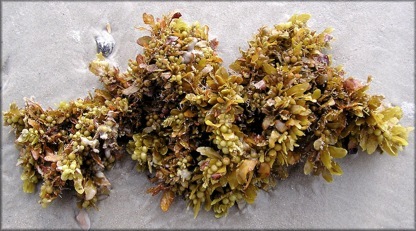
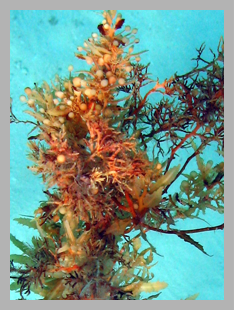
Sargassum — Gulf weed — comprises a huge number of seaweeds in all oceans, both bottom dwelling and free floating.  In fact, two common species found in Florida waters, S. natans and S. fluitans, are free floating all their lives.

Sargassum fluitans

This brown seaweed, which is also a vast floating masses in the Sargasso Sea in the north central Atlantic, is found washed ashore on the beaches often following sustained easterly winds such as during northeasters and hurricanes. It’s not only common in Florida but I also picked it up as a boy along the shores of New England. Although considered a smelly nuisance by beach-goers when it starts to decompose, the floating mats are a source of food or home to a huge variety of sea life. Often some of them will still be living on a clump of beached sargassum.

Species of Sargassum (sah-GAS-um) can be very difficult to identify because there’s a lot variability. But they do have some basic characteristics. Of all the seaweeds, Sargassum is the genus that looks the most like land plants.  It has an axis (stem) with distinct foliar blades (leaves.)  These “leaves” are long, oval-shaped, and may have smooth or toothed edges. In addition, Sargassum has small berry-like air bladders all over it. A member of the brown seaweed clan, its color doesn’t change much either, varying from yellow-brown to deep chocolate color.  Avoid any seaweed. Sargassum or otherwise,  with blue-green algae on it.

As one might expect Sargassum species vary in taste and texture so there is no one way to cook your local species. It takes experimentation.  More so, among seaweeds Sargassum is not a prime edible but a plentiful one. Slightly bitter, one might call it an acquired taste, then again all tastes are acquired except that for sugar. As Asian countries have the most experience with eating seaweed, most of the approaches have an Oriental spin.

Some Sargassums are consumed fresh, others cooked in coconut milk or a little vinegar or lemon juice. It is smoked-dried to preserve it.  Sargassum is also eaten by itself or added to fish and meat dishes. If not strong it can be added to salads after washing, or it can be cooked in water like a vegetable. If the Sargassum is strong flavored it can be boiled in two changes of water. Some recipes then call for it to be mixed with brown sugar and used as a filling in steamed buns but it could be eaten as is.

A second way of cooking Sargassum, such as S. fusiformis, is fry it quickly then simmer it in water with soy sauce and other ingredients for 30 minutes to two hours or more, depending upon the dish. Other areas of the world mix their Sargassum with oil, salt and green onions and using as filling in dumplings. It is also often cooked with tofu. One Fuji dish is to cook it with a fish then let it cool. When it sets it is sliced and eaten as a cold dish.

Indonesians like to drop Sargassum into boiling water and cook it for one minute then eat it with a sauce made with allspice. Or, they eat it with sugar or make it into a relish. Another option is to steam the seaweed. It can also be cooked into a jelly, firmed, and or used as a glue. Larger “leaves” make a chip when deep fried or the entire plant can be coated with a tempura batter, deep fried and served with a dipping sauce. Research shows that sargassum can collect large amounts of arsenic. Harvest carefully from clean waters.

Hawaiians had a variety of Sargassums to cook with. They stuffed fish with the leaves, or ate it raw with raw fish or octopus. The leaves can be added to soups and chowders or deep fried in tempura batter. Sun dried leaves can be eaten like chips, or they can be fried and sprinkled with salt.

Species found in Florida include: S. natans, S. fluitans, S. filipendula and S. pteropleuron. Those eaten elsewhere in the world include: S. aquifolium, S. fusiformis, S. granuliferum, S. mutica, S. polycyctum, and S. siliquosum. It can be cooked in coconut milk, or a little vinegar, or smoke dried.

As for the botanical name, the bladders look like grapes and were named Sargassum from the Portuguese word for grapes. Nutans (NEW-tanz)  means nodding, and fluitans (FLOO-ih-tanz )from the Greek word fluito, floating. I suspect that is where the word “fluid” came from in English.

Green Deane’s “Itemized” Plant Profile

IDENTIFICATION: Locally, S. nutans long narrow leaves and pointed air bladders, S. fluitans broad leaves and air bladders without pointed tips.  In the northeast U.S. any bottom attached Sargassum will be the S. filipendula.

TIME OF YEAR: All year, but is more plentiful in warm weather. In Florida winds and currents typically wash Sargassum to shore beginning in May. On the west coast of the U.S., spring to autumn.

ENVIRONMENT: S. nutans and S. fluitans are free floating. Other Sargassum are found just below the low water mark down to around 100 feet.

METHOD OF PREPARATION: Take younger leaves. Fried, boiled, steamed, dried.


HERB BLURB

Sargassums contain antibacterial fatty acids, has anti-oxidants and is mildly diuretic. Fresh Sargassum can be made into a poultice for cuts. In Chinese medicine Sargassum is dried, powered, and used to make a tea to control phlegm. Avoid Sargassum if you are iodine sensitive.

{ 58 comments }

Chrysophyllum oliviforme: “Chewy Olives”

Satinleaf, Chrysophyllum oliviforme

“Turn left at the Satinleaf.”

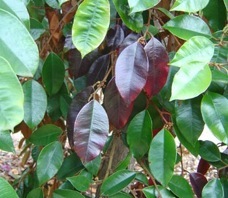
That’s not an unusual direction in an area where Satinleafs grow, they are that distinctive. It was also the Satinleaf that lured the Spanish of Yore off their ships to look for gold. You know the old story: There was so much gold in the New World even the leaves were covered with it.

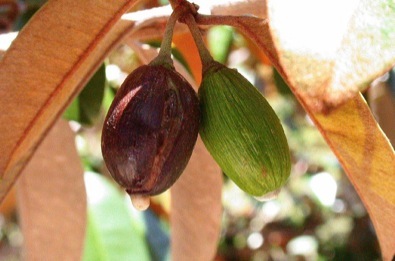
Dark green above, satin brown below, the tree became famous for its looks, but the fruit of the Satinleaf, also called the Olive Plum, is quite edible… well… chewable would be the more accurate description. You chew it for a long time before it feels safe to swallow. Think of it as gum on a tree.

It used to be a common tree — especially in south Florida — but one that has succumbed to development. It’s threatened in the wild but common enough in the landscape and the state’s been encouraging people to plant more of the evergreen.

Satinleaf, Olive Plum

Leaves are satiny copper underneath

Botanically it is Chrysophyllum oliviforme (kriss-so-FILL-um awl-liv-ih-FOR-mee) which in Greek and Latin means “gold leaf olive like.”  To English speakers calling the tree the Satinleaf was a natural. The Indians, who used the tree, had a different view. The Seminoles called it, hilokwa inlokci yaca kita, the Mikasuki hacalo pi ha, which are phrases that literally means something like “chewing strangler fig berries” but means something akin to ‘chewing gum tree.’ The black fruit are sweet and definitely chewy. Somehow each new generation of kids seems to learn they are a local source of gum.  Actually, they eat the pulp. spit out the seed, and chew the skin. The Satinleaf is related to the also edible. C. cainito, called the Star Apple.

Besides a mastication, the wood is hard but not easy to work. It’s used for fence posts, rafters and charcoal. Leaf decoctions are used to treat external cuts and abrasions. The species in the genus contain saponins, coumarins, alkaloids and glucosides.

Green Deane’s “Itemized” Plant Profiles

Pulp is milky sweet

IDENTIFICATION: Large shrub, small tree, to 30 feet or more, upright branches, leaves,  alternate, elliptic or oval, pointed, two to six inches long, leathery, dark and glossy above, coppery satin below. Flowers, white and small, fruit dark purple oval or oblong, about an inch long, rubbery, pulp lavender, milky, sweet, one half-inch seed

TIME OF YEAR: Spring

ENVIRONMENT: Hammocks, pine lands

METHOD OF PREPARATION: Ripe fruit eaten raw after much chewing, can be made into a jelly


{ 1 comment }