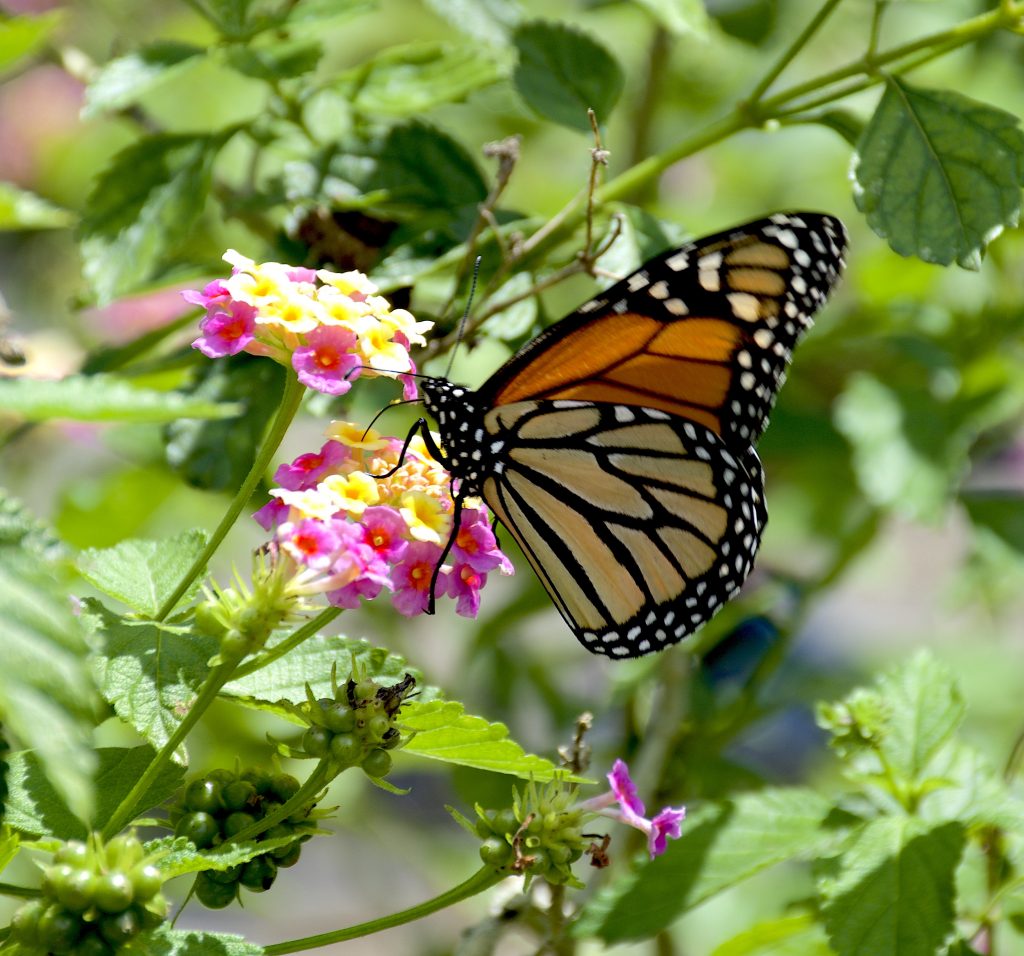
Butterfly on Lantana camara blossoms. Photo by Green Deane

Lantana camara: Much Maligned Nibble

Ask anyone who has heard of the Lantana camara and they will tell you it is poisonous.  And they are right. Unripe berries have killed children and the foliage has killed livestock. But listen to Professor Julia Morton who was the leading expert in Florida on toxic plants.
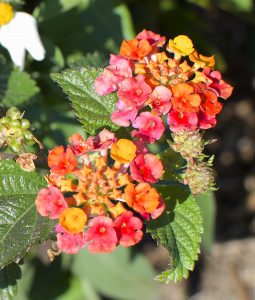
Lantana camara blossoms are multi-colored. Photo by Green Deane

In her book “Plants That Poison People in Florida” she states: “The ripe fruit are eaten by natives wherever the plant grows.” She wrote that in 1995. A 1996 study by Herzog said the same thing (Coppens d’Eeckenbrugge & Libreros Ferla 2000, TAMREC, 2000). On the other hand the University of Texas at Austin says the ripe berries are toxic and Delena Tull in her 1999 book about plants in Texas writes: “Though some previous publications assert that the ripe fruit is edible, experimental studies show that both ripe and unripe fruit are potentially lethal.”

So there you have it. Two views of the Lantana camara. I’ve eaten ripe berries as a trail-side nibble and I am still here. They are very sweet, crunchy and slightly aromatic. I have not made a pie nor have I consumed more than a handful at a time but they have posed no problem thus far. However, they can make you more light sensitive so it is a berry best tried one at a time until you know you are not effected by it.
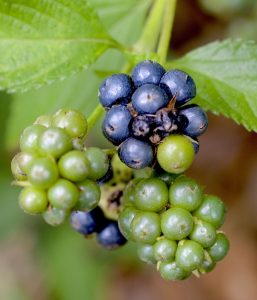
Unripe and ripe Lantana camara berries. Blue is ripe. Photo by Green Deane

Just so there is no confusion. Ripe means deep blue or black berries. Not green or partially green. There is no doubt that green Lantana camara berries have killed children and sickened adults. Conversely, a mild tea made from the leaf is still used in the Caribbean Islands to ease cold symptoms. The ripe berries are used to make jam, jellies, pies and cordials in Ecuador.

Lantana camara (lan-TAY-na ca-MAR-ah)  has had a bit of linguistic history. Virgil (70-19 BC) called a plant lenta viburna, or flexible viburnum, now called V. lantana. It was used by Linnaeus for the genus name for these plants. Camara is a local South American name for the plant. Lantana grows from North Carolina west to California and points south.

A native of the West Indies or perhaps introduced from South American, it is listed as one of the worst weeds in the world. Butterflies, however, love it and it is a must-have bush in every butterfly garden. It’s the birds that spread the seeds around.  It is also a cousin to the American Beautyberry. 

Lantana camara leaves are also toxic to dog livers.

Green Deane’s “Itemized” Plant Profile

IDENTIFICATION: A persistent evergreen shrub to 6 ft (1.8 m) high,  8 feet in width. Leaves are 2-5 inches long by 1-2 inches wide with rounded tooth edges and a textured surface. Stems and leaves covered with rough hairs. When leaves are crushed they smell similar to cat urine.  Flowers, small, in clusters typically 1-2 inches across. Flowers year round, color range from white to yellow, orange to red, pink to rose in unlimited combinations. Not all one color. Flowers often change color as they age.

Note: L. camara has blossoms of different colors, yellow and orange, pink and red. L. depressa has yellow blossoms only, or, white blossom with a yellow throat: No red, pink or orange blossoms. I have not found any reference as to the edibility of ripe L. depressa berries. 

TIME OF YEAR: Fruits can ripen all year but are heavy in the early summer. Fruit when ripe is purple/black.

ENVIRONMENT: Waste places to landscaping to a potted plant. Prefers full sun.

METHOD OF PREPARATION:D ark ripe berries out of hand. They have a flavor similar to a cross between black currants and cherries.  They can be used to make jams, jellies, pies, and cordials.  The fruits can be used to produce a light purple dye. The leaves can be used to polish wood.

From an article by Roger Hammer: 
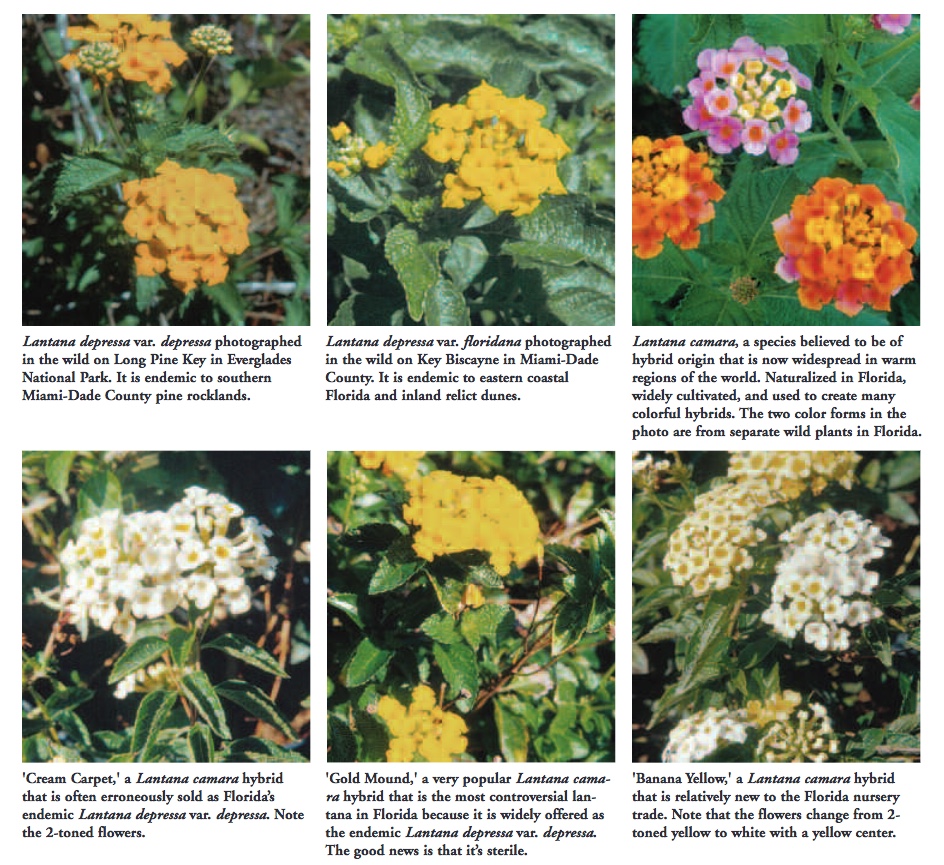
Various Lantana blossoms by species.
 

{ 75 comments }

Knotted lemon grass with stem to make tea

Cymbopogon citratus: A Real Lemon

Technically Lemon Grass is naturalized in only one county in Florida, but you can find it in many yards and landscaping, and in several warm states and northern flower pots.

Lemon Grass

I’ve grown two lemon grasses. One I got from a Chinese grocery that had some roots on it — locally grown —  and one from a fru-fru farmers’ market in Winter Park. I called one Chinese and the other was supposedly from India. After watching them for about ten years I think they are the same species, and they have spread easily in my yard. In fact, if I don’t mow — and I hate to mow — the lemon grass will quickly sprout from underground roots, though it also seeds. The only place I take it out is where it threatens to overshadow my sassafras sapling.

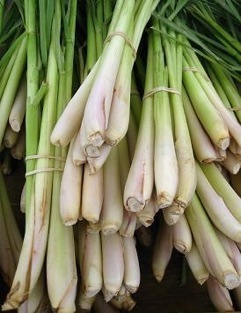
Lemon grass, Cymbopogon citratus, has two culinary claims to fame. Its leaves are used to make a tea or flavor soups and the like. Yes, it tastes lemony.  Its lower stalks can be chopped and also used as flavoring, or ground up for some pastes.

Roots are used for flavoring

Cymbopogon means “boat beard” referring to its boat-shaped bracts. Citratus means lemony.  In 2006 researchers found that lemon grass causes cancer cells to kill themselves, at least in the test tube. Lemon Grass did not affect healthy cells. The amount used was one gram of lemon grass in a cup of hot water. I use a heck of a lot more than that when I make lemon grass tea so I should be super safe.  In fact, here’s how I make Lemon Grass tea.

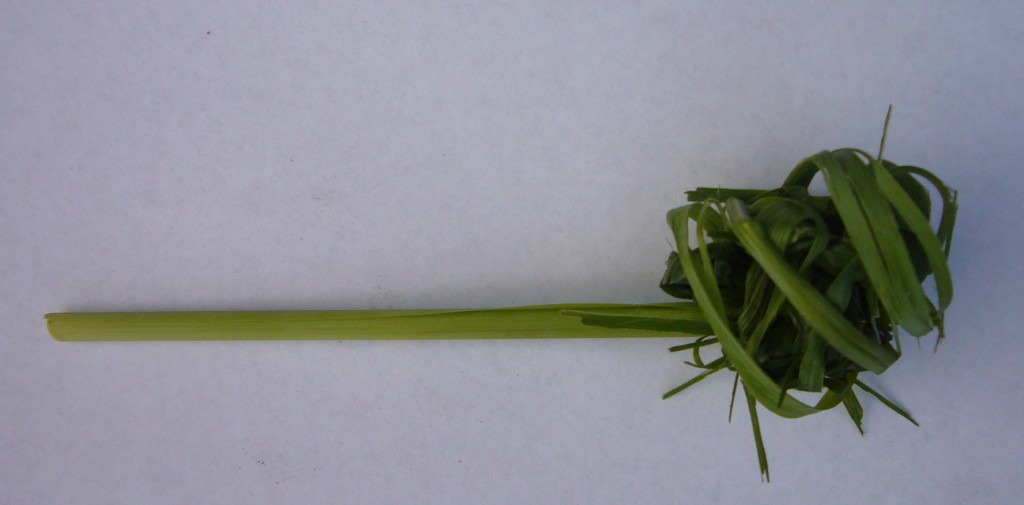
I take a full blade (be careful, the edges can cut you.) I start at the bottom and begin tying the blade in knots. I keep tying until I have a big knot and enough left over for a dipping handle. Then I put it in hot water. It floats but that’s no problem. You can also use the handle to stir it with. Let it seep for a minute or two.

I have been told all native grass seed in North America is edible, and while I suspect that is true I do not know so totally for a fact. There are also imported grasses, among them Lemon Grass. I don’t know know if the seeds of that family (also called Andropogon) are edible but I doubt it.

Green Deane’s “Itemized” Plant Profile

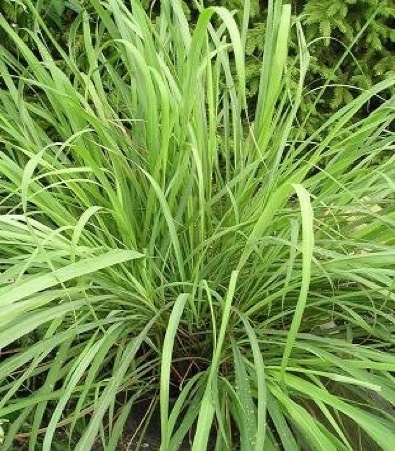
IDENTIFICATION: Lemongrass is a clumping evergreen with narrow blades ranging blue-green to gold, edges are sharp, tiny flowers on stalk are white, cream, or green. Can grow from two to five feet high. Crushed blade has distinct aroma of lemons.

TIME OF YEAR: Year round in warm climates

ENVIRONMENT: Pprefers moist soil and full sun. Propagated by dividing the root clump. Search the bucket of lemon grass at your local Asian market for lemon grass with some roots. Take home and plant.

METHOD OF PREPARATION: Blades (leaves) soaked to make tea or flavor soups. Roots chopped up in stir fry for flavor or made into a paste. Lemongrass leaves can be dried or frozen. Dried leaves need rehydration before use.


{ 10 comments }
Honeysuckle, Lonicera japonica

Some Honeysuckles are edible, some are toxic

Lonicera japonica: Sweet Treat

The honeysuckle family is iffy for foragers. It has edible members and toxic members, edible parts, toxic parts, and they mix and match. Some are tasty, some can stop your heart. So you really have to make sure of which one you have and which part is usable and how.

On the top of the common list is the Japanese Honeysuckle. It is the honeysuckle kids grew up with, picking the flowers for a taste of sweetness. Young leaves are edible boiled. In my native state of Maine there is the L. villosa, the Waterberry, some times called the Mountain Fly Honeysuckle, with edible berries. It is also sometimes mistakenly called L. caerulea (which is European.) Let me see if I can clear that up: If it refers to L. caerulea as edible it is usually L. villosa which is actually being identified (Waterberry.)  If it is L. caerulea and toxic it is usually the L. caerulea in Europe that is being referred to. How the L. villosa in North America got referred to as L. caerulea is anyone’s guess. Anyway, the Waterberry berries are quite edible.

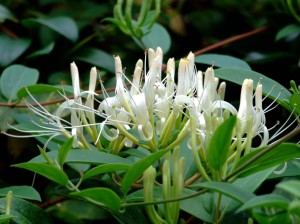
Blossoms have sweet nectar.

Blossoms have sweet nectar.

Among the edible are: L. affinis, flowers and fruit; L. angustifolia, fruit; L. caprifolium, fruit, flowers to flavor tea; L. chrysantha, fruit; L. ciliosa, fruit, nectar; L. hispidula, fruit; L. involucrata, fruit;  L. kamtchatica, fruit; L. Japonica, boiled leaves, nectar;  L. periclymenum, nectar; L. utahensis, fruit;  L. villosa, fruit; L. villosa solonis, fruit;

Among those that might be edible or come with a warning of try carefully are:  L. canadensis, fruit;  L. Henryi,  flowers, leaves stems; L. venulosa, fruit.

There are about 180 species of honeysuckle, most native to the northern hemisphere. The greatest number of species is in China with over 100. North America and Europe have only about 20 native species each, and the ones in Europe are usually toxic.  Taste is not a measure of toxicity. Some Lonicera have delicious berries that are quite toxic and some have unpalatable berries that are not toxic at all. This is one plant on which taste is not a measure of edibility. Properly identify the species.

Species in the genus are quite consistent. The leaves are opposite, simple, oval. Most loose their leaves in the fall but some are evergreen. Many have sweetly-scented, bell-shaped flowers with a sweet, edible nectar. The fruit can be red, blue or black berry, usually containing several seeds. In most species the berries are mildly poisonous, but a few have edible berries.

Adam Lonitzer, 1528-1586

Adam Lonitzer, 1528-1586

While the flowers are a popular nectar source for bees and butterflies L. japonica is considered an invasive weed throughout the warmer parts of the world, from Fiji to New Zealand to Hawaii. It was introduced to the United States about 200 years ago and because it has no natural enemies here has been spreading ever since. In my own yard it has proven to be very invasive, not only up but out. I’ve had a several year battle with it trying to cover a pear tree and a grape arbor.

Lonicera japonica is pronounced lah-NISS-ser-ruh juh-PAWN-nick-kuh. The genus was named after Adam Lonitzer (1528-1586) a German physician and botanist. Japonica means of Japan

Green Deane’s “Itemized” Plant Profile

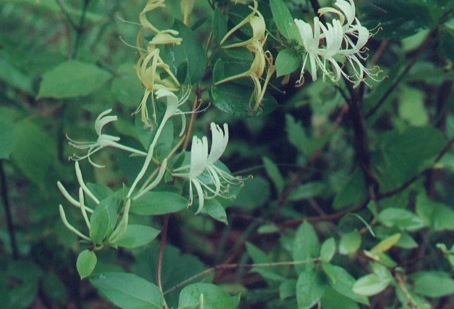
IDENTIFICATION: Lonicera japonica: A vine to 80 feet, twining, trailing, thin, sometimes rooting at nodes, reddish to brownish or purplish, younger parts hairy, often with thin woody bark on the lower stems. Leaves – opposite, with stems or without, leaves  variously hairy above and below but typically densely hairy, no teeth, ovate-oblong, pointed tip, rounded to heart-shaped at base. Flowers white, drying to yellow, a tube, upper lip 4-lobed, bottom lip single-lobed, Stamens 4, filaments hairless, white, style white, stigma green. Fruits black, fleshy globes, not edible.

TIME OF YEAR: Leaves when in season, flowers May to July in northern climes, nearly year round where it is warm

ENVIRONMENT: Landscaping, naturalized in open woods, thickets, roadsides, railroads

METHOD OF PREPARATION: Nectar sucked off the ends of the flowers, young leaves boiled. In China leaves, buds and flowers are made into a tea but the tea may be toxic. Proceed carefully.


{ 42 comments }

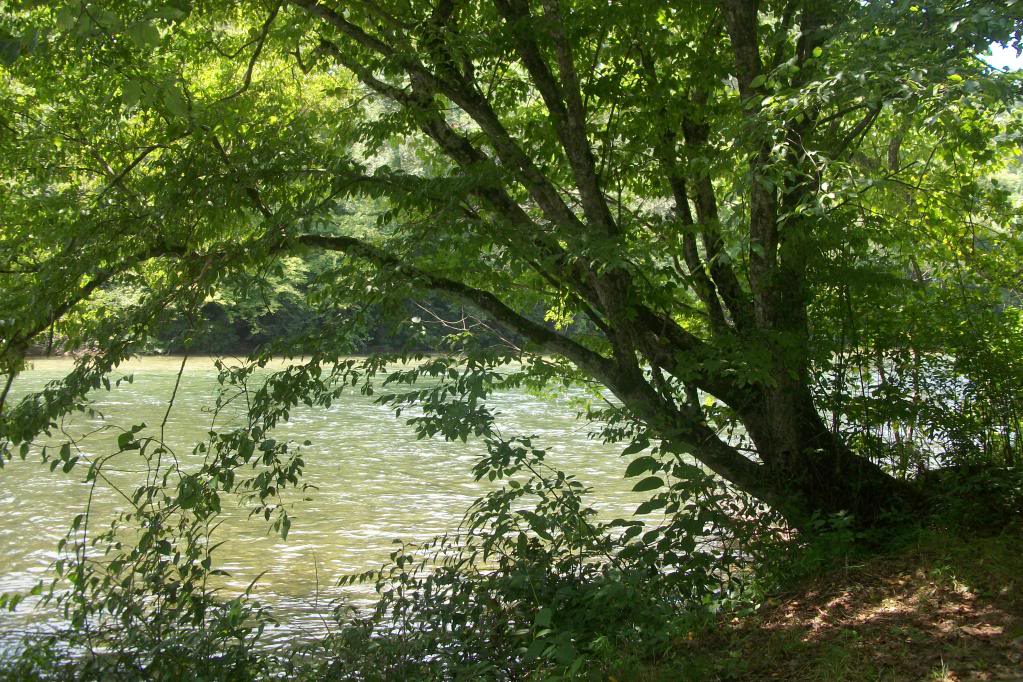
Hornbeam likes to grow near water or damp conditions

Carpinus caroliniana: Musclewood

British author Ray Mears must have been thinking of the Hornbeam when he said a forager mustn’t pass up food no matter how meager.

Not all of the wild edibles can produce the best-tasting and most plentiful foods, but many can make their small contribution. And so it is with the American Hornbeam, Carpinus caroliniana, (kar-PYE-nus kair-oh-lin-ee-AY-nuh.)

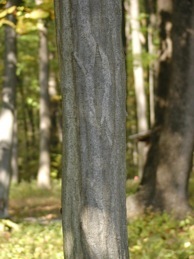
Where I grew up it was called Ironwood or Hornbeam (which means hard tree.) Here in the South you’ll hear it called Blue Beech or Water Beech. While it is not a beech per se, its leaves — which turn orange red in the fall —  can remind one of a beech as can its bark. But the hornbeam has its own special look, and it is of a well-muscled, sinewy tree.

Hornbeam has a weightlifter’s look

Hornbeam looks taut, cut and buff, as if it goes to the forest gym twice a day and lifts … iron. Hence its other common name: Musclewood. Once you have the look of a Hornbeam inside your head you will always recognize it easily.

Hornbeam never grows to a huge size, perhaps six or seven inches through on average. But, it is strong and dense, 45 pounds per cubic foot. It’s been used for tool handles and support poles and

as well as bowls and dishes because it does not crack or split or have any flavor.  It used to be favored to make charcoal powder.

Related to the Alders, Birches, Filberts, and Hophornbeams, the edible part are small nutlets,

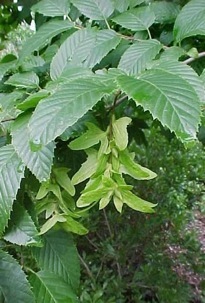
Leaves resemble a beech tree

though the bark does have some medicinal uses and the leaves have been employed as an astringent. There are some 33,000 seeds to a pound, though every three to five years the tree will produce larger crops than usual. A heavily seeding tree is between 25 and 50 years old.  As fare goes, the nutlets are neither great nor awful, but they are small, which is why they are diminished by most writers. They can be eaten raw or roasted. Ray Mears also reports the sprouts are edible.

As for its scientific name, Caroliniana (like Virginiana) means North America, or at least central North America. Carpinus is the classical Latin name for the Hornbeam, and comes from “carpentum” a Roman horse-drawn vehicle with hard-wood wheels.

The Hornbeam grows throughout eastern North American, from Florida to Quebec, Louisiana north to Ontario  It is also found in Texas, Arkansas, central and southern Mexico, Guatemala,

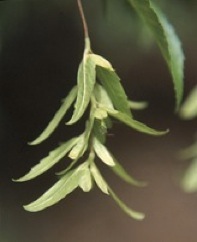
Rub papery wing off nutlet

and western Honduras. In timberland the Hornbeam is considered a tough weed because it is too small for commercial use. However, it makes a good firewood.

Seeds of the Hornbeam are an important food for squirrels. Seeds, buds, and or catkins are consumed by many birds: Ruffed grouse, ring-necked pheasants, bobwhite, turkey, ducks and warblers. The fox will eat the seeds as well. Leaves, twigs, and larger stems are eaten by cottontails, beaver, and white-tailed deer. Deer will eat the shoots but it is not a preferred food. The Hornbeam, however, is heavily used by beaver because it is common their habitat.  It is also the larval host of several butterflies including the Eastern Tiger Swallowtail, Striped hairstreak, Red-spotted Purple, and Tiger Swallow-tail.

Green Deane’s “Itemized” Plant Profile

IDENTIFICATION: A small tree, nearly shrubby, to 25 feet, rounded crown, twisted trunk. Leaves alternate, simple, elliptical to oval, 3 to 5 inches long, smaller on younger trees, pinnately veined, tip tapers to a sharp point, long and short teeth on leaves, smooth green above, paler below. Seeds, small, quarter to one third inch, ribbed nutlet on a 3-lobed, slightly folded leafy bract (resembles a maple seed), clustered on a long hanging stalk.

TIME OF YEAR: Flowers March to May, nutlets late August to winter. Wind can disperse them up to 64 feet from the tree.

ENVIRONMENT: Moist areas of established forests, occasionally fields.  Makes a nice small yard tree, slow growing.

METHOD OF PREPARATION: Nutlets raw or roasted, boiled or ground to add to other flours or food.  Take the papery bracts and rub them between you hands to free the nutlets.


{ 24 comments }

Conyza canadensis: Herb, Fire, Food

Conyza will light your fire!

If you’ve ever made fire with a bow and drill — you know, the Boy Scout way — you also know that choosing (or finding) the right materials is absolutely essential for you to create fire. Add to that a medicinal herb and some culinary uses and “horseweed” deserves a place among the useful weeds we should know about.

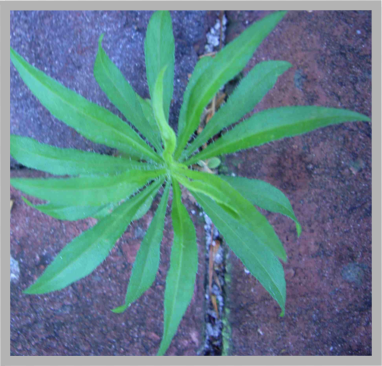
Conyza’s leaves appear to grow in a whorl but don’t

A native of North America, Conyza canadensis is now found around the world. First listed in North America in 1640 it was in France 13 years later (presumably via seeds on beaver pelts from Canada.) Native Americans used a tea from the leaves to treat dysentery and a tea from the boiled root for menstrual issues. It’s a diuretic and can make you sweat. Horseweed has also been called Fleabane because the leaves put in pets’ beds help to get rid of fleas.

As for food, young leafy seedlings  and young leaves can be eaten after boiling, dried leaves can be used as a seasoning with a flavor similar to tarragon. American Indians pulverized the young tops and leaves, eating them raw, similar to using an onion. Per 100g of dry weight the leaves have a small amount of protein and fat, more fiber, good amount of carbohydrates, 8.2 grams ash, 1010 mg of calcium, 280 mg phosphorus, and 2610 mg potassium. An essential oil of Conyza is used to flavor candy, condiments and soda. Fresh leaves contain 0.2 – 0.66% essential oil.

Botanically Conyza canadensis (CON-knee-zah, con-KNEE-zah, con-NEIGH-zah kan-ah-DENSE-iss) means flea from Canada. Conyza comes from the Greek word konops, meaning flea. Pliny used the name for a fleabane, which was put in pet and human beds to keep away fleas.

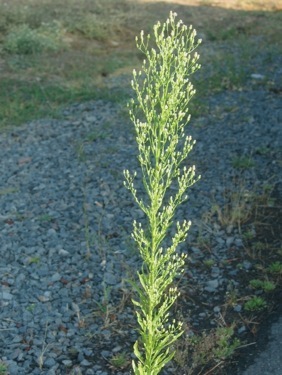
Conyza branches on top before flowering

Conyza canadensis can easily be confused with Conyza sumatrensis and Conyza bonariensis. Conyza canadensis is distinguished by hairless or nearly hairless bracts which lack a red dot at the top but have a brownish inner surface. Conyza sumatrensis has hairy bracts but there are no long hairs near the top of the bracts. Also inner surface of bracts are reddish brown. Conyza bonariensis has densely hairy bracts, and is especially hairy on the stems and around the leaf axils.

While native to North America C. canadensis can be found in The European part of the former USSR, the Caucasus, Western and Eastern Siberia, the Far East, Central Asia, Scandinavia, Middle and Atlantic Europe, the Mediterranean, Asia Minor, Iran, Mongolia, Japan, China, and Australia.

The horseweed is also one of the best, if not the best local material for a drill when making fire with friction. Actually too fragile to be used with a bow, it works very well using the hand method. As you might expect, choose tall straight plants, let dry, remove leaves, and you’re ready. Horsetail is so good often you don’t even need a V-notch to collect a coal, it will produce one in just a depression.

 Green Deane’s “Itemized” Plant Profile

IDENTIFICATION: Annual, one to seven feet tall, unbranched except for the flowering stems near top. Central stem ridged, covered with long white hairs; leaves alternate around this stem appearing whorled, similar length, 3-4″ long and ½” across, narrowly lanceolate or oblanceolate, a few teeth toward outer tips, fine white hairs along the edge. Smaller leaves near the blossoms more linear and less likely to have teeth. Many composite blossoms less than 1/8 of an inch across, lasting several weeks.

TIME OF YEAR: Summer to fall

ENVIRONMENT: Prefers full sun and good soil, well watered. But it can grow nearly anywhere, often forms colonies. Drought resistant.

METHOD OF PREPARATION: Dried leaves as a spice, very young leaves and shoots as a green boiled. Stem makes good drill for fire starting.


{ 15 comments }