Eryngiums: Elizabethan Eryngo Candy

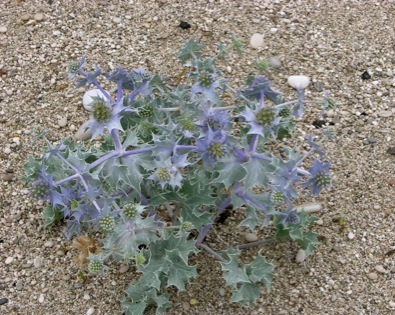
Eryngium maritimum

While the edible versions are not widely distributed in North America, Eryngo (ERR-in-go) was too pretty a name to be left off my edibles list.

The two edible versions are Eryngium maritimum and Eryngium campestre. They are in the carrot family and are used similarly. Both are sparely distributed whereas their more ornamental cousins in the same family are widespread.

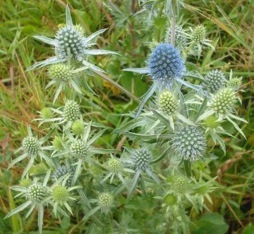
First E. maritimum, or the Sea Holly. On first glance when one sees the Sea Holly on the beach you think it is a lost thistle. The flower is burr-shaped but metallic blue, not pink white. It potential height, two feet, dwarfs the root’s potential depth up to…ah….down to 20 feet. No more than three is usual. Found naturally only near the sea it likes sand and is both a xerophyte and a halophyte, read it likes dry spots and salty spots.

Young leaves and shoots are blanched and prepared like asparagus. The roots were once sugared and sold as candy.  They were peeled, boiled, and cut into slivers which were twisted together and then covered with sugar. The English town of Colchester was famous for the candied roots for centuries. The candy was much sought after for colds, coughs, and as an aphrodisiac.  (An ancient recipe for candied Eryngo is below on bottom.) When the roots are boiled or roasted, they taste like cooked chestnuts and are quite nutritious.
Eryngium campestre

Eryngium campestre has skinnier leaves and branches. It is also green where as the E. maritimum is blue-green. The E. campestre can grow by the sea but prefers to be inland in dry areas. Called Field Eryngo, it’s found more often in Europe than England but is also naturalized sporadically in North America.

Eryngium (ear-WREN-gee-um) is the Greek name for the plant latinized. It may come from the Greek word ‘erugarein’ meaning ‘to cure belching.  Greek physician Dioscorides recommended the root to ease gas. Or it could come form ‘eerungos’, meaning ‘beard of a goat’. Plutarch recorded the effect of Sea Holly on goats: “It causes her first to stand still and afterwards the whole flock, until such time as the shepherd takes it from her.” Maritimum (mar-ih-TEE-mum) of or by the sea. Campestre (kam-PES-tree) means found in plains or similar flat or level places.

Green Deane’s “Itemized” Plant Profile

IDENTIFICATION: E. maritimus: spiny like a Holly, low growing but Thistle-like in appearance, bluish-green, stiffly hairy, spiny, leathery leaves, 3-lobed, folded. much-branched, numerous leaves, upper leaves clasping the stem, long thick roots. Flower heads, blue, are in heads with a whorl of stiff-colored bracts, spiny, petals narrow and deeply notched, turned down. E. campestre has slimmer or deeply cut leaves and stems and is green. It  grows more upright

TIME OF YEAR: Flowers July and August

ENVIRONMENT: One likes it by the sea, one inland in grassy areas, both like full sun.

METHOD OF PREPARATION: Young shoots and tips are blanched then eaten like asparagus. Young shoots can be pickled.  Roots can be candied, or boiled or roasted. The root is sweet but has little aroma. The plant is diuretic. Leaf juice was squeezed into ears to treat ear infections.

To candie orringo roots

Take fresh gathered oringo roots, set on a ketil of spring water, let it seeth, then put in ye roots & make them boyle as fast as a parsnep. Then cut them in ye midst & pick out theyr pith with a knife, then pill & throw them into a bason of aire water. Then wring them out of ye water & dry them with a cean cloth. Place them 3 or 4 together and tie them at each end with a third. Then take as much sugar as they weight & as much rose water & faire water together as will make a sirrup to cover them. Then set them over ye fire & dry them, after they are boyled in ye sirrup till it allmoste all boyled away & shaed in the bason to worke in ye sirrup. Then dry them by ye fire & box them for all ye year.

And creamed eryngo:

A 17th century recipe for ‘Eryngo cream’ by John Evelyn:: ‘Take halfe a pound of Eringo Roots and mince them very well then take an Ale pint of Creame sett them on the fire and boyle them with a piece of Isinglasse to thicken it boile a litle of it to trie the stiffnesses …
{ 4 comments }

 Oenothera biennis: Foraging Standby

Evening Primsoe

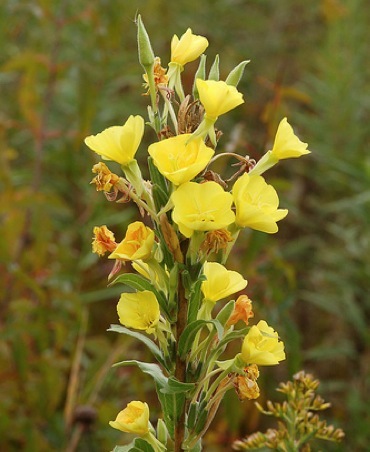
The Common Evening Primrose has long been a foraging standby and for a century or so was a common vegetable found in European gardens though it’s an American native….probably.

While the edibility of Oenothera biennis (ee-noh-THEER-uh  bye-EN-niss) is not in doubt much about the plant is. Linnaeus, who started naming plants in the mid-1700’s, said it was introduced to Europe from North America in 1614. But some modern botanists say it’s native to Europe and went to North America with colonists. Curious: For a plant that might have been native to Europe it certainly was not utilized there until after its discovery in North America. By the 1880s, however, the Evening Primrose was a common garden vegetable in Germany.

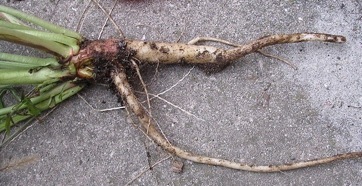
Evening Primrose root

The plant’s name also shrouded in a lexicographic fog. Oeno comes from the Greek word Oinos (said EE-nos which later went in to Latin and became vino. “Oi” in combination in Greek is always said “ee”.) Oinos means wine. Thera can mean catcher or hunter.  So in polite circles it is interpreted as a root that can absorb wine. There is speculation that ancient (European) hunters would give some wine-soak root to animals to calm them down.  I’m not sure that would work and might be a waste of good wine.

Pliny, 23-79 AD, had a different view of the word and wrote: “onothera, sive onear, hilaritatem afferens in vino” which translates into something like “ass catcher, a plant whose juice in wine causes happiness.” A 1601 translation read: “Oenothera, otherwise Onuris, an herb good also in wine to make the heart merry.”  The famous botanist Merritt Fernald in 1950 gave up and said it means “wine scented.”  Another interpretation is “wine imbibing.” Other views suggest it meant people believed the plant had ability to the calm ferocious man or beast. Biennis means two years, referring to the plant’s growth habit. Primrose means first rose, and since its blossoms open at night “evening” was added to common name a few centuries ago.

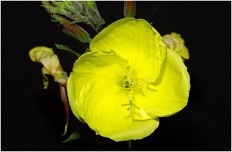
Blossom in normal light

During the first year there is only a rosette of basal leaves. Then the second year the plant sends up a tall stalk with alternative leaves and yellow flowers at the top. The flowers open quickly in the evening and, depending on the weather, usually fade by mid morning. The root of the first year plant, cooked, is edible, usually late in the season. Raw it will irritate the throat. Young leaves from the second year stalk were cooked as greens by the Cherokee indians (who first saw Europeans in 1540.)  Young second year stalks can also be peeled and eaten. That stalk dried makes a good drill for making fire. Leaves can be eaten if boiled more than once but they are usually tough and gritty. Flower buds can be eaten raw or cooked and the flowers added to salads.  The seeds are edible as well (those seeds can also remain viable in the soil for at least 70 years.)  Try all parts carefully and sparingly. They can bother the throat of some people even when cooked, and the taste may be acquired.

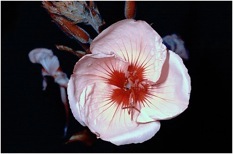
What some insects see, photo by Bjørn Rørslett - NN/Nærfoto

The young shoots of O. biennis, O. hookeri, and O. lamarckiana are edible raw. Roots of the O. hookeri have been eaten as well. The tough seedpods of the O. californica and O. nuttalli were eaten by the Indians as were the seeds of O. brevipes.  O. fruticosa leaves were used as a potherb and it grows throughout eastern North America. Young crown leaves of O. biennis can be blanched and used for salads. People aren’t the only ones who appreciate the Evening Primrose. A lot of insects also like it as well and O. biennis has ultraviolet markings to help the bugs land.

O. biennis is found throughout North America except Idaho, Colorado, Utah, Arizona, and Wyoming.

Green Deane’s “Itemized” Plant Profile

IDENTIFICATION: Lemon-scented, large yellow flowers at the top of a leafy, hairy stalk, stalks, often purple-tinged, erect, 2-6 ft. with leafy, branched stems from a basal rosette. Four-petaled flowers to 2 inches across open at night, close in the day.  Second year stalk has lance shaped leaves spiraling up the stem topped by flowers. Seed pod splits into four parts. There is great variability  in the plant but it rarely branches.

TIME OF YEAR: Young leaves, flowers and buds, in season, roots near end of first year, second year stalks early in season

ENVIRONMENT: Fields, prairies, thickets, waste ground, disturbed sites, cultivated areas, roadsides, railroads

METHOD OF PREPARATION: Numerous: Roots cooked, usually boiled, peppery. Young shoots – raw or cooked, mucilaginous and peppery. Flowers sweet, used in salads or as a garnish. Young seed pods – cooked, often steamed. The plant also has many medicinal applications.

{ 24 comments }

 Solidago Odora: Liberty Tea

Golden rod Photo By Green Deane

After the Boston Tea Party of 1773 the colonists had only one good alternative: Goldenrod tea, and not just any Goldenrod, but the Solidago odora (sol-i-DAY-go oh-DOR-uh.) It became known as “Liberty tea” and was even exported to China.

As a kid growing up 120 miles north of Boston I never thought of Goldenrod as a revolutionary potential tea. It was one of two blossoms that shaped my view of the world. In mid-May when the Lilacs bloomed I knew school was almost over for the summer. Who can ever forget the great joy that brought. And in late August the goldenrod began to bloom. Back to school. School always started the Tuesday after Labor Day. And to be fair that was usually exciting… for about a day.

Goldenrod is found throughout North American and you will read that nearly any goldenrod will make a tea, and that may be true if you have herbal applications in mind. But, leading the genus for a pleasant tasty tea is S. odora.  It’s one of 25 goldenrods found locally and grows from Nova Scotia south to Florida west to Arkansas and Texas. It has also traveled some.

Goldenrod was introduced into Europe some 250 years ago.  Solidago canadensisis now common in the wild there. In Germany  it is considered an invasive species, which brings up a word associated with this plant: Ruderal.

Goldenrod is known as ruderal species, that is, it is among the first to take advantage of disturbed ground. It grows so quickly it can often makes a cleared site fragrant and attractive. It has also has gotten some bad public relations regarding allergies, most of it undeserved. Its pollen is heavy, doesn’t travel well, and is not the allergen it was thought to be. Usually the problem is ragweed. Goldenrod  has, however, been linked to cases of dermatitis. The leaves are also toxic to sheep. And although goldenrod tea is a wholesome beverage, a toxic fungus that sometimes grows on the leaves may poison tea made from infected leaves. So make sure there are no problems with the leaves you collect.

As a kid I remember it as a particularly smelly because it was a common plant to make into homemade and very inaccurate arrows for playing Cowboys and Indians. We Indians always won because unlike the cowboys with their fake guns we had Goldenrod arrows launched on alder bows. The alders were fairly smelly too. (I think that’s how the Cowboys knew where we were hiding.)

Of course bees use the Goldenrod as do butterflies and oddly woodpeckers. Bees make an excellent honey from the Goldenrod. The butterfly’s dependence is totally different.  The butterfly lays an egg. The eggs becomes a larva that form a gall. Then certain parasitic wasps lay eggs in the larva in the gall. Woodpeckers, apparently experts in finding hidden food, peck open the galls and eat the growing insect inside.

Also know that the Goldenrod is not just another smelly flower with a pretty face. Thomas Edison experimented with goldenrod to make rubber, which it exudes naturally. In the 1930’s he managed to get 12% rubber out of each plant and Henry Ford gave Edison a Model T with tires made out of Goldenrod rubber. Edison turned his rubber research on the Goldenrod over to the government which carried it on until synthetic rubber was discovered during WWII. That ended Goldenrod as a source of rubber. However, its rubber is very strong and long-lasting, read better than synthetic rubber.

The Goldenrod is the state flower of Kentucky, Nebraska and South Carolina. It used to be the state flower of Alabama but was replaced with the camellia. Goldenrod also the state herb of Delaware. You didn’t know some states have State Herbs? You do now.

Solidago is from Latin and means to strengthen. This is in reference to the medicinal uses of the plant. Odora means fragrant.

 Green Deane’s “Itemized” Plant Profile

IDENTIFICATION: Goldenrod is a perennial, 2-5 ft tall, hairy stems, alternating stemless single-veined narrow dark green leaves, smooth or hairy margins, pointed tips, 1-4 inches long becoming small towards the top, and smells like licorice when crushed (from small glands.) Dense  golden-yellow flowers, late summer to mid-fall,  in branched clusters at the tops of the stems. Goldenrods hybridized, so you night not be able to identify the exact species. You want to find a Goldenrod whose leaves smell like anise.

TIME OF YEAR: Leaves anytime, blossoms late summer to fall. Flowers yield a deep yellow dye.

ENVIRONMENT: Naturally prefers poor sandy soil but grows well in fertile soil. Will also grow in clay, full sun or semi-shade but will do better on a reasonably fertile site.

METHOD OF PREPARATION: Dried leaves and flowers to make tea. Make sure the leaves are fungus free. A toxic fungus can grow on the leaves. Some report the seeds of several species were used as food.  There are herbal applications. Roots smell and taste like raw potatoes.

HERB BLURB

Solidago odora  leaves and tops (picked during the flowering period) have been used to make herbal medicines for a variety of disorders, including digestive and urinary problems, wounds, ulcers, and cancers. Hocking, 1997, reports S. canadensis was used as a carminative, diuretic and stimulant. Other uses included:  Boiled in water for a syrup for treating colds; an oral poultice made from leaves was placed for a toothache; a poultice the roots to soothe burns and boils; a tea for bruises; a salve for insect stings and saddle sores on horses.


{ 25 comments }

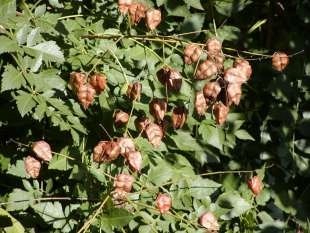
 Showers of Golden Rain Tree

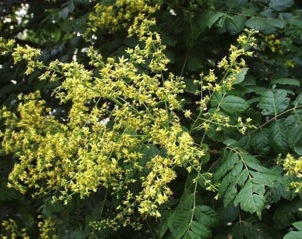
Golden Rain Tree Blossoms

The scallions didn’t have a chance.

My Taiwanese friend liked to grow scallions in a postage stamp garden in her back yard. They added fresh flavor to her down-home Chinese cooking. But her neighbor had a Golden Rain Tree that loomed over the scallion patch like an ominous shadow. In the fall it was constantly showering her garden with seed capsules, producing hundreds of sprout seasonally. The tree eventually won. Unfortunately this was a quarter of a century before I knew those Golden Rain Tree shoots were edible. You must, however, have the right species.As in the comments below make sure you have a golden rain tree and not a golden chain tree, Laburnum anagyroides, which is totally poisonous.

This particular Golden Rain Tree was a Koelreuteria paniculata (kole-roo-TEER-ee-uh  pan-ick-yoo-LAY-tuh) a native of China and Japan. It was named for Joseph Gottlieb Kolreuter,  1733-1806, who carried out experiments in hybridization and published research about tobacco. He was noted for two things; his ingenious experiments and his complaint that professors of botany didn’t make much money. My German isn’t that good but I think Koelreuter can mean “cabbage patch” or “cabbage thief.”

Golden Rain Tree seed pods

Besides eating tender young shoots and leaves (boiled) the yellow flowers produce a yellow dye and an eye wash. The mature leaves produce a black dye. As for eating the seeds… all reports say they are roasted but acidic, which makes sense as they have the same irritating oil found in unrefined canola oil (which if I remember correctly is erucic acid.) Their the seeds also might be insecticidal. By most accounts the roasted seeds are a famine food. I have not tried them. They’re on my list of things to do when I have better health insurance. The leaves and shoots have some antioxidant and anti-tumor “activity” but also have some traces of cyanide, hence the cooking. These are not for raw salads.

The Golden Rain Tree was introduced to the west from China by Jesuit missionary, Pierre d’Incarville in 1747. The trees were under cultivation in Jardin du Roi by 1763. The tree reached America by 1809 when Thomas Jefferson germinated seeds sent to him by a French friend. While it has since become a popular landscape tree worldwide it is also an invasive species in many places including Florida.

Green Deane’s “Itemized” Plant Profile

Joseph Gottlieb Kölreuter, 1733–1806

IDENTIFICATION: Trees or shrubs, deciduous, bark grayish brown to black, stout, fissured, lenticels gray to dark brown, small; branches tuberculate, appressed pubescent or glabrous with axes and petioles. Leaves fascicled on young branches, spreading, pinnate, imperfectly bipinnate, or sometimes bipinnate, sessile or very shortly petiolate, opposite or alternate, ovate or broadly ovate to ovate-lanceolate,  sometimes hairy or densely pale yellow pubescent. Flowers pale yellow, slightly fragrant, 4 petals

TIME OF YEAR: Locally it is in its ornamental glory in October.

ENVIRONMENT: Full sun, rich soil, will tolerate some variation.

METHOD OF PREPARATION: Boiled young shoots and leaves, roasted seeds… perhaps.

HERB BLURB

SUN Bao-teng et al (College of Life Science,Nanchang, University,Nanchang,Jiangxi 330031)

[Objective] The study aimed to analyze the oil content in seed kernel and the components of fatty acid in the seed oil of Koelreuteria bipinnata Var.integrifolia T.Chen.[Method] The seed oil of K. bipinnata was extracted with soxhlet extraction and the oil content in seeds was calculated. The component of fatty acid in seed oil was detected with gas chromatograph-mass spectrometer after the fatty acid being methyl esterified.[Result] The oil content in seed kernel of K. bipinnata reached 54.04%. There were 5 saturated fatty acids and 3 unsaturated fatty acids in seed oil,among which,the content of unsaturated fatty acid reached 75.26%,and the unsaturated fatty acid mainly contained oleic acid(31.07%), eicosenoic acid(35.07%) and erucic acid(9.12%). The nutrition value of seed oil of K. bipinnata was higher,but in which there were no polyunsaturated fatty acid with more higher nutrition value and there were erucic acid and arachidic acid that indigestible in the oil.[Conclusion] The seed oil of K. bipinnata had higher nutrition value, but whether it could be used as edible oil needs to make the toxicological study.  (GREEN DEANE NOTE: Erucic acid is limited to 2% and 5% in Canada and Europe respectively in Canola Oil for food.)

{ 13 comments }
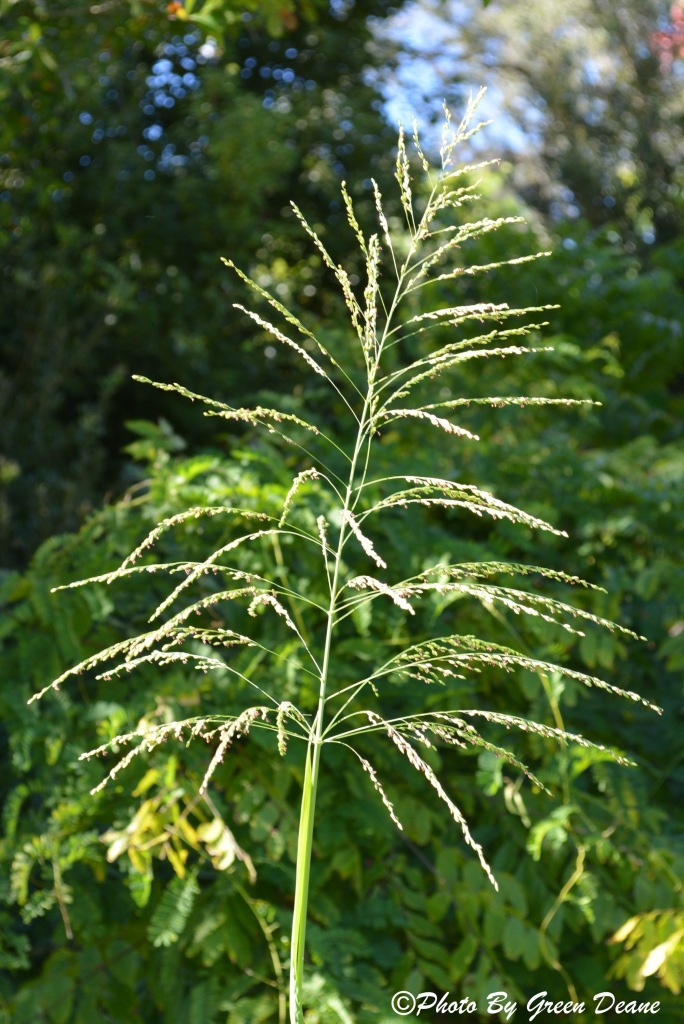
Panic grass starts out tightly bundles then relaxes outward. Photo by Green Deane

Panic grass starts out tightly bundles then relaxes outward. Photo by Green Deane

Panicum maximum and then some

I eat grass. Actually we all do — rice, wheat, oats, barley  — but my local trail nibble is Guinea Grass, a relative to millet.  I’d like to tell you I collect enough to bake a loaf of bread, but I don’t. It’s an extremely common small-seeded grass here in Central Florida, unlike say Barn Yard Grass, and offers itself as a supplement to ones diet. On the trail I strip a stalk and just chow it down raw  (making sure it is not purple or red or black or brown with fuzzy ergot.) Or, I gather a few cups and parch the seeds till lightly green/brown and then snack on them. No, I don’t winnow them. It has a slightly burnt peanut flavor, quite nice actually.

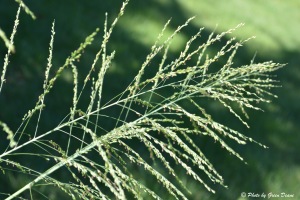
The small seeds often have red flower tufts. Photo by Green Deane

The small seeds often have red flower tufts. Photo by Green Deane

Relatives of Panicum maximum provide a lot of food around the world. You will find grasses among the most difficult foragables to sort out. There are few quality references and grasses are frustratingly alike. Fortunately, there are just a few poisonous grasses but one you do have to look out for in North America is Johnson Grass, Sorghum halepense. Its leaves are toxic to humans. The Andropogons are iffy, too. Panicum maximum PAN-ih-kum MAK-see-mum) means “big bread.” Millet is not an important grain source in the United States but it very common in the rest of the world. I suspect the seeds of most Panicums are edible.

This just in: This plant’s new name is Megathyrsus maximum… which means “Big Flower Stem.” I hope that nomenclature update makes things much, much clearer.

Green Deane’s “Itemized” Plant Profile

IDENTIFICATION: Panicum maximum  is a perennial with a short, creeping rhizome, height to seven feet. Leaf sheaths at the bases of the stems are covered in fine hairs. Blades are up to 1.5 inches wide, tapering to a long fine point. Inflorescence is a large multi-branched, open panicle with loose, flexible branches. The lower branches in a whorl. Spikelets are green to light purple. Usually in large stands.

TIME OF YEAR: Flowers from November to July, seeds in fall.

ENVIRONMENT: Prefers fertile soil, adapted to a wide variety of conditions. Grows well in shade, damp area, under trees, seen along rivers and open woodland.

METHOD OF PREPARATION: I eat them as a trail side nibble raw off the stalk, or parch them and eat without winnowing. Experiment.


{ 7 comments }