Caryota: Fishy Toxic Palms

Often the botanical name of a species tells you nothing about the plant. Magnolia comes to mind. It’s a person’s name. However “urens” does enlighten, Caryota urens specifically.

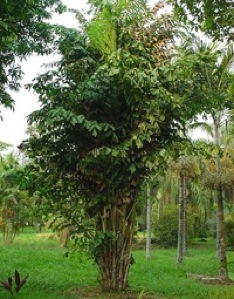
Multi-trunk fishtail palm

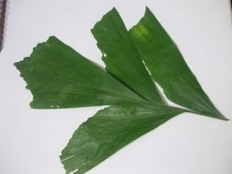
Caryota urens is the Fishtail Palm, so called because the bi-pinnated leaves resemble the back end of a fish.  Urens means “stinging” and the fruit does contain a chemical that does sting. That said, the kernel of the fruit is edible but it has to be cleaned completely of the stinging outer flesh.

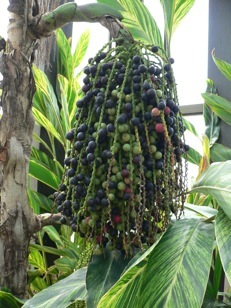
One of the odd thing about the genus is when it fruits the trunk the fruit is on dies. The single trunk Caryota urens grows fast and lives to between 20 and 25 years old but when it fruits, that’s the end of it, though it can take years to die. The multi-trunk species, Caryota mitis does better and grows a source of more trunks. But, they too die, fruiting from the top down.

As a forager I am used to being told this or that species is toxic. This was one so-called toxic plant that was true. However, that did not keep natives from using this palm. The primary product of the genus is a sugar substitute called kitul honey or jaggery. The juice from the flowers is boiled in a large wide-mouth vessel making golden syrup. The fruits have raphides of calcium oxalate and are not eaten. The seed kernel is edible, however.

Fish tail looking fronds

The growing tip of the palm is also edible as is the palm heart. The sap can also be fermented. Leaves are used for animal fodder, being 2% protein and 9.3% fiber. The sheathing leaf bases provide a strong fiber for brushes. Wood is used to make spears and used like gutters or pipes to carry water.

There are about 15 species of Fishtail Palm, C. urens is used the most. C. mitis has become an invasive in Florida. The botanical name, Caryota, (kair-ree-OH-tuh) is from Greek and means “nut.” Urens (UR-ens) means burning.  Mitis (MIT-iss or MY-tis) means soft, referring to the sheathing leaf bases particularly found on the smaller species.

 Green Deane’s “Itemized” Plant Profile

Seed pulp is toxic, the kernel is edible

IDENTIFICATION: Fronds resemble fish tails. Inflorescences can grow to 10 feet long emerging at the nodes, from the top of the palm down.

TIME OF YEAR: Fruits after 15 to 25 years then continuously until it dies.

ENVIRONMENT: Prefers rich, moist soil and much sun but can tolerate some shade and dry conditions.

METHOD OF PREPARATION: Sap is boiled into a syrup or fermented into wine or a spirit. The growing tip of C. urens is edible as is the heart and young leaf shoots cooked. The seed kernel of both are also edible but the pulp of the fruit of both is not. The bud of the C. mitis is edible after cooking but remains bitter.

{ 14 comments }


Forsythia

Foraging For Forsythia

If you study the eating habits of North American Indians you learn one thing quite quickly. They weren’t mono-green eaters. What I mean is, they usually didn’t eat just one green species of plant at a time.

Today when we have a meal we often have one green food, say string beans or spinach. That serving comprises the entire green portion of the meal. The Indians simply did not do that. It was a leaf here, a blade there, a shoot from over yonder, all mixed in together. From such meager foraging a meal is made. And while the Forsythia was not on their menu it’s one of those little edible you usually mix in with other things.

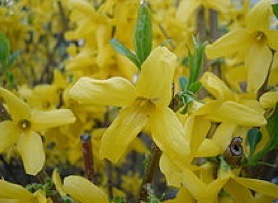
For a very common ornamental that has also liberated itself there is nothing about the Forsythia as an edible plant in my entire library, which is now around 100 books plus papers, DVDs et cetera. Yet the blossoms are edible raw, though they can be slightly bitter. They add color to salads and are a cheery garnish. The very young leaves are also edible raw but that’s iffy as they contain some of the glycoside Phillyrin, and it’s debatable just how nasty that is. Very young leaves have also been added to soups. As you can see the key is “very young leaves.” I suspect we know these things because some folks in were very hungry for anything green in the spring after long winters.

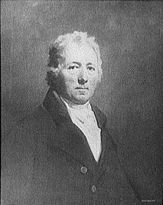
William Forsyth 1737-1804

The Forsythia genus is named for the Scottish botanist William Forsyth. He was the royal head gardener and a founding member of the Royal Horticultural Society. He is also credited with (intentionally) building the first English rock garden. As a bit of genealogical history the British entertainer Bruce Forsyth is a descendant of his.

As a native to China the Forsythia was introduced to the rest of the world by fellow scotsman Robert Fortune, below,  a famous/infamous plant hunter. It was Fortune who single-handedly smuggle the plants and know-how to make tea out of China establishing it in India, a bit of botanical espionage from which China has only recently recovered. After 250 years China now leads India in tea production. Fortune, who did not know much Chinese or botany did so disguised as a Chinese peasant. And now you know why the British drink tea. They had wars with China but India was their colony. So they planted tea in a friendly place, or occupied place. Views vary.

Robert Fortune 1812-1880

There are about a dozen species of Forsythia, depending upon who’s counting and if you include at least one hybrid. Most of them are native to eastern Asia but one is native to southeastern Europe. There are also many cultivars including dwarf and compact forms. F. suspensa, the weeping Forsythia, is an important herb in Chinese medicine and has been used for at least three thousand years, perhaps four. Called lian qiao it’s unripe yellow fruit and seeds are ground together. Lian qiao is used internally for chills, fevers, headaches and externally for burns, infections, rashes and the like. Lab tests show the seed to be anti-inflammatory (Rouf et ali 2001 and an anti-oxidant (Schinella et ali 2002.) But a 1991 study of 102 raw pharmaceuticals used in traditional Chinese medicine (Yin X et ali)  suggested lian qiao might be potentially cancer causing, perhaps that glycoside issue again. In 2009 (Wang F.N.,  et ali) found three new glycosides in the F. suspensa bringing the total to nine. Forsythia extracts are used in commercial products treating dandruff, acne, and athlete’s foot … Sticking with just the blossoms in a seasonal salad seems wise.

Like the Eastern Redbud (pink) and the Chickasaw plum (white) the Forsythia blossoms on naked branches before its leaves appear, giving us a seasonal flame of yellow. Each of those species use the massive show of color (and ultraviolet markings) to attract early pollinators. Forsythias are found in most urban areas but they have also escaped cultivation making them quite easy to find in spring. Just look for yellow flowers and no leaves.

Oddly, or perhaps understandably, gardeners have a love/hate relationship with the Forsythia. For two weeks every year it is the darling wherever it grows. Then it is rather boring for 50 weeks.  But that doesn’t deter some people. There is a Forsythia festival every year… the second week in March… in… Forsyth, Georgia, about one hour south of Atlanta. If the weather is bad the festival goes on anyway. Forsythias wait for no one. (And yes, there is a Miss Forsythia pageant.)

 Green Deane’s “Itemized” Plant Profile

IDENTIFICATION: Forsythias have narrow, dark green leaves with a lighter underside, in opposite pairs, the margin is serrated. There are also a large number of variegated and golden leaved varieties. Yellow flowers, four narrow petals at right angles form a short tube. One to three flowers per node.

TIME OF YEAR: Your spring

ENVIRONMENT: Sunny, well-drained soil, may need extra watering in dry spells

METHOD OF PREPARATION: Blossoms raw, or cooked but usually raw, slightly bitter. Very young small leaves raw or cooked. Exercise caution with the leaves.

HERB BLURB

Below is the abstract of a study in its entirety. Perhaps something is lost in the translation, or I am reading it wrong. But, the last sentence seems to say don’t worry about phillyrin or forsythiaside in the tissue of the dog you are about to eat because the dog eliminates them from its system quickly. (No, I am not kidding….)

Pharmacokinetics of phillyrin and forsythiaside following iv administration to Beagle dog. Li YX, Peng C, Zhang RQ, Li X, Jiang XH.

Chengdu University of Traditional Chinese Medicine, Sichuan, China.

Abstract

The objective of the present study was to firstly investigate the in vivo pharmacokinetics of phillyrin and forsythiaside in beagle dog. On I.V. administration, a rapid distribution was observed and followed by a slower elimination for phillyrin and forsythiaside. The mean t(1/2Z) was 49.99, 34.87 and 43.81 min for 0.19, 0.70 and 1.43 mg/kg of phillyrin, and 60.90, 64.30, 57.99 min for 0.62, 1.39 and 5.52 mg/kg of forsythiaside respectively. And the AUC(o-t) increased linearly from 36.51 to 160.22 microg x min/ml of phillyrin and from 50.63 to 681.08 microg x min/ml after the three dosage administrated. In the range of the dose examined, the pharmacokinetics of phillyrin and forsythiaside in beagle dog was based on first order kinetics. Although both drugs were widely distributed to various tissues in the dog, no concerns about extensive binding to tissues that may be consumed by the public should a dog be exposed to phillyrin and forsythiaside according to the rapid elimination.


{ 6 comments }

Geiger Tree, Scarlet Cordia

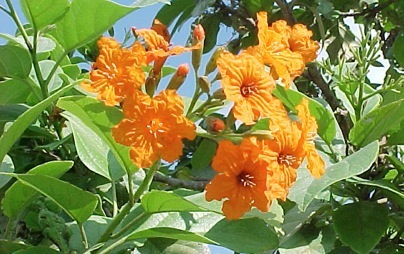
Cordia sebestena: Foraging Geiger Counter

Foragers eat the mild fruit of the Geiger Tree and care not about the particulars. Botanists care about particulars and can’t agree where it came from but they are pretty sure it is not a Floridian but in Florida it was named.

The Geiger Tree got it’s name from no less a person than John James Audubon. But, before I explain that, the record should be set straight about Jean-Jacques Fougère Audubon.

John James Audubon

He was born a French citizen in Haiti, went back to France as a boy then to the US at age 18 to avoid being drafted into the French army by Napoleon.  He learned English from Quakers and used “thee’s” and “thou’s” long since passe even then. That he was a bigger than life personality and an innovative artist is quite true and worthy of mention. His drawings did promote interest in nature. But you should know that the National Audubon Society is far more nobel than the man whose name they perpetuate.

The society not only had no substantial connection to Audubon but is an advocate of nature. Audubon raped nature. He kill scores, many times hundreds of just about every creature he ever drew. And that is not an exaggeration. He was not a protector of nature by any definition. A bad day was a day he did not shoot several hundred birds. He was a one-man extinction machine. Even by the standards of his day he was an excessive hunter when he did not have to be.  Conservation was not in his vocabulary. As an old man he changed his mind but I am not sure that has any value. It did not bring back the tens of thousands of the creatures he dispatched. Food is one thing, wholesale saughter is another. Since he was famous for his painting of birds it was a good marketing strategy for the nature group to call themselves the National Audubon Society. The irony is that the society is all about being good to nature while Audubon himself was all about being bad.

As for the Geiger Tree…  John H. Geiger was a sea captain, harbor master, salvager and pirate based in Key West, which at the time was the richest city in America. He made a lot of money legitimately and illegitimately and had a mansion there, though then the key was called Thompson Island. Audubon saw the Geiger House in 1832 while (hunting of course) and sketching 18 bird pictures. Geiger had reportedly planted two Cordia sebestena on the property — it is the prettiest of the genus. (I doubt a swashbuckling pirate would plant a pretty tree so maybe Mrs. Geiger deserves the credit. ) Audubon used one of them in a drawing prompting the tree to be called the Geiger Tree.  Audubon wrote:

“The Rough-leaved Cordia

This plant, on account of its large tubular scarlet flowers, is one of the most beautiful of the West Indian trees. I saw only two individuals at Key west, where we supposed, they had been introduced from Cuba. They were about fifteen feet high, the stem having a diameter of only five or six inches. They were in full bloom in the early part of May, and their broad deep green leaves, and splendid red blossoms, mingled with the variety of plants around me, rendered their appearance delightful. Both trees were on private property, and grew in a yard opposite to that of Dr. Strobel, through whose influence I procured a large bough, from which the drawing was made, with assistance of Mr. Lehman. I was informed that they continue to flower nearly the whole summer.”

Audubon, by the way, did not stay at the now “Audubon House” while in Key West.  He slept aboard the revenue cutter Marion.  The Marion and crew escorted Audubon and entourage plus his dog Plato around the keys and Dry Tortugas for six weeks in April and May 1832. They were the coast guard of their day and saw much action.

Geiger fruit edible raw or cooked

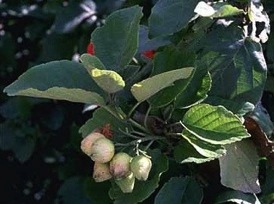
The Cordia sebestena (KOR-dee-uh seb-ess-TAY-nuh) has been planted through much of the warm world for its scarlet flowers and edible white drupes. While the fruits are edible their smell is better than they taste. Cooking improves their flavor some. They are also fibrous. The tree also has a long medicinal history. Where it is from is a debate, from Cuba to the West Indies to South America. The teapot tempest rages on. The fruit of the C. alliodora is also edible.

Cordia (which means late) was named for father and son German  botanists/pharmacists/physicians Euricius Cordus (1486-1535) and Valarius Cordus (1515-1544.)  Euricius (Heinrich in German) was a professor and the 13th son of a farmer named Urban Solden. As number 13 little Heinrich was called the “late one” or in Latin Cordu. He kept the name as a last name when he Latinized his name as many educated people of that age did, going from Heinrich Urban Solden to Euricius Codus.  His son, Valarius Codus, died at 29 of malaria while in Rome but had already established himself as an intellectual heavyweight of his age. His posthumous publications bolstered his reputation even more.  Sebestena is from Sebesten, a name given to a related tree with similar fruit.

 Green Deane’s “Itemized” Plant Profile

IDENTIFICATION: A small tree, usually under 25 feet, upright slender branches, leaves drop in cold or dry periods. They are alternate, ovate, pointed , sometimes slightly toothed near tip, five inches to a food long, three inches to half a foot wide, dull, rough hairy above, and pale and nearly smooth below, in clusters at the ends of branches. Flowers scarlet or orange, funnel shaped, five to seven lobes, slightly crinkled, one to two inches wide, showy flat terminal clusters. The calyx (fruit) is conical or pear-shaped one to one and a half inches long, white, pleasantly fragrant, with one or two large dark brown seeds.

TIME OF YEAR: Spring to late fall

ENVIRONMENT: Hammocks, sand dunes, landscaping

METHOD OF PREPARATION: Fruit is juicy and edible raw (not the seeds.) Cooking improves the flavor.


{ 2 comments }

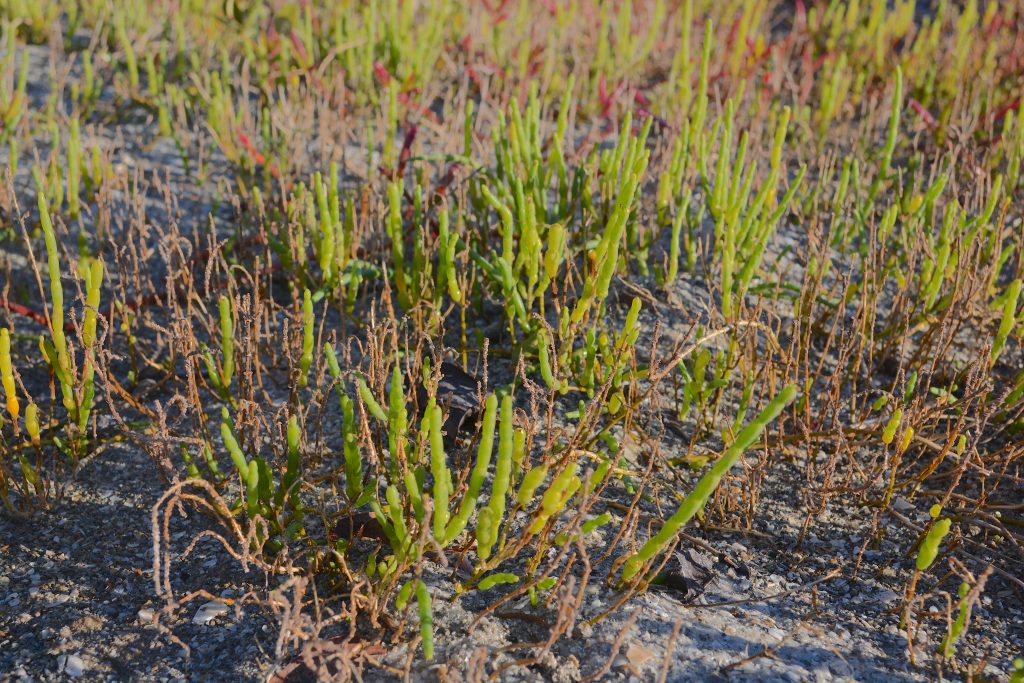
Glasswort, a tasty plant growing where others cannot. Photo by Green Deane

Salicornia bigelovii, Brackish Nibble

Glasswort does not sound like breaking glass at all, though it does crunch a bit.

Salicornia bigelovii (sa-li-KOR-nee-a big-eh-LOV-ee-eye)  has been used by most indigenous people around the world. Like many other salt-tolerating plants, it grows in salt marshes, on beaches, and among mangroves. They are native to the United States, Europe, South Africa and South Asia.

There’s significant commercial interest in glasswort in that it can be watered with salt water and can produce an excellent and nutritious oil. The raw seeds themselves are not edible because of saponins, but those remain with the meal when the oil is extracted. It is similar to safflower oil in composition, has a nutty flavor with a texture like olive oil.  An ash made from the plant was used in the manufacturing of glass, hence its name. Glasswort has also been used as a diuretic and an antiscorbuitic.  l like it raw in salads.

Jacob Bigelow 1787-1879

Besides foragers glasswort is the favorite of several butterflies particularly Lepidoptera species including the Coleophora case-bearers C. atriplicis and C. salicorniae, the latter which feeds exclusively on SalicorniaSalicornia means salt horn, referring to the plant’s branches. And Bigelovii: It was discovered in the New World by American botanist, Jacob Bigelow, right, 1787-1879. Of course, native Americans discovered it long before Jacob did. Professor Bigelow’s other claim to fame was he established the first rural garden cemetery in North America, Mount Auburn Cemetery in Cambrdge and Watertown, Massachusetts. He was not fond of doctors and was a vocal critic of their practices.

A close cousin to the S. bigelovii is the S. virginica (ver-JIN-ni-ka) meaning “of Virginia” read middle North America. Essentially the main difference is while the S. bigelovii can be stout the S. virginica tends to be trailing and forms mats on the ground. It is not as esteemed as its cousin but can be cooked and eaten the same way. However, it can be stringy so some folks like to put the cooked vegetable through a strainer to get rid of some stringiness. Another local species is S. ambigua, common on the local west coast.

Called Pickleweed and Woody Glasswort (from the sound some think it makes when you walk on it) glasswort can be found New Hampshire to Texas and up the Pacific coast. Often it turns red in the winter and red parts taste more salty.  It has woody, jointed stems and leaves like fleshy sheaths. The flowers are extremely small, sunken into the joints, usually only the stamens visible.  Four to 18 inches in height, it usually forms dense stands, miniature upright forests in tidal areas.
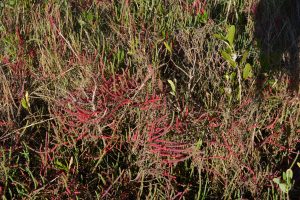
The more red the more salt. Photo by Green Deane

As with most greens, harvest when young and tender, or the growing tips. The entire glasswort grows woody as it ages, but in stages. You may find when you go to chop it that you have some with a thin woody core and fleshy on the outside. Just bend up those pieces and boil them any way. When they are done, the fleshy green exterior can be easily stripped of the inner light yellow wood. Toss the woody parts away. For raw in salads and as pickles pick the youngest parts possible and keep checking for a woody core, which you don’t want if you aren’t going to cook them. Older pink parts of glasswort can be used to make salt or for seasoning. Incidentally, the ash, which can be used for making glass and leaching lichen, is also good for making soap, especially if you don’t have hard wood ashes available for soap .

Green Deane’s “Itemized” Plant Profile

IDENTIFICATION: Glassworts are succulent, fleshy plants with opposite leaves and jointed stems, found in saline environments. Plant, 2 to 12 inches, erect, may turn red in winter. Leaves very small, scale-like. Flowers tiny, sunken into stem joints, commonly only stamens visible. Joints wider than long. Fruit small, succulent containing one seed.

TIME OF YEAR: All year round

ENVIRONMENT: Salt marshes, and along interior salt lakes.

METHOD OF PREPARATION: Young leaves and stems, raw, cooked or pickled. Oil pressed. Another species, S. perennis, is likewise usable after cooking but should be strained. Scalornia gets woody as it ages and is not edible.

HERB BLURB

Salicornia bigelovii Torr.: An Oilseed Halophyte for Seawater Irrigation

EDWARD P. GLENN 1, JAMES W. O’LEARY 1, M. CAROLYN WATSON 1, T. LEWIS THOMPSON 1, and ROBERT O. KUEHL 2. 1 Environmental Research Laboratory, 2601 East Airport Drive, Tucson, AZ 85706

2 Statistical Support Unit, College of Agriculture, University of Arizona, Tucson, AZ 85721

The terrestrial halophyte, Salicornia bigelovii Torr., was evaluated as an oilseed crop for direct seawater irrigation during 6 years of field trials in an extreme coastal desert environment. Yields of seed and biomass equated or exceeded freshwater oilseed crops such as soybean and sunflower. The seed contained 26 to 33 percent oil, 31 percent protein, and was low in fiber and ash (5 to 7 percent). The oil and meal were extracted by normal milling equipment, and the oil was high in linoleic acid (73 to 75 percent) and could replace soybean oil in chicken diets. The meal had antigrowth factors, attributed to saponins, but could replace soybean meal in chicken diets amended with the saponin antagonist, cholesterol. Salicornia bigelovii appears to be a potentially valuable new oilseed crop for subtropical coastal deserts.

{ 14 comments }

Edible Elaeagnus

First it was “poisonous.” Then it was “not edible.” Later it was edible but “not worth eating.” Actually, it’s not toxic but tasty, and easy to identify. It makes one wonder how some plants get so maligned.

Elaeagnus pungens

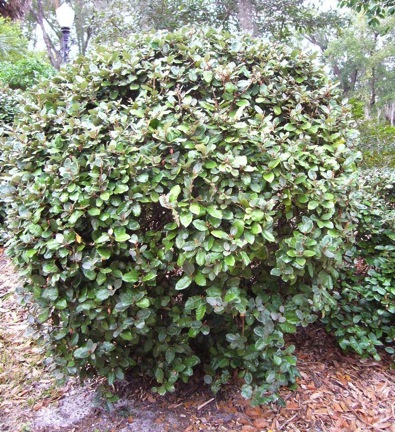
The Silverthorn, Elaeagnus pungens, came from China and Japan to North America  some 200 years ago in the early 1800’s. It’s an ornamental landscape plant often used for hedges and barriers. The Silverthorn is also closely related to the Autumn Olive and Russian Olive, both of which have edible fruit as well (E. umbellata, E. angustifolia.)

Perhaps the bad-mouthing also comes from the fact the Silverthorn has escaped cultivation. The shrub is found from Virginia south to Florida and west to Texas. It is also found at Smith College in Northampton, Massachusetts. Florida lists it as a Category II invasive exotic species. Seems to me the only civic thing to do is eat the weeds.

Evergreen, the Silverthorn is also called the Thorny Olive and the Thorny Silverberry. It blooms

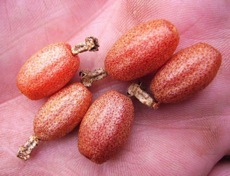
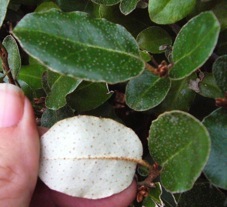
Silver back, rust-colored spots

around October and has edible fruit about February. Authors’ opinions on the berry, actually a fruit, range from toxic to edible but lousy. I find them sweet and tart at the same time, and very much worth eating. But you do have to get them ripe or they can be astringent. I have also reached the conclusion that folks who write books on landscaping actually hate the plants they write about. Personally, I look forward to Silverthorn season every year. Better, it fruits in the middle of our winter. Few plants do.

From a nutritional point of view the Elaeagnus has 17 times the lycopene than tomatoes. Yes, 17 times more.  The edible seed has fiber and omega 3 fatty acids but is on the bitter side. One can also eat the seed shell but I prefer not to. The plant is a nitrogen fixers which means it can grow in poor soil and provide nitrogen for other plants.

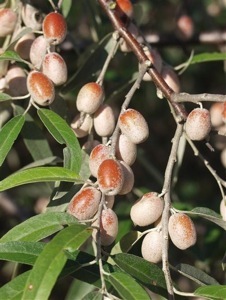
As for the common names, the bush does not really have thorns but rather sharp twigs that grow into branches. The berry-like fruit is red and silver/gold (from a distance it looks like red and silver but up close red and gold.) The botanical name is a mixed menu. Pungens (PUN-jenz) is easy. It means sharp or pointed. Reminds me of the punji sticks used in Vietnam. Elaeagnus is a bit of an amalgamation and Latinized Greek. It means “Sacred Olive.” Elaia = olive tree, agnos = sacred.  Why the genus was named that is anyone’s guess.

Russian Olive

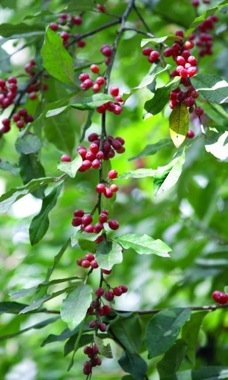
Also edible are the fruits of the E. commutata, which is native to North America. Alaskan natives fried them in Moose fat.  E. multiflora, the climbing E. philippensis, and E. latifolia are also edible, the latter often cooked and or made into a compote. Many Elaeganus in their native range elsewhere in the world have edible fruit. The seed is also edible on E. umbellata.  The genus is closely related to the Sea Buckthorn. (See separate entry.)

The Elaeagnus clan was championed at one time by various official and unofficial plant groups as good for land and animal. Song birds in particular like the fruit. Turkeys, hens and bears do,too. But in recent years opinions have changed and now it is view as a competitor for native species and is on several states’ hit list. I’ve only seen it under cultivation.

Elaeagnus fruit has numerous uses. It can be eaten out of hand though they tend to be astringent if picked too early.  It can easily be made into fruit leather, juice, jam and jelly. You can freeze the juice and use it in yogurt or to make a tea. The fruit can be dehydrated as well. Several species have edible seeds.  I usually eat the kernel and toss away the hull.

Green Deane’s “Itemized” Plant Profile

Autumn Olive

IDENTIFICATION: Shrub 3 to 25 feet, leaves are lance-shaped, evergreen, simple or wavy edges, 2 to 4 inches long. Upper leaf surface is waxy green, often scaly. Lower leaf surface are silvery and scaly with brown dots. The leaves feel tough and grainy. Young branches on branches are thorny. The Fruit can be red to red with silver or gold glitter. The seed covering has longitudinal ridges.

TIME OF YEAR: Blossoms in fall, fruits in early spring. (The Autumn Olive fruits generally in late summer or fall.)

ENVIRONMENT: Full sun is preferred and good soil but it can grow in partial shade and poor soil

METHOD OF PREPARATION: Usually eaten out of hand. Can be made into jam, jelly, fruit leather, juice can also be used to make tea or flavor yogurt. Seed kernel is edible.


{ 36 comments }