Forage, Grain, Flour, Manna, Pest

Americans did two interesting things when they moved from the farm to suburbia after World War II: They surrounded their homes with toxic ornamentals and attacked edible plants as if they were life threatening.
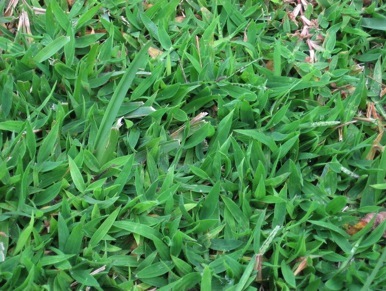
The Dreaded lawn Invader Crab Grass

Still on that list of dreaded home invaders is crabgrass. It would be difficult among the decapitated grass crowd to find a more hated grass than crabgrass. Multi-millions of dollars are spend annually trying to chemically choke it to death; uncounted hours are spend on hands and knees yanking it from yards. Air is polluted with crabgrass-inspired profanity. One of my neighbors spent the majority of her warm-weather weekends pulling crabgrass from her yard (which my little plot replenished!)   Even the name suggests a loathsome disease: Your lawn has the crabs. My solution? Eat the weeds.

Let’s start with a basic question: Why do lawn folks hate crabgrass? Two main reasons: Visually it does not look like the other common lawn grasses so a patch of it stands out. Next, it does not grow consistently all season so a lawn with crabgrass can look patchy. It looks good in the warm months but can grow ratty in the winter in warm climes. That is, of course, presuming you have a lawn and care what it looks like. I don’t try to keep up with the DuPonts or put their chemicals on what little lawn I have.
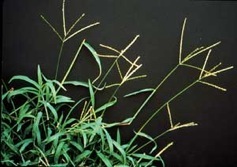
Crabgrass seed heads

Adding to the manicured mania is the fact crabgrass can produce some 150,000 seeds per plant. Nature plays hardball. Said another way, lawn grass is weak and crabgrass is strong and if folks don’t constantly fight crabgrass it will win. For that matter, the trees would win over lawn grass but grass has enlisted humans in its war against trees so we keep the trees at bay as well. Lawn grass survives because it has made human allies. For my audio editorial on that click here.

While we try to get rid of  crabgrass in America in parts of Africa crabgrass (fonio) is a staple grain, and as forage it can produce a whopping 17 tons per acre. Crabgrass seed can be used as a flour, couscous or as a grain, such as in porridge or fermented for use in beer making. Now that’s a label I’d like to see: Crabgrass Beer. Crabgrass is not only nutritious but one of the world’s fastest growing cereals, producing edible seeds in six to eight weeks. It grows well in dry areas with poor soils, and fantastically in watered lawns. It’s a horrible weed and a wonderful edible, a great crop if you are starving.

Husking the small grains can be time-consuming, however. Traditional methods include pounding in a mortar with sand then separating the grain and sand. Another method is  “popping” seeds over a flame and then pounding said which produces a toasted grain. If you have a LOT of crabgrass you can even buy a crabgrass husking machine.
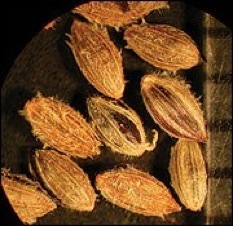
Crabgrass Seeds

Stone Age dwellers in Switzerland cultivated crabgrass and it was important food crop in China by 2700 B.C. It’s a traditional food in India and Africa. It was first introduced into the U.S. in 1849 by the United States Patent Office as forage for cattle, sheep, hogs and horses. Then the Department of Agriculture was formed and it took over making crabgrass a main agricultural crop.  Immigrants from eastern Europe. Poles, Czechs, Slovaks, and Hungarians also relied on the traditional grain. They called it kasha/kasza and spread it around but then corn was developed as an agricultural crop. Growers soon learned that corn and wheat could be grown just as easily and was worth more money than crabgrass. The beginning of crabgrass’ transition from valued food to hated weed was born.

Digitaria sanguinalis  (dij-ih-TARE-ree-uh san-gwin-NAY-liss) means red fingers. Crabgrass grows from a rosette (kinda looks like a crab) and the older leaves and sheaths can turn red to maroon. The Dogon of Mali, who call crabgrass “po,” believe the supreme creator of the universe, Amma, made the entire universe by exploding one grain of crabgrass inside the “egg of the world”.

The leaves can be used to make paper, and ten percent of people tested are allergic to crabgrass. Lastly, even if one does not eat crabgrass seeds, it can be gotten rid of by mowing techniques.  Chemicals are not needed. Personally, I raid my neighbors’ lawns.

Crabgrass Muffins

1 cup flour
1 cup crabgrass flour
2 teaspoons baking soda
2 teaspoons ginger (optional)
3/4 cup water
2 eggs
1 teaspoon vanilla
1/4 cup oil
1/2 cup raisins

Preheat oven to 350 degrees F. Place flours and baking soda in bowl, mix in water, eggs, vanilla and oil.  Fold in raisins thoroughly  Fill muffin tins 1/2 full or pour in 8 inch square baking pan.

Bake 20 to 25 minutes

Let cool and remove from pan. Makes 6 muffins

Green Deane’s “Itemized” Plant Profile

IDENTIFICATION: A mat-forming grass, rooting at the nodes. Leaves alternate, long, grass-like, some parallel veins, pointed tip, toothless, flowers tiny, stalkless, flattened along branches. Sides minute.

TIME OF YEAR: Seeds in fall, best after a frost.

ENVIRONMENT: Sandy soil, poorly tended lawns, gardens, old fields, roadside and waste places.

METHOD OF PREPARATION: Stripped off seeds can be toasted and ground into flour, use as couscous, porridge or for making beer.  Untoasted it can be used like rice. Avoid any crabgrass that has purple or black mold on it.
{ 58 comments }

Pyrrhopapppaus carolinianus not a dandelion

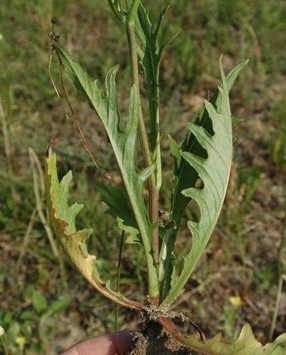
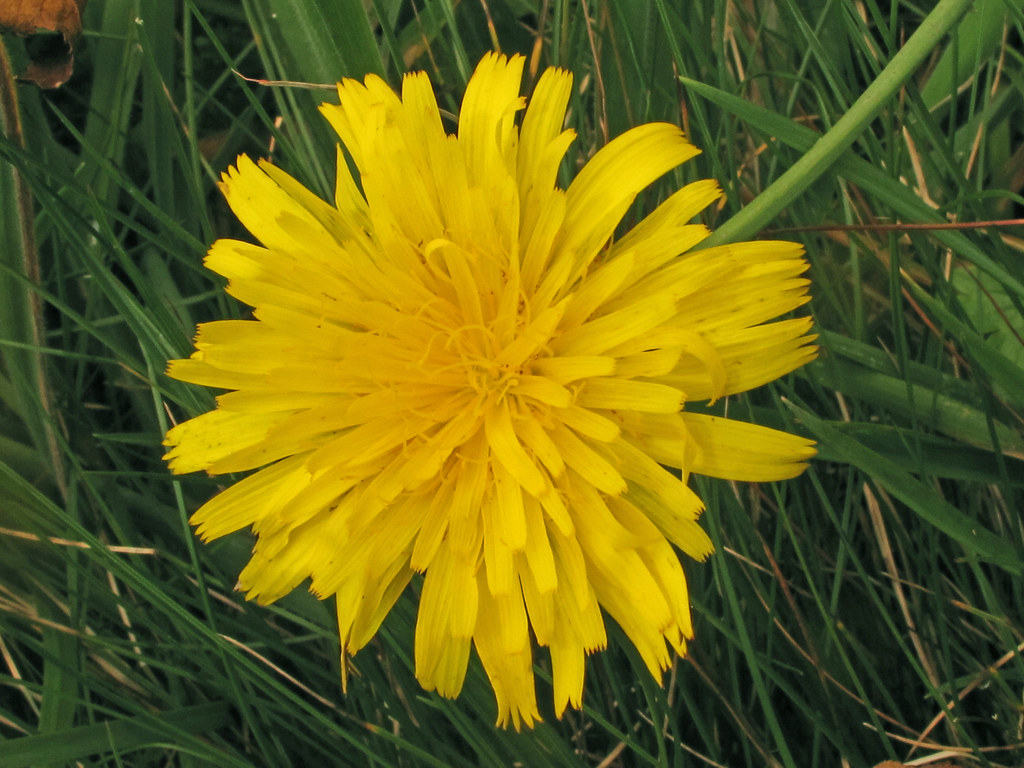
Pyrrhopappus, & Hypochoeris: Are Dandelion Impostors

Most people don’t notice False Dandelions because they have the real thing. But here in the South where real dandelions are scarce and scraggly, False Dandelions stands out. Actually, they are found most of the Eastern US, and up the west coast. Let’s look at several of them starting with the Pyrrhopappus carolinianus.

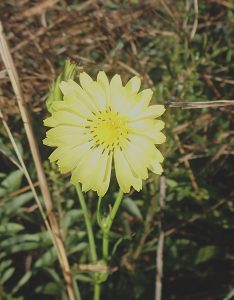
Pyrrhopappus carolinianus

P. carolinianus is not mentioned in any edible plant book I have. I learned about it from Dick Deuerling, author of “Florida’s Incredible Wild Edibles” which is still in print, the profits from which go to non-profit plant causes.

Dick, however, had a slightly different take on the False Dandelion. While ethnobotanical research shows the natives ate the roots, Dick preferred the leaves, raw in salads or cooked. The roots, by the way, are said to be much sweeter when picked in autumn. I use them just like Dandelion leaves, that is, young and tender leaves in a salad, older leaves boiled as a greenI learned from Suzanne Shires one can cook the stems and use like spaghetti.

Pyrrhopappus (pye-roh-PAP-pus) means “fire fluff” a reference to the floating dandelion-like seed. Carolinianus (kair-oh-lin-ee-AY-nus) means “of Carolina” which was an old way of saying middle America.

Hypochoeris radicata sometime call the Hairy Cat’s Ear. Photo by Green Deane

The second false dandelion is better known and more wide-spread. The Hypochoeris radicata  (hye-poe-KÊ-ris rad-i-KAY-ta) is also called by several other names usually involving “cat’s ear” such as “Smooth Cat’s Ear” or “Spotted Cat’s Ear.”   See pictures at right.

Unlike the previous “false dandelion” the radicata is an import from Europe. It is still very popular wild weed in France, Spain, Italy and Greece. It is one of only 17 plants that are still gathered by farming communities in those countries. You can find it in grassy areas and road sides. They can tolerate dry ground but like moist soil as well. In very wet conditions the rosette can grow in to a clump.  On a sunny cay it covers my cousin’s lawn in South Carolina.

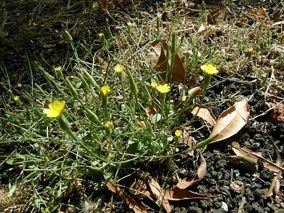
Hypochoeris glabra

H. Radicata might be an acquired taste. Cooking reduces the bitterness but there is always left over bitterness, and the leaves are hairy as well. They can go in go raw in salads, or cooked in soups and also steam well. The “cat’s ear” part refers to the bitter hairy leaves. Radicata means “rooted.” Hypochoeris is translated to mean “for the hogs” because pigs like the roots. Another Hypochoeris, the glabra, right,  is less bitter and is often eaten raw. Glabra means smooth, read hairless. Young tender stems of cat’s ear can be boiled and used like spaghetti.

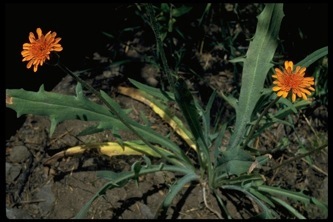
Agoseris aurantiaca

Lastly a fourth false dandelion, also called the Mountain Dandelion, is the Agoseris aurantiaca, (a-go-SER-iss aw-ran-ti-AYE-kuh) below, found mostly in the western half of north America. It’s leaves were eaten by the Indians.   Agoseris combines two Greek words, aego (goat) and seris (the genus name for a lettuce-like plant) and aurantiaca which means orange-red color.

 Green Deane’s “Itemized” Plant Profile

IDENTIFICATION: On first glance you’ll think P. carolinianus is a dandelion but the flower’s rays are more sparse and you will see dark anthers in the middle area of the flower. The stem is thinner and stronger than a dandelion, and the leaves skinnier and far less intended. They tend to curl laterally towards the center.

H. radicata: first leaves are club-shaped, round end, and hairless, mature leaves grow to eight inches long. Leaves arranged in a basal rosette, hairy, toothed or irregularly lobed edges. Basal leaves obovate in shape and to 8 inches long and 1.5 inches wide with toothed edges that are deeply wavy. The basal leaves are very hairy and sessile (without stalks.) Leaves grow smaller up the stem, have a milk sap, leafless flower stalks with two to seven flowers on each stalk.  H. glabra is similar to radicata but hairless.

Agoseris aurantiaca: Perennial with basal patch of long leaves, variable in shape but 15 inches in length, no stem, several flowers on tall peduncles up to two feet tall. Flower is ray florets with squared, toothed tips, deep orange to red, occasionally yellow, seed has dandelion-like tuff attached.

TIME OF YEAR: Same time as dandelions, greens spring and summer, roots in fall.

ENVIRONMENT: Same environment as dandelions, lawns, fields, common areas, sidewalk cracks. Prefers moist soil.

METHOD OF PREPARATION: P.  carolinianus: Young leaves raw in salads, older leaves boiled like dandelions for a potherb, young stems like spavhetti. Autumn roots boiled or roasted.  H. radicata, young leaves raw or cooked. H. glabra, leaves cooked or raw. Flower and buds of all can be used like dandelions. A. aurantiaca, cooked leaves

{ 44 comments }

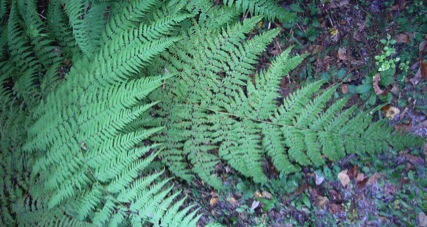
Bracken Fern, Pteridium aquilinum

Fiddlehead Fanatics

If poke weed tests your foraging bravery, fiddleheads test your foraging philosophy.

Pokeweed can kill you within hours if you make a mistake and consume some of the root. Fiddleheads might cause cancer, someday, maybe, maybe not.  Humanity has been eating fidddleheads (Pteridium aquilinum) (ter-ID-ee-um ak-wee-LIE-num) since before civilization. Modern science says we shouldn’t have.

Before I let empiricism totally rain on this parade, fiddlehead greens were a rite of spring in the area I grew up. It was one of two things everyone talked about, that and when the ice would sink in Sebago Lake (sah-BAY-go.) Maine’s lakes are glacier dug and very deep, sometimes hundreds of feet. You can tread water in a Maine lake in the summer (both days of it)  getting heat stroke from the neck up and freezing your feet off down below. One reason is the winter ice in a lake sinks all at once. There is no gentle melting like an ice cube in a glass. All the ice sinks at once and slowly melts on the bottom ensuring out-of-state visitors get icicle toes in August. Raffles are held as to the exact day, minute and second the ice sinks. Sebago, as the largest lake in southern Maine, is of prime interest, but only second to coming of fiddleheads. As the snow melts and warm days come around, fiddlehead greens is the talk de spring.

Some families dedicate several weeks to their harvest, cooking and canning. One of the Yankee signs of friendship is to be given a jar of fiddlehead greens long after the season has past. Spouses are more easily loaned. My step-father adored fiddleheads, my mother did not. He lived to 86 and she 88.  I personally know one family that cannot can enough of them, have been canning them for decades, and are still here… which leads to the intrusion of science.

Animals that do not boil fiddleheads before eating can get cancer from them, such as mice, rats, cattle and raw vegetarians. They are also toxic to horses if fed in the hay over time. In areas where there is a lot of P. aquilinum the culprit chemical, ptaquiloside, can leach into the water supply, and yes, there is an increase of gastric and throat cancers in people who live in those areas… read a lot of the chemical over time.

On the other side is the argument that boiling the ferns — read cooking them throughly — takes care of that problem, or lessens it to an acceptable risk level. That said, it is good they only come in great amounts in the springtime for a diet of them will also reduce your thiamine level and can cause beriberi, Clearly moderation is wise.  Personally, I hunt Florida fiddleheads. I think nearly everything causes cancer and I am willing to risk a few fiddleheads with butter once or twice a spring, which is about as often as I can collect enough in this warm place.

The roots of the Pteridium aquilinum also have been used to brew beer, and the root starch used like arrowroot. Bread can be made out of dried and powered roots, either by themselves or with flour. Natives baked the roots then peeled and ate them or pounded them into flour removing fibers.

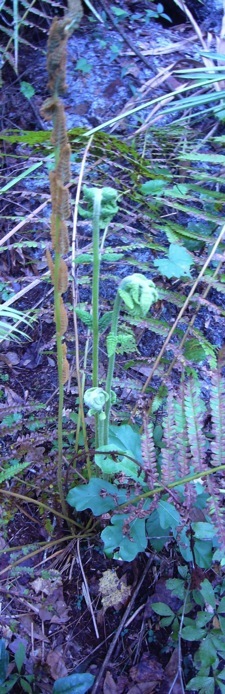
Cinnamon Fern

Unless you live in a desert or on constant ice, there is a fiddlehead-producing fern near you. Besides the P. aquilinum, which ranges around the world and has for 55 million years, there are at least three other ferns with edible fiddle heads: The cinnamon fern, Osmunda cinnamomea;  the Ostrich fern, Matteuccia struthiopteris, very common in the northeast; and the Sensitive fern, Onoclea sensibilis. There are also a few ferns that are used for tea in North America: Maidenhair fern, Adiantum capilillus-veneris and Adiantum pedatum; Cliff Brake, Pellea mucronata and Pellea ornithropus;  the Sword Fern or Holly Fern, Polystichum munitum. Two northwest ferns, Polpodium glycyrrhiza and Polpodium vulgare have useable roots. By the way Tide Head, New Brunswick, bills itself as the Fiddlehead Capital of the World.

Lastly, there are two ferns found only in Florida and Puerto Rico that have edible fiddleheads, one is rare, one common. The rare one is Acrostichum aureum (ack-row-STISH-um AW-ree-um.) Acrostichum is a combination of two greek words, akros (tipl) and stichos (a row.) Aureum is Latin for gold, or golden. Terminal row of gold. The frond can indeed look golden.

Also called the Coast Leather Fern and Golden Leather Fern, it can be found on the Mainland,  in the Keys, in swamps, salt marshes, brackish canals and sinkholes.  It’s a coarse fern with stiff fronds, up to seven feet or more long. The upper leaflets of the spore-bearing leaves are clearly covered on the underside with golden brown spores. The uncoiling new leaves, the fiddleheads, are quite tender and resemble asparagus in taste. They are a bit mucilaginous. They can be eaten raw or cooked. However, while not endangered, it is usually found only under cultivation. Graze accordingly.

It’s cousin, Acrostichum danaeifolium, is a different matter. Called the Giant Leather Fern and Inland Leather Fern. It is the behemoth fern of Florida, eight feet high, 10 feet across, found in the same environment as its cousin. Its fiddle head is also edible.  Danaeifolium (dan-ay-ee-FOH-lee-um) means leaves like the Danaea fern. Danae is named for the mythological Greek daughter of the King of Argon.

It’s not too hard to tell them apart? A. Danaeifolium is very common and huge. It’s the one you most likely find. It  has red spores under the leaves that  remind you of suede. It’s leaves are close together.  A. aureum is smaller, leaves are farther apart,  and has golden spores under the leaves. Leaf spacing is the most dependable difference.

 Green Deane’s “Itemized” Plant Profile

IDENTIFICATION:Bracken: only large northern fern with a three part form on one tall stalk. Other large ferns have single fronds rising from  deep many-branched root. Leaves horizontal, broad, triangle-shaped; leaflets opposite, lower two larger and twice-divided, upper ones usually once-divided; spores in linear strips under leaf near edges. Cinnamon ferns are easily identified by their cinnamon-colored non-leaflike fertile fronds

TIME OF YEAR: Spring, but in some climates constantly

ENVIRONMENT: Woodlands, well-drained soil that holds water

METHOD OF PREPARATION: Fiddleheads under two inches only. Remove any yellow/brown skin, boil sprouts twice with a change of water between boilings. Boil 10 minutes or steam for 20. Gourmets spread a thin layer in a steam basket and steam until just tender crisp.

{ 10 comments }

 Citharexylum fruticosum: Edible Guitar

The Fiddlewood tree is not high on the list of edibles. As some authors state, only kids eat the fruit, lots of seed, sparse on pulp. But it has some personal history to me — remotely — and is also a medicinal tree.

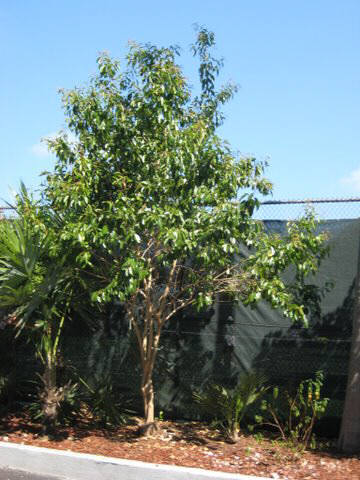
Fiddlewood, Citharexylum fruticosum

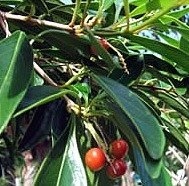
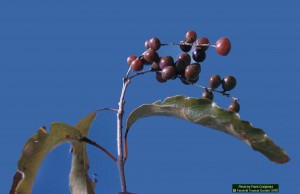
First edibility: The fruit resembles red wild cherries when unripe, and perhaps that is where the first disappointment arises. Like the Indian Strawberry the association implies something it is not. (The same thing happens with the Suriname Cherry.)  And the taste of the Fiddlewood fruit when ripe is not great. It depends on how hungry you are though opinions vary. Many like it. The fruit has two stones, is sweet and is available all year in its native range, which is where it is warm

The botanical name is Citharexylum fruticosum (sith-ar-RECKS-sil-lum  froo-tick-OH-sum) a name that can take us on quite a linguistic journey because “cithera” means guitar. So why is it “fiddlewood?”  Almost directly translated the botanical name means “lyre wood shrubby”  Put in better terms it could mean “guitar wood tree” or more directly  “shrubby kythera.” (KITH-ah-rah)  Kythera (a lyre is kythara, kith-THA-rah) is also the Greek word from which we get “guitar” … kith-THA-rah… get-TAR…see it? Hear it? The Fiddlewood tree is also called the Guitar Tree. To explain it all we have to go to Greece.

Unripe berries are reddish

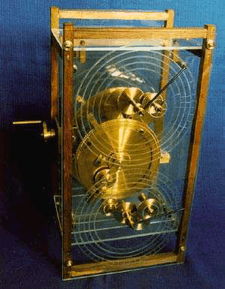
One can navigate by sight from the western end of Crete northward to the southern tip of the Greece mainland in The Mani, where the Spartans lived. Cretans and Maniotes call themselves First Brothers and have much in common in dress, cooking and customs.  From Crete’s Gramvousa Peninsula you can see Little Kythera, some 20 miles away. Little Kythera (Antikythera) sits on a fault line and a few decades ago part of the small island rose 20 feet, a change that is still quite visible today. That is also where a brass sextant of sorts (the Antikythera Mechanism, below right) was found in 1901 proving celestial calculations with an instrument was possible two thousand years ago. Little Kythera as of this writing has 44 permanent residents. They want people with kids to move there and will provide housing.

Antikythera Mechanism

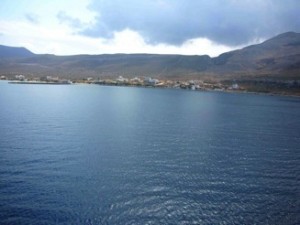
Incidentally, the ferry in season, see photos below, lands twice a week at Little Kythera doing the nautical equivalent of a “touch and go.” The football-field-long ferry backs up to the dock, lowering the gang way as it backs up. The very moment the gang way is over the dock it drops. All things going off or on do so in about a minute. The gang way lifts a few inches and the ferry leaves immediately, cranking the gang way up the rest of the way while over open water. The docking, exchange, and departure takes less than five minutes. While there look south, you can see where the earthquake lifted part of the island.

From Little Kythera you can see Crete to the south and Kythera to the north, taller but farther away. And Kythera is indeed shaped like a lute or a guitar. A large island, it has some 3,000 permanent residents plus an airport. Interestingly, some 100,000 Greeks in Australia claim ancestry to Kythera and try to return at least once a year, in the Greek summer, which is conveniently the Australian winter.  Kythera is the birth place, so to speak, of Aphrodite. The island was first inhabited by the Minoans and then the Phoenicians, both of whom wanted the Murex, a tiny shell fish whose tiny anal gland was the only source of royal purple dye in ancient times. How they discovered that is anyone guess.  From Kythera one can see Little Kythera to the south and to the north the southern tip of the main land called Peloponneus, specifically “The Mani” from where we get the word “maniacs” in English because of how tenaciously they fought. It is one area of Greece never occupied by the enslavingTurks or the starvation-imposing Germans.

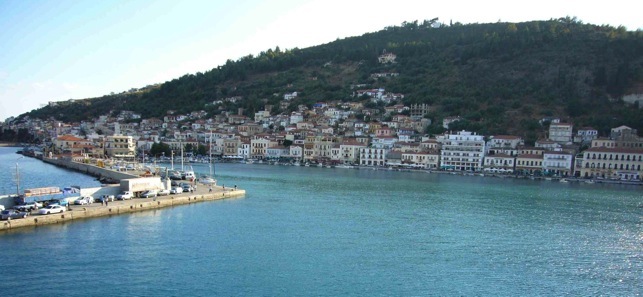
If you take the day-long ferry from Crete it lands at Little Kythera, Kythera, then on the mainland at the little city of Gythio, whose sole industry in the past was collecting the royal purple as well… there’s about 10 square feet of ruins there right beside the road.  Gythio was also the home port of the Spartans and the area where this writer’s family comes from.

Ripe fiddlewood berries are black-ish

Now which came first, the instrument then the naming of the island or the island and the naming of the instrument is a debate. But, kythera …kythera…came to mean lyre and from kythara we got guitar and from that we got the fiddlewood tree. How? When Linnaeus was naming plants the English words “violin” or “fiddle” were not common in his time plus he preferred classical names. He knew the wood was used to make musical instruments so he named it  “guitar wood shrub” Citharexylum fruticosum. That got stretched into Guitar Tree and then Fiddlewood Tree. Now you know.

The most common name for the tree in the Caribbean islands is “old woman’s blisters” read it’s used for a lot of ailments. Boiled twigs and decoctions are used if you’re chilled. When mixed with Strongback and Spoonbush it is used for sores. Boiled with mahogany, lignum vitae, Doctor Club roots, Snowberry and papaya latex, it was used to aid indigestion… or perhaps create it…. Also beware… insects of all sorts love the tree so you will encounter them, in numbers. The fruit plup is edible but not prized. Do not eat the seeds.

Green Deane’s “Itemized” Plant Profile: Fiddlewood Tree

IDENTIFICTION: Citharexylum fruticosum: Shrub or tree to 30 feet, short trunk or several trunks, erect branches, compact. Leaves opposite, oblong to oval, with pointed or notched tip, to six inches long, glossy, yellow-green leathery, with orange stalks. Flowers white, tubular, five lobed, 1/8 inch wide, fragrant, in hairy clusters to six inches long. Fruit half-inch wide, brown or orange red when unripe, purple black when ripe. Sweet, two seeds.

TIME OF YEAR: All year

ENVIRONMENT: Coastal pine lands and hammocks

METHOD OF PREPARATION: Ripe fruit edible raw, but not great.  Do not eat the seeds.

Backing up to the dock at Little Kythera, Photo by Green Deane

Right, backing up to the dock at Little Kythera, Greece. The ferry comes by twice a week in season, south to Crete one day, north to the mainland the next. Below left is Kythera showing the “neck” of the guitar.  The large picture is the small city of Gythio, home port of the Spartans and of this writer’s ancestors in the villages of Karea to the southwest and Konakia to the northwest.  A small island just a few hundred feet off to the left of Gythio was where Paris and Helen spent the night consummating their love, starting the Trojan War, or so the romantic story goes.

Gythio, Greece


{ 6 comments }

Wild Ficus: Who Gives An Edible Fig?

It’s only 90 miles to the east, and 117 to the west, but the Strangler Fig and Banyan trees will grow farther south and on each coast but not here in Central Florida. One is a native, and one came from India, but they’re cousins none the less, figs as it were, and in the greater Mulberry family. You didn’t know figs and mulberries were related? You do now.

Strangler Fig

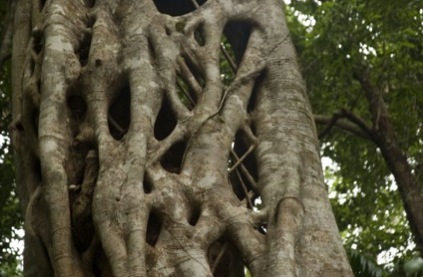
The trees take over in similar ways. The Strangler Fig often starts as an epiphyte, a seed “deposited” by a bird in the top of a tree. The fig sends a root down to find earth. Once it does It slowly takes over the tree, enveloping it, sending down more roots. In time it becomes a huge tree. Usually the original victim simply dies and disappears.

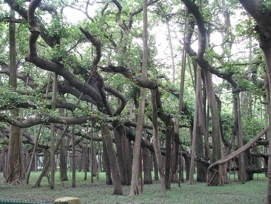
The Banyan “walks.” The first time you see one you are amazed. The horizontal branches send down vertical “prop” roots that grow into trunks. The tree simply keeps growing out and down, covering acres. Nearly everything under its shade dies.

The Florida fig is Ficus aurea, FYI-kuss AR-ree-ah, or FEEK-uss AW-ree-ah, Ficus is an old Latin name for the tree or fruit and probably comes from the older Greek word for fig, Siga (SEE-gah and earlier sykon.)  Aurea means golden, referring to the figs’ color when ripe. The Miccosukee and Creeks people called the tree a phrase that gets translated into the “sticks to you” perhaps a reference to the latex sap. They ate the ripe fruit, used the stems for arrows, made bowstring and netting out of the bark of the roots. They used latex to treat wounds. That latex can also be used to curdle milk for cheese making. The Natives also used the dried latex like gum.

One Banyan Tree

The Banyan tree is also a fig, now called Ficus benghalensis (ben-gal-EN-sis) meaning from Bengal. The largest is in India and covers four acres. It has a circumference of about a half a mile, is some 80 feet high and has  3772 aerial roots reaching down to the ground. (2880 in 2008) It is said it can shelter 2,000 people.

The reddish fruit of the Banyan tree is not toxic per se but they are barely edible, the worst of famine food. While its leaves are said to be edible, they are more often used as plates and for wrapping food. Fig leaves are also used to impart flavor to fire cooked foods. Some fig leaves in some areas are cooked and eaten. There is only one original reference to  the leaves of the F. benghalensis as being edible so I would view it as suspect. I would want more independent confirmation before I tried to eat one. But, I would cook with it and wrap with it.  The Banyans grow in the warmer areas of the United States including Florida, Texas, Arizona and Southern California.

A third fig in Florida is the Shortleaf Fig or Ficus citrifloia. As its name implies it has leaves similar to citrus trees. The one-inch fruit goes from yellow to dark red when ripe. It is edible but not prime — tasteless actually — and is not improved by cooking.

On a personal note, I have a fig tree in my front yard that is at least 80 years old, and probably much more, from the Azores. Of course, the fig would not be allowed in the United States now but it got here when folks weren’t concerned about such things. The grandfather of a friend married a Portuguese woman back in the 1930s. She was from the Boston area but her family was directly from the Azores, Portuguese being their first language as in my family Greek was. Either she or her relatives brought a cutting from a fig tree in the Azores to Florida via Boston and planted it next to their house in DeLand, Florida. Some 70 years later the original slip, now an aging tree, was losing a battle with dry rot so I took several slips off the tree and got them to root. The tree is gone now but at least four of those slips are still growing and are now trees themselves. They grow big green figs similar to the Kalamata figs of my ancestral home, the Mani, in Greece. That tree, or it clones, has been in the presence of a lot of human life. How old was it on the Azores before a slip was taken? We’ll never know. That slip endured several thousand miles at sea and then a slow 1,200 mile drive down the east coast of the United States. It grew next to the house where Vern Gifford raised two kids, saw numerous grandchildren and went quickly while in his 90s. And the tree lives on.

Also edible: Ficus auriculata, fruits;  Ficus benjamina, ripe fruit; Ficus carica, ripe fruit; Ficus capensis, fruit, young aerial shoots eaten as a vegetable, bark is chewed with cola nuts to alleviate thirst; Ficus elastica, fruit and young leaf shoots cooked. This is the infamous “rubber plant” in home and offices around the world; Ficus glomerata, young shoots cooked, Ficus hirta, very young top shoot eaten raw, ripe fruit edible; Ficus insipida, fruit sometimes good to eat; Ficus lacor, young shoots and sour leaves eaten raw or cooked. Fruit also edible; Ficus laevigata, ripe fruit; Ficus palmata, fruit edible, unripe figs and leafy young shoots boiled and fried and used as a green vegetable; Ficus pseudoplama, young leaves are eaten raw in salads or cooked as a potherb. Fruits also edible; Ficus pumila, ripe fruit; Ficus racemosa, ripe fruit edible, unripe fruits pickled, young shoots eaten raw or cooked; and, Ficus sycomorus, fruit edible, leaves eaten in soups.

Two factoids: Figs are pollinated by a wasp that crawls into the developing fruit. Its “blossoms” all face inward. And the fig tree, called “sycamore” in the Bible, was a common wood for caskets back then. It is the most common ancient casket wood found today.

Green Deane’s “Itemized” Plant Profile

IDENTIFICATION: Strangler fig:  Tree to 65 feet, milky sap, orange twigs, smooth gray or light brown bark, flaking, many aeriel roots. Leaves alternate, stalked, oblong, oval or elliptic, pointed or wedge shaped, two to five inches long, leathery, dark glossy above, paler below. Fruit stalkless, yellow when unripe, dark red when ripe, about one   half inch wide.

TIME OF YEAR: All year

ENVIRONMENT: Hammocks, pine lands, old residential areas

METHOD OF PREPARATION: Raw fruit out of hand. Latex as chewing gum. Banyan leaves can be used as plates and to wrap food.


{ 24 comments }